Wishful thinking about nuclear energy won’t get us to net zero
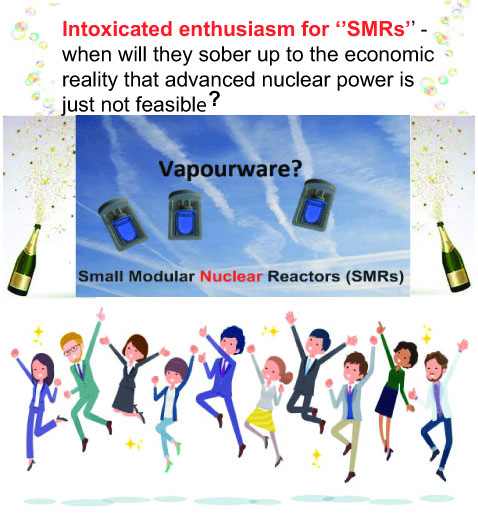
The climate problem is too serious to engage in unrealistic modelling exercises. Wishful thinking about nuclear energy will only thwart our ability to act meaningfully to lower emissions rapidly.
BY M.V. RAMANA AND SUSAN O’DONNELL | July 3, 2023 https://www.hilltimes.com/story/2023/07/03/wishful-thinking-about-nuclear-energy-wont-get-us-to-net-zero/391721/
On June 20, the Canada Energy Regulator (CER) released its 2023 Canada’s Energy Future report, developing scenarios for a path to net zero by 2050. These scenarios project roughly a tripling of nuclear energy generation capacity in Canada by 2050, seemingly reinforcing then-natural resources minister Seamus O’Regan’s statement in 2020 that there is “no path to net zero without nuclear.”
However, underlying both the scenarios and O’Regan’s contention is wishful thinking about the economics of nuclear energy, and how fast nuclear power can be scaled up.
The new nuclear capacity the report envisions consists of so-called small modular nuclear reactors (SMRs), which have so far not been built in Canada. Aside from refurbishing existing CANDU reactors, the CER does not think any more standard sized nuclear reactors will be built in Canada. Most of this buildup is to happen between 2035-2050, meaning that nuclear power will not help meet the government’s stated goal of decarbonizing the electricity grid by 2035.
But can SMRs be built rapidly after 2035? Only two Crown companies in the business of generating electricity for the grid have proposed to build SMRs: NB Power in New Brunswick, and Ontario Power Generation (OPG).
The reactor designs proposed for New Brunswick are cooled by molten salts and liquid sodium metal. Despite decades of development work and billions of dollars invested, major technical challenges have prevented molten salt reactors and sodium-cooled reactors from commercial viability, making it highly unlikely that the New Brunswick designs can be rapidly deployed in the time frame envisioned by the CER.
Assuming that OPG’s chosen design—the 300-megawatt BWRX-300—is the one to be deployed widely, then around 70 SMR units would need to be built and operating effectively on the grid between 2030-2050. The BWRX-300 design is yet to be approved by any safety regulator anywhere in the world.
But the report has an even more serious problem: economics. Nuclear power cannot compete economically, which is why its share of global electricity generation has declined from 17.5 per cent in 1996 to 9.2 per cent in 2022. Because SMRs lose out on economies of scale, they will produce even more expensive electricity.
The CER’s scenarios for nuclear power are based on the Electricity Supply Model, meant to calculate “the most efficient and cost-effective way to meet electricity demand in each region.” Such models are widely used in energy analysis and policymaking, but their utility depends on the validity of the assumptions used; garbage in, garbage out.
Two key parameters underlie the report’s scenarios: the capital cost of an SMR, and how that cost evolves with time. The CER’s assumptions in the two net-zero scenarios are that a SMR costs $9,262 per kilowatt in 2020, falling to $8,348 per kW by 2030, and to $6,519 per kW by 2050. Both these assumptions are ridiculously out of touch with the real world.
Consider the CAREM-25 SMR designed to feed 25 megawatts of electricity into the grid, being built in Argentina since 2014. Its original cost estimate in 2014 of US$446-million has escalated significantly since then, but even using these original costs, the project costs nearly $30,000 per kilowatt in 2022 Canadian dollars.
The NuScale design, arguably the closest to deployment in the United States, has been in development since 2007 with the build not yet begun. The January 2023 cost estimate for six NuScale SMRs with a total capacity of 462 megawatts is $9.3-billion, or over $26,000 per kilowatt in Canadian dollars.
Finally, the cost of the five-megawatt Micro Modular Reactor Project at Chalk River, Ont., was estimated by the proponent in May 2020 to be between $100- and $200-million. In 2022’s Canadian dollars, that works out to $22,000 to $44,000 per kilowatt.
In other words, the CER’s cost assumptions are wild underestimates, two-and-a-half to four times lower than the current evidence.
The second incorrect assumption is that costs will decrease with time. Both in the United States and France, the countries with the highest number of nuclear plants, the trend was the opposite: costs went up—not down—as more reactors were built. In both countries, the estimated construction cost of the most recent reactors being built—Vogtle in the United States and Flamanville-3 in France—have broken new records.
We need government organizations to do better. The climate problem is too serious for such unrealistic modelling exercises. Wishful thinking will only thwart our ability to act meaningfully to lower emissions rapidly.
M.V. Ramana is the Simons Chair in Disarmament, Global and Human Security and professor at the School of Public Policy and Global Affairs at the University of British Columbia. Susan O’Donnell is adjunct research professor and primary investigator of the CEDAR project at St. Thomas University in Fredericton, N.B.
Nuclear Contaminated Water Dumping: IAEA Concludes ‘Absolute Safety of Nuclear Contaminated Water’ – with Japanese Government Money?

Date: June 29, 2023 Author: dunrenard FUKUSHIMA 311 WATCHDOGS
Foreign Ministry official reveals in alleged transcripts of conversations
“More than 1 million euros handed over to IAEA officials, director general, etc.”
“IAEA report conclusion of nuclear contaminated water was ‘absolutely safe’ from the beginning”
Adopting an investigation method that detects only easy-to-detect elements129 etc.
South Korea’s Kim Hong-seok and others “IAEA experts are just decorations”
A memo from a senior official at the Ministry of Foreign Affairs’ 1
A document has surfaced in Japan that raises suspicions that the Japanese government is paying IAEA officials large sums of money to work with each other and “collude” in the dumping of Fukushima nuclear contaminated water into the ocean.
‘Foreign Ministry Executive A Memo’, 1 million euros to IAEA
According to the document, which was obtained by citizen journalist Mindle on Nov. 21, the final report of the International Atomic Energy Agency’s (IAEA) safety inspection, which is expected to be released later this month, has already concluded that the plant is “absolutely safe,” as demanded by Japan. To this end, the Japanese government has paid more than 1 million euros in “political contributions” to IAEA officials, so there is “no need to worry” about opposition from South Korea and China to the dumping of contaminated water into the ocean, which will begin as early as mid to late July, according to “Foreign Ministry official A” in the document.
Date: June 29, 2023Author: dunrenard0 Comments
Foreign Ministry official reveals in alleged transcripts of conversations
“More than 1 million euros handed over to IAEA officials, director general, etc.”
“IAEA report conclusion of nuclear contaminated water was ‘absolutely safe’ from the beginning”
Adopting an investigation method that detects only easy-to-detect elements129 etc.
South Korea’s Kim Hong-seok and others “IAEA experts are just decorations”
A memo from a senior official at the Ministry of Foreign Affairs’ 1
A document has surfaced in Japan that raises suspicions that the Japanese government is paying IAEA officials large sums of money to work with each other and “collude” in the dumping of Fukushima nuclear contaminated water into the ocean.
‘Foreign Ministry Executive A Memo’, 1 million euros to IAEA
According to the document, which was obtained by citizen journalist Mindle on Nov. 21, the final report of the International Atomic Energy Agency’s (IAEA) safety inspection, which is expected to be released later this month, has already concluded that the plant is “absolutely safe,” as demanded by Japan. To this end, the Japanese government has paid more than 1 million euros in “political contributions” to IAEA officials, so there is “no need to worry” about opposition from South Korea and China to the dumping of contaminated water into the ocean, which will begin as early as mid to late July, according to “Foreign Ministry official A” in the document.
A even says that “if the relationship with the IAEA Secretariat is good, the experts are just a decoration.” Thus, the criticism that the Korean inspection team’s visit to Fukushima was nothing more than a bridesmaid to support Japan’s “safety” claims can be found here.
Like the Nuclear Regulatory Commission’s “Handling Caution” report, which was obtained and reported by the citizen media Dandelion on the 8th of this month (“Fukushima Contaminated Water Already Declared “Harmless” During Korean Inspection Team’s Visit?”), this document does not reveal its source or how it was written, but its contents are very specific and in line with the actual situation, so there is a lot of room for insiders to leak confidential documents.

Date: June 29, 2023Author: dunrenard0 Comments
Foreign Ministry official reveals in alleged transcripts of conversations
“More than 1 million euros handed over to IAEA officials, director general, etc.”
“IAEA report conclusion of nuclear contaminated water was ‘absolutely safe’ from the beginning”
Adopting an investigation method that detects only easy-to-detect elements129 etc.
South Korea’s Kim Hong-seok and others “IAEA experts are just decorations”
A memo from a senior official at the Ministry of Foreign Affairs’ 1
A document has surfaced in Japan that raises suspicions that the Japanese government is paying IAEA officials large sums of money to work with each other and “collude” in the dumping of Fukushima nuclear contaminated water into the ocean.
‘Foreign Ministry Executive A Memo’, 1 million euros to IAEA
According to the document, which was obtained by citizen journalist Mindle on Nov. 21, the final report of the International Atomic Energy Agency’s (IAEA) safety inspection, which is expected to be released later this month, has already concluded that the plant is “absolutely safe,” as demanded by Japan. To this end, the Japanese government has paid more than 1 million euros in “political contributions” to IAEA officials, so there is “no need to worry” about opposition from South Korea and China to the dumping of contaminated water into the ocean, which will begin as early as mid to late July, according to “Foreign Ministry official A” in the document.
A even says that “if the relationship with the IAEA Secretariat is good, the experts are just a decoration.” Thus, the criticism that the Korean inspection team’s visit to Fukushima was nothing more than a bridesmaid to support Japan’s “safety” claims can be found here.
Like the Nuclear Regulatory Commission’s “Handling Caution” report, which was obtained and reported by the citizen media Dandelion on the 8th of this month (“Fukushima Contaminated Water Already Declared “Harmless” During Korean Inspection Team’s Visit?”), this document does not reveal its source or how it was written, but its contents are very specific and in line with the actual situation, so there is a lot of room for insiders to leak confidential documents.
‘Memo A from a Foreign Ministry official’ 2
‘Recovered from the meeting table’ external secret (社外秘)
The three-page document exposed this time is titled “Memo of Foreign Ministry Executive A,” and is written in the form of a conversation with a foreign ministry executive named A (hereinafter referred to as A) in which the “person in charge” Asakawa asks questions and A answers. ……………………..
……………………….this document is also marked with a red lettering of “seat recall,” and the words “private secret” in pale large letters are stamped at an angle throughout the document.
The IAEA’s methodology and conclusions were dictated by Japan.
…………………………… Japan provides not only technical but also financial support to the IAEA, handing over “more than 1 million euros (about KRW 1,421.5 million)” to “Mr. Freeman” and “Mr. Grossi” as “political contributions”.
He also claims that the IAEA’s first test of contaminated water during the “release of treated water” (dumping of contaminated water), which is expected to begin in “mid or late July,” is a low-precision “rapid analysis”……………………………
‘Memo A of the Foreign Ministry Executive’ 3
Radioactivity in ALPS coarse contaminated water 30,000 times above the standard
However, he said that the testing of ALPS-treated contaminated water is not perfect due to some constraints, and in 2020, the concentration of strontium 90 in the contaminated water in the J1 tank group that had undergone nuclide filtration was 100,000 Bq/L, which is 30,000 times higher than the standard.
Perhaps more importantly, he said, they still don’t know why it happened. That’s why the IAEA uses rapid analysis, he said, because they don’t know the cause. In Mr. A’s words, the Japanese government and the IAEA are “colluding” not to find and fix the faulty ALPS operation and its cause, but to cover it up with other tricks and present it as safe. The process and results of IAEA final inspections are reported to Japanese officials before IAEA headquarters. One cannot help but suspect that this is also a conspiracy to hide and mislead and, if necessary, to pay off.
“You won’t want to eat fish for a while after the release of treated water”………………………………….
Below [on original] is a translated version of the three-page document in question, which calls for the “immediate retrieval of the statue from the meeting table…………… more https://dunrenard.wordpress.com/2023/06/29/nuclear-contaminated-water-dumping-iaea-concludes-absolute-safety-of-nuclear-contaminated-water-with-japanese-government-money/
IAEA chief Rafael Grossi says he’s satisfied with Japan’s plans to release Fukushima wastewater
[Ed note. In this IAEA’s internal document the IAEA is seen coaching TEPCO about what to tell and what not tell to the public regarding the « treated » water to be soon discharged into the Pacific Ocean.
One thing that can be drawn from that document’s content is that the IAEA and TEPCO have no intention to be fully transparent about the radioactive contamination of the said « treated water », only the one to cushion insidiously the real facts to the public eyes.]


BY MARI YAMAGUCHI, July 5, 2023
FUTABA, Japan (AP) — The head of the U.N. atomic agency toured Japan’s tsunami-wrecked Fukushima nuclear power plant on Wednesday and said he is satisfied with still-contentious plans to release treated radioactive wastewater into the Pacific Ocean…………………………………

The wastewater release still faces opposition in and outside Japan.
Earlier Wednesday, Grossi met with local mayors and fishing association leaders and stressed that the IAEA will be present throughout the water discharge, which is expected to last decades, to ensure safety and address residents’ concerns. He said he inaugurated a permanent IAEA office at the plant, showing its long-term commitment.
The water discharge is not “some strange plan that has been devised only to be applied here, and sold to you,” Grossi said at the meeting in Iwaki, about 40 kilometers (25 miles) south of the plant. He said the method is certified by the IAEA and is followed around the world…………………….
Local fishing organizations have rejected the plan because they worry their reputation will be damaged even if their catch isn’t contaminated. It is also opposed by groups in South Korea, China and some Pacific Island nations due to safety concerns and political reasons.
Fukushima’s fisheries association adopted a resolution on June 30 reaffirming its rejection of the plan.
The fishery association chief, Tetsu Nozaki, urged government officials at Wednesday’s meeting “to remember that the treated water plan was pushed forward despite our opposition.”
Grossi is expected to also visit South Korea, New Zealand and the Cook Islands to ease concerns there. He said his intention is to explain what the IAEA, not Japan, is doing to ensure there is no problem.
In an effort to address concerns about fish and the marine environment, Grossi and Tomoaki Kobayakawa, president of the plant operator, Tokyo Electric Power Company Holdings, signed an agreement on a joint project to determine whether they are impacted by tritium, the only radionuclide officials say cannot be removed from the wastewater by treatment.
In South Korea, officials said in a briefing Wednesday that it’s highly unlikely that the released water will have dangerous levels of contamination. They said South Korea plans to tightly screen seafood imported from Japan and that there is no immediate plan to lift the country’s import ban on seafood from the Fukushima region.
Park Ku-yeon, first vice minister of South Korea’s Office for Government Policy Coordination, said Seoul plans to comment on the IAEA findings when it issues the results of the country’s own investigation into the potential effects of the water release, which he said will come soon.
China doubled down on its objections to the release in a statement late Tuesday, saying the IAEA report failed to reflect all views and accusing Japan of treating the Pacific Ocean as a sewer.
“We once again urge the Japanese side to stop its ocean discharge plan, and earnestly dispose of the nuclear-contaminated water in a science-based, safe and transparent manner. If Japan insists on going ahead with the plan, it will have to bear all the consequences arising from this,” the Chinese Foreign Ministry said.
Grossi said Wednesday he is aware of the Chinese position and takes any concern seriously. “China is a very important partner of the IAEA and we are in close contact,” he said…………………. https://apnews.com/article/japan-fukushima-radioactive-water-a4dcc4457c95f15ac7636fde4aca1df3
—
1 This month
17 October, Free Public Talk on Nuclear Issues in South Australia
David Noonan will speak on public interest concerns over the new Roxby Downs Indenture Act 2026 on BHP copper-uranium mining and ore processing in SA, and on how AUKUS may face SA with a High-Level nuclear waste agenda.
Dr Jim Green will discuss international developments in the field of nuclear power including ‘small modular reactors’ and Generation 4 ‘advanced’ nuclear reactor concepts.


Help Aunty Sue Protect Her Land and Sacred Sites From Destructive Rocket Testing.
.

Australians deserve the truth
about
AUKUS – https://aukuspublicinquiry.com/

PETITION – To: Prime Minister Anthony Albanese and the Australian Labor Government

of the week – Australians for War Powers Reform (AWPR)
To see nuclear-related stories in greater depth and intensity

