This week’s news about the military-industrial-nuclear-communications ecosystem

Some bits of good news – The positive impact of conservation action. The ‘Green Nobel Prize’ announced its winners. Solar Balconies Are Booming in Germany and You Can Plug in and Install Them Yourself
TOP STORIES.
72 Minutes Until the End of the World? Is There Life Beyond Nuclear Armageddon?
Five Things the “Nuclear Bros” Don’t Want You to Know About Small Modular Reactors.
University Investments: Divesting from the Military-Industrial Complex.
Bill before Australian Parliament would allow UK and USA to dump decades of high-level nuclear waste in Australia.
Climate. ‘Inside an oven’: sweltering heat ravages crops and takes lives in south-east Asia. Brutal 48C heatwave takes its toll on east Asia. – ALSO AT https://nuclear-news.net/2024/05/06/1-b1-inside-an-oven-sweltering-heat-ravages-crops-and-takes-lives-in-south-east-asia/
Noel’s notes. The global nuclear industry – rotten to the core. Small modular reactors – yes -the nuclear lobby will keep hyping them – no matter what!
AUSTRALIA.
- Parliamentarians renew their support for the Treaty for the Prohibition of Nuclear Weapons. https://www.youtube.com/watch?v=7cvo1cOMpxE “History is Calling: Australia and the Treaty on the Prohibition of Nuclear Weapons” .
- Bill lets UK/US “dump nuclear submarine waste here” Critical worker shortage menaces nuclear-powered submarine workforce, Start thinking now about alternatives to AUKUS Pillar 1.
- Staggering rise of clean energy in China a wake-up call to Australia – including on nuclear.
- Nuclear power makes no sense for Australia – but it’s a useful diversion from real climate action.
- Murrumbidgee Council launches survey on establishing nuclear power generator near Coleambally, Darlington Point or Jerilderie. Bowen says Coalition’s nuclear push would put grid reliability at risk due to delays in coal plant closures.
- Off the Books: how the Army privatised SAS elite to dark ops outfit Omni
- Australia and the F-35 supply chain: in lockstep with Lockheed.
**************************************************************************
NUCLEAR ISSUES
| ARTS. UK/Ireland Nuclear Free Local Authorities to join new “Rock Solid2” art exhibition. | CIVIL LIBERTIES. Academic arrested for “statements against Zionism” as Israel intensifies anti-genocide crackdown.Enforcing Silence on Genocide. | CULTURE.Israel’s Defenders Talk So Much About Feelings Because They Can’t Talk About Facts |
| ECONOMICS.Industrial action by nuclear submarine workforce hits Rolls Royce.UK government pushing institutional investors to support Sizewell C nuclear project. A new nuclear energy law will likely mean higher utility bills. Georgia’s Vogtle 2 nuclear reactors cost over $30Billion, – but were meant to cost $14Billion | ENERGY.G7 Countries Task IRENA to Monitor Group’s Renewable Energy Progress.Germany records 50 hours of negative electricity prices for April, largely due to renewables.California hits stunning new solar and battery records in postcard from energy future. Huge success of renewable energy in California – over 100% of demand for many days |
| ETHICS and RELIGION. Israel ‘undoubtedly’ committing genocide says Holocaust scholar Amos Goldberg. | HEALTH. Dounreay & Scottish Nuclear Policy.. ALSO AT https://nuclear-news.net/2024/05/01/2-b1-dounreay-scottish-nuclear-policy/ | INDIGENOUS ISSUES. First Nations leaders voice opposition to nuclear power plants.Land Defence Alliance stands united against the burial of nuclear waste.Nuclear Waste Management Organization (NWMO) responds to Land Defence Alliance protest. | HUMAN RIGHTS. New US Antisemitism Law Turns Critics Against Israeli Genocide Into Criminals. |
| LEGAL. INTERNATIONAL DARK SKY ASSOCIATION vs. FCC AND SPACEX. How Israel violates International Law in Gaza: expert report. | MEDIA. The Vow from Hiroshima film is coming on PBS, this month. https://www.youtube.com/watch?v=3RcSCgUBrUc New Book – The Scientists Who Alerted Us to the Dangers of Radiation. Gaza Journalists Killed by Israel Honored on World Press Freedom Day. As Peace Protests Are Violently Suppressed, CNN Paints Them as Hate Rallies. https://www.youtube.com/watch?v=qOBEHXtWMRI |
| POLITICS. Inside story: Will Iran’s supreme leader revise his ‘nuclear fatwa’? US Presidential candidate arrested at anti-Israel protest. France’s Macron wants to build 14 new Nuclear reactors by 2050. 6 is more realistic. France Increases State Funding for Advanced Nuclear R&D Project. UK / Parliamentary Committee Chair Criticises Lack Of Clarity On SMR Plans. Why UK Government nuclear quango has ruled out Trawsfynydd from initial mini-nuke rollout. The breadth and depth of the nuclear lobby in Canada. | POLITICS INTERNATIONAL and DIPLOMACY. Why Iran may accelerate its nuclear program, and Israel may be tempted to attack it. US vs China, Israel vs Iran, India vs Pakistan: Asia plays with fire as nuclear war safety net frays. |
| SAFETY. Alarm over nuclear safety lapses on the Clyde. Fears raised over Wales accident risk involving aircraft carrying nuclear materials. IAEA’s top nuclear salesman-cum-watchdog, Rafael Grossi, to visit Iran | SPACE. EXPLORATION, WEAPONS.Dead satellites are filling space with trash. That could affect Earth’s magnetic field. Nukes in space: Why a very very stupid idea just became more likely. |
| TECHNOLOGY. A Closer Look at Two Operational Small Modular Reactor Designs. Can floating nuclear power plants help solve Northern Canada’s energy woes?. (ALSO AT https://nuclear-news.net/2024/05/05/2-b1-can-floating-nuclear-power-plants-help-solve-northern-canadas-energy-woes/) Small reactors don’t add up as a viable energy source. Small modular reactors aren’t the energy answer for remote communities and mines. ARC might need to redesign its SMR technology: former president + US bans import of enriched uranium + more to the story | URANIUM. US cutoff of Russian uranium imports viable but costly to replace. | WASTES. The undersea nuclear graveyard now more costly than HS2. Barrels Of Radioactive Waste Turn Up Off The Coast Of California. To find a place to store spent nuclear fuel, Congress needs to stop trying to revive Yucca Mountain. Toxic sewage discharged at Chalk River nuclear lab. Nuclear-waste compensation (?bribery) numbers raise eyebrows. |
| WAR and CONFLICT. The Israel-US game plan for Gaza is staring us in the face. Israel’s Finance Minister Smotrich calls for ‘total annihilation’ of Gaza. CodePink – Tell President Biden: WE WANT COOPERATION, NOT CONFLICT! NATO using war games to ‘prepare for conflict’ – Moscow. | WEAPONS and WEAPONS SALES.Zelensky wants ten more years of US funding. NATO state rejects €100 billion Ukraine war chest ‘madness’. US Air Force pays $13 billion for new ‘doomsday’ planes that protect president during a nuclear attack . The Fight Over THAAD in Korea. |
Bill lets UK/US “dump nuclear submarine waste here”
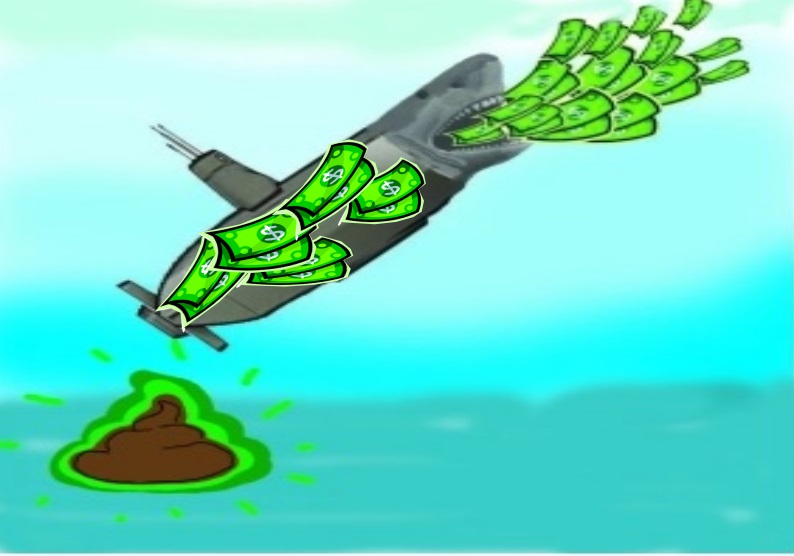
Ben Packam 6 May 24
The British company appointed to build Australia’s nuclear submarines says the government’s draft nuclear safety laws would allow the disposal in Australia of high -level radioactive wastes from UK submarines.
BAE Systems chief counsel made observation at committee hearing examining the government’s naval nuclear power safety bill, which is due to be pushed through Parliament after next week’s federal budget………….
Under questioing by Greens Senator David Shoebridge, BAE’s Peter Quinlivian agreed that the wording of the bill opened a pathway for the disposal of high-level British radioactive waste in Australia.
“The legislation as drafted is in language that would accommodate that scenario” he said.
Britain is yet to dispose of any of the nuclear submarines it has decommissioned since the 1980s. It estimates it won’t fully dispose of the boats, plus seven more dure to retire in coming years, until the late 2060s.
Mr Quinlivian said that BAE had not informed the British government of the prospects that Australia could legally dispose of its nuclear waste “because it didn’t immediately strike us”
The apparent loophole flies in the face of Australia’s reassurances that AUKUS won’t require us to become a dumping ground for other countries’ nuclear wastes.
Liberal Senator David Fawcett asked Defence officials in the April 22 committee hearing whether the bill could be amended to avoid unintended consequences, something that the government is understood to be open to.
In a written response, Defence conceded that a tightening of the bill’s language could be needed. It said specifying the “disposal” of only “Australian submarine” nuclear waste would be consistent with government policy, but the government would have to “carefully consider any amendment which excluded the possibility of regulatory control of the management of low level radioactive waste from UK or US submarines……………….
The Australian Radiation Protection and Nuclear Safety agency is poised to declare a site at the HMAS Stirling naval base off Perth as a low level radioactive waste management facility, but a decision on where to store high level waste from Australia’s planned nuclear submarines is years if not decades away

Defence Minister Richard Marles said that after the government announced its nuclear submarine plans in March 2023, Australia would not take nuclear waste from its AUKUS partners
“We’re not talking about establishing a civil nuclear industry, nor are we talking about opening Australia up as a repository for nuclear waste from other countries” he told the ABC.
Senator Shoebridge said that British bureaucrats were almost certainly “rubbing their hands together at the prospect of the Albanese government being foolish enough to pass this bill”
“Minister Marles has now been embarrassed by not only his own department but the very people he signed up to make the nuclear subs” he said.
The Senate standing committee on foreign affairs defence and trade is to release its report on the Australian Naval Nuclear Power Safety Bill 2023 on May 11.
Off the Books: how the Army privatised SAS elite to dark ops outfit Omni
Michael West Media, by Stuart McCarthy | May 4, 2024
Former SAS officers referred to national corruption watchdog over $230 million in government contracts to private security and intelligence “front company” Omni Executive. A Stuart McCarthy investigation.
According to the company’s website, Omni was established in 2012 and focuses on “delivering innovative national security, intelligence and critical infrastructure solutions to further our national interests.”
Since 2015, Omni has been awarded more than $230 million in security and intelligence related contracts by the departments of Defence, Foreign Affairs and Trade, Home Affairs, Prime Minister and Cabinet, the Australian Signals Directorate, the Australian Federal Police and the Australian Criminal Intelligence Commission.
Omni contracts hidden……………………………………………………………….. more https://michaelwest.com.au/army-privatised-sas-elite-to-dark-ops-outfit-omni/
Is There Life Beyond Nuclear Armageddon?

Bruce Dorminey, Senior Contributor, Forbes, 30 Apr 24
Earth is a very rare jewel of a planet. A completely serendipitous chance encounter with a Mars-sized impactor some 4.5 billion years ago created our anomalously large moon which to this day gives our planet its stable axial tilt. All of which enabled our planet to evolve its current life-rich biosphere.
Yet only in the last 300,000 years or so have we been around long enough to watch Earth’s civilizations come and go. And only within the last hundred years have we created weapons of mass destruction so powerful that if used in anger, they could wipe out billions of years of biological evolution.
Given recent geopolitics, however, in fifty years’ time I wouldn’t bet on there being anybody here to ponder such philosophical musings.
Thus, could life survive a full-scale nuclear war?
A nuclear Armageddon might be broadly similar to the K/Pg impact (the “dinosaur killer”) some 66 million years ago, Ariel Anbar, a geochemist and President’s Professor at Arizona State University in Tempe, told me via email. But in terms of the energy released the impact was thousands of times larger than even an all-out nuclear war would release, he says. Nuclear war also brings with it radiation that can drive mutations, which is a special kind of “nasty” but both scenarios are more than enough to bring down human civilization, says Anbar.
Most if not all of humanity would simply disappear.
My suspicion is that something like 99.9% of all humans would die, and our civilization would never rebound, Bruce Lieberman, a paleontologist and evolutionary biologist at the University of Kansas in Lawrence, told me via email. Either we wouldn’t survive, or it would be so bad for those few that lived that they would be better off if they didn’t survive, says Lieberman.
But Would Our Biosphere Survive?
Earth’s biosphere would survive even though it would take a big hit, says Anbar. Leaving aside the consequences of radioactive fallout, a nuclear war would be less severe than the K/Pg impact some 66 million years ago, he says. The consequences of nuclear fallout from a global exchange are hard to gauge since there’s a lot we do not know, says Anbar. But plenty of animals would likely survive so evolution is not likely to be “reset” back to microbes, he says.
How would nuclear Armageddon compare to natural planet killers that have befallen planet Earth, such as giant asteroids, comets as well as nearby gamma ray bursts or supernova explosions?
Life eventually rebounded after each of these mass extinctions, though it took at least 10-20 million years for diversity to reach former levels and for ecosystems to return to their pre-extinction levels of complexity, says Lieberman.
Even so, Lieberman says a global nuclear holocaust would cause a tremendous initial loss in biodiversity, perhaps on the order of 70% to 95% of all animal and plant species on land and 25% to 50% in the oceans.
The lesson here is that our planet’s fate can turn on a dime…………………………………………………………………………. more https://www.forbes.com/sites/brucedorminey/2024/04/30/is-there-life-beyond-nuclear-armageddon/?sh=30cdf0a04eb0
Nukes in space: Why a very very stupid idea just became more likely

Fears of a Cold War nightmare are resurfacing.
Tom Howarth, May 4, 2024, https://www.sciencefocus.com/space/nukes-in-space
Could a nuke be used in space? Last month, Russia seemingly took a step toward making the idea a reality. In defiance of a US and Japan-sponsored UN resolution, the country vetoed plans to prevent the development and deployment of off-world nuclear weapons.
Fortunately, the country didn’t actually threaten to launch such a device into space, an act that would violate the 1967 Outer Space Treaty. However, the UN representative for Russia did call the new resolution a “cynical ploy” and claimed “we are being tricked”.
But what would actually happen if Russia – or any other country – detonated a nuke above Earth? The worrying answer: such an explosion could be as devastating as one on ground level.
What happens if you detonate a nuclear warhead in space?
There are some pretty stark differences between setting off a nuke at ground level and up in orbit.
“When nuclear weapons go off on the ground, a lot of energy is initially released as X-rays,” Dr Michael Mulvihill, vice chancellor research fellow at Teesside University, tells BBC Science Focus.
“Those X-rays superheat the atmosphere, causing it to explode into a fireball – that’s what produces the shockwave and characteristic mushroom cloud that sucks up dirt and produces fallout.”
But in space there is no atmosphere. So no mushroom clouds or shockwaves are formed when you set off a nuke in space. That doesn’t mean the effects are any less terrifying, however.
“In space, a nuclear explosion releases a huge amount of energy as X-rays, gamma rays, intense flows of neutrons and subatomic charged particles. It also produces what’s known as an electromagnetic pulse, or EMP,” Mulvihill says.
An EMP is effectively a burst of electromagnetic energy; when one interacts with the upper atmosphere, it strips electrons from it, blinding radar systems, knocking out communications and wiping out power systems.
After the initial explosion, a belt of radiation wraps around the Earth that persists for months, possibly even years – no one knows for sure. The radiation can damage satellites and, as Mulvihill points out, would pose a serious risk to anyone in space at the time – such as astronauts on the ISS.
“The EMP would knock out power systems on the ISS, effectively destroying the life support systems and everything that circulates the atmosphere within the space station. And I imagine the astronauts would be exposed to high levels of radiation too,” Mulvihill explains.
“It would be highly hostile to life in orbit.”
Space is becoming more and more crowded with satellites – approximately 10,000 satellites are in low earth orbit right now, and tens of thousands more are planned for launch in the coming years. This significantly raises the stakes of unleashing nuclear energy in space, as we become more reliant on the systems we put into orbit.
From ground level, however, other than blowing power grids and disrupting communications, the effects could also be somewhat beautiful.
As charged particles from the explosion interact with the Earth’s magnetic field and the atmosphere, they would cause brilliant auroras, stretching across huge distances that could last for days. So there’s that, at least.
Have nuclear explosions reached space before?
Unsurprisingly, during the Cold War, global superpowers (namely, the US and Russia) tested nukes in just about every scenario imaginable. On land, underwater, in a mountain – you name it, they tried blowing it up.
It comes as no surprise then, that detonating nuclear weapons in space has been done before. In total, the US conducted five space nuclear tests in space; the most famous of which, according to Mulvihill, occurred on 9 July 1962 near(ish) to the Pacific island paradise of Hawaii.
Starfish Prime was launched 400km (250 miles) above Johnston Island and had an explosive power of 1.4 megatons – about 100 times more powerful than the Hiroshima bomb.
The EMP was much larger than expected, compromising the classified nature of the test as streetlights and phone lines were knocked out in Hawaii 1,450 km (900 miles) away from the detonation point.
The ensuing red auroras stretched across the Pacific Ocean and lasted for hours.
“At the time there were around 22 satellites in space, of which around a third were knocked out,” Mulvihill says. The casualties included the world’s first TV communication satellite, Telstar 1, which had been a beacon of US technological development until Starfish Prime caused it to prematurely fail after just seven months in orbit.
In the following years, everyone came to their senses a bit and decided that testing nuclear warheads in space constituted a bad idea. Thus, the Outer Space Treaty (OST) was born.
Signed in 1967 by the US, UK and Soviet Union, the OST now has over 100 signatories and designates space as free for all to use for peaceful purposes only. The world breathed a sigh of relief and got on with using space for nice things like astronomy, space stations and WiFi for the next 60 years. So, what’s changed?
How worried should we be?
Rumours of a change in the orbital security situation began swirling when earlier this year the US House Intelligence Committee chairman Mike Turner issued a vague warning about a “serious national security threat” posed by Russia.
Following this, news outlets began reporting that the threat pertained to a possible “nuclear weapon in space”.
“It’s certainly concerning, but don’t lose sleep over it,” Mulvihill says. “Russia is still a signatory of the OST, so any sort of weapon in space would be absolutely illegal.”
He also points out that as Starfish Prime demonstrated, nuclear weapons in space are indiscriminate, meaning any detonation would do just as much damage to Russia and its allies as anyone else.
“It wouldn’t just knock out Starlink [the SpaceX system of satellites that provides internet to 75 countries]. It would knock out Chinese satellites and everyone else’s too.”
Another possibility, Mulvihill thinks, is that countries could develop nuclear-powered ‘jammers’. In other words, not a bomb (phew), but something that uses nuclear power to generate a signal that could disrupt, rather than destroy, other satellites.
Ultimately, though, this could all be little more than geopolitical posturing. “Deterrence is all about messaging and trying to persuade somebody that you would do it without ever actually getting there. I think that’s probably the psychology that’s going on with this,” Mulvihill concludes.
Inside story: Will Iran’s supreme leader revise his ‘nuclear fatwa’?
https://amwaj.media/article/inside-story-will-iran-s-supreme-leader-revise-his-nuclear-fatwa 5 May 24
The direct confrontation between Iran and Israel has sparked speculation about a potential shift in the Islamic Republic’s nuclear policies under the leadership of Ayatollah Ali Khamenei.
Following Iran’s Apr. 14 military action against Israel in response to the Apr. 1 bombing of the Iranian consulate in Damascus, a senior commander of the Islamic Revolutionary Guard Corps (IRGC) explicitly suggested the possibility of a revision to Tehran’s objection to atomic weapons. The suggestion may only be a part of the war of words between Iran and Israel. However, the fact that such discourse is rapidly becoming mainstream in Iran raises questions of what may lie ahead—including whether a shift may take place under Khamenei, who has long opposed atomic weapons on a religious basis.
Rapidly changing discourse
Amid media speculations of a major Israeli attack in response to Iran’s Apr. 14 drone and missile strike on sites inside Israel, Gen. Ahmad Haqtalab—the commander of the Protection and Security Corps of Nuclear Centers—on Apr. 18 stated, “If the Zionist regime wants to use the threat of attacking our country’s nuclear centers as a tool to pressure Iran, it is possible to review the nuclear doctrine and policies of the Islamic Republic of Iran and deviate from the previous considerations.”
The warning was rare, and even as tensions eased between Tehran and Tel Aviv, Iranian officials continued to underscore the significance of the matter. Four days after Haqtalab’s intervention, former IRGC commander and current MP Javad Karimi Qoddousi tweeted, “If permission is issued, there will be [only a] week before the first [nuclear] test.” Qoddousi separately posited that the same amount of time was needed to test missiles with an increased range of 12,000 km (7,456 miles).
However, Iranian Foreign Ministry spokesman Nasser Kanani promptly interjected, dismissing the notion of any alteration to the country’s nuclear doctrine. Meanwhile, government-run Iran daily slammed Qoddousi, characterizing his statements as “untrue” and possibly being exploited by “enemies” to pursue further sanctions and fear mongering against Iran. Several other outlets, including conservative-run media, notably echoed such criticisms.
Yet, despite the blowback, Qoddousi went ahead and posted a video on Apr. 25 in which he said that Iran needs only half a day to produce the 90%-enriched uranium necessary to build nuclear bombs.
Khamenei and the ‘nuclear fatwa’
In Shiite Islam, a fatwa is a religious edict issued by a high-ranking Islamic jurist on the basis of interpretation of Islamic law. To followers of the jurist in question, fatwas are binding and the primary point of reference for everything from major life decisions to day-to-day matters. Fatwas can also be a part of state policies.
Ayatollah Khamenei has on multiple occasions over the past two decades reiterated his objection to the development, stockpiling, and usage of nuclear weapons as haram or religiously impermissible. Among believers, violating what is deemed haram would have serious consequences both in this life and the hereafter. In 2010, the supreme leader reiterated his objection to weapons of mass destruction in a message to an international conference on nuclear disarmament, stating they “pose a serious threat to humanity” and that “everyone must make efforts to secure humanity against this great calamity.”
Critics of what became known as the nuclear fatwa have over the years raised a variety of objections, from the modality of Khamenei’s religious edict to the manner in which it has been presented. Some even question whether the ruling really exists. What is indisputable, however, is that the religious edict has previously averted conflict by aiding diplomacy.
For instance, in connection with the 2013-15 nuclear negotiations that led to the signing of the Joint Comprehensive Plan of Action (JCPOA) between Iran and world powers—which saw Tehran agree to restrictions on its atomic program in exchange for sanctions relief—there were suggestions that the Islamic Republic should codify the fatwa.
Amid the nuclear negotiations with Iran, then-US secretary of state John Kerry in 2014 stated, “We take [Khamenei’s fatwa] very seriously….a fatwa issued by a cleric is an extremely powerful statement about intent. Our need is to codify it.” In another interview the same year, Kerry asserted that “the requirement here is to translate the fatwa into a legally binding, globally recognized, international understanding…that goes beyond an article of faith within a religious belief.”
Only days after the signing of the JCPOA in 2015, Khamenei said, “The Americans say they stopped Iran from acquiring a nuclear weapon. They know it is not true. We had a fatwa, declaring nuclear weapons to be religiously forbidden under Islamic law. It had nothing to do with the nuclear talks.”
Will Khamenei change his fatwa?
Khamenei is not the first Iranian Islamic jurist to issue a fateful religious edict on a highly politicized matter. Back in 1891, Mirza Mohammad Shirazi (1815-95), a leading Shiite religious authority at the time, issued a hokm or verdict against the usage of tobacco in what became known as the Tobacco Protest. The move came in protest against a concession granted by the Qajar monarch Naser Al-Din (1848-98) to the British Empire, granting control over the growth, sale, and export of tobacco to an Englishman. The hokm issued by Shirazi ultimately led to the repeal of the concession.
Neither a fatwa nor a hokm is set in stone and can be revised. The main distinction between the two types of rulings is that a hokm tends to have more conditions and requirements attached to it. Moreover, while a fatwa must be followed by the followers of the Islamic jurist who issued it, a hokm must be followed by all believers—including Shiites who are not followers of the jurist in question.
Explaining the intricacies of a hokm, a cleric and professor of Islamic law (fiqh) at the Qom Seminary told Amwaj.media, “There are primary hokm and secondary hokm. The former is like the necessity of the daily prayer that is mentioned in the Quran and the hadiths [traditions], or the prohibition on consuming alcohol. The secondary hokm is based on expediency and necessity that leads to the first ruling being changed. For example, if alcohol helps someone stay alive, then it is not haram [religiously impermissible] for him or her [to make use of it].” He added, “A fatwa can be changed too.”
1 This month
7 April – WEBINAR – Australia and the Doomsday Clock – Preventing nuclear war through NoFirstUse and other policies
Online | Tuesday April 7, 4:00-5:30pm, Australian Eastern Time / 8:00-9:30am Central Europe Time
– Access the registration link
15 April – Zoom –Nuclear Power is Not the Solution
Apr 15, 2026 01:00 AM in Canberra, Melbourne, Sydney

Join the International Physicians for the Prevention of Nuclear War (IPPNW) on Tuesday, April 14th for a timely webinar exploring the risks associated with nuclear power and challenging the myth that it offers a simple, safe, carbon-free solution to the climate crisis

21 April Webinar: No Nuclear Weapons in Australia
Start: 2026-04-21 18:00:00 UTC Canberra, Melbourne, Sydney (GMT+10:00)
End: 2026-04-21 19:30:00 UTC Canberra, Melbourne, Sydney (GMT+10:00)
Event Type: Virtual
A virtual link will be communicated before the event.
Host Contact Info: australia@icanw.org

of the week – Australians for War Powers Reform (AWPR)
To see nuclear-related stories in greater depth and intensity
 Antinuclear