TODAY. Jobs jobs jobs in the nuclear industry – but is it true?

Go to Google news for nuclear information, and you’ll be swamped with glowing stories from the World Nuclear Association, the IAEA, and the big corporate media outlets – all about the wonderful future for the nuclear industry- –
all those jobs! including in the lovely nuclear weapons industry.
Jobs in renewable energy. This year’s report finds that renewable energy employment worldwide has continued to expand – to an estimated 13.7 million direct and indirect jobs in 2022. We can expect the creation of many millions of additional jobs in the coming years and decades. https://mc-cd8320d4-36a1-40ac-83cc-3389-cdn-endpoint.azureedge.net/-/media/Files/IRENA/Agency/Publication/2023/Sep/IRENA_Renewable_energy_and_jobs_2023.pdf?rev=4f65518fb5f64c9fb78f6f60fe821bf2

Jobs in nuclear power. I have not been able to find any kind of authoritative report on global jobs in nuclear power. I did find one source (on Quora) stating that each nuclear reactor in construction provides 1400-1800 jobs, and in operation 400 -700 jobs. The nuclear industry claims many more, but for construction, we must remember – this is all in the rather distant future.
The figure below is a prediction from many years ago. If we are to believe the nuclear lobby, this prediction should change rapidly.


What we do know is that at present, renewable energy jobs are increasing exponentially, and nuclear power building is almost at a standstill.
The figure on the left is also from many years ago. But I doubt that much has changed.
Of course – this is all about the actual reactors. There are many jobs in uranium mining, milling, transport etc, and of course, in nuclear weapons-making
The quality of jobs.
In energy efficiency there are many interesting and clean jobs. Also, workers know that they are contributing to a healthier planet – something to be proud of.
In renewable energy the jobs are relatively clean and healthy, and there’s again, the knowledge of being in an alternative to the polluting industries – coal and nuclear.
In nuclear energy and nuclear fuel, the workers are involved in the risky area of ionising radiation. There’s a huge amount of documentation on this. It is NOT a healthy job, though I suppose that it’s better to be a highly paid nuclear executive or lobbyist, safe in a nice office.
I doubt that nuclear workers can get much satisfaction about “helping the planet”, as the “peaceful” nuclear industry is so dirty, dangerous, and intimately connected with nuclear weapons.
No doubt some nuclear workers get paid a lot more that renewable energy workers do. But, there’s real value in knowing that your contribution to society is a clean and positive one.
Inside the nuclear influence machine

Documents unearthed by The Fifth Estate lay bare how funding for the strategy, now in motion, is coordinated by a coal mining leader from Queensland, working with possibly Australia’s most influential conservative think tank, and also a key member of Australia’s unofficial nuclear club.
Is the push for nuclear power in Australia more stalking horse for coal than a genuine alternative for a clean energy future? Here’s how the nuclear cabal is working its pitch
THE FIFTH ESTATE, MURRAY HOGARTH, 29 May 24
There’s a sophisticated, well funded strategy underway to prolong coal and gas and eventually take Australia down the nuclear road.
Documents unearthed by The Fifth Estate lay bare how funding for the strategy, now in motion, is coordinated by a coal mining leader from Queensland, working with possibly Australia’s most influential conservative think tank, and also a key member of Australia’s unofficial nuclear club.
For this to work, the Liberal-National coalition needs to win back political power at the next federal election due by May next year.
- A key conservative think tank aims to keep coal until nuclear power arrives
- Its energy security argument is echoed by Peter Dutton as coalition policy
- A Queensland coal baron mustered donors to fund this influence machine
As things stand, nuclear power is currently prohibited in Australia, and the Labor government is committed to fast-tracking a renewables-led energy transition and says it has no plans to lift the ban.
Canberra retreat
The documents we’ve obtained and refer to in this article are the script and slides from a revealing energy security project update to a private strategy retreat held in Canberra last year on 12 May 2023 by the Institute of Public Affairs (IPA).
Behind the current campaign to bring nuclear energy to Australia is a deliberate agenda to prolong coal generation and disrupt the renewables rollout
The Fifth Estate contacted the speaker and two other key IPA-connected figures identified in this story for comment on Monday 27 May, inviting on-the-record interviews and providing questions. On Tuesday evening 28 May, the IPA chief executive officer Scott Hargreaves responded by email but declined to be interviewed. Full details of that response and related information are included at the end of this article.
The Melbourne based IPA is known as Australia’s leading conservative think tank, a key influencer of Coalition policies, and breeding ground for conservative politicians.

It habitually loads speaking point bullets for coalition politicians to fire. And it looked like Opposition Leader Peter Dutton did just that when he delivered his headland nuclear policy speech at an IPA public event, just two months after the Canberra retreat on 7 July last year.
In 2023, the IPA threw an arm around one of the favourite sons of the nuclear club, University of Queensland Adjunct Professor Stephen Wilson, making him a Visiting Fellow, as part of a big new donor-funded influence project, running over three years.
A key and recurring focus of this project and subsequent related policy talking points is energy security.
The internal IPA documents, authored by Wilson, lay out what many people suspect and have alleged: that behind the current campaign to bring nuclear energy to Australia is a deliberate agenda to prolong coal generation and disrupt the renewables rollout.
The final commentary and slide in Wilson’s presentation show an IPA-orchestrated master plan for Australia to defend and preserve coal and gas in the 2020s; then build “mini and small modular reactor (SMR)” nuclear plants in the 2030s under the mantle of reaping energy security, environmental and low-cost rewards in the 2040s.
It’s a parallel universe to the view a vast number of people have of Australia’s energy future. And it’s totally at odds with the clean energy transition agenda and the federal government’s targets of 43 per cent greenhouse gas emissions reductions below 2005 levels and 82 per cent renewables by 2030.
Threat to climate targets
It’s also likely to breach Australia’s staged progress, with five yearly sub targets (for example 43 per cent by 2030, with 2035 targets due to be announced early next year, with a range of 65-75 per cent being evaluated by the Climate Change Authority), towards its bipartisan commitment to 100 per cent net zero by 2050, which was made by the former Morrison coalition government ahead of the UN Climate Summit in Glasgow in the UK in 2021.
The IPA, however, is no fan of UN processes, and as Wilson made clear in his project update notes for the IPA insiders, the aim of its strategy was definitely not to prolong a Labor government……………………………..
The coal connection
Wilson also identified in the presentation who was pulling together the funding for his IPA project, with a bit of ideological explanation to set the scene:…………………………………………………………………….
Bring on Peter Dutton
The private IPA retreat in Canberra on 12 May last year was followed less than two months later by Dutton’s major speech to launch the coalition’s new energy security themed nuclear policy. This was delivered at a public IPA event in Sydney on 7 July.
Dutton’s speech mirrors the theme
Dutton’s headland nuclear speech substantially mirrored the energy security theme and language from the IPA retreat. And it also picked up on themes from earlier “nuclear club”events and activities, a number of them involving Stephen Wilson. If Australia’s nuclear club has anyone it would like to make its intellectual rock star, it’s Wilson.
Dutton’s IPA speech directly referenced Wilson, most significantly:
Professor Wilson says that we must stop procrastinating and prepare real options to deploy nuclear energy in case we need them. Countries are queuing up to put in their orders. Australia could have SMRs [small modular reactors] installed within a decade.
Wilson also confirmed his presentation to the IPA retreat in the video of another IPA event earlier this year, its 2024 Generation Liberty IPA Academy aimed at young conservatives, and relayed how Dutton had quoted him on a couple of occasions, expressing some surprise, saying, “I didn’t know he was going to do that.” (Dutton’s 7 July speech also quoted three other nuclear club regulars, as well as Wilson.)
Since then, SMRs have been a disappointment. Very inconveniently for Dutton and Wilson, the US showcase for new and thus far commercially-unproven SMR-design nuclear power stations, the NuScale project in Idaho, was cancelled in November last year due to cost overruns and lack of electricity buyer interest.
NuScale’s chief executive officer was reported as saying: “Once you’re on a dead horse, you dismount quickly. That’s where we are here.”
On message for energy security
However insecure the NuScale experience sounds, it’s worth remembering that the core theme of Wilson’s earlier 12 May IPA presentation, based on the notes and slides, was energy security. That was also a central theme of Dutton’s 7 July IPA speech:………………………………………………………………
The future of the nation and Western civilisation as we know it
On a geo-political note, national security was weighing heavily on Wilson’s mind on 12 May, as it did for Dutton on 7 July. According to Wilson’s speaking notes, at stake was nothing less than the future of the nation and Western civilisation as we know it:…………………………………………………………………..
Nuclear club bona fides
To be clear, this is the same Stephen Wilson who joined Queensland Liberal MP Ted O’Brien, Dutton’s Shadow Minister for Climate Change and Energy, and other nuclear club players, on a so-called “due diligence” study tour to the US and Canada in January-February 2023.
As Wilson’s slide deck for the IPA Canberra Retreat showed, the study tour group visited major nuclear industry companies, government representatives, lobbyists and campaign organisations. (Ted and friends’ excellent nuclear adventure in North America will feature in other upcoming articles in The Nuclear Files.)
By his own account, judging by a number of publicly available videos, Wilson imbibed deeply in the North American nuclear sector Kool-Aid, riffing off a theme he picked up on the US study tour, to proclaim that: energy security IS national security.
That became the inspiration for a key paper he published with the IPA on 1 November 2023, titled Energy security is national security. Its 1 November 2023 launch, in London on the perimeters of a global gathering of about 1500 ultra-conservatives, is another story coming soon from The Nuclear Files.
The Fifth Estate’s questions to key players in this story
The Fifth Estate provided these questions to IPA CEO Scott Hargreaves early on Monday afternoon:………………………………………………………………………………
The nuclear story, then and now, in brief
Nuclear power has been considered for Australia numerous times over the past nearly 70 years, from the 1950s, but has never happened, mainly for economic reasons. Historically because of the low cost and wide availability of coal, and now it is the low cost of renewables. This month the 2024 CSIRO GenCost report found that traditionally designed large scale nuclear power stations would cost at least 50 per cent more than solar and wind backed by batteries, and take at least 15+ years to develop, and more technically-advanced Small Modular Reactors (SMRs) could be four to six times more expensive than renewables.
On ABC Radio Sydney on Wednesday morning, 29 May, Opposition nuclear frontman Ted O’Brien was pressed on the timing for release of the coalition’s highly anticipated nuclear policy, and insisted it would be revealed “in due course”. He confirmed that the coalition wanted to replace coal-fired power stations, as they exit the electricity grid, with nuclear ones, and that gas generation would fill any gap (which could be one to two decades) between coal shutting down and nuclear starting up. https://thefifthestate.com.au/columns/columns-columns/the-nuclear-files/inside-the-nuclear-influence-machine/
CSIRO stands by nuclear power costings that contradict Coalition claims

The Coalition has attacked the GenCost report that found nuclear power plants would be at least 50% more expensive than solar and wind
Graham Readfearn, 29 May 24, https://www.theguardian.com/australia-news/article/2024/may/29/csiro-nuclear-power-plant-australia-cost-peter-dutton-liberal-coalition
The CSIRO says it stands by its analysis on the costs of future nuclear power plants in Australia after the Coalition attacked the work, which contradicted its claims reactors would provide cheap electricity and be available within a decade.
The opposition’s energy spokesperson, Ted O’Brien, claimed on Tuesday in the Australian newspaper that the CSIRO should re-run its modelling to account for longer life-spans and running times of nuclear generators in other countries with nuclear programs.
Last week the CSIRO released its GenCost report on the costs of different generation technologies, saying nuclear would be at least 50% more expensive than solar and wind and would not be available any sooner than 2040.
The Coalition has yet to reveal any detail on its nuclear plan, including what type of reactors it would build, how large they would be and where they would put them.
A CSIRO spokesperson told Guardian Australia: “CSIRO provides impartial and independent advice and does not undertake modelling for specific policy directions.
“While we stand by the data provided, any alternative scenarios assessed by others would not carry CSIRO’s endorsement.”
O’Brien pointed to an assumption used in the GenCost report that nuclear plants would have a “capacity factor” – how often they are generating electricity relative to their maximum capacity – of between 53% and 89%.
O’Brien wanted the CSIRO to use a higher figure of 92.7% for nuclear based on the performance of plants in the US.
But the GenCost report discusses the reasons for setting capacity factors, saying new baseload generators such as nuclear “are expected to struggle to present the lowest cost bids to the dispatch market” and would, therefore, likely be generating less often.
O’Brien also wanted the CSIRO to model the full lifespan of nuclear plants – which could be as long as 80 years – and to add a start date of 2035 to its modelling.
The report provides cost estimates for power from different generation technologies, including both large and small reactors, for the years 2023, 2030 and 2040.
The CSIRO spokesperson said: “Specific issues in regard to economic life of generation assets and capacity utilisation, including large scale nuclear, have been assessed by the GenCost team as part of the consultation process for the 2023-24 report.”
Australia has never built a nuclear reactor for electricity and the technology has been banned since 1998.
The CSIRO report said if a decision was made in 2025 to adopt nuclear power, it would be at least 15 years until a reactor was producing power.
The report said: “Nuclear technologies need to undergo more extensive safety and security permitting, nuclear prohibitions need to be removed at the state and commonwealth level and the safety authorities need to be established.”
The report estimated if Australia could establish a nuclear industry, then a 1,000MW plant would cost $8.6bn, but the first reactors could cost double that amount – more than $17bn.
The report said: “Given the lack of a development pipeline and the additional legal and safety and security steps required, the first nuclear plant in Australia will be significantly delayed. Subsequent nuclear plant could be built more quickly as part of a pipeline of plants.”
Among opposition leaders, Peter Dutton is a miracle survival story. But is he about to nuke himself with women voters?
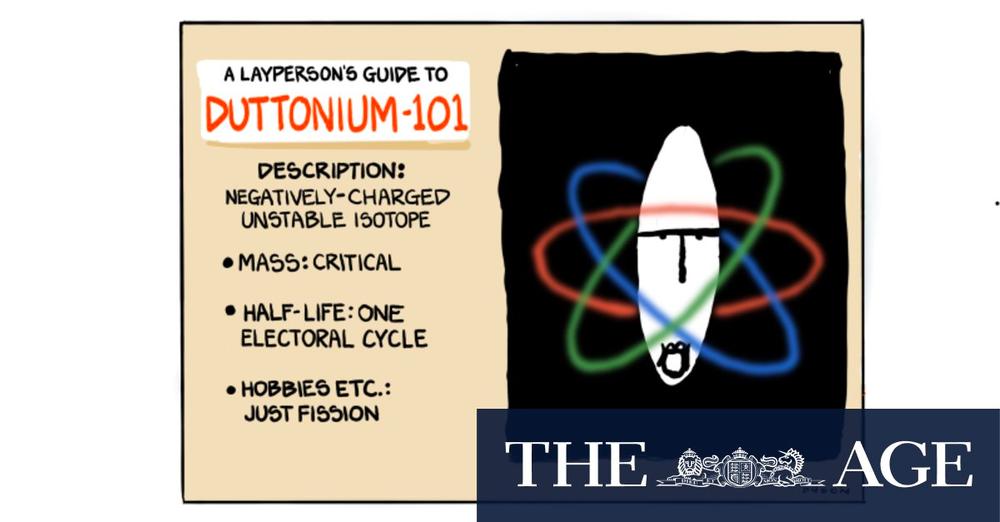
ABC, By Annabel Crabb 29 May 24
Peter Dutton is a freak of nature. Politically, that is…………………………………
Two years in, Dutton is not only still in office, but nobody inside his own party — or even in the National Party — is trying to blow him out of it. It is a truly extraordinary achievement.
His public popularity remains firmly in negative territory, according to Newspoll. So why isn’t this translating into the customary seasonal orgy of backstabbing?
Two reasons.
The first is that there really isn’t, ahem, any alternative……………………………………………………………………………….
Dutton much a much more dangerous opponent for Anthony Albanese than is commonly assumed.
But there is one risk associated with this unseasonably warm bath of internal approbation……………………..his decision to pursue nuclear energy as a principal policy decision is a high-risk call, as a new piece of research — supplied to the ABC — makes clear……………………
When it comes to nuclear, public opinion divides along gender lines
Over recent weeks, the RedBridge Group conducted a survey of around 2,000 Australian voters, seeking their views on various issues including nuclear energy. Respondents were asked whether they would support or oppose an Australian government lifting the ban on nuclear power so private investors could build nuclear power plants here.
The responses, across all voters, were kind of evenly divided. Strong supporters constituted 17 per cent, another 17 said they were supportive, 19 per cent were “neither”, 15 per cent were opposed, 20 per cent strongly opposed, and 12 per cent were unsure. This shakes out to an extremely slender net negative of-1
But the truly fascinating detail in the survey comes when you dig down into who especially loves the idea of nuclear, and who hates it.
And the biggest difference of opinion on nuclear, it turns out, breaks along gender lines……………….
Women disapproved of nuclear power strongly – just 7 per cent strongly agreed a ban should be lifted, compared with 24 per cent of male respondents. That’s a net negative of -29 for women, and net positive of 26 for men.
The only demographics showing real enthusiasm for nuclear power were Coalition voters, those aged over 65, those who earn more than $3,000 a week, and those who own their own home. In each of these instances, every other group was majority opposed.
In other words, every other party’s voters apart from the Coalition’s registered a net negative, as well as every other age bracket apart from the most elderly, and all other income brackets apart from the top one.
Renters and mortgage holders alike disapproved on the whole. Among those who described themselves as under “a great deal of financial stress”, the feeling on nuclear ran at negative 15. Among those under “no stress at all”, however, the reception was much warmer – positive 19…………………………………………………………………………….
And in the two years that have elapsed since female voters demonstrated their annoyance at being ignored and talked down to, the Liberal Party has failed to do anything about its structural under-representation of women in parliament, …………………………………………………………..
There always seems to be an abundance of reasons to get rid of women; almost as many reasons as traditionally abound for holding on to and even promoting male duds. Women do notice this stuff.
And “Never mind ladies, have a nuclear power plant” may not be a very compelling change of subject. https://www.abc.net.au/news/2024-05-29/peter-dutton-nuclear-power-policy-may-risk-alienating-women/103870338
Nuclear will cost Queensland jobs

JOINT STATEMENT Premier The Honourable Steven Miles, Minister for Energy and Clean Economy Jobs, The Honourable Mick de Brenni, 13 May, 2024 https://statements.qld.gov.au/statements/100305
- The LNP backed “Nuclear for Climate Australia” has identified multiple sites in North Queensland for nuclear reactors.
- This would see nuclear reactors in Townsville, the Sunshine Coast, Rockhampton, Brisbane Valley, Toowoomba, the Darling Downs and more.
- LNP going nuclear risks Copperstring jobs, critical minerals boom for Townsville to Mount Isa
- Labor backs clean and renewable energy not nuclear.
- The Miles Government is already delivering jobs and clean energy through the Queensland Energy and Jobs Plan and development of the SuperGrid.
- Those jobs would be at risk with the LNP’s nuclear plans.
The Miles Government is focussing on clean energy jobs and has a working plan for a safe and responsible transition to renewable energy, that will protect existing jobs and create new ones.
Queenslanders from Townsville to Mt Isa are at the heart of Labor’s leading plan for a clean economy future.
Our plan to build CopperString will provide more than 800 jobs during construction and will unlock the $500 billion North West Minerals Province, by linking it with Hughenden and up to 6,000 MW of renewable energy.
This is the nation’s largest expansion to the power grid and it is paid for by progressive coal royalties.
By putting their fossil fuel friends before Queensland’s transition, the LNP is risking thousands of jobs and return to high unemployment.
The LNP’s nuclear option is an LNP recipe for a cost-of-living meltdown. Nuclear is the most expensive option. It is 5 times the price of renewables.
International examples show it will take around 19 years to build a nuclear power station.
This is decades too late for Townsville employers who need clean, affordable energy now to remain competitive.
Nuclear is neither clean nor renewable. And it’s illegal in both Queensland and Australia.
The LNP backed proposal targets nuclear power stations in Townsville, Gladstone, Sunshine Coast, Toowoomba, Brisbane Valley, Ipswich, Darling Downs, the Western Downs, Rockhampton, and Callide.
Quotes attributable to Premier Steven Miles:
“The LNP are proposing nuclear reactors right across this state. Up to three near Townsville, while they have earmarked locations on the Sunshine Coast, Toowoomba, Brisbane Valley and Ipswich.
“What we know about those nuclear reactors is that they will be much more expensive. As much as five times more expensive for your household power bills.
“We also know that as a result of those reactors, future generations of Queenslanders will have to manage nuclear waste forever.
“That’s the LNP’s plan. Higher prices and nuclear waste; putting our waterways, our environment and our beautiful state at risk.”
Quotes attributable to Energy Minister Mick de Brenni:
“Everyone from Townsville Enterprise to the Queensland Resources Council backs Labor’s plan on renewable energy, because Copperstring means jobs and long-term prosperity for the region.
“The only exception is the LNP, who voted in Parliament to oppose the Energy and Jobs Plan, because they are opposed to renewables and public ownership.
“It seems that everybody in Townsville wants local manufacturing and jobs here, except David Crisafulli, who will not stand up to Peter Dutton and Ted O’Brien and actually back Townsville jobs.
“We know how risky and expensive nuclear is and we know David Crisafulli deserted North Queensland for the glitter strip on the Gold Coast, and now he’s setting Townsville up for an unemployment and cost of living meltdown.
“North Queensland already has the world’s best plan to protect local jobs through the transition, so why would the LNP turn its back on the Queensland Energy and Jobs Plan and Copperstring, just so they can cosy up to their big donors?
“Labor is backing renewable energy because it protects jobs in North Queensland, from Townsville to Mt Isa and beyond, and Labor is not prepared to risk those jobs.”
Quotes attributable To Thuringowa MP Aaron Harper:
“I do not want to see a nuclear reactor in Townsville and anywhere near the banks of the much loved and well used Ross River.
“Nobody in Thuringowa and the Upper Ross will accept nuclear waste travelling down Riverway Drive.
“We know the LNP back nuclear energy and are against renewable energy.
“We know that David Crisafulli and the state LNP are too weak to stand up to Peter Dutton’s nuclear agenda.
“There are serious questions to answer from the LNP about their connections to Nuclear for Climate’s plan for nuclear power in Townsville.
“Peter Dutton and David Crisafulli’s nuclear agenda pose an unacceptable risk to Townsville.”
Background information:
- Nuclear for Climate Australia, which has the backing of the Coalition, has identified multiple sites in Queensland as ideal spots to host nuclear reactors.
- Nuclear power is currently illegal in Queensland.
- Miles Government is delivering cheaper, cleaner, reliable power to develop the North West Minerals Province.
- Nation’s largest expansion to the power grid – SuperGrid, not a MiniGrid.
- CopperString will connect nation’s largest renewable energy zone at Hughenden and power a critical minerals industry that will supply world’s transition
- CopperString will be 100% publicly owned
Fast Facts
- Nuclear power production is prohibited under two pieces of legislation:
- Australian Radiation Protection and Nuclear Safety Act 1998
- Environment Protection and Biodiversity Conservation Act 1999
- CSIRO estimate the capital cost of small modular reactors in 2030 to be $15,959/kW, compared to wind at $2105/kW and solar at $1134/kW.
1 This month

of the week – Australians for War Powers Reform (AWPR)
To see nuclear-related stories in greater depth and intensity
 Antinuclear