TODAY. Turning Point .The bomb and the cold war. Episode 4: The Wall – outlines the nuclear weapons race.
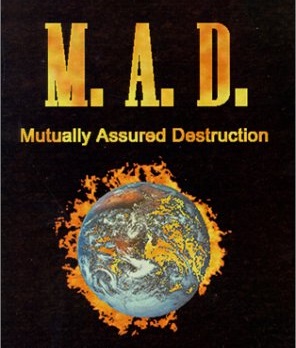
Introduction: 2019, with Donald Trump in power Mike Pompeo, Secretary of announces that USA is ls leaving the Arms Control Treaty – the Intermediate Range Nuclear Forces Treaty with Russia. Only the New Start Treaty remains, due to expire soon . USA-Russia relations at a low point because of Ukraine, Russia withdraws from nuclear communications. Now other nations also have nuclear weapons, increasing the danger of confrontation, not co-operation, and of nuclear war.
************************
The Soviets were always insecure about American power. Americans also afraid of Soviet might. So Kruschev exaggerated Soviet nuclear weapons, to impress Americans. So USA in 1956 devised U2 spy plane. 1957 – Soviets develop Sputnik satellite- a space win, increasing USA’s fear. CIA satellite spying showed Soviet nuclear weapons much fewer. Daniel Ellsberg (Rand Corporation analyst 1959- 64) shows that Soviets were not trying for a first strike capability, not trying to dominate the world militarily. That discovery should have led to a change in USA thinking.
But it didn’t. USA propaganda continued, with the fraudulent belief that Russia ‘s foreign policy was world domination
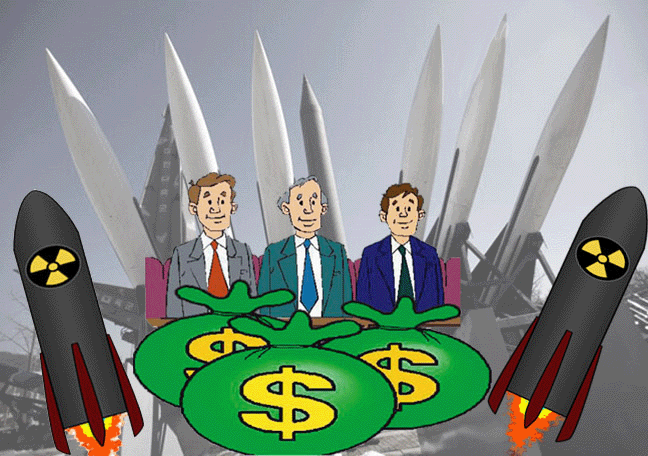
Why has this totally fraudulent belief persisted all this time? Because there are jobs in it, and it’s very profitable. So many companies – Boeing, Lockheed, IBM, Martin and more become reliant on the government and the defense industry, becoming “a nuclear-headed hydra”. It changed universities, with 75% of natural science funding coming from defense industries. Society becomes oriented around defense, security and nuclear weapons. Exponential increase in the number and diversity of weapons, with an unlimited budget. (Good visuals of many types of nuclear weapons) By 1961 23000 nuclear weapons, most of them thermonuclear- a thousand times more powerful than the one dropped on Nagasaki. Eisenhower finally realised what a threat that this permanent armaments industry was to democracy – and warned against the “military-industrial-complex”. So many congressmen were reliant on the armaments jobs in their district. Armaments were seen as good business by Republicans and Democrats.
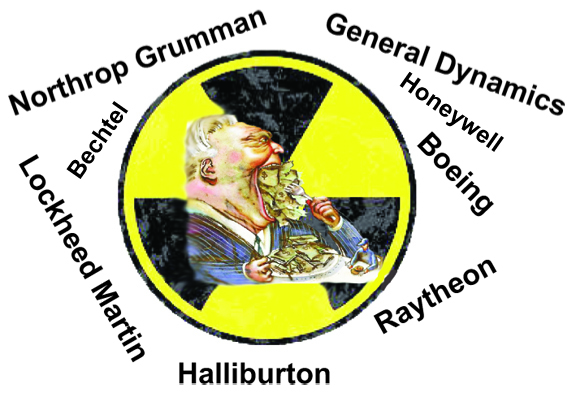
Presidents Richard Nixon and then John Kennedy push for the weapons industry aiming to race the Soviets, beat the so-called “missile gap”. Confrontation increasing, between Kruschev and Kennedy, (told by Kruschev’s great-granddaughter). Focus on Berlin, – graphic coverage of the Wall going up, the guards, the repression, the “death strips” .
Meanwhile American missiles set up in Europe, aimed at Russia., in Turkey aimed at the Kremlin. So Soviets tried to set up a threat to USA in Cuba’s communist regime. A CIA-led insurgency there had failed, (told by veterans) .
Pressure on Kennedy to invade Cuba, but he was reluctant. Castro urged Kruschev to attack USA, but Kruschev was reluctant. Tortuous secret diplomacy. Privately both Kennedy and Kruschev wanted no nuclear war. But they were not really in control, and they publicly threatened with nuclear weapons. This crisis led to the PARTIAL NUCLEAR TEST BAN TREATY putting nuclear testing underground.
1963: Kennedy assassinated, 1964 – Kruschev deposed. Brezhnev took over, aiming to be ahead in nuclear missiles. Both USA and Soviet union raced for nuclear missile superiority, but aiming to never use these weapons – use would be a mutual suicide pact. They developed the policy of Mutually Assured Destruction. Use of thousands of these weapons within 30 minutes – would kill of the entire earth, cut out sunlight and plant growth, and coat the earth with radioactive fallout.
So – the battles between the Soviets and the USA were proxy battles in other countries, intervening in other countries ‘ civil wars – Nicaragua, Angola, North Yemen, Domenica, Bangladesh, East Timor, Mozambique. Congo, (brutish visuals) . In Vietnam China and Russia supported the North Vietnamese, while many Asian allies supported USA. USA used Latin American countries to mobilise the Cold War. In Chile USA orchestrated the overthrow of President Allende, and the takeover by fascist Augusto Pinochet. U.S. intervention left a chaotic rule in Guatemala , an authoritarian rule in Iran. Far from spreading democracy, USA “got into bed with anyone who called themselves anti-communist“.
1969 President Richard Nixon- publicly blustered about the evils of Soviet communism, but in reality, talked with the Soviets about negotiation, introducing “detente”. The Strategic Arms Limitation Agreement (SALT 1) 1n 1972, the first agreement to limit intercontinental ballistic missiles. The U.S. Anti Ballistic Missile System. But the number of warheads was increasing in both USA and Russia – to a total of 70.000 nuclear weapons. A movement in USA to not trust the Soviets will culminate in the 19080s with President Ronal Reagan. Still, Reagan’s hatred of nuclear weapons brought him and Russia’s Mikhail Gorbachev together.
Do young people support nuclear power?

Jim Green 31 May 24
Earlier this year the Murdoch-Coalition echo-chamber was excited about younger poll respondents in a February Newspoll survey ‒ 65 percent support and 32 percent opposition among 18 to 34-year-olds to this survey question: ‘There is a proposal to build several small modular nuclear reactors around Australia to produce zero-emissions energy on the sites of existing coal-fired power stations once they are retired. Do you approve or disapprove of this proposal?’
However the Newspoll survey was a crude example of push-polling as discussed by polling experts Kevin Bonham and Murray Goot and by economist Professor John Quiggin. The question was loaded, the response options were mischievous (excluding a “neither approve nor disapprove” option, without which majority support (across all age groups) almost certainly would not have been achieved), and the Murdoch/Sky reporting on the poll was biased and dishonest.
Moreover, as Murray Goot notes, other polls reach different conclusions:
“But eighteen- to thirty-four-year-olds as the age group most favourably disposed to nuclear power is not what Essential shows, not what Savanta shows, and not what RedBridge shows.
“In October’s Essential poll, no more than 46 per cent of respondents aged eighteen to thirty-four supported “nuclear power plants” — the same proportion as those aged thirty-six to fifty-four but a smaller proportion than those aged fifty-five-plus (56 per cent); the proportion of “strong” supporters was actually lower among those aged eighteen to thirty-four than in either of the other age-groups.
“In the Savanta survey, those aged eighteen to thirty-four were the least likely to favour nuclear energy; only about 36 per cent were in favour, strongly or otherwise, not much more than half the number that Newspoll reported.
“And according to a report of the polling conducted in February by RedBridge, sourced to Tony Barry, a partner and former deputy state director of the Victorian Liberal Party, “[w]here there is support” for nuclear power “it is among only those who already vote Liberal or who are older than 65”.”
“Truly the stuff of nightmares”: unprecedented low in Antarctic sea ice recorded

By Jeremy Smith, May 31, 2024, https://johnmenadue.com/truly-the-stuff-of-nightmares-unprecedented-low-in-antarctic-sea-ice-recorded/?fbclid=IwZXh0bgNhZW0CMTEAAR0LBw8Xpve2S05Os1FH_y7RYvvv8tqj0qhXrhsM-Z3e49hH1Uu2E44lQr4_aem_AbLMAUeHwooBl6H86wLEqHTtPllDKldX5fzB5e2_5LYTTkXQuf4y_brUHNORL5PsxpdKGuD227S1VVLTWCOjJj7N
Each winter the surface of the sea freezes around Antarctica, over a vast area, mostly to a depth of about one metre. But this is starting to change. Last year, the sea ice reached an unprecedentedly low maximum extent of only 17 million square kilometres.
Why aren’t we talking about sea ice? Perhaps it’s because most people haven’t even heard of it, which is a shame because it’s important.
Each winter the surface of the sea freezes around Antarctica, over a vast area, mostly to a depth of about one metre. The continent effectively doubles in size, with 18-20 million square kilometres being covered by floating ice. That’s an area 2.5 times that of Australia; 4% of Earth’s surface.
But this is starting to change. Last year, the sea ice reached an unprecedentedly low maximum extent of only 17 million square kilometres. Although this year looks like being a little less extreme, a clear and concerning trend appears to be under way. This is emphasised in the ice minimum values in late summer. By February each year the sea ice extent shrinks typically to about three million square kilometres (mostly in two large embayments, the Weddell Sea and the Ross Sea), but through most of the present decade it has dwindled to below two million.
Why does this matter? Well for a start, it is the underside of this huge area of sea ice where algae live and multiply, which feed the shrimp-like krill that in turn sustains an entire ecosystem: fish, seals, penguins, whales, the lot. The upper surface of sea ice is also crucially important. Its albedo, or reflectivity, means that 80-90% of the incoming summer sunshine is bounced back into space. Replace the ice with dark ocean and only about 9% is reflected, the rest going to warm the water. So the loss of sea ice is not only a symptom of climate change, it also contributes to it, in a feedback loop that might accelerate.
There’s more. When sea water freezes, the developing ice crystals comprise nearly pure water. Most of the salt is extruded as a heavy brine, and this cold, dense water sinks, becoming the Antarctic Bottom Current. This circulates around the Southern Ocean before spinning off into the other major ocean basins. As this deep cold flow moves north it displaces warmer water which then up-wells and forms the main surface currents. Without the annual ‘push’ of the Antarctic Bottom Current, these warmer currents might slow and cease.
The global ocean is so vast that it changes very slowly. We are only now beginning to see the results of the ocean’s absorbance of a century of industrial environmental heating, in the form of anomalously warm seas particularly this year. Any pronounced weakening of the ocean circulation due to sea ice loss will be slow – but inexorable.
The results, which are probably not going to happen in our own lifetimes but could well become part of our legacy to future generations, are likely to be dire. It could eventually mean goodbye to the Gulf Stream and the other currents which maintain benign climates on the European Atlantic coast, around Japan, and elsewhere in the northern hemisphere.
The possible consequences of such climate change for human societies are truly the stuff of nightmares.
1 This month

of the week – Australians for War Powers Reform (AWPR)
To see nuclear-related stories in greater depth and intensity
 Antinuclear