Coalition’s climate and energy policy in disarray as opposition splits over nuclear and renewables

Simon Birmingham contradicts Nationals’ leader, saying renewables are ‘an important part of the mix’ while Queensland LNP leader rules out nuclear.
Paul Karp and Andrew Messenger, Tue 18 Jun 2024
The federal Coalition’s climate and energy policy is in disarray, with a senior Liberal contradicting the Nationals’ anti-renewables push and the Queensland LNP leader ruling out allowing nuclear energy in that state.
After the Nationals further undermined the push for net zero by 2050 by claiming the Coalition would “cap” investment in large-scale renewable energy, the Liberal leader in the Senate, Simon Birmingham, declared on Tuesday it is an “important part of the mix”.
On Monday the Nationals leader, David Littleproud, said Australia did not need “large-scale industrial windfarms” such as those proposed for an offshore zone south of Sydney. That position was backed by Nationals senator, Matt Canavan, a longstanding opponent of net zero who nevertheless revealed the position had not been to their party room
On Tuesday Birmingham contradicted the junior Coalition partner’s stance. The leading member of the Liberals’ moderate faction told Sky News that there is “absolutely a place for large-scale renewables, as part of a technology-neutral approach” and they are an “important part of the mix”.
Birmingham said that renewables and other sources of power should be judged on reliability – “which is why nuclear is important” – price, including the cost of transmission, and the “social licence” aspects about whether local communities support them.
“There will be difficult discussions on that journey [to net zero by 2050]. We’ve been having them in relation to nuclear energy. The Albanese government has stuck its head in the sand.”…….
As the federal Coalition attempts to ramp up pressure on Labor for refusing to lift the ban on nuclear energy, it also faces opposition at the state level from its own side of politics, as Guardian Australia revealed in March.
In Queensland the Nuclear Facilities Prohibition Act 2007 bans “the construction and operation of particular nuclear reactors and other facilities in the nuclear fuel cycle”.
On Tuesday, the Queensland Liberal National party leader, David Crisafulli, was asked whether he would consider repealing the legislation if his federal colleagues proposed a nuclear plan that stacked up.
“The answer is no, and I’ve made my view very clear on that … contrary to some of the most childish memes that I’ve seen getting around social media from the Labor party,” he said.
Crisafulli said nuclear is a “matter for Canberra” and it is “not on our plan, not on our agenda”. “The things that we are offering are real and they are tangible, I understand there is that debate in Canberra, fair enough, but I can’t be distracted by it”…………..
CSIRO’s Gencost report found that electricity from large-scale nuclear reactors would cost between $141 a megawatt hour and $233 a MW/h compared with combining solar and wind at a cost of between $73 and $128 a MW/h – figures that include building transmission lines and energy storage.
The Albanese government on Saturday gave the green light to a 1,022 sq km area, 20km off the Illawarra coast, in the first stage of a process for it to become the country’s fourth dedicated windfarm zone.
Littleproud declared the Coalition was opposed to it and promised to “send the investment signals that there is a cap on where [the Coalition] will go with renewables and where we will put them”.
The energy and climate change minister, Chris Bowen, seized on the remarks which he said showed “while the world races to cleaner cheaper reliable renewables, the Nationals wants to stop new investment”.
“Peter Dutton would be worse on climate than Abbott or Morrison and David Littleproud would be worse than Barnaby Joyce,” he posted on X…………………………………………………………..
Scrutiny of the Coalition’s climate policy is increasing after Dutton announced a plan to oppose the 43% emissions reduction target by 2030, in contradiction of the Paris agreement.
On Tuesday Forrest warned that the proposal would hit Australian exports with penalty carbon taxes, and also cautioned against new limits on large-scale renewables.
“If we flip-flop between policies, if we go back to the past of uncertainty then it of course makes employing people and investing very difficult to impossible,” he told Radio National. “So that would be Australia kicking an own goal.”
With Graham Readfern https://www.theguardian.com/australia-news/article/2024/jun/18/coalition-climate-energy-policy-opposition-split-nuclear-renewables
Nuclear plan is fiscal irresponsibility on an epic scale and rank political opportunism

The LNP wants to burn untold tens of billions of public money in a nuclear debt bin fire because nuclear is 100% uncommercial – no private investor will touch it with a ten foot pole short of massive multi-decade subsidies.
The LNP wants to burn untold tens of billions of public money in a nuclear debt bin fire because nuclear is 100% uncommercial – no private investor will touch it with a ten foot pole short of massive multi-decade subsidies.
Tim Buckley & AM Jonson, ReNeweconomy, Jun 19, 2024
While the Coalition has failed to release any detail or costings, today we have confirmation that if it gets into office, Australians will be paying a mult-billion dollar “nukebuilder” tax for generations to come for a national build out of government-owned nuclear reactors across seven locations, including on the sites of former coal-fired power stations.
It beggars belief that opposition leader Peter Dutton proposes nationalising a nuclear public debt bomb and detonating it at the heart of energy policy in this country.
This exacerbates the problem that electricity generated from nuclear is two to four times as expensive as power from firmed renewables – as the CSIRO has confirmed – and would permanently lock in higher energy prices for consumers already crushed by cost of living pressures.
The medium term energy price implications are horrendous. Electricity prices would skyrocket as private investment in new replacement capacity is crowded out, resulting in undersupply for the next 15-25 years while we wait for the LNP’s nuclear white elephants to arrive.
We know that firmed renewables – utility scale solar and wind, backed by big batteries, and orchestrated with accelerated deployments of distributed consumer energy resources such as rooftop solar, storage and EVs in a modernised grid – can and will keep the lights on, delivering consistent, secure, reliable and affordable supply at a fraction of the cost. This transition is already underway and accelerating.
Critically, the Coalition’s announcement puts at serious and imminent risk planned private capital investments in clean energy as policy uncertainty and chaos make proposals uninvestable – especially in light of public statements by Nationals Leader David Littleproud that the LNP would, bizarrely, “cap” renewables investment here.
The thought bubble released this week threatens to undermine our energy and economic security and our future prosperity as it creates sovereign risk.
By destroying investor confidence, it deters the private clean energy capital we need to attract at speed and scale – capital for which we are competing with the rest of the world.
The LNP wants to burn untold tens of billions of public money in a nuclear debt bin fire because nuclear is 100% uncommercial – no private investor will touch it with a ten foot pole short of massive multi-decade subsidies.
As the Investor Group on Climate Change, representing energy investors with $35tn in assets, said, there is “no interest” among investors in nuclear, when nuclear has time blowouts up 15+ years and cost blowouts in the tens of billions, and lowest-cost technologies – renewables, batteries and so on – are available to deploy now.
Further, to model our energy transition on the great government-owned public infrastructure debacles of the last quarter century – Snowy 2.0 and the NBN – is an egregious blunder with dire consequences now and for future generations.
The LNP’s Snowy 2.0 was due to be operational in 2021 at a cost of $2bn. After a rolling series of crises, it’s now expected to come online around 2028 and is likely to cost Australians $15bn, a budget blowout of 700%. And we have been lumped with one of the world’s worst, slowest (64th fastest in the world) and most expensive NBNs after a litany of LNP mismanagement.
The idea that nuclear could be up and running in 2035-37 is fanciful. Community opposition, inevitable protracted state and federal legal challenges, technological hurdles and the requirement that nationwide legislative bans on nuclear be overturned make a 2035 timeline impossible.
There is zero mention of how Australia plans to deal with nuclear waste for many centuries to come, or provide for the $10bn per nuclear plant end of life closure costs, another two LNP debt burdens dumped on future generations. The people of Japan are funding the US$200bn cleanup of the Fukushima disaster for the next century.
The international experience shows that the western nuclear industry is plagued with massive delays and cost blowouts. There is zero reason to expect Australia would be any different when the risks for us are higher, as we have no history of deployment of nuclear energy generation here.
The Vogtle nuclear power plant expansion debacle in Georgia, US, is a case point, massively delayed and the most expensive public works project in US history at $35bn, with consumers left to carry the can for the runaway costs.
And the £33bn Hinkley Point C nuclear plant in England – with completion now delayed to 2031 – is a millstone around UK citizens’ necks for the next 60 years or so, even as owner EDF of France took a €12bn writedown on this white elephant after China General Nuclear (CGN) walked away.
Dutton now centres Australian energy and climate policy on nuclear against the explicit and unequivocal advice of our flagship national scientific agency, the CSIRO, which warned that nuclear would take until at least 2040 to stand up in Australia, if legislative bans and other barriers could be overcome, and the energy generated would cost at least twice that of firmed renewables. …………………………………………………………………………… more https://reneweconomy.com.au/nuclear-plan-is-fiscal-irresponsibility-on-an-epic-scale-and-rank-political-opportunism/
Lockheed Martin, Australian Government: joined at the hip
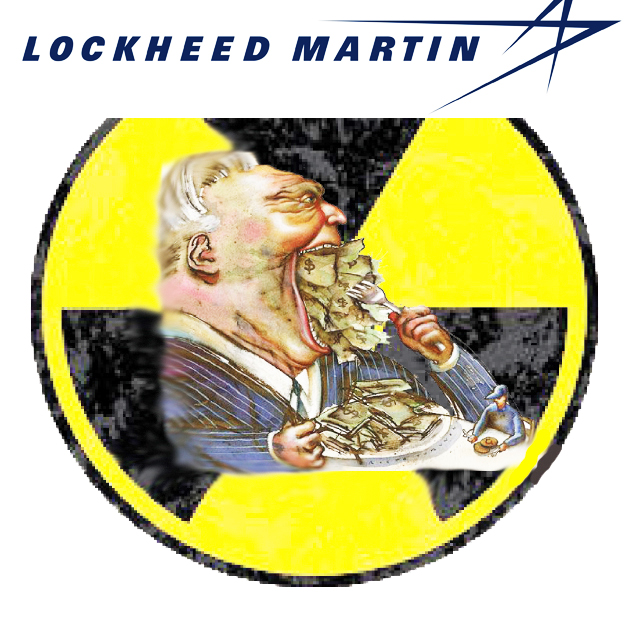
There is a remarkable “revolving door” of top people between Australian government and Defence Department roles and the world’s no 1 weapons-maker
MICHELLE FAHY, JUN 19, 2024
Global weapons giant Lockheed Martin – which has deleted from its website details about Australia’s key role in building F-35 fighter jets – has long had deep ties to the Australian government, investigations show.
Analysis shows a remarkable “revolving door” of people between top government and Defence Department roles and the world’s largest weapons-maker, whose F-35 fighter jets Israel is using to bomb Gaza.
The revolving door between government and corporations is well documented as a factor helping to undermine democracy.
In 2022, Lockheed Martin’s total global revenue was US$66 billion, with 90 per cent of it (US$59.4 billion) from the sale of arms.
Some of Australia’s most senior government officials, military officers, and Defence Department staff have been appointed to Lockheed Martin Australia’s board or have served as its chief executive or in other positions in recent years.
Constantly revolving door
Lockheed’s current CEO for Australia and New Zealand, retired Air Marshal Warren McDonald, officially joined the weapons maker’s ANZ leadership team as chief executive elect on July 1, 2021 having exited his 41-year career in the Royal Australian Air Force (RAAF) just seven months earlier. McDonald formally commenced as Lockheed’s local CEO in November 2021.
McDonald was deputy chief of the RAAF until mid-2017 when he was promoted into a new role as the Defence Force’s inaugural Chief of Joint Capabilities, a group comprising space, cyber and the defence networks tasked with preparing space and cyber power, and logistics capabilities, to serve the modern integrated defence force.
When later asked what had interested him about joining Lockheed Martin, McDonald said: “From all domains – space to the sea floor – Lockheed Martin has in its hands the combat capability of the Defence Force”…………………………………………………………………………more https://undueinfluence.substack.com/p/lockheed-martin-australian-government?utm_source=post-email-title&publication_id=297295&post_id=145632377&utm_campaign=email-post-title&isFreemail=true&r=ln98x&triedRedirect=true&utm_medium=email
Peter Dutton reveals seven sites for proposed nuclear power plants
By political reporter Tom Crowley and national regional affairs reporter Jane Norman, 19 June 24 https://www.abc.net.au/news/2024-06-19/dutton-reveals-seven-sites-for-proposed-nuclear-power-plants/103995310—
Peter Dutton has told his Coalition colleagues he will go to the next election promising to build seven nuclear power stations.
Mr Dutton will promise the first two sites can be operational between 2035 and 2037, several years earlier than the timeframe the CSIRO and other experts believe is feasible.
As had been previously flagged, the stations are all on retiring or retired coal sites.
The seven sites are:
- Tarong in Queensland, north-west of Brisbane
- Callide in Queensland, near Gladstone
- Liddel in NSW, in the Hunter Valley
- Mount Piper in NSW, near Lithgow
- Port Augusta in SA
- Loy Yang in Victoria, in the Latrobe Valley
- Muja in WA, near Collie
Five of the seven are in Coalition seats: Muja in Rick Wilson’s seat of O’Connor, Loy Yang in Darren Chester’s seat of Gippsland, Port Augusta in Rowan Ramsey’s seat of Grey, Callide in Colin Boyce’s seat of Flynn and Tarong in Nationals leader David Littleproud’s seat of Maranoa.
Mount Piper is in the seat of Calare, held by independent Andrew Gee who was elected as a Nationals MP in 2022 but quit the party.
Liddel is in only site in a Labor seat, the seat of Hunter, held by Labor’s Dan Repacholi.
Further details are expected later this morning, including about how much government funding would be required and whether the proposal is for large-scale nuclear reactors, small modular nuclear reactors, or a combination.
The Coalition had been promising a nuclear policy, including specific sites, for several months amid expert concerns over the cost and timeframe.
Last week, Mr Dutton also revealed the Coalition would campaign against the Labor government’s legislated target to reduce emissions by 43 per cent by 2030, and would not outline a 2030 emissions reduction target of its own before the election.
Coalition energy spokesperson Ted O’Brien and Nationals leader Mr Littleproud will address an energy conference held by The Australian today.
This morning, Treasurer Jim Chalmers will tell that conference the Coalition’s nuclear plan is “the dumbest policy ever put forward by a major party” and will seek to contrast the Coalition’s plan, likely to require significant public funding, with Labor’s plan to encourage private investment in renewables and gas.
1 This month
15 April – Zoom –Nuclear Power is Not the Solution
Apr 15, 2026 01:00 AM in Canberra, Melbourne, Sydney

Join the International Physicians for the Prevention of Nuclear War (IPPNW) on Tuesday, April 14th for a timely webinar exploring the risks associated with nuclear power and challenging the myth that it offers a simple, safe, carbon-free solution to the climate crisis

of the week – Australians for War Powers Reform (AWPR)
To see nuclear-related stories in greater depth and intensity
 Antinuclear