Australian Futures: Bringing AUKUS Out of Stealth Mode, and the true financial costs

June 21, 2024, by: The AIM Network, By Denis Bright
With both sides of the mainstream Australian political divide supporting the AUKUS deal, debate about the merits of this commitment by Scott Morrison has largely gone into recess.
As the third anniversary of Scott Morrison’s announcement of the AUKUS deal on 16 September 2021 approaches, there is growing confidence in the defence establishment that Australians have accepted the need for nuclear-powered submarines. The Defence Special Supplement in The Australian (28 May 2024) is a sign of this confidence. Multinational defence companies have lined up to fund advertisements which demonstrated their patriotic commitment to AUKUS with the support of the South Australia Government.
Each of the defence companies listed maintains a profitable involvement in both military and civilian projects. The KBR engineering company of Houston emphasizes a benign involvement in Australian civilian engineering projects like the Snowy Mountains upgrade and the Adelaide to Darwin Railway. This company is more deeply involved in the military sector globally.
Readers with access to the Defence Supplement can undertake their own research to uncover the ownership and activities of each of the British and US companies listed in the supplement. Here is a sample of the defence outreach from KPR Engineering:
KBR’s Defense Systems Engineering Business Unit goes beyond providing full spectrum engineering and technical solutions across the lifecycle of DoD military systems on land, at sea, in the air, and in space. KBR differentiates itself in the industry by integrating emerging technologies with platform experience to deliver increased value to US DoD and our allies.
Advertising in combination with sensational eyewitness news reporting works in eroding resistance to AUKUS. The Lowy Institute has monitored quite favourable public support for AUKUS arrangements:
Expect concerns about AUKUS to resurface in the future as the cost burdens increase and the encirclement of China by the US Global Alliance takes its toll on longer-term trade and investment relationships between Australia and China. Strategic mishaps are always possible as surface vessels and submarines compete for space in the South China Sea, the Taiwan Strait and the East China Sea. Sabre rattling over uninhabited rock outcrops and remote islands has continued for a couple of decades over rival claims about freedom of navigation. Fortunately. There have been no major mishaps.
Ironically, the US has not ratified the UN’s Freedom of Navigation conventions from the 1980s. Its strategic policies seek alternatives to Chinese trade and investment links with countries across the US Global Alliance as an afford to the peace outreach of China:
The costs of the AUKUS extend well beyond the financial and strategic costs of future naval hardware. Australia’s support for the naval encirclement of our best trading partnership will have an unknown impact on our own regional economic diplomacy. Australia’s Future Fund Chief Executive Dr Raphael Arndt dared to warn that global strategic tensions had intruded into financial decision-making and risk assessments (AFR Weekend 15 June 2024). The longer-term impact on Australian trade and investment with China is still a matter for speculation.
Financial Costs of AUKUS
According to Al Jazeera News (11 June 2022), the Albanese government completed a final payment to France of approximately $850 million for breach of contract over the abandonment of the purchase of twelve Attack-class submarines from Naval Group. Despite cost increases and construction delays, delivery of the diesel-electric submarines should have commenced in the late 2020s at a cost that was a fraction of the AUKUS estimates.
The costs of the AUKUS deal are less transparent. Construction costs alone extending over 30 years were initially set at up to $368 billion (AFR 17 March 2023). The extended delivery dates are a cause for concern. US and British supplied nuclear-powered (SSN) submarines might be deployed here in the late 2020s. At least three Virginia class submarines will be built for Australia with a new class of British submarines arriving in the late 2030s before Australian built SSNs come online in the 2040s.
Strategic Risks
Hopefully, the strategic risks of maintaining a new SSN fleet were considered prior to the AUKUS announcement by Scott Morrison on 16 September 2021. How could this have been achieved competently with a critical review from only three cabinet ministers?
Media concerns should have been raised after Scott Morrison claimed in the 7.30 Report interview with Sarah Ferguson that discussions on the AUKUS alternatives were made with just two other ministers at a time when he held multiple ministerial portfolios with the approval of the Australian Governor General between March 2020 and the election in 2022 (14 March 2023).
Before attending the G-7 Summit in Cornwall as a specially invited guest of the Summit Chair Boris Johnson, Scott Morrison had been sworn into the portfolios of Health, Finance, Industry, Science, Energy and Resources, Home Affairs and Treasury. The 47th G-7 Summit convened a month after Scott Morrison’s last two ministerial appointments. Perhaps Boris Johnson could be quizzed on this issue. Both Boris Johnson and Scott Morrison met in person at the G7 Summit in Cornwall (11-13 June 2021). It is logical for them to have discussed the emergent AUKUS deal which was hardly the brainchild of Scott Morrison as claimed by Sky News (27 February 2024).
New SSN submarines place at risk our currently favourable economic diplomacy with China. There are hazards for extended operations in stealth mode in disputed waters. Readers can always investigate the risks of accidental collisions, mechanical malfunction, radioactive hazards and psychological stress on crew members.
Even in friendly waters off Hawaii, the USS Greeneville (SSN-772) surfaced too close to a Japanese fishery high school training ship Ehime Maru. It sank with the loss of nine people on 9 February 2001.
A show of force to diffuse a territorial dispute is an archaic concept. Such gimmicks belong to the pre-1914 era. Both Britain and the US have a long history of involving middle powers in bolstering their strategic outreach…………………………………………………………………………………………………………………………
Both sides of Australian mainstream politics want to hoist those imperial umbrellas at great financial and strategic costs to future generations. Continuing to quiz political insiders about the consequences of their strategic and diplomatic policies is imperative in these troubled times. Asking questions should be imperative for all political parties. https://theaimn.com/australian-futures-bringing-aukus-out-of-stealth-mode/
Ziggy Switkowski and another big nuclear back-flip
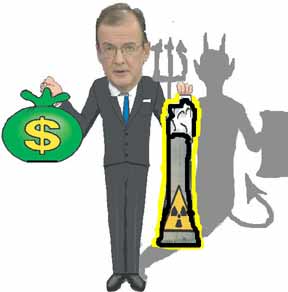
Ziggy 1.0 said in 2009 that the construction cost of a one gigawatt (GW) power reactor in Australia would be A$4-6 billion.
Ziggy 1.0 wasn’t wrong by 4-5 percent, or 40-50 percent. He was out by 400-500 percent. And yet he still gets trotted out in the mainstream media as a credible commentator on nuclear issues. Go figure.
Jim Green, Jun 21, 2024, https://reneweconomy.com.au/ziggy-switkowski-and-another-big-nuclear-back-flip/
Dr Ziggy Switkowski, best known as a former Telstra CEO, less well known as a former oil and gas company director, is a nuclear physicist by training. Wearing his nuclear hat, he was appointed by then prime minister John Howard to lead the 2006 Uranium Mining, Processing and Nuclear Power Review (UMPNER) inquiry.
The UMPNER inquiry didn’t inquire. The panel was comprised entirely of “people who want nuclear power by Tuesday” according to the late comedian John Clarke. Its report was predictably biased and misleading.
Howard evidently decided that he was pushing too hard and too fast. The UMPNER panel was required to finish its report in great haste in late 2006 and the Coalition tried to run dead on the nuclear issue in the lead up to the November 2007 federal election.
However, the Coalition’s political opponents – including Anthony Albanese – were more than happy to draw voters’ attention to the Coalition’s unpopular nuclear power plans. During the election campaign at least 22 Coalition candidates publicly distanced themselves from the government’s policy. Howard lost his seat and the Coalition was defeated. The nuclear power policy was ditched immediately after the election. Past as prologue, perhaps.
Ziggy 2.0
In recent years we’ve had Ziggy 2.0. To his credit, he reassessed his views in light of the cost blowouts with reactor projects and the large reductions in the cost of renewable energy sources.
He said in 2018 that “the window for gigawatt-scale nuclear has closed” and he noted that nuclear power is no longer cheaper than renewables, with costs rapidly shifting in favour of renewables.
Ziggy 2.0 noted in his evidence to the 2019 federal nuclear inquiry that “nuclear power has got more expensive, rather than less expensive,” and that there is “no coherent business case to finance an Australian nuclear industry.”
He added that no-one knows how a network of small modular reactors (SMRs) might work in Australia because no such network exists “anywhere in the world at the moment.”
Ziggy 2.0 noted the “non-negligible” risk of a “catastrophic failing within a nuclear system”. He acknowledged the difficulty of managing high-level nuclear waste from nuclear power plants, particularly in light of the failure of successive Australian governments to resolve the long-term management of low- and intermediate-level waste.
Ziggy 3.0
Now we have Ziggy 3.0, who sounds a lot like Ziggy 1.0. Peter Dutton and shadow energy minister Ted O’Brien “are as well informed on things nuclear as any group I’ve talked to in the last 20 years in Australia,” Ziggy 3.0 says.
Just about everything Dutton and O’Brien say about nuclear power is demonstrably false. Only the ill-informed could possibly claim they are well informed.
Ziggy 3.0 is spruiking the next generation of nuclear plants. Perhaps he’s talking about non-existent SMRs, or failed fast breeder technology, or a variety of other failed technologies now being dressed up as ‘advanced’ or ‘Generation IV’ concepts.
Who knows what he has in mind, and there’s no reason anyone should care expect that he has, once again, assumed the role of a prominent nuclear cheerleader.
“I think it’s unreasonable for anybody to expect the opposition leader to come out with a fully documented and costed plan at this stage,” Switkowski says.
But why is that so hard? O’Brien chaired a 2019 parliamentary inquiry into nuclear power. Coalition MPs initiated and participated in a 2022/23 parliamentary inquiry. And they have a mountain of other research to draw from.
Baseload
According to the Sydney Morning Herald, Switkowski now says “the cost curve for solar and wind has moved aggressively down” and he praises CSIRO for its work on the higher relative cost of nuclear power compared to renewables.
But Ziggy 3.0 goes on to say that “you need to have nuclear as well for baseload power”. Seriously? Nuclear power as a complement to renewables as we head to, or towards, 82 per cent renewable supply to the National Electricity Market by 2030? That’s nuts.
Perhaps he thinks non-existent SMRs can integrate well with renewables? Does he support the Coalition’s plan to expand and prolong reliance on fossil fuels until such time as SMRs i) exist anywhere in the world and ii) are operating in Australia?
Apart from the practical constraints (not least the fact that they don’t exist), the economics of SMRs would go from bad to worse if using them to complement renewables. According to the Institute for Energy Economics and Financial Analysis, power from an SMR with a utilisation factor of 25% would cost around A$600 per megawatt-hour (MWh).
Likewise, a recent article co-authored by Steven Hamilton – assistant professor of economics at George Washington University and visiting fellow at the Tax and Transfer Policy Institute at the ANU – states:
“Opposition Leader Peter Dutton said: “Labor sees nuclear power as a competitor to renewables. The Coalition sees nuclear power as a companion to renewables”.
“The trouble is that nuclear is a terrible companion to renewables. The defining characteristic of being “compatible” with renewables is the ability to scale up and down as needed to “firm” renewables.
“Even if we don’t build a single new wind farm, in order to replace coal in firming renewables, nuclear would need to operate at around 60 per cent average utilisation (like coal today) to keep capacity in reserve for peak demand. This alone would push the cost of nuclear beyond $225/MWh. To replace gas as well, the cost skyrockets beyond $340/MWh.”
Making sense of Ziggy 3.0
Ziggy 1.0 said in 2009 that the construction cost of a one gigawatt (GW) power reactor in Australia would be A$4-6 billion. Compare that to the real-world experience in the US (A$23.4 billion / GW), the UK (A$27.2 billion / GW) or France (A$19.4 billion / GW).
Ziggy 1.0 wasn’t wrong by 4-5 percent, or 40-50 percent. He was out by 400-500 percent. And yet he still gets trotted out in the mainstream media as a credible commentator on nuclear issues. Go figure.
Dr. Jim Green is the national nuclear campaigner with Friends of the Earth Australia and co-author of the ACF’s new report, ‘Power Games: Assessing coal to nuclear proposals in Australia’.
1 This month

of the week – Australians for War Powers Reform (AWPR)
To see nuclear-related stories in greater depth and intensity
 Antinuclear