Nuclear more costly and could ‘sound the death knell’ for Australia’s decarbonisation efforts, report says

Peter Hannam Economics correspondent, Guardian, Fri 28 Jun 2024
A nuclear-powered Australian economy would result in higher-cost electricity and would “sound the death knell” for decarbonisation efforts if it distracts from renewables investment, a report by Bloomberg New Energy Finance (BNEF) argues.
The report comes as ANZ forecast September quarter power prices will dive as much as 30% once government rebates kick in. A separate review by the market watchdog has found household energy bills were 14% lower because of last year’s rebates.
BNEF said the federal opposition’s plan to build nuclear power stations on seven sites required “a slow and challenging” effort to overturn existing bans in at least three states, for starters.
Even if they succeeded, the levelised cost of electricity – a standard industry measure – would be far higher for nuclear power than renewables. Taking existing nuclear industries in western nations into account, their cost would still be “at least four times greater than the average” for Australian wind and solar plants firmed up with storage today, Bloomberg said.
“Nuclear could play a valuable, if expensive, role in Australia’s future power mix,” the report said. “However, if the debate serves as a distraction from scaling-up policy support for renewable energy investment, it will sound the death knell for its decarbonisation ambitions – the only reason for Australia to consider going nuclear in the first place.”
Bloomberg’s analysis complements CSIRO’s GenCost report that also found nuclear energy to be far more costly than zero-carbon alternatives. Australia’s lack of experience with the industry would result in a learning “premium” that would double the price of the first nuclear plant, according to the CSIRO.
Bloomberg also found that assuming the opposition’s seven plants had a generation capacity of 14 gigawatts, they would supply only a fraction of the total market.
If governments tried to rely on inflexible generators – whether coal-fired or nuclear – as renewables increased, they would have to resort to subsidies and other market interventions at a cost to taxpayers, Bloomberg said.
“This report speaks for itself,” the energy minister, Chris Bowen, said. “It’s another example of experts confirming that nuclear energy is too slow, too expensive and too risky for Australia.
“The Albanese government’s plan is the only plan backed by experts to deliver clean, cheap, renewable power available 24/7, and get us to net zero by 2050.”
Guardian Australia sought comment from the opposition energy spokesperson, Ted O’Brien.
ANZ, meanwhile, expects residential electricity prices to begin to see big falls starting from next month as federal and state rebates take effect.
@ANZ_Research predicts electricity prices in the September quarter could fall by 30% as fresh rebates kick in. That would lop a large 0.7 percentage points off the inflation rate (to be recovered later unless the rebates continue). pic.twitter.com/fjHWP8duEn— @phannam@mastodon.green (@p_hannam) June 27, 2024
From 1 July, all households in Queensland get a $1,000 rebate, those in Western Australia the first of two $200 rebates and nationally the first of four $75 rebates from the federal government will arrive.
In the September quarter, ANZ estimates consumer prices will fall 0.7 percentage points, temporarily dampening overall inflation – assuming those rebates aren’t extended again.
The Australian Competition and Consumer Commission will also release its annual market inquiry report on Friday. It showed that without the federal government’s energy rebates in the May 2023 budget the median residential energy bill would have been 14%, or $46.64, higher across all regions…………………………………….more https://www.theguardian.com/australia-news/article/2024/jun/28/nuclear-energy-report-australia-expensive-decarbonisation-renewables
Small Modular Nuclear Reactors cost concerns challenge industry optimism
Reuters, Paul Day, Jun 27, 2024
Concerns over the potential cost of small modular reactors (SMRs) and the electricity they produce continue to cast a shadow over growing optimism for new nuclear.
Proponents say that the recent faltering history of large nuclear projects missing schedules and running over budget are just teething problems for a new industry in the midst of a difficult economic climate.
However, critics claim it as proof that nuclear is not economically viable at all, and it will take too long faced with pressing climate issues.
There is little doubt that new nuclear will, at least initially, be more expensive to develop, build, and run than many are hoping.
New Generation IV reactors, such as SMRs, are likely to produce hidden costs inherent in the development of first-of-a-kind technology, while high commodity and building material prices, stubbornly high inflation, and interest rates at levels not seen for decades are adding to mounting expenses for the new developers.
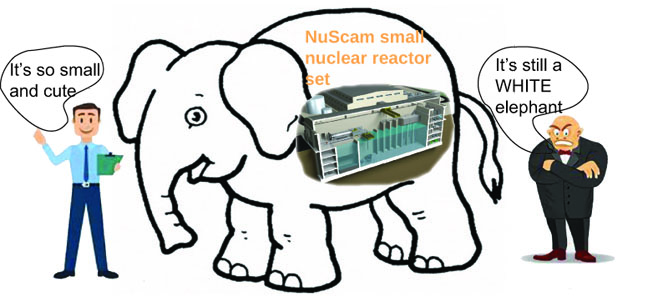
NuScale’s cancelled deal to supply its SMRs to a consortium of electricity cooperatives due to rising power price estimates prompted The Breakthrough Institute’s Director for Nuclear Energy Innovation Adam Stein to write that advanced nuclear energy was in trouble.

Speaking during an event at the American Nuclear Society (ANS) 2024 Annual Conference in June, Stein said nothing had changed to fix the fundamental challenges nuclear faces since he wrote that in November, but there was a greater sense of urgency.
“Commodity prices have come down slightly, though interest rates are largely still the same and those are risks, or uncertainties, that are outside of the developer’s control,” Stein said during an event at the American Nuclear Society (ANS) 2024 Annual Conference.
“Until those can be considered a project risk, instead of unknown uncertainties, they are not going to be controlled at all and can drastically swing the price of any single project.”
Enthusiastic hype
These criticisms clash with growing enthusiasm (critics say ‘hype’) surrounding the new technology.
Twenty two countries and 120 companies at the COP28 conference in November vowed to triple global nuclear capacity by 2050, and developers are making sweeping promises about the capabilities and affordability of their latest creations, many of which will not be commercially available in North America or Europe until the early 2030s.
SMRs, defined as reactors that generate 300 MW or less, cost too much, and deployment is too far out for them to be a useful tool to transition from fossil fuels in the coming 10-15 years, according to a recent study by the Institute for Energy Economics and Financial Analysis (IEEFA).
“SMRs are not going to be helpful in the transition. They’re not going to be here quick enough. They’re not going to be economic enough. And we really don’t have time to wait,” says co-author of the study Dennis Wamsted.
Existing SMRs in China (Shidao Bay), Russia (floating SMR such as the Akademik Lomonosov), and in Argentina (the still under-construction CAREM) have all cost significantly more than originally planned, the IEEFA says in the study ‘Small Modular Reactors: Still too expensive, too slow, and too risky.’
Construction work on the cutting-edge CAREM project has been stalled since May due to cost-cutting measures by Argentina’s President Javier Milei, the head of National Atomic Energy Commission (CNEA) told Reuters.
The billions of dollars the U.S. and Canadian governments are pouring into nuclear power through subsidies, tax credits, and federally funded research, would be better spent on extra renewables, Wamsted says.
Some 260,000 MW of renewable energy generation, mostly solar, is expected to be added to the U.S. grid just through to 2028, the study says citing the American Clean Power Association, way before any new nuclear is expected to be plugged in.
“Federal funds to nuclear is, in our opinion, a waste of time and money,” says Wamsted.
High uncertainty…………………………………………….
https://www.reutersevents.com/nuclear/smr-cost-concerns-challenge-industry-optimism
1 This month
15 April – Zoom –Nuclear Power is Not the Solution
Apr 15, 2026 01:00 AM in Canberra, Melbourne, Sydney

Join the International Physicians for the Prevention of Nuclear War (IPPNW) on Tuesday, April 14th for a timely webinar exploring the risks associated with nuclear power and challenging the myth that it offers a simple, safe, carbon-free solution to the climate crisis

of the week – Australians for War Powers Reform (AWPR)
To see nuclear-related stories in greater depth and intensity
 Antinuclear