Dutton’s Nuclear Push

DEAR News Of The Area,
I HAVE read with interest your correspondents’ comments on the proposed nuclear power initiative championed by the Federal Opposition.
They all seem quite focused on the legitimacy of the Coalition implementing the plan.
Mr Dutton states our first nuclear power plant can be operating by the mid 2030s.
Australia’s truly independent experts in the field from the CSIRO say that the unveiling date is more likely to be closer to 2040, but only if the work starts soon.
Putting aside the massive costs, social disruption, discord, and division this intention will create, I ask your readers to consider what Australia will be like in 2040?
Peter Dutton will be 70 years of age and no doubt very much enjoying his generous Federal Parliamentary pension.
He will certainly not be around to publicly account for or justify the mess this proposal may lead us to in terms of taxpayer debt, the safe storage of nuclear waste and the estimated huge per kilowatt cost of nuclear power to the consumer.
For this so-called necessary initiative, we will be billions of dollars in debt for decades (the plan is for the nuclear power plants to be owned by taxpayers), for a contribution to our energy needs provided by all these nuclear power plants of an estimated mere four percent of total national electricity supply.
The small modular reactors this plan is partly relying upon have not even been invented yet, and there are none currently producing nuclear power anywhere in the world, a carbon copy, spin doctor creation remarkably like the often-touted ‘carbon capture technology’.
They are both half-baked thought bubbles, con jobs without supporting science and ones that are entirely unaligned with either feasibility or reality.
By 2040 it is highly likely that advances in renewable energy generation, power storage in batteries and pumped hydro, and yet to be invented technological developments in generating power from clean, green renewable energy systems, such as ‘green hydrogen’, solar and wind, will continue to grow and increasingly dominate electricity markets, providing ever cheaper forms of power that don’t burn fossil fuels and are least damaging to our planet.
There will be an abundance of cheap electricity and we simply will not need that extra four percent nuclear power.
I cannot help but feel this nuclear energy push is little more than a white elephant charade, with the real intention being to undermine, and possibly even destroy confidence in the economic investment planning and accelerating adoption of the rapidly growing sustainable energy industry, and to allow the coal and gas giants to continue to quietly peddle and profit from their enormously destructive and dirty industries.
This nuclear energy proposal is the standard political dodge, kicking the can of important energy reform a little further down the road for someone else to pick up later, a ruse that conservatives often expertly adopt to benefit existing interests.
Our country, indeed, our world, cannot afford to wait.
Your sincerely,
Martin SMITH,
Fernbrook.
Australian conservation groups slam Federal Coalition’s “nuclear fantasy” plan as “a poison pill”

Craig Duncan, South Western Times, 4 July 24 https://www.swtimes.com.au/news/south-western-times/australian-conservation-groups-slam-federal-coalitions-nuclear-fantasy-plan-as-a-poison-pill-c-15218900
Conservation groups across Australia have slammed the Federal Coalition’s nuclear plans, describing them as “a poison pill” locking the country into fossil fuels for decades to come.
Opposition Leader Peter Dutton announced the party’s nuclear plans last month, which would see a reactor built at Collie’s Muja Power Station and several other locations across the country if the Coalition returns to power at the next Federal election.
Soon after the plans were revealed, conservation groups from across the country called out the proposal.
Conservation groups across Australia have slammed the Federal Coalition’s nuclear plans, describing them as “a poison pill” locking the country into fossil fuels for decades to come.
Opposition Leader Peter Dutton announced the party’s nuclear plans last month, which would see a reactor built at Collie’s Muja Power Station and several other locations across the country if the Coalition returns to power at the next Federal election.
Soon after the plans were revealed, conservation groups from across the country called out the proposal.
The Conservation Council of WA stated nuclear was no climate solution, with campaign director Mia Pepper calling the proposal a clear plan to distract and delay real action on climate change.
Conservation groups across Australia have slammed the Federal Coalition’s nuclear plans, describing them as “a poison pill” locking the country into fossil fuels for decades to come.
Opposition Leader Peter Dutton announced the party’s nuclear plans last month, which would see a reactor built at Collie’s Muja Power Station and several other locations across the country if the Coalition returns to power at the next Federal election.
Soon after the plans were revealed, conservation groups from across the country called out the proposal.
The Conservation Council of WA stated nuclear was no climate solution, with campaign director Mia Pepper calling the proposal a clear plan to distract and delay real action on climate change.
Journalism for the curious Australian across politics, business, culture and opinion.READ NOW
“Nuclear power is expensive, slow and dangerous, and simply cannot deliver the energy needed in the time frame we have to decarbonise,” she said.
“We have cheaper, safer, cleaner alternatives that are already delivering energy to hundreds of thousands of Australians.”
Ms Pepper said all West Australians had every right to be alarmed and concerned by the plan, which she said showed a complete disregard for the Collie community’s safety and input into future energy options.
“So, if you’re promoting nuclear, you are prolonging the use of fossil fuels,” she said.
Ms O’Shanassy said nuclear power was also dramatically more costly than investment in solar or wind.
“CSIRO modelling shows nuclear power is five to 10 times more expensive to generate than solar or wind power,” she said.
“Be in no doubt that extra costs of nuclear would be passed on to electricity users.
“On environmental and economic grounds, our energy future is renewable, not radioactive.”
Also dismissing the nuclear plans was Greenpeace Australia Pacific, which also described the plan as a bad-faith tactic to prop up climate-wrecking coal, oil and gas for as long as possible.
Chief executive David Ritter said there was not a “shred of credibility” to the Federal Coalition’s claims nuclear was a climate solution in Australia.
“Australians want and need credible climate action from their elected leaders,” he said.
Conservation groups across Australia have slammed the Federal Coalition’s nuclear plans, describing them as “a poison pill” locking the country into fossil fuels for decades to come.
Opposition Leader Peter Dutton announced the party’s nuclear plans last month, which would see a reactor built at Collie’s Muja Power Station and several other locations across the country if the Coalition returns to power at the next Federal election.
Soon after the plans were revealed, conservation groups from across the country called out the proposal.
The Conservation Council of WA stated nuclear was no climate solution, with campaign director Mia Pepper calling the proposal a clear plan to distract and delay real action on climate change.
Get in front of tomorrow’s news for FREE
Journalism for the curious Australian across politics, business, culture and opinion.READ NOW
“Nuclear power is expensive, slow and dangerous, and simply cannot deliver the energy needed in the time frame we have to decarbonise,” she said.
“We have cheaper, safer, cleaner alternatives that are already delivering energy to hundreds of thousands of Australians.”
Ms Pepper said all West Australians had every right to be alarmed and concerned by the plan, which she said showed a complete disregard for the Collie community’s safety and input into future energy options.
“There is no workforce, there are huge complexities with safety and security, the need for new laws and regulators who understand them,” she said.
“We don’t have 15 years to wait for an energy option that is dirty, dangerous, thirsty and increasingly insecure in a changing climate.”
The Australian Conservation Foundation was also quick to critique the Coalition’s proposal, pointing out the significant costs associated with the development of reactors and the increased reliance on fossil fuels which would be in place during their development.
Chief executive Kelly O’Shanassy said there was no chance a nuclear power station could be built before the mid-2040s.
“So, if you’re promoting nuclear, you are prolonging the use of fossil fuels,” she said.
Ms O’Shanassy said nuclear power was also dramatically more costly than investment in solar or wind.
“CSIRO modelling shows nuclear power is five to 10 times more expensive to generate than solar or wind power,” she said.
“Be in no doubt that extra costs of nuclear would be passed on to electricity users.
“On environmental and economic grounds, our energy future is renewable, not radioactive.”
Also dismissing the nuclear plans was Greenpeace Australia Pacific, which also described the plan as a bad-faith tactic to prop up climate-wrecking coal, oil and gas for as long as possible.
Chief executive David Ritter said there was not a “shred of credibility” to the Federal Coalition’s claims nuclear was a climate solution in Australia.
“Australians want and need credible climate action from their elected leaders,” he said.
“It is impossible to take the Coalition seriously on climate while it backs a doomed-to-fail technology like nuclear, while threatening to scrap renewable projects if elected.”
Mr Ritter said Greenpeace had a long and proud history of fighting against nuclear power and would continue to challenge the technology when cleaner, safer and cheaper renewable solutions existed.
“Let’s name the Coalition’s nuclear fantasy for what it is,” he said.
“A poison pill that claims to reduce emissions but instead locks us into coal and gas for decades.”
French nuclear giant scraps SMR plans due to soaring costs, will start over
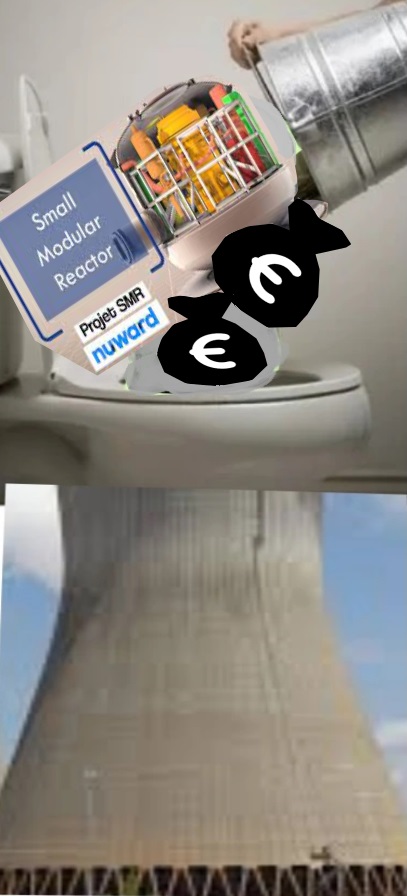
Another Small Modular Nuclear Reactor project goes down the toilet
This time it’s that great nuclear poster boy France that is facing the humiliation and embarrassment of wasting billions on “New Nuclear”
Last time it was the USA with the NuScale fiasco
Giles Parkinson Jul 2, 2024, https://reneweconomy.com.au/french-nuclear-giant-scraps-smr-plans-due-to-soaring-costs-will-start-over/
The French nuclear giant EdF, the government owned company that manages the country’s vast fleet of nuclear power stations, has reportedly scrapped its plans to develop a new design for small nuclear reactors because of fears of soaring costs.
EdF, which is now fully government owned after facing potential bankruptcy due to delays and massive cost over-runs at its latest generation large scale nuclear plants, had reportedly been working on a new design for SMRs for the last four years.
The French investigative outlet L’Informé reported on Monday that EdF had scrapped its new internal SMR design – dubbed Nuward – because of engineering problems and cost overruns. It cited company sources as saying EdF would now partner with other companies to use “simpler” technologies in an attempt to avoid delays and budget overruns.
Reuters confirmed the development, citing an email from a company spokesman that confirmed the program had been abandoned after the basic design had been completed.
“The reorientation consists of developing a design built exclusively from proven technological bricks. It will offer better conditions for success by facilitating technical feasibility,” an EDF spokesperson told Reuters via email.
It’s the latest problem to hit SMR technology, which the federal Coalition wants to roll out in Australia – starting with reactors in South Australia and Western Australia – as part of its goal of keeping coal plants open, building more gas, stopping renewables and putting clean energy hopes on nuclear.
The federal Coalition says it can have the first SMR up and running by 2035, but no SMRs have been built in the western world, and none have even got a licence to be built.
The closest to reach that landmark, the US-based NuScale, abandoned its plans after massive cost overruns and push back from its customers, who refused to pay high prices.
The EdF plans appears to have run into similar problems. Its potential customers, the European energy companies Vattenfall, CEZ and Fortum, wanted guarantees that the SMRs would not have a levelised cost of energy of more than €100 a megawatt hour ($161/MWh) and EdF decided that that was not possible.
It is now not expected to produce its first SMR until the 2030s, at the earliest – even though France is desperate for new reactors to replace its ageing power plants. Because of the costs, it expects to significantly reduce the share of nuclear in its energy mix as it focuses more on large scale solar and offshore wind.
EdF has run into similar problems with its large scale technology. The Flammanville project in France was announced in 2004 with a budget of €3 billion and a deadline of 2012. It is still not in operation and its costs have soared at least four-fold to €13.2 billion.
The Hinkley C project in the UK has been an even bigger disaster. EdF had promised in 2007 that it would be “cooking Christmas turkeys” in England by 2017, at a cost of £9 billion, but is already delayed to 2031 with a spiralling cost of £48 billion when inflation is taken into account, or $A93 billion.
EdF announced another impairment charge of €12.9 billion ($A20.7 billion) from Hinkley earlier this year. It had to be bailed out by the government last year after suffering record losses in 2022 caused by outages at nearly half of its nuclear power plants due to maintenance at its reactors across France.
Tim Buckley, from Climate and Energy Finance, seized on the news and called on Opposition leader Peter Dutton and energy spokesman Ted O’Brien to provide more details of their nuclear plans beyond the one page press release they released last month.
“Come’on guys, how naive do you take the average Australian voter for?” Buckley wrote.
“In your alternate fact world, who do you think will pay for the permanent around 50% increase in Australian energy prices for consumers? Are you really intent on destroying the international competitiveness of Australian industry purely in the service of your fossil fuel funders?”
Numerous cost assessments, particularly by the CSIRO and the Australian Energy Market Operator, have put the cost of nuclear at more than double the cost of wind, solar and storage. But they also point out that first of their kind projects in Australia could cost double that amount, and SMR technology is likely to be even more expensive.
The Coalition has attacked those reports, and the reputation of the CSIRO and AEMO – in concert with a group of so-called “think tanks” and the Murdoch media – but the latest polling from Essential Media suggests that the public might not be buying it.
The poll found that votes believe renewables are the most desirable (59 per cent) and the best for the environment (55 per cent). Nuclear energy was regarded by more as the most expensive (38 per cent versus 35 per cent for renewables).
An overwhelming majority of people aged 18 to 54 thought Peter Dutton’s nuclear energy plan “is just an attempt to extend the life of gas and limit investment in large-scale renewables”, while a majority of those aged over 55 thought the nuclear plan is serious and should be part of the future energy mix, Essential Media’s Peter Lewis wrote.
The federal Coalition has argued that nuclear might be expensive to build, but will deliver cheaper power to consumers. It has not explained how, but it has said that its reactors would be government owned, suggesting that – like France and Ontario – the costs would be borne by taxpayers and the supply of power to customers would be heavily subsidised.
Giles Parkinson is founder and editor of Renew Economy, and is also the founder of One Step Off The Grid and founder/editor of the EV-focused The Driven. He is the co-host of the weekly Energy Insiders Podcast. Giles has been a journalist for more than 40 years and is a former business and deputy editor of the Australian Financial Review. You can find him on LinkedIn and on Twitter.
Coalition nuclear policy leaves traditional owners of Kakadu uranium mine worried

ABC News, By Jane Bardon, 3 July 24
In short:
Kakadu traditional owners are worried the Coalition’s nuclear policy will drive demand for uranium mining on their land at Jabiluka.
Energy Resources of Australia (ERA) and traditional owners have asked the NT and federal governments to decide whether to extend the Jabiluka uranium mining lease.
What’s next?
ERA’s majority shareholder Rio Tinto is worried the Jabiluka lease stoush could drive up the costs of rehabilitating its closed Ranger Uranium Mine.
Mirarr traditional owner Corben Mudjandi is desperate for his spectacular land at Jabiluka to be incorporated into Kakadu National Park, which surrounds it, rather than mined for its uranium.
“Its sacred to us, and it’s a piece of human history, 65,000 years, we want Jabiluka not mined; we want to show people the beauty of nature, and what we call home,” he said.
Mr Mudjandi is worried the federal Coalition’s plan to open nuclear plants if it wins government could drive demand for Jabiluka’s uranium.
The Mirarr are also concerned that almost a year after Energy Resources of Australia (ERA) applied to extend its uranium mining lease over Jabiluka for another decade, the Northern Territory and federal governments have not yet decided whether to reject or approve it.
ERA’s current lease expires on August 11.
“The government are following process, but of course we hope they don’t support the application extension,” Mr Mudjandi said.
Senior Mirarr traditional owner Yvonne Margarula said she was worried that although ERA’s Jabiluka lease agreement enabled traditional owners to veto mining, they felt under constant pressure to change their minds.
“The mining companies might come back asking again and again, it’s annoying them asking more, enough is enough, so I hope the government is going to help us,” she said………………………………..
……………………….Professor of Archaeology at Griffith University Lynley Wallis said the Mirarr had a strong case for Jabiluka to be incorporated into Kakadu instead of mined, because of its 65,000 year-old-evidence of occupation.
“Archaeologically the escarpment that’s encapsulated within the Jabiluka mineral lease is unparalleled,” she said.
“There are hundreds of rock shelter sites, almost all of which have paintings in them, of which are incredibly well preserved, and then there are amazing objects that have been cached in those rock shelters, ceremonial wooden objects, grinding stones, spear points and scrapers.
………. the lease agreement includes a traditional owner right to veto mining……………
Lynley Wallis said the Jabiluka mining lease did not provide adequate protection.
“While a company holds a mineral lease over Jabiluka it is possible for them to apply to develop the resources in that land, and any development would pose imminent threat to the cultural sites that are within the lease,” she said.
While some of ERA’s minority shareholders want to keep the Jabiluka lease, which they estimate is worth $50 billion, its majority shareholder Rio Tinto does not.
Jabiluka is ERA’s only potentially valuable asset, but Rio Tinto estimates the rehabilitation costs would be much more than potential profits.
The cost of ERA’s rehabilitation of its neighbouring closed Ranger Uranium Mine on the Mirarr’s land has now blown out to more than $2.5 billion.
ERA is expected to run out of funds by September, and Rio Tinto has promised to fund Ranger’s rehabilitation.
But the ABC understands Rio Tinto is concerned ERA’s application to extend the Jabiluka lease is worrying Mirarr traditional owners so much, that they could delay further agreements needed on how the Ranger mine rehabilitation continues, adding to the project’s soaring costs.
Dave Sweeney, the Australian Conversation Foundation’s nuclear policy spokesman, has called on both governments to end the prospect of mining at Jabiluka.
“ERA are not making any money,” he said.
“They should be focused on getting the assured financial capacity on delivering on their legal obligations rather than appeasing minority shareholders in a fanciful push for a project that will never happen, but increases pressure on traditional owners who’ve had too much for too long.”
A spokesman for the federal Resources Minister Madeleine King said it was up to the NT government whether to renew ERA’s lease.
The spokesman said when Ms King provides her advice to NT government, she would “consider information about Jabiluka in good faith and with appropriate consultation”.
The NT Mining Minister Mark Monaghan would not explain why his government had not made a decision on the lease.
“We’re not delaying the decision, the decision is going through what is a process,” he said.
NT Opposition leader Lia Finocchiaro has backed ERA’s argument on why the lease should continue.
“Importantly that maintains the veto rights for the Mirarr people which we believe continues to be a very important right for them to have,” she said. worried
The nuclear and renewable myths that mainstream media can’t be bothered challenging

Mark Diesendorf, Jul 4, 2024, https://reneweconomy.com.au/the-nuclear-and-renewable-myths-that-mainstream-media-cant-be-bothered-challenging/
Nuclear energy proponents are attempting to discredit renewable energy and promote nuclear energy and fossil gas in its place. This article refutes several myths they are disseminating that are receiving little or no challenge in the mainstream media.
Myth: Renewables cannot supply 100% electricity
Denmark, South Australia and Scotland already obtain 88, 74 and 62 per cent of their respective annual electricity generations from renewables, mostly wind. Scotland actually supplies 113 per cent of its electricity consumption from renewables; the difference between its generation and consumption is exported by transmission line.
All three jurisdictions have achieved this with relatively small amounts of hydroelectricity, zero in South Australia. Given the political will, all three could reach 100% net renewables generation by 2030, as indeed two northern states of Germany have already done. The ‘net’ means that they trade some electricity with neighbours but on average will be at 100% renewables.
Computer simulations by several research groups – using real hourly wind, solar and demand data spanning several years – show that the Australian electricity system could be run entirely on renewable energy, with the main contributions coming from solar and wind. System reliability for 100% renewables will be maintained by a combination of storage, building excess generating capacity for wind and solar (which is cheap), key transmission links, and demand management encouraged by transparent pricing.
Storage to fill infrequent troughs in generation from the variable renewable sources will comprise existing hydro, pumped hydro (mostly small-scale and off-river), and batteries. Geographic dispersion of renewables will also assist managing the variability of wind and solar. For the possibility of rare, extended periods of Dunkelflaute (literally ‘dark doldrums’), gas turbines with stores of biofuels or green hydrogen could be kept in reserve as insurance.
Myth: Gas can fill the gap until nuclear is constructed
As a fuel for electricity generation, fossil gas in eastern Australia is many times more expensive per kilowatt-hour than coal. It is only used for fuelling gas turbines for meeting the peaks in demand and helping to fill troughs. For this purpose, it contributes about 5% of Australia’s annual electricity generation. But, as storage expands, fossil gas will become redundant in the electricity system.
The fact that baseload gas-fired electricity continues temporarily in Western Australia and South Australia is the result of peculiar histories that will not be repeated. Unlike the eastern states, WA has a Domestic Gas Reservation Policy that insulates customers from the high export prices of gas.
However, most new gas supplies would have to come from high-cost unconventional sources. South Australia’s ancient, struggling, baseload, gas-fired power station, Torrens Island, produces expensive electricity. It will be closed in 2026 and replaced with renewables and batteries.
Myth: Nuclear energy can co-exist with large contributions from renewables
This myth has two refutations:
- Nuclear is too inflexible in operation to be a good partner for variable wind and solar. Its very high capital cost necessitates running it constantly, not just during periods of low sun or wind. Its output can only be ramped up and down slowly, and it’s expensive to do that.
- On current growth trends of renewables, there will be no room for nuclear energy in South Australia, Victoria or NSW. The 2022 shares of renewables in total electricity generation in each of these states were 74%, 37% and 33% respectively.
Rapid growth from these levels is likely. It’s already too late for nuclear in SA. Provided the growth of renewables is not deliberately suppressed in NSW and Victoria, these states too could reach 100% renewables before the first nuclear power station comes online.
As transportation and combustion heating will be electrified, demand for electricity could double by 2050. This might offer generating space for nuclear in the 2040s in Queensland (23% renewables in 2022) and Western Australia (20% renewables in 2022). However, the cost barrier would remain.
Myth: There is insufficient land for wind and solar
The claim by nuclear proponents that wind and solar have “vast land footprints” is misleading. Although a wind farm can span a large area, its turbines, access road and substation occupy a tiny fraction of that area, typically about 2%.
Most wind farms are built on land that was previously cleared for agriculture and are compatible with all forms of agriculture. Off-shore wind occupies no land.
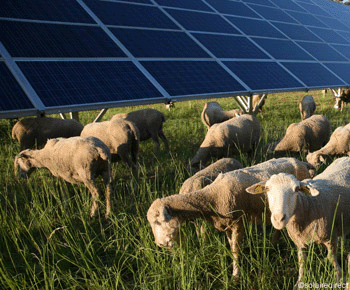
Solar farms are increasingly being built sufficiently high off the ground to allow sheep to graze beneath them, providing welcome shade. This practice, known as agrivoltaics, provides additional farm revenue, which is especially valuable during droughts. Rooftop solar occupies no land.
Myth: The longer lifetime of nuclear reactors hasn’t been taken into account
The levelised cost of energy method – used by CSIRO, AEMO, Lazard and others – is the standard way of comparing electricity generation technologies that perform similar functions.
It permits the comparison of coal, nuclear and firmed renewables. It takes account automatically of the different lifetimes of different technologies.
Myth: We need baseload power stations
The recent claim that nuclear energy is not very expensive “when we consider value” is just a variant of the old, discredited claim that we need baseload power stations, i.e. those that operate 24/7 at maximum power output for most of the time.
The renewable system, including storage, delivers the same reliability, and hence the same value, as the traditional system based on a mix of baseload and peak-load power stations.
When a nuclear power reactor breaks down, it can be useless for weeks or months. For a conventional large reactor rated at 1000 to 1600 megawatts, the impact of breakdown on electricity supply can be disastrous.
Big nuclear needs big back-up, which is expensive. Small modular reactors do not exist––not one is commercially available or likely to be in the foreseeable future.
Concluding remarks
We do not need expensive, dangerous nuclear power, or expensive, polluting fossil gas. A nuclear scenario would inevitably involve the irrational suppression of renewables.
The ban on nuclear power should be maintained because nuclear never competes in a so-called ‘free market’. Renewables – solar, wind and existing hydro – together with energy efficiency, can supply all Australia’s electricity.
Mark Diesendorf is Honorary Associate Professor at the Environment & Society Group in the School of Humanities & Languages and Faculty of Arts, Design & Architecture at UNSW. First published in Pearls and Irritations. Republished with permission of the author.
1 This month
15 April – Zoom –Nuclear Power is Not the Solution
Apr 15, 2026 01:00 AM in Canberra, Melbourne, Sydney

Join the International Physicians for the Prevention of Nuclear War (IPPNW) on Tuesday, April 14th for a timely webinar exploring the risks associated with nuclear power and challenging the myth that it offers a simple, safe, carbon-free solution to the climate crisis

of the week – Australians for War Powers Reform (AWPR)
To see nuclear-related stories in greater depth and intensity
 Antinuclear