TODAY. Media double standards – Ukraine civilian casualties versus Gaza civilian casualties
| COMMENT. I have now been informed that The missile that struck the hospital in Ukraine has been identified as a Ukrainian air defense missile. Russia did not target a hospital. This is the tragic fact about air defense missiles. They are used to prevent an enemy missile from hitting a military target, but then whether they miss or hit their targets, the debris or the missile harms civilians. The side that uses the air defense missile has chosen to put civilians at risk in order to protect military assets. And what does it tell you about the propaganda system that this damage by an air defense missile, supplied by NATO, is misrepresented as a Russian atrocity “deliberately targeting civilians”? At this stage, I do not have a definite source for this. |
I want to be clear. The bombing of civilians is an atrocity. On July 8th, Russian missile attacks targeted cities across Ukraine. That included a strike that hit the Okhmatdyt children’s hospital in Kyiv. That is an atrocity. (27 civilians, including four children, were killed, and 117, including seven children, were injured.)
On July 9th, an Israeli airstrike targeted a school-turned-refugee camp in the southern Gaza Strip, the fourth school Israel’s military has bombed in as many days. That is an atrocity. (29 Palestinians have been killed and dozens wounded )
But – contrast the media coverage of these events:
For the Western media – The attack on Ukraine was first of all – a useful news item for ramping up support at the NATO meeting, for more weapons for Ukraine -“A NATO summit is getting under way in Washington, with support for Ukraine top of the agenda after a children’s hospital was hit by a Russian missile.”
Emotional coverage. Australia’s ABC News gave an emotional account: “The offensive on Monday blasted Kyiv’s Okhmatdyt paediatric hospital, where thousands of children undergo treatment for cancer, heart problems, and severe injuries, in broad daylight. Parents holding babies walked in the street outside the hospital, dazed and sobbing after the rare daylight aerial attack. “
To be fair – the ABC also covered the Gaza atrocity, but in a less emotional way.
Over the past few years, the contrast in media coverage has been remarkable. This could be in Gaza, because the Western media are getting their information from Israeli sources, and not from Gaza. While for Ukraine, well the news is exclusively from Ukraine, and not at all from Russia.
Even the language of reporting has often shown the difference. For Ukraine, it has been reporting like ” Putin’s Russian mercenary soldiers have killed hundreds civilians ” For Gaza – “According to Hamas, hundreds of civilians died”. The inference is that in the case of Ukraine, the Putin’s brutal soldiers massacre civilians. But in Gaza, well the news from Hamas is not to be trusted anyway, and the civilian deaths were unfortunate collateral damage in the hunt for Hamas terrorists.
Again, to be fair, I think that media coverage of Gaza is improving. It would need to, as firsthand reports from Gaza cannot be ignored.
But finally – there’s a very clear dilemma for the West, in reporting the events in both countries, and the significance of these events.
Israel is designated as a major non-NATO ally . So is it OK by NATO and USA, for USA to keep supplying weapons for Israel’s attack on Gaza?
NATO is very upset about Russia’s invasion of Ukraine, so much so, that the top priority of the current NATO summit in Washington. Apparently the Israeli genocide in Gaza is not an issue.
Peter Dutton’s nuclear proliferation claims. What’s the scam?
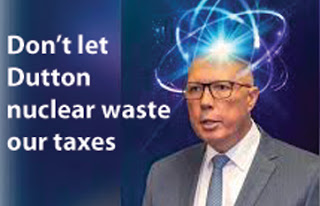
by AAP and Kim Wingerei | Jul 11, 2024 https://michaelwest.com.au/peter-duttons-nuclear-proliferation-claims-whats-the-scam/
The scam is that it is wrong. According to a fact check done by AAP, his claims are misleading at best. Five other nations in the top 20 – Germany, Italy, Turkiye, Saudi Arabia and Indonesia – do not generate nuclear energy.
Germany, Italy and Turkiye import very small amounts of electricity generated from nuclear sources, but Indonesia and Saudi Arabia don’t consume any nuclear power.
–Australia is the only top 20 economy that doesn’t generate, import or have a plan to do so.
Mr Dutton has made the claim at least four times in interviews about the coalition’s plan to build seven nuclear power stations in Australia without clarifying that he’s counting countries planning to use nuclear power among those that are actually using it.
“Nuclear energy actually is not used by three of the world’s 20 largest economies.”
Mr Dutton said nuclear power was “used by 19 of the 20 biggest economies in the world” at a June 18 press conference in NSW.
He again claimed that of the top 20 economies in the world, “Australia is the only one that doesn’t have nuclear” in a June 20 interview on Sky News.
That same day, the opposition leader spoke out about how Australia could benefit from nuclear power “as 19 of the world’s top 20 economies have done” in an ABC News Breakfast interview.
Mr Dutton again said Australia was the only one of the 20 biggest economies that “doesn’t operate” nuclear at a press conference on July 5.
Australia, Saudi Arabia and Indonesia do not generate or use nuclear power for electricity.
He also said Australia was the only G20 member that didn’t use or plan to use nuclear power in an ABC TV interview on April 2
The G20 is a global forum for countries with large economies. Despite its name, the G20 includes only 19 nations, plus the African Union and the European Union. Spain is invited to the G20 as a permanent guest.
It’s unclear if Mr Dutton is referring to the G20 countries plus Spain, or the 20 largest nations by gross domestic product, as he’s used both interchangeably.
However, AAP FactCheck has analysed the former because the nations that don’t generate nuclear power and the nations that only import small amounts of it are exactly the same for both groupings, as per World Bank 2023 GDP data.
Fourteen G20 countries operate nuclear power plants: Argentina, Brazil, Canada, China, France, India, Japan, Mexico, Russia, South Africa, South Korea, Spain, the UK and the US.
Three G20 nations that don’t generate nuclear power but import small amounts are Germany, Italy and Turkiye. That year, about 0.5 per cent of the electricity consumed there was imported from France, which generates about two-thirds of its electricity from nuclear sources.
Italy closed its last reactors in 1990. Today, about six percent of its electricity consumption is imported nuclear power.
The country effectively banned nuclear power in 2011, but the current government wants to restart it.
Turkiye is building a plant that could start generating electricity from 2025. The country is also planning to build two other nuclear plants.
In 2022, the country imported a tiny amount of the electricity it consumed, including 0.8 per cent from Bulgaria, which generates about 35 per cent of its electricity from nuclear sources.
Therefore, a fraction of Turkiye’s electricity consumption could be produced from nuclear – likely less than half a per cent.
The country effectively banned nuclear power in 2011, but the current government wants to restart it.
Therefore, a fraction of Turkiye’s electricity consumption could be produced from nuclear – likely less than half a per cent.
Saudi Arabia doesn’t use any nuclear energy either, but it’s taking steps towards doing so in future.
Indonesia doesn’t have any nuclear reactors but has tentative plans to build some in the coming decades.
Dr Yogi Sugiawan, a policy analyst at the Indonesian government agency responsible for developing nuclear energy policies and plans, told AAP FactCheck that his country doesn’t generate or import nuclear energy.
However, Dr Sugiawan says Indonesia’s government is considering nuclear power, with an initial plant “expected to be commissioned before 2040”.
The verdict
The claim that Australia is the only G20 nation that doesn’t use nuclear power is misleading.
Evidence and experts say six G20 countries do not generate any nuclear energy, and three of those don’t consume it either.
Misleading – The claim is accurate in parts, but information has also been presented incorrectly, out of context or omitted.
AAP FactCheck is an accredited member of the International Fact-Checking Network.
Dr Yogi Sugiawan, a policy analyst at the Indonesian government agency responsible for developing nuclear energy policies and plans, told AAP FactCheck that his country doesn’t generate or import nuclear energy.
However, Dr Sugiawan says Indonesia’s government is considering nuclear power, with an initial plant “expected to be commissioned before 2040”.
South Australia locks in federal funds to become first grid in world to reach 100 per cent net wind and solar
And to underline the difference in federal politics, the announcement was made at Port Augusta, the site of a former coal fired power station that the federal Coalition wants to turn nuclear, but which has already become a hub for green energy and green industry.
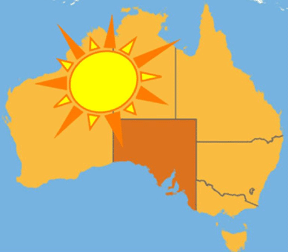
And to underline the difference in federal politics, the announcement was made at Port Augusta, the site of a former coal fired power station that the federal Coalition wants to turn nuclear, but which has already become a hub for green energy and green industry.
Giles Parkinson, Jul 10, 2024, https://reneweconomy.com.au/south-australia-locks-in-federal-funds-to-become-first-grid-in-world-to-reach-100-per-cent-net-wind-and-solar/
South Australia has locked in federal funding to ensure that it becomes the first non-hydro grid in the world to reach 100 per cent net renewables.
The funding deal – through what’s known as a Renewable Energy Transformation Agreement – means that the federal government will underwrite a minimum one gigawatt of new wind and solar generation capacity and another 400 MW (1,600 MWh) of storage – to ensure it meets its target of 100 per cent net renewables by 2027.
South Australia already leads Australia – and the world – with a wind and solar share of around 70 per cent over the last 12 months. The addition of the new capacity, along with the new Project Energy Connect transmission link from NSW, will enable it to become the first in the world to reach 1`00 per cent net renewables based around wind and solar.
That does not mean it will be powered at all times by wind and solar. But the amount of wind and solar generated and stored each year will be equivalent to what it consume each year. The state will export power at times and import at other times, and can fall pack on existing peaking gas plants to fill in the gaps.
Reaching that milestone will be a landmark for the state, and for advocates of the renewable energy transition, particularly as conservative and legacy fossil fuel interests continue to push back on the idea that a modern economy can be powered by renewables and storage.
The irony about South Australia is that the target of 100 per cent net renewables was originally committed by the state Liberal government. The state Labor government merely accelerated it from 2030 to 2027.
And to underline the difference in federal politics, the announcement was made at Port Augusta, the site of a former coal fired power station that the federal Coalition wants to turn nuclear, but which has already become a hub for green energy and green industry.
“South Australia has been a renewable energy pioneer – so much so that we recently brought forward our renewable energy target by three years, committing to ensure electricity generation can be sourced from net 100 per cent renewables by 2027,” state energy minister Tom Koutsantonis said in a statement.
“So we warmly welcome this agreement to accelerate the roll out of renewables while ensuring the reliability of the energy system.
“Our government is committed to working with the Commonwealth to establish a secured grid, supporting the power needs of South Australian households and businesses.”
South Australia has not added a new wind or solar project to the grid for around two years, although the biggest wind project in the state – the 412 MW Goyder South wind farm – is about to connect and send its first power to the grid.
Several new battery projects are also under construction – at Blyth, Hallett, Clements Gap and Templers and another, Tailem Bend, still waiting to be commissioned.
These projects will help propel the state towards 80 per cent renewables over the coming year, while the additional capacity of 1,000 MW of wind and solar, 400 MW of battery capacity (plus the minimum 200 MW included in the current CIS auction) will take it towards 100 per cent net renewables by 2027.
South Australia is also building the world’s first green hydrogen power plant at Whyalla, which will be accompanied by a 250 MW green hydrogen electrolyser and storage facilities, which will also be the world’s biggest when complete.
The state is also fielding huge number of inquiries from industry keen to source zero emissions and low cost green energy – with the local transmission company ElectraNet reporting that more than 2 gigawatts of load inquiries have been made.
Federal energy and climate minister Chris Bowen says the signing of the Renewable Energy Transformation Agreement means that South Australia is the first state to lock in the funding required to meet its targets under the federal government’s Capacity Investment Scheme.
The CIS aims to contract an additional 32GW of renewable generation and storage across the country to help it deliver most of the capacity needed to meet its 82 per cent renewable energy target by 2032.
The first tender of 6 gigawatts of new wind and solar capacity has been flooded with interest, with more than 40 GW of projects showing interest, while the first storage tender – for 600 MW, 2,400 MWh in Victoria and South Australia – was also heavily oversubscribed with some 19 GW of proposals.
Bowen says the bilateral agreements have been designed specifically to address the barriers developers, communities, and governments face in delivering renewable projects, and to replace ageing infrastructure that was built half a century ago.
“The Albanese Government is delivering the certainty and confidence the market spent a decade asking for,” Bowen said in a statement.
“The more renewable energy we have in our grid, the more downward pressure it puts on energy bills because it is the cheapest form of energy to power households and industry.
“Giving the market the confidence to build new projects is good; signing an agreement to collaborate with South Australia on practical steps to get the best out of this energy transformation for South Australian workers, communities and industry, is great.
“The Albanese Government’s Reliable Renewables Plan is the only plan supported by experts to deliver the clean, cheap, reliable and resilient energy system that Australians deserve. This is in sharp contrast to Peter Dutton’s anti-renewables nuclear plan – which remains uncosted and unexplained.”
As part of the deal, South Australia, will establish its own specific grid reliability mechanism and benchmark to be used in place of the national framework, and to be responsible for identifying and delivering new projects and technologies that will maintain reliability to that standard.
Renew Economy is seeking more information to understand what that means in practice.
For Australia – a cautionary nuclear tale from New Brunswick, Canada

New Brunswick’s nuclear-powered rate hikes, Commentary, by Janice Harvey, July 8, 2024, https://nbmediacoop.org/2024/07/08/new-brunswicks-nuclear-powered-rate-hikes/
The abject failure of this and previous governments’ energy policies is on full display these days. In the 1970s, New Brunswick was one of only three provinces that bought into the federal government’s agenda to build out a civilian nuclear power industry. Quebec has since shut its nuclear generators down, leaving only Ontario and New Brunswick as the nuclear flag-bearers. How has that worked out for us?
NB Power has come to the Energy and Utilities Board (EUB) with a request for the biggest rate hikes in the utility’s history. While the details are buried in thousands of pages of documents filed with the EUB, evidence from previous EUB hearings makes it crystal clear that the utility’s single greatest financial liability driving up power rates is the much-vaunted Point Lepreau Nuclear Generating Station.
Point Lepreau has been a financial white elephant since its construction ended up costing three times the original price tag. Its planned 30-year lifespan (over which all this extra cost was to be amortized) was cut short by premature aging of critical reactor components, prompting a decision to undergo an expensive refurbishment, which was to extend the life of the plant by a fantastical 40 years. At the time, the then-PUB determined based on the evidence that refurbishment was too big a financial risk for New Brunswickers to handle and recommended against it. The Lord government went ahead anyway.
Like the original construction, the refurbishment went way over the timeline and budget. The result has been very poor performance, a miserable 60 per cent in 2022 compared to the wildly optimistic 90 per cent capacity assumption that the EUB rejected. The costs of replacement power alone during these shutdowns have repeatedly sabotaged annual financial performance projections. Now, Point Lepreau is facing even more expensive upgrades to fix problems that were not dealt with during the refurbishment.
In short, Point Lepreau is the most unreliable and most expensive power generator on the grid, responsible for the lion’s share of NB Power’s debt. It is not going to get any better. Keeping it afloat until 2040, its new end-of-life target, is going to mean more of the same – throwing scarce money down a deep, black hole paid for by ever-rising power rates.

Despite the overwhelming evidence that New Brunswickers cannot afford nuclear power, the Higgs government has doubled down on nuclear, floating an equally fantastical proposition that the next generation of nukes – so-called small modular reactors – will quarterback New Brunswick’s climate change strategy, while an SMR export industry is expected to drive economic growth. To that end, New Brunswick taxpayers have already fronted a total of $35 million to two private nuclear upstarts, neither of which has designed or built a reactor. This is despite lots of reasons to put their rosy promises of “clean” nuclear-fueled prosperity in the same wishful thinking category as JOI Scientific’s power-from-water scheme that so beguiled NB Power executives.
Just as the EUB rate hearings got underway, an entirely predictable hitch in the Higgs’ nuclear dream occurred. It seems like the SMR upstart ARC Clean Energy is on its way down and out, taking $25 million provincial dollars and $7 million federal with it. If we’re lucky, Moltex Energy, propped up by $10 million in provincial and $50.5 million in federal tax dollars, will be close behind, and we can breathe a sigh of financial relief. The longer this nonsense persists, the more of our tax dollars will go into the nuclear black hole, and the greater the delay in meeting our climate change pollution targets.
Even if Moltex hangs on, or some other SMR promoter replaces them, any electricity that might eventually flow from an SMR will be, like Point Lepreau, the most expensive power on the grid – entirely unaffordable and unnecessary. The Higgs government knows this, passing legislation this spring requiring NB Power to buy electricity from the planned privately-owned SMRs regardless of price, a silent admission that electricity from SMRs, should they ever see the light of day, will be more expensive than any alternative. In other words, SMRs will drive up your power bill.
Meanwhile, the June 22nd issue of The Economist features the exponential growth of solar energy worldwide, the cost of which – even with storage – is falling exponentially. Other than home retrofits, this is the cheapest new power on offer.
The nuclear cost numbers are there for all to see. For elected representatives to support this industry, knowing people cannot tolerate higher power rates, is grossly irresponsible and a betrayal of trust. Renewables naysayers are depriving New Brunswickers of the benefits of this global energy transition. This – and our nuclear-powered rate hikes – need to be on the ballot on October 21.
Janice Harvey is the chair of the Environment and Society program at St. Thomas University
“The Sun has won”: exponentially growing solar destroys nuclear, fossil fuels on price

Given Dutton’s claims about solar power costing more than nuclear are made ridiculous by the fact that solar’s break-even price has fallen by a factor of more than 1000 and the trend is continuing.
Meanwhile cost overruns in nuclear are endemic and SMR’s only exist in Dutton’s imagination.
By Noel Turnbull, Jul 11, 2024, https://johnmenadue.com/the-sun-has-won-exponentially-growing-solar-destroys-nuclear-fossil-fuels-on-price/—
It’s not known if Peter Dutton reads The Economist but if he does, he must probably think from time to time that it is sometimes dangerously left wing.
In the 22 June issue, it had a special essay on solar power – headlined ‘The Sun Machine’. The sub-head was “An energy source which gets cheaper the more you use it marks a turning-point in industrial history’.
The essay is a total contradiction of almost everything Dutton is claiming about nuclear and renewable energy.
“What makes solar energy revolutionary is the rate of growth which brought it to this just-beyond the marginal state”, the essay says.
They cite a veteran energy analyst, Michael Liebreich, who shows that in 2004 it took a year to install a gigawatt of solar power capacity; in 2010 it took a month; in 2016 a week; and in single days in 2023 there were a gigawatt of installation worldwide.
Current projections are that solar will generate more electricity than all the world’s nuclear plants in 2026; than wind turbines in 2027; dams in 2028; gas-fired plants in 2026; and coal-fired ones in 2032.
All that well before Dutton’s nuclear plants – if at all – start generating power. Moreover, unlike nuclear power which notoriously always takes longer to build than predicted, predictions about the rate of solar power roll-out are consistently under-estimates.
The Economist points out that in in 2009 The International Energy Agency (IEA) predicted solar would increase from 23GW to 244GW by 2030. It hit that milestone in 2016 – less than a third of the predicted time. The world capacity was 1419GW by 2023.
Ironically, one of the few organisations which got their predictions roughly right was Greenpeace – yet even their prediction was an under-estimate.
Given Dutton’s claims about solar power costing more than nuclear are made ridiculous by the fact that solar’s break-even price has fallen by a factor of more than 1000 and the trend is continuing. Meanwhile cost overruns in nuclear are endemic and SMR’s only exist in Dutton’s imagination.
Dutton is stronger on ideology and outrageous claims than economics, but the manufacture of photovoltaics is a classic example of the benefits of mass production – benefits which have always eluded the nuclear power industry.
As The Economist points out solar cells are standardised products all made in basically the same way and “they have no moving parts at all, let alone the fiendish complexity of a modern turbine.”
“Manufacturers compete on cost, by either making cells that make fractionally more electricity, by either making cells that make fractionally out of a given amount of sunshine or which cost less.”
Economics 101 teaches us that a commoditised product does not lead to more and more aggressive competition on the supply side – simply in this case by getting more electricity out of any given amount of sunshine or by costing less.
Rob Carlson, a technology investor, told The Economist: “There is no other energy-generation tech where you can install one million or one of the same thing depending on your application.”
“The Sun has won” he says.
The Economist said: “From the mid-1970 to the early 2020s cumulative shipments of photovoltaics increased by a factor of a million which is 20 doublings. At the same time prices dropped by a factor of 500. That is a 27% decrease in cost of doubling of installed capacity, which means a halving of costs every time installed capacity increases by 360%.
Adair Turner, an eminent economist and financial services executive, was Chair of Britian’s Climate Change Committee which was set up to help transition to zero emissions.
He told The Economist: “We totally failed to see that solar would come down so much.”
BloombergNEF estimated, in 2015, that the cost for solar on a global basis was $122 per MWH – higher than on shore wind and coal. Today both solar and onshore wind are almost half the cost of coal.
Meanwhile, Dutton has welcomed Keir Starmer’s election win by pointing to his support for nuclear power. Which, given that the UK has already installed nuclear power, the cautious Starmer is unlikely to announce that he is closing it down.
Moreover, Starmer’s major problem with nuclear is managing the spiralling delays in, and cost of, nuclear plants being constructed following typical Tory blunders.
The question which Dutton needs to answer is why he knows more about nuclear and solar power than The Economist reporters, Bloomberg, Adair Turner, Rob Carlson, many major investment funds and the overwhelming majority of Australian scientists?
He might ponder all that while the Murdoch media is becoming a tad critical of him – criticising his policy on supermarket divestment and speculating on who might be the Liberal Party leader if Dutton loses the next election.
Meanwhile, notwithstanding their doubts about Dutton’s chances and policies (other than nuclear) The Australian never totally loses its manic opposition to anything progressive. The inimitable Greg Sheridan opined on The Australian front page (6/7) that Labour had not won but the Tories had lost. Partly true obviously, but his piece was enough to prompt the subs to headline the piece with “Self-described socialist is set to drag Britain far to the left”.
Sheridan also rehearsed his regular hates and speculated how it would all come undone.
Jeremy Corbyn would love that to be the case but Starmer not so.
Perhaps the funniest lines in Sheridan’s’ piece were: “Starmer is brainy and works hard. Too deep immersion in the law has rendered it impossible for Starmer to write felicitous prose or create memorable images.”
From a journalist who year after year simply reproduces the same old opinions on the same old subjects that is, to say the least, a bit much.
The IPA just exploded their argument that the “Atlas Network” is tinfoil hat conspiracy

Lucy Hamilton, 11 July 24 https://theaimn.com/the-ipa-just-exploded-their-argument-that-the-atlas-network-is-tinfoil-hat-conspiracy/
The Institute of Public Affairs (IPA) has just shown its links to the Atlas Network, the group to which the Heritage Foundation and Project 2025 belong. The IPA has been a blight on the Australian scene since some of its senior figures went to a Mont Pelerin Society meeting in Hong Kong in 1978 and determined to change it from being a body that promoted the market for businessmen (but with checks and balances) to a much more extreme agenda. Mike Seccombe recounted the story from the old guard’s explanation: “Former IPA head: radicals ‘hijacked’ thinktank.”
This reflects the fact that the IPA was established – in 1943 – before the Mont Pelerin Society first met in 1947. Both bodies grew out of a business world that was terrified by the New Deal and other Keynesian responses to the Great Depression and the Great War. The aristocrats and robber barons were aghast at the thought that they might lose property to the filthy masses as the Russian elites had in the revolution. They perceived government efforts to hold off revolution by offering some support to the population, immiserated by capitalism’s failure in the late 20s, as the first step to their own impoverished exile.
The program was funded and fostered by resource extraction money from the earliest days at both the Mont Pelerin Society and the IPA.
This Cold War bogeyman continues to haunt the IPA. It is campaigning to demonise socialism on social media, using propaganda resources manufactured by its partner organisations in the Atlas Network.
The IPA is terrified of a world where young people have seen the ugliness of neoliberalism. That term is best defined not so much as an ideology, but as the network of people and organisations which have worked over decades to turn us from societies into a global market of consumers. The massive inequality it has fostered since the Mont Pelerin Society’s campaigning moved from the fringes in the 1940s to power under Reagan, Thatcher, Pinochet and Rogernomics is clear and miserable. Social democracies seem a much sounder path to a sustainable society and world.
The Mont Pelerin Society first colonised the Chicago School. The laissez faire economics taught there had been fighting monopoly power as a distortion of the free market. Under Friedrich Hayek’s influence, they converted to fighting the antitrust law that impeded monopolists. The new agenda of Hayek’s Chicago School was for the big money to control government. Thus they would shackle their less-connected competitors, and prevent the masses standing in their way. Milton Friedman was their great salesman. His work became systemised, by founder Antony Fisher at Hayek’s instigation, in junktanks that pretended to be think tanks or university centres or phoney grass-roots civil society organisations.
There was no “free market.” That was propaganda. This is visible in the long trajectory of the campaigns the neoliberal network pursues. In America’s Republican states, it is stark. The blocking of union formation is a mission to prevent the worker having any power over their conditions. The campaign does not stop there. This is accompanied by non-compete clauses so that a worker who does not like their conditions of employment, in the most menial of jobs, cannot move to a rival who provides better conditions. Not only that, but state laws (of the kind written by these networks) punish employers within their state boundaries that offer better conditions.
Labor conditions in Republican states are appalling. It is worse in these Confederate states for non-White people. Through a raft of laws that make it miserable to exist, through to an entire infrastructure designed to imprison Black men and hire out their bodies as slave labour, the intent is clear. There is no free market for labour.
The redistribution of society’s tax money to the rich in a variety of ways (think Jobkeeper and Harvey Norman) shows, just as the Republican state experiment does, that the neoliberal experiment is not about “property rights” but “property rights for the rich.” Our property is their property.
If they wish to make our property worthless by fuming poisoned air over it, that is our tough luck.
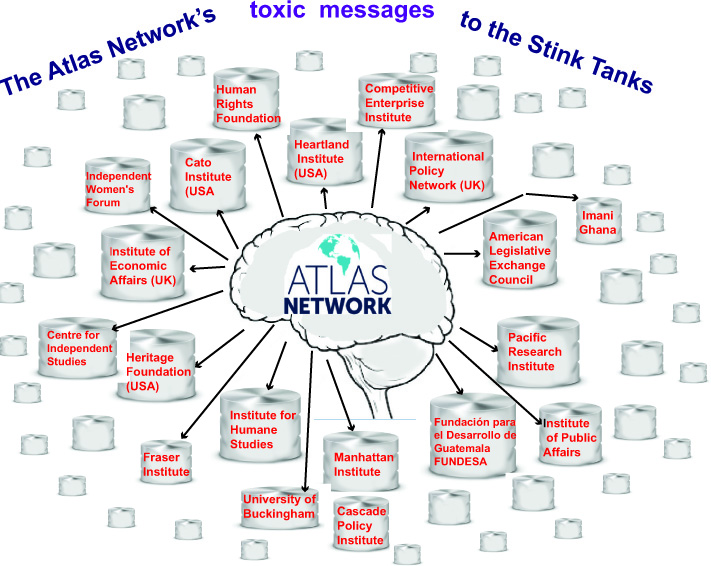
When one of the Atlas Network’s favourite IPA apparatchiks, Tim Wilson, was made Human Rights Commissioner by IPA-affiliate Tony Abbott, his public campaign was for free speech rights. Of course Yassmin Abdel-Magied’s free speech was not to be protected. Free speech is for their faction, not the Other.
Behind closed doors, however, Wilson’s primary battle for rights was for property rights. He spoke at the libertarian Friedman Conference with utter scorn of the high-ranking rights experts with whom he was forced to work in that role. His infantilised distortion of the British tradition of liberalism placed property rights as the prime factor. Their more sophisticated (French?) tradition of liberalism treated the rights of oppressed humanity as a higher priority.
Anyone watching the authoritarian intent behind the Project 2025 mission that threatens to accompany a Trump victory in November sees that it protects the property rights of the rich as much as key Atlas funder and strategist Charles Koch could demand. The human rights of anyone who fails to live as the obedient “traditional” identity, however, is under serious threat. The fact that the humanity of the gestating woman or pregnant person is made invisible, a machine gestating the potential humanity of a small ball of cells inside, illustrates the threat. Control of anyone who does not play by their rules is already a life and death matter in American Republican states.
The IPA shared a snippet of video made by one of the American Atlas partners, the Liberty Fund. In this, grim socialist footage of communist Estonia illustrates that “socialism” is ugly, monotone suffering not Bernie Sanders. The youth must be chastened out of the idea that their humanity deserves rights or that they have a justifiable claim for a decent standard of living, even if the plutocrats have to give up a little of their extraordinary wealth. At the bottom of that Liberty Fund page, key partners in the Atlas Network are listed.
The low-rent IPA campaigns on social issues to foment culture war. They aim to distract those most disadvantaged in neoliberalism’s world. They have not, however, forgotten the main game. A more equitable society means the rich must pay their fair share of tax. The financial, legal, governmental systems that they have gamed must be deconstructed. Before 2020, eight men alone owned as much property as that held by 3.6 billion people. Since the pandemic, that situation has worsened dramatically. In the years since 2020, 26 trillion dollars of new wealth has been snatched by the 1%. By contrast the rest of the world’s population gained $16 trillion. A 5% wealth tax on the handful of billionaires could raise enough to bring 2 billion people out of poverty.
Business has always benefitted from tax-funded infrastructure. Hospitals, schools, roads, railway, the internet etc make businesses possible. The bunk economics of neoliberalism denies that fact. Their friends at ultraconservative Quadrant warned that neoliberalism’s zero sum game would destroy the Australian way of life, and they are being proved right.
This impoverished world has been created by the plutocrats’ influence network and their junktanks infesting our public debate, media, academia and government. Neoliberalism was their construction and continues to threaten our survival by their obdurate refusal to transition away from carbon-based energy.
We should thank the IPA for sharing Koch (and Templeton) propaganda. Next time they say that talk of the Atlas Network is tin-foil hat conspiracy theory, we can remind them that they proved our point themselves.
1 This month

of the week – Australians for War Powers Reform (AWPR)
To see nuclear-related stories in greater depth and intensity
 Antinuclear