We published an analysis from a leading economist on soaring nuclear costs. Facebook removed it
Facebook pages all still full of articles and videos making outrageous claims about renewables and nuclear. But that, it seems, is OK for the social media giant.
Giles Parkinson, Jul 22, 2024 https://reneweconomy.com.au/we-published-an-analysis-from-a-leading-economist-on-soaring-nuclear-costs-facebook-removed-it/—
On Sunday, Renew Economy published an analysis on the soaring cost of nuclear power by leading economist John Quiggin. On Monday we attempted to post it in our feed on social media.
Facebook removed the item, saying it was an attempt to generate clicks by providing misleading information. We’d like to know on what basis this decision was made, but Facebook has yet to provide an answer.
It’s a concerning development, and not the first time one of our posts has been removed by Facebook.
Social media platforms including Facebook, X, YouTube, TikTok, and Instagram – are full of unchecked and misleading information about climate change and energy technologies. Much of it is complete nonsense creating FUD – fear, uncertainty and doubt – about new technologies.
It appears to be part of a well-funded and orchestrated plan by vested interests, and the fossil fuel industry in particular, to demonise renewables, electric vehicles, battery storage and other emerging competitors.
Much of this is amplified in mainstream media, where outrageous claims against renewables – and claims of blackouts, economic collapse and environmental failure – are repeatedly given voice.
Social media platforms including Facebook, X, YouTube, TikTok, and Instagram – are full of unchecked and misleading information about climate change and energy technologies. Much of it is complete nonsense creating FUD – fear, uncertainty and doubt – about new technologies.
It appears to be part of a well-funded and orchestrated plan by vested interests, and the fossil fuel industry in particular, to demonise renewables, electric vehicles, battery storage and other emerging competitors.
Much of this is amplified in mainstream media, where outrageous claims against renewables – and claims of blackouts, economic collapse and environmental failure – are repeatedly given voice.
Quiggin notes that the Czechia deal suggests the opposite is true, and confirms the widely held view in the energy industry itself that GenCost underestimates rather than overestimates the costs of nuclear. Nuclear, he says, is really really expensive.
But Facebook has now ruled that such analysis is misleading, and it won’t allow its users to view such information. Over the last few months, this has happened on several occasions to Renew Economy and its sister site The Driven.
Just last week, another article on the certification of green hydrogen technologies in Australia was pulled down. Last month, it was a story on how households will be a driving force of the energy transition. A few months earlier, an analysis on nuclear costs by Jeremy Cooper, the former deputy chair of ASIC and chair of the 2009/10 Super System Review, was also removed.
Over on The Driven, a story on how EVs are actually suitable for farmers in regional communities, was also pulled down. No explanation was provided. Despite protests, the posts were not reinstated.
Yet Facebook allows media groups such as Sky News Australia to post misleading information about renewables and climate without a check.
It’s a shocking development, and one that points to the manipulation of information by naysayers and vested interests. Some attribute it to the work of the Atlas Network, a shadowy group with strong Australian fossil fuel links that has campaigned against renewables, the Voice referendum, climate action, and climate protests.
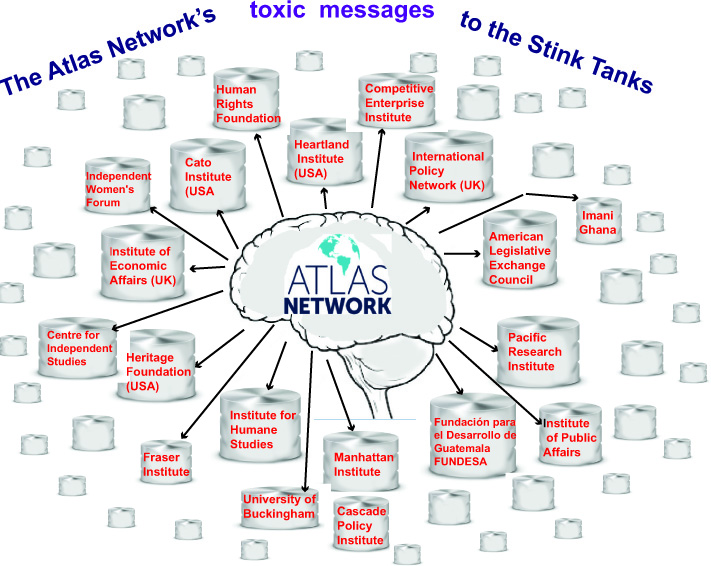
Researchers say that the whole point of the Atlas network of organisations and so called “institutes” and think tanks – which this article in New Republic says includes Australia’s Centre for Independent Studies, which has launched loud attacks against institutions such as the CSIRO, AEMO, and renewables in general – is to drown out actual academic expertise.
The Atlas Network does this, researchers say, to reduce the capacity for public and government influence with its own corporate propaganda that is dressed up as “research.”
George Monbiot, a columnist for the Guardian, calls many of the 500 institutions linked with the Atlas Network “junk tanks.” Jeremy Walker, from the University of Technology in Sydney, wrote in a paper that the network in Australia includes the CIS and the Institute for Public Affairs, both strongly anti renewable, and pro nuclear.
Their Facebook pages all still full of articles and videos making outrageous claims about renewables and nuclear. But that, it seems, is OK for the social media giant.
Australian nuclear news headlines 22-29 July.

Headlines as they come in:
- Prime Minister Albanese’s hypocrisy on matters nuclear
- Jabiluka uranium mine lease not renewed in decision heralded as ‘huge win’
- Critical AUKUS contract doubles in price and now a year late.
- Solar doesn’t need a toxic “friendship” with nuclear power.
- Forget nuclear: 5B says plunging price of PV means giga-scale solar farms the future for old coal plants
- Anthony Albanese slams Opposition’s nuclear ‘obsession’ as he doubles down on renewables push at NSW Labor conference
- Canada rejects AUKUS nuclear submarine deal
- Coalition to fast-track nuclear power.
- Shoalhaven’s nuke-free vote
- Australia / Academy Report – small nuclear reactors ‘high-risk when compared to existing energy options’
- Respect and responsibility: Jabiluka safe as uranium mining lease for Kakadu site not renewed.
- Jabiluka’s priceless heritage permanently protected
- AUKUS and the pride of politicians.
- UK Nuclear Free Local Authorities back joint statement condemning AUKUS nuclear proliferation.
- “I’m not interested in the fanatics:” Dutton responds to science academy’s report on nuclear SMRs
- Dutton’s nuclear delusion an exercise in stupidity.
- Clean Energy Sector Rallies Against Nuclear ‘Mistruths’.
- We published an analysis from a leading economist on soaring nuclear costs. Facebook removed it
- Defence Industry Minister Pat Conroy downplays Rockingham residents’ concerns of AUKUS nuclear waste storage
- Community alliance against Coalition’s nuclear policy
- Time for Dutton to produce the nuclear evidence
- Dutton comes to town to sell us nuclear power
- Nuclear + Solar In Australia = A Huge Waste Of Energy
- Upfront nuclear power cost will be significant: Dutton
- Peter Dutton visits Queensland back country in nuclear energy push
- One nuclear plant could see 45,000 rooftop solar systems shut off each day
- Czech nuclear deal shows CSIRO GenCost is too optimistic, and new nukes are hopelessly uneconomic.
Dutton’s nuclear delusion an exercise in stupidity.
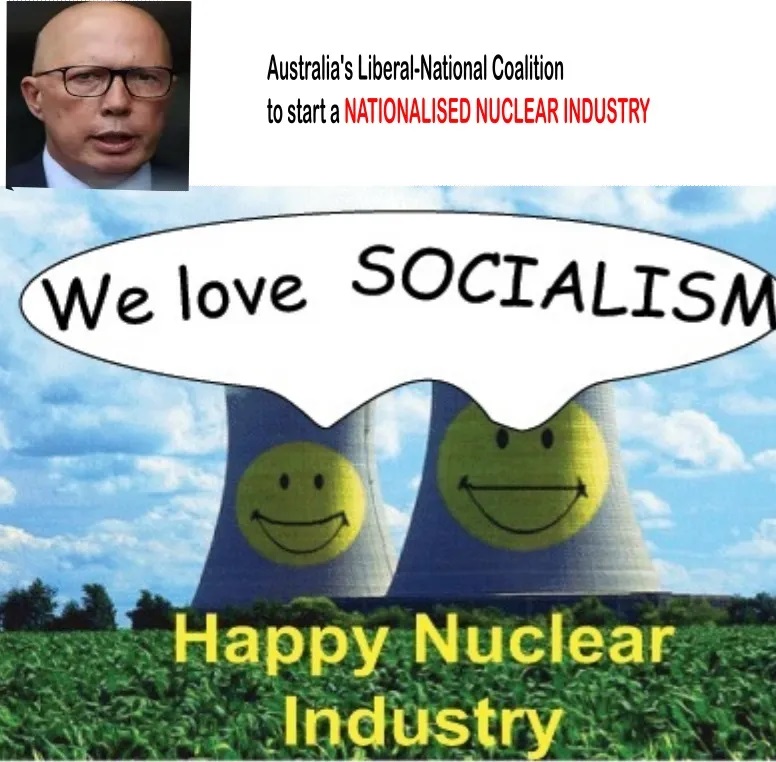
Aspects of the proposed program also go distinctly against the supposedly free market individualism so treasured by those on Dutton’s side of politics. If nuclear power was to become the fundamental means to decarbonise the Australian economy by 2050, it would entail crushing levels of debt and heavy government stewardship.
By its very nature, the Commonwealth would have to take the reins of this venture, given that private investors will have no bar of it
By Binoy Kampmark | 23 July 2024
Peter Dutton’s sketchy plan for Australia to go nuclear is nothing more than a political distraction with no actual benefits for the country, writes Dr Binoy Kampmark.
POLITICS AND FACTS are not necessarily good dinner companions. Both often stray from the same table, taking up with other, more suitable company. The Australian Opposition Leader, Peter Dutton, has never been discomforted by facts, preferring the chimera-like qualities demagoguery offers. His vision for Australia is admirably simple and simplistic.
In foreign policy, he supports U.S. interventions in any theatre of the globe without question. Ditto such allies as Israel. To the distant north, the evil Yellow Horde is abominated. Domestically, matters are similarly one-dimensional. Irregular boat arrivals are to be repelled with necessary cruelty. And then there is a near pathological hatred of renewable energy.
Needing to find some electoral distraction to improve the Liberal-National Coalition’s chances of returning to office, Dutton has literally identified a nuclear option. Certainly, it is mischievous, throwing those wishing to invest in the problematic Australian energy market into a state of confusion. As with any investment, the business of renewables is bound to also be shaken.
Last month, Dutton finally released some details of his nuclear vision. Seven nuclear projects are envisaged, using sites with currently working or shuttered coal-fired power stations. These will be plants up to 1.4 gigawatts (GW) to be located at Loy Yang in Victoria, Liddell in NSW’s Hunter Valley and Mt Piper near Lithgow, Tarong and Callide in Queensland. Small modular (SMR) reactors are planned for Port Augusta in South Australia and Muja near Collie in Western Australia.
The SMR gambit is particularly quixotic, given that they have yet to come to viable fruition. Besides, the entire reactor venture already faces glaring legal impediments, as nuclear power is prohibited by Commonwealth and state laws. (The ban on nuclear energy was, with sweet irony, legislated by the Howard Coalition Government a quarter of a century ago.)
Already, the handicaps on the proposal are thick and onerous. Ian Lowe of Griffith University witheringly describes the proposal as ‘legally impossible, technically improbable, economically irrational and environmentally irresponsible’.
The greatest of all handicaps is the fact that Australian governments, despite tentatively flirting with the prospect of a civilian nuclear sector at points, have never convinced the citizenry about the merits of such power. The continuous failure of the Commonwealth to even identify a long-standing site for low-level radioactive waste for the country’s modest nuclear industry is a point in fact.
Aspects of the proposed program also go distinctly against the supposedly free market individualism so treasured by those on Dutton’s side of politics. If nuclear power was to become the fundamental means to decarbonise the Australian economy by 2050, it would entail crushing levels of debt and heavy government stewardship.
By its very nature, the Commonwealth would have to take the reins of this venture, given that private investors will have no bar of it.
Tom Dusevic, writing in the otherwise pro-Dutton outlet The Australian, put it thus:
‘There is no other way because private capital won’t go anywhere near this risky energy play, with huge upfront costs, very long lead times and the madness that has pervaded our energy transition to meet international obligations.’
The extent of government involvement and ownership of the proposed nuclear infrastructure made The Age and Sydney Morning Herald search for a precedent. It seemed to have an element of “Soviet economics” to it, directly at odds with the Liberal Party’s own professed philosophy of “lean government that minimises interference in our daily lives; and maximises individual and private sector initiative”.
It would also add to the already monstrous AUKUS obligations Australia has signed up to with the United States and the United Kingdom, a sovereignty-shredding exercise involving the transfer and construction of nuclear-powered submarines to Canberra costing upwards and above $368 billion.
The Smart Energy Council has been good enough to offer its own estimate: the seven nuclear plants and reactors would cost somewhere in the order of $600 billion, securing a mere 3.7 per cent of Australia’s energy share by 2050.
While draining the treasury of funds, this nuclear-in-Duttonland experiment would do little to alleviate energy costs. The Commonwealth Scientific and Industrial Research Organisation (CSIRO), Australia’s national science agency, along with the Australian Energy Market Operator (AEMO), have concluded that nuclear power in Australia would not be prudent in terms of cost relative to other sources of power. The obstacles noted in their 2023-24 report are impressively forbidding.
According to the report, Australia, for instance, lacks existing nuclear power projects:
‘Therefore, although it is true that all technologies have extensive pre-construction development times, nuclear is unique in that it has an empty development pipeline in Australia.’
Throw in the layers of legal, safety and security steps, any pioneering nuclear plant in Australia would be ‘significantly delayed’, rendering nuclear power’s role in achieving net zero emissions by 2050 a nonsense.
The Dutton plan is scratched of all empirical shape. Estimates are absent. Numbers, absent. Capacity, absent. Figures, if supplied, will be done immediately prior to the next Federal Election, or while in government. Such moves teeter on the edge of herculean stupidity and foolhardiness, at least in Australian conditions. The exercise is also, quite rightly, being seen as an attempt to stealthily retain coal-fired stations while starving continued investment to the renewable sector.
Dutton’s junior partner, the Nationals, has also been very candid about its position on renewable energy projects.
Party Leader David Littleproud nailed his colours to the mast on that subject early last year. By August 2023, he was explicitly calling for a “pause” to the rollout of wind and solar and transmission links, calling the Albanese Government’s pursuit of its 82 per cent renewables target a “reckless” one. His implicit suggestion: wait for the release of the nuclear genie.
The Coalition Opposition’s nuclear tease continues the tendency in Australia to soil climate policy with the sods of cultural conflict. On any matter, Dutton would be happy to become a flat-Earther were there any votes in it. The problem here is that his proposal might, on some level, be disruptively attractive — in so far as the voters are concerned. With Labor dithering in office with the smallest of majorities, any disruption may be one too many.
1 This month

of the week – Australians for War Powers Reform (AWPR)
To see nuclear-related stories in greater depth and intensity
 Antinuclear