We published an analysis from a leading economist on soaring nuclear costs. Facebook removed it
Facebook pages all still full of articles and videos making outrageous claims about renewables and nuclear. But that, it seems, is OK for the social media giant.
Giles Parkinson, Jul 22, 2024 https://reneweconomy.com.au/we-published-an-analysis-from-a-leading-economist-on-soaring-nuclear-costs-facebook-removed-it/—
On Sunday, Renew Economy published an analysis on the soaring cost of nuclear power by leading economist John Quiggin. On Monday we attempted to post it in our feed on social media.
Facebook removed the item, saying it was an attempt to generate clicks by providing misleading information. We’d like to know on what basis this decision was made, but Facebook has yet to provide an answer.
It’s a concerning development, and not the first time one of our posts has been removed by Facebook.
Social media platforms including Facebook, X, YouTube, TikTok, and Instagram – are full of unchecked and misleading information about climate change and energy technologies. Much of it is complete nonsense creating FUD – fear, uncertainty and doubt – about new technologies.
It appears to be part of a well-funded and orchestrated plan by vested interests, and the fossil fuel industry in particular, to demonise renewables, electric vehicles, battery storage and other emerging competitors.
Much of this is amplified in mainstream media, where outrageous claims against renewables – and claims of blackouts, economic collapse and environmental failure – are repeatedly given voice.
Social media platforms including Facebook, X, YouTube, TikTok, and Instagram – are full of unchecked and misleading information about climate change and energy technologies. Much of it is complete nonsense creating FUD – fear, uncertainty and doubt – about new technologies.
It appears to be part of a well-funded and orchestrated plan by vested interests, and the fossil fuel industry in particular, to demonise renewables, electric vehicles, battery storage and other emerging competitors.
Much of this is amplified in mainstream media, where outrageous claims against renewables – and claims of blackouts, economic collapse and environmental failure – are repeatedly given voice.
Quiggin notes that the Czechia deal suggests the opposite is true, and confirms the widely held view in the energy industry itself that GenCost underestimates rather than overestimates the costs of nuclear. Nuclear, he says, is really really expensive.
But Facebook has now ruled that such analysis is misleading, and it won’t allow its users to view such information. Over the last few months, this has happened on several occasions to Renew Economy and its sister site The Driven.
Just last week, another article on the certification of green hydrogen technologies in Australia was pulled down. Last month, it was a story on how households will be a driving force of the energy transition. A few months earlier, an analysis on nuclear costs by Jeremy Cooper, the former deputy chair of ASIC and chair of the 2009/10 Super System Review, was also removed.
Over on The Driven, a story on how EVs are actually suitable for farmers in regional communities, was also pulled down. No explanation was provided. Despite protests, the posts were not reinstated.
Yet Facebook allows media groups such as Sky News Australia to post misleading information about renewables and climate without a check.
It’s a shocking development, and one that points to the manipulation of information by naysayers and vested interests. Some attribute it to the work of the Atlas Network, a shadowy group with strong Australian fossil fuel links that has campaigned against renewables, the Voice referendum, climate action, and climate protests.
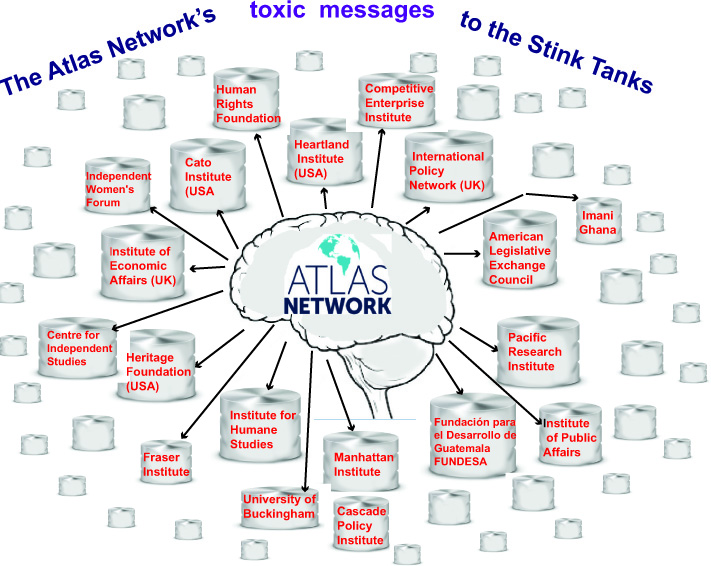
Researchers say that the whole point of the Atlas network of organisations and so called “institutes” and think tanks – which this article in New Republic says includes Australia’s Centre for Independent Studies, which has launched loud attacks against institutions such as the CSIRO, AEMO, and renewables in general – is to drown out actual academic expertise.
The Atlas Network does this, researchers say, to reduce the capacity for public and government influence with its own corporate propaganda that is dressed up as “research.”
George Monbiot, a columnist for the Guardian, calls many of the 500 institutions linked with the Atlas Network “junk tanks.” Jeremy Walker, from the University of Technology in Sydney, wrote in a paper that the network in Australia includes the CIS and the Institute for Public Affairs, both strongly anti renewable, and pro nuclear.
Their Facebook pages all still full of articles and videos making outrageous claims about renewables and nuclear. But that, it seems, is OK for the social media giant.
No comments yet.
1 This month

of the week – Australians for War Powers Reform (AWPR)
To see nuclear-related stories in greater depth and intensity
 Antinuclear
Leave a comment