For Australia, AUKUS and the planned nuclear submarines create more problems than solutions
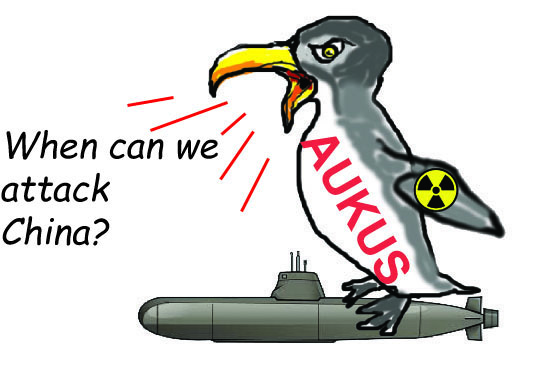
Preposterous’: AUKUS creates more problems than solutions THE AUSTRALIAN,
The timelines for Australia’s transition from ageing Collins-class to its first nuclear-powered sub just don’t add up. There is hardly a single strategist in the country who believes it will happen. By CAMERON STEWART 10 Dec 21

Now that Australia has finally weathered the diplomatic fallout caused by the creation of the three-nation AUKUS pact, it is time to work out exactly what it means for the nation’s security.
The Morrison government faces a series of critical multi-billion dollar decisions in the coming year that will set the course of Australia’s maritime defence for the next half a century.
These will require Canberra to test the limits of its alliance with both the US and the UK to ensure they make good on their AUKUS promise to share their sensitive nuclear know-how to help Australia acquire a nuclear-powered submarine fleet.
………….But the not-so-good news is that AUKUS has delivered as many conundrums for Australia as it has solutions.
………. the AUKUS announcement and the related scrapping of the French submarine project offers far more problems than solutions.
The timelines for Australia’s transition from its ageing Collins-class submarines to its first nuclear-powered submarine just don’t add up. Put simply, unless something changes, Australia risks having either no submarine fleet or a grossly antiquated one in the late 2030s and early 2040s……..
The government has given itself up to 18 months from the AUKUS announcement in September to study its options, although it says it hopes to decide on a plan of action earlier.
………………… The trouble is that the government’s initial projection for the completion of the first of eight nuclear-powered submarines, which it claims will be built in Adelaide, is not until 2038, meaning it would not be brought into naval service for another two years after that, in 2040, with one new nuclear boat every three years after that. This timetable is hugely ambitious and there is hardly a single strategist in the country who believes this will happen. The lessons of naval shipbuilding in Australia is that a first-of-class boat is never completed on time, much less the building of a nuclear submarine – easily the most complex construction of its kind in the country’s history.
……….
The solutions that have been floated, in no particular order, are to shorten the process by building at least some of the nuclear submarines overseas rather than in Australia; lease nuclear submarines from the US or UK; build a new conventional submarine in Australia as an interim measure; or extend the life of the Collins for a second refit cycle, meaning they would be sailing into the 2050s.
Every one of these proposals is problematic.
………………….. if the government chooses not to build a new conventional submarine and it deems that the Collins can be extended only for a decade, rather than two decades, then the only option is to acquire nuclear submarines more quickly than the current 2040 guideline.
This is the option that Dutton is pursuing but it requires delicate diplomacy with Australia’s AUKUS partners. First, Dutton must decide whether to ditch the government’s intention to build the eight nuclear submarines in Adelaide. While building all boats here will maximise Australian defence industry content, it will almost certainly slow the project down compared to a decision which would allow at least the first few boats to be constructed in US or UK shipyards.
Second, Dutton must choose between acquiring the US Virginia-class or the UK’s Astute-class submarines. Neither the UK nor the US production lines have room to include Australian boats in the foreseeable future. Dutton would need to lean heavily on London or Washington to make room for Australian boats to be constructed in their own shipyards. In the US, it would probably require Australia to partly fund a third shipyard to build the Virginia-class boats because the current two shipyards are struggling to keep up with the orders of the US Navy.
Hellyer believes the choice between the two countries is simple. “With nuclear submarines, we are not just picking a boat we are picking a strategic partner and that can only be the US,” he says…….
However, ditching the British submarine option would require delicate diplomacy from Canberra given that Britain’s prime minister Boris Johnson promised that the AUKUS deal would create “hundreds” of highly skilled jobs across the UK and would reinforce Britain’s place “at the leading edge of science and technology”.
The Morrison government appears to have gone cold on the option of leasing nuclear submarines to get them into the navy earlier. On closer inspection, neither the UK or the US have submarines available to lease. And in any case, Australia does not have the crews or the skills to sail them.
It will take at least a decade and probably longer for Australia to be able to train enough crew to the high levels required to man a nuclear-powered boat. A vast amount of that training will need to be done in the US or UK while Australia builds up the nuclear infrastructure and knowledge that will be needed to crew, maintain and manage a nuclear fleet.
All of these options amount to multi-billion dollar decisions by the government. If the wrong option is chosen, it will not only hit taxpayers, but it could severely compromise the country’s defence for decades.
The stakes could not be higher as the government moves to turn AUKUS from rhetoric to reality. www.theaustralian.com.au/inquirer/aukus-gives-us-more-problems-than-solutions-and-our-safety-is-at-stake/news-story/fff5b011740957f5cc246eb641408894
Hidden in mainstream Olympic Games news – an incisive comment on nuclear costs!

This naughty journalist understood that the news, at the present dragging-on time must be dominated by the Olympic Games, and nothing else matters.
So he wrote in a half page article -a quarter of a page virtuously all about the Olympic Games. Then – shock horror! He aberrated!
Taxpayers will come dead last at the Brisbane Games
Shane Wright, The Age, Business Section, 6 August 24
“……………………….There are myriad reasons why these costs blow out. Governments have a political incentive to under-estimate so they can win taxpayers over to the idea. Requirements for sports change. Organisers ignore inflation risks. And they have strict deadlines, which means paying whatever it takes to get everything ready on time………………….
Last year, Flyvberg and Dan Gardner published a book, How Big Things Get Done — a text that should be mandatory reading for every politician and engineer.
Based on a global database covering 16,000 major projects (including Olympic Games) from around the world and their cost to taxpayers, and stripped of the usual political spin used by every government and political party to sell their projects, it shows the single largest cost overruns for major projects are for nuclear storage projects. In third place is nuclear power itself. Taking out the silver medal for cost overruns is hosting the Olympic Games.
Of note to Dutton should be that the average cost blowout for nuclear storage is 238 per cent, with just under half of all projects suffering an overrun of at least 50 per cent.
Then, there’s nuclear power itself, where the average cost overrun is 120 per cent (the research covers almost 200 separate power plants). In terms of dollars, that means those who think – and will potentially promise voters – the nuclear dream will cost $10 billion will actually wind up billing taxpayers about $22 billion.
Also worthy of note is that in 55 per cent of all nuclear power cases, the overrun is at least 50 per cent. Of that subset, the average blowout is 204 per cent. Again, in terms of dollars, that would mean the $10 billion nuclear program would actually cost a little over $30 billion.
The project with the lowest risk and lowest overall cost of overrun?
Solar power.
Ultimately, the choice is to believe the reality of 16,000 projects from around the world, or politicians who have every reason not to be upfront about the true cost of their various promises.
There’s just one winner in that race, and unlike the Olympics, nuclear blowouts can’t be fixed with a cardboard bed. https://www.theage.com.au/politics/federal/taxpayers-will-come-dead-last-at-the-brisbane-games-20240805-p5jzio.html
TODAY. Relief – Hiroshima Day is over – now to our glorious $2 trillion nuclear weapons “modernization”!

August 7th. Hiroshima day is over. We can all breathe a sigh of relief. No need to be sad any more , about nuclear bombing. (Oh wait – there’s Nagasaki Day on the 9th. No matter, there’s very little coverage of that, and the people who count – the smart young people, probably have neder heard of it,
The good thing is – industry races on! Especially the USA nuclear weapons industry. Ain’t that great! They’re going to spend $2 trillion on “modernizing” nuclear weapons. And if Donald Trump gets in, backed by the Heritage Foundation, well – it will be more than $2 trillion.
I mean – think of the jobs jobs jobs! Think of the return to shareholders!
(Think of the American national debt – Nah – don’t go there. That is communist -style thinking and negativity)
No we don’t need negativity. Some people moan about not spending enough money on combatting climate change, on cleaning up plastic pollution, on preserving biodiversity, or even on feeding the world’s refugees and the hungry second-rate peoples.
No – positivity is the way to go. A positive approach to later on having a war against the evil Chinese and the evil Russians.
1 This month
17 October, Free Public Talk on Nuclear Issues in South Australia
David Noonan will speak on public interest concerns over the new Roxby Downs Indenture Act 2026 on BHP copper-uranium mining and ore processing in SA, and on how AUKUS may face SA with a High-Level nuclear waste agenda.
Dr Jim Green will discuss international developments in the field of nuclear power including ‘small modular reactors’ and Generation 4 ‘advanced’ nuclear reactor concepts.


Help Aunty Sue Protect Her Land and Sacred Sites From Destructive Rocket Testing.
.

Australians deserve the truth
about
AUKUS – https://aukuspublicinquiry.com/

PETITION – To: Prime Minister Anthony Albanese and the Australian Labor Government

of the week – Australians for War Powers Reform (AWPR)
To see nuclear-related stories in greater depth and intensity

