The legal decision on the Murdoch media – what does it mean for us?

NOEL WAUCHOPE, DEC 13, 2024, https://theaimn.com/the-legal-decision-on-the-murdoch-media-what-does-it-mean-for-us/
There is nothing either good or bad, but only thinking makes it so.
Shakespeare’s profound idea applies to that recent legal case, about the Murdoch Family Trust, in the Probate Court in Nevada.
The 93 year-old Rupert Murdoch sought to change the existing “irrevocable trust” which is to govern the arrangements of his media empire, after his death. The issue was that the trust should be in “the best interests” of the Murdoch children.
Rupert Murdoch argued that after his death, his children would benefit best if control of his media empire were to be changed from the existing trust arrangement which gives control to four of his children – Lachlan, Elizabeth, James and Prudence. Murdoch wanted that changed to control by only eldest son Lachlan. The other three disagreed, and took the case to court.
Rupert Murdoch’s given reason was that the whole media enterprise would thus be more profitable, – so all four children would get more money. That way, Elizabeth, James, and Prudence would not have control, but would be richer, and this would be “in their best interest”. Under the present unchanged “irrevocable” trust arrangement, they would share the control with Lachlan, but they would be less rich.
Many commentators are arguing that Rupert Murdoch’s real goal is power and influence – so that is why he wanted the very right-wing Lachlan to be in charge of the media show. Perhaps this is true.
The case was heard in a secret court, but the core of Rupert Murdoch’s argument was that the children’s monetary gain was in their best interest, rather than them having any control of the media and its content.
Apparently the three did not think so, and neither did Commissioner Edmund J Gorman, who ruled in the children’s favour, concluding that Murdoch and his son Lachlan, had acted in “bad faith”, in a “carefully crafted charade”.
Lachlan shares the same right-wing views as his father does, even more so,- while Elizabeth, James and Prudence are reported as having more moderate views. Murdoch has controlling interests in Fox News and News Corp , the Wall Street Journal, in the UK the Times and the Sun, the Australian and others. Apparently it is assumed by all, that the media empire will continue its current record profits only under Lachlan’s leadership. In 2023–24 the Fox Corporation’s net income was US$1.5 billion (A$2.35 billion).
This case raises the question – what is the purpose of the news media ?
According to the Murdoch argument, the purpose is to enrich the owners of the media. That would include all the shareholders, too, I guess. The means by which this is done is to provide entertainment and information to the public. And this is central to Rupert Murdoch’s stated argument.
Some people, including many journalists, and perhaps the Murdoch children, might see the informational role of the news media as its main purpose, with excessive profitability as a secondary concern.
Apparently Elizabeth, James and Prudence preferred to have some control in the media empire, even if that meant less money for them. They thought that “having a say” in the business was in their best interest. It is possible that they might take some pride in news journalism that would be more accurate and balanced than the Murdoch media is now.
Only thinking makes it so
The best example of “Murdoch media thinking” -is in its coverage of climate change. For decades, the Murdoch view was pretty much climate denialism – climate concern seen as a “cult of the elite” and the “effects of global warming have so far proved largely benign”. But more recently, this view was moderated, towards concern that some action should be taken to limit global warming – coinciding with the new right-wing push for nuclear power as the solution to climate change.
In the USA, Murdoch media has a powerful influence, supported by the big corporations, and the right wing in general, and by the Trump publicity machine, but it does have some competition from other right wing outlets like Breitbart and the Daily Wire, and in talk radio, and blogs. It has lost some influence in the UK, following its phone hacking scandal in 2011.
That Murdoch interpretation contradicts the view of thousands of scientists, yet is welcomed by the fossil fuel industries, the nuclear industry, and the right-wing governments that they support. Similarly, the Murdoch media’s view on international politics generally favours military action that the USA supports – on Ukraine’s side, by Israel, and now in Syria. All this is seen to be good – by the USA weapons manufacturers and salesmen, US and UK politicians, and presumably by the public.
In the USA, Murdoch media has a powerful influence, supported by the big corporations, and the right wing in general, and by the Trump publicity machine, but it does have some competition from other right wing outlets like Breitbart and the Daily Wire, and in talk radio, and blogs. It has lost some influence in the UK, following its phone hacking scandal in 2011.
In Australia, Murdoch media is far more pervasive, and has been described as a virtual monopoly – with the only national newspaper, newspapers in each state, (often the only newspaper), and News Corp controls radio and television in Australia through a number of assets.
So – what now, after this remarkable probate court decision?
Commissioner Gorman’s recommendation could still be rejected by a district judge. Murdoch’s lawyers can appeal the decision. Even if the decision is finally upheld, it will be a complicated process to rearrange the control of the media in the event of Rupert Murdoch’s death – and that might not happen for a decade or more. News Corp has a dual-class share structure which gives the family 41% of company votes, despite having just 14% of an overall stake in the company. Shareholders might change this arrangement.
In the meantime – fertile ground for endless speculation on what it all might mean – for the share price, for the future direction of the media, for the Murdoch family relationships.
Only thinking makes it so
Some see this legal decision as such a blow to the Murdoch empire – leading to its fatal collapse. And that thought can be viewed as a bad outcome. Even if Rupert Murdoch overturns the decision on appeal, it might have dealt a big blow to the empire.
Some welcome it, visualising a change in direction, with a more progressive media, directed by the three siblings with their more moderate opinions. For Australians who don’t like Donald Trump, and fear a Peter Dutton election win in 2025, well, it really doesn’t matter much. For the foreseeable future, the political right wing is still hanging on to its grip on news and information across this continent, thanks to the Murdoch empire.
Fears nuclear power ‘may stop people moving to the bush’

Stephanie Gardiner, 12 Dec 24, https://www.afr.com/policy/energy-and-climate/fears-nuclear-power-may-stop-people-moving-to-the-bush-20241211-p5kxn2
Regional Australia is having its “phoenix moment” as more people move to the bush, according to a local councillor, but some residents fear the Coalition’s nuclear plan could hinder growth and prosperity.
The Coalition has earmarked seven sites for nuclear reactors at former and closing coal power plants across Australia, including at Lithgow’s Mount Piper power station in central west NSW.
Tom Evangelidis, who sits on Lithgow City Council, told a parliamentary inquiry his family moved to the town at the foot of the NSW Blue Mountains four years ago for its affordability and proximity to Sydney.
The presence of a nuclear reactor could dissuade others from settling in the region at a time when it is planning a bright future, Mr Evangelidis told the parliamentary committee sitting in Lithgow on Wednesday.
“This is our phoenix moment,” he said, referring to the mythical creature that rises from the ashes as a symbol of renewal and progress. “Nuclear in our region will stop that.”
Opposition Leader Peter Dutton has pledged to release the costings of his nuclear plan soon, having slammed an experts’ report that showed solar and wind remained the cheapest forms of energy.
Mount Piper operator EnergyAustralia has plans for a 500-megawatt battery energy storage system adjacent to the site, while also looking into pumped hydro at nearby Lake Lyell.
Further west near Dubbo, there is a proposed Renewable Energy Zone, with 4.5 gigawatts of potential capacity through solar, wind and new transmission infrastructure.
Peter Hennessy, who lives on a property at Bathurst, said communities have been left “high and dry” by planning laws and consultation on renewable projects.
“[Energy Minister Chris Bowen] would have solar everywhere, couldn’t care less about the countryside at all,” Mr Hennessy said.
“[It’s] just an absolute disgrace and total disregard to the welfare of the land or the people surrounding or indeed anywhere else.”
Jim Blackwood, a retired GP and vice president of the Bathurst Community Climate Action Network, said it was redundant to debate the pros and cons of nuclear because it would take too long to establish.
“The issue is we need to do something now, and we need to do it in a time frame that is going to make a difference,” Dr Blackwood told the hearing.
Lithgow is at the front line of climate change tensions, facing the end of its economic base in the fossil fuel industry while also recovering from the Black Summer bushfires.
“Four years ago, this whole town was surrounded by an inferno, a raging inferno,” Dr Blackwood said.
“All the hills were a fire, and so those two things are basically what’s confronting all of us.”
The inquiry is due to sit in Sydney on Thursday.
Dutton to reveal just how much he’s gambling on nuclear power
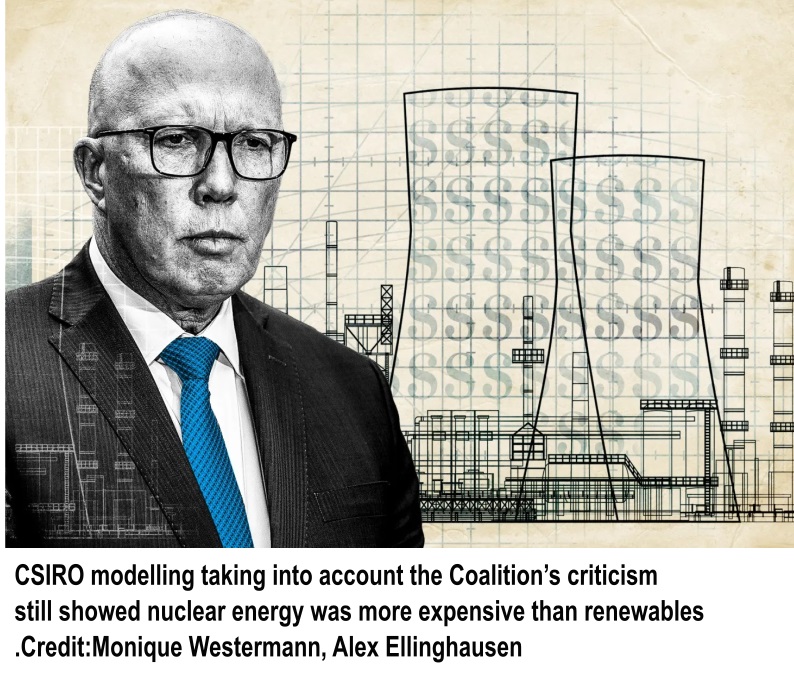
By James Massola, Paul Sakkal, Mike Foley and David Crowe, December 12, 2024 , https://www.theage.com.au/politics/federal/dutton-to-reveal-just-how-much-he-s-gambling-on-nuclear-power-20241210-p5kxai.html
Opposition Leader Peter Dutton will ask Australians to support hundreds of billions of dollars in new spending on nuclear energy, including a controversial move to use taxpayer subsidies to build the industry while promising to bring down household electricity bills.
The Coalition pledge comes as an exclusive survey reveals deep concerns about use of taxpayer funds to start the sector, with only 21 per cent of voters in favour of taxpayer investments or subsidies for nuclear power.
The Resolve Political Monitor, conducted for this masthead, showed renewable energy was more popular, with 45 per cent of voters backing subsidies for rooftop solar and 34 per cent supporting subsidies for home batteries – an option Labor is exploring as an election policy next year.
Dutton is expected to reveal more details of his plan on Friday with a pledge to build seven full-scale nuclear power stations, rather than smaller “modular” reactors, to deliver baseload electricity and lower the nation’s greenhouse gas emissions.
Coalition MPs will be briefed on the plan in a party room meeting on Friday morning at 10am.
A key part of the plan will be an assumption that coal-fired power stations will continue to operate while a Coalition government awards contracts to build the nuclear plants, even though energy companies are planning to stop using coal over the next two decades.
Recent modelling by consultancy Frontier Economics for the Coalition put a cost of $642 billion on Labor’s renewables rollout to 2050. As first reported by this masthead last week, the opposition will claim its nuclear plan will cost about $400 billion over the same period.
Subsidising power sources
Q: Which, if any, of the following do you think deserve subsidy or investment by taxpayers?
Rooftop solar
45%
Home batteries
34%
Renewables in general, such as wind and solar
33%
Large-scale batteries
28%
Large-scale solar farms
26%
Nuclear-powered electricity
21%
Hydro-electric energy from dams
21%
Natural gas-powered electricity
20%
Large-scale wind turbines on land
19%
Large-scale wind turbines off the coast
19%
Undecided
15%
Coal-fired electricity
13%
None of these
9%
n=1604
Source: Resolve Political Monitor
Energy Minister Chris Bowen rejects the $642 billion figure and stands by the energy grid operator’s forecast of $122 billion. The dispute is based on different ways of accounting for costs in the future.
Opposition veterans affairs spokesman Barnaby Joyce, one of the most outspoken proponents of nuclear power within the Coalition, said Australians had to decide whether “you want a grid that works or you don’t”.
Asked about earlier reports of a $500 billion projected cost, Joyce told this masthead: “It always was going to be this much. But we are spending $24 billion for pumped hydro, which gives maybe a day of power, and then you have to pay for transmission lines. The per-reactor price is lower.”
A key part of the Coalition argument is the cost blowout in the Snowy 2.0 project to generate more hydropower in the Snowy Mountains, while a nuclear project in the United Arab Emirates, backed by South Korean company KEPCO, has delivered results on time.
Joyce contrasted the Coalition plan with the controversial plan for the Hinkley Point C reactor in the United Kingdom, which is behind schedule, or the use of small modular reactors (SMR) in other countries.
“We are not devising a new reactor like in England, and we aren’t using an SMR,” he said.
“We are doing this with proven technology like in the UAE, it’s more economical that way. And that means the time frame can be realistic.”
Another member of the shadow cabinet, who asked not to be named, said most Australians were not concerned about nuclear power being rolled out as it would not be built anywhere near their homes.
“The biggest positive is that Peter has floated a big idea, a difficult idea, and he’s had the courage to do it. The debate over this will end up being modelling at 50 paces,” they said.
The Resolve Political Monitor found 34 per cent of voters supported the use of nuclear power, while 28 per cent were against it. Another 24 per cent said they did not have a strong view but were open to the government investigating its use.
The survey, conducted by research company Resolve Strategic, found 54 per cent of Coalition voters supported nuclear power while only 21 per cent of Labor voters and 15 per cent of Greens supporters said the same.
The question was: “There has been some debate about the use of nuclear power in Australia recently. What is your own view on the use of nuclear power in Australia?” The question did not outline the Coalition policy, given it had not been released.
The Resolve Political Monitor surveyed 1604 eligible voters from Wednesday to Sunday, generating results with a margin of error of 2.4 per cent.
While many Australians remain open to nuclear energy, views have tended to shift against the energy source since the survey asked about the issue more than one year ago.
The survey in October last year found that 33 per cent supported nuclear power and 29 per cent were open to the government investigating its use, leading to a total of 62 per cent who were prepared to back or consider it. This total slipped to 58 per cent in the latest survey.
The number of voters against nuclear increased from 24 per cent in October last year to 28 per cent in the latest survey.
In a separate question about taxpayer subsidies, the Resolve Political Monitor found 45 per cent of voters supported federal investments or subsidies for rooftop solar – the most favoured option. In contrast, only 13 per cent supported taxpayer subsidies for coal-fired electricity.
Power bills would rise by about $665 a year to repay the cost of building seven nuclear plants, according to analysis by the Institute for Energy Economics and Financial Analysis, based on the repayments needed to fund the average of construction costs from reactors recently built around the world.
The Coalition policy assumes a smaller addition of renewable energy to the electricity grid compared to government policy, which forecasts an increase in the share of renewable energy to 82 per cent of the grid by 2030.
The opposition has claimed the influx of renewables, which currently supply 40 per cent of electricity, will increase power bills and the risk of blackouts and disrupt regional communities where wind and solar farms are built.
Another key point of difference is the opposition’s assumption that the nation’s coal plants will run for decades longer than the Australian Energy Market Operator (AEMO) has forecast.
AEMO predicts that 90 per cent of coal-fired generation will be shut down before 2035, with closures complete by 2040.
The opposition has said its first nuclear reactor will be completed by 2035, while experts including the CSIRO say 2040 is the earliest possible date. A fully operational fleet of nuclear reactors cannot be expected before 2050.
Antarctica is in crisis and we are scrambling to understand its future

The last two years have seen unprecedented falls in the levels of sea ice around Antarctica, which serves as a protective wall for the continent’s huge ice sheets. Researchers are now racing to understand the global impact of what could happen next
By James Woodford, 2 December 2024
If all our fear and uncertainty over climate change could be distilled into a single statistic, then arguably it was delivered to an emergency summit on the future of the Antarctic last month.
Nerilie Abram at the Australian National University, Canberra, opened her presentation with a slide headlined “Antarctic sea ice has declined precipitously since 2014, and in July 2023 exceeded a minus 7 sigma event”.
Antarctica is in crisis and we are scrambling to understand its future.
The last two years have seen unprecedented falls in the levels of sea ice
around Antarctica, which serves as a protective wall for the continent’s
huge ice sheets. Researchers are now racing to understand the global impact
of what could happen next.
If all our fear and uncertainty over climate
change could be distilled into a single statistic, then arguably it was
delivered to an emergency summit on the future of the Antarctic last month.
Nerilie Abram at the Australian National University, Canberra, opened her
presentation with a slide headlined “Antarctic sea ice has declined
precipitously since 2014, and in July 2023 exceeded a minus 7 sigma
event”.
According to the US National Snow and Ice Data Centre, the 7
sigma event was the lowest maximum since records began in 1979. This year
was the second lowest, with Antarctic sea ice “stalling out” at a
maximum extent of 17.16 million square kilometres, or just 200,000 square
kilometres more than last year. Remarkably, that is 1.55 million square
kilometres below the expected average extent.
In other words, in the past
two years an area of ice nearly 6.5 times the size of the UK has
disappeared. Another way to imagine it is that the ring of sea ice that
forms every winter around the entire Antarctic continent has contracted by
an average of 120 kilometres, says Abram.
New Scientist 2nd Dec 2024
https://www.newscientist.com/article/2458211-antarctica-is-in-crisis-and-we-are-scrambling-to-understand-its-future/
1 This month
17 October, Free Public Talk on Nuclear Issues in South Australia
David Noonan will speak on public interest concerns over the new Roxby Downs Indenture Act 2026 on BHP copper-uranium mining and ore processing in SA, and on how AUKUS may face SA with a High-Level nuclear waste agenda.
Dr Jim Green will discuss international developments in the field of nuclear power including ‘small modular reactors’ and Generation 4 ‘advanced’ nuclear reactor concepts.


Help Aunty Sue Protect Her Land and Sacred Sites From Destructive Rocket Testing.
.

Australians deserve the truth
about
AUKUS – https://aukuspublicinquiry.com/

PETITION – To: Prime Minister Anthony Albanese and the Australian Labor Government

of the week – Australians for War Powers Reform (AWPR)
To see nuclear-related stories in greater depth and intensity

