Nuclear waste. AUKUS agency’s reckless indifference
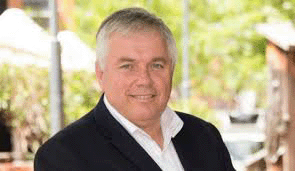
Last Friday, government solicitors acting for the Australian Submarine Agency sent me a warning against publishing some embarrassing information about their conduct.
Neither I (Rex Patrick) nor Michael West Media will be subject to their bullying, however.
The Australian Submarine Agency deals with high-level Defence secrets and fissile material, yet it has been caught ignoring security obligations while threatening Rex Patrick, who reports on their conduct.
by Rex Patrick | Feb 3, 2025, https://michaelwest.com.au/aukus-agency-reckless-on-nuclear-waste/
Last Friday, government solicitors acting for the Australian Submarine Agency sent me a warning against publishing some embarrassing information about their conduct.
Neither I nor MWM will be subject to their bullying, however.
The Australian Government has undertaken to accept responsibility for the spent nuclear fuel from our planned AUKUS submarines. This is no light undertaking. It’s more than a lifetime obligation; indeed,
it’s an obligation that will last tens of thousands of years.
The Government has announced that this high-level radioactive waste will be stored on Defence land.
As reported in MWM, in February 2023, the Australian Submarine Agency awarded a contract for nearly $400K to former Defence Department Deputy Secretary Steve Grzeskowiak to find a suitable Defence location
The very expensive irony that lurked behind this contract was the fact that Grzeskowiak had, when he was inside Defence, looked for a location on Defence land to store low-level radioactive waste and had been unable to find a suitable site.
According to Grzeskowiak, there wasn’t a single spot anywhere across the vast Defence estate that was suitable for storing low-level radioactive material. Yet he was now the go-to person who would, through some miraculous divination, find the Australian Submarine Agency a location across the very same territory.
Document request
In December 2023, I requested Mr Grzeskowiak’s report under our Freedom of Information laws. I was refused access on the basis the report was a Cabinet document.
But here’s the interesting thing. I knew that the report had been being worked on by multiple agencies, so I requested related documents from the Australian Nuclear Science and Technology Organisation (ANSTO), the Australian Radiation Protection and Nuclear Safety Agency (ARPANSA), Geoscience Australia (GA), the Department of Industry, Science and Resources (DISR) and the Department of Prime Minister and Cabinet (PM&C).
What those documents showed me was the report was not, at least until after I made my FOI request, developed on the Government’s CabNet+ system.
I’m now in a legal fight at the Administrative Review Tribunal, pressing my case for the report to be made public.
The Cabinet Handbook, the bible for Cabinet’s processes, makes it crystal clear that cabinet documents must be prepared on a special CabNet+ system.
The protective security framework of the Government also commands that Cabinet documents are stored on CabNet+.
Despite this, the Australian Submarine Agency didn’t do that.
Why? I can’t publish their evidence in the proceeding until the matter has been heard in the Tribunal, but what I can say is that it’s a case of reckless indifference to the rules.
It begs the question, will the Australian Submarine Agency also play fast and loose with the rules in relation to our highly classified data or our allies’ highly classified data?
“The Australian Submarine Agency is under a great deal of pressure to “get the job done”.
There are unquestionably a lot of unrealistic expectations coming down from the top. Will they follow the rules when it comes to nuclear safety, or will they bend and break the rules when they find it expedient to meet a politically driven objective?
Legal arguments
In their legal submissions, the Australian Government asserts: “The fact that the document was not created within the ‘CabNet’ system is not indicative one way or the other as to the intention of the authors.”
Actually, the rules of Cabinet are very strict. A document must meet two tests to qualify as a cabinet document 1) it must have been bought into existence for the dominant purpose of submission for consideration by the Cabinet, and 2) it must have been submitted to Cabinet.
I am satisfied it meets the second test but not the first.
To meet the first test the Government has to present objective evidence to the Tribunal that a minister so commissioned the document for consideration by Cabinet.
“They have not done so.”
And the fact that the document, in breach of the rules, just floated around on a government network not authorised to hold Cabinet documents for months on end will work against the Australian Submarine Agency in the end.
Hypocrisy
In response to insistence from Prime Minister Anthony Albanese that Peter Dutton should disclose the intended location of seven nuclear power stations, the Opposition Leader did so.
But Albanese is refusing to be transparent about the intended location of a high-level radioactive waste dump. His government wants to block public debate for as long as possible and then present people with a fait accompli.
It’s yet to be seen whether the Government will win on its claim that the report I’m after is a Cabinet document. But in the end, if it were determined that the report is that, there would still be nothing to stop Albanese from being true to his past rhetoric about the importance of government transparency and releasing the report to inform public debate.
“Australians have a right to know. The fact that the Prime Minister hasn’t already done this says a lot.”
For me, given that the Government has cautioned me against publishing details that reveal security incompetence inside the Australian Submarine Agency, I’ll wait for the knock on the door from the Federal Police. I’m not going to be intimidated.
There’s a vital democratic principle to be defended – the right to publish embarrassing information about government. The only way to protect that right, especially in the face of Government bullying, is to publish.
Dutton’s nuclear plan requires ‘huge’ new bureaucracy.
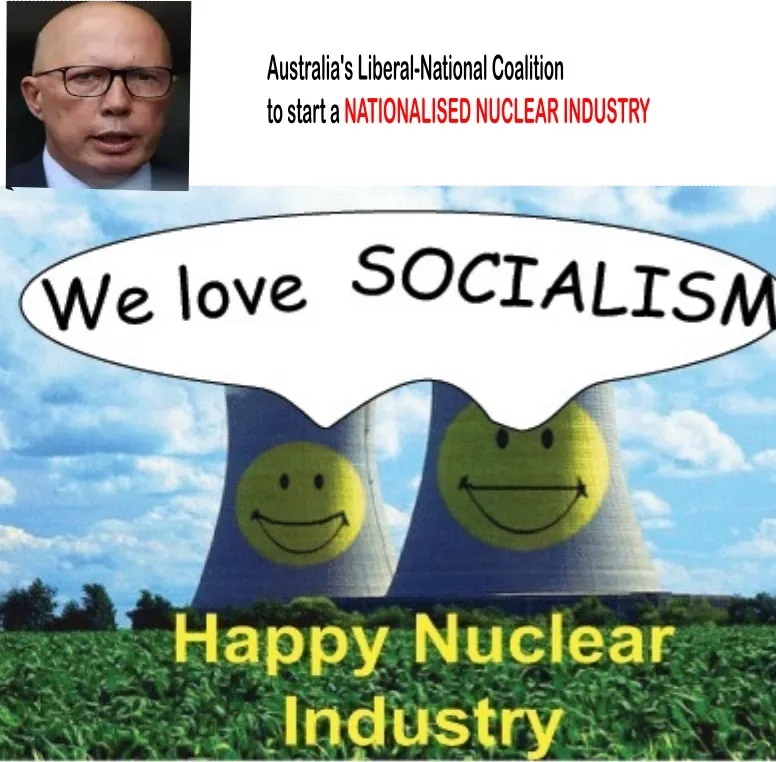
“Every single dollar spent on nuclear will come from the taxpayer. So of course, that will lead to a bureaucracy.
Opposition Leader Peter Dutton has criticised what he calls Labor’s “big government” approach and “wasteful” spending
A “huge” new bureaucracy, numbering thousands of extra public servant positions, would need to be created by the Coalition to establish and support an Australian nuclear power industry, according to the minister for public service, Katy Gallagher.
The proposal for a civil nuclear power program, as described by shadow energy minister Ted O’Brien last year, included “institutional architecture” that he said would entail an expansion of the regulatory agency, the Australian Radiation Protection and Nuclear Safety Agency (ARPANSA), a new independent nuclear energy coordinating authority and a government business enterprise to be called Affordable Energy Australia.
That architecture raises questions in the midst of the current opposition attacks on the growth and efficiency of the bureaucracy under the Albanese government. The Coalition’s election campaign push to cut government spending, sharpened by the nomination last week of Senator Jacinta Nampijinpa Price to lead a proposed efficiency department, has focused so far on paring back the public service.
The Coalition’s coal-to-nuclear strategy appears to defy that objective, as it requires building a large department “from scratch”, Gallagher tells The Saturday Paper. “We haven’t run state energy systems for so long,” the minister says. “It would be up there with departments like, you would think, Services Australia. Probably a bit smaller than the NDIA [National Disability Insurance Agency, Defence. It would be thousands of public servants.”
Gallagher likens the bureaucratic infrastructure for a nuclear power industry, which the Coalition has said would be taxpayer funded, to Labor’s creation of the Climate Change Department of more than 2500 staff. She expects more than that would be needed, including outside Canberra, for the Coalition plan to build its proposed seven nuclear power plants across five states.
“It would be planning, construction, safety, getting the skills. I don’t even know how you’re going to get the skills into that,” Gallagher said. “It’d be a lot of travel because you’re all around the country.”
Last year, O’Brien revealed that, under the Coalition’s plan, a coordinating authority would determine how much nuclear power is produced at each of the seven proposed sites before it enters the national energy mix.
“In terms of exactly how many on any plant, we’ll be leaving that to the independent nuclear energy coordinating authority,” he told the ABC’s Insiders last June. “It is right we want multi-unit sites. That’s how to get costs down.”
The shadow minister was not available for an interview. In response to emailed questions, O’Brien did not address the size of a civil nuclear power bureaucracy or the cost of expanding nuclear agencies and creating new ones, but acknowledged that “a highly skilled nuclear workforce will be paramount to ensuring the success of this plan”.
In his response, O’Brien gave more detail about the nuclear program, including outlines of private and public partnerships and a proposition to include the Australian Safeguards and Non-Proliferation Office (ASNO), which looks after Australia’s international treaty obligations.
“Experience is not cheap, because you’ll have to get it from overseas … we’ll be having to buy that in, at expense. You don’t just train someone up over a two-year period.”
“The ARPANSA legislation will be amended to allow the licensing and regulation of civilian nuclear facilities, including power stations,” the shadow minister said. “ARPANSA will have its resources increased to prepare to license the establishment projects and advice will be sought regarding the merits of regulatory consolidation of ARPANSA and ASNO.
“The independent Nuclear Energy Coordinating Authority will lead community consultation and manage a process to select experienced nuclear companies to partner with Government to deliver these projects.
“Affordable Energy Australia will be financed by the federal government through a combination of debt and equity and, through its partnership arrangements with experienced nuclear companies, will own, develop and operate the establishment projects.”
A former energy adviser to Britain’s Thatcher government says the Coalition is trivialising the bureaucratic support needed for a local nuclear power industry.
Greg Bourne, who is a former president of BP Australasia and is a councillor on the Climate Council, said the experience in the UK showed that the nuclear part of the electricity industry had to be regulated, as “no one commercially wanted it”.
He says established nuclear power countries in comparable democracies such as the United States have very large regulatory organisations rigorously covering issues such as skills, construction, safety, finance and radioactive waste.
“What you would need to do – almost certainly getting the people from overseas, building ARPANSA’s strength – it’s not a trivial act,” Bourne tells The Saturday Paper.
“They will have to build a complete set of public servants, for want of a better word, to be able to advise Department of Energy … on what can be done, what can’t be done, the pace at which it can be done and so on.”
The scale of the Coalition’s nuclear proposal, Bourne says, is obviously a far cry from Australia’s experience with its sole reactor, the 20-megawatt nuclear medical reactor at Lucas Heights in southern Sydney.
“We will have to buy experience. And buying experience is not cheap, because you’ll have to get it from overseas,” he says. “People will be coming in with different models. European models… a number of United States, Canadian models. They’ll all be coming in with different things, but we’ll be having to buy that in, at expense,” he says. “You don’t just train someone up over a two-year period.
“Lucas Heights is a very, very different thing. The people there are good. They understand what they’re doing. I do not think that [the Coalition] will be able to grab the head of the nuclear agency from Lucas Heights, and then that person will have credibility with two gigawatt-size reactors.”
The public service minister suggests that if the nuclear bureaucracy were to be added to the Department of Climate Change, Energy, the Environment and Water (DCCEEW), not only would the department need to be “a lot larger” but there would likely be “a huge consultant bill”, over decades. “You’d be paying for all of that before anything gets happening.”
The Albanese government, meanwhile, is moving to accelerate household electrification efforts, through a deal with the Senate crossbench to support Labor’s Future Made in Australia legislation. The government aims for 82 per cent of power to be sourced from renewable energy by 2030 – a plan the Coalition has derided as “unrealistic”.
Energy Minister Chris Bowen revealed this week he used ministerial powers at the end of last year to direct the Australian Renewable Energy Agency to consider funding solar panels and home batteries. However, the basis of Labor’s transition plan, Bowen says, is private-sector funded.
“Every single dollar spent on nuclear will come from the taxpayer. So of course, that will lead to a bureaucracy. Our plan is based on private-sector investment. Theirs is based on public investment and a bureaucracy,” the minister tells The Saturday Paper.
He points to the lack of detail in the Coalition’s planning, in contrast with its demands for more detail in the lead-up to the Indigenous Voice to Parliament vote: “They campaigned against an alleged government bureaucracy in the referendum, and they’re proposing at least two new government organisations.”
The Coalition’s plan to build seven nuclear power plants to replace Australia’s ageing coal-fired power stations is backed by a contested set of costings, prepared by Frontier Economics and released late last year, amounting to roughly $300 billion spread over 50 years. The modelling suggests the Coalition plan is $263 billion cheaper than Labor’s renewables proposal, but a wide range of economists have countered that the costings lack crucial information about how the figures were calculated, and are based on a scenario of dramatically lower energy use than is realistic.
The delays in getting the reactors on line have also drawn strong criticism. The opposition insists its plan, under the best-case scenario, would begin producing electricity by 2035, but this is five years earlier than the earliest estimate by the Australian Academy of Technological Sciences and Engineering, and assembling the necessary regulation and skills is a key component of that timeline.
The Coalition’s energy spokesman says the opposition’s civil nuclear policy is well formed and ready to start.
“[T]his policy follows the most comprehensive study ever undertaken by an Opposition, learning from experts in 10 nations about their decarbonisation policies while keeping prices down, the lights on and ensuring energy security,” O’Brien said in his statement.
“Upon entering government, the Coalition will be ready to implement a detailed energy policy immediately, informed by global best practices and established relationships.”
Opposition Leader Peter Dutton has criticised what he calls Labor’s “big government” approach and “wasteful” spending that he says has exacerbated inflation in the lead-up to an election that will be heavily focused on the cost of living.
His most cited example is the 36,000 additional Average Staffing Level places in the public service funded by Labor over three budgets.
The opposition leader now has four frontbenchers whose portfolios cover the public service, two of whom are solely tasked with zeroing in on waste and efficiency: Jacinta Nampijinpa Price and James Stevens.
While Dutton isn’t explicitly referencing as its inspiration the Elon Musk-led Department of Government Efficiency in the US, he’s elevating the mission within his ranks just as the Trump administration takes over. Australia’s richest person, Gina Rinehart, has long urged the Coalition to emulate the MAGA policy agenda.
“Our argument is to bring that role, that function, into [the Department of the] Prime Minister and Cabinet as a key central agency, and then to have the authority of Prime Minister and Cabinet to run the operation of senior efficiencies achieved across every department of the Commonwealth,” the Coalition leader told reporters in Perth on Tuesday.
“And that’s something that we would take very seriously.”
Dutton says Labor’s spending on public service positions is a question of “priorities”. Speaking to reporters in his electorate of Dickson last weekend, the opposition leader said, “That’s money that we could be spending elsewhere to provide support to people during Labor’s cost-of-living crisis, or into defence or into security and into priorities for Australians otherwise.
“I just don’t think any Australian can say that their lives are simpler or better off today because of the tens of thousands of additional public servants that the prime minister’s employed in Canberra.”
The plans for cuts have been flagged for at least six months.
“The first thing we’ll do is sack those 36,000 public servants in Canberra, that’s $24 billion worth,” Nationals leader David Littleproud told commercial radio station Triple M in August.
The figure for additional public servants equates to 20 per cent of the workforce, a boost that entailed rebuilding positions lost to more expensive outsourced labour. The cost cited by the opposition is over four years.
An audit, ordered by the Albanese government soon after the 2022 election, found that the Coalition government in the 2021-22 financial year alone spent $20.8 billion on almost 54,000 contractors and external providers. The bulk of the external labour was employed in the defence, social services and agriculture portfolios.
The 36,000 figure under the Albanese government, confirmed in federal budget papers, also covers Labor’s moves to rein in Centrelink and other government call centre waiting times, as well as additional staffing to reduce chronic backlogs in claims and visa processing times.
Gallagher, who is also finance minister, accepts that efficiencies remain to be made within government. She adds that $92 billion was saved over the past three Labor budgets and mid-year updates.
“We’ve had over $4 billion saved from not using consultants as much as the former government did,” the senator says.
She says there is an ongoing effort in explaining the worth and work of the public service.
“It’s always up to us to explain what we’re doing and why we’re doing it, but I would say to Peter Dutton, go and speak to a veteran who actually is getting their pension now, who’s getting their appropriate payment. There was a 40-month wait for people to get their pension,” she told reporters last week. “What he wants to pretend is that you don’t need anyone to do these jobs. Two thirds of these jobs are in the regions. They’re in every part of Australia.”
Dangerous climate radical, Lloyds of London, threatens the world economy

Look – the world authorities have got everything in hand. There should be no need to worry about that global heating nonsense. We learned at Climate Summits Cop 28 and Cop 29 that our shares in oil, gas, coal are going to continue OK. And now, the world’s leader, the USA is going to again withdraw from the landmark Paris climate agreement, so we can forget all that silly reductions emissions nonsense. And no more of our money to be grabbed by the United Nations Framework Convention on Climate Change.
Gee, America has just been saved from a “national energy emergency,” by President Trump’s foresight, with an executive order with its promise to “drill, baby, drill.” Saved in several other ways, such as removing incentives for electric cars.
Phew ! What a relief – as things can now go back to normal. We’ve really had the wool pulled over our eyes, by silly organisations like the UK Met Office, NASA. Copernicus in Europe, Berkeley Earth, U.S. Greenhouse Gas Center, the World Meteorological Organization, and The China Meteorological Administration.
All of these smartaleck bodies have very recently reported on climate change and its effects. The latest nonsense is in the January 15th Report from The World Economic Forum. Listing the top global risks, No.2 is Extreme weather events.
Now what would those elitists know – compared to the common-sense wisdom of a Donald Trump, a J.D. Vance, or a Peter Dutton? We don’t need to worry about all that complicated doom and gloom from academic old fogeys.
But one thing that bothers me is treachery. I’m talking about highly respected companies – in this case Lloyd’s of London, which apparently, in 2019 refused to reinsure some Canadian insurance companies. It is hard to find detail on this, but it was due to Canada’s succession of climate disasters – hurricanes, floods, wildfires, and extreme heat. Lloyds is the biggest global reinsurer, so could be said to have started, or at least accelerated a trend. In California from 2015-2019, insurers refused 350,000 policy renewals, because of the devastating wildfires. This trend is spreading to the reinsurance of insurance companies in other countries, including Australia.
Reinsurance companies nowadays adopt what is quaintly called “robust”underwriting decisions . In the most recent years, they’re assessing not only huge climate disasters, but also recognising smaller climate perils, like wind, hail or water damage. For areas at risk, they’re requiring preventative measures, insurance companies must charge more for homes in flood plains, wildfire-prone zones, or coastal areas at risk of hurricanes. So, insurance companies must comply, as they themselves need to be insured. Up go the premiums – for everybody – and especially those in the climate danger zones. . The current Los Angeles fires just add to the developing crisis in insurance. Insurance for many becomes unaffordable, – “It’s called the hardening of the market.”, and this flows on to mortgage costs. banks and stranded assets- threatening the overall financial sector.”
All this trauma is the result of Lloyds and others foolishly using the figures from The World Economic Forum, and those other bodies, and not paying proper attention to those who know the truth – of the non-existence or non-importance of global heating, top people – Donald Trump, JD Vance and Peter Dutton.
Climate researcher Paul Beckwith has set out the absurd climate claims: –
The World Economic Forum report preceding the Davos conference looks at global risks – with input from business leaders CEOs, scientists, and a wide range of academics- planetary risks over the next year or 2 and 5 years out. and 10 years out. The top risks by far are climate change risks, abrupt tipping points, extreme weather events – In 5 years more prevalent in 10 years they”ll dominate.
banks are in trouble too. In that chain of events, the stock bubble could blow up. Should we expect the unexpected: 2025 as the year of climate blow-back into the economy?
Climate scientists in America are thinking twice about whether to talk publicly about climate change. The Trump team has already demanded control over the next U.S. National climate assessment, due out in 2026 or 27. It is possible that the same concern about losing their jobs could affect Australian scientists, if Peter Dutton should win Australia’s federal election , due in a few months.
Former US beauty queen and nuclear energy expert Grace Stanke promotes nuclear in WA

“The perception from a lot of the community is they were using beauty to brainwash.”
By Kate Forrester, ABC South West WA
In short:
A campaign by proponents of nuclear have funded former Miss America and engineer Grace Stanke’s pro-nuclear tour of Australia.
Attendees say they had mixed emotions to whether or not the campaign message was what locals needed to hear.
What’s Next?
The tour, funded by Australian electronics mogul, Dick Smith will see the 22-year-old visit locations around Australia over the next week, to advocate for a nuclear future.
Nuclear energy advocates have begun a national tour to win the hearts and minds of coal towns promised nuclear facilities by the opposition.
Last year, federal opposition leader Peter Dutton identified seven sites across the nation to transition coal-fired power stations into nuclear power plants.
The South West town of Collie, 200 kilometres south of Perth, is one of seven sites identified by Mr Dutton.
Collie was the first stop on the campaign, spearheaded by former Miss America and nuclear fuels engineer Grace Stanke…………………………………..
One of the points the American presented to the crowd was jobs being transferable.
“I think for this town specifically, a lot of the skills current coal workers have can translate into a nuclear power plant or multiple power plants,” she said.
Differing opinions
Greg Busson, Secretary of the Mining and Energy Union, went to the meeting on Thursday night.
He disagreed with Ms Stanke’s position on jobs being transferable from coal to nuclear but said hearing another perspective was always worth it. ….majority of the workers I cover in Collie are coal miners. I don’t see where the link is there. They’ve never worked in a powerhouse.
“We don’t mine uranium, so where do those people fit in? What other industries are there that are linked to the nuclear industry that will give those coal workers comfort?”
Mr Busson said, looking around the hall, he thought a lot of the attendees had come from out of town.
“I think part of the problem is they portrayed Grace as a beauty queen, not just as a nuclear engineer,” Mr Busson said.
“The perception from a lot of the community is they were using beauty to brainwash.”…………………………………..more https://www.abc.net.au/news/2025-01-31/former-beauty-queen-grace-stanke-promotes-nuclear-in-wa-/104881056
Exploring Nuclear Energy Part 3: What Will Nuclear Power Mean for Australians?
The Coalition’s nuclear plan aims to reshape Australia’s energy future, but high costs, long construction times, and environmental concerns make its viability uncertain. Will nuclear power deliver stability or long-term challenges?
Nicole S, January 31, 2025
What is the Coalition’s plan for nuclear power?
The Australian Coalition, led by opposition leader Peter Dutton, has proposed integrating nuclear energy into Australia’s power grid. Their strategy involves repurposing existing coal power plant sites to house nuclear reactors, aiming for long-term energy security and emissions reduction.
Key features of the plan:
- Number of plants: Seven nuclear power plants are planned at current coal-fired power station sites.
- Locations: Expected to be in New South Wales, Victoria, Queensland, South Australia, and Western Australia.
- Timeline: The first plants are expected to be operational before 2040.
- Estimated cost: $331 billion for construction and infrastructure development.
- Comparative costs: Coalition claims its nuclear plan will be 44% cheaper than Labor’s renewable transition, which they estimate at $591 billion.
- Primary goal: Provide a stable, baseload power supply with lower emissions compared to fossil fuels.
- Job creation: Expected to generate thousands of jobs in engineering, construction, and nuclear facility operations.
Potential challenges and criticisms:
- High initial costs: Nuclear projects require large capital investment and can experience cost overruns.
- Long construction periods: With the first plants not operational until at least 2040, Australia will continue relying on fossil fuels for decades.
- Carbon emissions during transition: Reports estimate 1.6 billion tonnes of CO₂ emissions could be released between 2025 and 2051 due to prolonged coal and gas use before nuclear is fully integrated.
- Waste disposal: Australia currently lacks a high-level nuclear waste management facility.
- Public opposition: Surveys indicate strong resistance to nuclear power in some regions, particularly over safety and waste concerns.
The Coalition argues that nuclear energy is essential for Australia’s energy security and emissions reduction, but critics question whether the high costs and long timelines make it a viable alternative to renewables. According to their modelling, the plan would cost approximately $331 billion.
However, these estimates have been met with scepticism. Critics argue that the Coalition’s assumptions are overly optimistic, particularly regarding the projected costs of nuclear energy. For instance, the Coalition assumes nuclear energy can be supplied at $30 per megawatt-hour (MWh), while the CSIRO estimates a more realistic cost between $145 and $238 per MWh.
Additionally, the Climate Council has conducted independent analyses that suggest the Coalition’s nuclear plan could lead to at least $308 billion in climate pollution costs between 2025 and 2050 due to the prolonged reliance on fossil fuels during the transition period.
Therefore, while the Coalition has provided its own cost projections, these figures are subject to debate, with various organisations offering alternative estimates that highlight potential underestimations in the Coalition’s modelling.
Economic impact
If the Coalition wins the election and implements its nuclear energy plan, the economic impact on Australia will be substantial. The Coalition has proposed investing $331 billion to establish a domestic nuclear power industry over the next few decades. This includes constructing seven nuclear power plants by 2050 to replace aging coal-fired stations and ensure long-term energy security. Proponents argue that nuclear energy could stabilise electricity prices, create thousands of long-term jobs, and help Australia transition away from fossil fuels. However, critics warn that nuclear projects have significant upfront costs, long construction times, and potential cost overruns, which could place a financial burden on taxpayers.
Despite potential economic benefits, concerns remain about the feasibility and overall costs of nuclear power in Australia. A report by the Climate Council suggests that the Coalition’s nuclear plan could cost up to $490 billion more than expected and result in one billion additional tonnes of CO₂ emissions compared to alternative renewable energy strategies. Unlike solar and wind projects, which can be deployed quickly, nuclear plants take decades to become operational, delaying their economic benefits. Additionally, Australia would need to develop a regulatory framework for nuclear energy, including safety measures and waste disposal infrastructure, which could further increase costs. This has led to strong debates about whether nuclear energy is a viable economic option for the country.
With the information we have, let’s examine the predictions for Australia’s economy over the next 50 years.
1 This month.

Help Aunty Sue Protect Her Land and Sacred Sites From Destructive Rocket Testing.
.

Australians deserve the truth
about
AUKUS – https://aukuspublicinquiry.com/


PETITION – To: Prime Minister Anthony Albanese and the Australian Labor Government

of the week – Australians for War Powers Reform (AWPR)
To see nuclear-related stories in greater depth and intensity
 Antinuclear