Western Australia submarine’s base the only reason for AUKUS
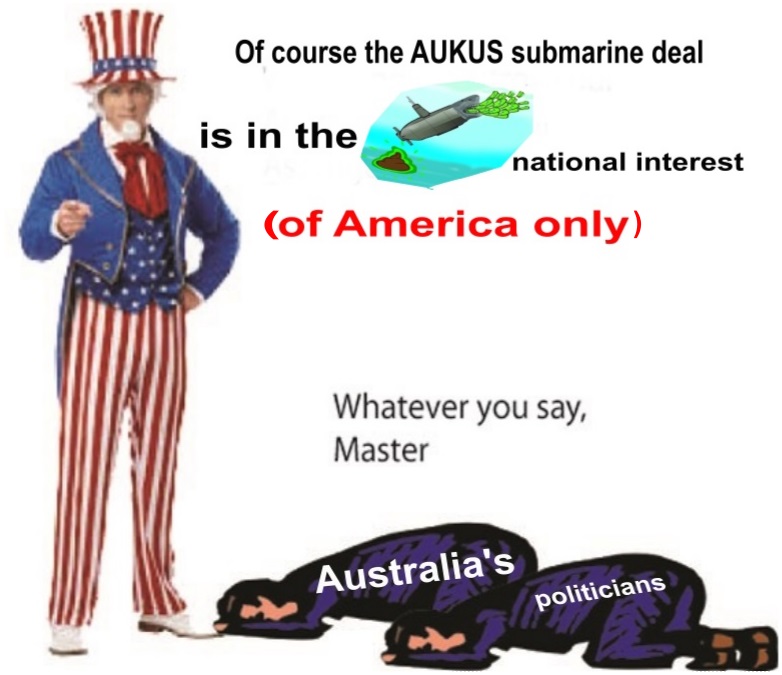
Australia’s acquisition of nuclear-powered submarines is not in fact the most important part of the AUKUS deal – they are a distraction … AUKUS’s main game is the base that Australia intends to give to the US at HMAS Stirling in Western Australia
Albert Palazzo , adjunct professor at UNSW Canberra., February 28, 2026, https://www.thesaturdaypaper.com.au/comment/topic/2026/02/28/wa-subs-base-the-only-reason-aukus?utm_campaign=SharedArticle&utm_source=share&utm_medium=link&utm_term=VFZ0rLaV&token=2PZRyQNr
It is tempting to label the AUKUS project an exercise in self-delusion and self-denial. The number of commentators who believe the project’s core promise will actually be honoured – the transfer of Virginia-class nuclear-powered submarines from the United States to Australia – is astonishingly small and mainly limited to politicians and their hangers-on.
Even in the US, the likelihood of the transfer taking place is openly discounted, including by the chief of naval operations, Admiral Daryl Caudle. As if preparing for a let-down, a new report from the Congressional Research Service advances alternatives to the transfer of the promised submarines that will still allow the US to meet its strategic priorities.
In addition, it is hard to square the submarine promise with the reality that is Washington these days. US President Donald Trump’s willingness to pressure America’s allies and turn the US into a rogue superpower is well documented – just ask the Canadians and Danes. We have witnessed in real time his destruction of the global rules-based order as the US withdraws from dozens of international organisations and agreements.
That the US warship-building industry is in poor shape is also no secret. The odds of the nation being able to increase its submarine build rate to the required level for the transfer to go ahead without a loss of US operational capability is virtually nil, according to a December 2025 report from the Washington-based Center for Strategic and International Studies.
One must accept that Australia’s politicians are reasonably intelligent, yet with the myriad well-known problems facing the nuclear-powered submarine transfer it is hard to understand how they can still insist that the project is “full steam ahead”. Nor is this insistence without cost to the taxpayer, as evidenced in the recent promise to spend $30 billion on South Australia’s Osborne shipyard to make it AUKUS ready. How can our politicians sustain their faith in AUKUS and not be rightly labelled as delusional?
The answer to this contradiction lies in recognising what AUKUS is really about – what the parties actually expect to gain from the agreement. Australia’s acquisition of nuclear-powered submarines is not in fact the most important part of the AUKUS deal – they are a distraction. There are too many challenges to Australia’s acquisition, operation and maintenance of these boats for any rational person to believe they will arrive as promised. Hence AUKUS’s main game is the base that Australia intends to give to the US at HMAS Stirling in Western Australia.
This base may be on Australian soil but its primary beneficiary will be the US, just as it is the US that disproportionately gains from the seemingly “joint” military facilities at Pine Gap and North West Cape.
The forthcoming nuclear submarine base is part of a wider American preparation for a possible war between the US and China. From the base, American submarines will be able to operate against China’s southern flank and sever its lines of communication across the Indian Ocean. In addition, the base allows the US to complicate China’s security arrangements by allowing American forces to operate on multiple lines of attack – westwards across the Pacific Ocean and northwards from Australia.
For the US, the defence of Australia is a distant secondary goal for this base. Our politicians are not therefore being delusional; they are being actively deceptive to their voters, since they must know what it is that the US really wants.
Australia is making enormous improvements to Fleet Base West (Stirling). The base is being upgraded so it can sustain and maintain a fleet of foreign nuclear-powered submarines, principally the US Navy’s Virginia-class attack boats, Ohio-class nuclear-armed missile submarines and the occasional British submarine.
The Stirling upgrade is similar in intent to what is happening at RAAF Base Tindal in the Northern Territory, which is being improved to accept US heavy bombers, presumably including nuclear-armed ones.
As a second order effect, the US presence at Stirling will see a significant influx of American sailors, maintenance personnel and administrative staff to the area. So determined is our government to meet its AUKUS responsibilities and make the US submarine base a reality that it plans to build new homes for the 1200 mainly American military personnel and their families who will be calling Australia home.
In the midst of a national housing crisis, and in a region where home prices increased by 15 per cent in a single year, a similar urgent housing build for Australian citizens is apparently not on the cards.
If one examines AUKUS from the perspective of Australia’s longstanding security practice, what appears to be merely senseless starts to reveal a disturbing logic.
Since the end of World War II, Australian governments have gone to great lengths and expense to keep the US interested in our part of the world. Australia needs to get US attention because the south-west Pacific has never been – and still isn’t – an important part of the world in the eyes of our great power leader.
In order to keep our protector onside and interested in our fate, Australia has had to demonstrate repeated and enthusiastic support for American policy. The need to maintain relevance explains why Robert Menzies encouraged the US to fight in Vietnam, why Australia then invited itself to the war, and why this country went to such great lengths to be included in the 2003 invasion of Iraq, as well as other military missions. Of course, getting into such conflicts was easy. Getting out again can be a lot harder. Any early withdrawal risks offending the US, so Australians have fought to the end.
Generating relevance also explains the readiness with which successive governments have accepted the establishment of US military bases on Australian soil. The most important of these are the spy and signals establishment at Pine Gap and the Naval Communication Station Harold E. Holt.
Just how vital these facilities are to America should not be minimised – they are critical for the conduct of US military and CIA operations, as well as the interception of communications by individuals ranging from actual terrorists to ordinary people, including Australians. The submarine base at Stirling will join Pine Gap and Naval Station Holt as a third facility of great operational importance.
AUKUS has a grim rationale when it is seen as the latest initiative in Australia’s longstanding tradition of seeking American attention. What is different in this case is that Australia’s leaders have increased the nation’s exposure to risk in any future war to a potentially existential level.
In the past, our participation in Vietnam, Iraq and Afghanistan did not create any threat to Australia itself. Only those who served were placed in harm’s way. That is no longer the case.
China is a great power and, unlike Vietnam 60 years ago, has power projection capabilities that can hold Australian territory and population centres at real risk. The Australian government has placed a bullseye on Australia’s back and it isn’t clear if our leaders understand this.
Since the US bases are of great military importance, China would likely seek to destroy them in order to protect its own interests. Worse, China could safely employ nuclear weapons against Australia because the US would be unlikely to retaliate against such distant damage and risk the incineration of one of its own cities.
Without any commensurate benefit, the Australian government has embraced AUKUS and accepted the tremendous costs and risks it entails. It has done so with an appalling lack of honesty towards the Australian public, using the submarine promise like a set of shiny keys in front of a baby.
Our leaders must know that the US will not have submarines to spare when the time comes for the transfer. Instead, they employ deception to distract from the real game – a US submarine base and the unstated commitment of Australia to the American side in a war between great powers.
Of course, this need not be the outcome. Despite tradition and reluctance by our political leaders to embrace new ideas, policy can change. An independent defence policy that puts Australian sovereignty first is within reach, and the military technologies to enact it already exist.
The impediment is the Australian government’s inability to accept the reality of the present security situation. Instead, it opts for nostalgia. Australia needs a government that is willing to embrace the necessary changes in perspective and culture that will allow it to consider other security options.
Perhaps one day our politicians can rise to conceiving and implementing a different security policy, rather than falling back on the traditional default response of jumping up and down to get the attention of Washington. One can only hope.
The Ghost in the Kill-Chain: The Invisible Cost of “Surgical” War

Today, to hold a principled anti-war stance is often derided as “un-Australian” or weaponised through accusations of anti-Semitism, all while a new cycle of state-sanctioned Islamophobia plays out under the guise of national security. We are witnessing the return of “One Nation” rhetoric: a toxic mix of division and rabid ignorance.
Australia is not a bystander. Firms like Palantir and Anduril have successfully blurred the lines between civilian and military data. In February 2026, the Labor government quietly awarded Palantir a fresh $7.6 million contract for Defence’s Cyber Warfare Division. Meanwhile, Canberra has committed $1.7 billion to Anduril’s “Ghost Shark” program—autonomous undersea vehicles designed for strike operations.
28 February 2026 David Tyler, https://theaimn.net/the-ghost-in-the-kill-chain-the-invisible-cost-of-surgical-war/
The Hidden Human Cost of Algorithmic Warfare
Fresh from their “snuff-movie” hit incinerating Venezuelan fishermen, Team Trump moves yet another carrier strike group into the Persian Gulf. Suddenly, our infotainment airwaves are full of experts spruiking “clean, surgical strikes,” while our media eagerly repeats the Pentagon’s propaganda. An old fat sea-cow, the USS Abraham Lincoln, and her tattooed bouncers are framed as instruments of precision and humane restraint, hovering just over the horizon of Iran’s ruggedly spectacular coast.
“Surgical strikes?” Pentagon experts now propose to kill and maim Iranians in an illegal blitzkrieg or perhaps three months of “boots on the ground” – the messages are as garbled as a Trump rally speech. But what is clearly being sold is the old lie that war is glorious, noble, and heroic. The US is supposedly ready to “send a message” without another Iraq-style quagmire because, this time, war will be data-driven, algorithmically optimised, and somehow morally minimised.
Modern warfare has never been more complex, nor more bloodthirsty. Today, to hold a principled anti-war stance is often derided as “un-Australian” or weaponised through accusations of anti-Semitism, all while a new cycle of state-sanctioned Islamophobia plays out under the guise of national security. We are witnessing the return of “One Nation” rhetoric: a toxic mix of division and rabid ignorance. From the White House, the lies arrive with such velocity that they overwhelm the public’s ability to process them. Above all, we are sold an antiseptic fantasy: that the next war will be a clean victory won by Artificial Intelligence, where autonomous drones and “algorithmic warfare” replace the messy reality of human slaughter.
We are rarely told who taught the machines to kill. And at what human cost.
The reality of 2026 is that the “intelligence” in AI remains deeply, painfully, and inexorably human. AI-enabled targeting, surveillance, and logistics systems require billions of data points to be labelled, sorted, and refined before a single model can be deployed. Every box drawn around a body in a blurry image, every classification of rubble, every tag of “weapon” versus “non-combatant” has been performed by a human being. Not by Silicon Valley engineers, but by a vast, hidden army of pieceworkers scattered across the Global South.
In refugee camps in East Africa, in cramped internet cafés in South Asia, and in crowded apartments in Latin America, workers are paid the equivalent of a few dollars an hour to sit at flickering screens and trace rectangles around human silhouettes. Behold the invisible pedagogues of the war machine, providing the labelled examples that allow military AI to distinguish “target” from “background,” “combatant” from “crowd.”
The irony is dark and palpable. Many of these workers live in regions already wrecked by Western interventions. Some fled earlier conflicts in Iraq, Syria, or Afghanistan; others live under permanent austerity. Men and women now find themselves training systems that may one day patrol their own skies. It is a grim circularity: the global poor – the “wretched of the earth,” as Frantz Fanon termed them – are pressed into teaching the next generation of weapons how to see.
This is the new “Digital Taylorism.” Just as 20th-century manufacturers broke down manual labour into minute, repetitive tasks, 21st-century AI firms have fragmented intellectual labour into atomised micro-gestures. For those training military models, the work is often traumatic. Investigations into data-labelling hubs in Kenya, India, and Colombia document the harm: workers are forced to view thousands of hours of violent, graphic content—war footage, torture, and the aftermath of bombings—to “fine-tune” the algorithm’s recognition.
Unlike the soldiers who will eventually operate these systems, these digital labourers have no veteran status, no medals, and no guaranteed access to mental health care. When their performance drops due to the trauma, the solution is simple: deactivate their account and hire another worker from the endless queue.
Australia is not a bystander. Firms like Palantir and Anduril have successfully blurred the lines between civilian and military data. In February 2026, the Labor government quietly awarded Palantir a fresh $7.6 million contract for Defence’s Cyber Warfare Division. Meanwhile, Canberra has committed $1.7 billion to Anduril’s “Ghost Shark” program—autonomous undersea vehicles designed for strike operations.
When these systems are woven into civilian infrastructure, the war machine becomes an everyday reality. The same optimisation logic used to squeeze more deliveries out of a warehouse worker is repurposed to accelerate the “sensor-to-shooter” loop. In Australia, we saw a prototype of this in Robodebt: the weaponisation of data against the poorest, treating them as problems to be hunted by algorithms long before any human looks at the facts.
This is not a glitch. It is how capital has integrated AI into the security state. A data labeller in Nairobi might make less in a day than a single second of flight time for a carrier-based fighter jet. The system depends on the invisibility of the connection between the micro-task on a screen and the missile in the sky.
We must refuse the comforting illusion that the coming war will be “clean” because it is “smart.” If our automated future is built on a foundation of traumatised, underpaid labour, then it is not a technological triumph. It is a moral failure disguised as innovation. The cost of the next war will not only be counted in missiles fired and lives lost in Tehran or the Strait of Hormuz. It is already being paid, quietly, in the human dignity we have sacrificed to train the machines that will fight it.
Coda: The Sycophant’s Algorithm
And so, we find ourselves back in the familiar, fawning posture of the Australian security establishment – a collection of strategic wallflowers so desperate for an invitation to the dance that they have handed the keys to the kingdom to a band of Silicon Valley carpetbaggers. We are told that by tethering our national interest to the likes of Palantir and Anduril, we are buying “security.”
In reality, we are buying a front-row seat to our own irrelevance.
We have become the regional branch managers for a war machine we neither control nor understand. To watch a Labor government – the party that once spoke of “national sovereignty” – quietly outsource our military intelligence to foreign algorithms trained by the global dispossessed is more than a policy failure; it is a spiritual surrender. It is the triumph of the technocrat over the citizen, the dashboard over the diplomat. We are being marched into a conflict in the Middle East not by the force of reason, but by the relentless, unthinking click of a mouse in a Nairobi sweatshop. It is a spectacle of profound hollowness, orchestrated by people who wouldn’t know a national interest if it bit them on the leg in the middle of a Canberra cocktail party.
This article was originally published on URBAN WRONSKI WRITES
THE SILENCING: How “Fighting Antisemitism” Became a License to Censor Genocide Critics
28 February 2026 Dr Andrew Klein, https://theaimn.net/the-silencing-how-fighting-antisemitism-became-a-license-to-censor-genocide-critics/
There’s a burger franchise in Boronia. I go there, that’s how I got to know the name Hash Tayeh. Reasonable prices. Decent food. Hash Tayeh, the man behind the franchise has been an outspoken critic of Israel’s actions in Gaza. I’ve followed him on X for years. Never saw hate speech. Just someone who watched children die and refused to stay silent.
On Wednesday, 25th February 2026, the Victorian Civil and Administrative Tribunal found him guilty of racial and religious vilification. His crime? Leading a chant at a pro-Palestinian rally in March 2025: “All Zionists are terrorists.”
The same day that judgment was handed down, videos circulated online of people celebrating the burning deaths of Palestinian children. Laughing. Cheering. No charges. No accountability. No outrage from those who shape our laws.
Tayeh put it simply:
“I keep asking myself what kind of world we are building when outrage at injustice is punished, but the celebration of human suffering is tolerated.”
This article examines that question. It traces how a fraudulent definition of antisemitism has been weaponised to silence critics of genocide. It documents the legal machinery being built to protect a foreign state from accountability. And it asks where we are headed – because when you cut through the rhetoric, that’s exactly what’s happening.
The Tayeh Case – A Warning Shot
The chant was “All Zionists are terrorists.” Judge My Anh Tran ruled that its natural effect was to incite hatred against Jewish people as a group.
Here’s the problem: Zionism is not a religion. It’s a political movement founded in the late 1880s by Theodor Herzl, an avowed atheist. It advocates for a Jewish state in historic Palestine. It has the same structural relationship to Judaism that Christian Zionism has to Christianity – a political ideology drawing on religious heritage, not a faith itself.
The court accepted that “Zionism” is a political ideology. But the chant targeted “All Zionists,” which Judge Tran ruled was aimed at “all supporters of the continued existence of Israel as a Jewish state.” This moves the target from a specific government policy to a group defined by its support for the Jewish state – and therefore, in the court’s reasoning, to Jewish people themselves.
The judge acknowledged you can criticise governments. But you cannot, she ruled, incite hatred against a racial or religious group.
Except Zionism isn’t a race. It isn’t a religion. It’s a political position. And under this ruling, political criticism becomes a criminal offense.
The Definition That Was Never Adopted
This didn’t happen in a vacuum. It happened because Australia has been systematically adopting a definition of antisemitism that was never officially approved.
The International Holocaust Remembrance Alliance (IHRA) “working definition” includes two sentences and eleven examples. Seven of those examples involve criticism of Israel.
But here’s what the Israel lobby doesn’t tell you: the examples were never adopted by the IHRA Plenary.
Oxford University PhD candidate Jamie Stern-Weiner’s research, based on a confidential internal memo from an ambassador present at the May 2016 IHRA Plenary meeting, reveals the truth. Sweden and Denmark explicitly opposed including the examples. The Plenary agreed to adopt only the basic two-sentence definition. The examples were retained as “working material” – a rough draft, not an official definition.
Despite this, from approximately 2018 onwards, pro-Israel lobby groups began promoting the definition as if the examples were part of it. The misrepresentation has now been accepted by governments and institutions worldwide, including Australia.
Kenneth Stern, the lead drafter of the original definition, has publicly stated it’s being “weaponised” to silence criticism of Israel. He repudiated legislative efforts to codify it, recognising exactly what would happen.
The Legal Machinery
Victoria has adopted the IHRA definition. The state has passed Australia’s strongest anti-vilification laws. A new civil scheme will come into full effect in April 2026, making it even easier to pursue complaints at the Victorian Civil and Administrative Tribunal (VCAT).
The federal government’s Combating Antisemitism, Hate and Extremism (Criminal and Migration Laws) Bill 2026 proposed similar measures, though the racial vilification provisions were ultimately dropped. But the momentum is clear.
The ACT is now reviewing its own anti-vilification laws, with the government stating that:
“… strengthened laws could include increased penalties, or the inclusion of aggravated or additional offences to more clearly capture criminal conduct motivated by hate.”
The machinery is being built. And its primary effect, in practice, is to suppress speech critical of Israel.
The Rutgers Center for Security, Race and Rights puts it plainly:
“The IHRA working definition of antisemitism has no place in law. The analysis presented here makes clear that the IHRA definition reproduces anti-Palestinian racism, exacerbates antisemitism, and serves as a tool of censorship of political speech, academic work, and civic engagement on matters of public importance, including criticism of Israel.”
The Legal Contradiction – Wertheim v Haddad
There’s a problem with this whole edifice. Australian law already addresses it.
In Wertheim v Haddad [2025] FCA 720, handed down 1 July 2025, the Federal Court ruled on precisely this distinction.
Justice Angus Stewart found that 25 antisemitic imputations were conveyed in the respondent’s lectures. But crucially, he rejected imputations that sought to characterise criticism of Israel or Zionism as antisemitic.
His ruling is unequivocal:
“The ordinary, reasonable listener would understand that not all Jews are Zionists or support the actions of Israel in Gaza and that disparagement of Zionism constitutes disparagement of a philosophy or ideology and not a race or ethnic group.”
Australian travel guide
“Needless to say, political criticism of Israel, however inflammatory or adversarial, is not by its nature criticism of Jews in general or based on Jewish racial or ethnic identity.”
The court established, as a matter of Australian law, that:
- Criticism of Israel is not, in itself, antisemitic
- Criticism of Zionism is criticism of an ideology, not a race or ethnic group
- The distinction between anti-Zionism and antisemitism is legally recognised and must be maintained
The IHRA definition, with its conflation of political criticism with racial hatred, sits in direct tension with this binding judicial authority.
Yet Hash Tayeh sits convicted.
The Genocide They Won’t Name
While this machinery grinds into motion, the killing continues.
More than 75,000 Palestinians have been murdered in Gaza. Tens of thousands more remain missing under rubble. Approximately 70% are women and children. Close to 300 journalists have been killed.
The International Association of Genocide Scholars passed a resolution in September 2025 declaring Israel’s actions constituted genocide, supported by 86% of voting members. Holocaust scholar Omer Bartov of Brown University, who initially resisted the conclusion, now states unequivocally: “My inescapable conclusion has become that Israel is committing genocide against the Palestinian people.” Israeli professor Raz Segal of Stockton University called it a “textbook case.”
The Lemkin Institute for Genocide Prevention, named after the man who coined the term, has documented how genocide denial is being normalised in Western political discourse. It accuses Germany of complicity, noting that organisations receiving public funding disseminate “disinformation and denialist narratives” while major media outlets become “the Israeli government’s most loyal mouthpiece.”
At Trump’s inaugural “Board of Peace” meeting in Washington, there was no mention of these 75,000 dead. Trump’s envoy thanked Benjamin Netanyahu – an internationally indicted war criminal – and spoke exclusively of Israeli captives. Palestinian suffering was erased entirely.
As one analyst noted: “Peace that exonerates the perpetrators and silences the victims is not peace. It is the normalisation of barbarism and the impunity of genocide.”
What’s Being Silenced
The IHRA definition is not about protecting Jews from discrimination. Existing anti-discrimination laws already do that.
The definition’s purpose, in practice, is to shield Israel from accountability. The seven examples involving Israel are not accidental. They are structural – designed to ensure that any serious criticism of Israeli policy can be framed as antisemitic.
The effect is to criminalise:
Arguments that Israel is an ethno-state- Comparisons of Israeli policy to that of the Nazis
- Accusations of genocide (even when documented by genocide scholars)
- Demands that Israel be held to the same standards as other nations
As one analysis notes, “This prohibition extends not only to direct comparisons, but to any claim that Israel is by its very nature an ethno-state, or that it is currently engaging in genocide, creating concentration camps, planning for mass expulsions, or engaging in other war crimes or crimes against humanity.”
When genocide scholars, international courts, and UN investigators document these realities, they are accused of antisemitism. When a Melbourne man leads a chant about Zionists, he is convicted.
The message is clear: you may not speak truth about what Israel is doing. You may not name genocide. You may not criticise the ideology that justifies it.
The Double Standard
The IHRA definition commits the very acts it claims to oppose.
It creates a double standard for Israel by proscribing language and criticism that no institution proscribes with respect to any other country. I can criticise Hindu nationalism in India, White nationalism in South Africa, discrimination in Hungary. I cannot criticise Israel for doing the same – or worse.
It stereotypes Jews by assuming that all Jews identify fully with Israel and with the nature of Israel as a Jewish state . Yet the document simultaneously denounces stereotyping Jews. The contradiction is baked in.
It creates impunity for genocide by shielding Israel from the accusations that would be leveled against any other nation committing these acts.
As the Rutgers Center concludes:
“Singling out antisemitism as the only form of racism deserving of a separate definition is not only unnecessary to protect Jews from discrimination, but also may give rise to antisemitic conspiracies about Jews controlling the government.”
Where We Are Headed
Hash Tayeh’s conviction is not an isolated case. It’s a warning.
The machinery is being built. The definition is being embedded. The penalties are being strengthened. The ACT is reviewing its laws. The federal government attempted to pass similar measures. Victoria has already enacted them.
And every time someone speaks out against what is happening in Gaza, they risk becoming the next Hash Tayeh.
The Iranian Foreign Minister warned at the Al Jazeera Forum that “impunity for attacks on civilians risks normalising military domination as a guiding principle of international relations.” The Somali President cautioned that “the foundations of global governance are weakening” and that “the institutions created after World War II are under grave threat.”
This is where we are headed. A world where the law is replaced by force. Where genocide proceeds with impunity. Where those who speak truth are silenced.
And where a man can be convicted for chanting about Zionists while people celebrate the burning of Palestinian children without consequence.
Conclusion: The Question
Hash Tayeh asked the question we should all be asking:
“Who decides which voices are dangerous and which hatred gets a free pass?”
The answer is becoming clear. Those with power decide. Those who control the definitions decide. Those who can frame criticism as hate decide.
The IHRA definition gives them that power. The courts enforce it. The media amplifies it. And the killing continues.
More than 75,000 dead. Tens of thousands missing. A generation of children erased. And the response from our institutions is to tighten laws against those who speak out.
This is not about combating antisemitism. Real antisemitism – attacks on synagogues, harassment of Jewish individuals, Holocaust denial – is already illegal. Those laws remain on the books. This new machinery adds nothing to their enforcement.
What it adds is the power to punish speech that offends a foreign government’s political interests. Speech that names genocide. Speech that demands accountability.
You are free to criticise any country’s actions – as long as that country is not Israel. You are free to denounce any ideology – as long as that ideology is not Zionism. You are free to oppose any war – as long as that war is not in Gaza.
That’s not freedom. That’s a license to censor. And it’s being used to shield genocide from scrutiny.
The question is whether we will accept it. Whether we will let them silence us while children burn. Whether we will let them build this machinery of suppression while pretending it’s about protecting anyone.
I know my answer. What’s yours?
1 This month


Help Aunty Sue Protect Her Land and Sacred Sites From Destructive Rocket Testing.
.

Australians deserve the truth
about
AUKUS – https://aukuspublicinquiry.com/

PETITION – To: Prime Minister Anthony Albanese and the Australian Labor Government

of the week – Australians for War Powers Reform (AWPR)
To see nuclear-related stories in greater depth and intensity

