Australian nuclear news headlines
Australian nuclear news this week
- Ode to a Compassionate Warrior
- 20 May – Webinar – The dangerous world of AUKUS, US, military occupation and suppression of dissent
- Why Australia Defence Spending Priorities Matter
- AUKUS submarine builds hit by contract and construction delays
- Where are the AUKUS nuclear waste costings (let alone the dump sites)?
- Australian Political Futures: Is Balancing Optimum Defence Self-Reliance with National Sovereignty Really Possible within US Global Hegemony?
- The Merchants of Death in Our Midst.
- Caps Off: How Mark Hammond’s Appointment Completes Labor’s Capture by Uncle Sam and the AUKUS Boondoggle.
What secret report reveals about British nuclear weapons tests – veterans claimed they were harmed by the fallout
Christopher R. Hill, Professor of History, Faculty of Business and Creative Industries, University of South Wales, Jonathan Hogg, Senior Lecturer in Twentieth Century History, School of Histories, Languages and Cultures, University of Liverpoo, l April 15, 2026 https://theconversation.com/what-secret-report-reveals-about-british-nuclear-weapons-tests-veterans-claimed-they-were-harmed-by-the-fallout-280189
“The Ministry of Defence has always maintained that it never rained,” said Ken McGinley, founder of the British Nuclear Test Veterans Association (BNTVA). “I’m sorry, you’re liars … I was there!”
McGinley, who was a royal engineer, gave this interview in January 2024, shortly before his death, as part of our Oral History of British Nuclear Test Veterans project.
McGinley was present during the Grapple nuclear weapons test series, conducted by the UK on the central Pacific island of Kiritimati (also known as Christmas Island) in the late 1950s. At the time, this remote atoll was inhabited by 250 villagers as well as thousands of British servicemen.
For decades, many of those present during this and other above-ground British nuclear weapons tests have argued they were harmed by radioactive fallout. McGinley founded the BNTVA in 1983 to “gain recognition and restitution” for the veterans who took part in British and American nuclear tests and clean-ups between 1952 and 1965.
Rain became a key symbol in their argument as one of the only tangible signs of fallout taking place. The nuclear physicist Sir Joseph Rotblat described these alleged post-blast showers as “rainout”, a phenomenon whereby rain and mushroom clouds interact, leading to the contamination of rain droplets by harmful radionuclides.
In almost all cases, any link to subsequent health issues has been denied by the UK government because of lack of evidence of widespread radioactive contamination. However, a review of the evidence – written in 2014 by anonymous government scientists in response to freedom of information requests – was recently leaked by whistleblowers.
It reveals that post-blast radiation readings increased by a factor of up to seven on the island, compared with the normal background level. In our view, this would be more than enough to satisfy the “reasonable doubt” that tribunals require for veterans to receive a war pension due to illness or injury related to their service, as stated in the Naval, Military and Air Forces (Disablement and Death) Services Pension Order.
The top secret review, first revealed publicly by the Mirror newspaper on March 14 2026, also contains new evidence of radioactive contamination of fish in the island’s waters.
The repeated dismissal of veterans’ testimony in court cases and pension appeals caused stress and trauma for many. The majority died insisting they were not deceitful or forgetful – and that it did indeed rain while they were living on Kiritimati.
Factually inaccurate’
Kiritimati was monitored for fallout by the Ministry of Defence (MoD) after each detonation over the island – the largest of which, Grapple Y, was 200 times more powerful than the bomb dropped on Hiroshima.
In 1993, environmental monitoring data was collated into a report by a team at the MoD’s Atomic Weapons Establishment (AWE). Known as the Clare report, this informed the UK’s official position on fallout: namely, that none occurred over populated areas and that veterans would need to prove otherwise to secure redress.
However, the 2014 review of fallout data concluded the Clare report was “incomplete and, in some cases, factually inaccurate”.
Despite this review being passed on to the MoD, however, it was kept secret for more than a decade. Following its release, the legal implications could be gamechanging. According to the 2014 review: “The instrument readings could potentially be used to challenge the validity of statements made by MoD and UK government regarding … fallout on Christmas Island.”
In a recent House of Commons debate on the issue, the UK minister for veterans and people, Louise Sandher-Jones, confirmed her commitment “to the nuclear test veterans and their fight for transparency … They have had a very long fight, and I really recognise how difficult it has been for them, and I want them to understand that I am committed to them.”
What Merlin reveals
Behind the scenes, the release of newly declassified archival material in the publicly accessible Merlin database has added to calls for government accountability about the nuclear tests.
Compiled by the treasury solicitor during a class action against the MoD between 2009 and 2012, the database was stored at AWE until the journalist and author Susie Boniface discovered it held information about the medical monitoring of servicemen and Indigenous people. Her work led to its release in 2025.
Holding over 28,000 files, Merlin was commissioned by the MoD in response to the compensation claims made by almost 1,000 veterans from 2009. Its contents include official reports and communications, photographs, maps, safety guidelines and health monitoring information. Video footage includes the Grapple X test in November 1957.
A University of Liverpool team based in The Centre for People’s Justice and the Department of History is working with Boniface and campaign group Labrats International to catalogue and analyse the contents of Merlin – combining it with other sources, including personal testimony. Recently released files indicate nuclear fallout in the island’s ground sediment and rainwater, and heightened radioactivity in its clams.
Evidence has also emerged of radioactive waste being dropped from aeroplanes into the sea off Queensland in 1958 and 1959. Although dumping radioactive waste was surprisingly common during the cold war, this revelation raises questions about how risk and danger was understood and managed during Britain’s nuclear test programme.
The files also show workers without protective clothing around a plutonium pit at Maralinga in South Australia, site of seven British atmospheric nuclear tests in 1956-57.
The Merlin releases have galvanised claims that not so long ago may have been interpreted as conjecture. The recent releases suggest that servicemen and islanders were exposed to radioactive fallout – not just from rain showers, but from the fish they ate and the water they drank.
While a causal link with subsequent health conditions would be hard to prove, we believe it is time for the UK government to get behind a public inquiry into the full impact of Britain’s nuclear weapons testing programme.
Who’s making money? The arsenal trade after Ukraine and Iran
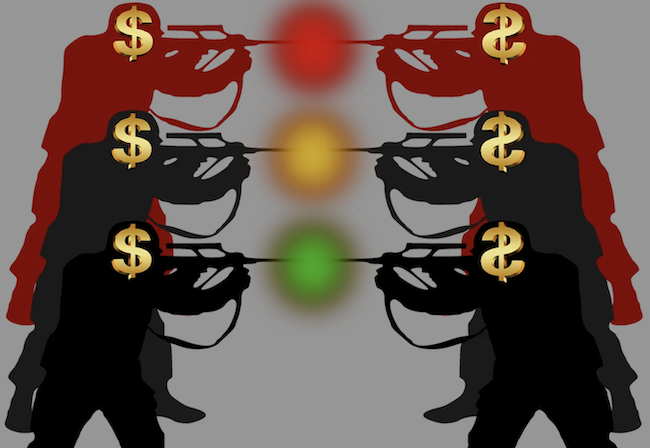
By Vince Hooper | 15 April 2026, https://independentaustralia.net/life/life-display/whos-making-money-the-arsenal-trade-after-ukraine-and-iran,20929
Defence is no longer a defensive trade, and nowhere is the question of who’s buying, who’s building, and who is being left behind more apparent than in Australia, writes Professor Vince Hooper.
Markets, missiles and the end of the peace dividend — and what it means for Australia
A South Korean missile-maker most Western investors could not have located on a map two years ago has just hit an all-time high. LIG Nex1, a precision-guided munitions and electronic warfare specialist headquartered in Yongin, has nearly quadrupled from its January 2025 base, touching 899,000 won on 6 March 2026 — days after American and Israeli aircraft struck Iranian nuclear and missile facilities.
The Korean defence sector as a whole has returned roughly 137 per cent over the past year. These are not the numbers of a sleepy industrial cyclical. They are the numbers of an asset class being repriced in real time.
Defence is no longer a defensive trade. It is the trade. And nowhere is the question of who is buying, who is building, and who is being left in the queue more pointed than in Australia.
Canberra in the queue
For Australia, the arsenal trade is not an abstract market story. It is a mirror.
AUKUS is now a procurement queue rather than a strategy and the cost of waiting for Virginia-class submarines while the Indo-Pacific darkens is becoming uncomfortable to discuss in polite company.
Canberra is, in effect, paying premium prices for late delivery, while Korean and Japanese yards offer shorter timelines at lower cost.
Hanwha’s confirmed 19.9 per cent strategic stake in Austal, cleared by both the Committee on Foreign Investment in the United States (CFIUS) and Canberra’s Foreign Investment Review Board (FIRB) by late 2025, the Henderson shipyards build-up (now known as the Australian Marine Complex), the AS9 Huntsman self-propelled howitzer program being built by Hanwha at Avalon, near Geelong are not coincidences. They are the early signs of an Australian defence industrial base quietly rotating away from Anglosphere dependence and towards Asian arsenals that can actually deliver.
The strain is visible in real time. As the Sydney Morning Herald reported last week, Canberra’s first crisis call during the Middle East escalation went to Beijing rather than Washington — a reflex inversion that would have been unthinkable a decade ago and that tells you more about the perceived reliability of the American guarantee than any AUKUS communiqué.
The ASX has noticed even if the cabinet has not: DroneShield, Electro Optic Systems, Codan and Austal have all attracted the kind of investor attention that only arrives when a market decides a sector’s tail risks have permanently thickened.
From cost centre to industrial darling
The Ukraine War did the structural work. It converted defence from a politically awkward line item into the most fashionable corner of industrial policy and it taught Western treasuries an uncomfortable lesson about how thin their magazines actually were. Three years of artillery duels in the Donbas drained stockpiles NATO had quietly assumed would last a generation.
The Middle East conflict is the second shock. Patriot interceptors, Terminal High Altitude Air Defense (THAAD) reloads, Iron Dome Tamirs, SM-3s, 155mm shells, loitering munitions — each salvo over the Gulf is, in accounting terms, a revenue recognition event somewhere in Arizona, Alabama, Haifa or Daejeon. Governments that spent the 2010s running down inventories on the assumption of a benign world are now writing cheques to rebuild them, and they are writing those cheques into the same handful of balance sheets.
Who, specifically, is making money
Four tiers are visible.
First, the American primes — Lockheed Martin, RTX, Northrop Grumman, General Dynamics, L3Harris. They capture the replenishment contracts, the integration work, and the multi-year framework agreements that Congress now waves through with rare bipartisan enthusiasm. Their backlogs are at record highs and, after two decades of monopsony complaints, their pricing power has quietly inverted.
Second, the European awakening — Rheinmetall, BAE Systems, Leonardo, Saab AB, Thales. Germany’s Zeitenwende turned out to be real, and Rheinmetall in particular has become the continent’s de facto shell foundry, trading less like an industrial stock and more like a leveraged proxy on NATO’s Article 5 itself.
Third, and most interesting from where Australia sits, the Asian arsenals — Hanwha Aerospace, Korea Aerospace Industries, Hanwha Systems and the LIG Nex1 of the opening paragraph, alongside Mitsubishi Heavy Industries and Kawasaki in Japan. South Korea has done what Europe spent 30 years failing to do: build a deep, exportable, price-competitive defence industrial base with delivery times measured in months rather than decades.
Warsaw noticed first. Riyadh, Canberra and Cairo are noticing now. Israel’s own Elbit, Rafael and IAI sit alongside them as the technological pace-setters, particularly in air defence and electronic warfare, where the Iran exchange has been a brutal but effective live-fire showcase.
Fourth, the invisible compounders — the propellant chemists, the rare-earth magnet refiners, the speciality steel mills, the gallium nitride foundries, the International Traffic in Arms Regulation (ITAR) cleared software shops, the maritime insurers writing war-risk cover on Hormuz transits at multiples of last year’s premium. This is where the quiet fortunes are being made. Lynas Rare Earths, sitting on one of the few non-Chinese heavy rare earth supply chains in existence, belongs in this tier, whether the market has fully priced it in or not.
The Gulf parallel
For the Gulf Cooperation Council (GCC), the calculation is different and more cynical than Australia’s, but the underlying logic is the same. Every Gulf capital is simultaneously a customer, a forward operating base, and a potential target. Sovereign wealth is rotating accordingly — not away from defence, but into it. Saudi Arabia, in particular, is building domestic primes such as the Synchronised Accessible Media Exchange (SAMI) — wholly owned by the Public Investment Fund and openly targeting a place in the global top 25 defence companies by 2030.
The export of security capacity has become a new instrument of influence and the capital flows track the doctrine more faithfully than any white paper. Australia, with its Henderson precinct ambitions and its Hanwha partnership, is on a milder version of the same curve.
The uncomfortable coda
None of this is a celebration. A rising LIG Nex1 share price is, in the end, a market-implied judgement that more young people in more places will be killed by better-engineered weapons. The honest analyst names that trade-off rather than hiding behind the chart.
But the honest analyst also tells the truth about incentives. The Ukraine War did not enrich defence contractors by accident and the Iran strikes will not either. Governments that spent a generation treating deterrence as a sunk cost are now paying the bill they should have been paying all along and the firms holding the order books are, predictably, getting rich.
CNN reported over the weekend that U.S. intelligence believes China is preparing to deliver shoulder-fired air defence missiles (MANPADS) to Iran during the current ceasefire — a claim Beijing has formally denied. If the reporting holds, that single fact reframes the arsenal trade as an explicit great-power contest rather than a Western replenishment cycle — and it makes every defence ministry from Canberra to Riyadh recalculate how long it can afford to wait in the AUKUS queue.
For Australia, the question is sharper than for most. Canberra can keep waiting for Virginia-class boats and hoping the phone in Washington still gets answered, or it can do what Warsaw and Riyadh have already done — back the arsenals that can actually deliver, and accept that strategic autonomy in 2026 looks less like an alliance white paper and more like a procurement contract with Daejeon, Tokyo, Henderson or Geelong.
The post-Cold War peace dividend has been spent. What replaces it is already listed, already trading and already on the front page. The only open question is whether Australia is reading the same page as the rest of the market.
Professor Vince Hooper is a proud Australian-British citizen and professor of finance and discipline head at SP Jain School of Global Management with campuses in London, Dubai, Mumbai, Singapore and Sydney.
Amid the Iran chaos, war over Taiwan just became less likely

by Marcus Reubenstein | Apr 15, 2026, https://michaelwest.com.au/amid-the-iran-chaos-war-over-taiwan-just-became-less-likely/
Last week’s meeting between Beijing and Taiwan’s main opposition leader is a bad sign for the China hawks and a sign of rapprochement. Marcus Reubenstein reports.
The combination of the US-Israel war on Iran and the anti-China media narrative in Australia has meant the visit of the leader of Taiwan’s main opposition party, Cheng Li-wun, to China has largely been ignored. Cheng chairs the Kuomintang (KMT) party, and she spent five days in mainland China from the 7th until the 12th of April.
Her public pronouncements indicate a belief that it is not in Taiwan’s interest to pin all of its hopes on an economic and military alliance with the US, and its future is better served with a pivot towards Beijing.
A significant proportion of Taiwan’s population does not want armed conflict with China. More importantly, Taiwan’s political leaders are acknowledging the fact that the US is becoming an increasingly unhinged and unreliable ally.
As reported by NBC News, Cheng points to Ukraine, saying,
“People do not want to see Taiwan become the next Ukraine.”
Add to that mix that Taiwan gets 70% of its oil from the Middle East, there is sentiment in Taiwan that the US bombing of Iran has been disastrously thought out and delivers Taiwan massive economic pain. Will Taiwan risk becoming the centrepiece of a future US military disaster?
In December, Cheng told the New York Times, “Could it be the United States is treating Taiwan as a chess piece, a pawn strategically opposing the Chinese Communist Party at opportune times?”
Taiwan’s ruling DPP (Democratic Progressive Party) had attempted to push a $US40B arms deal with the US through parliament in March, but that was sunk by Cheng’s KMT. The ruling DPP was eventually able to get a deal worth just $US11B through – around one third of an AUKUS submarine.
Cheng’s China visit
The visit to China by Taiwan’s opposition leader took in three very significant cities, Nanjing, Shanghai and Beijing. Shanghai and Beijing, as financial and political capitals, were logical, but Nanjing is of great historical significance.
She visited the Sun Yat‑sen Mausoleum in Nanjing with a large Taiwanese delegation, a site honouring the founding father of the Republic of China, revered in both Taiwan and mainland China. Nanjing is also the site of one of Japan’s greatest wartime atrocities, the so-called Rape of Nanjing.
A small number of hardline figures in Japan’s ruling LDP continue to deny Japanese participated in any wartime atrocities. The LDP’s newly elected prime minister, Sanae Takaichi, stating that Japan would send in its military to aid Taiwan in any conflict with China, has dramatically escalated tensions between Beijing and Tokyo.
Takaichi is one of Japan’s most pro-US leaders, and Cheng’s visit to Nanjing would not be lost on the US. By extension, Cheng’s point of visiting Nanjing could be seen as a backhanded message to Japan, which hosts 55,000 US troops, to stay out of Taiwan’s affairs.
Implications for Australia
Cheng’s trip to China has implications for Australia and our foreign policies towards both our biggest trading partner and most important strategic partner.
The Albanese government has gone all in on the US’s East Asia military push, and now the US is showing clear signs of stress. The US has redeployed Thaad missile systems from South Korea to fight its war with Iran, while supercarrier naval vessels based in Japan, and operating in the South China Sea, have also been sent to the Gulf. Despite being the greatest military power in global history, it’s obvious it doesn’t take much to wear US forces thin.
Neither Prime Minister Anthony Albanese, Foreign Minister Penny Wong, nor Defence Minister Richard Marles has deviated from Australia’s blind support for the US war on Iran.
The question is, will they follow the US into an inevitably disastrous war against China or, worse still, act as a proxy in a future war?
Australia’s tilt towards offensive military capability, also enthusiastically supported by the LNP opposition, and the billions committed to submarines which may never arrive, do not augur well.
If the US cannot defeat Iran, there is no path to victory against an equally determined China, far better equipped, with the world’s second largest economy, and that is not a pariah state.
1×1515
2:54 / 8:51
1×1515
0:16 / 8:51
Last week’s meeting between Beijing and Taiwan’s main opposition leader is a bad sign for the China hawks and a sign of rapprochement. Marcus Reubenstein reports.
The combination of the US-Israel war on Iran and the anti-China media narrative in Australia has meant the visit of the leader of Taiwan’s main opposition party, Cheng Li-wun, to China has largely been ignored. Cheng chairs the Kuomintang (KMT) party, and she spent five days in mainland China from the 7th until the 12th of April.
Her public pronouncements indicate a belief that it is not in Taiwan’s interest to pin all of its hopes on an economic and military alliance with the US, and its future is better served with a pivot towards Beijing.
A significant proportion of Taiwan’s population does not want armed conflict with China. More importantly, Taiwan’s political leaders are acknowledging the fact that the US is becoming an increasingly unhinged and unreliable ally.
As reported by NBC News, Cheng points to Ukraine, saying,
People do not want to see Taiwan become the next Ukraine.
Add to that mix that Taiwan gets 70% of its oil from the Middle East, there is sentiment in Taiwan that the US bombing of Iran has been disastrously thought out and delivers Taiwan massive economic pain. Will Taiwan risk becoming the centrepiece of a future US military disaster?
In December, Cheng told the New York Times, “Could it be the United States is treating Taiwan as a chess piece, a pawn strategically opposing the Chinese Communist Party at opportune times?”
Taiwan’s ruling DPP (Democratic Progressive Party) had attempted to push a $US40B arms deal with the US through parliament in March, but that was sunk by Cheng’s KMT. The ruling DPP was eventually able to get a deal worth just $US11B through – around one third of an AUKUS submarine.
Cheng’s China visit
The visit to China by Taiwan’s opposition leader took in three very significant cities, Nanjing, Shanghai and Beijing. Shanghai and Beijing, as financial and political capitals, were logical, but Nanjing is of great historical significance.
She visited the Sun Yat‑sen Mausoleum in Nanjing with a large Taiwanese delegation, a site honouring the founding father of the Republic of China, revered in both Taiwan and mainland China. Nanjing is also the site of one of Japan’s greatest wartime atrocities, the so-called Rape of Nanjing.
A small number of hardline figures in Japan’s ruling LDP continue to deny Japanese participated in any wartime atrocities. The LDP’s newly elected prime minister, Sanae Takaichi, stating that Japan would send in its military to aid Taiwan in any conflict with China, has dramatically escalated tensions between Beijing and Tokyo.
Takaichi is one of Japan’s most pro-US leaders, and Cheng’s visit to Nanjing would not be lost on the US. By extension, Cheng’s point of visiting Nanjing could be seen as a backhanded message to Japan, which hosts 55,000 US troops, to stay out of Taiwan’s affairs.
Implications for Australia
Cheng’s trip to China has implications for Australia and our foreign policies towards both our biggest trading partner and most important strategic partner.
The Albanese government has gone all in on the US’s East Asia military push, and now the US is showing clear signs of stress. The US has redeployed Thaad missile systems from South Korea to fight its war with Iran, while supercarrier naval vessels based in Japan, and operating in the South China Sea, have also been sent to the Gulf. Despite being the greatest military power in global history, it’s obvious it doesn’t take much to wear US forces thin.
Neither Prime Minister Anthony Albanese, Foreign Minister Penny Wong, nor Defence Minister Richard Marles has deviated from Australia’s blind support for the US war on Iran.
The question is, will they follow the US into an inevitably disastrous war against China or, worse still, act as a proxy in a future war?
Australia’s tilt towards offensive military capability, also enthusiastically supported by the LNP opposition, and the billions committed to submarines which may never arrive, do not augur well.
If the US cannot defeat Iran, there is no path to victory against an equally determined China, far better equipped, with the world’s second largest economy, and that is not a pariah state.
Respected US political scientist Professor John Mearsheimer says, US President Donald Trump’s war with Iran is “manna from heaven” for China. He argues the war on Iran has made the US an irresponsible stakeholder in the international system and that China looks like the “adults in the room.”
China’s carrot and stick
China’s approach to Taiwan, and more broadly to much of its global diplomacy, has been a mix of carrot and stick. Beijing is still dangling carrots in front of Taiwan. Reunification with Taiwan remains the endgame,
“but the overwhelming desire is that it should be achieved peacefully.”
Cheng was warmly received by Chinese President Xi Jinping, and following Cheng’s visit, the Chinese government announced a list of ten new policies to promote economic and travel initiatives to strengthen ties between Beijing and Taiwan.
In the background, a looming stick could be an easily achievable Chinese blockade of commercial shipping around Taiwan. As Iran’s blockade of the Strait of Hormuz demonstrates, it doesn’t take a great deal of military firepower to cripple an economy.
What would, or could, Australia do to intervene? Hypothetically, that is a question which may face Australia, but a reconciliation, indeed possible unification between Taiwan and China, would render moot Australia’s current strategic policy.
Taiwan’s future?
While opinions in Taiwan about Cheng are divided, she has a realistic chance of becoming Taiwan’s next president at the 2028 election. To win, she doesn’t only have to run on China policy; there are plenty of domestic issues facing voters. Also, there is no suggestion that a reunified Taiwan would be considered as a province of China. Instead, it would become a special administrative region, citizens would keep their Taiwanese passports, and the New Taiwan Dollar would remain the official currency.The line in the sand for Beijing would be separatist movements and their sympathisers speaking out publicly. Taiwan would also be prohibited from entering into any military alliances or agreements with other nations.
While this is the same set of conditions imposed on Hong Kong, Taiwan hardly has a tradition of democracy. For its first four decades as a territory, it was governed under martial law, and it wasn’t until 1996 that democratic presidential elections were held.
Current president, Lai Ching-te, is unpopular with his approval rating sinking to 33% in late 2025, having recovered to the low 40% mark in the most recent polls. Cheng’s approval rating is lower, reflecting the distrust Taiwanese people have for their political leaders.
In terms of specific issues, concerns over the economy rank first for Taiwanese voters.
The Chinese, that is to say those of Chinese ethnicity, are by and large very pragmatic. Cheng is betting on a belief that close ties with China represent the future and that the
“Taiwanese people will come to distrust Washington more than they distrust Beijing.”
1 This month
17 October, Free Public Talk on Nuclear Issues in South Australia
David Noonan will speak on public interest concerns over the new Roxby Downs Indenture Act 2026 on BHP copper-uranium mining and ore processing in SA, and on how AUKUS may face SA with a High-Level nuclear waste agenda.
Dr Jim Green will discuss international developments in the field of nuclear power including ‘small modular reactors’ and Generation 4 ‘advanced’ nuclear reactor concepts.


Help Aunty Sue Protect Her Land and Sacred Sites From Destructive Rocket Testing.
.

Australians deserve the truth
about
AUKUS – https://aukuspublicinquiry.com/

PETITION – To: Prime Minister Anthony Albanese and the Australian Labor Government

of the week – Australians for War Powers Reform (AWPR)
To see nuclear-related stories in greater depth and intensity

