Australian nuclear-related news – week to 2nd May
- Royal commission report doesn’t help us start making sense of Bondi terror attack
- ‘Critical time’: Minister’s ominous nuclear warning as US looks to resume tests.
- Antisemitism Royal Commission dilemma: not all Jews think the same
- The Enforcement- The lobby that bought Australian democracy
- PETITION – To: Prime Minister Anthony Albanese and the Australian Labor Government No Nuclear Weapons in Australia
- 19 May – Webinar- Webinar: No Nuclear Weapons in Australia
- Antisemitism and Israel: A challenge to the Australian narrative.
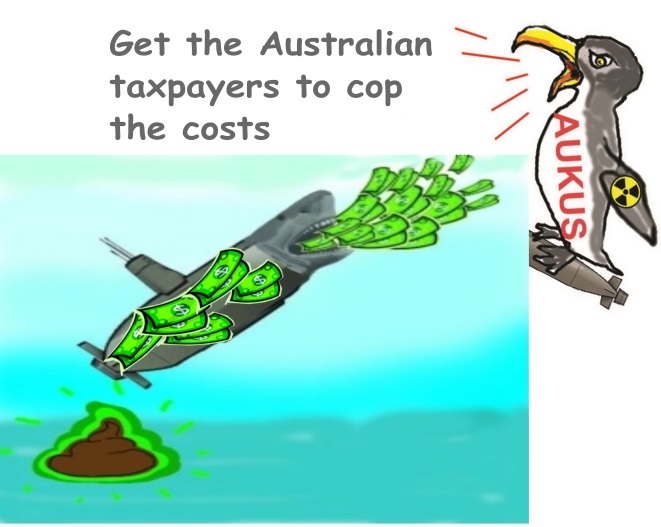
- How AUKUS is Becoming the Largest Wealth Transfer in Australian History – and Why the Government Won’t Tell You the Cost .
- UK parliament’s AUKUS inquiry report questions if Britain can keep nuclear submarine promises.
- Australia’s “Antisemitism Envoy” Makes It Clear That Israel’s Critics Are The Real Target.
- Built to fail? The National Anti-Corruption Commission (NACC): the integrity body undermined from within
- From Welfare to War: Following the 2007 Money Trail
Who Decides What Is a Just War? Imperial Violence and the Lies We Tell About Peace
Anzac Day and the Forgotten Treaty of Lausanne
Moreover, a coincident anniversary—25 April, Anzac Day in Australia—made me think of some eerie similarity. This central day in Australian war memorial practice marks the defeat of British imperial forces, including over 8,000 Australian deaths, at Gallipoli in 1915. Churchill ordered the amphibious assault to secure control of the Dardanelles and Turkish Straits, and knock the Ottoman Empire, which controlled what Westerners think of now as the Middle East, out of the First World War. The grandiose, reckless plan failed; perhaps like the USA’s assault on the Hormuz Strait.
The conflict between the British, European and American empires and the Ottoman empire was central to the causes and course of World War One, if often forgotten in the West. Two lingering effects of this contention are widely known: the Balfour Declaration, which made a dishonest promise of states for Israel and Palestine, and the Sykes-Picot Agreement, which parcelled out the ‘Middle East’ between the British and the French to defeat Arab nationalism.
But less known is that this conflict did not end in 1918, nor by the Peace of Versailles. In the years 1919 to 1923, the British Empire punched on to secure what was denied Churchill at Gallipoli. They fought to expand their empire while “a general crisis of European control was well under way across much of Asia” (Darwin, After Tamerlane, p. 382). The extended “small wars” of World War One continued to the Treaty of Lausanne in 1923. This “remarkable compromise” recognised Türkiye as an independent republic, defined the political geography of West Asia that is still with us, before oil was what mattered in the Middle East (the region produced 1 per cent of world output in 1920, and 5 per cent in 1939, principally from Iran)
Apr 25, 2026, Burning Archive, Jeff Rich,
Sooner or later, histories of colonisation, and decolonisation, must deal with the question of violence. So much depends, in history, on how the experience of violence is ordered collectively as war, empire, memory and resistance.
“Decolonisation is always a violent phenomenon,” declared Frantz Fanon. It may be right, from the beginning. As described in the climax of this month’s Book Club history, Magellan met a violent death at the hands of the resistance in the Philippines . . . and in revenge for his own unhinged violence and holy man madness.
But, on the other hand, Gandhi preached and practised non-violence, although there were fierce debates across the Indian independence movement about the question of when is violent rebellion justified. Still, more than any single individual, Gandhi has inspired people to believe that empires can be dismantled by peaceful means.
Violence and the “small wars” or “anticolonial uprisings” of the colonial frontier will be my theme for the next two weeks in this extended Season on Decolonisation.
I am spacing my reflections out over two weeks. Why? Three reasons.
Firstly, violence is challenging to write about in this time of war and unrestrained violence in many places. I am opening up a difficult conversation here, with no intent to close it after just one week.
Secondly, there is an important history book on imperial violence that I wanted to share, but it may best be done over a couple of weeks, including through sharing this week an interview with the author, conducted by Jeffrey Sachs.
Thirdly, I did two big interviews on these themes this week—with Jamarl Thomas and Pascal Lottaz— and wanted to share my reflections, beyond the recorded talk, on these topics of violence, our world crisis as a process of likely violent decolonisation, and lessons from history about how the USA empire is disintegrating.
Coincidentally, the Anzac Day memorial prefigures all three themes.
Anzac Day and the Forgotten Treaty of Lausanne
Moreover, a coincident anniversary—25 April, Anzac Day in Australia—made me think of some eerie similarity. This central day in Australian war memorial practice marks the defeat of British imperial forces, including over 8,000 Australian deaths, at Gallipoli in 1915. Churchill ordered the amphibious assault to secure control of the Dardanelles and Turkish Straits, and knock the Ottoman Empire, which controlled what Westerners think of now as the Middle East, out of the First World War. The grandiose, reckless plan failed; perhaps like the USA’s assault on the Hormuz Strait.
The conflict between the British, European and American empires and the Ottoman empire was central to the causes and course of World War One, if often forgotten in the West. Two lingering effects of this contention are widely known: the Balfour Declaration, which made a dishonest promise of states for Israel and Palestine, and the Sykes-Picot Agreement, which parcelled out the ‘Middle East’ between the British and the French to defeat Arab nationalism.
But less known is that this conflict did not end in 1918, nor by the Peace of Versailles. In the years 1919 to 1923, the British Empire punched on to secure what was denied Churchill at Gallipoli. They fought to expand their empire while “a general crisis of European control was well under way across much of Asia” (Darwin, After Tamerlane, p. 382). The extended “small wars” of World War One continued to the Treaty of Lausanne in 1923. This “remarkable compromise” recognised Türkiye as an independent republic, defined the political geography of West Asia that is still with us, before oil was what mattered in the Middle East (the region produced 1 per cent of world output in 1920, and 5 per cent in 1939, principally from Iran). It demilitarised the Straits, which became the foundation of the 1936 Montreux Convention, which some commentators have proposed as a model to resolve the disputes over the Hormuz Strait (as I discussed in my interview with Pascal Lottaz). It set the course for the modern history of Türkiye, and new forms of imperial colonialism in Egypt, the Levant, Iraq and Iran.
This forgotten, crucial treaty came to mind this week because of those connections with the small forgotten wars of colonialism, the resolution of our contemporary wars in West Asia, and a paradox that is often overlooked when commentators make cartoon comparisons of British and US American hegemony. 1923 was the high noon of British empire, when it controlled more territory than at any other time. The British made their empire great again by making the Middle East, but before the oil wells provided much return on investment. It was a paradoxical success, an imperial Pyrrhic victory. As John Darwin wrote,
Once the brief excitement of war imperialism had passed, there was little enthusiasm for an Arab empire in either Britain or France – especially one that was going to cost money. If the Middle East’s partition was the high tide of empire, it was the tide that turned soonest, the imperial moment that was shortest.
Darwin, After Tamerlane, p. 387
It was for this reason that, in my interview with Jamarl Thomas, I compared the USA’s current dark time of brutalist expansionism to this brief high tide of the British Empire.
Violence, Empire and Decolonisation
“Decolonisation is always a violent phenomenon,” declared Frantz Fanon in The Wretched of the Earth after years of the Algerian War of Independence. He did not live to see an alternative, but his tract still inspires believers in armed resistance to settler colonialism worldwide.
But was Fanon’s decree a rationalisation of bitter revenge? Was it a militant’s rallying cry for others to sacrifice their lives for a national cause? Was it another poet-psychiatrist’s elaborate projection of shadows, not more defensible than the ethnic cleansing of Radovan Karadzic? Did Fanon succumb to mimicry of imperial Manichean violence, as Nietzsche warned?
“Whoever fights monsters should see to it that in the process he does not become a monster. And if you gaze long enough into an abyss, the abyss will gaze back into you.”
Friedrich Nietzsche, Beyond Good and Evil (1886)
Reading The Wretched of the Earth inspires many who identify as belonging to an ‘axis of resistance’ or anti-imperial struggle. But it does chill my blood. The text is haunted by the violence of Fanon’s colonial oppressors………………………………………………………………………………………………………………………………………………………………………………………………………………………………………………. https://jeffrich.substack.com/p/who-decides-what-is-a-just-war-imperial?utm_source=post-email-title&publication_id=247469&post_id=195185147&utm_campaign=email-post-title&isFreemail=true&r=1ise1&triedRedirect=true&utm_medium=email
20 May – Webinar – The dangerous world of AUKUS, US, military occupation and suppression of dissent
Confronting laws restricting/suppressing protest speech and action
20 May 6.30 pm AEST.
A new Federal Police unit has been created which will impact on protesting against AUKUS.
The AUKUS AFP Command has been established under the Australian Federal Police (AFP), in conjunction with the Department of Defence. The AUKUS AFP Command’s powers cover the security of AUKUS operations, extending to wider US military activity elsewhere. Its activities are of considerable concern since among its roles is “Public Order Management” listing of “munitions” which include tear gas, pepper spray, rubber bullets and real firearms.
Is this the Australia we want for ourselves, our children and the world?
Since 2003 and 9/11 a raft of laws have been passed by successive Australian governments attacking our civil and democratic rights, including freedom of speech and political protest. Some of these laws have been used against the environment movement.
More laws have been passed recently aimed at suppressing the huge upsurge of outrage against Israel’s genocide in Gaza, including draconian anti-protest laws in several states, and “hate laws” by the Federal Government.
More widely, protests are arising from concern with the huge diversion of public money for the AUKUS war pact and its nuclear submarines away from urgent social needs including the climate crisis. Communities and environmentalists are concerned with nuclear exposures. There is growing opposition to AUKUS embedding Australia in another US-led war, possibly a nuclear war.
These public concerns extend to the increasing US military footprint across Australia, enabled by the 2014 Force Posture Agreement.
Australian people have a proud history spanning 170 years of collectively on mass opposing and defying oppressive anti-democratic laws. From the 1854 Eureka rebellion, the countless strikes by workers and their unions, against conscription and unjust wars, against the Vietnam and Iraq wars, and defending the environment.
This is a webinar you cannot afford to miss. BOOK HERE
The outstanding line up of speakers (below) will be supported by short contributions from anti-AUKUS activists on the ground where AUKUS submarine activities are taking place or proposed/expected to take place.
Facilitator: Kelli Tranter
Ex-Sen.Rex Patrick, Lawyer Nick Hanna, Arthur Rorris, Jorgen Doyle…………………………………………………………………… https://events.humanitix.com/the-dangerous-world-of-aukus-and-us-military-occupation
1 This month
17 October, Free Public Talk on Nuclear Issues in South Australia
David Noonan will speak on public interest concerns over the new Roxby Downs Indenture Act 2026 on BHP copper-uranium mining and ore processing in SA, and on how AUKUS may face SA with a High-Level nuclear waste agenda.
Dr Jim Green will discuss international developments in the field of nuclear power including ‘small modular reactors’ and Generation 4 ‘advanced’ nuclear reactor concepts.


Help Aunty Sue Protect Her Land and Sacred Sites From Destructive Rocket Testing.
.

Australians deserve the truth
about
AUKUS – https://aukuspublicinquiry.com/

PETITION – To: Prime Minister Anthony Albanese and the Australian Labor Government

of the week – Australians for War Powers Reform (AWPR)
To see nuclear-related stories in greater depth and intensity

