How AUKUS is Becoming the Largest Wealth Transfer in Australian History – and Why the Government Won’t Tell You the Cost
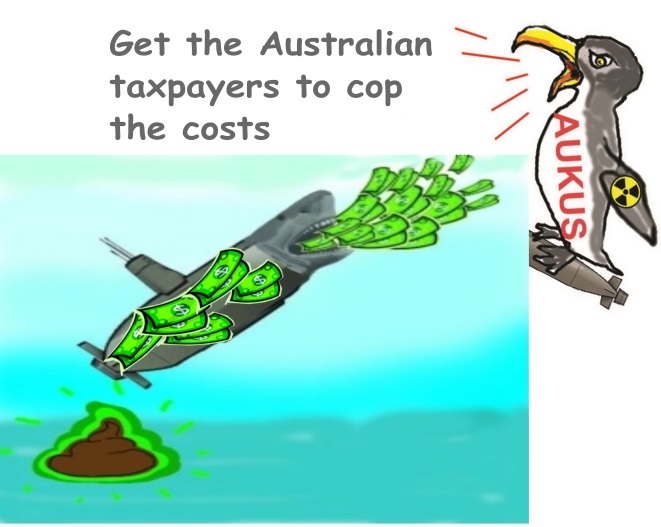
Under the revised AUKUS agreement, Australia will be liable for any problems or losses associated with disposing of nuclear waste. If something goes wrong, Australia pays. The liability is indefinite. The waste will remain hazardous for tens of thousands of years.
The government has calculated preliminary costs. The ASA has the documents. But when a citizen asks, the agency claims it cannot find them.
The government has calculated preliminary costs. The ASA has the documents. But when a citizen asks, the agency claims it cannot find them.
Whose Cradle? Whose Grave?
26 April 2026 Dr Andrew Klein, https://theaimn.net/whose-cradle-whose-grave/
I. The Question the Government Will Not Answer
In July 2025, Michael West Media submitted a Freedom of Information request to the Australian Submarine Agency (ASA). The question was simple: what are the latest cost estimates for a solution for the treatment and storage of high‑level radioactive waste from AUKUS?
This is not a radical question. Defence is supposed to provide “cradle to grave” costings for any major capability before it is approved. The AUKUS submarines were approved without those costings. The $368 billion price tag does not include radioactive waste storage and disposal.
The government has calculated preliminary costs. They exist. They are just not willing to share them with the people who will have to pay for them.
When the ASA finally responded, it did not provide the estimate. It claimed it could not find it.
The agency advised that:
“Preliminary searches have been carried out within one branch of one division of the ASA … that branch has advised that approximately 3,000 documents are potentially in scope. They would require manual examination.”
Three thousand documents. For one simple costing request. The agency is managing a $368 billion project, and it cannot find a single estimate for a cost that will likely run into the hundreds of billions of dollars.
As Rex Patrick, the former senator and transparency crusader, put it: “Quite unbelievable!”
II. The Cradle: Billions in Wealth Transfer
The cradle of the AUKUS program is a cascade of taxpayer funds flowing out of Australia.
The 2024 AUKUS budget of $53–63 billion has already blown out to $71–96 billion – a 52 per cent increase for the upper band. The Collins class submarine upgrade has blown out from $4–5 billion to $7.8–11 billion – a 120 per cent increase.
The money is not staying in Australia. It is flowing to American and British defence contractors. The US has expanded its AUKUS submarine support package to $1 billion. Australia is spending at least $30 billion on a new construction yard, and $21 billion on missile manufacturing.
The total cost of ownership of AUKUS could exceed $1 trillion.
This is not defence. This is wealth transfer – from Australian taxpayers to foreign defence giants.
III. The Grave: A Liability We Will Never Escape
The grave is the radioactive waste. The $368 billion AUKUS price tag does not include radioactive waste storage and disposal. That cost will be enormous – experts estimate it could double the total AUKUS price tag.
Under the revised AUKUS agreement, Australia will be liable for any problems or losses associated with disposing of nuclear waste. If something goes wrong, Australia pays. The liability is indefinite. The waste will remain hazardous for tens of thousands of years.
The government has calculated preliminary costs. The ASA has the documents. But when a citizen asks, the agency claims it cannot find them.
As Rex Patrick has noted, if the Minister asked for the latest cost estimates, he would get them almost instantly. But when a citizen asks, the agency claims it cannot find them.
IV. The Secrecy Is Deliberate
This is not the first time the government has gone to extraordinary lengths to hide information about AUKUS nuclear waste.
The ASA has argued that a $360,000 report on potential locations for a high‑level nuclear waste dump – a decision that will impact Australia for millennia – is a Cabinet document and must remain secret.
It took the agency to the Administrative Review Tribunal to fight the release of this report. The agency spent taxpayer dollars on lawyers to argue that the public should not be allowed to see a roadmap for where the most toxic material on our planet may be dumped for tens of thousands of years.
The report was prepared on unclassified computers and transferred on unclassified networks. It was never a Cabinet document. But the agency successfully argued that it should be treated as one.
This is not transparency. This is a cover‑up.
V. The Pattern: Moral Disengagement
This is the same pattern we have seen with Robodebt. With the Pezzullo affair.
The government has calculated the costs. The government has the documents. The government knows where the waste will go. But it will not tell you.
Why? Because the numbers are too big. The decisions are too controversial. The truth is too uncomfortable.
So they hide behind “Cabinet‑in‑confidence.” They hide behind “preliminary estimates.” They hide behind “3,000 documents.”
And they hope you will stop asking.
VI. The Mess at the Australian Submarine Agency
The ASA is not just disorganised. It is in a mess.
In November 2024, the government asked Boston Consulting Group to review the agency’s organisational structure. A contract was signed for $2.7 million. In April 2025, it was amended to $7.4 million. Three months later, it was amended again to a whopping $12.1 million.
In parallel, the defence minister asked former Defence Secretary Dennis Richardson to undertake an urgent top‑to‑bottom review of the ASA amid “serious concerns” about how it was managing AUKUS.
None of that seems to have helped. The agency still cannot find its own cost estimates.
VII. The Opportunity Cost
Every dollar spent on AUKUS is a dollar not spent on aged care, on health, on education, on housing, on climate action, on the things that actually keep Australians safe and well.
The $368 billion price tag is already blowing out. The waste disposal costs will add hundreds of billions more. The total could exceed $1 trillion.
This is not a defence strategy. It is a wealth transfer strategy – dressed up in flags and naval jargon.
The money is leaving Australia. The profits are flowing to Lockheed Martin, BAE Systems, Babcock. The waste is staying here. The liability is staying here. The secrecy is staying here.
VIII. Whose Cradle? Whose Grave?
The cradle belongs to the defence contractors. The profits flow to their shareholders. The grave belongs to Australia – to the communities that will host the waste, to the taxpayers who will pay the bill, to the generations who will inherit the liability.
This is not a failure of process. It is the process working as designed.
The government has calculated the costs. The government has the documents. The government knows where the waste will go. But it will not tell you – because the truth is too uncomfortable, and the wealth transfer is too profitable.
IX. A Final Word
Rex Patrick is one of the few people in this country who refuses to stop asking. He is a “Transparency Warrior” – a former senator and submariner who has made it his mission to hold the powerful to account.
He needs support. He needs attention. He needs people to share his work, to amplify his voice, to demand answers.
The truth will still be buried in those 3,000 documents – unless we keep digging.
Whose cradle? Whose grave? The answer is clear. And the silence is complicity.
A new nuclear arms race is accelerating. There’s only one way to stop it
A major failing of the last review conference in 2022 was that no measures were passed to protect nuclear facilities from attack.

April 27, 2026 , Tilman Ruff, Honorary Principal Fellow, School of Population and Global Health, The University of Melbourne, https://theconversation.com/a-new-nuclear-arms-race-is-accelerating-theres-only-one-way-to-stop-it-281130?utm_medium=email&utm_campaign=Latest%20from%20The%20Conversation%20for%20April%2027%202026%20-%203750638401&utm_content=Latest%20from%20The%20Conversation%20for%20April%2027%202026%20-%203750638401+CID_b464943fe1c89ff64a2ce9bfba273fa3&utm_source=campaign_monitor&utm_term=A%20new%20nuclear%20arms%20race%20is%20accelerating%20Theres%20only%20one%20way%20to%20stop%20it
This week in New York, diplomats from almost every nation will convene for a four-week review of the Treaty on the Non-Proliferation of Nuclear Weapons (NPT), the most comprehensive nuclear arms agreement in the world.
The stakes could hardly be higher.
Russia, Israel and the United States, all nuclear-armed, are conducting illegal wars of aggression against countries without nuclear weapons. Nuclear-armed India and Pakistan engaged in conflict last year across their disputed border, raising the spectre of nuclear escalation.
In February, the last remaining agreement constraining Russian and US nuclear weapons lapsed, with nothing to replace it. The two countries account for nearly 90% of the world’s nuclear weapons.
And all nine nuclear-armed states are investing vast sums in modernising their arsenals with more capable and dangerous weapons. Deployed nuclear weapons and those on high alert, ready to be launched within minutes, are also rising.
All these developments have brought the Doomsday Clock, which assesses how close the world is to existential catastrophe, closer to midnight than it has ever been since 1947.
What is the NPT?
The NPT is considered a cornerstone of international law in relation to nuclear weapons and disarmament. It has the widest membership of any arms control agreement, with 190 states. These include five countries that manufactured and exploded nuclear weapons before 1967 – China, France, Russia, the United Kingdom and the United States. All other members do not have nuclear weapons.
North Korea is the only state to have joined the NPT and then renounced it. India, Israel and Pakistan, all nuclear-armed, along with South Sudan, are the only countries that have never joined.
The NPT is essentially a bargain struck in the late 1960s between the states that had nuclear weapons and those that did not. The first five nuclear-armed states – also permanent members of the UN Security Council with veto rights – committed to end the nuclear arms race and eliminate their arsenals.
In exchange, states without nuclear weapons agreed to forego acquiring them, with the sweetener of assistance in developing peaceful uses of nuclear technology.
The International Atomic Energy Agency (IAEA) was established to ensure non-nuclear states did not acquire weapons. However, the treaty did not establish any timeframes, defined processes, or verification or enforcement mechanisms for nuclear-armed nations to disarm.
The NPT entered into legal force in 1970, initially for 25 years. It was hoped the task of nuclear disarmament would be accomplished by then.
When this was clearly not the case in 1995, the treaty was indefinitely extended, thereby removing an important source of pressure on nuclear-armed states to fulfil their side of the bargain. Since then, there have been reviews every five years to debate implementation of the treaty.
Rarely consensus
These conferences, however, have been fraught.
In 2015, for example, Canada, the UK and US blocked adoption of a painstakingly negotiated text at the behest of Israel, a non-member of the treaty. And in 2022, Russia blocked adoption of the final text, mainly due to references to the Zaporizhzhia nuclear power plant in Ukraine, which it attacked and occupied.
Since 1995, only two review conferences have produced an agreed outcome document.
In 2000, the members agreed to 13 practical steps to progress nuclear disarmament, but these remain almost completely unimplemented. And in 2010, the members agreed to a 64-point action plan, but implementation has been variable and weak, particularly for the 22 actions relating to disarmament.
The NPT has been moderately effective, though, in discouraging additional states from acquiring nuclear weapons. A number of countries, such as Canada, Germany, Sweden, Switzerland, South Korea and Australia, gave up nuclear weapons programs or ambitions after joining.
But when it comes to disarmament, the treaty has failed dismally.
The head of this year’s conference, Do Hung Viet, has stressed the risk of failing to find consensus again at this year’s review.
It may not put an end to the NPT itself but […] it may hollow out the NPT. We may lose the credibility of the NPT itself
Two main challenges ahead
In the current dysfunctional international environment, expectations for this year’s conference are low.
Nuclear-armed states have not only failed to disarm, they are growing, modernising and threatening to use their arsenals in an accelerating arms race. And two recent developments are likely to cast further shadows over the debate.
The first is Russia’s unprecedented weaponisation of nuclear facilities in Ukraine, including operating nuclear power plants with huge quantities of radioactive materials in the reactor cores and in spent fuel ponds. Russian forces have engaged in a number of reckless actions, including:
attacking and damaging the facilities- interfering with their operation and terrorising staff
- using some as military bases
- and jeopardising the power and water supplies critical to the essential cooling of reactors and spent fuel.
These actions risk a radiological disaster extending far beyond Ukraine’s borders.
A major failing of the last review conference in 2022 was that no measures were passed to protect nuclear facilities from attack.
The second major issue confronting this year’s review: the US–Israeli attacks on Iran’s nuclear facilities.
Both countries have cited Iran’s imminent acquisition of nuclear weapons as a pretext for their attacks, despite the fact US intelligence officials and the head of the IAEA said this wasn’t the case.
The might-is-right attacks by the US and Israel raise profound questions for the world’s non-nuclear nations in the value of adhering to the NPT. Why should they comply with the treaty’s stringent requirements when nuclear-armed states can use illegal force against them, at their will?
Non-proliferation cannot be secured by war. In fact, for the surviving members of Iran’s regime (and leaders of other nations), the war likely reinforces the opposite lesson: preventing military aggression is best assured by having nuclear weapons.
The risk of other states now following the North Korean model – leaving the NPT and developing an initially clandestine nuclear weapons program – is much higher.
In the nuclear age, security is either shared or non-existent. The only safe and sustainable future is predicated on eliminating nuclear weapons. This can only be achieved through cooperation, negotiation and international law, backed up by equitable verification.
1 This month
17 October, Free Public Talk on Nuclear Issues in South Australia
David Noonan will speak on public interest concerns over the new Roxby Downs Indenture Act 2026 on BHP copper-uranium mining and ore processing in SA, and on how AUKUS may face SA with a High-Level nuclear waste agenda.
Dr Jim Green will discuss international developments in the field of nuclear power including ‘small modular reactors’ and Generation 4 ‘advanced’ nuclear reactor concepts.


Help Aunty Sue Protect Her Land and Sacred Sites From Destructive Rocket Testing.
.

Australians deserve the truth
about
AUKUS – https://aukuspublicinquiry.com/

PETITION – To: Prime Minister Anthony Albanese and the Australian Labor Government

of the week – Australians for War Powers Reform (AWPR)
To see nuclear-related stories in greater depth and intensity

