Australian nuclear-related news
News -week to 10th May
- The Distraction of Selective Justice
- Why Palantir Australia Sparks Growing Privacy Fears.
- How AUKUS is Becoming the Largest Wealth Transfer in Australian History – and Why the Government Won’t Tell You the Cost
- Built to fail? The National Anti-Corruption Commission (NACC): the integrity body undermined from within
- From Welfare to War: Following the 2007 Money Trail Antisemitism. The Royal Conflation Commission is in session.
- The IDF Kidnapped and Assaulted an Australian Citizen in International Waters | Michael West media,
- Israel: The most dangerous nation on Earth.
- Toxic fantasy nuked; one year on from the Federal election.
The IDF Kidnapped and Assaulted an Australian Citizen in International Waters | Michael West media,
2 May 2026 The West Report playlist
Australian activist Zack Schofield recounts the interception of the Global Sumud Flotilla, seized on the high seas roughly 600 nautical miles from Israel while attempting to deliver humanitarian aid to Gaza. He describes detention aboard a prison ship, allegations of violence by Israeli forces, and the broader legal and political implications of the operation. The account raises serious questions about maritime law, the treatment of civilians, and Australia’s ongoing support for Israel, as pressure builds on the government to respond.
19 May – Webinar: No Nuclear Weapons in Australia
Go to https://actionnetwork.org/events/webinar-no-nuclear-weapons-in-australia
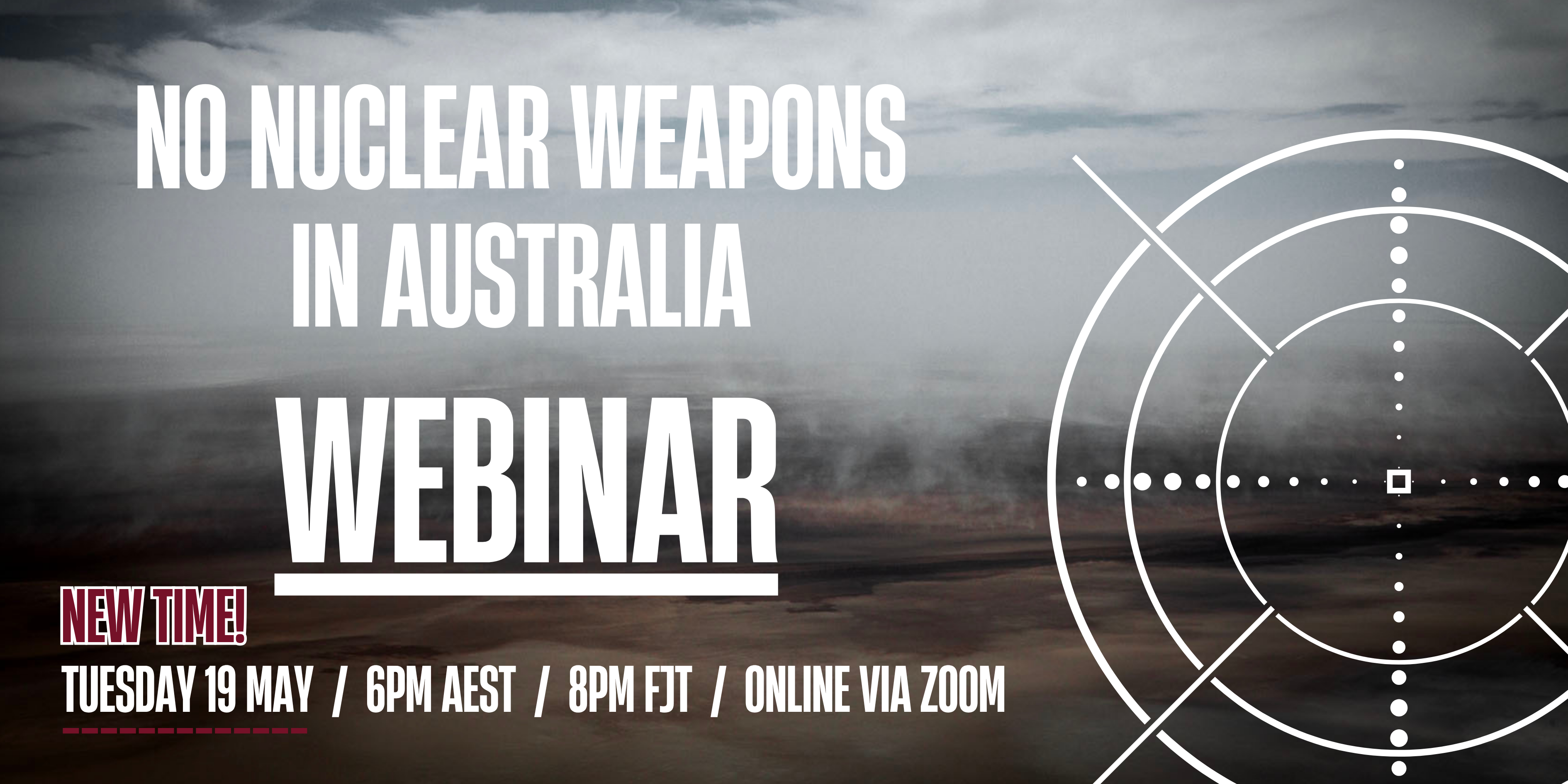
Start: 2026-05-19 18:00:00 UTC Canberra, Melbourne, Sydney (GMT+10:00)
End: 2026-05-19 19:30:00 UTC Canberra, Melbourne, Sydney (GMT+10:00)
Event Type: Virtual
A virtual link will be communicated before the event.
Host Contact Info: australia@icanw.org
No Nuclear Weapons in Australia: Webinar
As plans advance for Australia to host US nuclear-capable B-52 bombers and potentially nuclear-armed submarines, there are increasing concerns about the potential for Australia to unknowingly host American nuclear weapons in future. This is particularly concerning against a backdrop of Australia accepting US policy to neither confirm nor deny the presence of nuclear weapons.
Recently, over 150 civil society organisations across Australia and the Pacific launched the ‘No Nuclear Weapons in Australia’ Declaration calling on the Albanese government to push back on these policies of nuclear ambiguity and to reject Australia having any role in nuclear war. This declaration underscores that the security of a nation cannot be bought at the risk of the survival of humanity and the planet’s ecosystem, and that our region’s nuclear-free status is too precious to risk.
Join to hear eminent voices on nuclear policy, disarmament, advocacy and international humanitarian law in relation to Australia’s role in the global nuclear landscape. Together we’ll explore what the Declaration is asking for, what it means for Australia’s place in the Pacific, and what we can do together keep the pressure on.
The humanitarian consequences of even a single detonation, whether accidental or intentional, cannot be understated as it would be catastrophic and irreversible. No health system or humanitarian agency has the capacity to respond to the aftermath of a nuclear explosion; there is no “cure” for a nuclear catastrophe, only prevention. Beyond the immediate blast that would incinerate surrounding areas, the resulting radiation would inflict multi-generational health crises.
Speakers include:
- Janet Craven, Director, ICAN Australia
- Dr Emma Shortis, Director of International & Security Affairs Program, The Australia Institute
- Joey Tau, Coordinator, Pacific Network on Globalisation (PANG) and Chair of the Pacific Regional NGO (PRNGO) Alliance.
- Prof Richard Tanter, Senior Research Associate at the Nautilus Institute, and Honorary Professor at the School of Political and Social Science, University of Melbourne.
- Vince Scappatura, Sessional Academic in the School of International Studies at Macquarie University, and author of ‘The US Lobby and Australian Defence Policy’.
- More to be announced
This event is co-hosted by ICAN Australia and the Pacific Network on Globalisation (PANG).
‘Critical time’: Minister’s ominous nuclear warning as US looks to resume tests
Australia has delivered a message on nuclear weapons that could put Canberra at odds with the US and Donald Trump.
Benedict Brook in New York, April 29, 202 https://www.news.com.au/technology/innovation/military/critical-time-ministers-ominous-nuclear-warning-as-us-looks-to-resume-tests/news-story/2f432583102962402e8b922db84eeb8e
Australia has said “all nations” – including the US – should refrain from nuclear weapons testing after Donald Trump announced plans to potentially start exploding nukes for the first time in more than three decades.
Assistant Minister for Foreign Affairs and Trade Matt Thistlethwaite said the globe was entering a “critical time” where limits on weapons of mass destruction are being eroded
He is in New York this week representing Australia at a United Nations review of efforts to stop the spread and use of nuclear weapons.
Mr Thistlethwaite also told news.com.au that on the sidelines of the meeting he had held “frank conversations” with nations such as Japan, South Korea and Singapore to get “assurances” on fuel supplies to Australia.
‘Critical time’ for stopping nuclear weapons
The UN’s Treaty on the Non-Proliferation of Nuclear Weapons (NPT) entered into force in 1970 and now has 191 signatories, with notable exceptions being nuclear nations India, Pakistan and Israel.
The aim of the treaty is to stop the spread of nuclear arms and push for disarmament.
But New START, the last agreement to prevent the US and Russia from building more bombs, expired in February.
There are now concerns that a global nuclear arms race could be on the cards.
On Monday, UN Secretary-General Antonio Guterres told the New York meeting, “for too long, the treaty has been eroding.”
“The drivers of (nuclear) proliferation are accelerating.”
There’s little expectation the conference will notably change that gloomy outlook.
Critical time’
Asked if Australians should be concerned about the threat of nuclear weapons, Mr Thistlethwaite told news.com.au the New York review “does occur at a critical time.”
“We’ve got increasing uncertainty in the global geostrategic situation, particularly around the Middle East and Ukraine, and there’s increasing tension within the Asia Pacific region.
“We’re going to make sure that Australia plays a role in de-escalation, supporting peaceful outcomes and upholding the international rules.”
“We want to see a world where the spread of nuclear weapons is prevented … and we’ve been a loud voice in ensuring that nations shouldn’t be involved in testing nuclear weapons anymore.”
No nation should test nukes – including US
But one louder voice doesn’t seem to be on the same page as Australia.
In October, Donald Trump said the US would resume nuclear weapons testing “on an equal basis” with other nations.
“That process will begin immediately,” he said.
Mr Trump’s comments have led to confusion about what new US nuclear testing might involve.
The last country to explode an actual bomb was North Korea in 2017. The US and Russia haven’t tested nuclear weapons since the early 1990s. But Vladimir Putin claimed recently that Russia had tested a nuclear-powered torpedo that was capable of carrying nuclear weapons.
Would Australia be against the US resuming tests with actual nuclear bombs?
“We’re against all nations testing nuclear weapons,” Mr Thistlethwaite said, who did not mention the US by name.
“We know Maralinga (the UK’s 1950s nuclear weapons testing site in Australia) had a lingering effect on the Indigenous community.
“We want to make sure that we don’t see those situations in our region again, or indeed anywhere in the world.”
Iran nuclear role ‘not appropriate’
There was uproar at the UN NPT conference when Iran was announced as one of 34 vice presidents of the event.
Assistant Secretary for the US Bureau of Arms Control and Non-proliferation Christopher Yeaw told the conference it was an “affront” that Iran had been appointed to the role.
“(It is) indisputable that Iran has long demonstrated its contempt for the non-proliferation commitments of the NPT.
Iran’s role was “beyond shameful and an embarrassment to the credibility of this conference,” he was reported by Reuters as saying.
Ms Thistlethwaite said Australia had “expressed its concern and opposition” to Iran’s elevation.
“That wasn’t the appropriate move, and we’ve expressed our support for the United States position”.
‘Frank conversations’ with oil nations
Mr Thistlethwaite added that he had meetings with countries on the fringes of the event, including those critical to Australia’s energy security.
“An important part of this trip is working with our international partners on securing Australia’s fuel supplies,” he said.
“Most of our refined oil products come through Southeast Asia, so I’ve had meetings with (South) Korea, Singapore, Japan, Vietnam … to reiterate the importance that open trade and supplies continue to get through.
“It’s been heartening to have those frank conversations with those partners, to get those assurances regarding continued fuel supplies and to ensure that they remain trusted partners for Australia.”
Mr Thistlethwaite mentioned Australia’s trump card with nations that export oil – Australia’s abundance of liquid natural gas (LNG), which many countries need just as keenly.
“We’re a big supplier of LNG exports to countries in the region, and we’ve been making sure that we reiterate that fact that we’re a reliable supplier that will continue and the relationship with those important fuel partners is in a pretty strong position.”
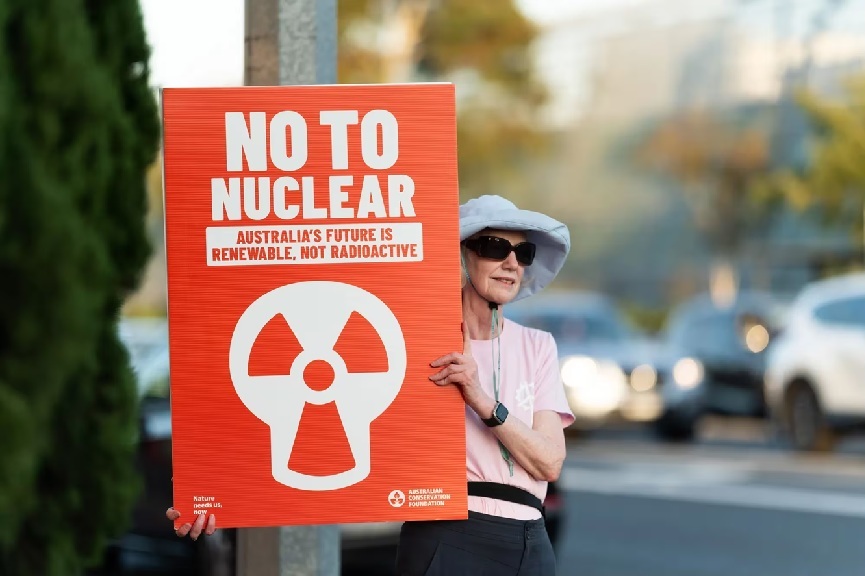
Toxic fantasy nuked; one year on from the Federal election
, https://www.acf.org.au/news/toxic-fantasy-nuked-one-year-on-from-the-federal-election
Exactly one year ago Australians braved the how to vote cards, ate or avoided democracy sausages and used a pencil to help write the next part of the Australian story.
In the months leading up to the 2025 federal election, papers, airwaves and social media platforms were full of talk about nuclear.
Then Opposition Leader Peter Dutton dubbed the 2025 federal election ‘a referendum on nuclear power’. It was the biggest policy difference between the two major political parties. The Coalition promised to build multiple nuclear reactors at seven sites across Australia while Labor, the Green and most independents opposed this nuclear plan and strongly supported renewables.
Nuclear proponents spent large, promised much and did their best to sidestep scrutiny over cost, timing, water, waste and more.
Environment groups joined with trade unions, public health experts, First Nation representatives and community members from regions targeted for reactors to make the case for a renewable energy future, free from nuclear risk and delays.
The message was clear: Nuclear is too risky, too expensive and too slow.
And at the end of months of talk, talkback, information stalls, protests and public forums, Australia voted.
And voted unequivocally no to nuclear.
The Coalition had its worst defeat since the formation of the Liberal Party in 1944, and nuclear champion Peter Dutton became the first sitting federal Opposition Leader in Australian history to lose their own seat at a general election. Seven News political editor Mark Riley described the Coalition result as ‘catastrophic’, adding “the party that chose nuclear energy as its policy has exploded in a nuclear bomb set on them by the voters tonight.”
Voters saw the Coalition’s nuclear fantasy for what it was: a toxic furphy designed only to prolong the life of coal and gas. They made a conscious and clear decision to reject nuclear power and provide our politicians with a clear mandate to get on with harnessing Australia’s abundant renewable energy resources to power our country.
Renewables already meet around half of Australia’s electricity needs, and this figure is growing every day.
Responsible renewables mean lasting regional jobs, low carbon and proven power.
Renewables also mean energy independence and energy security. Ships in the Strait of Hormuz might stop, but the wind and sun do not.
One year ago, Australians had a clear energy choice – and right across the nation we made a clear energy decision – our energy future is renewable, not radioactive.
Royal commission report doesn’t help us start making sense of Bondi terror attack
The Conversation, Keiran Hardy, Associate Professor, Griffith Criminology Institute, Griffith University, April 30, 2026 Justice Virginia Bell has handed the governor-general her interim findings from the Royal Commission into Antisemitism and Social Cohesion. Prime Minister Anthony Albanese responded immediately by promising to implement all its recommendations.
The interim report recommends specific changes to counter-terrorism policy – and a speedy resolution to the lagging gun buyback scheme.
These sorts of changes may help. But they don’t begin to answer deeper questions about how a terror attack on that scale could occur in Australia. The commission is yet to examine how underlying conditions might have fuelled the attack, and what else governments, their agencies and we as a society must do to prevent such a tragedy from happening again.
What does the interim report recommend?
The interim report contains 14 recommendations, five of them confidential.
Of the nine public recommendations, nearly all focus on counter-terrorism policy and the ways government agencies operate. For example, recommendations three through six focus on the Australia-New Zealand Counter-Terrorism Committee: a high-level coordination body made up of senior members of government.
The interim report recommends the committee be included in the Australian government’s Crisis Management Framework. The committee should brief National Cabinet at least annually.
Recommendation seven says ministers on the National Security Committee of cabinet should participate in a counter-terrorism exercise within nine months of each federal election.
These changes will not stop a terrorist from committing another attack. And most Australians could be forgiven for having never heard of these committees.
There’s also no reason why this all couldn’t have been investigated, possibly more quickly, by the original, departmental inquiry announced by Albanese. This was to be led by former head of ASIO, Dennis Richardson.
Richardson recently resigned from the royal commission, saying he felt like an overpaid research officer. He was also worried the process would take too long to deliver concrete recommendations on policing and intelligence…………………………………………………………………..
What can we expect next?
Public hearings for the royal commission will begin next week. In the first round, people with lived experience of antisemitism are expected to give evidence.
After that, it remains to be seen where the inquiry will direct its focus.
Its terms of reference are extremely broad, covering antisemitism, social cohesion, training for law enforcement, border control and immigration, radicalisation, specific circumstances surrounding the attack, and anything else that might be “reasonably incidental” or relevant.
It has so far received more than 3,500 submissions. The commission must report back by December 14 this year, before the one-year anniversary of the attack.
To report meaningfully on all these topics on such a pressured timeline will be a monumental task. Some focus may be necessary, but there will be valid differences of opinion as to whether this inquiry is primarily about antisemitism, social cohesion, counter-terrorism, radicalisation, the Bondi attack, or all of the above.
At the moment, it is about all these things, which may ultimately undermine what it is able to contribute on any one.
Bell clearly knows the scale of the task. She has warned that “examining the ways in which we might strengthen social cohesion in Australia could well be the work of years, not months”.
For now, there is little in the interim report for Australians to start making sense of last year’s terror and tragedy in Bondi. https://theconversation.com/royal-commission-report-doesnt-help-us-start-making-sense-of-bondi-terror-attack-281859?utm_medium=email&utm_campaign=Latest%20from%20The%20Conversation%20for%20May%201%202026%20-%203756238464&utm_content=Latest%20from%20The%20Conversation%20for%20May%201%202026%20-%203756238464+CID_8e5ae0e85bb178c16e80a5a039f5de96&utm_source=campaign_monitor&utm_term=Royal%20commission%20report%20doesnt%20help%20us%20start%20making%20sense%20of%20Bondi%20terror%20attack
1 This month
17 October, Free Public Talk on Nuclear Issues in South Australia
David Noonan will speak on public interest concerns over the new Roxby Downs Indenture Act 2026 on BHP copper-uranium mining and ore processing in SA, and on how AUKUS may face SA with a High-Level nuclear waste agenda.
Dr Jim Green will discuss international developments in the field of nuclear power including ‘small modular reactors’ and Generation 4 ‘advanced’ nuclear reactor concepts.


Help Aunty Sue Protect Her Land and Sacred Sites From Destructive Rocket Testing.
.

Australians deserve the truth
about
AUKUS – https://aukuspublicinquiry.com/

PETITION – To: Prime Minister Anthony Albanese and the Australian Labor Government

of the week – Australians for War Powers Reform (AWPR)
To see nuclear-related stories in greater depth and intensity

