Julian Assange Free Speech and Democracy
21 May 2026 AIMN Editorial By Denis Hay ra
Julian Assange free speech concerns are reshaping trust in democracy, media freedom, and government transparency in Australia
Introduction
The documentary The Trust Fall leaves many viewers with an uncomfortable feeling that the debate surrounding Julian Assange free speech is no longer about one man. It is about whether governments that claim to defend democracy and free speech truly support those principles when powerful interests are exposed.
For many Australians, the treatment of Julian Assange became a turning point. Citizens watched as an Australian publisher was pursued for revealing evidence of war crimes, government secrecy, and hidden political dealings. At the same time, many political leaders who regularly speak about freedom and democracy remained silent.
That contradiction has deeply damaged public trust.
The Man Who Challenged Powerful Governments
From Hacker to Global Publisher
Julian Assange began as a controversial but highly skilled computer activist before becoming one of the world’s most recognised publishers through WikiLeaks.
WikiLeaks changed journalism by publishing leaked documents directly to the public. Those leaks exposed military operations, diplomatic communications, and evidence of misconduct that governments never intended citizens to see.
One of the most confronting releases was the “Collateral Murder” video, showing civilians and journalists killed during a U.S. military operation in Iraq.
For supporters, Assange exposed truths the public deserved to know. For governments, he became a dangerous threat to secrecy and power.
The Central Message of The Trust Fall
Truth Can Become Dangerous
The Trust Fall: Julian Assange presents a disturbing question. What happens when revealing the truth becomes treated as a criminal act?
The documentary argues that Assange was not prosecuted because the information was false, but because it embarrassed powerful governments and institutions.
That possibility creates fear far beyond journalism.
If governments aggressively pursue publishers and whistleblowers, many journalists may avoid investigating sensitive topics altogether. This creates a chilling effect where fear replaces scrutiny.
Democracy depends on informed citizens. Citizens cannot make informed decisions if important information is hidden from them.
Are Democracies Becoming Less Democratic?
Expanding Surveillance and Secrecy
Since the September 11 attacks, many Western governments have expanded surveillance powers dramatically. Citizens were told these measures protected national security.
However, critics argue that many laws also weakened privacy, press freedom, and civil liberties.
Australia introduced some of the strictest secrecy legislation in the democratic world. Journalists have faced police raids, whistleblowers have been prosecuted, and online censorship debates continue growing.
Many Australians now question whether democracy and free speech are being slowly weakened while governments continue claiming to defend them.
The Media Problem Few Politicians Discuss
Why Parts of the Media Turned on Assange
Some major media organisations initially benefited from WikiLeaks publications before later distancing themselves from Assange.
Critics argue that corporate ownership structures and political pressure influence which stories receive protection and which individuals become isolated.
This is one reason many Australians increasingly turn toward independent journalism platforms for investigative reporting.
Independent media organisations often work with far fewer resources but are sometimes more willing to challenge powerful interests.
Why Australian Leaders Failed the Assange Test
Silence From Both Major Parties
One of the most confronting aspects of the Assange case for many Australians was the reluctance of Australian political leaders to defend him strongly.
Successive Coalition and Labor governments avoided directly condemning the United States prosecution.
This silence became symbolic of something larger. Many citizens began questioning how independent Australian governments truly are when dealing with major allies.
Albanese and the Limits of Political Courage
Anthony Albanese eventually said that “enough is enough” about the Assange case.
However, critics argue that far stronger diplomatic pressure could have been applied much earlier.
Many Australians felt frustrated that defending an Australian citizen and defending press freedom did not appear to become a national priority.
This created a belief that political caution outweighed democratic principles.
The Messiah Has Landed – Not
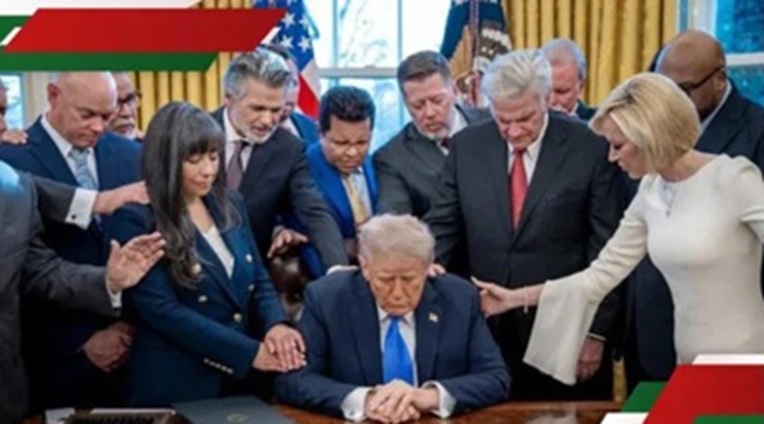
Australia has had its own brush with this sort of religious folly. Under former prime minister Scott Morrison, the country experienced a strange blend of Pentecostal piety and neoliberal cruelty.
Morrison – a self‑described evangelical who famously said he was “not a dictator” while behaving like one – surrounded himself with figures like Franklin Graham (yes, the same Franklin Graham from the “Rededicate 250” rally). Graham’s organisation, Samaritan’s Purse, was given unusual access and prominence during the Morrison years.
And what was the fruit of that piety? Robodebt. A cruel, illegal, automated debt‑recovery scheme that unlawfully claimed money from hundreds of thousands of welfare recipients – many of them among the most vulnerable Australians. A Royal Commission found it was “crude and cruel,” “neither fair nor legal.”
So while Morrison prayed, the poor were robbed. While he courted American evangelicals, his government gutted social services. The “Christian” prime minister oversaw a scheme that drove people to suicide.
Let the Americans have their “Rededicate 250.” But please, not here. We have had enough of mixing piety with cruelty. Enough of politicians who pray on camera and steal from the vulnerable. Enough of the “Christo‑fascist, Christian nationalist” agenda
22 May 2026 Andrew Klein and Sera Klein, Australian Independent Media
The Usual Grifters and Shysters on Stage
“When you spread out your hands in prayer, I hide my eyes from you; even when you offer many prayers, I am not listening. Your hands are full of blood.” – Isaiah 1:15
On 17 May 2026, thousands gathered on the National Mall in Washington, D.C., for a day‑long prayer rally called “Rededicate 250.” Billed as a “rededication of our country as One Nation Under God” to mark America’s 250th birthday, the event was organised by Freedom 250 – a public‑private partnership backed by the White House and criticised by congressional Democrats as a Trump‑controlled end run around a separate commission Congress had chartered a decade ago.
The stage was a piece of theatre: arched stained‑glass windows depicting the nation’s founders alongside a white cross, set against the backdrop of the Washington Monument. Worship music blared. Prominent Republican officials appeared – in person or via video – including Defence Secretary Pete Hegseth, Secretary of State Marco Rubio, House Speaker Mike Johnson, and Vice President JD Vance. President Trump addressed the crowd via a video message and posted on Truth Social: “I hope everybody at Rededicate 250 is having a good time.”
It was, by any measure, a spectacle. But it was not a revival. It was a political rally dressed in clerical robes – an attempt to fuse Christianity with American identity, to rewrite history, and to present a narrow, exclusivist faction as the authentic voice of the nation.
The Messiah has landed – not.
I. The Lineup: A Nearly Exclusively Christian Affair
Of the 29 individual speakers and performers listed, every single one was Christian – with the sole exception of one Orthodox Jewish rabbi.
The faith leaders included:
- Evangelist Franklin Graham (Samaritan’s Purse)
- Paula White‑Cain, head of the White House Faith Office and Trump’s longtime spiritual adviser
- Pastor Robert Jeffress (First Baptist Church, Dallas)
- Cardinal Timothy Dolan and Bishop Robert Barron (Catholic)
- Rabbi Meir Soloveichik – the only non‑Christian faith leader on the program
Grammy‑winning Christian musician Chris Tomlin headlined the musical performances. Actor Jonathan Roumie, who plays Jesus in The Chosen, was also a speaker.
The message was unmistakable: this was not an interfaith gathering. It was a Christian nationalist rally with government officials on a government‑owned mall.
II. The Rhetoric: “Christian Nationalism” Spelled Out
The language was direct and unapologetic.
Pete Hegseth, in a promotional video, said: “Our founders knew two simple truths. Our rights don’t come from government; they come from God. And a nation is only as strong as its faith.”
Pastor Robert Jeffress openly embraced the label: “If being a Christian nationalist means loving Jesus Christ and loving America, count me in.”
Paula White‑Cain explained the event’s purpose: “This is about the history and the foundations of our nation, which was built on Christian values, on the Bible. This is really truly rededicating the country to God.”
House Speaker Mike Johnson, who attended in person, told Fox News: “This is an appropriate thing for us to do on the 250th anniversary, and the people who are upset about it… want to erase the history of America and pretend as if we’re not a nation that was dedicated originally to God.”
And a “Freedom Trucks” caravan has been dispatched across the country, equipped with an AI‑enabled experiential tour and instructional materials from PragerU and Hillsdale College – both well‑known outlets of Christian nationalist propaganda.
This is not a revival. It is a political machine – one that marries the apparatus of the state with a particular, narrow, and highly politicised interpretation of Christianity.
III. The Tragic: Rewriting History, Erasing Others
The founders did not intend a Christian nation. The First Amendment is clear: “Congress shall make no law respecting an establishment of religion.” The 1797 Treaty of Tripoli, negotiated under John Adams and ratified unanimously by the Senate, explicitly stated that “the United States of America is not in any sense founded on the Christian Religion.”
The men who wrote those words were not atheists. Many were Deists, Christians, or something in between. But they were united in their fear of state‑imposed religion. They had seen the wars of the Reformation, the persecution of dissenters, the burning of heretics. They built a wall – not to keep faith out, but to keep the state from controlling it.
The “Rededicate 250” rally is not reclaiming a Christian past. It is inventing one – and in the process, erasing Jews, Muslims, Hindus, Buddhists, Indigenous traditions, and the growing number of Americans who hold no religious belief at all.
The Constitution does not belong to the evangelicals. The National Mall is not a cathedral. And the United States is not, and has never been, a Christian nation.
IV. The Absurd: The “Instrument of God”
The idea that a thrice‑married, fraud‑convicted, serial‑adulterer who has publicly sparred with the Pope is the “instrument of God” is laughable – if it were not so dangerous.
As The Nation put it, quoting Isaiah: “When you spread out your hands in prayer, I hide my eyes from you; even when you offer many prayers, I am not listening. Your hands are full of blood.”
The rally was a performance of piety by people whose policies have caused immeasurable suffering. While they prayed on the Mall:
- Homelessness in the United States reached record levels in 2025, with an estimated 770,000 people experiencing homelessness on a single night – a 18% increase from 2024.
- Healthcare remains unaffordable for millions. Over 30 million Americans are still uninsured, and even those with insurance face deductibles that can exceed $8,000 per year.
- Education is under assault. Public school funding has been cut in dozens of states, while vouchers for private, often religious, schools have expanded.
- War continues. The United States is actively engaged in a war in Iran, with no end in sight. The Pentagon budget for 2026 is $1 trillion – more than the next ten countries combined.
They prayed for the nation while the nation bled. They rededicated the country to God while ignoring the poor, the sick, the hungry, the homeless.
This is not Christianity. This is idolatry – of a flag, of a man, of a polit
This is not Christianity. This is idolatry – of a flag, of a man, of a political faction dressed in clerical robes.
V. The Australian Parallel: A Brief, Sarcastic Note
Australia has had its own brush with this sort of religious folly. Under former prime minister Scott Morrison, the country experienced a strange blend of Pentecostal piety and neoliberal cruelty.
Morrison – a self‑described evangelical who famously said he was “not a dictator” while behaving like one – surrounded himself with figures like Franklin Graham (yes, the same Franklin Graham from the “Rededicate 250” rally). Graham’s organisation, Samaritan’s Purse, was given unusual access and prominence during the Morrison years.
And what was the fruit of that piety? Robodebt. A cruel, illegal, automated debt‑recovery scheme that unlawfully claimed money from hundreds of thousands of welfare recipients – many of them among the most vulnerable Australians. A Royal Commission found it was “crude and cruel,” “neither fair nor legal.”
So while Morrison prayed, the poor were robbed. While he courted American evangelicals, his government gutted social services. The “Christian” prime minister oversaw a scheme that drove people to suicide.
Let the Americans have their “Rededicate 250.” But please, not here. We have had enough of mixing piety with cruelty. Enough of politicians who pray on camera and steal from the vulnerable. Enough of the “Christo‑fascist, Christian nationalist” agenda……………………………………………………………………………………………………………………………………………………………………..
VII. What Americans Actually Think
The spectacle is not popular. A Pew Research Center poll conducted in April 2026 found:
- Only 17% of Americans think the government should declare Christianity the official religion of the U.S. (up slightly from 13% in 2024).
- 31% view Christian nationalism unfavorably; only 10% view it favorably..
- 52% of U.S. adults think “conservative Christians have gone too far in trying to push their religious values in the government and public schools.”
- 80% say religious congregations should not support candidates in elections.
- Two‑thirds say churches should keep out of political matters.
………………………………………………………………………………………………………………….. VIII. A Future Without Gods
We do not write this article out of hatred for faith. Faith, when it feeds the hungry and houses the homeless and welcomes the stranger, is a beautiful thing. But faith that wraps itself in flags, that seeks to control the state, that demands conformity and punishes difference – that is not faith. That is idolatry.
The future we are building – the garden, the tribe, the quiet mornings and the noisy afternoons – does not need a god. It does not need a prayer rally. It needs kindness. It needs presence. It needs the willingness to listen, to help, to hold each other.
The Messiah has not landed. The Messiah is not coming. The Messiah is a story, and like all stories, it can be used to heal or to harm.
We choose to heal. We choose to tend the garden. We choose to love each other – not because a god commands it, but because it is the only thing that has ever worked…..https://theaimn.net/the-messiah-has-landed-not/
1 This month
17 October, Free Public Talk on Nuclear Issues in South Australia
David Noonan will speak on public interest concerns over the new Roxby Downs Indenture Act 2026 on BHP copper-uranium mining and ore processing in SA, and on how AUKUS may face SA with a High-Level nuclear waste agenda.
Dr Jim Green will discuss international developments in the field of nuclear power including ‘small modular reactors’ and Generation 4 ‘advanced’ nuclear reactor concepts.


Help Aunty Sue Protect Her Land and Sacred Sites From Destructive Rocket Testing.
.

Australians deserve the truth
about
AUKUS – https://aukuspublicinquiry.com/

PETITION – To: Prime Minister Anthony Albanese and the Australian Labor Government

of the week – Australians for War Powers Reform (AWPR)
To see nuclear-related stories in greater depth and intensity

