Australian nuclear news – week to 6th June

- Hegseth Orders Pacific Allies To Arm For China War.
- The Virginia-class submarine deal exposes the real purpose of AUKUS.
- Ed Husic breaks rank on AUKUS, demands ‘plan B’ as deal changes
- Can one optimal pathway have two lanes? When it comes to AUKUS submarines, apparently yes.
- ‘Capability that matters’: submarine switch played down
- Australian flotilla survivors describe ordeal after Gaza mission.
- A brief history of Australia eating shit on AUKUS.
- This is how billionaires buy the news.
- The Hand-Me-Down Alliance: Australia, AUKUS and Op-Shop Submarines.
- Will AUKUS keep us safe – at what cost? AUKUS- From ‘best’ we’ll never get to second hand subs.
- Peter Garrett to head independent inquiry into the Aukus submarine pact.
- Husic breaks ranks to demand rethink of Labor’s support for AUKUS.
- Labor MP Ed Husic challenges Albanese to reconsider AUKUS submarine deal.
- Richard Marles accepts used submarines in AUKUS setback.
- US to send only used nuclear subs to Australia in amended defence deal.
- Former Ambassador Joe Hockey says he is nervous about AUKUS – and wants Albanese to cold-call Trump.
- AUKUS is falling apart before our eyes. The government and alliance shills are silent.
- Royal Commission under fire for excluding Palestinian perspectives.
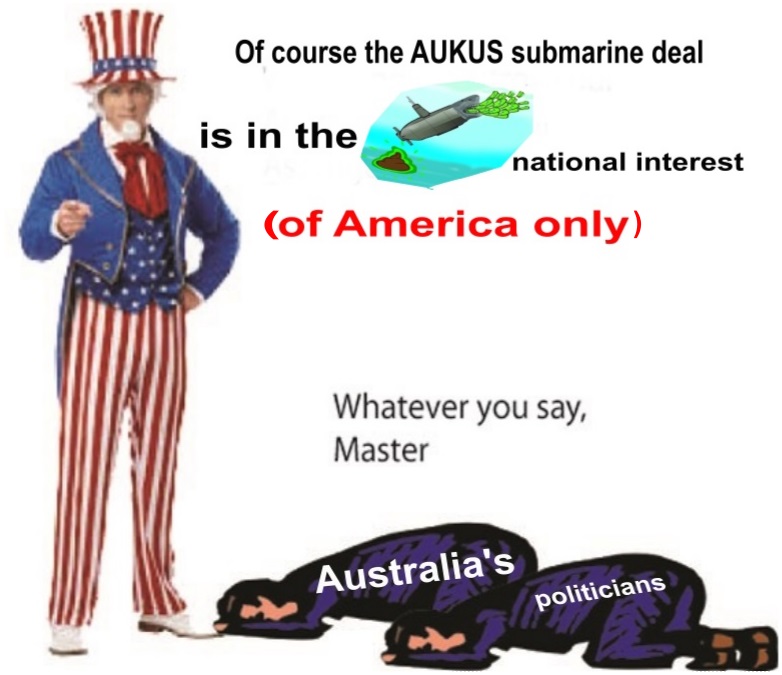
The Hand-Me-Down Alliance: Australia, AUKUS and Op-Shop Submarines
3 June 2026 Dr Binoy Kampmark, https://theaimn.net/the-hand-me-down-alliance-australia-aukus-and-op-shop-submarines/
One can never accuse the Australian political palette of being too demanding, let alone attentive. When it comes to matters of defence, that palette is happy to be deceived, remaining credulous to the notion it is sensitive to good taste and observant of flavours. When it comes to alliances, this especially so. As for the AUKUS agreement, it was clear that the Australian establishment was simply incapable of tasting anything in the way of the rancid or putrid. Of the three participating countries in this doomed ménage à trois – the United States, the United Kingdom and Australia – it was the last of the trio that has been left providing the most while receiving the least.
Centred on two pillars of poor understanding and unequal exchange, the AUKUS agreement is mouldering in unenviable disgrace. The first pillar envisages (dare on use the current tense?) the purchase of SSNs (nuclear-powered submarines) of the Virginia-Class from the United States that may run into three boats, possibly even two additional ones. According to the fatuous and vacuous Australian Submarine Agency’s assessment, the “acquisition will eliminate any capability gap and increase the 3 nations [sic] (Australia, UK and US) ability to deter aggression and contribute to peace and stability in the Indo-Pacific.” Eventually, the SSN-AUKUS, a hybrid of UK design, US technology and Australian gristle, will also be added to the fleet, a prospect bound to give few joy.
But the docile and the doltish in Canberra do not seem alert to the grumbling mood in Washington that any transfer of these hulks would only take place on exclusive American terms. Doubt about Australian worthiness in using such boats in a war with China if called upon (call it want of skill, call it reluctance); and doubts about the rate of production back home (the annual rate of two Virginia SSNs remains tardily elusive), has made the very idea of conveying such vessels to Canberra improbable.
The latest discussions by US Secretary of War Pete Hegseth, Australian Defence Minister Richard Marles and UK Defence Secretary John Healey, held on the sidelines of the International Institute of Strategic Studies Shangri-La Dialogue in Singapore, also confirms that the boats, should they ever arrive, will be of the optional, rather than optimal shop variety. They will be second hand goods with a shorter life span and less troubling to let go of by the US Navy. Give the Aussies the hand-me-downs. They’re worth it.
A May 30 joint statement from the ministers was a tedious, tortuous garble that did little to hide the fact that Australia has been degraded and sent packing to the cooler. “The Deputy Prime Minister and Secretaries welcomed the proposed approach to streamline Australia’s acquisition of Virginia-class submarines (VCS), simplifying chain management, operational and maintenance requirements and maximizing cost efficiencies. This approach would enable Australia to acquire three in-service VCs in lieu of a mixture of new and in-service VSs variants.” Without a smidgen to go on, the trio also claimed that “significant progress in the design and delivery of SSN-AUKUS, which will provide the UK and Australia with an advanced warfighting capability” had been made.
It is worth recounting the stages of cloddishness that culminated at this current pass. In 2023, the Australian government accepted the position that the US would sell it three Virginia-class boats in the early 2030s, with the following observation: “The first two will be used but refurbished Block 4 boats with 23 years of remaining life and the third will be a brand new stretched Block 6 boat fitted with the 84-foot-long payload of greatly increased weapons loads.”
Instead of expressing rage and disgust at this diminution of worth, the Australian defence minister has accepted the revised plans with beaming, coprophagic glee. Appended to the stained grin are explanations worthy of immediate sinking. Not having three second-hand SSNs would have seen a situation of one new Virginia-class SSN operating alongside in-service Collins-class submarines and the new SSN-AUKUS boats. This unpardonably dreamy nonsense, anticipating that all three boat varieties would be sharing the sea at the same time, at least allowed Marles to yearn for a simpler world of equipment. The word “simple,” it would seem, is his favourite word of the moment. In remarks to reporters, he observed that a “simpler pathway” had presented itself. “It will mean that the Virginia-class submarine that we are acquiring will be all of the same type of. And I cannot overstate the significance of that, both in terms of the submariners who are operating them, but also the people who are working on them to sustain those submarines.”
In Australia, the opposition defence minister, James Patterson, had least had the decency to demand “a proper explanation from the government – more than just a single sentence in a joint statement.” The Greens Senator David Shoebridge, was less accommodating to the servile capitulation from Marles. “We’re not just over a barrel with the United States – we have literally said to them they can name the price, they can give us the biggest lemon in the fleet – three of them – and Richard Marles will give that blank cheque to the US.”
All the signs of demented decay and facile strategic thinking are there in this pact. The need to extend the life of the Collins-class submarines. The likelihood that the United Kingdom will be unable to stomach its side of the bargain. The continued bleeding of the Australian purse for American and British submarine building. And the deeply troubling sense that, when the time comes, the United States will go to war with China, expecting Australia to muck in. Given that Canberra has contrived and connived to turn Australia into an increasingly attractive garrison for adversaries to target, the room for escaping the orbit of an avoidable catastrophe, be it financial or military, is rapidly shrinking. Marles is unabashed by it all. “Chasing simplicity is at the heart of why we have pursued this.” A simplicity that well qualifies for the “bloody fool” category, one soon to be explored by a public inquiry that promises to be a real hoot.
Will AUKUS keep us safe – at what cost?

AUKUS Public Inquiry, 2 June 2026, Canberra, https://newshub.medianet.com.au/2026/06/will-aukus-keep-us-safe-at-what-cost/155928/
For the first time, the Australian community will have the opportunity to investigate the controversial and secretive AUKUS defence pact. Today, five esteemed Australians will launch a nationwide Public Inquiry into AUKUS at Parliament House, Canberra. From diverse backgrounds and disciplines, but united in their commitment to transparency, democracy and the defence of Australia, Peter Garrett, Carmen Lawrence, Chris Barrie, Leanne Minshull and Karina Lester will head the public inquiry into AUKUS beginning today. Full Commissioner profiles can be viewed here.
There has never been a more critical time to get the truth about AUKUS and what it means for our nation. The Federal Government is planning to spend $368 billion-plus of our taxes on nuclear-powered submarines – the largest defence spend in our history — without answers to basic questions such as: will Australia receive the submarines we’re paying for on time and on budget; where will the high-level nuclear waste generated by the subs be stored; how many Australian jobs will be created and at what cost, and crucially, will this project keep us safe — or turn us into a nuclear target?
Lead Commissioner Peter Garrett said,
“AUKUS is by far the most expensive and complex undertaking ever entered into by any Australian Government and yet the opportunity to question, debate and decide has been taken out of the hands of the parliament and the people. A Public Inquiry into this massive spend of taxpayer’s money is long overdue.”
Commissioner Admiral (Retd) Chris Barrie AC said,
“As Chief of the Defence Force in the late 90s and early 2000s, I investigated the proposition of acquiring nuclear powered submarines for Australia but there was little interest in it then and we all need to know why suddenly, there is huge interest, secrecy and money available for the AUKUS submarines today. That’s what this Inquiry is for.”
Commissioner Dr Carmen Lawrence said,
“A basic requirement of any functioning democracy is transparency from our Government. It is simply not credible that the Federal Government can take nearly $400 billion from the Australian people, make private deals with US and UK technology companies and foreign governments to access the Australian mainland and our data, and then tell us not to ask questions. Australians would never accept that, and nor should we. That’s why this Inquiry is vital.”
Yankunytjatjara woman and Commissioner Karina Lester said.
“For decades Aboriginal people of this country have had nuclear weapons tested on our traditional lands, we have been pressured to be the solution to nuclear waste. Our traditional lands have been mined on and our communities continually pressured by an industry that has harmed us for generations. What is Australia’s plan to manage the nuclear waste under this AUKUS Agreement? Will Australia be taking in nuclear waste from the UK and the US under this agreement? We fear it will be our mobs and our countries that is expected to take it. And once again, no one has bothered to talk to us. We have the lived experience and that’s why First Nations voices are crucial to this Public Inquiry.”
Commissioner Leanne Minshull said,
“The projected cost of $368 billion for AUKUS is hard to conceptualise. Think about Australia’s biggest wealth fund, set up in 2006. After 20 years of squirreling away money and banking investment returns, the future fund is now worth $337 billion. The cost of AUKUS would wipe out these generational savings and then some.If we are to spend the equivalent of our national savings, on a single project, the benefit needs to be clear and overwhelming. What won’t we be able to fund? How many jobs will be created from this project? Where will those jobs be? In a tight labour market, how will those jobs be filled? Will they divert skills from other national priorities like building residential homes? Will these jobs be the worst targeted, most expensive in Australian history?”
This nation-wide inquiry into AUKUS will seek answers to a number of critical questions. The Terms of Reference can be found here and the website here. The Inquiry will be taking written submissions and conducting hearings across Australia.
AUKUS Public Inquiry media contacts:
Phil Davey 0414 867 188, phil@mountainmedia.com.au
Julie Macken 0400 925 217
Why Trump should be indicted

The details of the 2016 agreement that the Obama Administration and European allies made with Iran show why President Donald Trump should be indicted for the war crime of waging an aggressive war.
That agreement, the Joint Comprehensive Plan of Action between the nuclear-armed US, UK, France, China, and Russia, and Germany and Iran, which Iran abided by for two years until Trump tore it up, made it impossible for Iran to make a nuclear bomb.
Last week, the US Treasury Secretary Scott Bessent denied that the Obama-era agreement ever happened.
“This administration, President Trump, has done something that no other administration was able to do,” he said. “We have gotten the Iranians to talk about their nuclear program and perhaps commit to not having one. That has never happened before. It had been off the table.”
This is utterly untrue. Obama not only got Iranians to talk about their nuclear program but to agree to detailed restrictions on uranium and plutonium enrichment with verifiable inspections that would make construction of a bomb impossible.
In January 2016, under the headline, “The Historic Deal that Will Prevent Iran from Acquiring a Nuclear Weapon”, the White House stated: “On January 16, 2016, the International Atomic Energy Agency verified that Iran has completed the necessary steps under the Iran deal that will ensure Iran’s nuclear program is and remains exclusively peaceful.”
This is the verification of the International Atomic Energy Agency – the independent international body that has been doing nuclear verification since 1957.
Trump and his Cabinet toadies are in complete denial that it ever happened.
Defense Secretary Pete Hegseth said, “Only one president was willing to lay it out on the line and ensure after 47 years that Iran is not capable of having a nuclear weapon.”
Again, not true.
There are a couple of reasons for the denial. One, they work on the basis that anything Obama did must be bad or if good, deny it happened. And, secondly, that if in the past the US had the security of a nuclear-bomb-incapable Iran it would not be possible to argue that Trump’s 2026 attack on Iran was justified as self-defence.
There are only two legally valid reasons to go to war: self-defence and UN authorisation. Trump’s attack on Iran met neither of the criteria. It was the criminal waging of an aggressive war, and he is responsible for all the death and destruction that followed. The International Criminal Court should start an investigation into Trump.
This does not excuse the violence, aggression, and human-rights breaches by the Iranian regime. But they in turn do not excuse illegal Trump’s and the US conduct either.
Iranian scepticism of US bona fides is, however, justified, given US engineering of the 1953 coup against a democratic Iranian Government; the US arming and empowerment of the Shah of Iran’s 26-year brutal repression, torture and murder; the US’s unapologetic 1988 shooting down of Iran Flight 655 killing 290 innocent people; and the US’s reneging on the 2016 nuclear agreement after Iran had verifiably abided by it for two years.
Yes, international law is difficult or near impossible to enforce, but if both sides in any international conflict resort to right-is-might the consequence is always unnecessary death and destruction. More importantly, if a great number of nations adhere to international law, it isolates and pressures those countries and their leaders who do not. With economic and physical consequences.
At least, European and other democratic allies realised Trump’s Iran illegality and refused to take part. Once burned by US President George W Bush’s illegal invasion of Iraq, twice shy. At least Bush tried to get UN sanction for his invasion. Not Trump.
……………………………………………………………………………………………………………………………………………………………………………………..And the lessons for Australia? Stick to the rule of law and keep appropriate distance from the US. And the lessons for Australian voters, who on current polls seem set to give One Nation more votes than any other party? Pay attention. Look at history.
Look at Hanson cosying up to Trump and their similarities – joining forces with billionaires; accepting gifts of aircraft in questionable circumstances; and more.
British voters surely wouldn’t vote to leave the EU and trash their economy? US voters surely would not vote for Trump – twice – likely handing over world economic and political leadership to China?
Australians surely would not vote to put One Nation’s Pauline Hanson in the Prime Minister’s Lodge with who knows what consequences.
……………………………………………………………………………………………………………………………………………………………………………………………………………………………………………… https://www.crispinhull.com.au/2026/06/01/why-trump-should-be-indicted/?utm_source=mailpoet&utm_medium=email&utm_source_platform=mailpoet&utm_campaign=crispin-hull-column
Around the world, global solidarity and cooperation are remarkably popular

June 1, 2026, by Lawrence Wittner, https://peaceandhealthblog.com/2026/06/01/around-the-world-global-solidarity-and-cooperation-are-remarkably-popular/
One of the curious ironies of our time is that, although many politicians spout heated nationalist rhetoric, rail against foreign nations, and belittle international cooperation, this approach to international affairs is not at all what most people want.
The climate of aggressive nationalism is clear enough. In nations around the globe, demagogues (usually of a rightwing variety) whip up xenophobia, preach superpatriotism, demand vast military buildups, and―if holding public office―often launch invasions of other nations under the banner of restoring an allegedly glorious national past.
But what is often overlooked is that, across the planet, most people favor a very different way of engaging with the world.
In late 2025, Focaldata, a major research company commissioned by the Rockefeller Foundation, conducted a landmark survey of 36,405 people across 34 countries. The resulting report, Demanding Results: Global Views on International Cooperation, revealed that 55 percent of people worldwide “believe their country should cooperate on global challenges even if it means compromising on national interests.” If international cooperation was proven to solve global problems, public support jumped to 75 percent. Respondents viewed such cooperation as essential for food and water security, jobs, health, trade, and climate.
Other opinion surveys confirm the widespread nature of internationalist sentiment. An Ipsos poll conducted between February and April 2026 found a substantial increase over the previous year in support for global solidarity and cooperation, with net disagreement shifting to net agreement. Among the more than 22,000 adults in the 31 countries surveyed, nearly two-thirds now supported the claim that, “for certain problems, like environmental pollution, international bodies should have the right to enforce solutions.” Some 42 percent (a plurality) agreed with the idea that “my taxes should go towards solving global problems.” And nearly four out of ten respondents (a plurality) endorsed the statement: “I consider myself more a world citizen than a citizen of the country I live in.”
Another measure of the worldwide support for international cooperation is provided by polling on public attitudes toward international organizations. The Rockefeller Foundation-Focaldata study reported that public trust was strong for the United Nations (58 percent) and the World Health Organization (60 percent), although weaker for international financial institutions. The global popularity of the United Nations was also attested to by a Pew Research Center survey that appeared in September 2025. Covering 31,938 adults in 25 countries, it found that a median of 61 percent of adults had a favorable view of the world organization, while only 32 percent had an unfavorable one.
Even proposals for new, avant garde global institutions have attracted more public support than opposition. Commissioned by Democracy Without Borders, Nira Data conducted a global survey in September 2025 of public attitudes toward the election of a citizen-elected world parliament to handle global issues. The survey, released in January 2026, drew upon 117,000 people in 101 countries that held 90 percent of the world’s population. The finding was that 40 percent of respondents approved of the world parliament idea, while only 27 percent opposed it.
But what about the United States? Surely in this flag-waving nation, engulfed in the rabid “America First” rhetoric of the Trump administration and its MAGA acolytes, we might expect that the ideals of global solidarity and cooperation would be supported by no more than a small minority.
But that’s not the case at all.
One of the most striking findings of the Rockefeller Foundation-Focaldata survey is that 61 percent of U.S. respondents believed that the United States should cooperate on global challenges even it meant compromising on some national interests.
When it came to the United Nations, the Pew Research Center report revealed that 57 percent of Americans held a positive view of the world organization, as compared to 41 percent with a negative one. Moreover, it found that positive views of the United Nations had increased by 5 percent over the preceding year.
A study by the Chicago Council on Global Affairs, issued in September 2025, reported an even more favorable public attitude toward the United Nations. Two-thirds of the Americans surveyed, it noted, said that the United States should be more willing to make decisions within the framework of the United Nations, even if this meant that the country would sometimes have to go along with a policy that was not its first choice.
Admittedly, opinion surveys found that the level of support for international cooperation varied significantly from country to country. Thus, for example, the backing for international cooperation when that meant compromising on some national interests was greater in India (81 percent) and South Korea (73 percent), the countries highest on the scale, than in Argentina (41 percent) and Japan (34 percent), the countries at the bottom of the scale.
Furthermore, there was often a political dimension to worldwide public attitudes toward foreign affairs. According to the Pew Research Center, “people who place themselves on the left of the ideological spectrum are more likely than those on the right to have a positive view of the UN.”
This political division was particularly wide in the United States, where, as the Pew report maintained, “81% of liberals―versus 34% of conservatives―have a favorable opinion” of the United Nations. When it came to the issue of support for cooperation with other nations, the surveys by Rockefeller-Focaldata and the Chicago Council on Global Affairs both found substantial differences between the attitudes of Democrats (quite positive) and Republicans (far more negative).
Even so, in most countries, including the United States, support for international solidarity and cooperation is very substantial, and growing. Consequently, political activists and politicians shouldn’t be reluctant to speak out for them. Indeed, given the popularity of this internationalist approach to global affairs, it might even prove a winning political issue.
Lawrence S. Wittner (https://www.lawrenceswittner.com/ ) is Professor of History Emeritus at SUNY/Albany and the author of Confronting the Bomb (Stanford University Press).
Wildfires devastating richer areas but fewer hectares burned globally – study

Ajit Niranjan, June 26, https://www.theguardian.com/world/2026/jun/01/wildfires-devastating-richer-areas-but-fewer-hectares-burned-globally-study
‘Megafires’ in California, Canada, South Korea and Europe in 2025, but changes to farming slowed spread in parts of Africa.
“Devastating” wildfires ripped across the wealthier parts of the world in 2025, a study has found, even as globally, the area ravaged by flames fell.
Catastrophic blazes claimed lives, homes and jobs last year in California, Canada, Europe and South Korea. But the 335m hectares burned was the second-lowest since 2002, the review found, largely owing to the expansion of African farms that have fragmented landscapes and hampered the spread of large savannah fires.
The disasters in 2025 included a Scottish “megafire” that torched more than 100,000 hectares – contributing to the UK breaking its record for burned area – and the Palisades and Eaton fires in Los Angeles, which were among the most destructive in US history.
Record-breaking blazes in Spain and Portugal burned more than half a million hectares, while South Korea had its biggest and deadliest wildfire season on record.
Fires accounted for more than 38% of insured losses from weather disasters in 2025, the study found.
“2025 shows that a ‘quiet’ fire year globally can still be devastating,” said Matthew Jones, a climate scientist at the University of East Anglia and lead author of the study. “We are seeing a growing disconnect between total area burned and real-world impacts.”
Changes in land use mean wildfires burn less of the planet than they have historically done, but global heating is creating conditions allowing them to spread, increasing the danger at what researchers call the wildland-urban interface, where people are most at risk.
Adverse weather, inflamed by carbon pollution, turned some of last year’s fires into explosive infernos.
In southern California and South Korea, the researchers found, high winds and dry vegetation pushed fires through densely populated areas, causing “exceptional mortality, mass evacuations, and major infrastructure losses”. In the Mediterranean, meanwhile, drought and extreme heat drove severe blazes, from Portugal to Turkey.
“These conditions do not cause the fires, but in the event of a fire, we have material that is more flammable than usual – because it is drier – and wind conditions that fan the flames,” said David Garcia, an applied mathematician at the University of Alicante, who was not involved in the study. “This makes large fires more likely to occur.”
An attribution study Garcia co-authored last year found the extreme weather fuelling the flames in Portugal and Spain last year was made 39 times more likely by climate breakdown. “If we continue to warm the planet, large-scale fires will continue to increase,” he said.
The overall reduction in global burned area led to a drop in carbon dioxide emissions to their third-lowest level on record.
In Canada, though, extreme wildfire emissions were recorded for the third year in a row. Since 2023, boreal forests in North America have emitted close to 4bn tonnes of CO2, exceeding the total emissions of the preceding 15-year period.
As well as heating the planet, the pollutants in wildfire smoke lead to huge numbers of people dying from breathing dirty air. The toxic particles spewed by Canadian wildfires in 2023 killed 82,000 people, according to a study published in September, with smoke even choking cities in the US, Europe and Africa.
Adrián Regos, a landscape ecologist at the Biological Mission of Galicia, Spain, who was not involved in the study, said last year’s events illustrated how a relatively small number of extreme fires could dominate the ecological, social and economic consequences of an entire fire season.
“The broader pattern highlighted by this study is consistent with what we are observing across southern Europe: while total burned area may fluctuate from year to year, climate change is increasing the likelihood of extreme fire-weather conditions, and fuel accumulation associated with rural abandonment is making many landscapes more vulnerable to large, fast-moving fires,” he said.
“The challenge is therefore not only reducing the number of fires, but increasing the resilience of landscapes and communities to extreme events.”
AUKUS. From ‘best’ we’ll never get to second hand subs
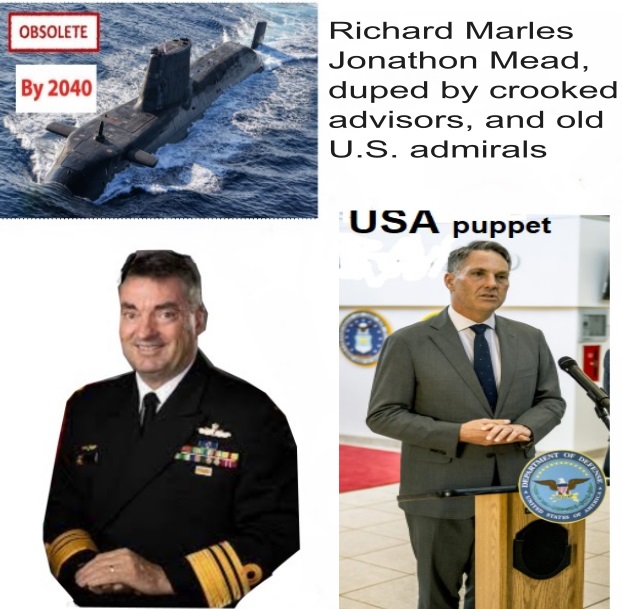
Meanwhile, Defence Minister Richard Mares maintains the facade. He’s either dishonest or dumb. Time will tell which one it is.
by Rex Patrick | Jun 1, 2026, https://michaelwest.com.au/aukus-from-best-well-never-get-to-second-hand-subs/
Defence Minister Marles announced a change to the AUKUS submarine program: second-hand subs! What’s the scam?
The scam is, at an enormous cost of (at least) $368B, we now only get second-hand subs from the US while we wait for the promised nuclear subs on the never-never.
In May 2023, Admiral Mead, the head of the Australian Submarine Agency, told the Senate that the first two Virginia-class subs that would be transferred to Australia would be second-hand, and the remaining subs would be brand new. He repeated it a year later.
But the reality is and always has been different. The US is only building about 1.2 subs per annum and needs to get to a built rate of 2.0 to meet US needs, and 2.3 to meet theirs and ours. They have no way of getting there.
We’ve sent $2.8B non-refundable taxpayers’ dollars to the US over the past two years to try to shift the build rate dial, and it’s done nothing, other than drain our Treasury.
Anyone who bothers to read the US Congressional Research Service’s advice to Congress on AUKUS knows we will not get subs from the US. Anyone who has bothered to read the recently released UK Parliamentary report on AUKUS knows we will not get subs from the UK.
The Albanese Government has embarked on an all-eggs-in-one-basket program where,
“the US hens are not laying enough eggs, and the UK chooks are headless?.
Meanwhile, Defence Minister Richard Mares maintains the facade. He’s either dishonest or dumb. Time will tell which one it is.
Rex Patrick is a former Senator for South Australia and, earlier, a submariner in the armed forces. Best known as an anti-corruption and transparency crusader, Rex is also known as the “Transparency Warrior.”
Royal Commission under fire for excluding Palestinian perspectives
Many have noted that Zionism has become like Nazism, imprisoning, killing and torturing the Palestinians.
Worldwide, many Holocaust survivors and their children have been horrified by and denounced Israel for its treatment of Palestinians. Many Jewish people with family connections to the Holocaust have marched in the streets carrying Palestinian flags and banners.
By Lyn Bender | 1 June 2026, https://independentaustralia.net/politics/politics-display/royal-commission-under-fire-for-excluding-palestinian-perspectives,21114
The Royal Commission into Antisemitism has sparked debate over free speech, protest rights and the place of Palestinian perspectives in public discourse, writes Lyn Bender.
IS CONCERN for Palestine and the Palestinian people the new McCarthyism?
Named for the Republican Senator who spearheaded (literally) the hunting down of suspected communist “infiltrators” and “sympathisers”, within the film industry, educational institutions, the government and even the army. No stone was left unturned in the search to uncover this threat to America.
The current identification of antisemitism as any criticism of Israel bears a stark resemblance to the search for the communist peril.
Protesting genocide has become a criminal offence in parts of Australia. People in Australia can be arrested for peacefully protesting ethnic cleansing and war crimes.
Thus far in the current Royal Commission into Antisemitism, the accused – by inference, Palestinians – cannot bear witness or plead their case.
The Australian Palestine Advocacy Network (APAN), a peak Palestinian body, has been denied permission to present at the Commission.
The Crucible, written in 1953 by Arthur Miller, reflected the communist purge in America of that time. Anyone could stand accused by the House Un-American Activities Committee of being communist sympathisers. Hundreds of those in the film industry lost their jobs or were boycotted by association. This list included Charlie Chaplin, who became an exile from America.
The Crucible is a play about the hysteria generated in a community in 1693 in Salem, America, regarding accusations of witchcraft. The Salem witch trials were an allegorical device used by Miller.
The Bondi shootings were a terrible trauma for the Jewish community, especially those directly impacted. But the insistent call for a royal commission was a massive error. The shock and fear had not been processed, nor had the motivation of the alleged assailants been investigated. In fact, the Commission may be hampered by this being a case under investigation.
Bondi is an iconic Aussie meeting place for many Australians.
Bondi belongs to all Australians.
The surfers, the swimmers, the lifesavers, the joggers, the sunbathers, the tourists lured by its beauty and those who come to enjoy a coffee overlooking its waters may all lay claim to Bondi. But Bondi’s unique status as a safe place for all has been assaulted. That is a deep wound.
Despite its clearly narrow agenda, I decided to offer a submission to the Royal Commission into Antisemitism.
I struggled with the decision to make a submission to this Royal Commission, but felt compelled to add my voice as a Jewish person who is horrified by the suppression and failure even to acknowledge Palestinian suffering.
In fact, it seemed that somehow the protests against the genocide of the Palestinians were being unjustly implicated in this terrible act. Despite the facts thus far known, that no Palestinians were involved in the massacre, the measures against protestors intensified, especially in NSW.
Protesters have also been criminalised in Britain.
Police became heavier-handed with protesters. The media cited the protests but seemed less interested in highlighting what the protests were about. Bombing and displacement in Gaza and settler violence that we could see on our iPhones every day.
Phrases became officially condemned. Saying “Free Palestine” could get you banned or moved on. It was more acceptable to utter almost any curse other than intifada. Intifada is Arabic for shaking off or resisting. Which human would not wish to rid themselves of a brutal apartheid occupation? If a person states this idea, they are accused by the Israeli narrative machine of being supporters of Hamas or antisemitic or both. If you are Jewish, you are denounced as a self-hating Jew or traitor.
Some appearing at the Commission have claimed that the display of the Palestinian flag traumatises them.
Transgenerational trauma is on display.
I can attest both personally and in my previous practice as a psychologist that transgenerational trauma is a psychological phenomenon. Growing up in a traumatised community or family imparts the trauma. Fears, beliefs and responses can be passed on non-verbally and behaviourally as well as verbally.
For some, trauma may lead them to have empathy for the suffering of others. For others, they may seek to become like the aggressor to escape victimhood. Bruno Bettelheim (who had been imprisoned in Nazi concentration camps) and other analysts named this as identification with the aggressor. It’s a defence mechanism of those in traumatic and extremely powerless situations.
Many have noted that Zionism has become like Nazism, imprisoning, killing and torturing the Palestinians.
Worldwide, many Holocaust survivors and their children have been horrified by and denounced Israel for its treatment of Palestinians. Many Jewish people with family connections to the Holocaust have marched in the streets carrying Palestinian flags and banners.
I found the boundaries specified for submitting almost squeezed me as the writer into delineating incidents of antisemitism. The saving grace was the question of social cohesion and how this might be impacted.
I responded that, firstly, I had received far more abuse and “antisemitism” from Zionists and pro-Israel Jewish people.
My view is that the Royal Commission is harming social cohesion. Claiming that criticism of Israel is antisemitic, as proposed by the Envoy, Jillian Segal, is actually crazy. That in failing to allow the “accused” Palestinians a voice at the Commission, it has fostered extreme social disunity.
I was not able to say all that I knew mattered. Even participating in this Commission feels as though I am part of a corrupted process.
My experience growing up in a community of Holocaust survivors was that we were indoctrinated, as in the U.S., with the belief that Israel was part of Jewish identity, a place of safety for Jewish people. That Israel could do no wrong. Jewish people were entitled to the land from the river to the sea.
Oh, the irony that Palestinian supporters are criminalised for using that expression. The absurdity of the assertion that Jewish people of European background somehow have the right of return while the Indigenous people expelled in the 1948 Nakba do not.
I am a supporter of the Jewish Council of Australia, which advocates for human rights for all and is opposed to the maltreatment of all abused groups, including Australia’s Indigenous people.
The absurdity of asserting that Jews are somehow one homogenous group.
But as I imbibed in my Jewish education, it is forbidden to kill. It is forbidden to steal. But Israel proudly proclaims its right to do both.
Claiming these atrocities on behalf of all Jewish people may account for a perceived rise in antisemitism.
Finally, we are all diminished when a tragedy, such as the Bondi shootings, is weaponised for political purposes.
1 This month
25 October – Film –Britain’s Nuclear Bomb Scandal: Our Story – part of the Adelaide Film Festival,
Screening and Conversation
A screening of Britain’s Nuclear Bomb Scandal: Our Story (2024) followed by a talk with 2026 Bettison and James Awardee and Tradtional Owner Karina Lester in conversation with Simone Tur.
When: Sun 25 Oct, 12:00pm-Screening, 1:15pm-Talk
Where: The Mercury
Free admission, register below by clicking on BUY TICKETS and select free event tickets, at end of web page:
https://www.adelaidefilmfestival.org/program/2026/britains-nuclear-bomb-scandal-our-story
.
Australians deserve the truth
about
AUKUS – https://aukuspublicinquiry.com/

PETITION – To: Prime Minister Anthony Albanese and the Australian Labor Government

of the week – Australians for War Powers Reform (AWPR)
To see nuclear-related stories in greater depth and intensity

