A brief history of Australia eating shit on AUKUS.
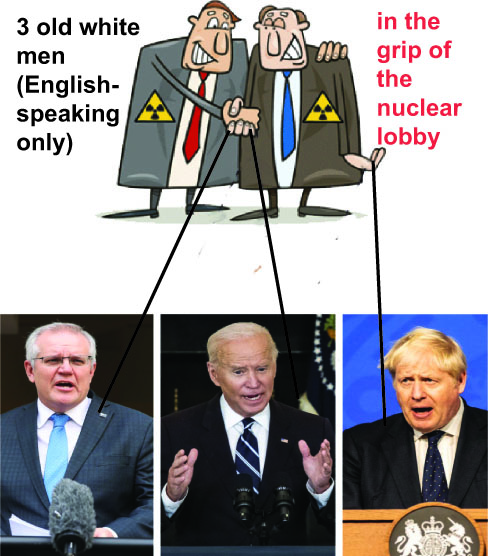


Australia remains undeterred in ‘welcoming’ AUKUS setbacks left, right and centre.
Charlie Lewis, Jun 3, 2026,
https://www.crikey.com.au/2026/06/03/aukus-setbacks-submarines-defence-richard-marles/
Defence Minister Richard Marles met with US Secretary of War Pete Hegseth in Singapore over the weekend to announce a “streamlining” of the AUKUS deal, under which Australia will buy three used Virginia-class submarines rather than two used and one new, as was initially agreed.
Under questioning from the shadow defence minister James Paterson in Senate estimates on Tuesday, Defence Secretary Meghan Quinn said, actually, this was what Australia had wanted all along: “Australia’s position is that we would have always … had a preference for three in-service (submarines).”
Labor’s former industry minister Ed Husic, more able to speak his mind after his post-election ousting, didn’t agree with this take, telling the media: “This deal has changed.”
Husic may be waiting a while if he’s hoping for a rethink. As Australia’s history demonstrates, our government has been willing to swallow a lot without its loyalty to the alliance being the least bit shaken.
It started as it meant to go on. On September 15, 2021, Scott Morrison, Joe Biden and Boris is Johnson — the respective world leaders at the time of Australia, the US and the UK — announced the $368 billion trilateral AUKUS deal.
Morrison spoke of how the submarine pact represented the countries’ mutual “enduring ideals and shared commitment to the international rules-based order” (a commitment that somehow looks even shakier now than it did then). It would later be revealed that Morrison had preemptively caved on local construction, reducing the previous requirement that 60% of the submarines be built in Australia to 40%.
Biden responded by forgetting Morrison’s name. “Thank you, Boris. And I want to thank that fella Down Under. Thank you, pal. Appreciate it, Mr Prime Minister.”
A side note: Morrison’s now irreparable reputation as a habitual liar (something that only malcontents like us seemed to have previously cared about) was sealed by AUKUS. A month after the deal was announced, French President Emmanuel Macron, whose own submarine arrangements with Australia were torn up to make way for AUKUS, told a press pack that he knew Morrison had lied to him.
Adding to the general sense of humiliation, Biden hung Australia out to dry, claiming that he was “under the impression that France had been informed” of the changes.
The sense that its arrangements with Australia weren’t exactly front of mind for the US was reiterated in February 2025 when newly reelected president Donald Trump was asked about AUKUS and had to be reminded what the program was.
In August last year, Richard Marles’ office said in a statement that he would be travelling to the United States that week, where, in Washington, D.C., he would meet with Secretary of Defense Pete Hegseth and other senior administration officials.
Except that wasn’t true: despite Marles’ posting of an illusory photo, the Pentagon made it very clear that “there was not a meeting” and that it was “a happenstance encounter”.
The next month, Anthony Albanese would do little better: during his visit to the US, unable to secure a proper meeting with Donald Trump, he was reduced to collaring the president for a selfie.
A meeting was eventually held between Trump and Albanese in October, but the Australian humiliation was not done. A Sky News Australia journalist made sure the topic of then US ambassador Kevin Rudd’s previous criticism of Trump came up, and the abiding memory of the meeting would be Trump, surrounded by nervous giggles, telling Rudd, “I don’t like you either, and I probably never will.”
In April 2025, the newly elected Labour government in the UK launched an AUKUS parliamentary inquiry. In June, the Trump government followed suit, with Under Secretary of Defense for Policy Elbridge Colby appointed to conduct the review.
And that was FINE, said Marles: “Our engagement with the Trump administration and across the full political spectrum in the United States has shown clear and consistent support for AUKUS. We look forward to continuing our close cooperation with the Trump administration on this historic project.”
Marles hadn’t, we can only assume, read Colby’s actual views on AUKUS going into the review, which stated that “the benefits are questionable and the viability is also questionable”. In July, Colby announced that the initial deadline of 30 days would not be met.
When asked if this is cause for concern, Albanese insisted: “No, it’s not surprising that that would be the case, and it’s something we expected, something like that. We expected a review from an incoming government, just like the Keir Starmer government did. We expect that those things take longer than just 30 days.”
In September 2025, the review was still not done. Richard Marles told ABC’s RN Breakfast that the US review was a good thing, actually: “As I’ve said repeatedly, we welcome this. It’s an opportunity to look at how we can move forward with AUKUS, how we can improve and do it better.”
In April this year, the UK defence committee delivered its review, finding, among other things, serious issues with worker shortfall in key production areas and a timeframe of at least 20 years to make the necessary upgrades to the Royal Navy to sustain its current boats and the new AUKUS vessels.
The government insisted it was “really comfortable that AUKUS is on track”.
But among all of these moments of humiliation, our favourite is that which must have befallen the Department of Defence official who pitched the “nuclear-powered submarine propulsion challenge” for high schools.
It was a combination of propaganda and child labour that would have been remarkably tone deaf at the best of times, but it went a step further, launching on the worst possible week to try to make kids think about submarines: when the Titan submersible suffered a “catastrophic implosion” and instantly killed all five passengers on board.
Charlie Lewis is Crikey’s reporter-at-large, focusing on politics, culture, history and the US. Got a tip? Contact him securely on Signal @clewis.25.
Australian flotilla survivors describe ordeal after Gaza mission
By Jane Salmon | 4 June 2026. https://independentaustralia.net/life/life-display/australian-flotilla-survivors-describe-ordeal-after-gaza-mission,21133
A humanitarian mission may have ended at the border, but for some Australian participants, the ordeal was only just beginning, writes Jane Salmon.
WHEN ACTIVIST Neve O’Connor boarded a humanitarian flotilla bound for Gaza, she knew there was a possibility she might be stopped.
What O’Connor did not expect, she says, was that the most frightening moments would come after the mission was over.
“Just when we thought we were safe, the beatings started again,” the Melbourne student and community organiser recalls.
O’Connor is among a group of Australian participants in the Global Sumud Flotilla who have returned home alleging they were subjected to violence, intimidation and degrading treatment following the interception of their aid mission.
The flotilla was attempting to deliver food, medicine and baby formula to civilians in Gaza. Participants say they were detained after the vessel was intercepted and have since spoken publicly about what they describe as a pattern of physical, psychological and sexual abuse during their detention.
Now, as lawyers, medical professionals and human rights advocates gather testimony from those involved, participants are revealing details of what they say happened in the final hours before they were deported.
For O’Connor, those memories begin at the airport. After days in detention, she believed the ordeal was finally ending. Instead, she alleges the violence intensified.
O’Connor says:
“Before I could speak to Australian representatives, I was grabbed and dragged away.”
According to O’Connor, participants were prevented from communicating with consular officials and were physically forced through the airport toward their departing aircraft.
She describes a truly unsettling scene.
People were allegedly shoved, kicked and struck as they were moved through the terminal and across the tarmac. O’Connor says she witnessed punches and elbows to the backs of people’s heads, repeated hair-pulling and participants being tripped as they walked.
One woman, O’Connor alleges, was thrown into a wall with such force that her elbow split open.
O’Connor says she herself was thrown into a door before being tripped and stomped on:
“I fell and several men stomped on me while I was on the ground.”
The alleged assault, O’Connor claims, continued right up to the stairs of a waiting aircraft.
For participants, the airport experience has become one of the most troubling aspects of their journey, occurring at the point when many believed they would finally be leaving danger behind.
O’Connor said:
“This is how Israel said goodbye to people whose only crime was trying to deliver food, medicine and baby formula to starving civilians.”
Participants argue that what they experienced was not limited to one location or one group of officials.
Instead, they allege that abuse occurred throughout the detention and deportation process and involved multiple layers of authority, including soldiers, immigration officers, police, prison guards and airport personnel.
That consistency, they argue, raises broader questions about how humanitarian activists were treated after being detained.
The Australians are also asking questions about their home country’s response.
Some participants say they were unable to communicate freely with consular representatives before departure and are seeking clarification about what Australian officials knew of their treatment during the transfer to the airport.
The questions did not end when the flight landed.
Several participants report being detained and searched upon arrival in Australia. They say mobile phones were confiscated and that they were instructed to provide passwords under threat of legal consequences.
For some, the experience was deeply unsettling.
Fellow participant Juliet Lamont said:
After everything that happened overseas, to be treated like terrorists or extremists rather than humanitarians was shocking.
Australians deserve answers about what happened when survivors came home. Serious questions remain about the treatment of Australians both overseas and upon their return.
The allegations come at a time of intense international scrutiny of Gaza and growing public debate over the treatment of humanitarian activists attempting to challenge restrictions on aid deliveries.
For O’Connor, however, the issue is ultimately personal. Raised believing in fairness and the value of human life, she says the devastation in Gaza compelled her to act rather than remain a distant observer. She rejects the idea that courage is simply enduring hardship. Instead, she sees it in collective acts of solidarity.
O’Connor says:
“Strength and bravery don’t look like grim endurance. They look like people choosing to sail toward Gaza because they refuse to let despair win.”
The Global Sumud Flotilla is calling for accountability over the allegations and has requested a meeting with Prime Minister Anthony Albanese.
Whether that meeting eventuates remains unclear.
What is certain is that, for those who returned home carrying both physical injuries and difficult memories, the voyage did not end when the boat was stopped.
For many participants, the journey is now entering a new phase — one focused not on reaching Gaza, but on seeking answers about what happened after they tried.
Jane Salmon is a refugee advocate whose family has benefitted greatly from the NDIS. You can follow her on Twitter @jsalmonupst
1 This month.
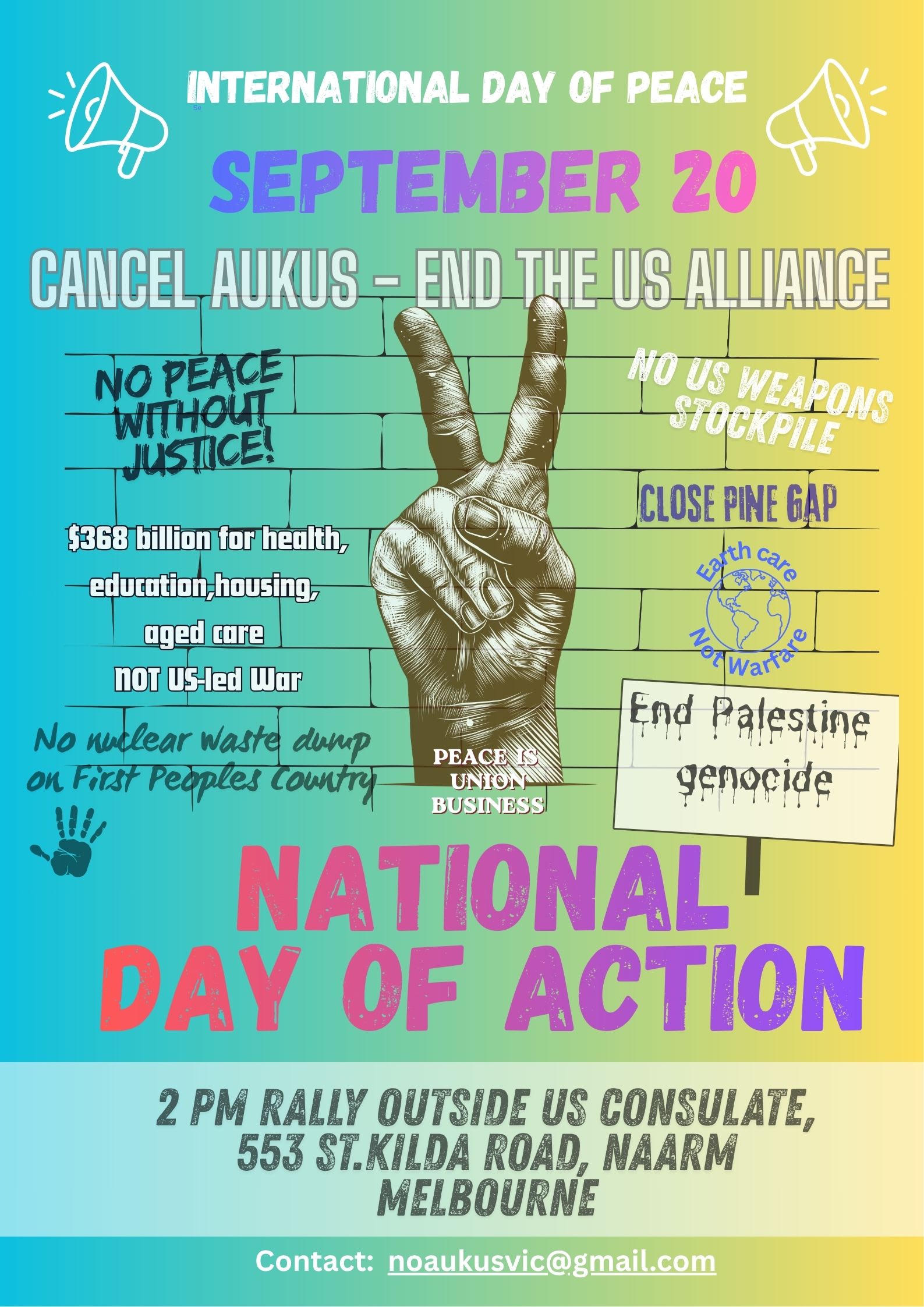
20 September –National Day of Action in Melbourne on the International Day of Peace

Help Aunty Sue Protect Her Land and Sacred Sites From Destructive Rocket Testing.
.

Australians deserve the truth
about
AUKUS – https://aukuspublicinquiry.com/


PETITION – To: Prime Minister Anthony Albanese and the Australian Labor Government

of the week – Australians for War Powers Reform (AWPR)
To see nuclear-related stories in greater depth and intensity
 Antinuclear