The Virginia-class submarine deal exposes the real purpose of AUKUS
June 4, 2026, Mike Gilligan, https://pearlsandirritations.com/post/2026/06/australias-submarine-betrayal/
Dr Mike Gilligan worked for 20 years in defence policy and evaluating military proposals for development, including time in the Pentagon on military balances in Asia.
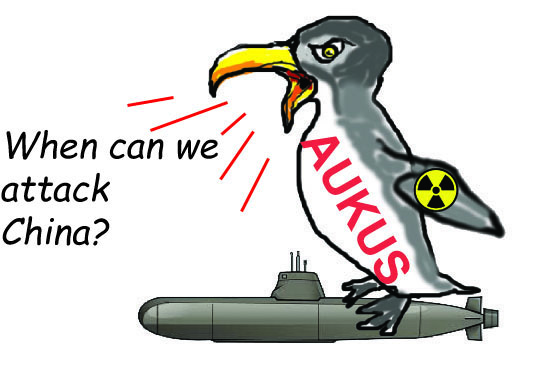
The shift to second-hand Virginia-class submarines exposes the deeper flaw in AUKUS: Australia is committing vast public funds to a capability designed around US strategic priorities rather than Australia’s own defence needs.
Yet another twist in Australia’s submarine fiasco has been disclosed by Defence Minister Marles. The United States has decreed it will sell us only used nuclear submarines of the Virginia class. Marles reportedly said that could mean financial savings short term, but not long run. As if he has ever revealed an instinct for efficiency in defence. No doubt Australians will experience another wave of waffle from the media, all of which misses th
Despite its crippling cost Marles has never explained what the Virginia class submarine is meant to do. Why has such an obvious ministerial obligation been evaded? Because it would reveal a sell-out of Australia’s security. And a massive direct underwriting of US defence budgets by Australian taxpayers – of say half a trillion of our dollars.
The Virginia class submarine is not a general-purpose vessel such as our Collins class. It is designed for supreme acoustic invisibility for a specific purpose – to find, track and attack submarines seen as a nuclear threat to the US mainland. That is the job which the US expects Australia’s submarines to do – effectively embedded into US military command – against China’s growing capacity to annihilate continental US from under the sea, anytime.e issue. What matters most about the AUKUS submarines has been concealed by this Minister throughout his tenure.
Why this role is of utmost priority for the US requires some explanation. Nuclear armed submarines, such as China possesses, present a uniquely difficult threat to the US homeland. Unlike the readily discernible launch locations of hostile land-based missiles, or from aircraft or sea-surface vessels, the submarine’s habitat and mobility make it largely invisible and impregnable across the vast ocean approaches to the US.
The US attempts to deal with this risk using specialised attack submarines (ie the Virginia), which can locate, track and destroy China’s nuclear submarines as they move into and around Pacific waters. This is one critical part of a mosaic of US self-protection measures, the effectiveness of which is eroding as China’s submarine production expands.
So, the hefty sacrifice which Australia’s taxpayers make to acquire new submarines is not for Australia’s benefit, but for defending continental US. Australia’s submarine needs are quite specialised and different, but simply ignored by Minister Marles. Australia is heavily gifting US defence spending while ignoring its own vulnerabilities, just as the President added another $500 billion to a trillion dollar defence budget. Now that the full horror of Marles’ tenure is established a Prime Minister would act.
Can one optimal pathway have two lanes? When it comes to AUKUS submarines, apparently yes

“Was the optimal pathway of last week actually not “optimal”? And if so, why was it called the “optimal pathway”?
Was the optimal pathway of last week actually not “optimal”? And if so, why was it called the “optimal pathway”?
By acting defence and national security correspondent Tom Lowrey, ABC News, Wed 3 Jun, 26
For an arm of the government tasked with a fairly straightforward mission — that is, fighting — Defence is famous for wrapping itself in impenetrable language.
Ships and planes are “platforms”, weapons are “capabilities”, soldiers are “personnel” and Australia’s road to running a fleet of nuclear-powered submarines is a “constrained optimal pathway”.
That optimal pathway has come in for plenty of scrutiny in the past few days.
The plan, as of last week, was for Australia to buy two “in-service”, that is, second-hand, submarines in 2032 and 2035, and a third brand-new submarine in 2038.
As of this week the plan is for Australia to buy three used submarines which the government is now arguing has been its preferred option all along.
Defence officials fronting up to estimates hearings this week have been copping questions on the surprise shift.
Was the optimal pathway of last week actually not “optimal”? And if so, why was it called the “optimal pathway”?
“You can absolutely have two constrained optimal pathways,” new Defence Secretary Meghan Quinn told Greens Senator David Shoebridge.
The exchange led Senator Shoebridge to accuse AUKUS of “not only damaging the public purse, but destroying the English language”.
Any economist will tell you constrained optimisation is taught in first year uni. It’s basically finding the best option with the cards you’ve been dealt.
But the exchange highlights the trouble the government is having explaining the changes it’s made and the risk to public confidence in Australia’s biggest ever defence project.
Substituting subs
Back when the “optimal pathway” was first announced in 2023, questions about the complexity of the plans were already being asked……………………….
The new Virginia class submarine would have arrived in 2038, and while details of exactly what it would have looked like aren’t known, it would likely have had some significant differences to its 2020s counterparts.
And the first Australian-made AUKUS submarine would have hit the water in Australia by 2042.
Marles has since argued Australia always held concerns about that plan and our preference from the outset was to acquire three in-service Virginia class subs to try and simplify things……………………..
Defence Industry Minister Pat Conroy addressed the shift on Radio National Breakfast.
“Submarine availability [and] maintenance has improved in the US system, which means that the US Navy feels comfortable releasing a third in-service submarine,” he said.
“That means it’ll be cheaper and simpler for us to run.”
…………………….. For some Australians it might look like the government is arguing a ten-year-old Toyota Corolla (with a responsible owner, of course) is actually a better option than a brand new model straight off the lot.
….It’s getting more real. It’s costing much more money, up to $96 billion between now and 2036, shipyards are being built, and sailors are being trained.
AUKUS is also going to attract much more scrutiny.,,,,,,,,,,,,,,,,,,,,,,,,,,,,,,, https://www.abc.net.au/news/2026-06-03/two-optimal-pathways-aukus-submarines/106755658
‘Capability that matters’: submarine switch played down
June 3, 2026, https://michaelwest.com.au/capability-that-matters-submarine-switch-played-down/
Australia receiving only used nuclear submarines from the US will not change the government’s commitment to the AUKUS pact, the foreign minister says.
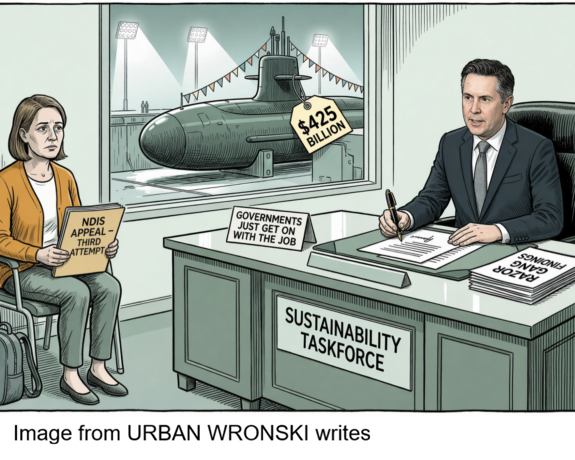
The $368 billion plan originally had Australia receiving three nuclear submarines from the US – two used and one new Virginia-Class vessels – before building its own in Adelaide.
But after changes to the deal, Australia will now get three used submarines from the US.
Foreign Minister Penny Wong said it did not matter whether the submarines were used or new.
“Whether it’s two (used) and one (new) or three, it’s the capability that matters,” she told ABC Radio on Wednesday.
“We want three submarines to deal with, from the United States, to deal with a capability gap before the AUKUS submarines are to be delivered … that is the plan.”
Defence officials revealed at a federal budget inquiry Australia preferred to receive second-hand vessels from the US.
Defence secretary Meghan Quinn told the inquiry on Tuesday night a reworking of the AUKUS deal was a joint idea between Australia and the US.
“Australia’s position is that we would have always … had a preference for three in-service (submarines),” she said.
“There are many reasons why three in-service (submarines) would be simpler, lower-cost through the training of staff, the sustainment arrangements, the maintenance requirements, and all of those considerations.”
Defence Industry Minister Pat Conroy said the change in the AUKUS deal did not mean a fundamental altering of the security pact.
“It will be cheaper, simpler to manage, and it’s been confirmed by the Pentagon overnight,” he told ABC Radio.
“We’ll get submarines … about six years into their 33-year life cycle. They’ll be cheaper, they’ll be really effective at that stage, and we’ll be acquiring the most capable nuclear-powered conventionally armed submarines in the world.”
Mr Conroy said Australia would save a “considerable” amount by not acquiring a new submarine, but did not disclose the cost.
He denied the used submarines would be more costly to maintain in the long term.
Ed Husic is casting doubt on the prospect of the submarines ever being delivered to Australia.
The comments come after Labor backbencher and former minister Ed Husic called for the government to rethink the multibillion-dollar plan.
Mr Husic said on Tuesday the deal also had to be rethought due to America becoming a more unreliable ally.
“You do wonder whether or not we will get the deal, even the reconfigured one that we have got,” the western Sydney MP told reporters at Parliament House.
Senator Wong said the backbencher was entitled to his view on AUKUS.
“It is in the best interests of our country for this project to continue to proceed. We believe it is necessary for Australian security and we believe chopping and changing will only set the country back,” she told ABC TV.
1 This month.
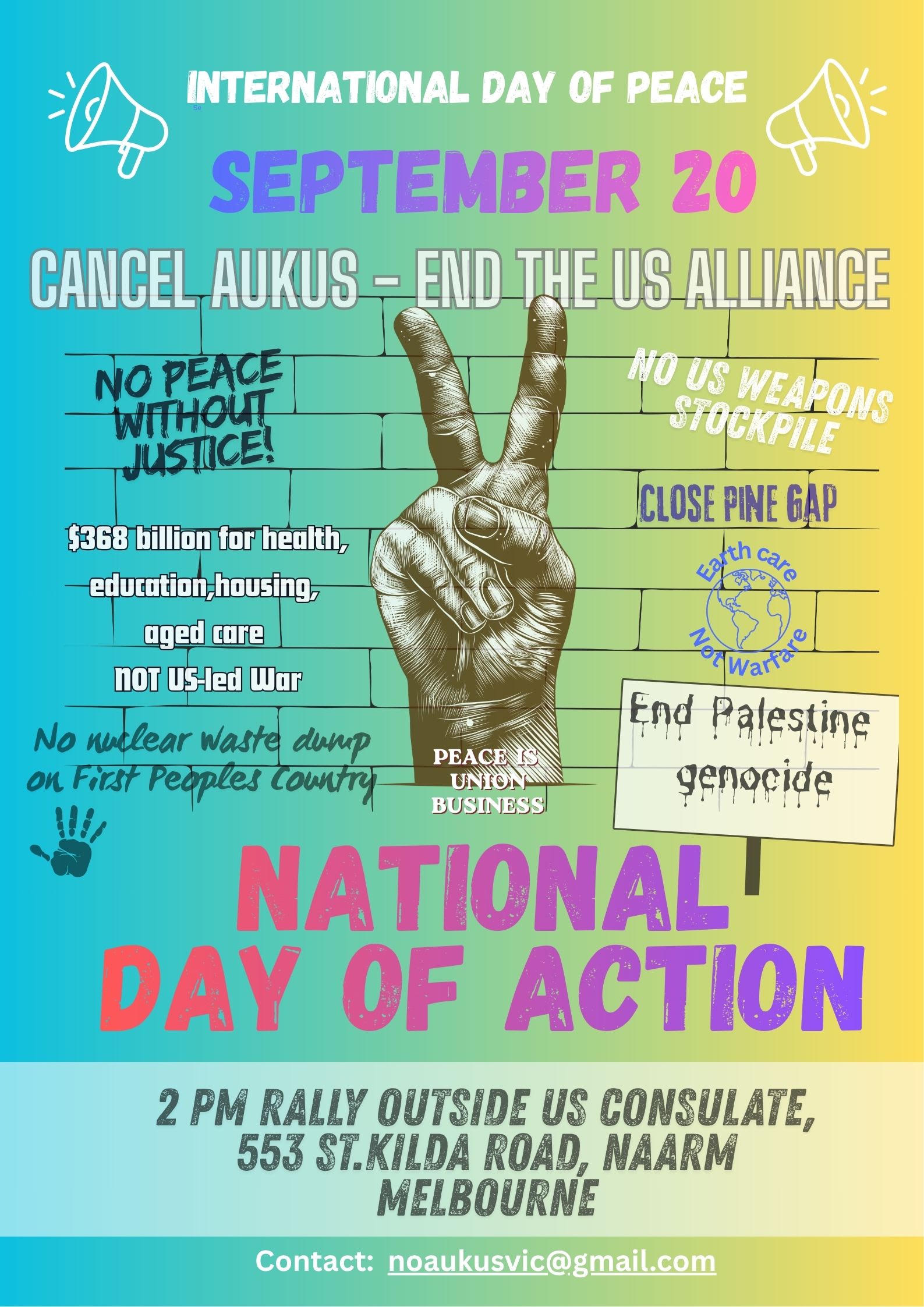
20 September –National Day of Action in Melbourne on the International Day of Peace

Help Aunty Sue Protect Her Land and Sacred Sites From Destructive Rocket Testing.
.

Australians deserve the truth
about
AUKUS – https://aukuspublicinquiry.com/

PETITION – To: Prime Minister Anthony Albanese and the Australian Labor Government

of the week – Australians for War Powers Reform (AWPR)
To see nuclear-related stories in greater depth and intensity
 Antinuclear