Greens warn nuclear submarines deal risks war with China as Albanese says Aukus ‘full-steam ahead’

David Shoebridge says Australia could become embroiled in a US war with China if purchase of Virginia-class attack submarines proceeds
Dan Jervis-Bardy, 7 June 26, https://www.theguardian.com/world/2026/jun/07/greens-warn-nuclear-submarines-deal-risks-war-with-china-as-albanese-says-aukus-full-steam-ahead
Anthony Albanese has reiterated that Aukus is “full-steam ahead” after the Greens renewed calls to cancel the nuclear-powered submarines deal, which the minor party warned could draw Australia into a potential US war with China.
Debate over the security pact has resurfaced after the announcement that Australia would buy secondhand Virginia-class submarines from the US, rather than a mix of old and new vessels.
The Greens have seized on the development to re-prosecute the case for the government to abandon the multi-decade, $368bn agreement.
Appearing on ABC’s Insiders program on Sunday, the Greens’ defence spokesperson, David Shoebridge, said the focus of Australia’s military assets should be on defending the nation’s borders.
He suggested that could be done with conventional submarines and other weapons, rejecting the need for capabilities designed to operate “thousands of thousands of kilometres from our shore” – such as the nuclear-powered vessels.
Shoebridge said buying the Virginia-class submarines would make Australia an “interoperable” part of the US military, drawing the country into a potential conflict with China.
“Nuclear submarines are pretty much a disaster on every front,” he said.
“Why are we inviting ourselves to a US war with China by buying this weapons platforms and making our defence an interoperable part of the US?”
Shoebridge said the greatest strategic threat facing the country was not China’s military buildup or disruptions to key shipping lanes.
Rather, it was the risk of Canberra losing its sovereignty to Washington, as he said occurred with the revised deal to send three secondhand submarines to Australia.
The government this week insisted it was always its preference to buy so-called “in-service” Virginia-class submarines from the US, saving money on acquisition, maintenance and training costs.
Shoebridge said there was a still a window of opportunity for Australia to dump Aukus and buy conventionally armed submarines from countries such as Japan, South Korea or Sweden without leaving a capability cap after the retirement of the Collins-class vessels.
He claimed the US was the world’s least-reliable supplier of submarines given the slow rate of production from its shipyards.
Shoebridge’s suggestion that Australia could acquire a different class of submarine appears to jar with the Greens’ own defence policy, which proposes to axe “unstrategic projects” including the Collins-class program.
Albanese brushed off Shoebridge’s criticisms when asked about them later on Sunday, declaring Aukus was “full-steam ahead”.
“We won’t be taking advice on defence from the Greens political party with respect,” the prime minister said at a press conference in Caloundra on the Queensland Sunshine Coast.
“What we’ll be doing is providing Australia with the defence assets that we need. Our alliance with the US is an important one but we promote peace and security in our region and the relationship with China is a very constructive one.”
The Aukus agreement – which also includes the UK – is expected to be on the agenda when the defence minister, Richard Marles, and the foreign affairs minister, Penny Wong, hold talks with their British counterparts next week.
Marles and Wong are scheduled to meet with the UK defence secretary, John Healey, and the UK foreign secretary, Yvette Cooper on Wednesday as part of a round of talks in Britain and Europe.
The Australian ministers will also sit down with their German counterparts for the first meeting of its kind since 2021.
Wong will also meet the French foreign affairs minister in Paris and Marles will hold talks with his Finnish counterpart during the trip.
“While geographically distant, Australia and Europe’s interests are increasingly interconnected which is why we must focus our partnerships on reinforcing collective deterrence,” Marles said.
“In complex and uncertain times, the United Kingdom remains a critical partner for Australia and we continue to strengthen and modernise our partnership including through the Aukus partnership.”
UK Navy nuclear submarine fleet stuck in dock while awaiting maintenance
The UK’s Navy’s entire available fleet of nuclear attack submarines is stuck in
port, leaving Britain vulnerable to Vladimir Putin’s underwater fleet. All
five of the UK’s Astute-class hunter-killer boats are awaiting maintenance
and repairs. A sixth, which was commissioned into the fleet, is not yet
ready to deploy. Naval commanders have said the situation makes the UK look
“toothless” in the eyes of Russia, which has ramped up naval activity
around British waters by a third in the past year. Cdr Ryan Ramsey, a
former nuclear submarine captain, said the lack of available attack boats
was a “serious wake-up call” for Britain.
Telegraph 7th June 2026, https://www.telegraph.co.uk/news/2026/06/07/navy-fleet-out-of-service-maintenance-russia-lord-west/
Freedom Of Information to die? Albanese’s nuclear strike on transparency

Instead of handing the documents over the Government has challenged the Tribunal’s decision in the Federal Court.
Who needs greater secrecy laws when you’ve got deep pockets funded by the very taxpayers’ they deny information to.
by Rex Patrick | Jun 7, 2026
So adamant is the Albanese Government to keep AUKUS nuclear waste plans secret, they initiated a Federal Court appeal to overturn an Administrative Review Tribunal transparency win. Rex Patrick reports.
Are we seeing another nail in the coffin of Freedom of Information and what is left of government transparency?
When ART Deputy President Britten-Jones handed down his decision in favour of disclosure he was adamant “there is a significant public interest in understanding policy decisions by Government in respect of nuclear waste management”.
He was quite convinced that the “best way to achieve [nuclear waste] social licence and trust is through transparency and not secrecy”.
But his very strong position was not enough to overcome Prime Minister Albanese’s secrecy obsession. In a very rare move, the Federal Government has appealed the Tribunal’s transparency decision to the Federal Court.
Political Sensitivity
It’s clear that the documents the Government was ordered to make public are politically sensitive. They may well be politically radioactive, but this is not an allowable reason under the Freedom of Information Act to refuse to release documents.
Britten-Jones stated in his decision:
I do not consider that there would be significant harm from disclosing geological information about a particular site even if it could be inferred that the site is either ruled in or ruled out from further consideration as a location for storage or disposal of nuclear waste.
At least one potential site for AUKUS waste is named in the documents.
In response to the Government’s pleadings for narrative control, Britton-Jones stated:
I can understand the [Government’s] preference for an orderly release of information but if the material was released, the Government would be able to provide its own context and the public would benefit from better understanding the process being undertaken.
He went on to declare:
Whilst there may be some inconvenient responses to the release of the information requiring Government action, the release would lead to and inform debate on a matter of public importance and it would increase scrutiny, discussion, comment and review of the Government’s activities. These are factors in the public interest that favour giving access to the material in issue to the Applicant. In my view, these factors outweigh any of the concerns expressed by the witnesses for the Respondent.
The documents requested also include documents that Britten-Jones stated “might well be contentious and give rise to sensitivities’.
That’s all too much for government.
Instead of handing the documents over the Government has challenged the Tribunal’s decision in the Federal Court.
The end of FOI?
The notice of appeal includes a request to the court that if the Government are successful,
“then I will have to pay their legal costs.”
I won the transparency battle in the Tribunal, and the Government now wants me to personally pay up to $150,000 if they win their appeal. With their very deep pockets (your money) they will likely engage a King’s Counsel to take on a bush lawyer.
In lodging the appeal and seeking costs against me the Government has ignored its own model litigant rules, which state that it can’t “take advantage of a claimant who lacks the resources to litigate a legitimate claim”. The rules also state that “In certain circumstances, it will be appropriate for the Commonwealth or Commonwealth entity to pay costs (for example, for a test case in the public interest).”
Greens spokesperson for Justice, Senator David Shoebridge, was unimpressed on hearing of the proposed cost order:
“The Labor government has repeatedly made it clear that they are willing to use millions of public dollars to silence whistleblowers and hide the truth from the public.
“But even from them, this is fresh territory.”
“Threatening someone with a potentially crippling legal bill simply because they put a successful FOI through the system is bullying, plain and simple.”
In September last year the Albanese Labor Government tabled an FOI Amendment Bill in the Parliament with provisions that sought to dramatically expand Government secrecy. After a significant campaign by civil society groups, the Bill was booted from the Parliament by all non-government senators.
“Albanese’s secrecy grab failed.”
The appeal in this matter revives Albanese’s secrecy plans. It matters little what the law is, if a citizen fights and gets a good transparency decision from the Information Commissioner or the Administrative Review Tribunal the Government can just appeal it to the Federal Court and threaten legal costs. The regular citizen will have to walk away. They can’t risk a loss.
Bingo for the Government! Who needs greater secrecy laws when you’ve got deep pockets funded by the very taxpayers’ they deny information to.
Senator Shoebridge stated further,
“This is another ugly precedent in secrecy from the Albanese government, and this time it’s delivered with a side serve of intimidation. It’s really shameful stuff.”
The approach taken is a nuclear strike on transparency of government and could well mean an end to FOI fights. It’s the absolute antithesis of the new era of transparency Albanese promised before his was elected. Indeed, it’s a very different story now that he’s got his hands on the government’s legal armoury.
Investigating the Foolish: The AUKUS Public Inquiry is Announced
The inquiry proposes to answer a number of salient if self-evident questions. Will Australia, for instance, ever receive the sought and undeservedly celebrated submarines? Where and how will the toxic medium to high-level nuclear waste be stored? How many actual jobs will be created in Australia, and at what opportunity cost?
7 June 2026 Dr Binoy Kampmark, https://theaimn.net/investigating-the-foolish-the-aukus-public-inquiry-is-announced/
Of the three countries involved in AUKUS, that most draining, useless and even pernicious of security pacts, Australia has been the only country indifferent, even scoffing, about the need for an inquiry into its merits. Unsurprisingly, both the US and UK inquiries have found much to merit the project – Australian taxpayer money has sluiced and soothed the submarine industrial base of both countries – but have also expressed concern about their respective production rates of nuclear-powered submarines.
While the first pillar of the agreement promises, with mighty emptiness, that the Royal Australia Navy will receive three Virginia-class nuclear-powered submarines (SSNs), with the possible opportunity to acquire a further two, the prospect of their timely arrival looks increasingly doubtful. The recent developments at the Shangri-La Dialogue held in Singapore that these will be hand-me-downs from the US Navy already suggests the lack of regard Australian personnel and their slavish representatives are held in. Add to this a joint as yet undesigned UK-Australian SSN design that will use US technology, the chances that a fleet of these expensive hulks finding their way into the hands of Australian sailors looks damnably remote.
With the Canberra mandarins and political governors insisting that no official inquiry be conducted into AUKUS, it has fallen to those keen on a public inquiry to take up the mantle. The crowd-founded AUKUS Public Inquiry, coordinated by the Australian Peace and Security Forum (APSF), will be led by a number of commissioners, spearheaded by former federal environment minister and frontman for Midnight Oil Peter Garrett. Former MPs, retired military and naval officers (these include former chief of the Australian Defence Force Chris Barrie), strategists and academics, human rights lawyers and union leaders promise to feature in this inquiry into the unpardonably foolish.
In remarks made on launching the inquiry, Garret declared that AUKUS “was the most significant, and by far the most costly decision made in secret by an Australian government, tying us to two other sovereign governments, and taking out an extraordinary amount of taxpayers’ money on a proposition which has got a lot of distinct and very difficult complexities and potential problems lying up ahead.”
The inquiry proposes to answer a number of salient if self-evident questions. Will Australia, for instance, ever receive the sought and undeservedly celebrated submarines? Where and how will the toxic medium to high-level nuclear waste be stored? (Australia lacks a single facility suitable for that task.) How many actual jobs will be created in Australia, and at what opportunity cost? (The conservative estimate of AU$368 billion is a ruinous one when considering what other parts of the federal budget will suffer as a result.) Why does Australia find itself in a situation where it will potentially join a war with the United States against China, its largest trading partner? The two last questions go to the central soundness (or lack of it) regarding AUKUS: whether sovereignty will be jeopardised (a moot point: it already has been), and whether the pact will turn the country into a nuclear target.
Other subsidiary matters will also fall within the purview of the inquiry. Transferring nuclear technology in this manner not only sets a precedent of destabilising value but raises concerns about nuclear non-proliferation treaty commitments and the environmental costs arising from developing nuclear storage facilities. Governments in Australia have repeatedly failed to consult and engage local communities about such projects, which have usually stymied in failed negotiations and costly litigation. How the martial dictates of AUKUS risks corrupting the tertiary sector in terms of research and university institutions is also a worry, given the tentacular nature of the military-industrial-university complex seen in such countries as the United States. Money hungry university vice chancellors and their morally flabby inner circles can always be trusted to make their institutions and countries less secure if the price is right. Then comes that most relevant of considerations: “Were credible and less costly alternatives to AUKUS properly assessed before the decision was made in secret?”
Civil society groups have welcomed this long-awaited effort. “The AUKUS agreement was conceived in secret and continues to be shrouded in secrecy,” observed Rtd Army Major Cameron Leckie, spokesperson for the Independent and Peaceful Australia Network (IPAN). “Australians deserve the truth about what they are paying for, what they are getting, and what risks this agreement carries for our sovereignty and security.”
In parliament, independent MP Allegra Spender raised a “Matter of Public Importance” demanding that the government “be transparent about the risks to the delivery of AUKUS and how Australia’s national and security interests will be protected especially in light of recent changes to contract terms.” There were also “emerging gaps in capability” arising from the Collins-class Life-of-Type Extension program, intended to supposedly drag out the deployment of boats beyond their retirement. Other parliamentarians, all independents, including Sophie Scamps, Dai Le, Zali Steggall, Nicolette Boele, Kate Chaney and Monique Ryan, also expressed similar reservations about AUKUS. Pithily, Ryan, who represents the Melbourne federal seat of Kooyong, called the crowdfunded independent inquiry into AUKUS “a national embarrassment” for the government: “it’s only a matter of time before we find ourselves crowdfunding for the submarines themselves.”
Even more heartily, there are rumblings of disquiet within the Australian Labor government about the pact. Former cabinet minister Ed Husic, whose career as a frontbencher was scrapped, if only temporarily, by the factional fanaticism of his own party, is demanding a fresh caucus vote on the agreement. “We are not going to get the deal that was promised,” Husic told Sky News. He suspected a straitjacketed deal were the submarines ever to arrive. “You know, you can almost imagine [the Americans] saying, ‘We give you these, you will do this with them’. And so there’s an active sovereignty question there.”
While his efforts to raise the issue on June 2 were dismissed by Prime Minister Anthony Albanese and the Minister for Defence Industry Pat Conroy with the usual nonsense that AUKUS was more than just a submarine agreement, the number of dissenters are growing. May their numbers burgeon sooner rather than later.
Ed Husic breaks rank on AUKUS, demands ‘plan B’ as deal changes

The news: Labor backbencher Ed Husic has broken rank on AUKUS, demanding a “plan B” and urging Australia to confront the “reality” that it may never receive the submarines it is entitled to under the agreement.
The context: The comments come two days after Defence Minister Richard Marles confirmed Australia would not receive a new Virginia class submarine from the US, instead receiving a third secondhand model.
Husic, who Marles ousted from cabinet in a factional stoush, questioned the defence minister’s claim that the change was based on making the deal more cost effective.
“I’d imagine that in the circumstances he’s been placed, he would have to say that,” Husic told reporters on Tuesday.
The Albanese government has staunchly defended AUKUS and received a boost last year when US President Donald Trump confirmed his administration was “full steam ahead” on the agreement.
But the wording of the agreement means that the Congress could prevent submarines from being handed to Australia, if doing so would degrade Washington’s capabilities.
American manufacturers are currently producing submarines at a rate of less than 1.5 per year, well under the threshold needed to fulfill its AUKUS commitments.
“This deal has changed and … we need to recognise [that]. Is there anything that is going to improve this outcome?” Husic said.
“I don’t think so.”
Labor’s caucus backed the AUKUS deal from opposition in 2021, though there was disquiet among rank-and-file members — and former prime minister Paul Keating — over the deal.
Husic’s intervention came after a Labor-aligned group picked former minister Peter Garrett to head an independent review into AUKUS.
“You’ve seen within the broader movement a general disquiet about the nature of the deal itself,” Husic said.
“But putting all that aside, there’s an issue about reality confronting us about whether or not we will even get the new deal that has been put to us.”
Husic insisted the proper processes were followed at the time but stressed the situation had materially changed since 2021.
What they said: “That deal versus what we’ve got now are different,” Husic said.
“I think that it now gives us a moment to think about whether or not the deal should be reconfigured, or what are the contingencies.”
The source: Ed Husic press conference
1 This month.
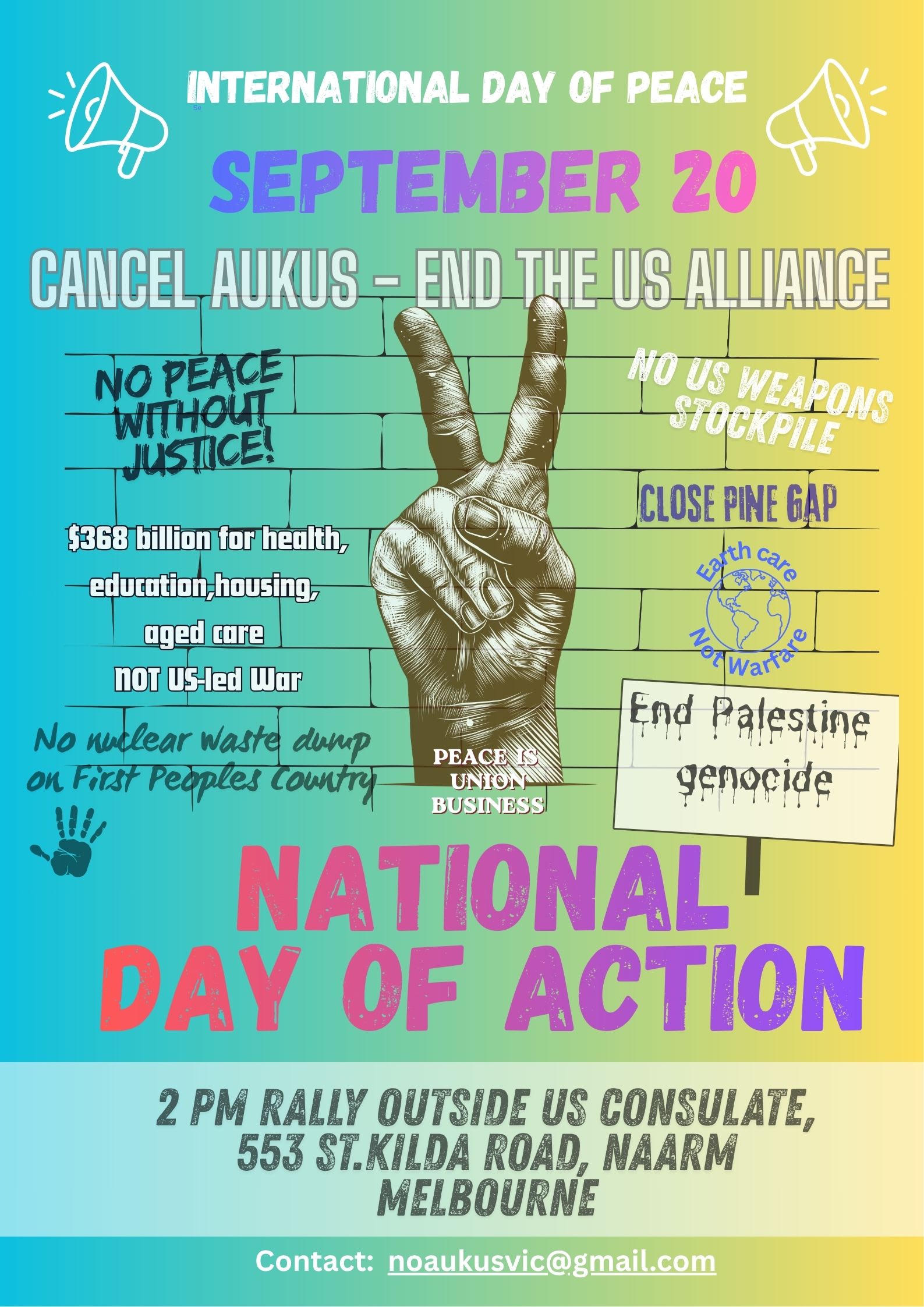
20 September –National Day of Action in Melbourne on the International Day of Peace

Help Aunty Sue Protect Her Land and Sacred Sites From Destructive Rocket Testing.
.

Australians deserve the truth
about
AUKUS – https://aukuspublicinquiry.com/

PETITION – To: Prime Minister Anthony Albanese and the Australian Labor Government

of the week – Australians for War Powers Reform (AWPR)
To see nuclear-related stories in greater depth and intensity
 Antinuclear