SUBMISSION: Radiation protection for workers and members of the public under AUKUS.

Submission to the national AUKUS inquiry by Dr Tony Webb, 11 June 25
About the author
I think the issues addressed in this submission should stand or fall on the relevance of the
concerns raised and the scientific evidence it highlights rather than who is raising them.
That said I do have some professional qualifications and a history of international
engagement with this issue. I hold an MSc in Energy Resources Management from the
Polytechnic of the Southbank, now Southbank University, London (1990) and a PhD from the
University of Western Sydney (2003). Retired from a senior lecturer position in the School
of Science and Health at the University of Western Sydney in 2013. Much of my work over
the past half century has been on the interface between the trade union / labour and
environment movements. In the UK in the 1970s I worked as national resources campaign
coordinator at Fiends of the Earth, coordinator of the Socialist Environment and Resources
Association Alternative Energy Campaign, founding director of the UK Radiation and Health
Information Service, and National Organiser of the UK national Anti-Nuclear Campaign. In
the 1980s I was director of the Radiation and Health Labor Project targeting US unions and
their members, worked as consultant to Canadian Labor Congress and Canadian unions
with members in uranium mining, nuclear power generation, and Health Services, and on
returning to the UK coordinated what became an international Food Irradiation campaign
through the London Food Commission and worked as senior researcher for Frank Cool MP
coordinating a Radiation Roundtable dialogue between unions environment and health
groups. I have continued aspects of this work in Australia most recently as an active
member of the South Australian Citizen’s Jury on the importing of nuclear wastes and lately
raising the concerns identified in this submission with environment, anti-nuclear, peace,
public health, political and trade union groups.
Summary of key issues covered in this submission
The key issues I wish to raise for consideration as part of this Inquiry into the AUKUS
submarine program are:
*That there is a potential risk to health of workers and the public from routine as well
as unpanned/accidental exposures to ionising radiation from many aspects of this
AUKUS program including: submarine construction, operation, maintenance,
decommissioning, and long-term management of radioactive waste materials.
*It has long been an established principle for radiation protection that there is no
threshold or safe level of exposure – that even small doses may result in stochastic
health effects where probability of effect rises with the level of exposure rather than
disease outcomes being determined by dose. As a result, it is expected that all
exposures need to be justified against some expected social benefit, be kept as low
as reasonably achievable (ALARA) and be kept below strict annual worker and public
exposure limits.
*These established principles are currently being challenged in the USA as a result of a
2025 Presidential directive that instructs the US Nuclear Regulatory Commission to
abandon the no threshold and ALARA principles and revise occupational and
exposure limits to reflect deterministic rather than stochastic health effects –
changes that, if implemented would significantly increase permissible exposures.
*It is unclear how such changes might be applied to nuclear submarine operations
under AUKUS particularly where US or Australian-US co-owned/operated boats use
Australian facilities. Pressure from the US to operate within US standards can be
anticipated. It should be noted that Australia has already established a Naval
Nuclear Protection Standards Regulator (ANNPSR) – separate from the current
Radiation Protection and Nuclear Safety Agency (ARPANSA) – that will regulate all
aspects of safety for the AUKUS program.
* The changes to US standards – already weaker than those applied under
international recommendations by most other countries, come at a time when
scientific evidence from large scale epidemiological health studies on workers
employed in, and communities living close to, nuclear facilities indicates that the
estimates used in setting current standards underestimate the risks to health and
need to be significantly tightened.
Details and evidence relating to these issues are outlined below. I will be happy to provide
further information and be questioned on matters arising if this would assist the Inquiry.
Impending changes to radiation protection standards
Changes for worse or better protection for workers and the public is on the international
and national political agenda in a number of countries. Trade Union, environment and
public health groups around the world are concerned that the USA is considering proposals
that would weaken radiation protection standards at a time when the scientific evidence
suggests these need to be significantly tightened. These need to be resisted with pressure
to provide better not worse protection for workers and the public.
In May 2025 US President Donald Trump issued a Directive (EO 14300) 1 requiring the US
Nuclear Regulatory Commission (NRC) to review nuclear safety regulations with particular
reference to radiation protection of workers and the public. The Directive instructs the NRC
to abandon fundamental principles that have formed the basis for radiation protection for
much of the past century. These include: the internationally accepted position that there is
no threshold or safe level of exposure to ionising radiation; that, as a consequence, all
exposures should be kept as low as reasonably achievable (ALARA); and that exposures to
workers and the public be kept below strict annual limits in line with the best
Evidence for increased health risk from radiation exposure
The evidence used to set current standards is drawn mainly from the studies of cancer rates
among the Japanese A-bomb survivors who were exposed to relatively high doses over short
time periods. Since then, studies of workers in nuclear power facilities exposed to lower
doses over long time periods show higher rates of cancer than predicted by the Japanese
studies. Rather than indicating any threshold these studies suggest that at low doses the
cancer rates are proportionately higher than expected from the Linear No-Threshold (LNT)
model used to set current standards. 2 Worker studies also show elevated rates of cardio-
vascular diseases 3 , and increased rates of dementia 4 . In addition, studies on populations
around nuclear power plants are now showing higher cancer rates affecting the population
generally 5 and particularly children 6 and the elderly 7 with level of health damage correlated
with how close they lived to these facilities.
Despite this evidence, the US NRC is considering weakening protection standards
Despite this mounting evidence that exposure limits should be tightened the likely result of
changes in line with the Presidential directive would be to increase the permissible exposure
limit for workers and the public to five times the current internationally recommended level.
The US NRC is clearly faced with a dilemma. Adopting the changes demanded by the
President would require reversing its 2021 decision that specifically rejected these same
proposals 8 . The initial date for publication of the NRC’s draft response for public
consultation was 23 February 2026. This have been deferred several times – first to 30 April
then 24 June and now 2 July. Despite large scale resignations and lay-offs among NRC staff
perhaps there remain some with scientific integrity opposing the changes they believe are
unjustifiable. Further delays may occur but the final revision of standards is required by end
of December 2026. Given the President’s record for seeking retribution on government
representatives or officials who oppose his plans it is hard to see any outcome from the NRC
other than a change to weaken the US standards.
US pressure on global standards
If they go through there will also likely be pressure on international and national standards
agencies to align with changes in the USA. There is already some push-back. In June 2025
the heads of European standards agencies issued a statement supporting the LNT and
ALARA principles and insisting that exposure standards be set on the basis of the scientific
evidence without undue influence. 9 In May 2026 the World Health Organisation urged
national and international bodies to continue collaboration to “harmonise standards, share
data and strengthen coordination on radiation and health.” 10
The AUKUS connection
In Australia there are a number of joint ventures in uranium and radioactive rare earths and
mineral sands mining and the government has already established a separate Naval Nuclear
Power Safety Regulator (ANNPSR) to oversee all aspects of construction, operation,
maintenance, decommissioning and nuclear waste management under the Australia-UK-US
(AUKUS) nuclear submarine program. While these nuclear submarine standards are
expected to be consistent with those of the current Australian Radiation and Nuclear Safety
Agency (ARPANSA) it is unclear whether US or Australian standards will apply to US military
or joint US Australian assets operating from Australian facilities. Pressure for change is
inevitable. Hopefully the outcome of politically independent science-based pressure will be
not merely opposition to changes prompted by the US President’s directive but for
significantly better standards to protect health of workers and the public where they are
routinely exposed to ionising radiation.
What the AUKUS investigation might recommend
First: that Australian radiation protection should continue to be based on the established
principles that: there is no safe level of exposure to ionising radiation; that all exposures in
the workplace, and in community from whatever source need to be justified against some
recognizable benefit and where justified be kept as low as reasonably achievable and in any
case below strict exposure limits that are set on the basis of the best available evidence for
the level of risk of health damage.
Second: that all radiation protection safety standards operated under the AUKUS program
and regulated by the ANNPSR be consistent with those developed by ARPSANSA for
occupational and public exposures generally and that these apply to construction,
maintenance, decommissioning and waste management for all nuclear-powered
submarines whether these are owned by Australia or another country – Australian
standards rather than those of another country should apply in Australia.
Third: that ARPANSA be asked to provide a clear and unequivocal statement that Radiation
Protection standards in Australia will not be changed in line with the US Presidential
Directive
Fourth: that ARPANSA be asked to undertake a systematic review of the evidence suggesting
that the current occupational and public exposure limits need to be revised – and tightened
so as to lower permissible exposure limits.
References and Further Reading
1 Directive EO14300 Ordering the Reform of the Nuclear Regulatory Commission 23 May 2025.
https://www.presidency.ucsb.edu/documents/executive-order-14300-ordering-the-reform-the-nuclear-
regulatory-commission see Section 5 for directives relating to Radiation Protection
2 Richardson et al. 2023. Cancer mortality after low dose exposure to ionising radiation in workers in France,
the United Kingdom, and the United States (INWORKS): cohort study. British Medical Journal 16 August 2023.
See https://www.bmj.com/content/382/bmj-2022-074520 The study concludes:
This major update to INWORKS provides a direct estimate of the association between protracted low-dose
exposure to ionizing radiation and solid cancer mortality based on some of the world’s most informative
cohorts of radiation workers. The summary estimate of excess relative rate solid cancer mortality per Gy is
larger than estimates currently informing radiation protection, and some evidence suggests a steeper slope for
the dose-response association in the low dose range than over the full dose range. These results can help to
strengthen radiation protection, especially for low dose exposures that are of primary interest in contemporary
medical, occupational and environmental settings.
3 Little et al, 2023. Ionising radiation and cardiovascular disease: systematic review and meta-analysis. BMJ
March 2023. doi: https://doi.org/10.1136/bmj-2022-072924
4 Frangione et al. Exposure to ionizing radiation and dementia mortality among nuclear power plant workers in
the Canadian national dose registry. Occupational and Environmental Medicine. November 5, Oral session:
Specific exposures: pesticides & Ionizing radiation.. https://doi.org/10.1136/oemed-2024-EPICOHabstracts.61
5 Alwadi Y, et al (2026). A national analysis of the impact of proximity to nuclear power plants on lung, breast
and colon cancer moralities in the U.S., 2000-2020, Journal of Exposure Science & Environmental Epidemiology.
https://www.nature.com/articles/s41370-026-00922-2
6 Fairlie, I. 2021. Radiation and Cancer in Children. Report for the UK Charity Children with Cancer. See
https://www.ianfairlie.org/news/a-report-on-radiation-risks-and-on-cancer-in-children/
7 Alwasi Y. et al. 2026. National analysis of cancer mortality and proximity to nuclear power plants in the
United States. Nature Communications 17, 1560, 13 April 2026. https://www.nature.com/articles/s41467-
026-69285-4
8 Petition for Rulemaking; Denial: Linear No-Threshold Model and Standards for Protection Against Radiation
Posted by the Nuclear Regulatory Commission on Aug 16, 2021 https://www.regulations.gov/document/NRC-
2015-0057-0671
No comments yet.
1 This month.
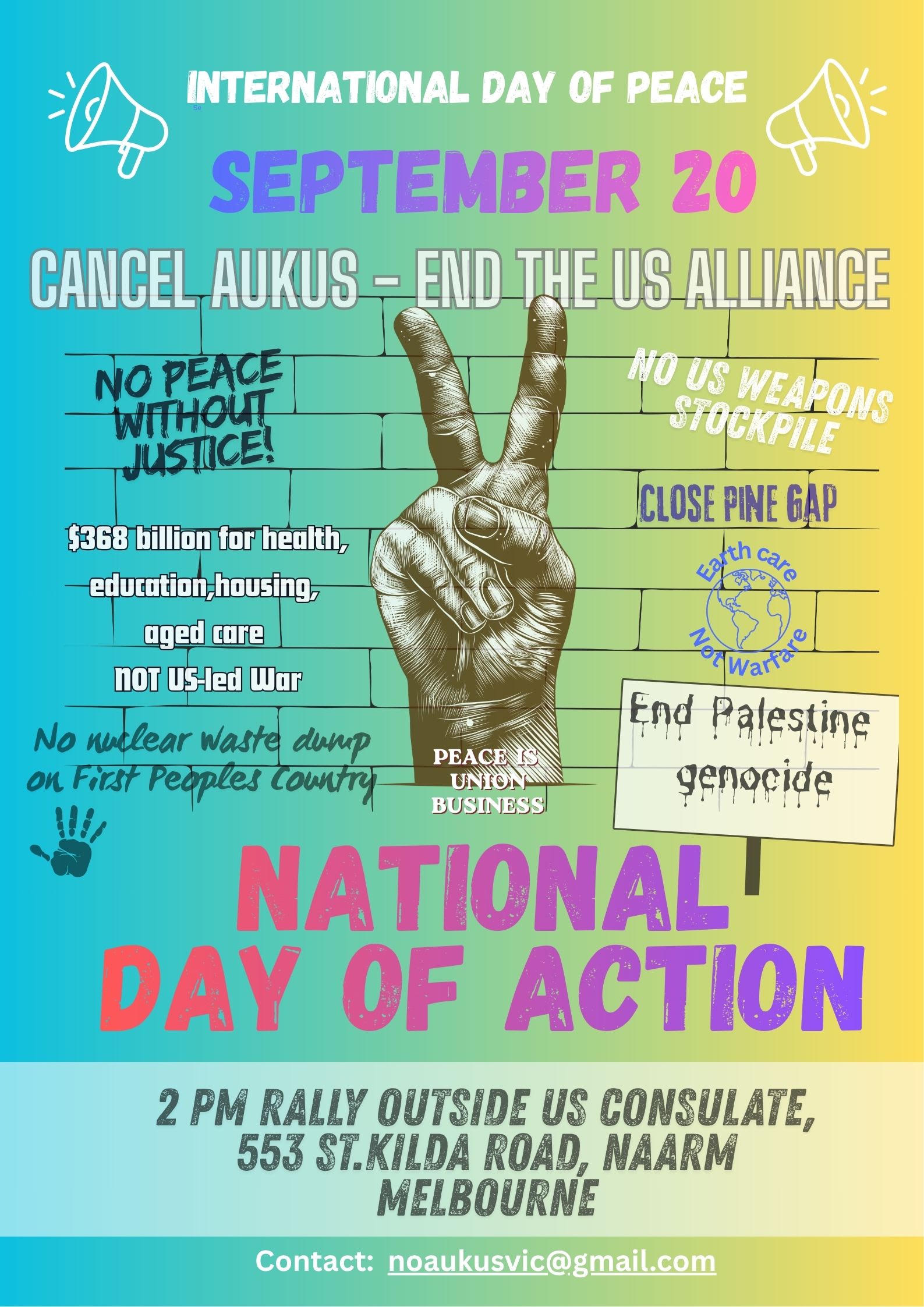
20 September –National Day of Action in Melbourne on the International Day of Peace

Help Aunty Sue Protect Her Land and Sacred Sites From Destructive Rocket Testing.
.

Australians deserve the truth
about
AUKUS – https://aukuspublicinquiry.com/

PETITION – To: Prime Minister Anthony Albanese and the Australian Labor Government

of the week – Australians for War Powers Reform (AWPR)
To see nuclear-related stories in greater depth and intensity
 Antinuclear
Leave a comment