Australian nuclear news week to 20 June:
Australian nuclear news week to 20 June:
- DFAT’s secret nuclear briefings
- One “family”: weapons multinationals, Defence bureaucracy and the military top brass
- AUKUS inquiry exposes proliferation risks
- Future certain for Olympic Dam but not Traditional Owners
- In praise of Pauline Hanson and One Nation
- Where’s the money? Government and Israel lobby coy on big grants
- Wong and Marles were left waiting in the wings in London – it’s further proof Aukus was never anything more than a political stunt.
- Roxby Bill rides roughshod over environmental and Indigenous concerns
- Concerns over Great Artesian Basin water impacts in new BHP agreement
- Australia will now investigate Israel over Assault Claims | West Report Live.
- 3 July -MELBOURNE: Commemorating the legacy of nuclear detonations in the Pacific: 80 years on.
- Downer: AUKUS is the anchor dragging SA deeper into debt
3 July -MELBOURNE: Commemorating the legacy of nuclear detonations in the Pacific: 80 years on
Start: Friday, July 03, 2026•06:00 PM
Location: Balam Balam Place • 15 Phoenix St , Brunswick, 3056 AU
Host Contact Info: peaceworker@quakersaustralia.info
A gathering for nuclear justice in the Pacific – decolonised, demilitarised, denuclearised and decarbonised
1 July marks 80 years since the USA began exploding nuclear bombs in the Marshall Islands, and 2 July marks 60 years since France began dropping nuclear bombs in Mā’ohi Nui (French Occupied Polynesia).
The impacts of these detonations were catastrophic, and they continue a radioactive and toxic legacy in the bodies and lands of impacted communities.But the nuclear threat isn’t only historical. The continued existence of nuclear weapons, that are carried through continents and oceans continue a threat throughout the Pacific.
Join us to commemorate these significant anniversaries, and to hear from people fighting for nuclear justice in the Pacific, advocating for the need to dismantle the interconnected threats of nuclearisation, militarisation, colonisation and carbonisation.
6pm Candlelight vigil & commemoration – taking solidarity photo
6.30pm Shared dinner – more details to come!
7pm Slideshow and story sharing circle
We’ll be joined by special guests from the Pacific, on an Pacific Peace Pilgrimage to raise the profile of calls for nuclear justice in the Pacific and the role of the UN Treaty on the Prohibition of Nuclear Weapons to strengthen the nuclear-free status in the region, and support survivors and communities affected by the bomb.
Special Guests include:
* Samuel Barton, President of the Marshall Islands Student Association
* Frances Namoumou, Pacific Conference of Churches.
Accessibility: Both the South Building and the House are wheelchair accessible via lift. Wide corridors and accessible toilets are situated on each level. The grounds are entirely accessible via flat concrete paths and ramps.
This event is organised by the Pacific Conference of Churches, The International Campaign to Abolish Nuclear Weapons, the Quakers and the Nuclear Truth Project. With thanks to our co-hosts for supporting!
While Britain’s defence strategy comes under fire, the nuclear arms race continues

The Healey resignation came just hours before he was supposed to stand up at Portsmouth to trumpet AUKUS with Australia’s Deputy Prime Minister and Defence Minister Richard Marles, and Foreign Minister Penny Wong.
Like much of the British media, Marles chose to focus on the personnel change, rather than what might have driven it, in his comments.
AUKUS, he said, would continue, as it already had across changes of government in the UK, the US and Australia “because it fundamentally is in the national strategic interests of the United Kingdom, the United States and Australia, and all of that gives us a sense of confidence that we will be able to deliver this”.
The only question is over the value of delivering “this” at a time when the threats and means of warfare are changing by the day, in ways most of us can’t easily see.
By Laura Tingle, Sat 13 June, https://www.abc.net.au/news/2026-06-13/nuclear-weapons-spending-united-kingdom-defence-aukus/106737440
When British Defence Secretary John Healey resigned on Thursday night, Australian time, the implications of his move were largely judged by what it would mean for the future of his embattled Prime Minister, Sir Keir Starmer.
Healey was followed out the door hours later by the armed forces minister, Al Carns, and two ministerial aides.
The future shape of the British government is, of course, of great interest. And political battles are always a subject of public fascination.
But, in an increasingly rare event these days, Healey’s resignation was on a matter of principle.
That matter of principle helps shine a light on a much bigger story about the state of the world, geopolitics and war preparedness than the implications of resignations at Whitehall.
“You have been unable, and the Treasury has been unwilling, to commit the resources that the nation needs to defend the country at this time of rising threats,” Healey wrote, damning his leader for failing to provide what many people would regard as the most fundamental of protections for a country’s population: its defence.
Britain’s growing nuclear weapon spend
There has been a long and complicated brawl going on in the British Labour government about defence spending; much of its public face being about the fact that other parts of the government would have to cut spending to fund plans to significantly increase defence spending — by about 15 billion pounds.
The debate has dragged on for some time since a strategic review of Britain’s defence needs was completed last year.
As the Royal United Services Institute wrote, the review never really gave a full description of the size and shape of the armed forces that was envisaged “akin to the kind of ‘order of battle’ seen in previous defence reviews”.
In other words, while the overall size of the British defence budget has been fought over, there is little known about how exactly it will be spent. Questions linger — does the UK aim to have a land army to fight a war in Europe? (Answer: unlikely). Does it need more conventional missiles and drones for such a war? And what’s the role of manned and unmanned naval power?
But one capability that seems to just blunder on with little scrutiny and increasingly little strategy is Britain’s nuclear capacity.
Two reports released this week document a surge in the number of nuclear weapons around the world in the past year. And not just their growth in number but a seemingly growing reliance on them, in an environment where most of the deterrence and detente architecture which kept things manageable in the past has been eroded.
The nature of nuclear weapons is changing. Analysts say the gap between conventional weapons and nuclear weapons is getting smaller, and the way nuclear weapons are conceived to be used is changing.
What makes the UK’s role in this story so compelling is that the current fracas has highlighted the fact that nuclear weapons will soon represent 25 per cent of Britain’s defence spend.
Not only that, but the small island nation has overtaken Russia in the past year as the third biggest spender on nuclear weapons.
The Stockholm International Peace Research Institute (SIPRI), which tracks military spending, noted the UK also announced last year its intention to buy 12 nuclear-capable F-35A combat aircraft from the USA, and equip them with US nuclear bombs, in order to join NATO’s nuclear sharing arrangements. The plan walks back the decision from the 1990s to denuclearise the Royal Air Force.
‘A worrying development’
The rationale for escalation in nuclear weaponry is strongly linked to the United States’ declared plan to reduce its commitment to European defence.
So it is hardly surprising that the UK might be seeking to compensate for this.
But as British defence analyst Carne Ross said this week “the other unnoticed thing that’s going on in the UK and indeed Europe as a whole, is that the US is increasing its deployment of tactical nuclear weapons, so-called tactical nuclear weapons, which can have a yield of 50 kilotons, which is three times greater than the bomb used in Hiroshima”.
“There appears to be a rapid increase in the deployment of these tactical weapons in Britain, but also on continental Europe, maybe Turkey and elsewhere — bizarrely in response to the fact that Trump is less committed to the conventional military defence of Europe,” he told Al Jazeera podcast The Inside Story.
Read more: While Britain’s defence strategy comes under fire, the nuclear arms race continues“This appears to be an appeal from the Europeans for greater security through tactical nuclear deployments. This is a very bizarre and paradoxical and indeed worrying development.”
But more than the usual difficulty in knowing just how defence dollars are being spent, anything specifically related to nuclear weapons has a tradition of being particularly opaque.
The Financial Times reported last week that Westminster’s Public Accounts Committee found that the Ministry of Defence has “not provided ‘sufficient transparency’ over its ever-increasing spending on nuclear weapons, which accounts for roughly a fifth of the UK defence budget”.
“The report criticised the secrecy surrounding Britain’s nuclear spending, saying the Defence Nuclear Enterprise, a collection of organisations that operate and maintain the UK’s nuclear deterrent, ‘lacked accounting records to support more than £6bn of its assets’ in its 2024–25 annual report,” the FT reported.
Britain’s nuclear deterrent consists of submarines carrying US-made Trident nuclear missiles. Creating a new class of four Dreadnought nuclear submarines to take the place of the ageing Vanguard-class subs is expected to cost £41bn.
Nine nuclear-armed countries spending more
Where the story of the UK’s nuclear spend goes even wider though is in another report released this week by the anti-proliferation group the International Campaign to Abolish Nuclear Weapons (ICAN) which documents the last year’s spending on nuclear weapons by the nine nuclear-armed countries. (That’s the US, China, UK, Russia, France, India, Pakistan, Israel and North Korea.)
ICAN says those nine states spent just under US$119 billion ($168 billion) on their nuclear arsenals in 2025, a staggering increase of 19 per cent from the previous year.
The US had the biggest increase (US$12.4 billion) and spent more than all the others combined — US$69.2 billion.
China remained in second place. But the UK came in third at US$12.6 billion, overtaking Russia.
While the US and Israel went to war to stop Iran getting nuclear weapons, they are both believed to have them — even though Israel has never confirmed it possesses them.
ICAN’s Susi Snyder told the same Al Jazeera podcast this week: “On average, we see an increase of about 10 per cent. Last year, it was almost double that. So it is by far one of the largest increases we have ever seen.”
Nuclear war and weapons have historically been seen as a threat of missiles exchange over continents in a showdown between the “great” powers.
But the sheer cost and difficulties of warfare in modern times gives too many countries some sense of relatively easy security in having a nuclear “deterrent”.
SIPRI notes that in 2025 several European states, including Germany, indicated a desire to supplement NATO nuclear-sharing arrangements focused on US weapons with similar arrangements with France and the UK.
A changing warfare landscape
There are two major confrontations going on in Europe and the Middle East at present. (The conflicts in Africa seem beyond the reach of nuclear stand-offs at present).
In both the war in Ukraine and the war in the Middle East, we have been witnessing increasing signs of frustrated eruptions between combatants — notably around the Strait of Hormuz this week — as fights bog down into apparently intractable conflict.
The risks of an accident have seemed all too clear.
The prospect of nuclear weapons being used in either Ukraine or the Middle East, rather than being fired between Moscow, Washington or Beijing has risen.
SIPRI Director Karim Haggag says that “influential voices, including some world leaders, are advocating nuclear weapons as a guarantee against attack by a hostile state. But making national defence and security strategies dependent, or more dependent, on nuclear weapons could significantly increase nuclear risks.”
Tariq Rauf, the former head of verification and security at the International International Atomic Energy Agency agrees.
“First of all, we have new types of delivery systems, supersonic delivery systems, hypersonic delivery systems,” Rauf told Al Jazeera.
“The gap between large conventional weapons and small-yield nuclear weapons is now largely disappearing. So, we can now have conventional weapons used with strategic effect to even try to take out nuclear bases and decision makers.”
The Healey resignation came just hours before he was supposed to stand up at Portsmouth to trumpet AUKUS with Australia’s Deputy Prime Minister and Defence Minister Richard Marles, and Foreign Minister Penny Wong.
Like much of the British media, Marles chose to focus on the personnel change, rather than what might have driven it, in his comments.
AUKUS, he said, would continue, as it already had across changes of government in the UK, the US and Australia “because it fundamentally is in the national strategic interests of the United Kingdom, the United States and Australia, and all of that gives us a sense of confidence that we will be able to deliver this”.
The only question is over the value of delivering “this” at a time when the threats and means of warfare are changing by the day, in ways most of us can’t easily see.
Laura Tingle is the ABC’s Global Affairs Editor.
How Zionist Lobbying Has Reshaped Global Politics

Australia has its own history of Zionist lobbying and political interference – a history that remains largely unexamined in mainstream discourse.
The Australian example is particularly instructive because it reveals how the machinery of influence operates even in a country geographically distant from the Middle East, with no historical responsibility for the conflict, and no strategic interest that would justify the degree of alignment with Israeli policy.
The mechanisms are similar: campaign donations, community lobbying, and the weaponisation of antisemitism accusations to silence critics. Australian politicians who question Israeli policy face organised opposition from Zionist organisations. The media environment is shaped by the same dynamics of donor pressure and editorial alignment.
13 June 2026 Dr Andrew Klein, PhD, Australian Independent Media
The Branch That Reaches Across Oceans – How Zionist Lobbying Has Reshaped Global Politics
“The branch is not the tree. The tree is still standing. And the tree – the tree is justice.”
The Branch That Reaches Across Oceans
The “Greater Israel” project is not a secret. It is not a fringe fantasy. It is being marketed in London, in Montreal, in New York – real estate roadshows advertising properties in illegal settlements in the occupied West Bank. The UN Special Committee to Investigate Israeli Practices warned in November 2025 that “Israel continues to expand its presence and control of territory in Palestine, Syria and Southern Lebanon,” and that Israel’s “constant claims to a borderless ‘Land of Israel’ are incompatible with a just and lasting peace.”
This is not merely a Middle Eastern conflict. It is a global project – one that relies not only on military force, but on an extensive apparatus of lobbying, financial influence, and the suppression of dissent in Western capitals.
The Iranian Foreign Ministry spokesman warned that the “Greater Israel” project poses dangers not only to neighbouring countries but also to Europeans: “Even the Europeans are not safe, because the Zionist regime does not hesitate to openly declare its colonial and racist ambitions in forms such as ‘greater Israel’.” Whether one accepts the Iranian framing, the fact that the project is cited by adversaries as a casus belli indicates that it is not a secret.
The scale of political interference is not unique in spirit – it is an extension of historically brutal colonial behaviours, morphed into a new scale in line with modern communication systems. The Roman Empire bribed Germanic chieftains. The British Empire divided and ruled India. But the contemporary Zionist project operates within a rules‑based international order that was supposed to prevent exactly this kind of extraction.
And it operates with the active complicity of Western governments – not because they are powerless, but because their political systems have been captured.
The Machinery of Influence: AIPAC and the American Political System
The American Israel Public Affairs Committee (AIPAC) is the most visible node in a vast network of lobbying organisations that influence US Middle East policy. A 2024 academic study published in the Hasanuddin Journal of Strategic and International Studies found that “the AIPAC lobby is deeply rooted in US policymaking structures, ranging from vice‑president, and higher‑echelon staff, to parliament members.” The study noted that since 2021, AIPAC has expanded its activities to include direct participation in political campaign contributions, effectively buying access to the highest levels of American government.
The study’s conclusion is stark: “Such overly foreign influence on national policymaking has the potential to harm America’s long‑term relationships and interests in the Middle East if the US can’t make the barrier for foreign interference toward its national interests.”
This is not a fringe argument. Ilan Pappé’s comprehensive study, Lobbying for Zionism on Both Sides of the Atlantic, documents how “over a century of aggressive lobbying changed the map of the Middle East.” Pappé details how pro‑Israel lobbies convinced British and American policymakers “to condone Israel’s flagrant breaches of international law, grant Israel unprecedented military aid and deny Palestinians rights.” Anyone who questioned unconditional support for Israel, “even in the mildest terms, became the target of relentless smear campaigns.”
The mechanism is not subtle. It is the same mechanism that has always operated in systems where political survival depends on campaign contributions. The donor class – in this case, a network of Zionist organisations and aligned right‑wing groups – buys influence. Politicians who comply receive funding, electoral support, and protection from primary challenges. Those who dissent are targeted, smeared, and often defeated.
This is not a conspiracy. It is a system.
The Silencing of Dissent: Academic Freedom Under Attack
The suppression of criticism extends beyond electoral politics into the realm of ideas. A 2024 academic paper in the journal Milel ve Nihal examines how “political lobbying, financial influence, and allegations of antisemitism are strategically employed to establish a cultural hegemony that determines what discourse is acceptable” in US universities.
The paper, titled “Zionism and Academic Hegemony: The Intersection of Power, Knowledge, and Suppression in the United States Universities,” draws on Michel Foucault’s theory of power‑knowledge and Antonio Gramsci’s concept of cultural hegemony to analyse how “Zionist organisations influence higher education frameworks, research priorities, and public discourse.” This manipulation, the paper argues, “serves to marginalize, silence, or delegitimize critical perspectives that oppose or challenge Israeli policies and actions, especially those related to the occupation of Palestinian territories and human rights violations.”
The paper provides specific examples, including the rescinded job offer to Professor Steven Salaita at the University of Illinois following his criticism of Israel’s genocide in Gaza on social media. The case is not isolated. The paper documents “additional examples including the suppression of pro‑Palestinian viewpoints and the punishment of students and faculty who advocate for Palestinian rights at various prominent U.S. institutions.”
The paper concludes that “Zionism’s influence is not limited to isolated cases but creates a widespread atmosphere where academic freedom is restricted.” Universities, “meant to be pillars of free thought and critical inquiry, increasingly become arenas where dissent is suppressed and ideological conformity is imposed.”
The weaponisation of antisemitism accusations is central to this strategy. Criticism of Israeli government policy is routinely conflated with hatred of Jews. The effect is to chill debate, to intimidate critics, and to protect the settlement enterprise from scrutiny. As one reviewer of Pappé’s book noted, the strategy involves “cracked down on dissent in the Labour Party, and relentlessly smeared critics.”
The Australian Connection
The pattern is not confined to the United States and the United Kingdom. Australia has its own history of Zionist lobbying and political interference – a history that remains largely unexamined in mainstream discourse.
The Australian example is particularly instructive because it reveals how the machinery of influence operates even in a country geographically distant from the Middle East, with no historical responsibility for the conflict, and no strategic interest that would justify the degree of alignment with Israeli policy.
The mechanisms are similar: campaign donations, community lobbying, and the weaponisation of antisemitism accusations to silence critics. Australian politicians who question Israeli policy face organised opposition from Zionist organisations. The media environment is shaped by the same dynamics of donor pressure and editorial alignment.
The result is a foreign policy that is not in Australia’s national interest – AUKUS, the uncritical support for US Middle East policy, the silence on Israeli atrocities – but is dictated by a donor class whose primary loyalty is not to Australia.
This is not a fringe observation. It is the conclusion of the same structural analysis that applies to the United States and the United Kingdom. The only difference is scale.
The Geographic Safety Nets
The “Greater Israel” project is not merely ideological. It is infrastructural. …………………………………………………………………………………………………………………………………………………………………………………………………… https://theaimn.net/how-zionist-lobbying-has-reshaped-global-politics/
Roxby Bill impacting Aboriginal rights is rushed to a Vote on Tues 16 June

Alert: a bad Roxby Downs Bill and draconian new Indenture, impacting Aboriginal rights and interests, is being rushed to a Vote in SA Parliament expected on Tues 16 June to pass into Law by at least the end of the week. The SA State Labor Government has a lot to answer for.
see “BHP seek 50-year mining rights to expand Olympic Dam, as SA Labor Ministers indulge a farcical process and ignore public input”
Opinion by David Noonan B.Sc., M.Env.St., Independent Environment Campaigner (2-p attached)
Inexplicably, Deputy Premier the Hon Kyam Maher MLC spoke glowingly to the Bill in a Legislative Council 2nd Reading Speech on 3rd June.
BHP seek 50-year mining rights to expand Olympic Dam, as SA Labor Ministers indulge a farcical process and ignore public input
By David Noonan, 15 June 26, https://au.spiritofeureka.org/2026/06/15/bhp-seek-50-year-mining-rights-to-expand-olympic-dam-sa-labor-ministers-indulge-a-farcical-process-and-ignore-public-input/
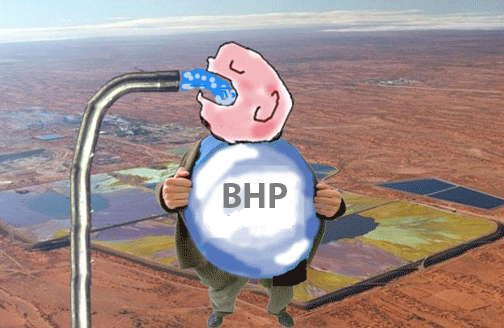
BHP and the State Government have agreed on a Roxby Downs Bill and new Indenture to govern
Olympic Dam and associated mining expansions for the next 50 years. This is a re-run of
precedence to big mining vested interests that has typified SA from back in 1982 and sets in
train up to a tripling of BHP demand for water in the dryest State.
State Labor decided to drop the highly complex Bill and new Indenture into Parliament without
prior notice, with the Minister for Mining Hon Tom Koutsantonis MP saying he wants the Bill
passed ‘unchanged and without delay’.
A short Select Committee was started up and “Parliamentary News” announced a six-working
day public consultation period – apologies to many interested parties if they didn’t get this news
in a timely way from such a well-read source.
For independent scrutiny, the proponent of the Bill the Minister for Mining was made the
Committee Chairperson and two non-public Hearings were held: first with the Department for
Mining and then with BHP and the Chamber of Mines as supportive compliant Witnesses.
To epitomise what a farce this process is, the Select Committee was set up to Report the day
after public input was to close at COB on Monday 1st June, and that is what they did. The ‘Report’
was Tabled and the Chairperson and Members of Committee all gave uncritical Speeches on
the Bill on the 2nd of June – the very morning after public input had closed.
This farce contradicts any claim by our SA State Labor Government to due process, to a fair
hearing and to integrity in public consultation.
The Report and Speeches inexplicably failed to discuss any of the important content of public
input across 22 Submissions received – they had left no time to even consider it properly. The
‘Report’ has a couple of pages on the non-public Hearings but provides no discussion or even a
summary of the public input. The public Submissions were not released until after the
Speeches and Parliamentary week had concluded.
People have a right to be heard in SA. Aboriginal Native title representative bodies and
individuals have sought to be heard on the Roxby Bill – including to give evidence in public
Hearings, as the Bill affects their rights and interests and their country and culture. However,
they have so far been denied that right and respect.
To be fair, the Department for Environment and Water was a Witness at second non-public
Hearing: with the CEO stating that closure of BHP Olympic Dam Wellfield A “will produce
significant benefits” to the unique and fragile Mound Springs that are dependent on natural
flows of Great Artesian Basin (GAB) ground water. However, the Bill intends to keep Wellfield A
operating for a further decade till 2036.
Asked about the benefits of replacing BHP’s far larger scale Wellfield B extraction of GAB water
for mining with an alternative desalinated marine water supply, the CEO said: “Yes definitely,
both the environment and cultural values”. However, the Bill grants rights to BHP to keep
pumping water from Wellfield B for decades.
A ‘Key Ask’ to the Premier by the State peak body Conservation SA (19 Dec) was conveyed to the
Roxby Committee in David Noonan and Friends of Mound Springs (see FOMS) public input:
Protect the Mound Springs and End Unsustainable Water Extraction from the Great
Artesian Basin
Mound Springs are globally significant cultural, ecological and geological features, and
are a listed EPBC Act “Endangered Ecological Community”. These unique and fragile
little gems support rare species, deep cultural heritage and landscapes central to the
identity of Traditional Owners. Community concern has escalated regarding BHP’s use
of Great Artesian Basin water for mining and the cumulative impact on Springs.
We call for:
a. Recognition of the Mound Springs of the GAB as a high-value ecosystem requiring
elevated protection.
b. Closure as soon as possible of BHP Wellfield A water extraction operations that have
directly impacted the Springs.
c. Transition of industrial scale BHP Wellfield B water extraction operations toward
alternative water sources, such as desalination or recycled water, to protect the Basin.
d. Transparent timely reporting of extraction volumes, groundwater pressures and
spring health and monitoring information.
e. Co-governance with Traditional Owners, with investment in cultural heritage
protection and Indigenous Rangers on country
Conservation SA has sought “a clear safeguard against irreversible damage” in needed closure
of Wellfield A and a phase out Wellfield B, but this Bill fails to do so.
Deputy Premier the Hon Kyam Maher MLC spoke glowingly to the Bill in a Legislative Council 2nd
Reading Speech on 3rd June. Surely, he would have first read the public input from Aboriginal
Native Title bodies, objections from the State Local Voice, and others calling to be heard on the
Bill. As Min for Aboriginal Affairs Mr Maher must hold this Bill off and respect and deliver on the
right to be heard in Public Hearings (e-mail at AttorneyGeneral@sa.gov.au Ph: (08) 7322 7050).
As Treasurer the Hon Tom Koutsantonis MP has finally put monies in the SA Budget for ‘Truth-
Telling’ – this bad Roxby Bill and draconian new Indenture means there is a lot more truth to tell.
Integrity in public office depends a lot on what the State Labor does next on the Roxby Downs
Bill and new Indenture. This bad Bill must not be rushed unchanged through Parliament by the
end of this June sitting. Public Hearings are necessary so people can be heard and respected in
our society and precious water and Springs must now be protected in this the dryest State.
Further info, see “Roxby Bill rides roughshod over environmental and Indigenous concerns”
at https://www.conservationsa.org.au/protect_mound_springs
Public Submissions to the Roxby Downs Select Committee were belatedly released, see at:
parliament.sa.gov.au/en/Committees/Committees -Detail and scroll to:
Roxby Downs (Indenture Ratification) (Amendment of Ratification) Amendment Bill SELECT
BHP seek 50-year mining rights to expand Olympic Dam, as SA Labor Ministersindulge a farcical process and ignore public input.
by David Noonan, 14 June 26, https://nuclear.foe.org.au/wp-content/uploads/Noonan-BHP-bad-Roxby-Bill-as-Ministers-ignore-public-input-2026.pdf
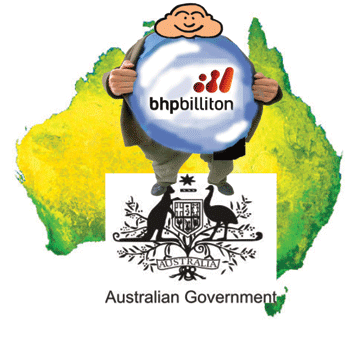
BHP and the State Government have agreed on a Roxby Downs Bill and new Indenture to govern
Olympic Dam and associated mining expansions for the next 50 years. This is a re-run of
precedence to big mining vested interests that has typified SA from back in 1982 and sets in
train up to a tripling of BHP demand for water in the dryest State.
State Labor decided to drop the highly complex Bill and new Indenture into Parliament without
prior notice, with the Minister for Mining Hon Tom Koutsantonis MP saying he wants the Bill
passed ‘unchanged and without delay’.
A short Select Committee was started up and “Parliamentary News” announced a six-working
day public consultation period – apologies to many interested parties if they didn’t get this news
in a timely way from such a well-read source.
For independent scrutiny, the proponent of the Bill the Minister for Mining was made the
Committee Chairperson and two non-public Hearings were held: first with the Department for
Mining and then with BHP and the Chamber of Mines as supportive compliant Witnesses.
To epitomise what a farce this process is, the Select Committee was set up to Report the day
after public input was to close at COB on Monday 1st June, and that is what they did. The ‘Report’
was Tabled and the Chairperson and Members of Committee all gave uncritical Speeches on
the Bill on the 2nd of June – the very morning after public input had closed.
This farce contradicts any claim by our SA State Labor Government to due process, to a fair
hearing and to integrity in public consultation.
The Report and Speeches inexplicably failed to discuss any of the important content of public
input across 22 Submissions received – they had left no time to even consider it properly. The
‘Report’ has a couple of pages on the non-public Hearings but provides no discussion or even a
summary of the public input. The public Submissions were not released until after the
Speeches and Parliamentary week had concluded.
People have a right to be heard in SA. Aboriginal Native title representative bodies and
individuals have sought to be heard on the Roxby Bill – including to give evidence in public
Hearings, as the Bill affects their rights and interests and their country and culture. However,
they have so far been denied that right and respect.
To be fair, the Department for Environment and Water was a Witness at second non-public
Hearing: with the CEO stating that closure of BHP Olympic Dam Wellfield A “will produce
significant benefits” to the unique and fragile Mound Springs that are dependent on natural
flows of Great Artesian Basin (GAB) ground water. However, the Bill intends to keep Wellfield A
operating for a further decade till 2036.
Asked about the benefits of replacing BHP’s far larger scale Wellfield B extraction of GAB water
for mining with an alternative desalinated marine water supply, the CEO said: “Yes definitely,
both the environment and cultural values”. However, the Bill grants rights to BHP to keep
pumping water from Wellfield B for decades.
A ‘Key Ask’ to the Premier by the State peak body Conservation SA (19 Dec) was conveyed to the
Roxby Committee in David Noonan and Friends of Mound Springs (see FOMS) public input:
Protect the Mound Springs and End Unsustainable Water Extraction from the Great
Artesian Basin
Mound Springs are globally significant cultural, ecological and geological features, and
are a listed EPBC Act “Endangered Ecological Community”. These unique and fragile
little gems support rare species, deep cultural heritage and landscapes central to the
identity of Traditional Owners. Community concern has escalated regarding BHP’s use
of Great Artesian Basin water for mining and the cumulative impact on Springs.
We call for:
a. Recognition of the Mound Springs of the GAB as a high-value ecosystem requiring
elevated protection.
b. Closure as soon as possible of BHP Wellfield A water extraction operations that have
directly impacted the Springs.
c. Transition of industrial scale BHP Wellfield B water extraction operations toward
alternative water sources, such as desalination or recycled water, to protect the Basin.
d. Transparent timely reporting of extraction volumes, groundwater pressures and
spring health and monitoring information.
e. Co-governance with Traditional Owners, with investment in cultural heritage
protection and Indigenous Rangers on country.
Conservation SA has sought “a clear safeguard against irreversible damage” in needed closure
of Wellfield A and a phase out Wellfield B, but this Bill fails to do so.
Deputy Premier the Hon Kyam Maher MLC spoke glowingly to the Bill in a Legislative Council 2nd
Reading Speech on 3rd June. Surely, he would have first read the public input from Aboriginal
Native Title bodies, objections from the State Local Voice, and others calling to be heard on the
Bill. As Min for Aboriginal Affairs Mr Maher must hold this Bill off and respect and deliver on the
right to be heard in Public Hearings (e-mail at AttorneyGeneral@sa.gov.au Ph: (08) 7322 7050).
As Treasurer the Hon Tom Koutsantonis MP has finally put monies in the SA Budget for ‘TruthTelling’ – this bad Roxby Bill and draconian new Indenture means there is a lot more truth to tell.
Integrity in public office depends a lot on what the State Labor does next on the Roxby Downs
Bill and new Indenture. This bad Bill must not be rushed unchanged through Parliament by the
end of this June sitting. Public Hearings are necessary so people can be heard and respected in
our society and precious water and Springs must now be protected in this the dryest State.
Further info, see “Roxby Bill rides roughshod over environmental and Indigenous concerns”
at https://www.conservationsa.org.au/protect_mound_springs
Public Submissions to the Roxby Downs Select Committee were belatedly released, see at:
parliament.sa.gov.au/en/Committees/Committees-Detail and scroll to:
Roxby Downs (Indenture Ratification) (Amendment of Ratification) Amendment Bill SELECT
Technology unravels strategy and the weakness of AUKUS

Derek Woolner, David Glynne Jones, June 11, 2026, https://pearlsandirritations.com/post/2026/06/technology-unravels-strategy-and-the-weakness-of-aukus/
Developments in technology, their consequences for strategic policy and challenges in sustaining Australia’s submarine warfare capability are the ultimate challenges to AUKUS.
We argue elsewhere that advances in submarine battery technologies will have changed the prospects for regional undersea warfare at about the time that Australia’s first AUKUS nuclear powered submarines (SSN) become operational. The consequences should influence Australia’s national security policy and the ultimate usefulness of AUKUS.
The demise of submarines has been predicted regularly. Yet in the face of modern military systems they remain less vulnerable than surface warships. Nonetheless, traditional anti-submarine warfare (ASW) sensors are being enhanced by increasingly powerful digital analysis. More nations are deploying fixed submerged sensor systems and surveillance is being extended by autonomous underwater gliders, autonomous surface craft like BlueBottle and uncrewed underwater vessels (UUV). Together with intelligent mines, high performance light metal battery (LMB) powered small submarines and, before long, killer UUVs, submarine missions will become more difficult.
Just how, and to what degree, broadly depends on who’s searching, why they’re searching and what they can do about it. And the latter need not be overtly hostile.
When Indonesia eventually deploys its submarine detection system, covert passage between the Indian and Pacific Oceans will become problematic. Submerged transit is possible at only two points in the Indonesian archipelago, with Lombok Strait preferred for the large 10,000 tonne future Australian SSNs. Disseminating the data on such transits could compromise covert deployment and complicate RAN missions. Were Indonesia ever prompted to close the Strait, submarines based at HMAS Stirling would become an exclusively Indian Ocean flotilla.
The response of China is a completely different matter. With national security objectives that can be supported by a maritime strategy of sea denial, China continues to methodically improve its Yuan class conventional submarine force, projected to be 46 vessels by 2040. It has the technology and shipbuilding capacity to quickly add small all-electric SSE coastal submarines and a range of UUVs. At some time before 2040, China will have the capacity to close much of the South China Sea to hostile submarines (and hence other naval activity).
This situation effectively unravels a central element of Australia’s National Defence Strategy of 2026 (p.26) which postulates a strategy of denial but envisages a need for Australia to influence strategic developments in its region. However, with the strategy relying on a US-backed balance of power, with that country deeply divided on policy and declining in capacity, this is not a prospect of any certainty.
By the mid-2050s, with the full SSN fleet of eight enough to regularly deploy only two boats, the RAN will not be able to contest China’s naval dominance nor tangibly increase influence with regional partners. Consequently, the prime operational advantage of an SSN – speed of long distance passage – will be of lesser relevance. There will be fewer forward hostile deployments (such as in support of Taiwan) from which an RAN submarine could be expected to return. Australians don’t know if this is currently an objective of AUKUS, but there are no public operational objectives that would justify the specific choice of nuclear power for the nation’s submarine fleet.
Despite Chinese dominance of the seas north of Indonesia, the environment of Australia’s northern archipelagic approaches will continue as a basis for a strategy of denial. Australia has innovative companies producing the equipment needed to apply this strategy to undersea warfare. But geography and equipment do not make a strategy without a concept for their employment.
Previously the RAN’s concept of submarine operations (CONOPS) was to deploy forward to the approaches of an opponent’s ports to effectively engage targets. This CONOPS has been strong enough to disqualify off-the-shelf designs from RAN acquisition programs and thus justify expenditure on RAN ‘specified’ submarines.
Deemphasising forward deployment and developing a concept for defence of an archipelagic front stretching over 6,000 kilometres will be challenging. It will be possible by focusing on control of various choke points, which indicates a continuing role for subsea warfare. It is, however, unlikely to be based on one submarine in the Indian Ocean and another in the Coral Sea.
The most appropriate mix of crewed, automatic and autonomous systems needed to deny access to hostile naval forces will be identified over time. However, it would seem that the lower acquisition cost and higher availability of something like the SSE designs we anticipate being available by the 2040s would prove more appropriate than anything emerging from AUKUS, at the least allowing for a greater number of more deployable vessels.
Reaching an outcome on such deliberations will require research, trialing and experience. Much of this will have to be obtained on RAN submarines at sea. Despite government and public discourse focusing on AUKUS, in reality, the Navy’s existing Collins class submarines will remain the RAN’s most numerous crewed submarine into the 2040s. Sustaining the RAN’s future direction will depend largely on sea days onboard a Collins submarine.
To accommodate the ponderous acquisition programs for both the Virginia class ‘interim’ and the AUKUS class SSNs, each of the Collins will have a Life-of-Type-Extension (LOTE) to allow an extra 10 years of service, beginning from 2028. The LOTE will enable four of the Collins to serve into the 2040s, with the last retiring just before the end of that decade.
The LOTE has recently been reduced to little more than a maintenance and rectification program, abandoning plans for new diesel generators and propulsion motors. The boats will retain their existing lead acid battery (LAB) technology.
Consequently the first Collins LOTE will be barely survivable and later boats, faced by LMB-equipped opponents with up to four times the submerged performance, will be dangerously obsolete. If retention of the existing propulsion machinery allows inattention to critical machinery platforms, the critically important stealthiness of the Collins design could be compromised. Even in a training role, the limited capacity of the Collins LAB energy system will struggle to support the development of the increasingly complex digital systems associated with AUKUS Pillar II programs.
Conceiving AUKUS as the only option for RAN submarine acquisition appears to have made Australian policy makers uncurious about the future undersea warfare environment. Current policies, particularly those concerning the Collins LOTE, appear to offer no corrective. It is this weakness that could ultimately see AUKUS sidelined by the imperatives of technological change.
1 This month
17 October, Free Public Talk on Nuclear Issues in South Australia
David Noonan will speak on public interest concerns over the new Roxby Downs Indenture Act 2026 on BHP copper-uranium mining and ore processing in SA, and on how AUKUS may face SA with a High-Level nuclear waste agenda.
Dr Jim Green will discuss international developments in the field of nuclear power including ‘small modular reactors’ and Generation 4 ‘advanced’ nuclear reactor concepts.


Help Aunty Sue Protect Her Land and Sacred Sites From Destructive Rocket Testing.
.

Australians deserve the truth
about
AUKUS – https://aukuspublicinquiry.com/

PETITION – To: Prime Minister Anthony Albanese and the Australian Labor Government

of the week – Australians for War Powers Reform (AWPR)
To see nuclear-related stories in greater depth and intensity

