The state of nuclear power in 2026
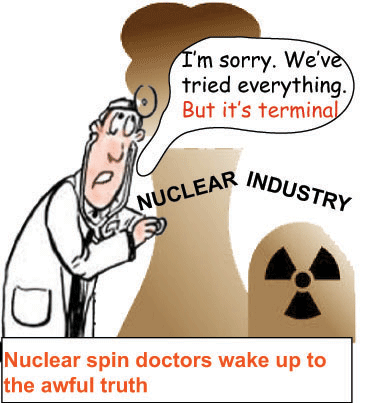
On life support, barely comatose
There was a renewed burst of enthusiasm for nuclear power a few years ago. In Australia it was confined to the political right and didn’t last long, but elsewhere support was broader. Most notable was the 2023 commitment by more than 20 countries, led by the US, UK and France, to triple global nuclear capacity by 2050. In the three countries mentioned, that would imply building 330 GW of new capacity as well as replacing retiring capacity
So far, this commitment has produced only one final investment decision, for two reactors at Sizewell C in the UK. Construction is expected to start in 2027, with commercial operation in the late 2030s at best. After that, there are no large plants even on the drawing boards in the UK. A few sites have been identified, and there’s a proposal for some half-size reactors (called SMRs but not actually modular or very small) to be built by Rolls-Royce. These don’t even have a prototype yet.
France is a few steps behind. Three sites have been identified, each with two reactors, but none has reached final investment decision yet. The most likely to happen is at Penly, but even that is doubtful. And once Macron’s term finishes in 2027, the political push is likely to dissipate.
Nothing at all is happening with large-scale new nuclear in the US. Proposals to complete the half-finished VC Summer plant in South Carolina have gone nowhere, and even the planned restart of the Palisades plant has missed multiple deadlines. The Trump Administration recently announced an $18.7 billion loan program with the aim of building ten AP1000 reactors, but this is just theatre. There are a few pilot small reactors with construction underway, but all such efforts have failed until now.
Looking at the world as a whole, the first half of 2026 has seen
* two (2) new reactors connected to the grid, both in China
* three (3) construction projects reaching first nuclear concrete, all in China
* zero (0) new final investment decisions outside China
* one (1) new/revised export contract, probably just symbolic, between Rosatom and Uzbekistan
Generously assuming a 4:1 capacity ratio, the two new reactors would be equivalent to around 8 GW of firmed solar. That’s what China installs every week or so, and the world as a whole every four or five days.
In summary, nuclear power isn’t a vital source of energy, obstructed by politics. Outside China, it’s a zombie, animated by political imperatives. In China, it’s an afterthought, running far behind solar and wind, as well as (regrettably) new coal and gas, and about level with new hydro.
How the Iran War Fuel Crisis Is Reshaping the Pacific
June 25, 2026, Hugo Temby, Australian National University and Joel Nilon, Australian National University for The Conversation, https://scheerpost.com/2026/06/25/how-the-iran-war-fuel-crisis-is-reshaping-the-pacific/
The past five years have not been easy for the people of the Pacific. COVID restrictions disrupted tourism and upended supply chains, while global fuel shocks raised prices and hit island economies hard.
The region relies on expensive imports of fossil fuels, as domestic sources are largely lacking. Some nations spend up to 25% of their GDP on securing fuel, even before this year’s price spikes.
In recent months, authorities in the Marshall Islands and Tuvalu announced emergency measures to conserve fuel. Fiji’s main energy provider has warned electricity rationing is now a possibility, and the Samoan government is considering school closures to save fuel.
News of a peace deal between the United States and Iran has been welcomed. But even if the deal holds, it’s unlikely to lead to quick relief.
In May, the region’s leaders took a rare collective step by invoking the Biketawa Declaration by consensus. It means governments are united in their response to the ongoing fuel crisis.
Why is this significant?
Pacific leaders formalised this declaration in 2000 at the Biketawa Islet in Kiribati as a way to collectively respond to major regional challenges such as conflict.
The declaration paved the way for the long-running Regional Assistance Mission to Solomon Islands (2003–17) during a period of conflict, and the Pacific Regional Assistance Mission to Nauru (2006–09) during an economic crisis.
Over time, it has been drawn on to manage the region’s security more broadly, including environmental and social threats.
Most recently, the declaration enabled a regional response to the COVID pandemic, allowing transport of vaccines and other medical equipment to Pacific countries during lockdown periods.
This year’s fuel crisis has affected the entire region. As Pacific Islands Forum Secretary General Baron Waqa recently warned, the region is “highly exposed to external shocks”. He said the fuel crisis is:
beginning to intersect across Pacific economies, with direct implications on essential services, connectivity, economic resilience and the livelihoods of our people
The first step has been to establish a regional response mechanism to the fuel crisis, encouraging better coordination between nations.
An unequal crisis
The fuel crisis poses a bigger challenge to Pacific Island countries than many other nations. Almost all the region’s fuel is imported from a handful of East Asian countries, where it is refined. These countries were in turn highly reliant on oil from the Middle East – 80% of the crude oil processed in refineries was transported via the Strait of Hormuz.
The full impact of the Iran war has not yet washed through. Tankers in transit before the Hormuz closure have continued to make deliveries, while support from donors such as Australia has helped some countries manage what has, so far, mostly been a price shock.
Nations such as Fiji had healthy fuel reserves before this year’s fuel crisis.
But others had very little buffer, from about a month’s supply (Tonga, Cook Islands and Tuvalu) to even less (Kiribati).
Maintaining fuel storage facilities in difficult environmental conditions is an ongoing challenge for many nations.
What now?
It’s an uncertain time for the Pacific. The Iran peace deal — if it holds — may mean more oil products can flow. But damage to energy infrastructure will take time to repair. Insurance premiums and food prices may stay high for some time.
Pacific foreign ministers have left open the possibility of more direct measures if fuel security isn’t assured. These haven’t been determined, but joint purchases of fuel could be on the table if political and practical challenges can be overcome.
Australia has indicated its priority is to monitor the situation in the Pacific and engage with Pacific partners. In a recent round of “fuel diplomacy” in Asian markets, Australia called for continued attention to the Pacific’s unique energy security needs.
But difficult choices lie ahead.
Access to affordable, reliable energy is one of the world’s sustainable development goals, and Pacific communities deserve no less.
The region and its partners will need to find a way to respond to the immediate crisis without worsening the longer-term and much larger threat posed by climate change.
Before this year’s crisis, many leaders were focused on reducing fossil fuel imports and boosting energy self-reliance through renewables. The goal was to be the first region to run on 100% renewables.
Fuel security is the most pressing problem today. But the broader goal is still clear. Pacific energy ministers recently reaffirmed the goal of a 100% renewable energy future and agreed to accelerate the rollout.
The world’s continued reliance on fossil fuels created the conditions for both crises. Only reducing the world’s reliance on fossil fuels will solve them.
Hugo Temby, Research fellow, Australian National University and Joel Nilon, Senior Pacific Fellow, Australian National University
Iran trumps US on Hormuz

| US President Donald Trump’s innate inability to empathise with others and lack of intelligence to foresee consequences are likely to hand Iran a long-term financial advantage and incidentally, but more importantly, threaten the treaty that has been the most productive of peace and prosperity in recent history – the United Nations Convention on the Law of the Sea. |
Crispin Hull,June 30, 2026, https://www.crispinhull.com.au/2026/06/30/iran-trumps-us-on-hormuz/?utm_source=mailpoet&utm_medium=email&utm_source_platform=mailpoet&utm_campaign=crispin-hull-column
The tit-for-tat breaches of the US-Iran 60-day ceasefire in the past few days certainly point that way. Let me explain.
Of 193 members of the UN, 44 are landlocked. The other 149 have coastlines linking each of their coastlines to the other 148 countries’ coastlines such that they can as a practical matter drive to those other nations by boat or ship with no natural barrier or no requirement to use easily blocked roads or railways.
The UN convention took eight years to negotiate in the 1970s. It was a triumph of diplomacy and law over the assertion of power and force. It resulted in one of the greatest trade-offs in history between powerful nations, on one hand, and less powerful nations, on the other.
In short, before the convention, powerful trading nations saw their economic interests in both the unfettered exploitation of the resources of the oceans and in having freedom of navigation across the oceans to help free trade, but ultimately they were willing to forgo the former in order to secure the latter.
The trade-off was enormous. Rich, powerful nations thought that freedom of navigation across the world’s oceans was so important for trade and hence prosperity that they were willing to grant poor and less powerful nations significant exclusive rights to their adjacent oceans in return for that freedom.
The question posed by the negotiators was how to achieve peace and greater prosperity. The answer was negotiation and compromise.
Each nation, even the militarily and economically weak, got the exclusive rights to all the ocean’s resources, particularly fishing and mining, up to 200 nautical miles from their shore and the total sovereign rights of territorial waters up to 12 nautical miles from their shore.
n return vessels from any nation, especially militarily strong and rich trading nations could sail anywhere on the oceans, but if they came within 12 nautical miles of another nation’s shores they had to inform that nation of their passage, and make their passage expeditious – no more lingering with menace close to other nations’ shores (gunboat diplomacy).
The arrangement facilitated trade and made the passage of warships less threatening. Good all round.
Before that, the three-nautical-mile limit was the general unwritten rule. Within that limit, nation states could do whatever they liked with their ocean and beyond that foreign vessels could do whatever they liked – from fishing to playing wargames.
Three nautical miles was of practical importance. In the nineteenth century that was the limit of a cannon shot. It meant that a ship outside that limit could not hit land and that land-based artillery could not hit a ship.
But It also meant that the nations either side of major choke points in world navigational routes – especially Gibraltar, Malacca and Hormuz – which did not have at least a little strip of international waters in the middle had to permit free passage of all vessels.
The latest US-Iran talks and spats over Hormuz, now puts this arrangement in jeopardy. At its narrowest Hormuz is less that 24 nautical miles wide. It means that the territorial waters of Iran to the north and Oman to the south overlap in the middle. It means any ship travelling through has to identify itself to either Iran or Oman and travel expeditiously, or it could be prevented from passage.
Under the ceasefire agreement Iran agreed to allow free passage, but the agreement was vaguely worded. Vessels seeking passage opted to travel as close to the Omani side as possible. Iran read that as a breach of the ceasefire and fired on those vessels. The US retaliated by hitting Iranian targets on the coastline.
It is clear that Iran wants to come to some arrangement with Oman to charge vessels fees in the future in return for passage rather than allowing Oman to let its side of the Strait be used for free safe passage. Whether those fees are characterised as fees for services or a toll, they will still be contrary to the convention. And once one nation starts, others will surely follow.
With drones and rockets we now have the reverse of the 19th century position. Instead of a nation worrying about ship-based weapons firing on its land, ships now have to worry about land-based weapons firing upon ships.
It puts Iran in the box seat. With that threat in place Iran can insist on payment of a fee before guaranteeing safe passage. Iran can just use the insurance system to enforce payment. Without insurance no ship-owner will transit, and without guarantee of safe passage no insurer will grant insurance to a vessel.
All very foreseeable. But it would require thinking in a way that strategists usually think – asking the question: what would I do if I were in the enemy’s position? How would I react if I were the enemy? But Trump is incapable of viewing anything from any perspective but his own.
Arguably, the UN Convention on the Law of the Sea has done more in the past 40 years to prevent hostilities and to create the certainty for shipping that generates trade and prosperity than all the force and threat of force that any single nation can muster.
But Trump and Israeli Prime Minister Benjamin Netanyahu have always preferred force to negotiation.
From the start, they asked the wrong question and got the wrong answer. Netanyahu, facing an election this October, asked how could he stay in power after the Hamas-inspired attack on Israel in October 2023 so he does not have to face questions about how he allowed such a lapse of security? Trump asked, having torn up the well-negotiated Obama deal with Iran to prevent its acquisition of nuclear weapons, how can he ensure Iran does not get those weapons.
The wrong answer they got was: war. In Netanyahu’s case it was genocidal war. If only they chose negotiation and the rule of law rather than force, the world would not be facing an even stronger Iran and an indefinite economic threat to the world that its stranglehold over Hormuz now gives it.
If the world had insisted that Israel follow the 1947 UN resolution that called for the termination of the British Mandate and the partition of historic Palestine into independent, democratic Arab and Jewish states with guaranteed rights for all citizens, there would now be peace in the Middle East.
Trump has always preferred force and the threat of force over the rule of law – domestically and internationally. What he does at home is for the Americans to worry about. After all, they voted him into office. But there is little or no redress for those affected by what he does in the world – usually foolishly and impetuously.
That is why Australia should use whatever tools it has to steer international affairs towards the rule of law and negotiation and away from the use of force.
1 This month
17 October, Free Public Talk on Nuclear Issues in South Australia
David Noonan will speak on public interest concerns over the new Roxby Downs Indenture Act 2026 on BHP copper-uranium mining and ore processing in SA, and on how AUKUS may face SA with a High-Level nuclear waste agenda.
Dr Jim Green will discuss international developments in the field of nuclear power including ‘small modular reactors’ and Generation 4 ‘advanced’ nuclear reactor concepts.


Help Aunty Sue Protect Her Land and Sacred Sites From Destructive Rocket Testing.
.

Australians deserve the truth
about
AUKUS – https://aukuspublicinquiry.com/

PETITION – To: Prime Minister Anthony Albanese and the Australian Labor Government

of the week – Australians for War Powers Reform (AWPR)
To see nuclear-related stories in greater depth and intensity

