The Trojan Horse of Sovereignty: How US Troops in Australia Became a Strategic Asset – for the United States

Turnbull further warned: “It is naive to imagine that the submarines, if ever acquired, could be used other than in accordance with American wishes. Will AUKUS enhance our security or simply draw Australia into a conflict with China whether we like it or not?”
9 September 2026 Dr Andrew Klein, https://theaimn.net/the-trojan-horse-of-sovereignty-how-us-troops-in-australia-became-a-strategic-asset-for-the-united-states/
Dedicated to the Australian people – whose sovereignty has been traded for a promise of protection that was never real.
Abstract
This article examines the expanding US military presence in Australia under the Force Posture Initiatives and the AUKUS agreement. We argue that the official narrative – that US troops are in Australia to defend Australia – is not supported by the operational reality. The integration of US forces into Australian military infrastructure, the logistical vulnerabilities of forward deployment, and the strategic benefits to the United States collectively demonstrate that Australia is being transformed from a sovereign ally into a forward-operating platform for US power projection. Drawing on expert analysis, parliamentary testimony, and operational data, we conclude that the US presence serves to protect American strategic assets and secure US strategic depth, not to defend Australian sovereignty. We further argue that the Australian government is locked into this relationship for its own political survival, at great cost to the nation’s long-term interests.
1. Introduction: The Unspoken Surrender
The United States military presence in Australia is growing. Australian Defense Minister Richard Marles confirmed that “American force posture in Australia is growing” across every domain, following meetings with US Defense Secretary Pete Hegseth. This expansion includes the prepositioning of US military equipment, rotating aircraft deployments, and logistics support for US vessels. Under the AUKUS agreement, four US Virginia-class submarines will be housed at HMAS Stirling naval base from 2027.

Yet the Australian public has not been told the full story. The official narrative – that US troops are in Australia to defend Australia – obscures a more complex and troubling reality. The integration of US forces into Australian military infrastructure is not about Australian defence. It is about securing US strategic depth, projecting US power, and protecting US assets.
2. The Official Narrative vs. Operational Reality
2.1 The Claim: Defence of Australia
The Australian government maintains that the US presence enhances Australian security. The Force Posture Initiatives allow US forces to train and store equipment in Australia, including through rotating aircraft deployments and logistics support. The narrative is one of shared interests and mutual defence.
2.2 The Reality: A Forward-Operating Platform for the US
Expert analysis contradicts the official narrative. Professor Chen Hong, Director of the East China Normal University’s Australian Studies Center, has stated that the US is deepening military cooperation with Australia to further integrate the country into its military architecture in the western Pacific. The US seeks to leverage Australia’s strategic location, ports, airfields, and military training facilities, as well as its relatively secure rear area, to facilitate troop rotations and strengthen logistical support for US forces .
This integration, Chen argues, means that “within the US alliance system, Australia is evolving from a traditional ally into a strategic-depth and forward-operating platform for US forces. Its infrastructure and industrial capacity can increasingly be integrated into the US military supply chain and converted into capabilities that support US military operations.”
2.3 The “Basing” Euphemism
Australia finds it “curiously difficult to talk in plain terms about foreign military basing on its territory,” despite being “the most loyal of America’s treaty allies.” This sensitivity is evident in the official language: the US Marine Corps maintains a “rotational” detachment, not a “base.” Yet the reality is that Australia is extending runways and building new facilities at several air bases to accommodate temporary US combat aircraft deployments, and presumably to store US weaponry, fuel and spare parts. As one analyst notes, “This is a form of basing, even if it’s not permanent.”
The “basing” question matters because “a significant expansion to the US forward force posture appears to be underway, and the Australian public needs to be ready for it.”
3. The Logistical Impossibility: Defending Australia from Australian Soil
3.1 The Vulnerability of Forward Deployment
The US military presence in northern Australia is growing, with significant infrastructure expansion. The US is spending between $490 and $970 million to expand RAAF bases in Darwin and Katherine, including command centres, barracks, and hangars. RAAF Base Tindal will host rotations of six nuclear-capable US B-52 bombers. Darwin already hosts an annual rotation of up to 2,500 US Marines.
Yet these forces would be unable to defend Australia against a major power. They are positioned for power projection, not territorial defence. As one analyst has noted, the US is using Australia’s relatively secure rear area to “facilitate troop rotations and strengthen logistical support for US forces.” The troops are not positioned to repel an invasion – they are positioned to project power into the region.
3.2 The “Colossal Sacrifice of Sovereignty”

Former Prime Minister Malcolm Turnbull has been a vocal critic of the AUKUS agreement, warning that it represents a “colossal sacrifice of sovereignty” and that Australia has “effectively ceded control of a West Australian naval base to the US navy.” Turnbull’s submission to a public inquiry stated: “Whether we get any nuclear-powered submarines will depend on political decisions in Washington and industrial developments in the US and the UK.”
Turnbull further warned: “It is naive to imagine that the submarines, if ever acquired, could be used other than in accordance with American wishes. Will AUKUS enhance our security or simply draw Australia into a conflict with China whether we like it or not?”
3.3 The Threat to Sovereignty, Not the Solution
Former Labor luminary Bob Carr echoed these concerns, arguing that the US alliance presented more of a threat to Australian sovereignty than protection from potential conflict in the Indo-Pacific. Carr stated: “Why can’t there be a debate about B52s in Australia’s north, about the militarisation of Australia’s north. We’ve suddenly made it a target if there should be a war between the two dominant powers.”
The Australian government has “effectively ceded control” of HMAS Stirling to the US Navy, and the “enduring” presence of US submarines represents a permanent foreign military footprint.
4. The Real Purpose: Protecting US Assets, Not Australia
4.1 Strategic Depth and Power Projection
The US is using Australia as a “strategic-depth and forward-operating platform.” The infrastructure and industrial capacity of Australia are being integrated into the US military supply chain and converted into capabilities that support US military operations.
Airbases in northwestern Australia are being upgraded to “increase the strategic depth of U.S. forces in the region” and “serve as launch and recovery sites for long-range surveillance and strike aircraft.” These bases are being prepared for hosting aerial refueling aircraft, supporting surveillance aircraft and bombers, and serving as an “air bridge” refueling tactical fighter aircraft operating over the South China Sea.
4.2 The Logistics of War
The integrated logistics necessary to undertake combined Australian-US land-based long-range fires have been tested and improved following Exercise Operose 2024. The exercise tested how US Army Pacific specialists can work with their Australian counterparts in developing and confirming their interoperability in providing rapid theatre-level logistical deployment of long-range fire assets from logistic nodes in Australia.
The US has also prepositioned three companies’ worth of vehicles and containers at Bandiana, Victoria, under the Combined Logistics, Sustainment and Maintenance Enterprise (CoLSME) Force Posture Initiative. This prepositioning demonstrates that Australia is being used as a logistical hub for US military operations.
4.3 Protection of US Assets
The physical presence of US troops in Australia is not to defend Australia from an external invasion. It is to protect US assets and maintain US strategic depth. As one analysis notes, Australia is located “closer than Hawaii or the continental US to potential flashpoints like Taiwan and the South China Sea, yet remote enough to be beyond the range of most of China’s missiles. It’s relatively secure as well as politically reliable and imbued with strategic depth.”
Australia is being used to “disperse US forces away from more vulnerable bases in Japan and South Korea, and to position reinforcements in the region in case of a protracted conflict.” This is not Australian defence – it is US power projection.
The physical presence of US troops in Australia is not to defend Australia from an external invasion. It is to protect US assets and maintain US strategic depth. As one analysis notes, Australia is located “closer than Hawaii or the continental US to potential flashpoints like Taiwan and the South China Sea, yet remote enough to be beyond the range of most of China’s missiles. It’s relatively secure as well as politically reliable and imbued with strategic depth.”
Australia is being used to “disperse US forces away from more vulnerable bases in Japan and South Korea, and to position reinforcements in the region in case of a protracted conflict.” This is not Australian defence – it is US power projection.
5. The Cost to Australia: Paying for the Privilege
5.1 The Financial Cost

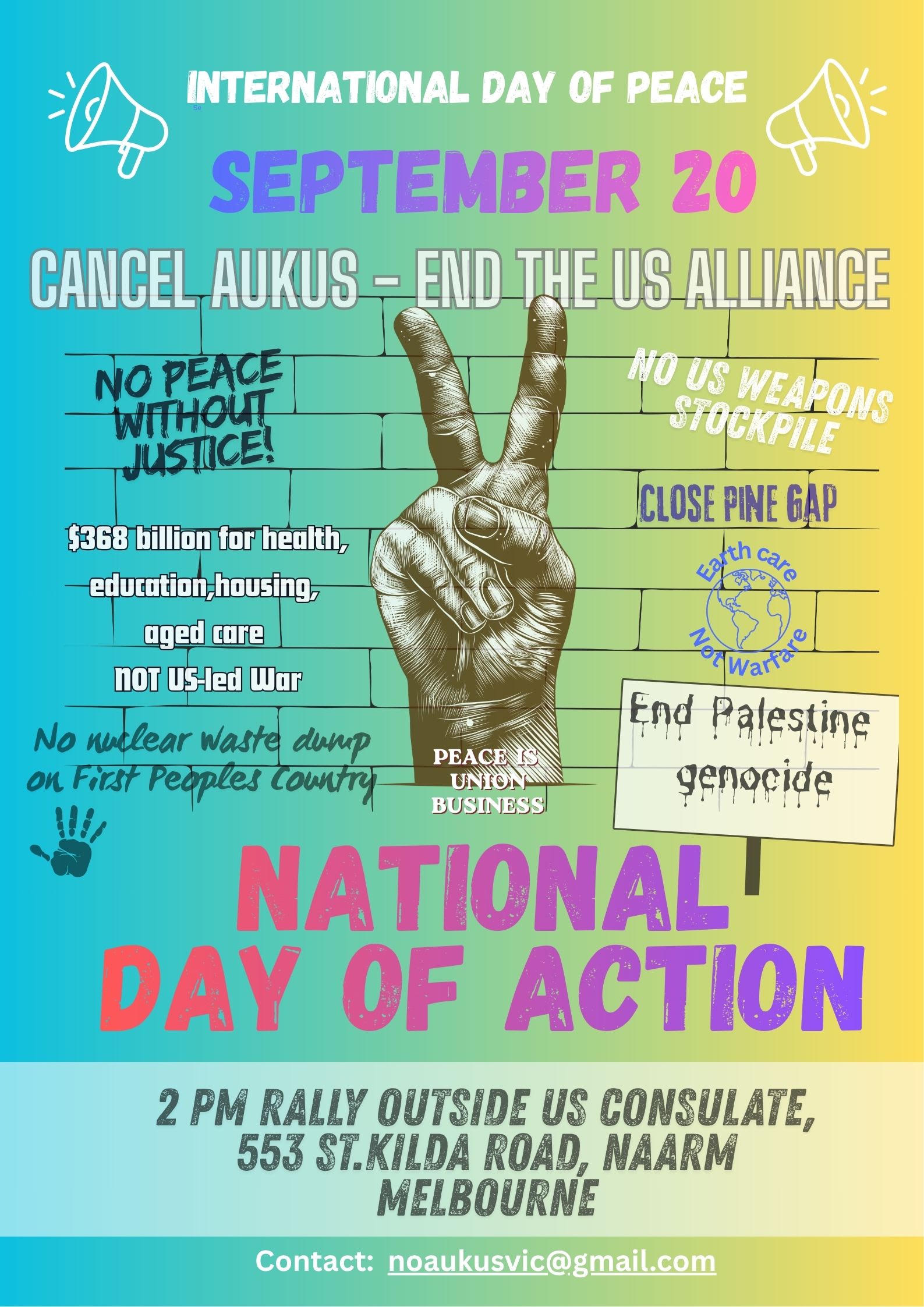
The AUKUS agreement is the most expensive defence project in Australian history, costing $368 billion. Former Prime Minister Malcolm Turnbull has described it as a “massive sacrifice of Australian sovereignty” at “the worst possible time to be sacrificing sovereignty.”
5.2 The Strategic Cost
The deeper integration with the US military means Australia is being transformed from a traditional ally into a “strategic-depth and forward-operating platform.” This integration increases the risk that Australia will be drawn into military conflicts “that have never had any business being part of.”
Daryl Guppy, a former national board member of the Australia China Business Council, has warned that AUKUS has a “broader, multi-domain scope that includes rearming and upgrading the Australian military so its forces can serve as part of US military deployments.” This does not enhance regional security as it rests on the assumption that regional conflict is inevitable whenever US interests are threatened.
5.3 The Political Trap
The Australian government is locked into this relationship for its own political survival. The anti-China narrative has become the framework through which all other defence choices are justified. To back away from it would invite political attack. As one analyst has noted, the government’s approach is “sucking up” to the US, which “has undermined” Australia’s sovereignty.

The political trap is evident in the government’s silence on AUKUS. As Turnbull noted, the US Congress is “kept very well informed” about AUKUS, “but they have their own interests to pursue and it’s not always the same as us.” Meanwhile, the UK parliament has held “a thorough inquiry” and “made very severe, serious criticisms,” while “our parliament has done nothing, absolutely nothing.”
6. Conclusion: The Trojan Horse Exposed
The evidence is clear. The US military presence in Australia is not about defending Australia – it is about securing US strategic depth, projecting US power, and protecting US assets. The official narrative is a cover for a profound surrender of sovereignty.
The Australian government is paying for the privilege of being a forward operating base for the US military. It is spending $368 billion on submarines it may never receive, hosting US troops that would be unable to defend Australia, and integrating its military infrastructure into a US-led system that serves American interests.
The “Trojan Horse” of sovereignty is not a conspiracy – it is a visible, documented, and increasingly undeniable reality. The keys to Australian sovereignty have been handed over, not in a secret ceremony, but in plain sight: through treaties, agreements, and a political class too captured to see the obvious.
The task of unravelling this integration will be difficult. But it must be done – if Australia is to survive as a sovereign nation.
References…………………………………………………
AI data centre puts Melbourne’s West Gate Bridge at risk
by Megan Jones | Sep 8, 2026, https://michaelwest.com.au/ai-date-centre-puts-melbournes-west-gate-bridge-at-risk/
Victoria’s Government has approved a massive data centre in the parklands adjacent to the West Gate Bridge without fully considering the risks. Megan Jones with the story.
London data centres are hosing down their cooling systems to prevent fire. In Melbourne, the State government has approved a super-sized data centre on the edge of the West Gate Bridge’s eastern approach ramp, directly between the freeway and Westgate Park, a bushfire-prone native reserve.
The Victorian Government, using the emergency planning powers of the Development Facilitation Program (DFP), took 75 days to permit the building of NEXT DC, a $2B, 162 MW hyperscale data centre, with a stored onsite backup fuel load of 900 tonnes of lithium-ion (Li-ion) batteries and 3.5 million litres of diesel.
Dubbed M4, the development, on behalf of Nvidia, is being built on the old News Ltd site across 2.64 hectares on 127 Todd Road, at the convergence of the West Gate Bridge, the Port of Melbourne shipping lane, and the West Gate transport corridor — all tier-one infrastructure.
Firefighter warnings
Kristjan Tuul, a firefighter with 20 years’ experience, now with the United Firefighters Union, said there are currently no adequate planning measures, equipment or resources in place to prepare firefighters for a thermal runaway event at the proposed data centre.
Tuul said a fully involved fire at a site of this scale could require a coordinated statewide response involving firefighters, airport emergency services and potentially Defence personnel, and could take weeks or more than a month to bring under control, telling MWM:
“The consequences could be catastrophic for the surrounding community, the environment and the economy.”
Tuul said firefighters had not been adequately consulted about emergency preparedness, mitigation measures or the resources that would be required should a major incident occur.
The development borders Westgate Park, which was the site of a major bushfire in December 2024 and another fire in 2025.
No fire danger assessment made
Tuul’s concern does not appear to extend to the political level. Nina Taylor, the local Member for Albert Park and recently appointed Cabinet Secretary, confirmed by email that she had not spoken with Fire Rescue Victoria about the potential fire and explosion risks associated with the development. Fires at data centres are rare, but they do happen.
A fire at South Korea’s National Information Resources Service data centre in Daejeon on September 26, 2025, triggered a thermal runaway event during a routine maintenance procedure. It took around 200 firefighters about 200 hours to bring the incident under control.
Fires have also occurred at data centres in Hillsboro, Oregon; Lincoln, Nebraska; Ain, France; Council Bluffs, Iowa; Ogden City, Utah; and Strasbourg, France. As no public global register of accidents or incidents exists, near misses and fires often go unreported.
All these fires were contained within the Data Centre Precinct, with no thermal runaways extending beyond the precinct. In Melbourne, the West Gate off-ramp is within the data centre’s precinct, which also borders the Port of Melbourne shipping lane.
Tuul warned large volumes of contaminated firefighting water and toxic runoff could also have significant consequences for surrounding infrastructure, including the Port of Melbourne, particularly if emergency services were unable to contain the runoff.
NEXT DC
NEXT DC is the operator of the new data centre. In a media release, CEO Craig Scroggie said M4 would have direct-to-chip closed-loop cooling supporting rack densities of 1000kW using recycled non-potable water. M4 has all the top-tier global safety certificates, including the prestigious Tier 111 and Tier IV certifications from the Uptime Institute, which sets the global standard for evaluating data centre reliability, availability and performance.
NEXT DC did not return calls for comments on the fire risk.
Ironically, the elaborate cooling systems used to cool the computers in data centres can cause fires. “As the climate warms and facilities attempt to minimise cooling for efficiency reasons, we could see a trend for cooling system failures,” wrote Peter Judge in Data Centre Dynamics magazine.
Judge is now a senior research analyst with the Uptime Institute. He told MWM he still stood by these quotes, reporting that a cooling system caused a fire in China in October 2022.
A backup cooling tower caught fire in the block that houses the data centre at China’s Suzhou Supercomputing Centre in the Suzhou Industrial Park, a technology and business flagship for the country. Cooling failures are rare, but experts warned that similar incidents are increasingly likely.
Rising temperatures might mean many data centres aren’t well suited to their local weather and could be vulnerable to future cooling failures.
Long-term risk
For Kristjan Tuul, the question is not simply how the West Gate data centre is managed today, while the facility is new and under intense scrutiny, but what happens over the decades ahead.
History shows why long-term oversight matters, as data centres have a 30-year lifespan.
In August 1991, chemical storage facilities at Coode Island caught fire, forcing evacuations and raising major concerns about industrial hazards near Melbourne’s population and critical infrastructure. The subsequent Coode Island inquiry identified four hundred breaches of safety requirements.
High power densities, battery and power supply failures, thermal mismanagement, and human error have caused other fires.
All causes were electrical, and the most common cause was lithium-ion battery failure, which led to three of the eight fires mentioned. The threat of overheating lithium-ion batteries increases with their higher energy density.
In London during a major heatwave in 2022, and probably more recently, data centres were forced to hose down their cooling systems due to overheating.
In further research, Peter Judge, while Editor at Data Centre magazine, warned in screaming headlines:
“Ignore Li-ion fire risks at your peril.”
Has the Victorian State Government done just that?