US turning Australia into military base

“Over more than a decade, the United States has been preparing the capacity for high-tempo warfighting operations with China, springboarding from Australia. From a Chinese perspective, Australia is not so much hosting US bases on its territory, it’s a US base in its own right… Australia is a serious piece of real estate in the US warfighting machine.”
Wed, 09 Sep 2026 , https://www.sott.net/article/508329-US-turning-Australia-into-military-base-Guardian
USA • Australia military eventThe US is turning Australia into a forward base for potential military operations in the Pacific, with American forces and defense contractors controlling or having access to roughly two-thirds of the country’s military facilities,The Guardian reported on Sunday.
Citing data compiled by the Nautilus Institute for Security and Sustainability, the newspaper identified 110 facilities across Australia with some form of US military or corporate presence out of 168 surveyed.
The US military directly controls 17 facilities, including the Pine Gap intelligence complex in central Australia, which plays a major role in US surveillance and military operations. The facility tracks missile launches, intercepts communications and provides targeting information for American forces around the world.
Other installations include a naval communications station in Western Australia used to communicate with submerged US submarines and RAAF Base Tindal in the north, which is being expanded to accommodate nuclear-capableB-52 Stratofortress bombers.
The Guardian wrote:
“These aircraft are able to land on Australian soil carrying nuclear weapons. The US government won’t tell Australia if and when they are. The Australian government won’t ask.”
Beyond the facilities it directly controls, the US military has access to dozens of Australian installations, while American defense contractors, including Lockheed Martin and Northrop Grumman, operate at others. According to the Nautilus data, 41 of the 168 facilities surveyed have no significant US presence, while the status of another 17 remains unresolved.
The American footprint is also expanding. In June, AFP reported that the US was preparing to establish a permanent stockpile of battle-ready weapons, ammunition, and equipment for the Marine Corps in Australia, with the facility expected to reach full capacity by 2028.
An honorary professorial fellow at the University of Melbourne, Richard Tanter, the author of the Nautilus database, told The Guardian:
“Over more than a decade, the United States has been preparing the capacity for high-tempo warfighting operations with China, springboarding from Australia. From a Chinese perspective, Australia is not so much hosting US bases on its territory, it’s a US base in its own right… Australia is a serious piece of real estate in the US warfighting machine.”
Canberra maintains that the growing American presence strengthens Australia’s security.Defense Minister Richard Marles said in June that the expanding US footprint was important both for building the country’s military capabilities and for its national security.
Marles also argued that the US presence helped counter what he described as China’s “very significant military buildup” in the region.
Former Australian Defense Minister Christopher Pyne has similarly said the 2021 AUKUS pact between Australia, the US, and UK goes beyond Canberra’s acquisition of nuclear-powered submarines. He described the arrangement as establishing “a new United States submarine base in the Indian Ocean” that would provide Washington with a “massive strategic advantage.”
Tanter criticized Canberra’s approach, calling it:
“A massive institutional failure in Australia, a kind of learned incapacity at a political, parliamentary and bureaucratic level.”
Comment: Tanter is right: Trust and comfort never convey the total picture, nor be they the appropriate guardians of sovereign control.
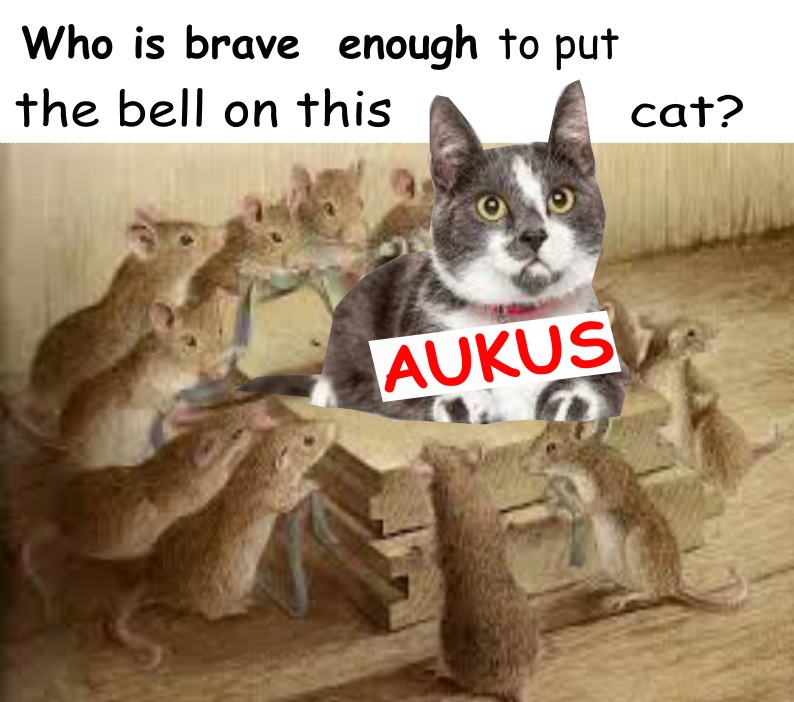
Skidding Pacts: An AUKUS Delusion Update
9 September 2026 Dr Binoy Kampmark, https://theaimn.net/skidding-pacts-an-aukus-delusion-update/
In the unpardonable ecosystem of graft, favours and corruption that is defence contracting, defence conferencing and all matters tanking over the thinking – in short, the world of defence – the convenient delusion will always have truck over the inconvenient empirical. Phantoms are elevated and celebrated; bogeymen are treasured by the entire security apparatus that links obeisant academics, overpaid consultants and waxwork politicians. Budgets of criminally unaccountable proportions are approved, not least because the fictional threat is so impressive as to scare the living daylights out of an imbecilic political class.
Even as the Australian public inquiry into the tripartite security pact with the United States and the United Kingdom known as AUKUS rumbles along, the devotees of delusion continue to be busy in Canberra and beyond. For them, defence is not a reality so much as a style: the need to be seen on the circuit, the necessity of keeping the wheels of alliances greased. The Australian establishment hankers to be clubbable, and that club is known as the Anglosphere. On September 2, Michael Pezzullo, a figure disgraced by his conduct when Secretary of the Home Affairs Department, took the stage as sage and pontificator before that very same inquiry. In addressing its members, he was convinced about the Chinese threat. “It’s an aggressive and assertive combination of Marxist-Leninist politics, Chinese nationalism, and aggressive positioning in Asia, that is as terrifying to Japan and the Philippines and other countries in Asia as it should be to us.”
The following comments, published in the Australian Strategic Policy Institute’s outlet The Strategist, are even less guarded and worthy of mention. While the publication claims them to be an edited version of Pezzullo’s address, those edits were made with some muscle. In essence, “Australia would favour fighting an offensive campaign, without having to call on the combat forces of the United States or anyone else.” Expressed like a true hardboiled warmonger. Given its limitations, Pezzullo suggests that Australia would find itself going on the defensive “until allied help arrived, until the United States prevailed to the point where it could dictate terms or until conflict was contained in an uneasy truce that arrested a slide into the nuclear abyss of planetary destruction.”
After this febrile nonsense, the sort that makes Tom Clancy’s unspeakable prose passable, Pezzullo hits his stride. Previous submarine plans were not pursued. He has pleasant words for the Rudd government’s 2009 submarine plan that never eventuated, largely because this mirror-gazing bureaucrat was, at the time, deputy secretary of defence. But never mind. “The AUKUS program puts us back on track.” As with so much writing on defence strategy, the language resembles that of a narcotics addict awaiting that cathartic hit: the gift is just around the corner, even if that corner is excruciating in distance. “Acquiring submarines of the US Virginia class and then the Anglo-Australian SSN-AUKUS class – or if the latter fails, joining the USN SSN-X program – will give us a pathway to undersea warfare dominance.” This is playground posturing at its worst.
The logistics of acquiring these needless hulks is not explained, because their relevance is assumed. Pezzullo is a self-styled Ur-warrior, drinking from ancient wells of numbing power. “More crucially, by integrating our submarine industrial and technology base with those of the United States and Britain, we will forge an exclusive club of undersea dominance.” It would be far more accurate to recast dominance as subservience, with the Australian taxpayer providing enormous sums to the submarine industrial bases of both the US and the UK without any enforceable undertaking of returns.
It is worth noting that Pezzullo’s appearances in the media as a specialist – a term so stretched as to have lost meaning – are never qualified by the spoiling conduct that demonstrated his inadequacy as a fair-minded public servant giving advice on the issues of the day. It would be good for audiences to know that one of Australia’s formerly most powerful bureaucrats was a meddlesome sot crazed by visions of war and a shaky grasp of history, not least the US-Australian relationship. He was sacked in November 2023 after revelations that he had used WhatsApp to communicate at length with former New South Wales Liberal Party deputy director Scott Briggs, offering gobbets of advice on party room politics. Frank views about various cabinet ministers were also offered, hardly in keeping with the best traditions of a supposedly uncorrupted public service. An inquiry into Pezzullo’s conduct, a redacted version of which was obtained under Freedom of Information in April, identified 14 breaches of the government code of conduct. Instead, we find his biography on the United States Studies Centre website making no mention of his reputational soiling. “He is now retired, after almost 37 years of service, principally in the areas of defence, national security, immigration, and border protection.”
While Pezzullo was making his interventions in the AUKUS debate, the toadying Defence Minister Richard Marles, whose significance in the AUKUS relationship never rises above that of implausible water carrier, made a journey to the United Kingdom to catch up with the unnervingly chilly Wes Streeting. While Australia’s politicians delude themselves about American submarines they will never receive in the form of their choosing, if at all, the UK side of the bargain, which envisages the construction of the SSN-AUKUS, is even more dubious. In terms of boat production, the British submarine base has proven even tardier than their US counterparts. Sharp reservations have also been expressed about the nuclear reactor core project of the SSN-AUKUS, notably by the Infrastructure and Projects Authority (IPA), incarnated as the National Infrastructure and Service Transformation Authority (NISTA). IPA’s report released at the start of 2025 is grave on the subject: “Successful delivery of the project appears to be unachievable.” It identified“major issues with project definition, schedule, budget, quality and/or benefits delivery, which at this stage do not appear to be manageable or resolvable. The project may need re-scoping and/or its overall viability assessed.”
The British proved keen to assure the press – and a credulous Marles – that AUKUS had continued standing and vitality. “AUKUS,” according to Streeting, “says to our adversaries that if you attack one of us, you are challenging a coalition that is willing to stand together to defend the values we cherish and to fight alongside one another.” With little by way of justification, Streeting went so far as to suggest that AUKUS was “global” in nature, able to deliver submarines “which can be deployed everywhere from the Euro-Atlantic to the Mediterranean to the Indo-Pacific.” (Australian personnel, take note.) The US ambassador to the UK, Warren Stephens, was also keen to chant the mantra. “We should be under no illusion,” he stated, “that there are many who do not want this partnership to succeed. It’s not a secret.”
What is also not a secret is that the pact is skidding. The defence establishment operates a permanent, around the clock rinsing facility for the sketchy and mediocre, fostering a tribalism by seeking enemies that, at best, resemble fantasy woodland creatures. On this occasion, the fictional enemy is set to be confronted by fictional nuclear-powered submarines – at enormous cost. Australia, in its remarkable fortune of location and creation, has every reason to be the congenial middleman of international relations, the sage of diplomatic partiality and cool arbitration. Instead, it has opted for the role of Freudian paralytic and emotional cripple, drunk on the terror of abandonment and keen, therefore, to be client, vassal and a sort of wretched facsimile of Jeeves. If only its representatives were as capable.
1 This month


Help Aunty Sue Protect Her Land and Sacred Sites From Destructive Rocket Testing.
.

Australians deserve the truth
about
AUKUS – https://aukuspublicinquiry.com/

PETITION – To: Prime Minister Anthony Albanese and the Australian Labor Government

of the week – Australians for War Powers Reform (AWPR)
To see nuclear-related stories in greater depth and intensity

