Submission to the AUKUS Public Inquiry -No 37. Louise Fowler-Smith- a Personal View.
I’m a 5 th generation Australian woman and have never been more concerned
about my country of birth. There are many reasons for my concern but the topic at
hand is Aukus. From the outset I , amongst many other educated Australians,
could not believe that this country would accept the insanity of the deal of Aukus.
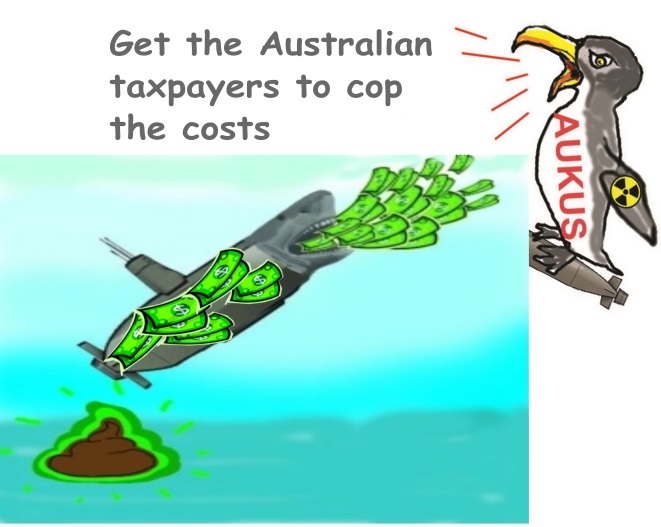
To spend hundreds of billions of Australian tax payers money on something that
ultimately will not help Australia nor Australian people is gobsmackingly stupid.
There is every likelihood that these submarines will not be delivered when
predicted- and worse- will cost a lot more than the sum approved. But beyond
that, why does Australia need these submarines? To fight China? China is not our
enemy. It is a major trading partner for Australia and if we were wise we would be
treating China respectfully and as a friend. Considering our relationship with the
USA – a country led by an insane despot- is completely broken why are we bowing
down to the USA? We are being conned by the USA and should stand up to them ,
as a sovereign nation.
I have visited China and I do not believe they want to invade
Australia. Why would they need to conduct such aggression towards us? The
aggressors of the world are the USA and Israel – not China. It is clear that the only
country that will benefit from this deal is the USA. Why are we funding their war
machine – especially after witnessing the illegal war they have started with Iran-
let alone all the other illegal and covert wars that the USA has waged against
countries across the planet for decades! This deal with the USA actually endangers
Australia and its people – rather than protecting us. It makes us complicit in the
illegal wars that the USA is so eager to wage. Beyond that we are bringing
dangerous nuclear waste onto our shores. If we really must spend money on
defense, there are many alternatives to the Aukus deal which would be much
cheaper and deliver submarines now rather than in many decades time.
This huge amount of money should be spent on Australians – not as a hand out to
America. It could support so much good in Australia – schools, hospitals, the
housing crisis and importantly- towards the climate change crisis! This is what’s
important to the Australian people.
This deal was introduced to Australia in secret , with no debate, by a despicable
and corrupt Liberal Prime Minister- Scott Morrison. There has been outrage at this
decision since the beginning so why is a Labour Government allowing this corrupt
folly to continue? I used to be a Labour voter- but not any more. They have lost my trust. https://drive.google.com/file/d/1FFpew7tazm6KVf3oZRepvkR3x9oA8FDj/view
What Australia has spent so far
Five years into AUKUS, what do we have to show for it? We’ve measured progress on three key metrics
Thomas Corben and Esther Soulard, The Conversation, 15 Sept 26,
“. What Australia has spent so far.…………………………………………………………Australians are justified in wanting to know how much money their government has invested in AUKUS, and where it has gone.
When the Optimal Pathway was announced in 2023, the Albanese government costed it at 0.15% of GDP annually over the life of the program. This would amount to roughly A$268 billion to A$368 billion over three decades.
Since then, the A$368 billion figure has been widely cited by the media as the ultimate price tag.
Crucially, at the time, a third of this total – around A$122.9 billion – was set aside as contingency funding to absorb the delays and cost pressures that come with a 30-year program. In other words, it may not actually be spent.
Accurately tracking Australia’s overall spending to date is difficult. Since 2023, there has been a flurry of government statements announcing or promising funding to support various aspects of AUKUS over different time frames. These figures are scattered across portfolios, and are sometimes announced and then folded into the forward estimates of the federal budget. Some are projections, rather than down payments.
Both the Liberals and Greens have pressed the government to share updated costings for AUKUS. Budget papers do not offer an itemised account nor a consolidated overall figure for the program so far.
With no central database for AUKUS spending, we set out to build one.
We went through public announcements, portfolio budget statements, annual reports and strategy documents, and attempted to trace everything that’s been spent, announced, promised or projected.
What we’ve come up with hardly qualifies as a ledger. Still, it reveals three important things.
First, the bulk of the funding announced in Australia has gone to infrastructure, across three main sites:
- A$12 billion on the Henderson Defence Precinct, a shipbuilding and submarine maintenance hub on the west coast
- A$8 billion to expand HMAS Stirling so it can host US and UK submarines under SRF-West from 2027, and Australia’s own fleet of submarines from the early 2030s
- A$8.5 billion to the Osborne Nuclear-Powered Submarine Construction Yard, where Australia’s nuclear submarines will be built.
Second, Canberra is investing in the UK and US submarine industrial bases to support the delivery of the Virginia-class and future AUKUS-class submarines to Australia. This reflects the additional demand Australia’s submarines will put on production and maintenance capacity in both countries.
This has included US$2 billion (about A$2.8 billion) to the US in three instalments, with a further US$1 billion (A$1.4 billion) in instalments pledged over the next decade.
Canberra has also paid A$310 million to the UK for components needed to build nuclear submarines and has committed an additional £2.4 billion (about A$4.6 billion) over a decade to expand the UK’s submarine production capacity.
Third, AUKUS will consume a growing share of the Australian defence budget, even if the government follows through on its commitment to increase spending to 3% of GDP by 2033.
In 2023, the Parliamentary Budget Office projected annual AUKUS spending to be roughly A$2.2 billion per year over the program’s first four years, rising to more than A$8 billion annually for the next three decades. This means most of the spending is still to come.
There’s a long list of various capabilities required to meet Australia’s future defence requirements. If the Defence budget does not grow sufficiently and AUKUS eats into those programs, the overall investment in these capabilities could become lopsided.
2. A new submarine base in WA
Until the Virginia-class submarines arrive, we still need to make sure our near-term defence needs are being met. We also need to be ready for when our subs show up.
This is where Submarine Rotational Force-West comes in.
The first phase of the AUKUS program involves frequent visits by US and UK submarines to HMAS Stirling in Perth from next year. These subs won’t be formally based in Australia; they will rotate in and out.
But these aren’t mere pitstops. Australians are being trained in how to maintain the ships and handle their weapons. Some US submarines already have Australians serving onboard. These initiatives are helping to prepare Australia to maintain our own nuclear-powered submarines when they come online.
The US is also setting up local operations to provide services, logistics and operational support to these rotating submarines and their crews. This will be the only location outside US and UK territories in the Indo-Pacific where these subs can receive sophisticated maintenance support.
Crucially, these facilities will be beyond the range of most (though not all) of China’s growing missile capabilities…….
3. US submarine availability
Sceptics in both the US and Australia have expressed doubt about Washington’s willingness to sell at least three submarines to Australia beginning in the 2030s, given how much it relies on them and how long it takes to build them.
Indeed, the speed of US submarine production has been under particular scrutiny. The conventional wisdom is production needs to hit around 2.33 boats per year to meet both US and Australian requirements.
There are no consistent public records for the actual production rate, but the estimates are sobering.
New builds have averaged 1.1–1.3 submarines per year since the COVID pandemic, down from a high of 1.9 per year from 2016–19. US Navy leaders anticipate reaching two subs per year by 2032 – still short of the 2.33 goal.
Yet, production rates only tell part of the story. If Australia is supposed to receive in-service submarines from the US, understanding the state and size of the existing fleet is just as important.
In 2016, the US Navy declared it needed a force of 66 submarines to counter growing Chinese and Russian threats – up from a previous requirement of 48.
But since then, the US’ submarine fleet size has gradually declined, with older submarines retiring at a marginally higher rate than their modern replacements (the Virginia-class subs) have been introduced.
This reflects the difficulties Washington has had speeding up production, even with US$15 billion (about A$21 billion) in navy investments since 2018, contributions from the Australian government, and a growing number of Australian companies supporting US shipbuilding.
What’s more, since 2016, between 25–33% of the US submarine fleet has been undergoing maintenance, at significant financial and operational cost. For Australia, addressing that backlog will be as important as boosting US production rates.
Australia is already helping to ease these challenges with investments at Submarine Rotational Force-West and its own shipyards. If the AUKUS partners take full advantage of these developments, this could increase the number of boats available to the US Navy – and, by extension, to Australia.
So, while the US has a mountain to climb to boost sub production, that won’t be the only factor that determines the timeline for Australia’s AUKUS fleet………………………………………………………. https://theconversation.com/five-years-into-aukus-what-do-we-have-to-show-for-it-weve-measured-progress-on-three-key-metrics-289885?utm_campaign=the-daily-39531&utm_content=the-daily-39531_au%7C1%7C39531%7Cc3c55007&utm_medium=email&utm_source=braze&utm_term=whether+our+investments+to+date+are+worth+it
Wrong way. Australia’s expanding embrace of Israel
by Kellie Tranter | Sep 13, 2026, https://michaelwest.com.au/wrong-way-australias-expanding-embrace-of-israel/
Despite the ongoing illegal Israeli activities in Palestine, the Albanese government refuses to stop trading with a state credibly accused of genocide. Kellie Tranter of Declassified Australia.
The depth and breadth of Australia’s ongoing political and economic relationships with Israel and Israeli businesses can’t be viewed as anything but a deliberate and brazen disregard for our legal obligations under international law.
The Albanese government’s latest decision not to follow Britain’s lead and sanction products from occupied Palestine reveals an unwillingness to take any substantive steps to economically isolate the Jewish state.
In its Advisory Opinion of 19 July 2024, the International Court of Justice (ICJ) identified a range of obligations arising for states in dealings with Israel, including a duty of distinguishing between its own territory and the Occupied Palestinian Territory (OPT).
The ICJ said this included an obligation to abstain from entering into economic or trade dealings with Israel concerning the OPT (or any part of it) which may entrench its unlawful presence in the territory and to take steps to prevent trade or investment relations that assist in the maintenance of the illegal situation created by Israel in the OPT.
In his December 2024 legal opinion, Dr Ralph Wilde, Professor of International Law at University College London, confirmed that:
In his December 2024 legal opinion, Dr Ralph Wilde, Professor of International Law at University College London, confirmed that:
“The Israeli presence in the OPT is linked to the Israeli state, including its military, and the Israeli economy and society, including cultural, sporting and educational life, in a complex and multifaced manner so as to be factually and legally inextricable. In consequence, when it comes to the behaviour of third States, and the EU, and all other actors, in their relations with the Israeli state, including the Israeli military, the Israeli economy, and other Israeli actors, including Israeli companies, and universities, it is impossible, because of the way things operate, to meaningfully disaggregate relations that are, one way or another, connected to the Israeli presence in the OPT, and relations that are entirely free of such a connection…” [Emphasis added]
This is consistent with the original UK Foreign Office view that “it [is] impossible to distinguish between products emanating from illegal settlements and those from Israel. The UK officially regards all Israeli civilian settlements built on territories captured during the 1967 Six-Day War as illegal under international law.”
Never an objective player in Middle East politics, even the UK is prepared to respond to public pressure, and risk incurring Israeli Prime Minister Benjamin Netanyahu’s inevitable wrath, by banning at least the import of products from illegal West Bank settlements.
Given the incredible turnout for the Harbour Bridge protest in Sydney in support of Palestine on 3 August 2025, any similar proposal by the Australian government would probably enjoy even greater public support here.
Australia embraces trade with Israel
As a proponent of and claimed adherent to international law, the Australian government would or at least should be well aware of its obligations under the ICJ Opinion, which are separate from and quite independent of its duties in relation to the genocide in Gaza, yet it repeatedly has done nothing beyond imposing personal sanctions on a few lawless ‘settlers’.
At the same time, it has repeatedly breached its obligations by participating in or encouraging activities that flagrantly breach them.
Examples abound, but perhaps the most extraordinarily egregious is that on 25 March 2025 the trade and commercial arm of the Israeli Embassy in Australia, TradeIL Australia – headquartered in Sydney but without a published street address – was permitted to
“call for Australian investment in Israeli war bonds.“
In its media release, ‘Strengthening Ties: Investing in Israel’s Bonds from Australia,’ TradeIL states:
The phrase “war bonds” conjures images of national unity and financial mobilization, reminiscent of the UK’s efforts during World War II. These instruments served a dual purpose: fuelling the war effort and allowing citizens to actively participate in their nation’s defence. Today, Israel’s increased issuance of government bonds to fund its ongoing conflict draws a clear parallel, albeit with a crucial distinction.
Like their historical counterparts, these Israeli bonds are fundamentally designed to finance the escalating costs of conflict. This includes substantial military expenditures, critical infrastructure repairs, and the broader financial burdens of a nation at war. However, unlike the WW2 models, which primarily targeted domestic populations, Israel is actively marketing its bonds on a global scale, seeking investment from international markets.
Beyond the immediate context of conflict financing, Israeli government bonds present a compelling proposition for investors seeking diversification and stability. In a climate of economic uncertainty, these bonds offer a potential alternative to term deposits, promising attractive yields, capital preservation, and a hedge against market volatility. Their consistent income streams can surpass domestic cash rates, acting as a defensive bulwark during downturns.
For Jewish Australian investors, incorporating these bonds into a portfolio can enhance diversification. By spreading investments across different currencies and economic cycles, reliance on a single market is reduced, bolstering overall resilience. Israeli bonds, with their solid credit ratings (A, A, Baa1), exemplify this potential, offering exposure to global markets while mitigating localised risks.’ [Emphasis added]
The Australian government has taken an equally appalling approach to attempts by Israelis to sell ‘homes’ on unlawfully occupied Palestinian land as reported in the The West Report by doing nothing to outlaw the acts of local groups pursuing these acts.
Turning to more conventional financial dealings, in November 2025 the Australia Israel Exchange (AUXiL) – an initiative of a group called CBD Chabad Sydney (which functions as a registered charity) – officially launched as ‘an open-sourced, collaborative marketplace where Australians and Israelis can meaningfully engage across investment, entrepreneurship, defence innovation, and R&D. [AUXiL aims] to become one of Sydney’s leading gateways into Israeli innovation and commercial partnership.’
Uni protests prevail at UTS
At the AUXiL launch, former Israeli Trade Commissioner Ohad Blumberg’s is reported as ‘underscoring AUXiL’s strong collaborative partnerships with the Israel Trade Commission and Technion Australia…a leading public research university located in Haifa, Israel’.
It is worth remembering that in June 2025 the University of Technology Sydney (UTS) cut ties with Technion – the Israeli Institute of Technology – after almost a year of consistent pressure, campaigning, and coordinated actions by students and staff.
UTS campaigners argued that, ‘Technion has been a core part of Israel’s military and weapons development since 1948. It is deeply enmeshed with the Israeli arms industry, contributing to the ongoing genocide in Gaza through helping Israeli weapons companies such as Elbit and Rafael develop military technology. Technion helped develop the remote controlled D9 bulldozers used to demolish Palestinian homes in the occupied territories.’
Also presenting at AUXiL’s official launch was Jonathan Hulaty, Senior Director at Elbit Systems Australia, a leading Israeli arms manufacturer, who ‘offered an inside look at both national and global achievements of Elbit’s Australian operations, providing rare insight into the technological and defence capabilities that define Israel’s contribution to global innovation.’
In February 2026, Ohad Blumberg, the same former Israeli Trade Commissioner, was interviewed in a SBS Hebrew podcast in which he highlighted that he was an Israeli diplomat who formed part of Israel’s Ministry of Economy and Industry, which manages the country’s economic policy, trade relations, industry growth, and labour regulations.
He said: “We promote Israeli businesses, technologies and commercial partnerships in the geographies where we are positioned and what we do in the day to day is we are actually the face of Israeli industry in Australia or in New Zealand, in my case, and we are actively promoting the Israeli technologies, founders and companies in order to enter the Australian market, engage more with the Australian corporate world and to attract investments into the Israeli economy…
“So think of us as business development managers of the entire Israeli technology economic ecosystem. So what we do on a daily basis, we scout for opportunities for the Israeli companies – they are our, if you want to call it, our customers – and we provide them with business opportunities and we can do that in very different ways…”
Israeli company surge in Australia
In response to a specific question about attitudes towards Israeli trade post October 7, 2023, Blumberg expressed very little concern:
Obviously October 7 was a turning point in terms of Israel in general and in the Israeli economy more broadly and it did affect our activity because in any conflict it’s not good for business, however, I would have to say we were able to navigate and adjust our activity to make it more appropriate in how we do things for example because we couldn’t take a lot of delegations from Australia to Israel, we put a focus on bringing more delegations from Israel to Australia and we have managed to do a lot of things virtually or to substitute things that were supposed to be physical in Israel to virtual activity.
We saw a surge of Israeli companies coming to tour around Australia and we assisted them with business introductions and with their meetings here and around Australia…. Obviously there were very, very minimal resentment, and I have to say minimal resentment, but the vast majority of interactions and introductions that were made were very, very much welcomed.
Blumberg made special mention of Israeli companies that are market leaders operating in Australia such as Netafim, Monday.com and SodaStream but also referred to
“more than 400 Israeli companies every year that are active in the Australian market.”
Netafim was specifically criticised in the 2025 report ‘From economy of occupation to economy of genocide’ by UN Special Rapporteur, Francesca Albanese:
“Netafim, a global leader in drip irrigation technology, now 80 per cent owned by the Mexican company Orbia Advance Corporation, has designed its agritech in concert with the expansion imperatives of Israel. While maintaining a global image of sustainability, Netafim technology has enabled intensive exploitation of water and land in the West Bank, further depleting Palestinian natural resources, while being refined through collaboration with Israeli military-technology firms.
I”n the Jordan Valley, Netafim-aided irrigation systems have facilitated Israeli crop expansion, while Palestinian farmers – denied water and with 93 per cent unirrigated land – are pushed out, unable to compete with Israeli production. Furthermore, such irrigation techniques threaten to exhaust the Jordan River and Dead Sea.
“Companies such as Netafim continue to manufacture food security for Israelis, while the food system to which they belong causes food insecurity – and even famine – for others. Netafim brands itself as a sustainable innovator, while perfecting age old techniques of colonial exploitation.”
Corporate links to oppression of Palestinians
Monday.com has been named by the BDS movement and others as being indirectly linked to the OPTs because it pays taxes that fund the Israeli Army (IDF), ultimately contributing directly to the occupation of Palestinian territories and ongoing instances of violence, discrimination, and oppression of the Palestinian people .
As to SodaStream, in November 2025 the International Centre of Justice for Palestinians (ICJP) wrote to four major UK-based suppliers alerting them to potential legal and regulatory exposure arising from its continued sale of its products linked to illegal Israeli settlements in the occupied Palestinian territory, noting that:
“Until 2015, its principal manufacturing facility was located in Ma’ale Adumim, an illegal Israeli settlement in the occupied West Bank. Following sustained international criticism, the company relocated operations to the Negev (Naqab) region inside Israel. However, multiple independent reports indicate that the current facility is situated adjacent to, and benefits from, the displacement of unrecognised Bedouin communities, whose homes have been demolished to make way for industrial expansion, including SodaStream’s plant.
“Palestinian workers at SodaStream factories have also highlighted exploitative labour practices, lack of religious accommodations and discriminatory treatment. Workers have been fired when raising these concerns.”
Genocide is no barrier to investment in Israel
In a July 2026 interview just prior to the conclusion of his four-year term as Israel’s Trade Commissioner, the same Ohad Blumberg confirmed that ‘bilateral trade between Israel and Australia now sits at $US1.9 billion – an eight per cent increase on the previous year and higher than pre-war 2022 levels.
Of the current figure, he revealed that about 87 per cent of that trade flows from Israeli exports to Australia and of that, some $US1.2 billion worth is in services, mostly in high-tech … Australia now ranks as the sixth-leading destination globally for Israeli tech companies….more than 150 Israeli companies now have local operations in Australia, describing it as an all-time peak, alongside the trade figure total itself.
Cyber security remains “by far” the largest area of activity and deal flows, followed by agTech, healthcare services and medTech…’ [Emphasis added]
He identified those as the next frontier in the trade relationship’s potential, while noting that Israel and Australia are both founding members of the Pax Silica treaty, aimed at streamlining the AI value chain, from critical minerals to data centres.
Pax Silica Declaration is a United States-led international partnership launched on December 12, 2025, to secure supply chains for artificial intelligence (AI), semiconductors, and critical minerals among allied nations.
The initiative was originally signed in Washington, D.C. by representatives from the United States, Australia, the United Kingdom, Japan, South Korea, Singapore, and Israel. It is an agreement [emphasis added] ‘to partner on building secure, prosperous and innovative global technology supply chains. Secure supply chains are critical to ensuring technological progress and economic security in Australia’s interests.’
The Australian government continues to grapple with the AI era, and putting aside questions of some partners’ trustworthiness, partnering with Israel at all on artificial intelligence (AI) and surveillance technologies creates severe legal and ethical risks under international law due to their widely reported deployment in military targeting and mass surveillance across the occupied Palestinian territories.
Little has changed since 7 October 2023 in reducing the business interest between Israel and Australia. For example, it’s currently being advertised that The Jerusalem Post Group’s Asia-Pacific Summit is set to take place in Sydney later in the year, to ‘convene senior business leaders, investors, entrepreneurs, policymakers, philanthropists, community leaders, and innovators from Australia, Israel, and the broader Asia-Pacific region for a high-level gathering focused on strengthening economic, strategic, and communal ties between Australia and Israel.’
The listed speakers include Lt Col (res) Jonathan Conricus, former IDF International Spokesperson, Ayelat Shaked, Israel’s former Minister of Justice (who was denied a visa by the Australian government in 2024), Jacob Nagel, former Israeli acting National Security Adviser, Admiral Michael S Rogers, Former Director of the US National Security Agency (NSA), Commander of US Cyber Command and Chief of the Central Security (and now a partner in Israeli venture capital group Team8 and advisory committee chairman for cyber unicorn Claroty).
It is astounding that all of this can be occurring on Australian soil when one considers Australia’s obligations under international law.
Global government responses
“Spain has taken a more principled stance.“
In September 2025, it enacted bans on imports of all products from illegal Israeli settlements in the Palestinian territories, along with bans on defence materials and technologies.
In May, the Council of Ministers in the Netherlands agreed to ban the trade in goods from illegal Israeli settlements and is investigating whether a ban on services and investments is also possible.
In June, Norway put forward a proposal for a bill banning trade with Israeli settlements in Palestine which is now being circulated for general consultation.
In July, France warned companies that doing business in illegal Israeli settlements in the Occupied Palestinian Territory could expose them to being found responsible for violations of international law.
Also in July, Ireland – another European Union country – passed legislation banning the import of goods from illegal Israeli settlements in the occupied West Bank and East Jerusalem, following the 2024 International Court of Justice (ICJ) advisory opinion declaring Israeli settlements illegal under international law
The UK government has this week unveiled a ban on the trade of goods and some services from Israeli settlements in the West Bank after promising to take a tougher stance in support of Gaza. The decision also comes in response to plans in the occupied West Bank, in which Israel issued tenders for 1,200 homes as part of the E1 settlement project.
Is Australia doing anything?
Instead of legislating like Ireland or Spain, or even issuing guidelines like the UK or France, the Australian government is not openly doing anything to comply with its obligations under international law. In fact, as the representative illustrations above show, it is actively encouraging or tacitly facilitating behaviour that contravenes it.
The Treasury Laws Amendment (Divesting from Illegal Israeli Settlements) Bill 2024 was introduced by Senator Lidia Thorpe (co-introduced with Senator Fatima Payman) in the Australian Senate on 28 November 2024 for the purpose of amending the Future Fund Act 2006 and other legislation to stop financial investments by Australia’s sovereign wealth fund and registered charities in companies operating within illegal Israeli settlements.
“The bill failed to proceed due to a lack of support from the major political parties.“
Declassified Australia wrote to the Department of Foreign Affairs and Trade asking it to confirm whether DFAT has issued any notices, advice or guidelines to Australian businesses following the findings of the International Court of Justice in 2024 about the illegal occupation of Palestinian land. If so, what was the advice or guidelines and when was it issued?
DFAT did not respond to our questions.
Israel funded the legal assault on Mary Kostakidis
by Stephanie Tran and Michael West | Sep 14, 2026, https://michaelwest.com.au/israel-funded-the-legal-assault-on-mary-kostakidis/
The Zionist Federation of Australia’s legal assault on Israel critic and journalist Mary Kostakidis was financed by the Israeli war machine via the World Zionist Organisation. Investigation by Stephanie Tran and Michael West.
The Zionist Federation of Australia’s chief executive Alon Cassuto has dropped his case against Mary Kostakidis. The ZFA is the Australian arm of the World Zionist Organisation. The World Zionist Organisation has a settlement division which is responsible for expanding illegal settlements in the West Bank and East Jerusalem – in contravention of international law.
It also has extensive ties to United Israel Appeal (UIA) and Jewish National Fund (JNF), organisations which
“raise funds for the IDF and illegal settlements.“
The Zionist Federation of Australia, whose chief executive Alon Cassuto brought a racial discrimination case against former SBS journalist Mary Kostakidis, is financially dependent on the World Zionist Organization and Keren Hayesod for the majority of its revenue, according to the Federation’s latest financial report. Cassuto is paid by the ZFA which is in turn funded by the WZO.
The ZFA’s 2025 financial report, states that the organisation is “dependent on the funding from the World Zionist Organization and Keren Hayesod for the majority of its revenue used to operate the business”.
The ‘charity’ warchest
The report says the directors “have no reason to believe that the World Zionist Organisation and Keren Hayesod will not continue to support Zionist Federation of Australia Limited.”
The financial statements show that the ZFA received $3.44m in total revenue in 2025, compared with $3.61m the previous year. Of that 2025 total, $1.61m was recorded as revenue and a further $1.746m as subsidies. It is cashed up, with a war chest approaching $5m.
The report does not disclose the source of the subsidies nor does it identify the precise amount ZFA received from either Keren Hayesod or the World Zionist Organization during 2025.
The ZFA has declined to respond to questions as to whether it also received ‘security funding’ from ECAJ public grants.
The ZFA did not respond to questions about the precise amounts it received from the World Zionist Organization and Keren Hayesod, or whether any of that funding was connected to the organisation’s legal action against Kostakidis.
The ZFA describes itself as the peak body for Zionist organisations in Australia and represents more than 200 affiliated organisations.
The Federation also maintains an office in Israel. In 2025, the ZFA spent $190,189 on its Israel office.
The ZFA’s directors in 2025 included president Jeremy Leibler, treasurer Benjamin Simon, secretary Lauren Blecher, vice-presidents Paul Gould, Jeffery Lin, Ehud Hauben and Elyse Schachna, and immediate past president Danny Lamm.
The Federation’s principal activity, according to its directors, was to “uphold and foster the aim of Zionism”.
The ZFA is the Australian branch of the World Zionist Organization, which describes national Zionist federations as umbrella organisations for Zionist bodies in each country.
“The WZO has a direct role in Israeli settlement activity.“
According to reports by Israeli advocacy organisation Peace Now, the Israeli government “finances and operates the Settlement Division of the World Zionist Organization”.
Established in 1971, the Settlement Division of the WZO has enabled Israel to “establish and develop settlements far from the public eye, using controversial means, with full funding from the state and without any oversight or control.”
Ties to UIA and JNF
The ZFA’s constitution also commits the organisation to supporting the fundraising activities of the “National Funds”, defined as Keren Hayesod – United Israel Appeal and Keren Kayemeth LeIsrael – Jewish National Fund.
The constitution states that one of the Federation’s objects is “to support the fundraising activities of the National Funds”.
It also requires state Zionist councils to work with Keren Hayesod’s state directorates to ensure the “maximum success” of United Israel campaigns.
The constitution further states that, state Zionist councils must “stipulate that all its member Zionist Organisations commit their members to fulfilling their obligations towards the National Funds and stipulate that all members of its Executive shall have an obligation to take part in the work of the National Funds”
Investigations by MWM have found that United Israel Appeal and the Jewish National Fund are among a number of Australian charities that are raising tax-deductible funds for programs supporting the IDF and illegal Israeli settlements in the occupied Palestinian territories.
The Federation has also publicly rejected international legal findings that Israel has committed genocide in Gaza.
It described a UN commission of inquiry report alleging Israel committed genocide in Gaza as “a baseless and biased assault on truth and justice”, and rejected the ICJ’s advisory opinion as “politically driven” and “deeply flawed”.
BOOK REVIEW: The Reverse Centaur’s Guide to Life After AI by Cory Doctorow

An essential guide for anyone trying to navigate the confusion and noise of the current AI landscape. Is AI good? Is AI bad? Can’t it be both? It manages to be educational without sounding like a textbook and will leave you with a much clearer picture of where we are headed. And yes, you will understand the title of this book after reading it.
JJ Cooper, May 09, 2026
BOOK: The Reverse Centaur’s Guide to Life After AI by Cory Doctorow https://nerdynerdybookbook.substack.com/p/book-review-the-reverse-centaurs
SYNOPSIS:
“In modern tech parlance, a centaur is a person who is able to use technology to be a better, more productive version of themself. A reverse centaur is a person who is forced by technology to work at an inhuman pace—a driver made to deliver all day long, nonstop; a warehouse worker made to work without food or bathroom breaks; a programmer made to crank out impossible amounts of code.
The Reverse Centaur’s Guide to Life After AI is not another anti-AI screed. Cory Doctorow uses AI in his work every day. As a creative person, he has no moral or dogmatic issue with AI—he thinks the technology is useful, even exciting, and full of potential. And yet
AI has arrived surrounded by unprecedented hype driven by a tech industry desperate to maintain its unprecedented valuation based on its own promises of endless financial growth. Despite the fact that almost all of AI’s real-world implementations have proved underwhelming, AI is projected to be worth more than $16 trillion—a number that only makes sense if AI replaces vast swathes of the wage-earning human workforce. To justify that level of “value,” every story about AI must be presented as inevitable, world-changing disruption. Even the tales of the robot apocalypse are a calculated attempt to bolster the fearsome power of AI.”
💬 THE VIBE:
An accessible look at the reality of AI beyond the doomsday headlines.
STANDOUT ELEMENTS:
• It broke down complex technological concepts into a language that is easy for everyone to digest.
• Offered a balanced perspective from someone who actually uses the technology.
• Focused on the human cost and the economic motives behind the boom of AI.
🧠 WHAT STUCK:
This audiobook was perfect for someone who understands a little or a lot about AI. I consider myself about middle of the road regarding my understanding of the current capacity of AI, but after listening to this, it all made so much more sense. It didn’t speak over my head at all. It confirmed some suspicions I had regarding its uses, like gig worker pay, but it also taught me so much more.
One of the biggest takeaways for me was how all of our data is fed to the benefit of companies, and it never defaults to benefiting the consumers…ever. I also learned the crucial different between generative AI and AI that is truly helpful without requiring the human to be the one “helping” the tech. It was eye-opening and a great listen/read for anyone living in this digital age.
WHAT DIDN’T WORK FOR ME:
While I appreciated that it it a consumable length, the nerd in me would have loved more examples of its proper use and misuse.
IF YOU LIKE:
• Social commentary on technology and how it impacts the every day human.
• Books that give you a behind the scenes view of corporate hype.
IF YOU DON’T LIKE:
• Technical nonfiction.
• Knowing how technology can be used against you. Some would rather not know.
📝 FINAL VERDICT:
An essential guide for anyone trying to navigate the confusion and noise of the current AI landscape. Is AI good? Is AI bad? Can’t it be both? It manages to be educational without sounding like a textbook and will leave you with a much clearer picture of where we are headed. And yes, you will understand the title of this book after reading it.
1 This month
17 October, Free Public Talk on Nuclear Issues in South Australia
David Noonan will speak on public interest concerns over the new Roxby Downs Indenture Act 2026 on BHP copper-uranium mining and ore processing in SA, and on how AUKUS may face SA with a High-Level nuclear waste agenda.
Dr Jim Green will discuss international developments in the field of nuclear power including ‘small modular reactors’ and Generation 4 ‘advanced’ nuclear reactor concepts.


Help Aunty Sue Protect Her Land and Sacred Sites From Destructive Rocket Testing.
.

Australians deserve the truth
about
AUKUS – https://aukuspublicinquiry.com/

PETITION – To: Prime Minister Anthony Albanese and the Australian Labor Government

of the week – Australians for War Powers Reform (AWPR)
To see nuclear-related stories in greater depth and intensity

