US looks to Australia to help solve its nuclear-powered submarine problem
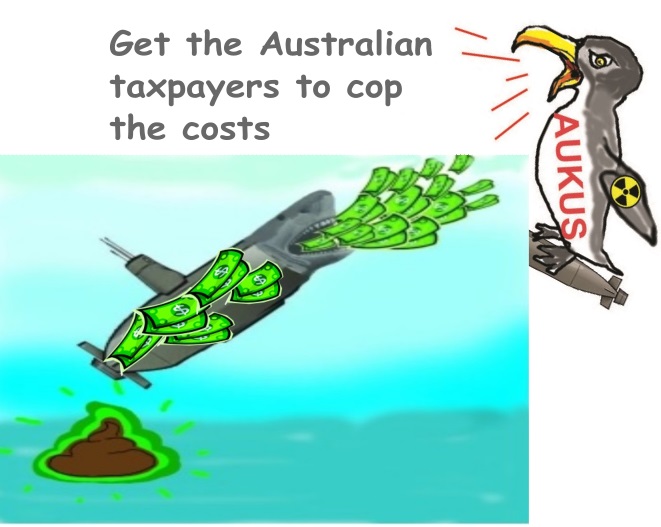
former deputy US secretary of state Kurt Campbell warned at a US Studies Centre forum in Sydney that there were sceptics at the Pentagon who would “love a stumble” on AUKUS.
After a US report found the country is losing billions on idle submarines, a top AUKUS ally in Congress pointed out Australia is happy to help.
Anton Nilsson, Sep 25, 2026, https://www.crikey.com.au/2026/09/25/aukus-us-congress-nuclear-powered-submarines-report-henderson-defence-precinct/
A top AUKUS supporter in Washington has pointed to Australia’s contribution to the alliance as a way to solve America’s problems with maintaining its submarine fleet.
Democratic representative Joe Courtney, a co-chair of the Friends of Australia caucus in the US Congress, issued a statement on Wednesday in response to a damning report on the USA’s ability to maintain its submarines.
The report by the US Government Accountability Office (GAO), published last month, found the US Navy had “lost more than 15,000 operational days due to maintenance delays and idle time on active attack submarines” over the past decade.
“Inactive idle time describes when an attack submarine designated for decommissioning cannot be inducted into a dry dock in a shipyard,” the report said. “As a result, the submarine and its crew must remain pier-side until a shipyard has the capacity in a dry dock to defuel their nuclear reactor.”
Virginia-class submarines — the type Australia hopes to purchase through the AUKUS agreement — cost US$237,080 per day to operate, and had been idle or in “depot maintenance delay” for a total of 3,522 days between 2016 and 2025, the report said. That meant the total cost for those idle vessels was US$835 million, equivalent to $1.1 billion in Australian currency, in that time period.
Another type of submarine the report looked at, the Los Angeles-class, had a total cost of US$3.3 billion over 15,165 idle days. The problem with inactive idle time was projected to worsen, and could cost the US $3.1 billion through 2030 if solutions aren’t found.
The GAO recommended the Navy try new ways of decommissioning submarines, including defueling outside of dry docks and reducing the crew numbers required on boats waiting to be decommissioned.
In his statement, Courtney pointed out that the “swift authorisation of the AUKUS security agreement” would mean “the US Navy’s submarine fleet will have new intermediate repair capacity” at a new Australian Defence Force site at Henderson, WA.
Courtney also pointed to Australia’s US$8.5 billion investment in “repair availability for Virginia-class submarines and the future SSN-AUKUS submarines”, a planned new class of nuclear-powered submarines that forms a cornerstone of the agreement between the US, Australia and the UK.
Australia’s government has said the under-construction Henderson Defence Precinct site will include dry docks and other infrastructure for maintaining the country’s future submarines. Royal Australian Navy personnel have in the past participated in maintenance work on US nuclear-powered submarines on Australian soil, work that Canberra has described as a “significant leap in Australia’s journey to acquire a sovereign capability to operate and maintain conventionally-armed, nuclear-powered submarines”.
Not everyone in Washington is viewing the AUKUS agreement with such positivity: former deputy US secretary of state Kurt Campbell warned at a US Studies Centre forum in Sydney that there were sceptics at the Pentagon who would “love a stumble” on AUKUS.
“I still think there are probably people at the [US] Department of Defence that would love a stumble [on AUKUS] to be able to say, ‘Ah, gee, this is something we need to reevaluate.’ It’s going to be very important to keep those folks on their back heels, and I believe that we’re doing that,” Campbell said on Wednesday, according to The Australian.
“So, you know, we have many hurdles ahead, and this is going to continue to require consistent, high-level application, challenges and training operations. But I think, so far, I would give us better than a pass grade [on AUKUS].”
1 This month


Help Aunty Sue Protect Her Land and Sacred Sites From Destructive Rocket Testing.
.

Australians deserve the truth
about
AUKUS – https://aukuspublicinquiry.com/

PETITION – To: Prime Minister Anthony Albanese and the Australian Labor Government

of the week – Australians for War Powers Reform (AWPR)
To see nuclear-related stories in greater depth and intensity

