Submission to AUKUS Inquiry – Unwise to integrate Australia into USA’s military power -David Jonathan Beardsmore.
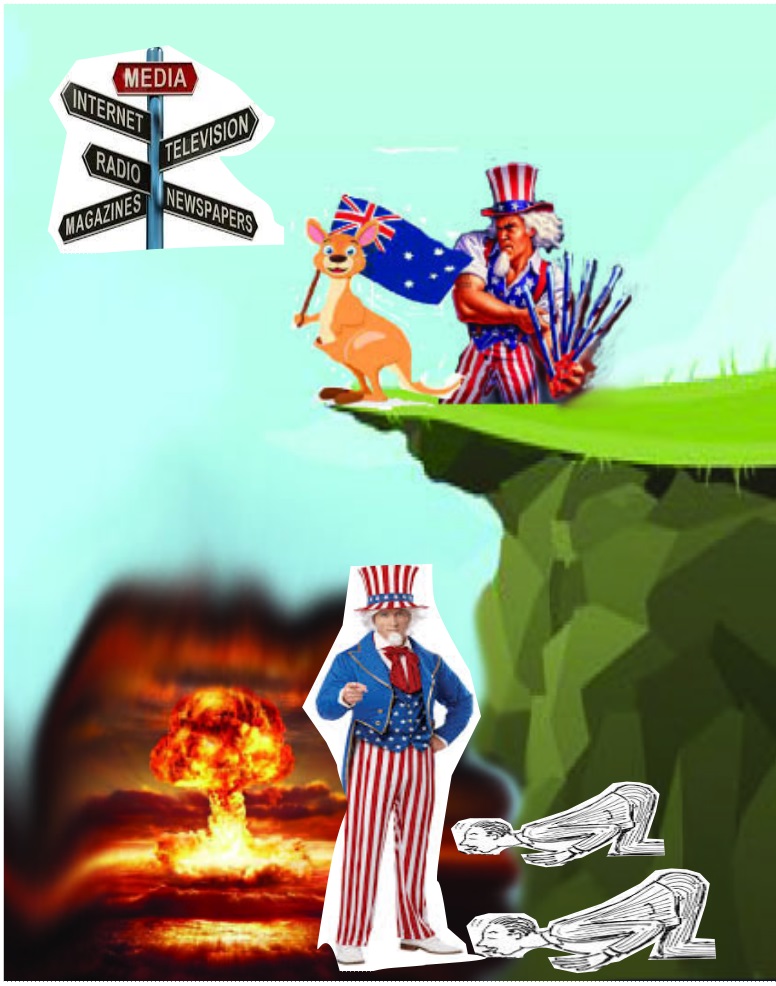
147 – extract of a long submission
“…………………………………My submission advances three core arguments. First, that AUKUS operationally integrates
Australia into United States power projection in a way that serves US strategic interests rather
than Australian ones, and exposes Australia to risks it cannot control.
Second, that the
opportunity cost of AUKUS is indefensible, the soft power strategy that would actually serve
Australian regional security is being systematically underfunded while $368 billion is
committed to submarines that may never arrive on schedule, if at all.
Third, that a right-sized,
conventionally capable, agile defence force, including the asymmetric and drone capabilities
that have proven decisive in recent conflicts, oriented toward genuine Australian territorial
defence and regional partnership would serve Australian security better and at a fraction of the
cost.
AUKUS Was Conceived in a Strategic Environment That No Longer Exists
AUKUS was announced in September 2021 under a specific set of assumptions about the
international environment: that the United States was a reliable, rules-based actor committed
to multilateral institutions; that the primary strategic challenge was Chinese military
expansionism requiring a conventional military counterbalance; and that deep operational
integration with the United States would enhance rather than constrain Australian strategic autonomy. Each of those assumptions has been fundamentally called into question by subsequent events.
The United States has withdrawn from or undermined multiple international agreements and
institutions. It has used economic coercion against allied trading partners including Australia. It
has made explicit territorial claims over allied and sovereign territory, including Greenland and
assertions about the Panama Canal. Its current National Defense Strategy includes explicit
assertions of US dominance over the Western Hemisphere that echo 19th century Monroe
Doctrine thinking, with implications for how it would expect allied military assets to be
deployed.
I put a direct question to the inquiry that has not been adequately answered in public debate:
how does Australia procuring nuclear-powered submarines align with the actual current US
defence strategy? That strategy, as articulated under the current administration, appears to
prioritise the Western Hemisphere and Latin America as the primary zone of US strategic
concern, while effectively ceding leadership in Southeast Asia. If the US is reorienting toward
its own hemisphere, the strategic rationale for Australia acquiring submarines designed to
operate in partnership with US forces in the Indo-Pacific requires urgent re-examination. We
may be purchasing a capability designed to serve a US strategic posture that the US itself is
abandoning.
I put a further direct question: if Australia were to have a Virginia class submarine operating
under shared protocols with the United States Navy today, would Australia be in a position to
refuse if the United States requested operational support for naval activities in the Caribbean,
the Gulf of Mexico, or the waters around Venezuela or Cuba? The deeper the operational
integration, the harder the answer to that question becomes. AUKUS does not merely procure
submarines, it structurally commits Australia to follow the United States wherever its strategic
interests lead, for the next fifty years.
I also note that the AUKUS commitment appears to have been made without the standard due
diligence that would be required of any comparable major public or private investment. There
is no publicly available independent cost-benefit analysis. There is no published risk
assessment. The business case, to the extent one exists, has never been released. A
commitment of this magnitude made without this foundational work did not follow due process
by any reasonable standard, and the inquiry should name that failure directly.
A $368 billion commitment made on the basis of strategic assumptions that have demonstrably
shifted, without adequate due diligence, deserves to be revisited. That is not an anti-American
argument. It is the most basic principle of prudent risk management. I note in this context that
the terms of the deal have already changed significantly, Australia will now receive three
second-hand Virginia class submarines rather than the originally planned mix of new and used
boats. The goalposts have moved before a single submarine has been delivered. This ought to
raise serious questions about what further changes lie ahead over a fifty-year programme.
The Difference Between Alliance and Operational Integration
I wish to draw a distinction that has been largely absent from the public debate on AUKUS.
There is a meaningful difference between maintaining an alliance relationship with the United
States and being operationally integrated into US power projection.
Australia has maintained an alliance with the United States for over eighty years. That alliance
has served Australian interests in some respects and has drawn Australia into conflicts that did
not serve Australian interests in others, Vietnam, Iraq, and Afghanistan being the most obvious
examples. In each case, the alliance logic made refusal politically costly even when the
strategic case for participation was weak or non-existent.
AUKUS takes that logic and embeds it in steel and nuclear reactors. Nuclear-powered
submarines operating under shared US protocols, based at HMAS Stirling near Perth, are not
a defensive capability for protecting Australian territory and maritime approaches. They are a
contribution to US power projection across the Indo-Pacific and potentially beyond. That is a
fundamentally different strategic posture, and it has been adopted without the Australian
people being given the opportunity to debate or decide it.
I submit that Australia can and should maintain its alliance relationship with the United States
while declining to be operationally integrated into US power projection. New Zealand has done
exactly this, maintaining its alliance relationships while exercising greater strategic
independence, and it has not been invaded or left without allies. The argument that Australia
must choose between full operational integration with the United States and strategic isolation
is a false binary that serves the interests of the defence industry and alliance managers, not
the Australian people.
The Opportunity Cost: Soft Power Is Australia’s Greatest Strategic Asset
Australia’s greatest strategic asset in the Indo-Pacific is not military capability. It is trust,
proximity, shared vulnerability to climate change, and a history of engagement with Pacific and
Southeast Asian nations that cannot be replicated by either the United States or China. That
asset is being systematically squandered while $368 billion is committed to submarines.
The Pacific Islands Forum member nations have been explicit about their strategic priorities.
Their existential threat is climate change, not Chinese military aggression. When Australia
commits $368 billion to nuclear submarines while cutting development assistance and climate
finance to Pacific Island nations, it sends a clear message that Australian strategic priorities
have nothing to do with their actual needs. That message drives Pacific nations toward China,
not because they embrace Chinese authoritarianism, but because China is building ports,
hospitals, roads and renewable energy infrastructure while Australia is buying submarines.
China’s Belt and Road Initiative has created genuine dependency across the Indo-Pacific, in
Southeast Asia, and in Africa. That dependency is not the same as military conquest, but it
represents a form of strategic influence that shapes the decisions of governments and
peoples. The way to counter it is not submarines, it is offering a genuine alternative at scale.
Australia, in partnership with Japan, South Korea, India and European allies, has the capacity
to offer such an alternative. What has been lacking is the political will and financial commitment
to do so. AUKUS forecloses that option by consuming the resources that would make it
possible.
I submit that every dollar committed to AUKUS is a dollar not available for the development
finance, climate adaptation support, educational exchanges, diplomatic engagement, and
multilateral institution-building that constitute genuine soft power, and that would do more to
advance Australian security and regional influence than any number of nuclear submarines.
A Considered Assessment of the Chinese Strategic Challenge
I wish to be clear that I do not dismiss the Chinese strategic challenge. China’s militarisation of
disputed features in the South China Sea, its coercive economic behaviour toward trading
partners including Australia, its dismantling of Hong Kong’s democratic institutions in breach of
the Sino-British Joint Declaration, its treatment of the Uyghur population in Xinjiang, and the
ongoing military threat to Taiwan are all matters of genuine concern that deserve serious policy
responses. However, I submit that the appropriate Australian response to these challenges is
not submarines. It is the consistent application of international law, multilateral diplomatic
engagement, support for regional institutions, economic diversification to reduce dependency on any single trading partner, and the kind of soft power investment described in the previous section.
ASEAN, the ten-nation Southeast Asian bloc that sits between Australia and China, has
explicitly and consistently rejected the framing of a binary choice between Washington and Beijing. ASEAN’s strategic preference is for a rules-based regional order maintained through
multilateral institutions, not through US or Chinese military dominance. AUKUS cuts across
that preference and makes Australian diplomacy in ASEAN more difficult, not less. A
submission from Australia to the region that says ‘we are deploying nuclear-powered
submarines under US protocols’ is not the same as a submission that says ‘we are investing in
your development, your climate resilience, and your institutional capacity.’
On the question of Taiwan specifically, I acknowledge the genuine complexity of its historical
and legal status, and I recognise the democratic character of its 23 million people and their
right to determine their own future free from military coercion. However, the question for
Australian strategic policy is not whether Taiwan matters, it is whether AUKUS submarines
would meaningfully alter the outcome of a conflict over Taiwan without catastrophic
consequences for Australia. The answer to that question is clearly no. A war between the
United States and China over Taiwan, fought with Australian submarines alongside the US
Navy, would not save Taiwan and would expose Australia to retaliatory strikes against facilities
including HMAS Stirling, making Perth one of the first targets in a conflict that would threaten
the survival of Australian society as we know it.
This risk is compounded by the observable instability of United States policy on Taiwan itself.
The recent Trump administration’s engagement with China, including high-level diplomatic
contact and signals of reduced commitment to Taiwan’s defence, demonstrates that US
Taiwan policy is subject to rapid reversal depending on the domestic political calculations of
any given administration. Australia should not be structuring a fifty-year strategic commitment
around the reliability of US Taiwan policy when that policy has demonstrably shifted within a
single presidential term. We risk being entangled in a conflict the United States itself may
choose to step away from.
A Right-Sized Defence Force for Australia’s Actual Security Needs
Australia’s genuine defence needs can be summarised as follows:
- Maritime patrol and surveillance capability sufficient to monitor Australia’s vast
exclusive economic zone and maritime approaches. - Cyber capability, the most likely domain of future conflict affecting Australian interests,
which is chronically underfunded relative to conventional platforms. - Rapid response forces capable of responding quickly to crises across the Indo-Pacific,
including disaster relief, humanitarian assistance, and peacekeeping operations that
build regional relationships. - Conventional deterrence sufficient to make any direct attack on Australian territory
prohibitively costly for any potential adversary. - Space-based intelligence, surveillance and reconnaissance capability that provides
genuine strategic awareness without dependence on US systems. - Advanced asymmetric capabilities, including drone swarms, loitering munitions,
electronic warfare, and autonomous underwater vehicles, that represent the cutting
edge of modern warfare at a fraction of the cost of conventional platforms.
None of these requirements needs nuclear submarines. All of them could be funded at world-
class levels for a fraction of $368 billion, with substantial funds remaining for the soft power
investment that is Australia’s most effective strategic tool………………………….
The Unresolved Nuclear Waste Question and True Cost of AUKUS
I note with serious concern that no credible answer has been provided to the question of where
the high-level nuclear waste generated by AUKUS submarines will be stored. This is not a
minor administrative detail. It is a fundamental question about the use of sovereign Australian
territory that affects First Nations communities, environmental values, and Australia’s
international standing as a non-nuclear-weapons state.
I wish to draw the inquiry’s attention to a question about the $368 billion cost estimate that I do
not believe has been adequately addressed in public debate: does that figure include
decommissioning costs? For nuclear facilities, decommissioning costs typically exceed the
original capital cost of construction, sometimes by a significant multiple, and extend across
decades after the facility ceases operation. If the $368 billion figure does not include the full
lifecycle cost of nuclear waste storage, management, and eventual decommissioning of the
submarines themselves, the true cost to Australian taxpayers and their descendants is
substantially higher than has been publicly stated. The inquiry should require a full lifecycle
cost disclosure before any further commitments are made.
Australia has ratified the Nuclear Non-Proliferation Treaty as a non-nuclear-weapons state. To
be clear, the AUKUS submarines will be nuclear-powered but conventionally armed, the
nuclear technology is in the propulsion system, not in the weapons they carry. The Australian
government and its AUKUS partners argue that this arrangement complies with the written
terms of the NPT because the treaty relates only to nuclear materials associated with nuclear
weapons, not propulsion. However, this compliance is genuinely contested and unresolved.
The arrangement involves the transfer of tonnes of highly enriched uranium to Australia, the
same material used in nuclear weapons, and cooperation in developing capabilities for nuclear
submarine operations that IAEA safeguards were not expressly designed to cover.
The Arms
Control Association and independent non-proliferation experts have noted these concerns.
Australia would become the first non-nuclear-weapons state to acquire nuclear-powered
submarines, setting a precedent that could significantly undermine the global non-proliferation The Arms
Control Association and independent non-proliferation experts have noted these concerns.
Australia would become the first non-nuclear-weapons state to acquire nuclear-powered
submarines, setting a precedent that could significantly undermine the global non-proliferation
I submit that the AUKUS commitment should not proceed, and certainly should not consume
further public resources, until the full lifecycle cost, including waste storage and
decommissioning, has been publicly disclosed, and until the waste storage question has been
answered transparently and publicly with full community consultation including First Nations
communities on whose land nuclear waste storage may ultimately be proposed.
The Democratic Deficit
Regardless of one’s view on the strategic merits of AUKUS, the process by which it was
decided represents a democratic failure that this inquiry should name clearly.
A commitment of up to $368 billion, extending obligations across multiple generations of
Australians who have not been consulted and cannot consent, was made in secret, announced
without prior parliamentary debate, and has been shielded from meaningful parliamentary
scrutiny by bipartisan political agreement. The argument that bipartisan support makes
parliamentary scrutiny unnecessary inverts the purpose of parliamentary democracy.
Bipartisan agreement between major parties is precisely the circumstance in which
independent scrutiny becomes most essential.
I submit that this inquiry should recommend that no further commitments under AUKUS be
made without a full parliamentary debate and vote, that the complete terms of existing
agreements be made public, and that an independent cost-benefit analysis, including full
lifecycle costs, be commissioned and publicly released before the submarine acquisition
proceeds further.
Conclusion and Recommendations
I summarise my recommendations to the inquiry as follows:
- Suspend further AUKUS commitments pending independent review of the changed
strategic environment, including the altered behaviour and reliability of the United
States as an alliance partner and the shift in US strategic focus toward the Western
Hemisphere. - Commission and publicly release an independent full lifecycle cost-benefit analysis,
including decommissioning and nuclear waste storage costs, comparing AUKUS
against alternative defence capability options and against redirecting equivalent
resources to soft power, development finance, and regional engagement. - Resolve the nuclear waste storage question transparently and with full community
consultation, including First Nations communities, before any further nuclear-related
commitments are made. - Require a full parliamentary debate and vote before any further AUKUS commitments
are entered into. - Develop and resource a comprehensive Indo-Pacific soft power strategy, including
development finance, climate adaptation support, educational engagement, and
multilateral institution-building, as Australia’s primary tool for countering Chinese
regional influence and building genuine security relationships. - Commission a comprehensive review of Australia’s defence capability mix in light of
the lessons of the Ukraine and Lebanon conflicts, with specific assessment of investment in asymmetric, drone, autonomous, and cyber capabilities as alternatives to or complements of conventional platform spending. - Right-size Australia’s defence force around its actual security needs, territorial defence, maritime surveillance, cyber capability, rapid response, asymmetric deterrence, and regional partnership, rather than around the requirements of US power projection.
- Maintain the alliance relationship with the United States while declining operational integration that commits Australia to US military adventures beyond its own strategic interests.
No comments yet.
1 This month
17 October, Free Public Talk on Nuclear Issues in South Australia
David Noonan will speak on public interest concerns over the new Roxby Downs Indenture Act 2026 on BHP copper-uranium mining and ore processing in SA, and on how AUKUS may face SA with a High-Level nuclear waste agenda.
Dr Jim Green will discuss international developments in the field of nuclear power including ‘small modular reactors’ and Generation 4 ‘advanced’ nuclear reactor concepts.


Help Aunty Sue Protect Her Land and Sacred Sites From Destructive Rocket Testing.
.

Australians deserve the truth
about
AUKUS – https://aukuspublicinquiry.com/

PETITION – To: Prime Minister Anthony Albanese and the Australian Labor Government

of the week – Australians for War Powers Reform (AWPR)
To see nuclear-related stories in greater depth and intensity


Leave a Reply