Submission to AUKUS Public Inquiry – Radiation protection for workers and members of the public under AUKUS – Dr Tony Webb
No. 204 -Summary
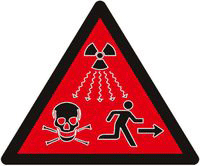
Summary of key issues covered in this submission
The key issues I wish to raise for consideration as part of this Inquiry into the AUKUS
submarine program are:
That there is a potential risk to health of workers and the public from routine as well
as unpanned/accidental exposures to ionising radiation from many aspects of this
AUKUS program including: submarine construction, operation, maintenance,
decommissioning, and long-term management of radioactive waste materials.
It has long been an established principle for radiation protection that there is no
threshold or safe level of exposure – that even small doses may result in stochastic
health effects where probability of effect rises with the level of exposure rather than
disease outcomes being determined by dose. As a result, it is expected that all
exposures need to be justified against some expected social benefit, be kept as low
as reasonably achievable (ALARA) and be kept below strict annual worker and public
exposure limits.
These established principles are currently being challenged in the USA as a result of a
2025 Presidential directive that instructs the US Nuclear Regulatory Commission to
abandon the no threshold and ALARA principles and revise occupational and
exposure limits to reflect deterministic rather than stochastic health effects – changes
that, if implemented would significantly increase permissible exposures.
It is unclear how such changes might be applied to nuclear submarine operations
under AUKUS particularly where US or Australian-US co-owned/operated boats use
Australian facilities. Pressure from the US to operate within US standards can be
anticipated. It should be noted that Australia has already established a Naval
Nuclear Protection Standards Regulator (ANNPSR) – separate from the current
Radiation Protection and Nuclear Safety Agency (ARPANSA) – that will regulate all
aspects of safety for the AUKUS program.
The changes to US standards – already weaker than those applied under international
recommendations by most other countries, come at a time when scientific evidence
from large scale epidemiological health studies on workers employed in, and
communities living close to, nuclear facilities indicates that the estimates used in
setting current standards underestimate the risks to health and need to be
significantly tightened.
Details and evidence relating to these issues are outlined below. I will be happy to provide
further information and be questioned on matters arising if this would assist the Inquiry.
Impending changes to radiation protection standards
Changes for worse or better protection for workers and the public is on the international and
national political agenda in a number of countries. Trade Union, environment and public
health groups around the world are concerned that the USA is considering proposals that
would weaken radiation protection standards at a time when the scientific evidence
suggests these need to be significantly tightened. These need to be resisted with pressure
to provide better not worse protection for workers and the public.
In May 2025 US President Donald Trump issued a Directive (EO 14300) i
requiring the US Nuclear Regulatory Commission (NRC) to review nuclear safety regulations with particular
reference to radiation protection of workers and the public. The Directive instructs the NRC
to abandon fundamental principles that have formed the basis for radiation protection for
much of the past century. These include: the internationally accepted position that there is
no threshold or safe level of exposure to ionising radiation; that, as a consequence, all
exposures should be kept as low as reasonably achievable (ALARA); and that exposures to
workers and the public be kept below strict annual limits in line with the best evidence of
radiation-induced health risks.
Evidence for increased health risk from radiation exposure
The evidence used to set current standards is drawn mainly from the studies of cancer rates
among the Japanese A-bomb survivors who were exposed to relatively high doses over short
time periods. Since then, studies of workers in nuclear power facilities exposed to lower
doses over long time periods show higher rates of cancer than predicted by the Japanese
studies. Rather than indicating any threshold these studies suggest that at low doses the
cancer rates are proportionately higher than expected from the Linear No-Threshold (LNT)
model used to set current standards.ii Worker studies also show elevated rates of cardio-
vascular diseases, and increased rates of dementiai. In addition, studies on populations around nuclear power plants are now showing higher cancer rates affecting the population
generallyand particularly childrenvi and the elderly with level of health damage correlated
with how close they lived to these facilities……………………
US pressure on global standards
If they go through there will also likely be pressure on international and national standards
agencies to align with changes in the USA. There is already some push-back. In June 2025
the heads of European standards agencies issued a statement supporting the LNT and
ALARA principles and insisting that exposure standards be set on the basis of the scientific
evidence without undue influence. ix In May 2026 the World Health Organisation urged
national and international bodies to continue collaboration to “harmonise standards, share
data and strengthen coordination on radiation and health.”
The AUKUS connection
In Australia there are a number of joint ventures in uranium and radioactive rare earths and
mineral sands mining and the government has already established a separate Naval Nuclear
Power Safety Regulator (ANNPSR) to oversee all aspects of construction, operation,
maintenance, decommissioning and nuclear waste management under the Australia-UK-US
(AUKUS) nuclear submarine program. While these nuclear submarine standards are
expected to be consistent with those of the current Australian Radiation and Nuclear Safety
Agency (ARPANSA) it is unclear whether US or Australian standards will apply to US military
or joint US Australian assets operating from Australian facilities. Pressure for change is
inevitable. Hopefully the outcome of politically independent science-based pressure will be
not merely opposition to changes prompted by the US President’s directive but for
significantly better standards to protect health.
What the AUKUS investigation might recommend
First: that Australian radiation protection should continue to be based on the established
principles that: there is no safe level of exposure to ionising radiation; that all exposures in
the workplace, and in community from whatever source need to be justified against some
recognizable benefit and where justified be kept as low as reasonably achievable and in any
case below strict exposure limits that are set on the basis of the best available evidence for
the level of risk of health damage.
Second: that all radiation protection safety standards operated under the AUKUS program
and regulated by the ANNPSR be consistent with those developed by ARPSANSA for
occupational and public exposures generally and that these apply to construction,
maintenance, decommissioning and waste management for all nuclear-powered submarines
whether these are owned by Australia or another country – Australian standards rather than
those of another country should apply in Australia.
Third: that ARPANSA be asked to provide a clear and unequivocal statement that Radiation
Protection standards in Australia will not be changed in line with the US Presidential
Directive
Fourth: that ARPANSA be asked to undertake a systematic review of the evidence suggesting
that the current occupational and public exposure limits need to be revised – and tightened
so as to lower permissible exposure limits.
References and Further Reading………………………….
International law isn’t dead. It’s being tested. Australia can prove it matters
by Emily Crawford | Oct 5, 2026, https://michaelwest.com.au/international-law-isnt-dead-its-being-tested-australia-can-prove-it-matters/
The silence in Canberra over attacks on the ICC, the US attack on Venezuela and the war on Iran rings loudly. Australia has a unique chance to uphold it, writes Emily Crawford.
When a powerful state breaks the rules, the temptation is to declare international law dead.
Over the past 20 months, there has been plenty of evidence to feed that mood. The Trump administration alone has withdrawn from the WHO, the Paris Agreement, the UN Human Rights Council and UNESCO.
It has sanctioned the judges and prosecutors of the International Criminal Court. It has threatened to seize Greenland and take back the Panama Canal. It has struck Venezuela and seized its president, with no Security Council authorisation and no credible claim of self-defence.
UN Special Rapporteur Ben Saul has found that the US campaign of boat strikes, which has killed at least 223 people, amounts to “serial extrajudicial killings”. More than 100 international law experts have warned that strikes on civilian sites in Iran may constitute war crimes.
In addition, we are seeing widespread violations of the law in Myanmar, Sudan, and Gaza, among other sites of atrocities.
The cynics
Cynics say this proves international law is a fiction that binds only the weak. Its an appealing conclusion – after all, the UN Charter was founded on the promise of outlawing war.
But the UN is not the totality of the international legal system. And legal system that has its rules broken is no less a legal system for the breach. After all, we do not unilaterally declare that laws against theft are meaningless because theft occurs.
A prohibition on the use of force, on attacking civilians, on forcibly transferring populations, exists precisely because states are tempted to do these things.
“What matters is how the world responds.”
When a violation is named as a violation, documented by UN investigators, condemned by legal scholars and recorded for future accountability, the law is doing its work. Even the powerful tend to reach for legal language to justify what they do, because they know the rules carry weight.
Nobody feels the need to argue that a rule doesn’t apply to them unless the rule matters.
The rules also matter most to those with the least power. Australia is the textbook example. As a middle power, we cannot secure our interests by force alone. We depend on freedom of navigation, on binding trade rules, on arms control agreements that restrain nuclear weapons, and on the expectation that borders cannot be redrawn by whoever is strongest.
Successive Australian governments have understood this, and Australia has long been a builder and beneficiary of the multilateral system.
Wrong way Australia
That is what makes the recent silence so striking. Canberra did not respond to the attacks on the ICC or the strikes in the Caribbean, and it backed the new war on Iran. If international law is the foundation of Australian security, treating its erosion as somebody else’s problem is a strange way to defend it.
Yet there is a real opening. Since announcing its bid for a seat on the UN Security Council, the government has been talking about international law constantly. The Prime Minister Anthony Albanese has said the international rule of law
“isn’t something that is regarded as, if you like, optional”.
The Foreign Minister Penny Wong says Australia wants “a safer world … governed by rules, not power and force alone”, and has promised a Council term focused on conflict prevention, the protection of civilians and “defending the rules that protect us all”.
Australia’s ambassador to the UN has set out why rules and norms matter to Australia’s prosperity and security, from trade to nuclear non-proliferation to the aviation and satellite systems that most of us rely on without thinking.
These are good words, and for anyone who cares about international law, hearing them from those in power is welcome.
But words in a campaign are cheap.
A Security Council bid is a promise to the world that Australia will defend the rules, and the test is whether that promise is matched at home.
Red Lines
That is where the Red Lines Package comes in. It was recently introduced into Parliament, and it is a chance to turn the government’s rhetoric into something concrete.
Professor Emily Crawford is one of the panelists to be discussing international law with the International Criminal Court’s Judge Hilary Charlesworth on 13 October at the NSW Teachers Federation Conference Centre in Surry Hills.
Yet Labor and the Coalition combined to prevent it from receiving scrutiny through a Senate inquiry. It is hard to reconcile a campaign that puts the rule of law in every speech with a refusal to let Parliament examine a proposal built on that principle.
If the commitment is genuine, an inquiry should be welcome, since the statements already made would be the strongest possible case for it.
The lesson is not that international law has failed. Law has always depended on people choosing to uphold it, insisting on it, and paying a price for doing so. It survives every time a state, a court, an expert or a citizen refuses to accept that might makes right.
The Security Council bid gives Australians a rare lever. We can take the government at its word and ask it to act on what it has said.
1 This month
17 October, Free Public Talk on Nuclear Issues in South Australia
David Noonan will speak on public interest concerns over the new Roxby Downs Indenture Act 2026 on BHP copper-uranium mining and ore processing in SA, and on how AUKUS may face SA with a High-Level nuclear waste agenda.
Dr Jim Green will discuss international developments in the field of nuclear power including ‘small modular reactors’ and Generation 4 ‘advanced’ nuclear reactor concepts.


Help Aunty Sue Protect Her Land and Sacred Sites From Destructive Rocket Testing.
.

Australians deserve the truth
about
AUKUS – https://aukuspublicinquiry.com/

PETITION – To: Prime Minister Anthony Albanese and the Australian Labor Government

of the week – Australians for War Powers Reform (AWPR)
To see nuclear-related stories in greater depth and intensity

