Former defence chief urges rethink of Australia’s relationship with China
Rob Harris November 4, 2026, https://www.smh.com.au/politics/federal/too-risky-too-costly-aukus-should-be-scrapped-finds-peter-garrett-led-inquiry-20261104-p61bbt.html
Australia must rethink its relationship with China rather than blindly follow the United States into a disastrous military confrontation, former defence force chief Chris Barrie has warned as part of a review demanding the federal government overhaul its signature security strategy.
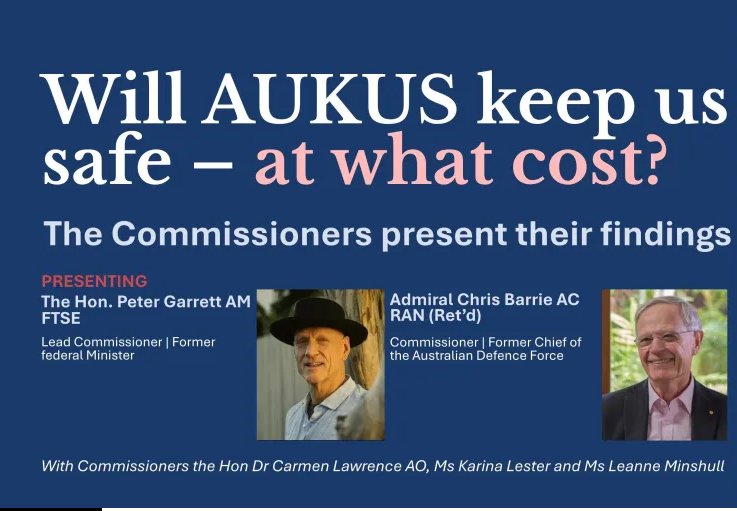
The retired admiral delivered the warning at the National Press Club in Canberra on Wednesday as he joined former Labor minister Peter Garrett to launch a scathing report calling for the immediate cancellation of the $368 billion AUKUS nuclear submarine pact, arguing it threatens Australian sovereignty and risks dragging the nation into a war with China.
The inquiry calls for the nuclear submarine program to be scrapped, a royal commission into AUKUS, the suspension of US submarine operations near Perth and a fundamental overhaul of Australia’s defence strategy and relationships with Washington and Beijing.
“Whatever way you want to look at the future in this region, by 2050, China will be the world’s largest power, the world’s greatest power,” Barrie said. “I don’t see any evidence of global aspirations and global dominance aspirations that we’ve seen out of the United States. And that’s why I worry about the contest between the United States and China.”
Barrie, who led the Australian Defence Force from 1998 to 2002, said Australia needed to better its relationship with Beijing and invest far more heavily in diplomacy rather than allowing its strategic priorities to be dictated by Washington.
Barrie, who recalled travelling through China with the head of the People’s Liberation Army during his time as defence chief, said Australia needed a more sophisticated understanding of Beijing’s strategic ambitions.
The retired admiral said Australia’s tendency to lecture Beijing publicly had damaged relations, and warned against viewing China’s rise solely through the prism of American strategic competition.
“I think we need to recalibrate the way we deal with China,” he said, suggesting Australia’s embassy in Beijing should become its second-largest diplomatic mission, if not the largest.
His intervention came as a union and community-backed public inquiry accused successive Coalition and Labor governments of committing generations of taxpayers to an extraordinarily expensive defence program without adequately examining its costs, feasibility or consequences for Australia’s independence.
The report, Surrendering Australia: The AUKUS Deception, concluded the submarine acquisition program was unlikely to deliver on its promises and could leave the Australian Navy without an effective submarine fleet. It labelled the program the “worst, riskiest and most costly” defence decision made by an Australian government.
The inquiry’s findings challenge the bipartisan consensus behind AUKUS, which the Albanese government maintains is essential to Australia’s long-term defence capability and deterrence in the Indo-Pacific.
Garrett, the Midnight Oil frontman, lashed the absence of meaningful debate within his own party over AUKUS, saying the evidence presented to commissioners had reinforced his original concerns about the deal.
“My major objection to AUKUS in the first instance was that there was no debate,” Garrett said.
“Where was the vigorous debate in the caucus? Where was the vigorous debate in the cabinet? We don’t have any sense that there’s been a debate.”
Garrett said the enormous cost, the failure to account for the safe storage of radioactive waste and the terms of the agreement had convinced him the program was fundamentally flawed.
“Your conclusion after looking at it and hearing from expert advice is that it is a complete absolute crock.”
The report, which backs longstanding criticisms from former prime ministers Paul Keating and Malcolm Turnbull, calls for a comprehensive national security strategy and accuses both major parties of surrendering critical defence decisions to foreign powers.
Among the 17 recommendations, the inquiry recommended urgently developing a cheaper alternative to replace the ageing Collins-class fleet, while reviewing the separate AUKUS agreement on advanced defence technologies. It also calls for an Australian National Audit Office investigation into its costs.
Work on the AUKUS submarine construction facilities at Adelaide’s Osborne naval precinct should halt, while Australian submariners should stop being seconded to American vessels, the report argues.
The report also warns that the US and Britain could walk away from the agreement without delivering the promised submarines while retaining billions of dollars for their shipbuilding industries.
It also questions whether the delivery timetable is achievable and warns that attempting to operate three different classes of submarines could place intolerable pressure on Defence personnel and resources. Australia is scheduled to receive its first US-built Virginia-class nuclear submarine in 2032, with a subsequent boat arriving every four years until the sovereign fleet is operational. The first Australian-built SSN-AUKUS vessel is slated to enter service in 2042.
The public inquiry, convened by the Australian Peace and Security Forum, received more than 1000 written submissions and heard evidence over 10 days across eight cities, with its organisers raising $220,000 to fund the exercise.
A government spokesperson brushed off the inquiry, noting AUKUS had already faced extensive parliamentary scrutiny and remained vital in tackling the nation’s toughest strategic challenges since World War II.
Defending the project’s multi-billion-dollar cost, the spokesperson said the partnership was designed to bolster the Australian Defence Force’s strike power.
“We need to support the development of an ADF with a much greater capacity to project so we can defend Australia and contribute to regional security and stability,” they said.
The government also said the pact would create roughly 20,000 direct jobs across industry, defence, and the public sector over the next three decades.
Independent public inquiry report finds AUKUS nuclear submarine ambitions are ‘unachievable’
4 November 2026 | By Andrew McLaughlin https://psnews.com.au/independent-public-inquiry-report-finds-aukus-nuclear-submarine-ambitions-are-unachievable/188112/
A public inquiry into the trilateral AUKUS construct has released its Commissioner’s Report into one of Australia’s most controversial defence projects ever, the planned acquisition by the Royal Australian Navy of nuclear-powered attack submarines.
Titled Surrendering Australia, the AUKUS Deception, the report says the AUKUS Pillar I agreement between Australia, the UK and the US for nuclear submarines from these countries to be rotationally based in Western Australia from 2027, for Australia to buy up to five Virginia-class nuclear-powered submarines from the US in the 2030s, and for Australia to build new submarines of a British design in the 2040s should be scrapped.
The report says, since the AUKUS agreement was announced in 2021, the government has declined to thoroughly review the agreement, and hasn’t explained in detail how it advances Australia’s interests or better protects us.
“They have avoided answering fundamental questions about the costs and risks associated with AUKUS and have simply not answered the key question: ‘why AUKUS?’” it reads.
“Similarly, MPs from the major parties have brushed aside community concerns and avoided their responsibility to seriously debate in the parliament Australia’s largest ever defence acquisition program – estimated at over half a trillion dollars when the cost of nuclear waste disposal is included.
“After carefully considering all the material presented to us – over 10 days of hearings around Australia and more than 1000 submissions – we concluded that AUKUS is the worst, riskiest and most costly defence decision ever made by an Australian government,” it says.
“Neither the submissions we received nor the hearings we conducted uncovered any convincing foundations for AUKUS.”
The inquiry found the planned delivery schedule for the Virginia-class submarines and the follow-on SSN-AUKUS boats was “at best, problematic, and most likely unachievable”.
“What is more, successive governments have never adequately explained the need for nuclear-powered attack submarines in preference to submarine types with a more defensive capability and better suited to Australia’s regional waters.”
It said Australia had already spent about $9.2 billion to shore up the defence industrial bases of the US and UK and to start building a submarine shipyard in Australia, and that a further $50 billion was planned to be spent before any submarines are delivered.
“Extraordinarily, the lopsided agreement means the UK and US could walk away without delivering any submarines while retaining the billions of dollars we are providing to support their submarine building industries. Australia would have no redress,” it says.
In addition to these doubts, the report also cited unexplained costs, a declining trust in government here and in the US and a growing overreliance on the US, questions over Australia’s sovereignty over the submarines, a lack of strategic justification premised on what it says are false assertions of an increased risk of war with China, and long-term high-level nuclear waster storage and disposal problems, as reasons not to proceed.
Coordinated by the Australian Peace and Security Forum (APSF) and funded through crowd sourcing, the inquiry was launched on 3 June with the goal of conducting open hearings into the proposed $368 billion project.
The inquiry was headed up by former Labor minister and Midnight Oil frontman Peter Garrett, and included fellow commissioners former WA Labor premier and federal Labor minister Dr Carmen Lawrence, former Chief of Navy and Chief of Defence Force Admiral Chris Barrie (Ret’d), the co-CEO of the Australia Institute Leanne Minshull, and Yankunytjatjara woman Karina Lester.
“This is a once in a generation, if not once in a century, serious level decision-making exercise by Australian governments plural,” Garrett said at the launch. “The Australian people need to be a part of it.”
Over the four months of the inquiry from June to September, hearings were held in Melbourne, Fremantle, Adelaide, Sydney, Newcastle, Wollongong, Brisbane, and Canberra. In total, the hearings heard from more than 150 witnesses, while more than 1000 written submissions were received.
“The Australian Peace and Security Forum, supported by several trade unions and community groups, combined to establish a public inquiry into AUKUS, relying on crowdfunding and grants,” the report reads
“With terms of reference agreed, the inquiry accessed information available on the public record from the three AUKUS partners and invited submissions and testimony from experts and citizens.
Presentations were made by former politicians including former prime minister Malcolm Turnbull, former Labor ministers for foreign affairs Professor Gareth Evans and Bob Carr, former Labor deputy prime minister and defence minister Kym Beazley, and former Coalition defence minister Christopher Pyne and defence industry minister Linda Reynolds.
Current politicians who presented included ACT independent Senator David Pocock, NSW Greens Senator David Shoebridge, and Tasmanian MP Andrew Wilkie, WA independent MLA Johanthan Huston, WA Greens MLC Sophie McNeill, SA Greens MLC Melanie Selwood, Newcastle Deputy Lord Mayor Charlotte McCabe and Greens Councillor for Newcastle Siobhan Isherwood.
The government’s failure to appear and present comprehensive information on, and the reasons for, the AUKUS pact, and to answer the many serious questions asked by constituents was telling, and represents a failure in public accountability,” the report says.
1 This month
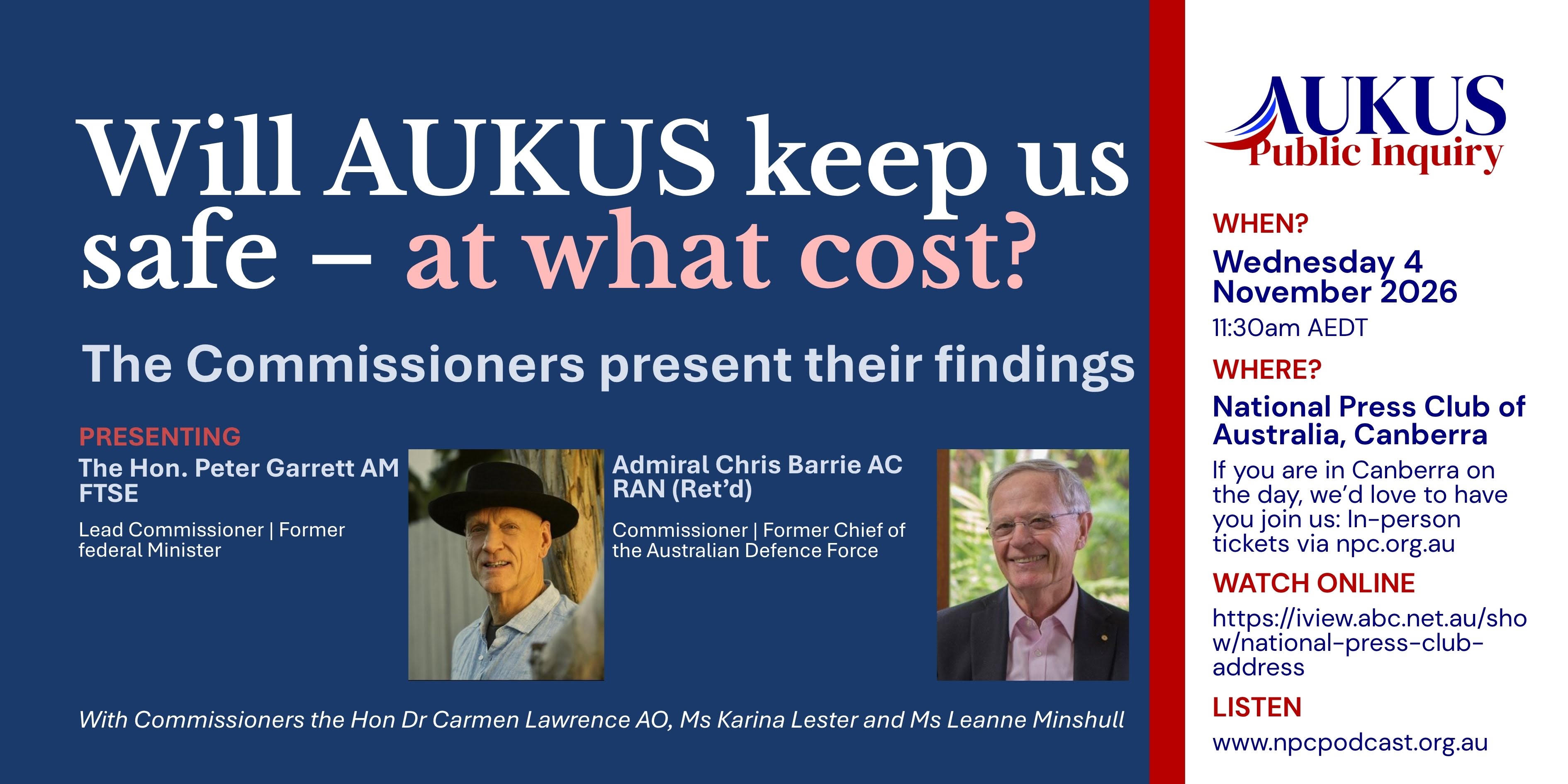
4 November – Will AUKUS keep us safe – at what cost?
the Commissioners of the AUKUS Public Inquiry present their findings at the National Press Club of Australia in Canberra. iview.abc.net.au/show/national-press-club-address
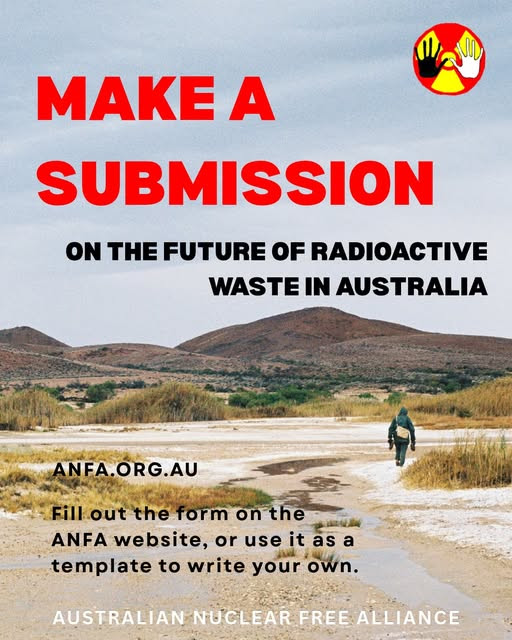
Submissions to the federal government’s new draft framework close on the 13th November 2026.
Australians deserve the truth
about
AUKUS – https://aukuspublicinquiry.com/

PETITION – To: Prime Minister Anthony Albanese and the Australian Labor Government

of the week – Australians for War Powers Reform (AWPR)
To see nuclear-related stories in greater depth and intensity

