Native title stand-off casts a shadow over BHP’s copper (and uranium) heartland
BHP has been told to raise its compensation offer to native title custodians if it wants an updated agreement for its biggest South Australian copper (and uranium) mine.
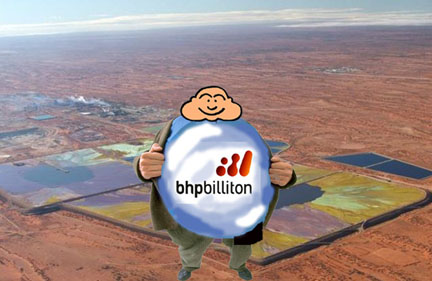
The byproducts included 393,000 ounces of gold, 1.9 million ounces of silver and 3600 tonnes of uranium
Peter Ker, Nov 22, 2026, https://www.afr.com/companies/mining/native-title-stand-off-casts-a-shadow-over-bhp-s-copper-heartland-20261122-p61fnz
Kokatha native title custodians rejected a compensation offer from BHP earlier this year, which was designed to reset the relationship ahead of a decade in which the miner wants to build $US17.4 billion ($25.9 billion) of growth projects on Kokatha land.
Kokatha elders gathered on Saturday and Sunday and were briefed on the latest status of negotiations with BHP for a new “Olympic Dam Agreement”, which will recognise their exclusive native title over the nation’s richest copper district near Roxby Downs, 565 kilometres north of Adelaide.
Kokatha elders gathered on Saturday and Sunday and were briefed on the latest status of negotiations with BHP for a new “Olympic Dam Agreement”, which will recognise their exclusive native title over the nation’s richest copper district near Roxby Downs, 565 kilometres north of Adelaide.
Directors of the Kokatha Aboriginal Corporation did not put BHP’s most recent offer to members for a vote because they deemed the compensation proposal to be “substantially below” expectations.
Corporation director Glen Wingfield, a member of the Kokatha delegation negotiating with BHP for a new Olympic Dam Agreement, said the two parties were not close to a deal.
But the Kokatha delegation has made clear to BHP it expects the new agreement to recognise 50 years of disturbance at the site since the enormous copper, gold and uranium deposit was discovered in 1975.
A new Olympic Dam Agreement has been required since 2014, when the Kokatha people were granted exclusive native title over the region.
The 2014 native title determination rendered a 2008 agreement struck by BHP out of date; that agreement paid benefits from Olympic Dam to the Kokatha and two other Indigenous groups in the Upper Spencer Gulf region.
A BHP spokeswoman confirmed that a new Olympic Dam Agreement had not yet been reached. “We are in active agreement-making with Kokatha. Negotiations are going well, and we are making good progress,” she said.
The impasse over a new deal does not affect the daily operation of Olympic Dam, which continues to mine, refine and smelt ore into sheets of pure copper metal.
But the long-running dispute comes ahead of an era in which BHP will need Kokatha support for numerous copper mining projects in the region, including a new desalinated water pipeline required for BHP to achieve its goal of doubling copper production by 2040.
Disagreement over the Olympic Dam Agreement did not stop a majority of Kokatha members from voting in favour of a land-use agreement to build an exploration decline at the nearby Oak Dam deposit – now renamed Ankata – in April 2025.
But relations between Kokatha and BHP were harmed by this year’s passage through the South Australian parliament of new laws governing mine operations in the district.
The Kokatha people were angered by a lack of consultation over the new laws from both BHP and the state government.
This year, BHP applied to the South Australian government for permission to disturb 700 Indigenous heritage sites while building the Ankata decline to about 800 metres underground.
The mining giant is also seeking government permission to build a new waste dam for the Carrapateena mine 90 kilometres south-east of Olympic Dam, which will permanently bury a registered Indigenous heritage site called OX15-10. Official documents describe the site as a “culturally significant rocky outcrop associated with a traditional storyline”.
Wingfield said the Kokatha people did not want details of heritage sites published, and that all heritage sites were important.
BHP will host an investor tour on Monday and Tuesday at Olympic Dam, Carrapateena, Prominent Hill and Ankata.
The tour will update investors on the latest strategy for the province, which was consolidated when BHP paid $9.6 billion to acquire the operator of Carrapateena and Prominent Hill, OZ Minerals.
Kokatha elders spent the weekend debating whether to approve plans by Aurizon for a larger logistics hub to service BHP’s mines.
Aurizon won a 10-year, $1.5 billion contract from BHP last year to transport copper and equipment between the mines and Port Adelaide. The expanded logistics hub at Pimba is required to handle the increased volumes of copper and equipment expected if BHP proceeds with its expansion plans.
BHP produced 321,000 tonnes of copper in South Australia in the year to June 30, plus other metals as byproducts.
The byproducts included 393,000 ounces of gold, 1.9 million ounces of silver and 3600 tonnes of uranium. Once those byproducts were sold, the cost of producing each pound of copper in the state was just US32¢ last year, well below the average selling price of $US5.74 a pound.
“We are still a long way away,” Wingfield said. “I hope I don’t die negotiating it like my elders did.”
Asked whether the Kokatha community was seeking a financial settlement in the millions or billions of dollars, Wingfield declined to comment, saying the exact details were confidential.
1 This month

Read the Public Inquiry Report, the Commissioners’ report, Surrendering Australia: The AUKUS Deception is available to download for free at aukuspublicinquiry.com. Or just watch the replay of the National Press Club Luncheon.

Will AUKUS keep us safe – at what cost?
the Commissioners of the AUKUS Public Inquiry presented their findings at the National Press Club of Australia in Canberra. iview.abc.net.au/show/national-press-club-address

Submissions to the federal government’s new draft framework close on the 13th November 2026.
Australians deserve the truth
about
AUKUS – https://aukuspublicinquiry.com/

PETITION – To: Prime Minister Anthony Albanese and the Australian Labor Government

of the week – Australians for War Powers Reform (AWPR)
To see nuclear-related stories in greater depth and intensity

