Saying “Hamas Just Needs To Surrender” Is Saying “We’ll Kill Kids Until We Get What We Want”

“It’s heartbreaking,” added Biden, referring to the genocide that he himself is actively backing and could choose to end at any time.
CAITLIN JOHNSTONE, MAR 9, 2024
Of the many awful warmonger comments President Biden made in his State of the Union address Thursday night, arguably the worst was when he reiterated the US empire’s position that it is fine and good for the IDF to keep murdering Gazan civilians until Hamas bows to all of Israel’s demands.
Biden did this by lamenting the “heartbreaking” death and starvation of civilians in Gaza while in the same breath stating that Hamas could end all of this violence by laying down arms and surrendering those responsible for the October 7 attack.
“Israel has a right to go after Hamas,” Biden said. “Hamas ended this conflict by releasing the hostages, laying down arms — could end it by — by releasing the hostages, laying down arms, and surrendering those responsible for October 7th.”
“This war has taken a greater toll on innocent civilians than all previous wars in Gaza combined,” Biden went on to say. “More than 30,000 Palestinians have been killed, most of whom are not Hamas. Thousands and thousands of innocents — women and children. Girls and boys also orphaned. Nearly 2 million more Palestinians under bombardment or displacement. Homes destroyed, neighborhoods in rubble, cities in ruin. Families without food, water, medicine.”
“It’s heartbreaking,” added Biden, referring to the genocide that he himself is actively backing and could choose to end at any time.
(Democrats love babbling about how “heartbreaking” Gaza is. It’s their favorite thing to do. They love nothing more than to weep publicly over the death and starvation and unfathomable human suffering they themselves are directly responsible for, as though it’s some kind of natural disaster and not a US-backed genocide that is only happening because this Democrat-run administration actively facilitates it.)
We don’t talk enough about how horrifyingly evil it is that the actual, stated position of Israel and its immensely powerful allies is that all of the killing and starvation of Palestinian civilians in Gaza is entirely the fault of Hamas, because Hamas has not acquiesced to the military demands made by Israel. In effect, it is saying “We will kill thousands and thousands of children until you give us everything we want.”
I mean, imagine if Russia did that. Imagine if Putin started raining military explosives on parts of Ukraine known to be densely packed with children, and then saying the mass-scale child-killing will continue until Ukraine surrenders and that all of the child deaths are actually the fault of the Ukrainians because they still haven’t given Putin everything he wants.
I think we all know that if such a thing were to happen it would be the subject of worldwide condemnation, and justifiably so. Such a tactic is not meaningfully different from lining up children on their knees on the battlefield and shooting them one by one in the back of the head until the enemy unconditionally surrenders.
They’re not just doing this with airstrikes and bullets — they’re doing it with food as well. Aaron Maté has a new article out titled “The Biden doctrine in Gaza: bomb, starve, deceive” which picks apart statements from White House officials about the temporary pier this administration is planning to build on Gaza’s coast over the next several weeks, ostensibly to allow for the arrival of more aid into the enclave………………………………………………………………………………………………………………
Maté explains that Vice President Kamala Harris recently gave a speech in which she said Hamas needs to agree to a hostage deal in order to “get a significant amount of aid in,” which is the same as saying Israel and its allies will help starve Gazan civilians until Hamas capitulates to their demands.
“The very fact that the delivery of ‘a significant amount’ of aid is conditional on Hamas accepting Israeli demands underscores that Israel, with US backing, is using that aid as a tool of coercion,” Maté writes, noting that this directly contradicts Biden’s admonishment to Israeli leaders in his State of the Union address that “Humanitarian assistance cannot be a secondary consideration or a bargaining chip.”
Washington’s role in the mass murder of Palestinians in Gaza makes a lot more sense when you stop looking at it as a reluctant passive witness to Israel’s crimes and begin viewing it as an active participant. US officials will occasionally wag their fingers at the Netanyahu government and act like Israel’s worst atrocities are being carried out against the beneficent humanitarian wishes of the United States, but if you mentally mute all the narrative spin that’s being placed on this thing you just see a giant concentration camp packed full of children being murdered at mass scale by the most powerful empire that has ever existed. https://www.caitlinjohnst.one/p/saying-hamas-just-needs-to-surrender
Our International Women’s Day Heroine: Rosalie Bertell

ON BY MARIANNEWILDART, https://mariannewildart.wordpress.com/2024/03/08/our-international-womens-day-heroine-rosalie-bertell/
Rosalie Bertell, PhD (1929-2012), was a biometrist – a mathematician who analyzed risks to health from radiation and pollution. In this interview she mainly tells about her research on radiation and cancer, which led to restricting X-rays to diagnostic uses, revealed how above-ground nuclear testing had led to elevated breast cancer cohorts, and helped prevent the establishment of nuclear power plants in several communities.
http://www.radio4all.net/files/wingsradionews@gmail.com/WINGS-33-23CancerMath-28_58-128kbps.mp3
Rosalie Bertell was one of the first to raise concerns about military geoengineering and her book “Planet Earth – Latest Weapon of War” was re-published in 2020 as an updated version thanks to another heroine Dr. Claudia von Werlhof. The book’s first appearance in 2000 did not reach the international reader, because the publisher, The Women´s Press, London, went bankrupt and the book was available only in Canada (Black Rose 2001).

Dr Werlhof said “Rosalie and I, we met only once, in Bonn, Germany, in 2010 at the 30th Anniversary of the Right Livelihood Award, where she proposed to sign the following petition:
“It is morally reprehensible and an offense against humanity and the Earth to interfere with the normal function of the planetary system – to cause or enhance storms, hurricanes, tsunamis, monsoons, mud slides, draught, flooding, earth quakes or volcano eruptions”.
The 22 laureates present from different parts of the world, all of them signed it.
Meeting Rosalie Bertell in person was for me like meeting a very old friend. It is because I share with her the same motivation, feeling and thinking about our Mother Earth: the indignation and pain about her ongoing destruction, the immense love for her, and the necessity of a general planetary upheaval in support of Mother Earth. For this we need exactly what Rosalie Bertell embodied: a burning heart, a very clear mind and a ”planetary consciousness“ that knows about the Planet, our Mother Earth, as a huge living being, the ways she is endangered today, and the firm decision to fight for her life. What else? Mother Earth or Death!
This is what the reader of ”Planet Earth” should learn from its author. We need a world in which it is not necessary to write books like ”Planet Earth”, anymore!”
Peter Dutton’s nuclear implosion after Dunkley byelection loss

The Saturday Paper, 9 Mar 24 Paul Bongiorno
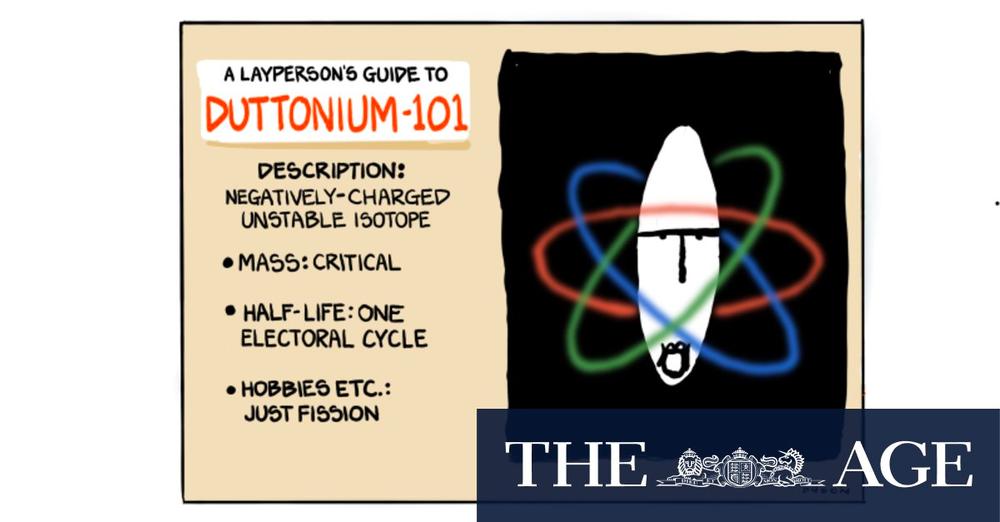
Anthony Albanese had a good week, thank you very much. His opponent, Peter Dutton, not so much. In fact, you could say the Dunkley byelection blew the opposition leader’s credibility out of the water and left him stranded for a reset.
Not that anyone who bothered to watch the byelection night on the news channels would get the impression from the Liberals they had fallen miserably short of stalling Albanese’s new year momentum. Nor did their performance demonstrate that their strategy was on target to recapture the outer suburban seats they need to offset the loss of 19 seats at the 2022 election………………………………………………………………………………………………………………………………………………………..
a lesson for Advance and Dutton is that winning an election is a very different challenge to disrupting a referendum……………………………………………………………………………………………….
We now have the framework for the Coalition’s “energy plan” – although whether this policy to build large-scale and yet to be commercially viable nuclear small modular reactors (SMRs) is a winner is questionable to say the least.
Albanese took time out from hosting the Association of Southeast Asian Nations (ASEAN) summit in Melbourne to say he looked forward to Dutton announcing the locations for nuclear reactors and where the financing would come from.
Dutton is in the same denial mode his colleagues showed in their reactions to the byelection loss. When he finally put up his head on Tuesday, the opposition leader ducked questions on who would pay for his nuclear “fantasy”, as Albanese calls it, and kept talking about a cheaper, firmer option. His spiel could only be viewed as unbelievable.
The GenCost report from the CSIRO and the Australian Energy Market Operator estimates by 2030 the cost of power from an SMR would be between $200 and $350 per megawatt hour, compared with between $60 and $100 per megawatt hour for wind and solar.
Treasurer Jim Chalmers said Dutton “is always on the hunt for cheap politics, not cheap electricity”.
It’s hard to see this as the winning reset the Liberals crave. https://www.thesaturdaypaper.com.au/comment/topic/2024/03/09/peter-duttons-nuclear-implosion#mtr
Ralph Nader: Stop the Worsening Undercount of Palestinian Casualties in Gaza

By Ralph Nader, March 5, 2024
Since the Hamas raid penetrated the multi-tiered Israeli border security on October 7, 2023 (an unexplained collapse of Israel’s defensive capabilities), 2.3 million utterly defenseless Palestinians in the tiny crowded Gaza enclave have been on the receiving end of over 65,000 bombs/missiles plus non-stop tank shelling and snipers.
The extreme right-wing Netanyahu regime has enforced its declared siege of, in its genocidal words, “no food, no water, no electricity, no fuel, no medicine.”
The relentless bombing has destroyed apartment buildings, marketplaces, refugee camps, hospitals, clinics, ambulances, bakeries, schools, mosques, churches, roads, electricity networks, critical water mains – just about everything.
The U.S.-equipped Israeli war machine has even uprooted agricultural fields, including thousands of olive trees on one farm, bulldozed many cemeteries and bombed civilians fleeing on Israeli orders, while obstructing the few trucks carrying humanitarian aid from Egypt.
With virtually no healthcare left, no medications, and infectious diseases spreading especially among infants, children, the infirm and the elderly, can anybody believe that the fatalities have just gone over 30,000? With five thousand babies born every month into the rubble, their mothers wounded and without food, healthcare, medicine and clean water for any of their children, severe skepticism about the Hamas Health Ministry’s official count is warranted.
Netanyahu and Hamas, which he helped over the years, have a common interest in lowballing the death/injury toll. But for different reasons. Hamas keeps the figures low to reduce being accused by its own people of not protecting them, and not building shelters. Hamas grossly underestimated the savage war crimes by the vengeful, occupying Israeli military superpower fully and unconditionally backed by the U.S. military superpower.
The Health Ministry is intentionally conservative, citing that its death toll came from reports only of named deceased by hospitals and morgues. But as the weeks turned into months, blasted, disabled hospitals and morgues cannot keep up with the bodies, or cannot count those slain laying on roadsides in allies and beneath building debris. Yet the Health Ministry remains conservative and the “official,” rising civilian fatality and injury count continues to be uncritically reported by both friend and foe of this devastating Israeli state terrorism.
It was especially astonishing to see the most progressive groups and writers routinely use the same Hamas Health Ministry figures as did the governments and outside groups backing the one-sided war on Gaza. All this despite predictions of a human catastrophe in the Gaza Strip almost every day since October 7, 2023, by arms of the United Nations, other besieged international relief agencies on the ground, eyewitness accounts by medical personnel, and many Israeli human rights groups and brave local journalists in that Strip, the geographic size of Philadelphia. (Unguided Western and Israeli reporters and journalists are not allowed to enter Gaza by the Israeli government.) (See the open letter titled, “Stop the Humanitarian Catastrophe” to President Biden on December 13, 2023, by 16 Israeli human rights groups that also appeared as a paid notice in the New York Times.)
Then came the December 29, 2023, opinion piece in The Guardian by the Chair of Global Public Health at the University of Edinburgh, Devi Sridhar. She predicted half a million deaths in 2024 if conditions continue unabated. (See her piece here: https://www.theguardian.com/commentisfree/2023/dec/29/health-organisations-disease-gaza-population-outbreaks-conflict).
In recent days, the situation has become more dire. In the March 2, 2024, Washington Post, reporter, Ishaan Tharoor writes: “The bulk of Gaza’s more than 2 million people face the prospect of famine — a state of affairs that constitutes the fastest decline in a population’s nutrition status ever recorded, according to aid workers. Children are starving at the fastest rate the world has ever known. Aid groups have been pointing to Israel restricting the flow of assistance into the territory as a major driver of the crisis. Some prominent Israeli officials openly champion stymying these transfers of aid.”
Tharoor quotes Jan Egeland, chief of the Norwegian Refugee Council: “We must be clear: civilians in Gaza are falling sick from hunger and thirst because of Israel’s entry restrictions.” “Life-saving supplies are being intentionally blocked, and women and children are paying the price.”
Martin Griffiths, the United Nations lead humanitarian officer, said “Life is draining out of Gaza at terrifying speed.”
U.N. Secretary-General António Guterres, according to the Post, warned of an “‘unknown number of people’ – believed to be in the tens of thousands – lying under the rubble of buildings brought down by Israeli strikes.”
Volker Turk, the U.N. high commissioner for human rights, said “All people in Gaza are at imminent risk of famine. Almost all are drinking salty and contaminated water. Health care across the territory is barely functioning.” “Just imagine what this means for the wounded, and people suffering infectious-disease outbreaks. …many are already believed to be starving.” UNICEF, the International Rescue Committee, the Palestinian Red Crescent, and Doctors Without Borders are all relating that the same catastrophic conditions are getting worse fast.
Yet, and get this, in this article, the Post still stuck with the “more than 30,000 people in Gaza have been killed since the ongoing war began.”
Just like the entire mass media, many governments, even the independent media and critics of the war would have us accept that between 98% and 99% of Gaza’s entire population has survived – albeit the sick, injured and more Palestinians about to die. This is lethally improbable!
From accounts of people on the ground, videos and photographs of deadly episode after episode, plus the resultant mortalities from blocking or smashing the crucial necessities of life, a more likely estimate, in my appraisal, is that at least 200,000 Palestinians must have perished by now and the toll is accelerating by the hour.
Imagine Americans, if this powerful U.S.-made weaponry was fired on the besieged, homeless, trapped people of Philadelphia, do you think that only 30,000 of that city’s 1.5 million people would have been killed?
Daily circumstantial evidence of the deliberate Israeli targeting of civilians and civilian infrastructures requires more reliable epidemiological estimates of casualties.
It matters greatly whether the aggregate toll so far, and counting, is three, four, five, six times more than the Health Ministry’s undercount. It matters for elevating the urgency for a permanent ceasefire, and direct and massive humanitarian aid by the U.S. and other countries, bypassing the sadistic cruelty against innocent families of the Israeli siege. It matters for the columnists and editorial writers who have been self-censoring themselves, with some, like the Post’s Charles Lane fictionally claiming that Israel’s military doesn’t “intentionally target civilians.” It matters for accountability under international law.
Above all, it lets weak Secretary of State Antony Blinken and duplicitous President Joe Biden be less servile when Netanyahu dismisses the low death toll by taunting them: what about Dresden, Hiroshima and Nagasaki?
As a percentage of the total population being killed, Gaza can expose the Israeli ruling racist extremists to a stronger rebuttal for ending U.S. co-belligerent complicity in this never-to-be-forgotten slaughter of mostly children and women. (The terrifying PTSD on civilians, especially children will continue for years.)
Respecting the more accurate casualty toll of Palestinian children, mothers and fathers presses harder for permanent ceasefires and the process of recovery and reparations for the survivors of their Holocaust.
Coalition must come clean on how its nuclear vision would work
NUCLEAR QUESTIONS
Simon Holmes a Court is right, “Australia’s climate wars will not end until the Coalition chooses engineering and economics over ideology and idiocy”, (“Nuclear option scorns our natural advantage”, 7/3).
Shadow minister for climate change and energy, Ted O’Brien has said, “The world is embracing zero-emissions nuclear energy because it solves the energy trilemma of affordability, reliability and emissions reduction”.
Does the Coalition honestly believe, in the face of successive GenCost reports and overwhelming overseas experience, that nuclear would provide Australian consumers with cheaper-than-renewables electricity? What then of the huge government subsidies propping up nuclear, for instance the $4 billion for the failed US NuScale SMR experiment?
If we, as David Littleproud suggests, allowed “the marketplace to decide”, how much would Australians subsidise such ventures? How does the Coalition propose to create reliability in our energy grid with nuclear, when it would not be available until at least around 2040?
Finally, in what year does the Coalition propose reaching net zero emissions? Some in its ranks want to renege on our 2050 international commitments, so any commitment is sounding hollow.
The Coalition needs to come clean with the electorate.
Fiona Colin, Malvern East
Nuclear numbers don’t add up
Nuclear power plants take six to eight years to construct. They have an expected working life of 20 to 40 years, but decommissioning takes 20 to 30 years. The numbers just don’t stack up. However, the building and decommissioning phases would provide substantial employment opportunities.
Louise Zattelman, Box Hill
What does Dutton know that we don’t?
Peter Dutton must believe the nuclear option for the provision of power is a vote winner at the next federal election. This seems to fly in the face of public opinion, experts who claim it is not feasible, practical, proven or economical.
So what does he know that we don’t? An election is looming. It’s time for the Coalition to think of practical policies that at least give them a chance.
Bruce MacKenzie, South Kingsville
Buried Nuclear Waste May Soon Rise From the Grave

If we don’t get a handle on climate change soon, we may have a serious radioactive issue on our hands.
BY DARREN ORF MAR 07, 2024 https://www.popularmechanics.com/science/a60067341/gao-nuclear-waste-report/
- During the Cold War, the U.S. stashed nuclear waste—or accidentally dispersed it—in several sites around the world.
- The Government Accountability Office (GAO) recently released an update on three of those sites in Spain, Greenland, and the Marshall Islands.
- Two of those sites are currently under threat from climate change in the form of either melting ice or rising sea levels, which could eventually reveal these dump sites’ deadly contents.
During the Cold War, the U.S. and Soviet Union had the bright idea to irradiate the planet with nuclear bomb testing.
Of the 67 U.S. nuclear tests during this period, Castle Bravo—conducted on the Marshall Islands on March 1, 1954—was the biggest of them all. This denotation, along with all the others, came with an ecological and human toll on the surrounding area. And now, during the era of climate change, the specter of the most dangerous era of the nuclear age is haunting the world once again.
A new report by the Government Accountability Office (GOA) re-evaluated three sites around the world contaminated by U.S nuclear waste. One of these sites included Palomares, Spain—in 1966, a U.S. B-52G bomber carrying four thermonuclear bombs collided with a KC-135 tanker in the area. The collision didn’t cause the bombs to explode (you probably would’ve heard about that one time we accidentally bombed Spain) but it did disperse a lot of radioactive material. The report finds that the U.S. and Spain continue to monitor the contamination to this day.
However, the nuclear waste sites in Greenland and the Marshall Islands are currently a more direct threat to the world due to climate change. Entombed in ice under Greenland is roughly 47,000 gallons of radioactive waste produced by the Portable Mobile-2A (PM-2A) reactor, which powered the “city under the ice” known as the U.S. Camp Century base. Although the reactor was removed, the waste was left behind. Simply put, engineers at the time never thought it’d be exposed, but climate change—a term that wasn’t even coined yet when the base was built in 1960—is slowly melting the ice cap, which could reveal the radioactive waste hiding below.
“The scientists concluded that the contaminants should remain entombed in the ice at least through 2100,” the report reads. “The radioactive isotopes will continue to decay while entombed in the ice sheet and, as a result, will be less of a threat to human health the longer they remain locked in the ice.”
However, of most pressing concern is the nuclear waste currently impacting the Republic of the Marshall Islands. Runit Island houses a “nuclear coffin” that contains 110,000 cubic yards of radioactive contaminated soil and 6,000 cubic yards of contaminated debris, and it’s already been documented that rising sea levels are impacting this coffin. Nuclear radiation can also be measured at several atolls as well, including Bikini, Enewetak, Rongelap, and Utrik Atolls.
The U.S. Department of Energy and the RMI have disagreed over the impacts of the U.S.’s past nuclear testing on the people of this island, and the GOA believes that a new communication strategy could help alleviate mistrust—which isn’t exactly what the Marshallese people want to hear.
“What we need now is action and implementation on environmental remediation,” Ariana Tibon, chair of RMI’s National Nuclear Commission told the environmental website Grist. “If they know that it’s contaminated, why wasn’t the recommendation for next steps on environmental remediation?”
In other words, it’s time for the U.S. to stare down the ghosts of its nuclear past.
Could Fukushima’s radioactive water pose lasting threat to

studies have highlighted how tritium can be absorbed into sediments and soils, raising concerns about its potential transfer to the water cycle and the food web.
research showing that fish have transported radioactive particles generated by the Fukushima incident far and wide. Like a number of other nuclear accidents before it, that makes what happened at Fukushima a global concern.”
by Alan Williams, University of Plymouth, https://phys.org/news/2024-03-fukushima-radioactive-pose-threat-humans.html
The meltdown of Japan’s Fukushima Daiichi power plant, caused by the devastating earthquake and tsunami of March 2011, represents the most severe nuclear power accident of the 21st century so far.
However, a new study highlights how the decision by the Japanese government to begin releasing the radioactive water stored within it—a decision approved by the International Atomic Energy Agency (IAEA)—has generated scientific and public debate, given its potential to cause environmental harm for decades to come.
Writing in the journal Environmental Science and Technology, researchers say the water cannot be stored indefinitely due to the ongoing risk of earthquakes and tsunamis in the region.
But they say not enough is known about the long-term impacts of tritium—the primary radionuclide present, with a half-life of 12.6 years—to ascertain if the release of more than one million tons of water can be considered safe or not.
As a result, they have called for assurances that regular monitoring will be carried out in different components of the region’s ecosystem to examine any impacts the release might be having on the environment.
They have also suggested more evidence is needed about the future effects of tritium in the presence of multiple and emerging stressors, such as hypoxia, rising ocean temperatures, and microplastics, given that environmental contamination can occur in many combinations.
The study was carried out at the University of Plymouth, where researchers have been examining the environmental impacts of radioactive material for almost three decades.
“The Japanese tsunami of 2011 was devastating for people living along this whole coastline. The presence of a nuclear power plant within the region left a lasting threat, and this study highlights some of the complex challenges that need managing and scientific questions that still need addressing.”
“Being in a region prone to earthquakes and tsunamis, there is an obvious danger in simply storing radioactive water there indefinitely. But based on our research, not enough is known about the impacts of tritium on both environmental and human health to say that releasing the water into the ocean is completely safe,” says Awadhesh Jha, professor in genetic toxicology and ecotoxicology and corresponding author on the research.
The new study includes a review of existing literature on the behavior of tritium in the environment and studies that have assessed its impact on individual species.
That includes studies that have highlighted how tritium can be absorbed into sediments and soils, raising concerns about its potential transfer to the water cycle and the food web.
There has also been research showing that tritium can cause DNA damage to certain fish species, which could impact their physical and reproductive fitness and—ultimately—the genetic diversity of a population.
However, the researchers say there is little data available on the distribution, behavior, and potential effects of tritiated water and organically-bound tritium, and therefore assessing the broad risks is almost impossible.
They also say the Fukushima situation cannot be compared with the Chornobyl accident, as some authorities have attempted to do, given the differing geographical locations of the two plants and the fact the long-term environmental impacts of Chornobyl are still being debated.
“Through our study, we have found research showing that fish have transported radioactive particles generated by the Fukushima incident far and wide. Like a number of other nuclear accidents before it, that makes what happened at Fukushima a global concern.”
“As such, we urgently need global research into the impacts of tritium—and how they might be managed—especially with the nuclear power industry set to expand significantly. If it does indeed expand, the construction of nuclear power plants, especially in coastal regions, should also take into account worst-case scenarios of flooding, earthquakes, and tsunamis as part of a fundamental goal to minimize radioactive discharges to the environment,” says Professor Jha.
The need for clear thinking on the Holocaust in Gaza

Sometimes I wonder if very high education and learning can be an impediment to clear thinking. So many highly educated, prestigious, individuals calmly accept without question the numbers published by various authorities, on the deaths in Gaza. But when you ignore all the learned and official stuff – and just stop and think about this matter – they’re counting only the deaths that have been definitely identified, not the number who lie under the rubble of the bombing.
Fortunately, not all prestigious individuals are as complacent as that. U.N. Secretary-General António Guterres, warned of an “‘unknown number of people’ – believed to be in the tens of thousands – lying under the rubble of buildings brought down by Israeli strikes.”
And what about the deaths from disease, malnutrition, starvation? Are these deaths from “natural causes” – or from the actions of the Israeli campaign against the Gazans?
Ralph Nader gives an estimate – considering all factors, of a Palestinian death toll today of 200,000 – a number “accelerating by the hour”
And here’s another matter for clear thinking. The Israeli administration and their supporters are vociferous about the evil of Hamas. And I think that they are right about this . Hamas (Harakat al-Muqawama al-Islamiya ) can purport to respect other nations, and merely seek Palestinian rights, but in fact, their beliefs are profoundly anti-Jewish, denying the Holocaust, aiming to destroy the State of Israel and kill all Jews.
But – not all Gazans believe in that extreme philosophy. Many adults there have joined Hamas simply because that is necessary to get a decent job. And are we to believe that all children there understand and support that philosophy?
So – the Hamas philosophy is evil. Does that make Jewish Zionism good?
Zionism should not be confused with Judaism. Zionism is not the Jewish religion. It is a philosophy dedicated to the continuance of “the Jewish State” run by “the chosen people” at all costs, and the eradication of those untermenschen – the Palestinians. It’s very like Nazism – it’s OK to kill children , pregnant women, anyone -in revenge for Hamas’ violent actions.
Of course, there are historic reasons for the development of Zionism, and of Hamas. But that doesn’t make either of them OK.
Clear thinking is not black and white, supporting one side because we’ve decided that the other side is evil.
Clear thinking is about what is actually happening now. 200,000 Gazans have been killed, and that number is accelerating, – as the world-leader USA feigns regret, pretends to help the Gazans, while funding Israel and providing the weapons for the killing.
Meanwhile – the USA focusses on two individuals strutting about, trying to become the next President, each boasting about himself, and how bad his opponent is – both apparently oblivious to the reality of Gazan catastrophe that America is promoting – what a pathetic sight – American politics!
‘Mr Dutton is right’: Murdoch’s News Corp papers grant nuclear power glowing coverage

News Corp has done a climate turnaround, spruiking the Coalition’s new nuclear policy at every opportunity. But how much Kool-Aid have its reporters drunk?
DAANYAL SAEED, MAR 06, 2024, https://www.crikey.com.au/2024/03/06/news-corp-peter-dutton-nuclear-policy/
The Coalition’s solution to the climate crisis is set to be unveiled, with Peter Dutton reportedly planning to announce sites for a number of nuclear power stations, which would necessarily involve lifting Australia’s long-standing ban on nuclear power.
While the Coalition’s policy has been rubbished as “misinformed bulldust” by the likes of Andrew Forrest, a “dumb idea” by experts and “hot air” by the energy minister, the News Corp papers have been at the forefront of nuclear advocacy.
In the past month, The Australian has published a number of articles on nuclear power, with only one of its many op-eds (the aforementioned “hot air” piece by Energy Minister Chris Bowen) arguing in favour of Australia’s ban on nuclear.
Conversely, the paper has run several opinion pieces in favour of nuclear power, including two editorials advocating for its use, the most recent of which was published this morning.
The paper’s editorial on March 6 said it was “time for a properly costed plan on the nuclear option”, stating “Peter Dutton’s embrace of a nuclear option for consideration is worthwhile”.
“Dutton is right to develop a net-zero plan that includes nuclear,” the piece continued. “Refusing to lift the ban or even consider the issue … makes the federal government look out of touch with what is happening in the modern energy world.”
Crikey asked The Australian’s managing editor Darren Davidson on March 5 whether the paper had an editorial view on the merits of nuclear energy, and how it balanced any view it may have with the Coalition’s policy position, as well as any ethical obligations that may arise in its reportage. He declined to comment.
This morning’s editorial comes on the heels of one published on February 17 headlined “Nuclear option made easy by the renewables miscue”. It went on to describe nuclear power as “a logical option for emissions-free power”, a “sensible option”, but admitted it was “incendiary politics”
It rekindles the climate wars and undermines the certainty that is craved by business.”
Political editor Simon Benson has been responsible for much of this nuclear coverage, penning an op-ed on February 25 that argued the Labor government was “at risk of ending up on the wrong side of history in its fanatical opposition to nuclear power”.
Benson was also responsible for an exclusive, also published on February 25, that showed Newspoll data conducted for The Australian that showed 55% of Australian voters “supported the idea of small modular nuclear reactors as a replacement technology for coal-fired power”.
As early as February 15 Benson had insights into the Coalition’s policy, penning a piece titled “Liberals’ nuclear policy has potential to electrify”.
The Australian has also ran a number of opinion pieces over the past month in favour of the Coalition’s policy, including one by Peta Credlin headlined: “Liberal true believers stand firm against false net-zero gospel”.
However the paper also ran a piece by Sarah Ison on February 16 that highlighted one of the limits of the introduction of nuclear power in Australia. Ison interviewed Australian Industry Group climate change director Tennant Reed, who said that Australia may be waiting for more than 20 years for economically viable nuclear power.
The Coalition wants nuclear power. Could it work – or would it be an economic and logistical disaster?

Guardian, Graham Readfearn, 8 Mar 24
The prospect of Australia trying to build nuclear reactors at soon-to-be-closed coal plants raises many questions. Here’s what we know.
The prospect of Australia turning to nuclear power has been little more than a politically radioactive thought bubble – until the Coalition this week confirmed it wants to put reactors at the sites of soon-to-be-closed coal plants.
Energy experts have previously derided the idea, saying some of the technologies being touted did not exist, and that nuclear would be too slow, too expensive and unnecessary in a country with so much free solar and wind available to harness.
But as the Coalition promises to take a pro-nuclear policy to the next election, the prospect of Australia trying to build nuclear reactors raises many questions.
Could it even work, or would it be an economic and logistical disaster?
What’s being proposed?
The Coalition is understood to be looking at both conventional large-scale nuclear reactors and small modular reactors (SMR) which are not expected to be available commercially until the early 2030s, or potentially later.
The Coalition has said more details will come before its reply to the federal budget, expected in May.
What about timing?
The Australian Energy Market Operator’s latest draft plan to develop the national electricity market (that’s everywhere except Western Australia and the Northern Territory) says under the most likely future scenario, 90% of coal plants will have retired by 2035, with the rest gone by 2038.
That means governments and electricity generators are already having to work at breakneck speed to add enough renewable energy and storage, such as batteries and pumped hydro, to make sure Australia can meet its obligations to bring down greenhouse gas emissions while delivering the cheapest and most reliable electricity system possible.
Those decisions are being made based on the technology that is available now, and based on economics. Renewables backed up by storage are the cheapest option, according to the vast majority of experts.
The Coalition argues building reactors on the sites of old coal plants would avoid some of the costs of building new transmission lines and the storage needed to allow for the times when wind and solar production is low.
Tony Wood, the director of the Grattan Institute’s energy program, says by the time a hypothetical nuclear plant could be built and operating – which he says could be 20 years away – “the coal-fired power has been closed down and you’re in deep trouble”.
“I just think the economics and the timescales don’t fit.”……………………………………….
When could reactors be built in Australia?
A Coalition government, if elected, would have to agree regulations to govern a brand new industry and create new government institutions such as the US Nuclear Regulatory Commission to run the industry.
Dr Dylan McConnell, an energy systems analyst at the University of New South Wales, says: “Recent nuclear power projects in comparable countries have experienced considerable delays and cost overruns. There is little prospect of a conventional nuclear power plant delivering electricity before the 2040s.”
Construction on two nuclear units in the US started in 2009 and were seven years late and reportedly US$17bn (A$25bn) over budget when they started generating power last year.
In the UK, French company EDF’s 3,200MW Hinkley Point C plant began construction in 2017 and, after several revisions, the company says it may not be delivering electricity until 2031. Initial cost estimates of £18bn (A$34bn) have been revised as high as £46bn (A$89bn).
A deal to buy the electricity using a surcharge on UK customer bills has put “an albatross around the neck of UK consumers for a very long time”, says Woods.
And who would build them?
Glenne Drover, the secretary of the Victorian branch of the Australian Institute of Energy and a broad supporter of nuclear power, thinks the biggest potential block for nuclear in Australia would be finding overseas companies to actually build reactors.
At last year’s Cop28 climate talks, more than 20 countries pledged to triple nuclear power capacity by 2050. The books of many nuclear builders are filling up.
“Australia could do what the United Arab Emirates did and go out with a tender process, but who would take that up?” he asks.
“Would we be happy if one of those companies was Chinese or Russian? Kepco [a South Korean company] maybe, but could you get them?”………………………………….
Could nuclear work in Australia’s grid?
McConnell says conventional nuclear plants need to be almost constantly running to be economically viable. But as we head towards 2040, Australia’s energy system will be dominated by renewable energy and storage, such as batteries and pumped hydro.
This would be a “very challenging power system for nuclear power to economically operate in”, says McConnell.
“Some of the challenges facing the economic viability of coal generation are directly transferable to nuclear power generation.
“Low-cost renewable generation is eroding both the utilisation and market value of coal generation and would have similar effects on a nuclear generator.”
But large nuclear reactor units could also create a headache for the electricity grid. The biggest single generating source on Australia’s grid is a 750MW coal unit in Queensland.
“The typical size of conventional nuclear units today is larger than any existing coal units in the national Eeectricity market,” says McConnell. “The loss of such a single large unit represents a risk to the operation of the electricity system. This risk would need to be managed and would come at some additional cost.”
McConnell questions if the sites of old coal plants would be available to buy. “The grid connection points are valuable assets,” he says. “Old power station sites are already being developed to make use of these valuable connection points.”

What about costs?
Without knowing what kind of reactors might be built, and how they would be paid for, and the price of establishing an industry, it’s difficult to know the future costs of nuclear. But it’s unlikely to be cheap.
For SMRs, the CSIRO gives a theoretical range of $382 to $636 per MWh in the year 2030, compared with $91 to $130 for wind and solar. CSIRO has so far not provided estimates for conventional nuclear but, using US data, nuclear is among the more expensive power options.
John Quiggin, a professor of economics at the University of Queensland, says without a carbon price, nuclear plants would need very large taxpayer subsidies in Australia.
He says one of the only countries to have recently started a nuclear industry is the United Arab Emirates that drew up its first nuclear policy in 2008, commissioning South Korean company Kepco to build four 1,400MW units.
Quiggin says these four reactors will likely have cost the UAE as much as $100bn – enough money to put a large solar system on the roof of every Australian house, he says.
The first of the country’s four nuclear power units came online in 2020 and a fourth is expected to start producing electricity in the coming months – all between three and four years later than expected.
That’s a 16-year process in a country that, without a democratic system, can make arbitrary decisions to get plants built. It is not a good comparison for what might happen in Australia.
“When the economics of this comes up in Australia, it will look very bad,” he says. https://www.theguardian.com/australia-news/2024/mar/07/the-coalition-wants-nuclear-power-could-it-work-or-would-it-be-an-economic-and-logistical-disaster
Australia nuclear facility installs massive rooftop solar system to save $2 million
Jacinta Bowler, Mar 8, 2024, https://reneweconomy.com.au/australia-nuclear-facility-installs-massive-rooftop-solar-system-to-save-2-million/
One of the major nuclear research facilities belonging to the Australian Nuclear Science and Technology Organisation (ANSTO)’s is installing a major rooftop solar system that will save $2 million.
The ANSTO campus in Clayton hosts the Synchrotron, where electrons are accelerated to almost the speed of light to allow researchers to investigate materials down to the atoms. An electron beam travelling at about 299,792 kilometres a second requires plenty of energy.
The facility is now host to a 1.59 MW rooftop solar system, one of the largest in the state, with 3,000 panels installed by RACV Solar. It is expected to save two million kilowatt hours a year, and $2 million over the first five years of operation.
“The engineering and technical expertise required to deliver this type of project is complex,” said RACV’s head of energy Greg Edye.
“The solar panel installation was completed over five months, and it covers the rooftops of the main Australian Synchrotron building, the Australian Synchrotron guesthouse, and the environmentally controlled storage facility.
“There will be a significant reduction in energy costs for ANSTO, with these savings used to support operations and important research. Not only are they reducing their carbon footprint, but they are also investing in a cleaner energy future.”
Synchotron director Professor Michael James says Going solar was a “no-brainer” because of the size of the facility’s rooftops and the “ample, uninterrupted exposure to sunlight” at the location within the Monash University precinct.
“While our science facility operates 24 hours per day, during daylight hours, the new solar plant provides a cyclical way to harness the power of light – from the Sun to help power our facilities,” he said.
“That in turn, allows us to generate brilliant beams of synchrotron light that are more than a million times brighter than the light from the Sun.
“Some of those brilliant beams of synchrotron light are even used to undertake research into the next generation of solar cell technology.”
The ANSTO team are hoping that the investment will save them $2 million over a 5 year period, as well as stop 1,680 tonnes of carbon equivalent entering the atmosphere every year.
“The reduction in our carbon footprint is enough to offset 367 family-sized cars each year,” James added.
“This investment in renewable technology is just one way ANSTO can meet its own sustainability goals, while also acting as a buffer against increasing energy overheads in the future.”
Israel Didn’t Even Try to Defend the Legality of Its Occupation to World Court

Israel’s system is “an even more extreme form of the apartheid” than South Africa’s was, South African ambassador said.
By Marjorie Cohn , TRUTHOUT, March 6, 2024
or six days, more than 50 countries, the League of Arab States, the African Union and the Organisation of Islamic Cooperation presented testimony to the International Court of Justice (ICJ, or World Court) about the legality of Israel’s occupation of Palestinian territory. The overwhelming majority of them, largely from the Global South, told the court that the occupation was illegal.
The historic hearing, which took place February 19-26, was held in response to the United Nations General Assembly’s December 30, 2022, request for an advisory opinion on the following questions:
(a) What are the legal consequences arising from the ongoing violation by Israel of the right of the Palestinian people to self-determination, from its prolonged occupation, settlement and annexation of the Palestinian territory occupied since 1967, including measures aimed at altering the demographic composition, character and status of the Holy City of Jerusalem, and from its adoption of related discriminatory legislation and measures?
(b) How do the policies and practices of Israel … affect the legal status of the occupation, and what are the legal consequences that arise for all States and the United Nations from this status?
The General Assembly asked the ICJ to discuss these issues with reference to international law, including the UN Charter; international humanitarian law; international human rights law; resolutions of the Security Council, General Assembly and Human Rights Council; and the 2004 advisory opinion of the ICJ finding that Israel’s wall on Palestinian land violated international law.
Israel regularly thumbs its nose at the World Court. It ignored the court’s ruling that the wall was illegal and refuses to implement the ICJ’s provisional order to refrain from committing genocidal acts and ensure humanitarian aid to Gaza.
Before the hearing, Israeli Prime Minister Benjamin Netanyahu blasted the court: “Israel does not recognize the legitimacy of the proceedings of the international court in The Hague regarding ‘the legality of the occupation’ — which are an effort designed to infringe on Israel’s right to defend itself against existential threats,” he said. “The proceedings in The Hague are part of the Palestinian attempt to dictate the results of the diplomatic settlement without negotiations.”
Although Israel didn’t appear at the hearing, it submitted a five-page statement which called the General Assembly’s questions “a clear distortion of the history and present reality of the Israeli-Palestinian conflict.” Israel didn’t even attempt to defend the legality of the occupation, focusing instead on why the ICJ should not issue an advisory opinion.
Israel complained that the ICJ “is asked simply to presume Israeli violations of international law — to accept, as given, plainly biased and flawed assertions directed against Israel alone.” Although consent of the parties is not required for the ICJ to render advisory opinions, Israel protested that it had “not given its consent to judicial settlement of its dispute with the Palestinian side.”
A handful of countries — including the U.S., Canada, U.K., Fiji, Hungary, Italy and Zambia — sided with Israel. Only Fiji argued that the occupation was lawful. The U.S. contended that an occupation can be neither lawful nor unlawful; it is rather governed exclusively by international humanitarian law, which only deals with acts by the occupying power, and doesn’t examine the legality of the occupation itself.
“The court should not find that Israel is legally obligated to immediately and unconditionally withdraw from occupied territory,” said Richard Visek from the U.S. State Department, urging the court to consider Israel’s “legitimate security needs.” Visek defended Israel in the ICJ the day after the U.S. vetoed a Security Council resolution demanding an immediate ceasefire in Gaza for the fourth time.
Israeli Genocide Is “Result of Decades of Impunity”
“The genocide underway in Gaza is the result of decades of impunity and inaction. Ending Israel’s impunity is a moral, political and legal imperative,” Palestine’s Foreign Minister Riyad al-Maliki told the court……………………………………………………………………………………………
Israel’s Occupation of Palestinian Territory Is Illegal
It is a peremptory norm of international law that territory cannot be acquired by force. In 1967, Israel launched a “preemptive” war against Egypt, Jordan and Syria, and seized the West Bank, Gaza, Jerusalem, the Golan Heights and the Sinai Peninsula. Israel has occupied those Palestinian territories ever since.
Visek from the U.S. State Department told the ICJ that Israel was defending itself in the 1967 war. But it was Israel that initiated the war. Rossa Fanning, Ireland’s attorney general, called it “the war [Israel] launched,” thus, an act of aggression. Wilde noted that Israel “claimed to be acting in self-defence, anticipating a non-immediately imminent attack,” but “even assuming, arguendo, its claim of a feared attack, States cannot lawfully use force in non-immediately imminent anticipatory self-defence.” Article 51 of the UN Charter forbids a state from using military force except in self-defense after an armed attack by another state.
…………………………………………………………….Israel asserts that it has not occupied the Gaza Strip since 2005, when it withdrew its military forces and settlements. But it continues to exercise military control over Gaza by continuous military operations in and against Gaza.
……………………….Gaza and its population remain under effective Israeli control and are, therefore, occupied. ………………………………………………………………………………………………………………………………
Apartheid “Goes Hand-in-Hand” With Violation of Right to Self-Determination
Israel maintains a system of apartheid in the occupied Palestinian territory, as confirmed by Amnesty International, Human Rights Watch and Israeli human rights group B’Tselem. Vusimuzi Madonsela, South Africa’s ambassador to the Netherlands, called Israel’s apartheid system “an even more extreme form of the apartheid that was institutionalized against Black people in my country.”
In the West Bank, Israel preserves its separation wall, segregated roads, checkpoints and restrictive permit requirements. While Israelis are subject to a civil legal system, Palestinians are controlled by a military system. They can be held indefinitely with no charges or due process in administrative detention and can be convicted based on secret evidence………………………………………………….
Israeli Settlements Constitute Illegal Annexation
More than 700,000 Israeli settlers — 10 percent of the nearly 7 million people in Israel — have been transferred into the occupied Palestinian territories, “continuously terrorizing and forcibly displacing Palestinians from even more of their territory and engaging in pogroms against them,” Shoman from Belize stated.
This constitutes a “disguised form of annexation,” Ireland’s Fanning said. “The prohibition on the acquisition of territory by force is firmly established in customary international law. Using force to occupy and maintain such occupation for the purposes of territorial acquisition or annexing an occupied territory by force in whole or in part, is each illegal.”
Israel’s policy of settling its civilians in occupied Palestinian territory and displacing the local population violates international humanitarian law, as the ICJ has ruled. Article 49 of the Fourth Geneva Convention says: “The Occupying Power shall not deport or transfer parts of its own civilian population into the territory it occupies.”
Legal Consequences for All States and the UN
“Israel must dismantle the physical, legal and policy regime of discrimination and oppression … evacuate Israeli settlers from Palestinian territories, permit Palestinians to return to their country and property, and lift the siege and blockade of Gaza,” Webb from Belize told the ICJ. “These consequences, taken collectively, mean that Israel must immediately, unconditionally, and totally withdraw from the entire Palestinian territory.”
…………………………………………………………………………………… The ICJ will likely issue its advisory opinion in about six months. https://truthout.org/articles/israel-didnt-even-try-to-defend-the-legality-of-its-occupation-to-world-court/
F-35A aeroplanes officially certified to carry thermonuclear bomb

The designation marks the first time that a stealth fighter can carry a nuclear weapon, in this case the B61-12 thermonuclear gravity bomb.
Breaking DEFENSE, By MICHAEL MARROW, March 08, 2024
WASHINGTON — The F-35A Joint Strike Fighter has been operationally certified to carry the B61-12 thermonuclear gravity bomb, a spokesman for the F-35 Joint Program Office (JPO) tells Breaking Defense.
In a statement, JPO spokesman Russ Goemaere said the certification was achieved Oct. 12, months ahead of a pledge to NATO allies that the process would wrap by January 2024. Certain F-35As will now be capable of carrying the B61-12, officially making the stealth fighter a “dual-capable” aircraft that can carry both conventional and nuclear weapons.
“The F-35A is the first 5th generation nuclear capable aircraft ever, and the first new platform (fighter or bomber) to achieve this status since the early 1990s. This F-35 Nuclear Certification effort culminates 10+ years of intense effort across the nuclear enterprise, which consists of 16 different government and industry stakeholders,” Goemaere said. “The F-35A achieved Nuclear Certification ahead of schedule, providing US and NATO with a critical capability that supports US extended deterrence commitments earlier than anticipated.”
Responding to follow-up questions from Breaking Defense, Goemaere said US disclosure policy prohibits the release of information on dual-capable aircraft among NATO partners. According to analysis by the Federation of American Scientists, as of 2023 approximately 100 older variants of B61 bombs are housed by NATO allies Belgium, Germany, Italy, the Netherlands and Turkey, who share the alliance’s nuclear strike mission. The first four nations are all planned F-35 operators, with the need to have a nuclear-capable aircraft a key reason for Germany signing onto the program.
The F-35A is certified to only carry the newer B61-12 variant, which will replace the older models………………………………………………………………………………………………………………………………
Hans Kristensen, director of the Nuclear Information Project with the Federation of American Scientists, noted the announcement is another milestone in America’s ongoing nuclear modernization effort.
“The stage is set for the tactical nuclear weapons upgrade in Europe with full-scale production of the B61-12 and four NATO allies and the US fighter wing at Lakenheath upgrading to operate the bomb on the F-35A,” he said……………….. more https://breakingdefense.com/2024/03/exclusive-f-35a-officially-certified-to-carry-nuclear-bomb/—
The horrors of nuclear weapons testing

I think that enough time has gone by that the longer-term dangers of nuclear weapons, such as radioactive fallout, have largely disappeared from the public consciousness—much to the agony and despair of those afflicted to this day.
Radioactive fallout and its long-term effects—things that the average person today does not really appreciate—would be the result from any future nuclear weapons explosion that touched the Earth’s surface. Fallout does not just affect the target, but also the surrounding areas—which could be as far as hundreds of miles away. And the effects could last for years, if not decades thereafter.
Bulletin By Walter Pincus, March 7, 2024
There has been talk in the national security community lately about the so-called “merits” of resuming underground or even atmospheric nuclear weapons tests. I think this would be a grave mistake for many reasons—chief among them is that it forgets the horrific health effects that resulted from some previous nuclear tests.
To be clear, since 1963, atmospheric tests of nuclear weapons have been banned, as have tests in outer space and under water. And underground explosive tests have been banned ever since the 1996 Comprehensive Nuclear Test Ban Treaty, or CTBT. (Technically speaking, while the United States and China have signed the CTBT, neither has ratified it. Russia did both sign and ratify the treaty but on November 2, 2023 Russia announced it had rescinded its ratification. All three countries, however, have so far abided by the CTBT treaty.)
Meanwhile, sub-critical nuclear tests—which use tiny amounts of plutonium but do not create self-sustaining, exponentially-growing, nuclear chain reactions—have continued to this day, in laboratories or in specially constructed underground tunnels. The US is building new tunnels for sub-critical tests at the Nevada Nuclear Test Site where they are expected to help in designing the new, US W93 nuclear warhead now under development.
Presumably, then, what we are referring to when we talk about the possible resumption of nuclear testing is not the latter sub-critical testing, but some version of atmospheric, outer space, underwater, or underground explosives testing.
And here things get tricky.
Because I think that enough time has gone by that the longer-term dangers of nuclear weapons, such as radioactive fallout, have largely disappeared from the public consciousness—much to the agony and despair of those afflicted to this day.
I believe that the more people understand and even can visualize the immediate and long-term dangers of nuclear weapons use, the less likely it is that they may be used. Several nuclear scientists have told me they have memories of specific past nuclear atmospheric tests, most memorably two who were involved in the Manhattan Project—Harold Agnew and Hans Bethe.
Agnew photographed the Hiroshima mushroom cloud from the US aircraft that followed the Enola Gay that dropped the atomic bomb. Agnew almost always brought up the effect that had on him when we met.
For his part, Bethe, at 88—on the 50th anniversary of the birth of the atomic bomb—wrote: “I feel the most intense relief that these weapons have not been used since World War II, mixed with horror that tens of thousands of such weapons have been built since that time—one hundred times more than any of us at Los Alamos could ever imagine.”
In an interview years earlier at Cornell University where he was teaching, Bethe had told me something similar—and at 91, I have never forgotten those words.
The closer you are to nuclear weapons, the more you are aware of the dangers if they were to be used again. However, I believe, most people today have forgotten, if they ever knew, what a single nuclear weapon could do.
Seeing is believing. But believing in this case should make you work to oppose their use, as can be seen in a very rough sort of timeline of my own life…………………………………………………………………………………………………………………
It was in February 1966, well after the 1963 atmospheric test ban treaty, that I first wrote about the impact of nuclear weapons. It was a rather flip, three-paragraph note in The Reporter Magazine, which no longer exists. The story concerned a law that had passed Congress the previous month, a measure which required the US Government to pay $11,000 to each of the 82 men, women and children—or their survivors—who had been on Rongelap Atoll in the Marshall Islands in the central Pacific on March 1, 1954 when the United States detonated Test Bravo from a tower on an artificial island built within Bikini Atoll, more than 120 miles west of Rongelap.
Bravo was the first US test of a deliverable thermonuclear bomb and was expected to have a six-megaton yield, the equivalent of six million tons of TNT. In fact, the explosion was more than double that—15 megatons—and one thousand times more powerful than the atomic bomb that destroyed Hiroshima.
Thanks in good part to thousands of documents on nuclear weapons declassified and released during the Clinton Administration, I was able to describe details about the Bravo explosion two years ago in my book, Blown To Hell: America’s Deadly Betrayal of the Marshall Islanders, as follows:
In a few seconds the fireball, recorded at one hundred million degrees, had spread nearly three miles in diameter, then quickly spread to ten miles. The sandspit and nearby reef where Bravo had stood, along with coral island areas, were vaporized down almost two hundred feet into the sea, creating a crater about one mile in diameter.
It was estimated that three hundred million tons of vaporized sand, coral and water shot up into the air as the fireball rose, and one-hundred-mile-an-hour winds created by the blast pulled additional debris up into the fireball. Within one minute, the fireball had gone up forty-five thousand feet with a stem four miles wide filled with radioactive debris. It continued to zoom upward, shooting through the troposphere and into the stratosphere within five minutes.
Later data showed the cloud bottom was at fifty-five thousand feet, the secondary mushroom cloud bottom was at one-hundred-fourteen thousand feet, and the upper cloud hit one-hundred-thirty thousand feet.
Ten minutes after detonation the mushroom cloud had widened and measured seventy-five miles across just below the stratosphere.
Original projections had predicted Bravo radioactive fallout would emanate from a fifteen-mile-wide cylinder that could stretch into the stratosphere. Instead, it turned out to be a one-hundred-mile-wide cloud where “debris was carried up and dispersed over a much larger area than was thought possible,” wrote Dr. William Ogle, the test’s task force commander of the scientific group that dealt with radioactivity.
Radioactive fallout and its long-term effects—things that the average person today does not really appreciate—would be the result from any future nuclear weapons explosion that touched the Earth’s surface. Fallout does not just affect the target, but also the surrounding areas—which could be as far as hundreds of miles away. And the effects could last for years, if not decades thereafter. These effects are worth spelling out in detail, using what happened downwind of the test as an example.
That March 1, 1954 morning, the Japanese fishing boat Lucky Dragon, with a crew of 23 aboard, was trawling its nets 90 miles east-northeast of Bikini. A crewman at the stern rail saw a whitish flare in the west that briefly lit up the clouds and the water. It grew in size, turned to yellow-red, then orange. After a few minutes, the colors faded and shortly thereafter the ship was rocked by the blast of an explosion.
The Lucky Dragon’s captain and the fishing master, who had read ship warnings before they left port, realized they might have strayed into a nuclear test area. They quickly decided to haul in their fishing nets and head back to Japan, almost 2,500 miles away.
It was another two or three hours before a fine white dust began to come down on the boat. With a light rain, the radioactive dust continued to settle on crewmen and the fish on the deck as they worked for another two hours to bring in their lines.
On Rongelap about 30 miles further east, at about 11:30 a.m., a similar powdery, radioactive ash began falling in the area. It stuck to the Marshallese people’s skin, hair, and eyes; many walked barefoot and the powder stuck to their toes; it fell on fish drying on wooden racks that would be eaten that night. Rain briefly fell as the fallout continued into afternoon, dissolving the powdery ash on roofs and carrying it down drains into water barrels that provided drinking water to each household.
On parts of Rongelap Island, where most people lived, the almost five hours of fallout led to drifts of up to one-inch or more high on the ground, on roofs, and along the beach. People recalled that when the moon broke through the clouds that night, it looked like patches of snow on the ground.
It would be two days before the Marshallese were evacuated from Rongelap and taken to the Kwajalein Navy Base by a US Navy destroyer. By then, most of the Rongelapese people had suffered from acute radiation exposure and nausea; some had experienced skin lesions as well.
Since the Bravo test was highly classified, a decision was made in Washington to keep the fallout incident secret, although the Atomic Agency Commission (AEC) had released a statement on March 1, 1954 that a nuclear test had taken place in the Marshall Islands Pacific Proving Ground. That had generated a small front page story in the March 2, 1954, edition of The New York Times. It was not until March 11, 1954, that the AEC admitted people “unexpectedly exposed to some radioactivity” had been moved to Kwajalein “according to a plan as a precautionary measure.”
Two weeks passed before the Lucky Dragon returned to its home port in Japan. It was only then that on March 16, 1954, the first story appeared in the Japanese Yomiuri Shimbun newspaper of what had happened to the boat’s crew and their fish—not what happened to the Marshallese. That story immediately triggered initial worldwide attention to the dangers of fallout from nuclear weapons.
However, it was not until President Eisenhower’s March 31, 1954 press conference that AEC Chairman Lewis Strauss, who had just returned from observing post-Bravo nuclear tests, admitted publicly that the Bravo test was “in the megaton range” and “the yield was about double that of the calculated estimate.” ……………………………………………………………………………………………………….
The early part of the 1955 report described the blast and heat effects of early atomic bombs detonated in the air, before discussing fallout from Bravo and other detonations. “In the air explosion, where the fireball does not touch the earth’s surface, the radioactivity produced in the bomb condenses only on solid particles from the bomb casing itself and the dust which happens to be in the air. In the absence of materials drawn up from the surface, these substances will condense with the vapors from the bomb and air dust to form only the smallest particles. These minute substances may settle to the surface over a very wide area—probably spreading around the world—over a period of days or even months. By the time they have reached the earth’s surface, the major part of their radioactivity has dissipated harmlessly in the atmosphere and the residual contamination is widely dispersed.”
The report then turned to what fallout would occur if the fireball hit the ground. “If however the weapon is detonated on the surface or close enough so that the fireball touches the surface, then large amounts of material will be drawn up into the bomb cloud. Many of the particles thus formed are heavy enough to descend rapidly while still intensely radioactive. The result is a comparatively localized area of extreme radioactive contamination, and a much larger area of some hazard. Instead of wafting down slowly over a vast area, the larger and heavier particles fall rapidly before there has been an opportunity for them to decay harmlessly in the atmosphere and before the winds have had an opportunity to scatter them.”
It described the Bravo fallout as looking like snow “because of calcium carbonate from coral,” and then noted its “adhesive” quality thanks to moisture picked up in the atmosphere as it descended. In the end it contaminated “a cigar-shaped area extending approximately 220 statute miles downwind, up to 40 miles wide,” from Bikini. It “seriously threatened the lives of nearly all persons in the area who did not take protective measures,” the report said.
The report then talked about radioactive strontium in fallout as having a long, average lifetime of nearly 30 years, noting it could enter the human body either by inhaling or swallowing. Deposited directly on edible plants, the strontium could be eaten by a human or animal. While rainfall or human washing of the plants would remove most of the radioactive material, radioactive strontium deposited directly on the soil or in the ocean, lakes, or rivers could be taken up by plants, animals, or fish. There it would lodge in their tissue where it could later be eaten by humans…………….
The other radioactive element in fallout described specifically as a threat in the report was radioactive iodine. Even though the average life of radioactive iodine was only 11.5 days, it was described as a serious hazard because, if inhaled, it concentrated in the thyroid gland where it could damage cells, depending on dosage………………………………………………………………………………………………………………………………………………………………..
Back on Rongelap, despite some cleanup, there are few in residence. A study published in the Proceedings of the National Academy of Sciences in July 2019, done by researchers from Columbia University, found that levels of plutonium and cesium in the soil on Rongelap and other Marshall Island atolls were “significantly higher” than levels that resulted from fallout existing from the July 1986 Chernobyl nuclear power accident—which occurred 28 years after US nuclear tests had ended in the Marshalls.
The Rongelap Marshallese as well as the Japanese seamen who were exposed to fallout on March 1, 1954, can be seen as surrogates for anyone caught in a future nuclear war. Rongelap Atoll, as well as Bikini Atoll, for the most part still cannot be inhabited despite attempts to decontaminate them. Think of what today’s cities would be like if hit by a thermonuclear weapon whose fireball struck the ground and created radioactive fallout.
Within weeks it will be 70 years since the Bravo test. The more the US public and the world are reminded of that test and the resulting Rongelap story, the more they should work to deter any potential use of nuclear weapons. https://thebulletin.org/premium/2024-03/the-horrors-of-nuclear-weapons-testing/?utm_source=Newsletter&utm_medium=Email&utm_campaign=ThursdayNewsletter03072024&utm_content=NuclearRisk_NuclearTestingHorrors_03072024
[Episode #219] – Nuclear Illusions
Energy Transition Show 6th March 2024 https://xenetwork.org/ets/episodes/episode-219-nuclear-illusions/—
In Episode #209, we peeled back the layers on civilian nuclear power, revealing its history as a facade for the nuclear weapons industry with a corresponding legacy of deception.
Yet, the allure of small modular reactors (SMRs) has recently been touted as the nuclear industry’s saving grace and a beacon of hope with the potential to sidestep a muddled past. Despite all the fanfare and substantial investments, the crumbling of prominent SMR initiatives exposes the continuation of the industry’s tradition of overpromising and underdelivering, a pattern all too familiar to those who’ve been watching closely.
Joining us in this episode is Jim Green from Friends of the Earth Australia, a seasoned nuclear journalist with three decades of experience in critiquing nuclear energy. Jim offers an unparalleled depth of insight into the industry’s persistent shortcomings and the realities behind the SMR hype. Together, we delve into the track record of conventional nuclear power, the latest trends in nuclear plant construction and retirements worldwide, and examine the companies at the forefront of the SMR push, offering a candid exploration of the nuclear power industry’s claims versus its actual performance.
Guest:
Jim Green is the National Nuclear-Free Campaigner with Friends of the Earth Australia, a member of the Nuclear Consulting Group (nuclearconsult.com), and former editor of the World Information Service on Energy’s ‘Nuclear Monitor’ newsletter. He has a First Class Honours degree in Public Health and a Doctorate in Science and Technology Studies for his thesis on the debates over the replacement of Australia’s nuclear research reactor.
1 This month
25 October – Film –Britain’s Nuclear Bomb Scandal: Our Story – part of the Adelaide Film Festival,
Screening and Conversation
A screening of Britain’s Nuclear Bomb Scandal: Our Story (2024) followed by a talk with 2026 Bettison and James Awardee and Tradtional Owner Karina Lester in conversation with Simone Tur.
When: Sun 25 Oct, 12:00pm-Screening, 1:15pm-Talk
Where: The Mercury
Free admission, register below by clicking on BUY TICKETS and select free event tickets, at end of web page:
https://www.adelaidefilmfestival.org/program/2026/britains-nuclear-bomb-scandal-our-story
.

Australians deserve the truth
about
AUKUS – https://aukuspublicinquiry.com/

PETITION – To: Prime Minister Anthony Albanese and the Australian Labor Government

of the week – Australians for War Powers Reform (AWPR)
To see nuclear-related stories in greater depth and intensity

