Former CIA intelligence officer Larry Johnson says the decision to launch a drone attack on the Kremlin was made by the United States.
The Wednesday attack, which was likely to have been targeting Russian President Vladimir Putin, was stopped by electronic warfare systems which disabled the drones before they could reach their target.
According to Johnson, the attack must have been spearheaded by the Biden administration and the US military-industrial complex because “decisions on such attacks are made not in Kiev, but in Washington.”
“Washington should understand clearly that we know this,” Johnson told reporters.
Although the attack, which Ukraine denied it was involved in, failed to accomplish its tactical goal, it was still highly “symbolic,” according to Johnson……………………………………….
What would it look like to build international solidarity against imperial rivalry from below?By Ashley Smith , TRUTHOUT, May 4, 2023
The daily news is filled with stories about the spiraling conflict between the U.S. and China over everything from trade to geopolitical squabbles and dueling military exercises. All of these converge over Taiwan — a small nation claimed by China as a renegade province, backed by the U.S., and home to the most advanced microchip manufacturing plants in the world.
These plants produce chips that power everything from iPhones to Washington’s F-35 fighter bomber, and other high-tech weaponry. That fact raises the stakes of a long-simmering dispute punctuated with periodic “Taiwan Strait Crises,” turning it into a volatile diplomatic, economic and military confrontation.
On Capitol Hill and in boardrooms, as Edward Luce notes, “the old Washington Consensus” of integrating of China has been replaced with a new one of “dis-integrating China.” Joe Biden has continued Donald Trump’s grand strategy of great power rivalry with Beijing………………………………………………………………………………………………………..
the relative decline of U.S. imperialism and the rise of today’s asymmetric multipolar world order. The U.S. remains, of course, the most dominant imperialist state, but it now faces China as a rising rival, a revitalized Russia as an outsize regional power and a host of sub-imperialist states from Saudi Arabia to Israel and Brazil, which variously challenge and cooperate with the U.S.
The Rise of Chinese Imperialism
Washington views China as its biggest rival. Beijing has transformed itself from an autarchic, underdeveloped economy into a capitalist superpower. It is now the world’s second-largest economy, the number one manufacturer, the largest exporter, main trade partner with most of the world’s major economies, a leading exporter of capital, largest creditor and a top recipient of foreign direct investment……………………………………………………
Biden’s Imperialist Keynesianism
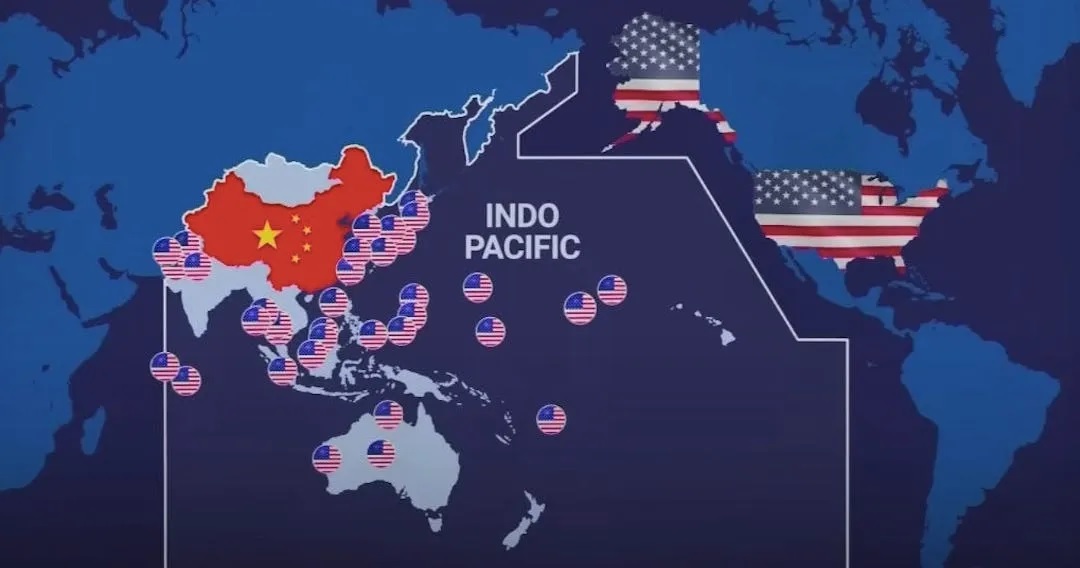
Of course, the U.S. remains the world’s largest economy, controls the dollar as the international reserve currency, boasts the largest network of military allies, spends nearly three times as much as China on defense and possesses over 750 bases around the world. To enforce its supremacy, it has taken an increasingly aggressive turn to contain Beijing……………………………………………………………………………….
“Democracies” Versus Autocracies
To complement this imperialist industrial policy, Biden has launched a geopolitical campaign to forge a front of democracies against autocracies. A lot of this is ideological posturing, as U.S. democracy is, to say the least, ridden with crisis (remember January 6?) and the allies it invited to its two “Democracy Summits” included states that Freedom House categorized as “partly free,” “not free at all” and “electoral autocracies.”……………………………………………………………………………………………….
Taiwan: Strategic Flashpoint of Imperial Rivalry
The conflict between the U.S. and China is coming to a head over Taiwan, with American Gen. Mike Minihan going so far as to predict war in 2025. Beijing claims the island as a renegade province it aims to reintegrate, while the U.S. holds a position of “strategic ambiguity,” upholding a One China policy that only officially recognizes Beijing, while remaining unclear whether it would militarily defend Taiwan in order to deter China from invading and Taiwan from declaring independence.
………………………………………………………………………….. The Taiwanese people are caught between China and the U.S., their right to self-determination threatened by Beijing and cynically supported by the U.S. for imperial motives.
Neither Washington, Nor Beijing
War between the U.S. and China is, however, unlikely at this point. Their economies remain deeply integrated, both possess enormous stockpiles of nuclear weapons, and they are embedded in elaborate international geopolitical and economic institutions, all factors that mitigate the chances of war.
But, amid global capitalism’s multiple crises, both powers are whipping up nationalist hostility and implementing increasingly antagonistic geopolitical and economic policies. In such volatile conditions, it is essential for the international left to agitate against the drive toward imperialist war.
In the U.S., the left’s top priority must be to oppose Washington’s attempt to enforce its hegemony against China’s challenge. Washington remains, as Martin Luther King Jr. said decades ago, “the greatest purveyor of violence in the world today,” a fact most recently confirmed by its destruction of Afghanistan and Iraq.
At the same time, we should not fall for the politics of “my enemy’s enemy is my friend” and support Washington’s main imperial rival, China, nor lesser ones like Russia. They are no less predatory and avaricious imperialist states, as Beijing’s record in Xinjiang and Hong Kong attests, as does Moscow’s similarly brutal one in Syria and Ukraine.
Building International Solidarity From Below
Instead, the left must build international solidarity from below between oppressed nations like Palestine, Ukraine and Taiwan, as well as exploited workers in both countries and throughout the world. This project is not an abstraction, but a necessity and possibility…………………………………………
The former heads of nuclear power regulation in the U.S., Germany, and France, along with the former secretary to the UK’s government radiation protection committee, have issued a joint statement that in part says, “Nuclear is just not part of any feasible strategy that could counter climate change.”
The statement issued Jan. 25 notes the importance of global action to combat climate issues, but the four leaders say nuclear power is too costly, and too risky an investment, to be a viable strategy against climate change.
The four leaders issuing the joint statement include:
Dr. Greg Jaczko, former Chairman of the U.S. Nuclear Regulatory Commission, and founder of Maxean, an energy company.
Prof. Wolfgang Renneberg, a university professor and former Head of the Reactor Safety, Radiation Protection and Nuclear Waste, Federal Environment Ministry, Germany.
Dr. Bernard Laponche, a French engineer and author, and former Director General, French Agency for Energy Management, former Advisor to French Minister of Environment, Energy and Nuclear Safety.
Dr. Paul Dorfman, an associate fellow and researcher at the University of Sussex, and former Secretary UK Govt. Committee Examining Radiation Risk from Internal Emitters.
Here’s the text of the statement:
“The climate is running hot. Evolving knowledge of climate sensitivity and polar ice melt-rate makes clear that sea-level rise is ramping, along with destructive storm, storm surge, severe precipitation and flooding, not forgetting wildfire. With mounting concern and recognition over the speed and pace of the low carbon energy transition that’s needed, nuclear has been reframed as a partial response to the threat of global heating. But at the heart of this are questions about whether nuclear could help with the climate crisis, whether nuclear is economically viable, what are the consequences of nuclear accidents, what to do with the waste, and whether there’s a place for nuclear within the swiftly expanding renewable energy evolution.
“As key experts who have worked on the front-line of the nuclear issue, we’ve all involved at the highest governmental nuclear regulatory and radiation protection levels in the US, Germany, France and UK. In this context, we consider it our collective responsibility to comment on the main issue: Whether nuclear could play a significant role as a strategy against climate change.
“The central message, repeated again and again, that a new generation of nuclear will be clean, safe, smart and cheap, is fiction. The reality is nuclear is neither clean, safe or smart; but a very complex technology with the potential to cause significant harm. Nuclear isn’t cheap, but extremely costly. Perhaps most importantly nuclear is just not part of any feasible strategy that could counter climate change. To make a relevant contribution to global power generation, up to more than ten thousand new reactors would be required, depending on reactor design.”
The statement includes a list of items (below) the leaders see as making an argument against nuclear power.
In short, nuclear as strategy against climate change is:
Too costly in absolute terms to make a relevant contribution to global power production
More expensive than renewable energy in terms of energy production and CO2 mitigation, even taking into account costs of grid management tools like energy storage associated with renewables rollout.
Too costly and risky for financial market investment, and therefore dependent on very large public subsidies and loan guarantees.
Unsustainable due to the unresolved problem of very long-lived radioactive waste.
Financially unsustainable as no economic institution is prepared to insure against the full potential cost, environmental and human impacts of accidental radiation release – with the majority of those very significant costs being borne by the public.
Militarily hazardous since newly promoted reactor designs increase the risk of nuclear weapons proliferation.
Inherently risky due to unavoidable cascading accidents from human error, internal faults, and external impacts; vulnerability to climate-driven sea-level rise, storm, storm surge, inundation and flooding hazard, resulting in international economic impacts.
Subject to too many unresolved technical and safety problems associated with newer unproven concepts, including ‘Advanced’ and Small Modular Reactors (SMRs).
Too unwieldy and complex to create an efficient industrial regime for reactor construction and operation processes within the intended build-time and scope needed for climate change mitigation.
Unlikely to make a relevant contribution to necessary climate change mitigation
needed by the 2030’s due to nuclear’s impracticably lengthy development and construction time-lines, and the overwhelming construction costs of the very great volume of reactors that would be needed to make a difference.
My thanks to Caitlin Johnstone for her jolly thought about how we good upright Westerners can destroy Russia. We’re being told by our betters, the Western experts – that the recent drone attack on the Kremlin could be “a false flag operation by Moscow designed to justify more intense attacks in Ukraine or more conscription“.
So, as Caitlin observes, the logical conclusion is to send heaps of weaponry to Russia and let Russia destroy itself!
Another laugh could come from watching the gyrations of the Australian government, as it aims for setting up a high-level radioactive waste dump on Aboriginal land. (ABORIGINAL LAND is, of course, what they mean when they say ‘A “REMOTE SITE“).
The Australian government is currently fighting a legal battle against an Aboriginal group who are objecting to the government siting a radioactive waste dump on their traditional land.
At the same time, the Australian government is ever so piously saying that it wants to establish an “Aboriginal Voice to Parliament”.
A changing climate is upon us, with more frequent land and marine heatwaves, forest fires, atmospheric rivers and floods. For some, it is the backdrop to day-to-day life, but for a growing number of people it is a life-changing reality.
Labor members are set to join unionists at a rally in Wollongong’s Port Kembla on Saturday to urge the Albanese government to rule out the location as a future base for the Aukus nuclear-powered submarines.
Rally organisers say the debate is “a proxy battle” for Australia’s future and warn the delay in making a decision will only deter renewable energy investment in Port Kembla.
The former Morrison government named it as well as Newcastle and Brisbane as three potential sites for a new east coast base, with reports earlier this year suggesting Port Kembla was favoured by defence planners.
But in the wake of the defence strategic review, the Labor government has delayed a decision on the location and has signalled it will not limit itself to the Morrison government-era shortlist. It also now talks about a “facility”, not necessarily a base.
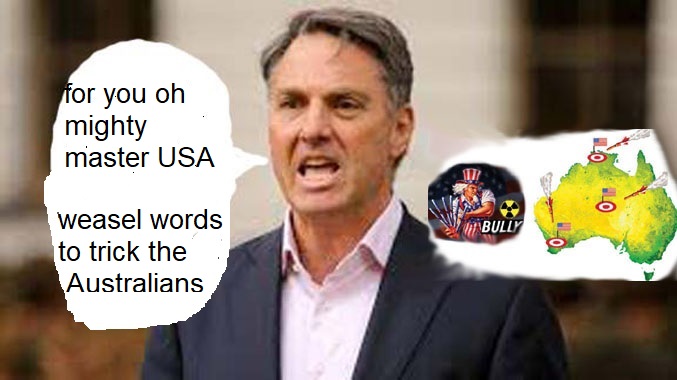
A spokesperson for the defence minister, Richard Marles, said the government would “develop a process to consider all feasible options for an east coast facility to support Australia’s future submarine capability”.
A decision would be made “late in this decade”, the spokesperson said………………..
The South Coast Labour Council’s annual May Day march has been moved from Wollongong to Port Kembla to shine a spotlight on opposition to the proposed base………..
Rorris said locals had “grave fears” that the prospect of a submarine base would crowd out potential energy investors.
“That is why we are asking the federal government: rule it out, take it off the table and say that it will never be a nuclear base. Until that happens, economically and industrially, we have a major and unacceptable problem.”………….
Rorris said it was a “choice between the industries of the future to save the planet versus the war machines that may well destroy it”.
Science and Technology: ¶ “The People Living Ultra Low-Carbon Lifestyles” • Surveys show that many people want to participate in climate actions, but putting a very low-carbon life into practice can mean be tricky: it can mean changing several aspects of daily life, particularly for the richer parts of society. What do truly low-carbon lifestyles […]
In a recent briefing with Illawarra industry, community and business leaders, Assistant Defence Minister Matt Thistlethwaite said other locations would be considered.
“Everything is on the table,” he said.
“There are a number of factors — deepwater ports are essential, ensuring that there is a domestic industry base that can service a base like that, ensuring there is a skilled work force.
…………………….. “We are looking at close to a decade before that decision is made.”
Other locations ‘hot potatoes’
The announcement opens the door for defence to reconsider the Garden Island naval base in Sydney and Jervis Bay on the NSW south coast.
The sites were among the top locations identified by Defence in a 2011 report obtained by former South Australian Senator and submariner Rex Patrick under freedom of information laws.
“I think the other sites are political hot potatoes and the government is seeking to diffuse those aspects of this particular AUKUS program,” Mr Patrick said.
“Garden Island in Sydney is a significant population site surrounded by the residents of Sydney who simply will be uncomfortable with the stationing of a nuclear submarine in the harbour.
He said winning community support for a base in Jervis Bay would also be a difficult proposition due to the environmental sensitivity of the site.
“There have been many campaigns over the years to stop the navy conducting activities in Jervis Bay, even though it is a pretty good environmental tenant,” he said.
“I can see huge problems with government trying to impose a nuclear base in that pristine environment.”
‘The air has to be cleared’
The government is also facing a challenge at Port Kembla, where the Illawarra community also has a long history of opposing nuclear projects and has already begun rallying opposition to a base.
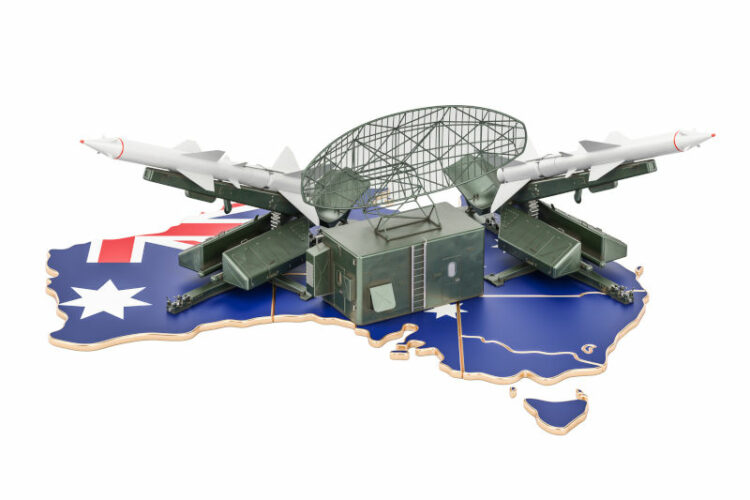
The 2023 Defence Strategic Review has recommended Australia adopt a new strategic conceptual framework dubbed ‘National Defence’ that incorporates a ‘strategy of denial’. This approach is tied to a broader concept of ‘collective security’ in the Indo-Pacific and is aligned with America’s framework for ‘integrated deterrence’ of China. ‘National Defence’ is consistent with American force structure designs to develop the northern Australian expanse as an increasingly important base of operations for force-projection.
From ‘Defence of Australia’ to ‘National Defence’
The recommendation by the 2023 Defence Strategic Review (DSR) to abandon the long-standing strategic doctrine known as ‘defence of Australia’ (DoA) has been met with approval by the Albanese government, even as the doctrine had been previously eviscerated to conform with the requirements of the US alliance.
DoA reached its zenith with the release of the 1986 ‘Dibb Review’ that recommended a shift in Australia’s defence strategy from dependent expeditionary combat to ‘self-reliant’ protection of the continent and the air and maritime approaches to Australia. This was to be achieved by adopting ‘an essentially defensive posture in our region’ and employing a ‘strategy of denial’ with strike capabilities strictly limited in range to accomplish that objective………………………………….
However ………… long-standing aspirations for Australia to be an influential ‘middle power’ in international affairs, or more accurately, a ‘sub-imperial power’, which required undertaking regional ‘burden sharing’ responsibilities to preserve ‘stability’ on behalf of the US-led global order.
………………. A major turning point came in late 2001 when the Howard government committed Australia to America’s ‘global war on terror’. ……………….
……. While DoA and ‘self-reliance’ remained official strategic guidance, operationally the Australian Defence Force (ADF) largely came to serve as an adjunct to the US military.
DoA has now been jettisoned entirely by the DSR in favour of ‘National Defence’, a new strategic conceptual framework based on the prospect of higher-level direct threats to Australia’s ‘national interests’ arising from US-China competition………….. This entails abandoning a ‘balanced’ force in favour of a force structure that is ‘focussed’ on preparing for major war – with China.
…………………….. Today, it is the supposed threat to the ‘rules-based order’ that functions as the new ‘domino theory’, where legitimate concerns about Chinese assertiveness in long-standing territorial disputes in the South China Sea is imagined as a direct military threat to Australia and our ‘national interests’.
………… maintaining a ‘balance of power’ has long been a euphemism in Australian political discourse for sustaining American military dominance or ‘primacy’…………..
……………….. achieving ‘balance’ translates into an agenda for Australia to work even more closely with the United States, and key American security partners like Japan, to further encircle China militarily.
…………………………………..Unlike the strategic approach articulated in the 1986 Dibb Review, the ‘strategy of denial’ adopted by the DSR is tied to a broader concept of ‘collective security’ in the Indo-Pacific and is aligned with America’s framework for ‘integrated deterrence’ of China. It is consistent with American force structure designs to develop the northern Australian expanse as an increasingly important base of operations for force-projection
………..The biggest change foreshadowed by the DSR is to the Army, which will have its infantry fighting force dramatically scaled back and be optimised for littoral operations and enhanced long-range fire.
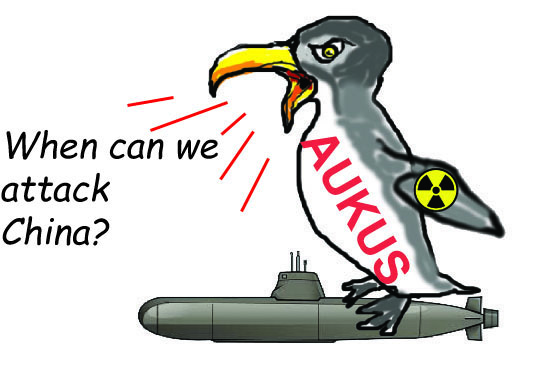
……………………………… This is the great strategic folly of AUKUS. It will equip the ADF with a potent capability to strike the Chinese mainland and, in coalition with the United States, play a frontline role in hunting China’s nuclear-armed submarine force and its critical second-strike nuclear deterrent capability.
While AUKUS risks contributing to an existential nuclear threat to China, the DSR reassures Australians that we remain safe from nuclear annihilation under the protection of America’s ‘extended nuclear deterrence’, for which there are no credible assurances, and in efforts to pursue ‘new avenues of arms control’, of which there are none, except that which the Albanese government has yet to join – the Treaty on the Prohibition of Nuclear Weapons – despite assurances by the Labor Party to the contrary
Finally, climate change is belatedly recognised as a significant national security issue in the DSR, but largely as a distraction that risks detracting from Defence’s primary objective of defending Australia against China…………………..
The DSR overstates the threat China poses to Australia, appears wilfully blind to the risks of nuclear escalation inherent in the defence strategy it recommends, and understates the existential threat of climate change which it fails to confront. What’s more, ‘National Defence’ dictates an acute focus on preparing Australia’s armed forces to integrate in a substantial way with American force structure plans to carry out what should be utterly unthinkable: a high-end war with a nuclear-armed China that risks wreaking a global catastrophe. https://johnmenadue.com/labors-serial-betrayal-of-australia/
JOHN PILGER: Danger of war exists if we don’t speak up now
Independent Australia, By John Pilger | 2 May 2023
“………………………………………………………………………………… The rise of fascism in Europe is uncontroversial. Or “neo-Nazism” or “extreme nationalism”, as you prefer. Ukraine as modern Europe’s fascist beehive has seen the re-emergence of the cult of Stepan Bandera, the passionate anti-Semite and mass murderer who lauded Hitler’s “Jewish policy” which left 1.5 million Ukrainian Jews slaughtered. ‘We will lay your heads at Hitler’s feet,’ a Banderist pamphlet proclaimed to Ukrainian Jews.
Today, Bandera is hero-worshipped in western Ukraine and scores of statues of him and his fellow fascists have been paid for by the EU and the U.S., replacing those of Russian cultural giants and others who liberated Ukraine from the original Nazis.
In 2014, neo-Nazis played a key role in an American-bankrolled coup against the elected President, Viktor Yanukovych, who was accused of being “pro-Moscow”. The coup regime included prominent “extreme nationalists” — Nazis in all but name.
At first, this was reported at length by the BBC and the European and American media. In 2019, Time magazine featured the “White supremacist militias” active in Ukraine. NBC News reported, ‘Ukraine’s Nazi problem is real’. The immolation of trade unionists in Odessa was filmed and documented.
Spearheaded by the Azov regiment, whose insignia, the “Wolfsangel”, was made infamous by the German SS, Ukraine’s military invaded the eastern, Russian-speaking Donbas region. According to the United Nations, 14,000 in the east were killed. Seven years later, with the Minsk peace conferences sabotaged by the West, as Angela Merkel confessed, the Red Army invaded.
This version of events was not reported in the West. To even utter it is to bring down abuse about being a “Putin apologist”, regardless of whether the writer (such as myself) has condemned the Russian invasion. Understanding the extreme provocation that a NATO-armed borderland, Ukraine, the same borderland through which Hitler invaded, presented to Moscow, is anathema.
Journalists who travelled to the Donbas were silenced or even hounded in their own country. German journalist Patrik Baab lost his job and a young German freelance reporter, Alina Lipp, had her bank account sequestered.
In Britain, the silence of the liberal intelligentsia is the silence of intimidation. State-sponsored issues like Ukraine and Israel are to be avoided if you want to keep a campus job or a teaching tenure. What happened to Jeremy Corbyn in 2019 is repeated on campuses where opponents of apartheid Israel are casually smeared as anti-Semitic.
Professor David Miller, ironically the country’s leading authority on modern propaganda, was sacked by Bristol University for suggesting publicly that Israel’s “assets” in Britain and its political lobbying exerted a disproportionate influence worldwide — a fact for which the evidence is voluminous.
The university hired a leading KC to investigate the case independently. His report exonerated Miller on the ‘important issue of academic freedom of expression’ and found ‘Professor Miller’s comments did not constitute unlawful speech’. Yet Bristol sacked him. The message is clear: no matter what outrage it perpetrates, Israel has immunity and its critics are to be punished………………………………………
When 9/11 happened, the fabrication of new “threats” on “America’s frontier” (as the Project for the New American Century called the world) completed the political disorientation of those who, 20 years earlier, would have formed a vehement opposition.
This figure does not include the dead of U.S.-led and fuelled wars in Yemen, Libya, Syria, Somalia and beyond. The true figure, said the report, ‘could well be in excess of 2 million [or] approximately 10 times greater than that of which the public, experts and decision-makers are aware and [is] propagated by the media and major NGOs.’
At least one million were killed in Iraq, say the physicians, or five per cent of the population.
The enormity of this violence and suffering seems to have no place in the Western consciousness. No one knows how many is the media refrain. Blair and George W Bush – and Straw and Cheney and Powell and Rumsfeldet al – were never in danger of prosecution. Blair’s propaganda maestro, Alistair Campbell, is celebrated as a “media personality”.
……………………………………Had journalists done their job, had they questioned and investigated the propaganda instead of amplifying it, a million Iraqi men, women and children might be alive today; millions might not have fled their homes; the sectarian war between Sunni and Shia might not have ignited; and Islamic State might not have existed.
Cast that truth across the rapacious wars since 1945 ignited by the United States and its “allies” and the conclusion is breathtaking. Is this ever raised in journalism schools?
Today, war by media is a key task of so-called mainstream journalism, reminiscent of that described by a Nuremberg prosecutor in 1945:
‘Before each major aggression, with some few exceptions based on expediency, they initiated a press campaign calculated to weaken their victims and to prepare the German people psychologically… In the propaganda system…it was the daily press and the radio that were the most important weapons.’
…………………………………………………………. On 14 September 2016, the House of Commons Foreign Affairs Committee in London reported the conclusion of a year-long study into the NATO attack on Libya which it described as an ‘array of lies’ — including the Benghazi massacre story:
‘The NATO bombing plunged Libya into a humanitarian disaster, killing thousands of people and displacing hundreds of thousands more, transforming Libya from the African country with the highest standard of living into a war-torn failed state.’
……………………………….Reminiscent of the Scramble for Africa in the 19th Century, the U.S. African Command (Africom) has since built a network of supplicants among collaborative African regimes eager for American bribes and armaments. Africom’s “soldier to soldier” doctrine embeds U.S. officers at every level of command from general to warrant officer. Only pith helmets are missing.
……………………… In the year NATO invaded Libya, 2011, Obama announced what became known as the “pivot to Asia”. Almost two-thirds of U.S. naval forces would be transferred to the Asia-Pacific to “confront the threat from China,” in the words of his Defence Secretary.
There was no threat from China; there was a threat to China from the United States; some 400 American military bases formed an arc along the rim of China’s industrial heartlands, which a Pentagon official described approvingly as a “noose”.
At the same time, Obama placed missiles in Eastern Europe aimed at Russia. It was the beatified recipient of the Nobel Peace Prize who increased spending on nuclear warheads to a level higher than that of any U.S. administration since the Cold War — having promised, in an emotional speech in the centre of Prague in 2009, to help “rid the world of nuclear weapons”.
Obama and his administration knew full well that the coup his assistant secretary of state, Victoria Nuland, was sent to oversee against the government of Ukraine in 2014 would provoke a Russian response and probably lead to war. And so it has.
…………………………………………………….. Ho Chi Minh’s Vietnam was victorious and none of the above happened. Instead, Vietnamese civilisation blossomed, remarkably, in spite of the price they paid — three million dead. The maimed, the deformed, the addicted, the poisoned, the lost.
Make no mistake, the Albanese government knows that in joining the US fight against China, Australia will be left defenceless on American withdrawal. And only a dodo could not know this risk is high. Maybe the government doesn’t appreciate that war for America is different. It is the war which matters, not the result. “Winning” is incidental.
Thinking deeply about Australia’s future is simply beyond the Albanese/ Wong/ Marles triumvirate.
Originally my editor requested a survey of Australia’s media response to the government’s Defence Strategic Review (DSR) – tackily released during the ANZAC devotions. It became clear that this was a trivial exercise. The bulk of our mainstream print, TV and radio accepted the tenet that Australia should treat China as an emerging military threat, and spend heavily against the prospect of war. None challenged it.
A sane assessment would find that China presenting a military threat to Australia is fabrication – to rival that of Iraq’s weapons of mass destruction. Thereby America itself has become a great danger to Australia. Its propensity for conflict and brutal self-interest is amply evidenced, over decades. To Washington’s strategists, Australia exists foremost as another object to be exploited for their world wide web of wars. With some distinguishing attributes. We are an ally which profitably pays it way, eagerly, for which the US is un-obligated. Meaning the US can freely entwine Australia in a war with China, then just go home when things get tough, responsibly in its view. As it does, with practised facility.
Despite our hapless, shameful experiences and ever-mounting evidence of America’s implacable hegemony our governments increasingly have conflated Australia’s interests with America’s.
Once Australians rightly could have expected a Labor government to be discerning of our unique interests. But we have to go back to Hawke and Keating to be confident of it. When America’s interests would not swamp our own. Today, it matters not which major political party holds the reins. Bipartisanly, our leaders are preparing Australia for war against the fresh superpower of China. At America’s instigation. While America complains that it lacks the resources for the job, and must rely critically upon allies. And the massive stakes unique to Australia are subordinated to those US interests.
How could anything else rate higher as an issue for Australia?
The seeds of betrayal
We are told by Defence Minister Marles that the DSR comes at a “watershed moment” and that “Australia has lost ten years of warning time.” That is, Australia should have been preparing for war long ago. In fact, Labor created the watershed moment more than ten years ago,………………………………………
Perhaps those years of Labor hand-sitting while our defences were being turned over to US objectives might have been tolerable, if the Albanese government had set about securing Australia’s interests upon gaining power. But the opposite has unfolded. Labor is accelerating spending for war.
Those with long faith in Labor had assumed that the lie of a China military threat to us would be scrutinised once the LNP government fell. Intelligence advice had to be assessed independently. Because on official Pentagon advice to the US Congress China’s forces are stretched just in trying to meet America’s threat to its periphery. But no, Labor didn’t want to know. Instead of getting to the heart of the matter promptly, a defence review was commissioned. And that same conflicted intelligence apparatus provided the foundation for it. Thereby another year has slipped by, in war preparation.
“The review’s outcome was set before it started by the politics of Labor signing up in a matter of hours to carry Scott Morrison’s Anglophone burden. Paul Keating’s charge remains unanswered that Labor’s defence policy was set by wanting to provide no target when blindsided by Mr Morrison’s submarine adventure.”
Unsurprisingly, the stench of political duplicity intensified as the review proceeded.
America’s wars are not about winning
The big betrayal is Labor’s doubling down on the path to war once in power. It is clear now that this was always the intent. What is new in the DSR is that finally a government admits that Australia is entirely dependent on the US:
4.7 However, Australia does not have effective defence capabilities relative to higher threat levels which can only be achieved by working with the United States…..
Make no mistake, the Albanese government knows that in joining the US fight against China, Australia will be left defenceless on American withdrawal. And only a dodo could not know this risk is high.
Maybe the government doesn’t appreciate that war for America is different. It is the war which matters, not the result. “Winning” is incidental. There is always Stateside to come home to. What matters is disempowerment of the adversary – degradation of state, polity, economy, infrastructure and population. That is grist-to-the-mill for the US State Department. Constantly played out by lounging analysts on buttoned leather sofas in the palatial “map room” at Foggy Bottom. Australia’s fate is amongst those gamed there, incidentally.
Even if it did, there can be little doubt now that the Albanese government has chosen to look straight ahead. It has Australia comfortably settled on America’s accelerating train to war with China. To meet a vigorous superpower on its home ground. The war is unwinnable. Impossible to imagine the residual mess. Which will endure in many dimensions for us. But that is of no matter to America. Who in the government knows, or would care?
Here is the future which the Albanese government is steering Australia into. Without a whimper within the Labor party. Thinking deeply about Australia’s future is simply beyond the Albanese/ Wong/ Marles triumvirate. Creative dimensions such as our former ambassador in Beijing Dennis Argall has espoused are beyond Labor.
The way out
While our nation is engulfed in a spiral to war, Foreign Minister Wong has demonstrated no capacity to protect it. In opposition Wong claimed to appreciate the effect of conflict with China. But now talks merely of “lowering the heat” while lining up stoically behind Marles’ indulgent militarism. Paralysed by politics.
Australia’s prospects are unthinkable. We have no alternative but to embrace wider geostrategic options. To give self-interest and self- belief a real shot.
That new road will be complex to map. And long. Our nation no longer possesses the administrative machinery critical for an independent State. Intelligence is compromised, foreign policy and defence gutted, politicised and Americanised. Fixing that is the basic first step. No doubt the nation still possesses independent, experienced, cultivated minds up for it. We can grow up. Again. https://johnmenadue.com/labors-serial-betrayal-of-australia/
While no threat from China exists, media propagandists are trying to ignite a war the likes of which we’ve never seen. John Pilger reminds us that we need to raise our voices before it’s too late.
“IN 1935, the Congress of American Writers was held in New York City, followed by another two years later. They called on ‘the hundreds of poets, novelists, dramatists, critics, short story writers and journalists’ to discuss the ‘rapid crumbling of capitalism’ and the beckoning of another war………………………………………………
The journalist and novelist Martha Gellhorn spoke up for the homeless and unemployed, and “all of us under the shadow of violent great power”. ………………………….
On 7 March, the two oldest newspapers in Australia – The Sydney Morning Herald and The Age – published several pages on “the looming threat” of China. They coloured the Pacific Ocean red. Chinese eyes were martial, on the march and menacing. The Yellow Peril was about to fall down as if by the weight of gravity.
No logical reason was given for an attack on Australia by China. A “panel of experts” presented no credible evidence; one of them is a former director of the Australian Strategic Policy Institute, a front for the Defence Department in Canberra, the Pentagon in Washington, the governments of Britain, Japan and Taiwan, and the West’s war industry.
There is no threat to Australia. None. The faraway “lucky” country has no enemies, least of all China, its largest trading partner. Yet China-bashing that draws on Australia’s long history of racism towards Asia has become something of a sport for the self-ordained “experts”. What do Chinese-Australians make of this? Many are confused and fearful.
The authors of this grotesque piece of dog-whistling and obsequiousness to American power are Peter Hartcher and Matthew Knott, “national security reporters” I think they are called. I remember Hartcher from his Israeli government-paid jaunts. The other one, Knott, is a mouthpiece for the suits in Canberra. Neither has ever seen a war zone and its extremes of human degradation and suffering.
How did it come to this? Martha Gellhorn would say if she were here. Where on Earth are the voices saying no? Where is the comradeship?
The voices are heard in the samizdat of this website and others. In literature, the likes of John Steinbeck, Carson McCullers and George Orwell are obsolete. Post-modernism is in charge now. Liberalism has pulled up its political ladder. A once somnolent social democracy, Australia, has enacted a web of new laws protecting secretive, authoritarian power and preventing the right to know. Whistleblowers are outlaws, to be tried in secret. An especially sinister law bans “foreign interference” by those who work for foreign companies. What does this mean?
Democracy is notional now; there is the all-powerful elite of the corporation merged with the state and the demands of “identity”. American admirals are paid thousands of dollars a day by the Australian taxpayer for “advice”. Right across the West, our political imagination has been pacified by PR and distracted by the intrigues of corrupt, ultra-low-rent politicians: a Johnson or a Trump or a Sleepy Joe or a Zelensky.
South Korean President Yoon Suk-yeol was on a state visit to the US from April 25 for six days. The top agenda of the visit was ‘how to contain, control, and neutralize the North Korean nuclear threat.’
Since the beginning of 2023, North Korea has carried out about a dozen missile tests. Kim Jong Un, the North Korean dictator, has been categorical in condemning military exercises being carried out jointly by South Korean and US military and has threatened to retaliate.
South Korea and the US have regularly carried out military exercises. …………………………….
Proposed US Nuclear Submarine Deployment
To protect South Korea from the North Korean nuclear threat, the US has announced that it will deploy SSBN in South Korean waters. The event is yet to take place.
Proposed US Nuclear Submarine Deployment
To protect South Korea from the North Korean nuclear threat, the US has announced that it will deploy SSBN in South Korean waters. The event is yet to take place.
A look at the globe will indicate that US nuclear submarines, equipped with nuclear-warhead Submarine Launched Ballistic Missiles, will also be able to strike mainland China.
However, if the SSBN deployment indeed does take place, it might, and will, be different from the Cuban Missile Crisis due to the following reasons:
a. In 1962, only two nuclear powers, the US and the USSR, challenged each other with a nuclear strike.
b. China, then, was not a nuclear power. China exploded its first nuclear device on October 8, 1964.
c. In 2023, there are nearly a dozen nations in possession of nukes.
d. China is a formidable economic and nuclear power now.
e. In 1962, the USSR’s decision to deploy nuclear missiles in Cuba forced the US to retaliate. Then, the USSR was the initiator. The US was the affected party.
f.In 2023, China will be the affected party, and the USA will be the initiator if the US does not back off from its decision to deploy SSBNs near South Korea.
g. In the event of an escalation, the US will have to face nukes from China and North Korea but also (maybe) from Russia.
Key Issues
The key issue, which might rather lead to a similar situation as the Cuban Missile Crisis, is the US announcement to deploy nuclear weapons capable submarines near South Korea.
Such a deployment aims to protect South Korea from any North Korean military or nuclear misadventure. However, a closer look at the probable region of deployment of nuclear submarines will indicate that the US will be able to threaten the underbelly of China exactly in the same manner as the Soviet missiles threatened the US underbelly. China will almost certainly react or retaliate in the way deemed fit.
Should that happen, will diplomacy succeed yet again and prevent a nuclear holocaust? Global grouping in 2023 is vastly different from what prevailed in 1962………..
SSBNs are extremely difficult to track. China, Russia, or North Korea cannot track and confirm the presence of US Navy SSBNs. If deployed in the abovementioned areas, the SSBN will threaten North Korea, China, and Russia.
China’s Concerns
Beijing has already reacted by describing the planned deployment of SSBNs by the US as a bid to promote the latter’s selfish geopolitical interests.
The US expansion of the nuclear umbrella has been termed an irresponsible action and a threat to world peace. The Chinese spokesperson said, “The United States has put regional security at risk and intentionally used the (Korean) peninsula issue as an excuse to create tensions.
What the US does is full of Cold War thinking, provoking bloc confrontation, undermining the nuclear non-proliferation system, damaging the strategic interests of other countries, exacerbating tensions on the Korean peninsula, undermining regional peace and stability, and running counter to the goal of the de-nuclearisation of the peninsula.
………….. The recently concluded AUKUS treaty has already raised hostility between China and the US. The decision to deploy SSBNs capable of carrying up to 20 MIRVed ballistic missiles in close proximity has invited extremely adverse reactions from China………………………………………………………………………………………
The Energy Mix, May 2, 2023. Primary Author: Christopher Bonasia @CBonasia_
Several Members of Parliament and activists are warning the Canadian government that its support for nuclear energy projects could prove costly and ineffective—even as Prime Minister Justin Trudeau maintains that nuclear is “on the table” for achieving the country’s climate goals.
The federal government considers nuclear energy—including small modular reactors (SMRs) that are touted as easier to build and run than traditional nuclear plants—as key to meeting energy needs while aiming for net-zero by 2050.
………………..But on April 25, anti-nuclear activists and a cross-partisan group of MPs held a media conference on Parliament Hill, urging Ottawa to rethink its stance on nuclear and calling the energy source a dangerous distraction from climate action, reported CBC News.
Speakers in the group said Trudeau and his cabinet are getting bad advice about nuclear energy.
“The nuclear industry, led by the United States and the United Kingdom, has been lobbying and advertising heavily in Canada, trying to convince us that new SMR designs will somehow address the climate crisis,” said Prof. Susan O’Donnell, a member of the Coalition for Responsible Energy Development in New Brunswick (CRED-NB). The reality, she added, is that SMRs will produce “toxic radioactive waste” and could lead to serious accidents while turning some communities into “nuclear waste dumps”.
Moreover, there is “no guarantee these nuclear experiments will ever generate electricity safely and affordably,” O’Donnell said, since SMRs are still relatively untested.
Green Party Leader Elizabeth May called government funding for nuclear projects a “fraud.”
“It has no part in fighting the climate emergency,” May said. “In fact, it takes valuable dollars away from things that we know work, that can be implemented immediately, in favour of untested and dangerous technologies that will not be able to generate a single kilowatt of electricity for a decade or more.”
Liberal MP Jenica Atwin, New Democrat Alexandre Boulerice, and Bloc Québecois MP Mario Simard also attended the media event, the National Post reports. Atwin, who was first elected as a Green in 2019 before crossing the floor, “is the only Liberal to publicly break ranks so far, but said she has had conversations with colleagues who appear to be ‘open-minded’ to learning more about her concerns,” the Post says.
Advocacy groups like the Canadian Environmental Law Association (CELA) have also pushed back against SMRs, arguing they “pose safety, accident, and proliferation risks” akin to traditional nuclear reactors. CELA urged[pdf] the federal government to “eliminate federal funding for SMRs, and instead reallocate those investments into cost-effective, socially responsible, renewable solutions.”
The International Energy Agency (IEA) says renewables will “lead the push to replace fossil fuels” but that nuclear can help in countries where it is accepted. As of 2022, there were only three SMR projects in operation—one each in Russia, China, and India, CBC News reported.
Canada’s First SMR Passes Pre-Licencing
In Ontario, which currently produces 60% of its electricity from conventional nuclear stations, plans for one such SMR passed a regulatory checkpoint in March. Slated to be Canada’s first new nuclear reactor since 1993, the BWRX-300 is being built by Ontario Power Generation (OPG) and North Carolina-based GE Hitachi.
…………………………………………………………………….The review is not binding on the commission and does not involve the issuance of a licence, but its completion does give OPG “a head start on licencing,” said GE Hitachi spokesperson Jonathan Allen.
However, the pre-licencing review also revealed “some technical areas that need further development,” CNSC said. The commission will require OPG to supply further details on severe accident analysis and the engineered features credited for mitigation. OPG must also demonstrate that the reactor’s design meets the requirement for two separate and diverse means of reactor shutdown (or an alternative approach) and provide further information “on the protective measures for workers in the event of an out-of-core criticality accident.”
“From the list of areas needed for further development, it looks like [GE Hitachi] has some work to do,” said Allison Macfarlane, director of the University of British Columbia’s public policy school, who chaired the U.S. Nuclear Regulatory Commission (NRC) between 2012 and 2014.
BWRX-300 Raises Safety Questions
The BWRX-300 is a leading concept that GE Hitachi says is its simplest boiling water design, and could deliver 60% lower capital costs per megawatt than other SMRs.
But Edwin Lyman, director of nuclear power safety for the Union of Concerned Scientists, told The Mix he has concerns about the design. He pointed to a joint CNSC-NRC review[pdf] that identified several issues associated with reactor containment, including a potential for “reverse flow” of steam from the containment back into the reactor vessel under certain accident conditions. The review also found that the reactor’s reliance on isolation condensers may not always be effective to remove heat from the reactor during loss-of-coolant accidents.
“The consequences of a failure of isolation condensers is apparent from the fate of Fukushima Daiichi Unit 1, which experienced a core melt only hours after the system was lost,” Lyman said, citing the 2011 nuclear disaster in Ōkuma, Japan.
He added he is “extremely skeptical” that the BWRX-300 design will mature quickly enough to allow CNSC to make a meaningful determination of its safety in time for the anticipated 2028 start date. SMR designs need to undergo further testing and analysis before they can be considered safe, and yet vendors are rushing to deploy new, untested reactor designs without going through the necessary stages of technology development, including testing of full-scale prototypes, Lyman said.
“History has shown that shortcuts in this process are an invitation to disaster,” he added.
SMRs fall under the same Class 1A Nuclear Facilities Regulations as traditional reactors, so they do receive the same level of CNSC scrutiny. With its mandate to ensure the safe conduct of nuclear activities in Canada, the commission “will only issue a licence if the applicant has demonstrated the reactor can be operated safely,” the spokesperson said.
Next steps for the DNNP include a CNSC assessment, already under way, to review OPG’s licence application. This will result in a Commission Member Document that offers results and recommendations to an independent commission. Then there will also be two public hearings. The first is slated[pdf] for January 2024 and will consider the applicability of the previous environmental assessment to the BWRX-300. A separate, future hearing will determine whether to issue a construction licence for the DNNP.
Vaulta’s first international investor has joined its effort to make the battery industry more sustainable. The post Brisbane recyclable battery start-up signs up first international investor appeared first on RenewEconomy.