Declassified Video Shows How B-52 Crews Would Conduct Nuclear Strikes During Cold War

The Aviationist March 26, 2023 STEFANO D’URSO
A 1960 Strategic Air Command training video familiarized B-52 crews with the devastating effects of nuclear weapons and how to navigate through a nuclear battlefield.
The U.S. National Archives and Records Administration (NARA) recently declassified some very interesting training films and film reports that the Strategic Air Command prepared in the 1960s to prepare bomber pilots and crews for a potential nuclear war. Among these there is the United States Air Force Training Film 5363, “Nuclear Effects During SAC Delivery Missions,” made in 1960 and which kept its secret classification until now.
The purpose of Training Film 5363 was to familiarize SAC pilots and crew members with the devastating effects of nuclear weapons detonations and the detailed plans that were developed so the crews could evade the dangers of a nuclear battlefield and return home after completing their mission. These plans were among the contents of the “Combat Mission Folders,” which included guidance needed to reach targets and return to base safely and were assigned to each nuclear-armed bomber on alert duty.
…………………… The film begins with a B-52 flying a sortie of the Emergency War Order, launched under Positive Control and on its way to the “go/no-go” position, but without the crew knowing if this is a real mission or an exercise until they get there. Before eventually going in, however, the narrator explains that, while they know that the mission can be successfully accomplished as it was carefully planned and reviewed by highly qualified combat planners and they flew countless profile missions, they need to know the nuclear effects of a detonation.
The narrator then takes the viewers trough the basics of a nuclear detonation’s thermal, blast and radiation effects and the efforts that the U.S. Air Force had taken to prepare the crews for situations where they might experience them. In fact, the central part of the film covers the effects of nuclear explosions of both aircraft and crew and the measures taken to minimize crew exposure, like carefully planned routes that created a safe distance between the bomber and the detonation of their weapon and the detonations caused by other SAC bombers operating in the same area.
The film then returns to the B-52 approaching the turnaround point, when then a radio message from SAC comes in: “Sky King. Sky King. This is Migrate. This is Migrate. Do not answer. Break. Break. Alpha Sierra Foxtrot Juliet Oscar Papa Mike Tango. Break. Go-Code.” The crew scrambles to verify the code and discover that this is the go code for a real mission: “Pilot to crew. We checked the go code and verified it. This is it. We’re going in”.
After a very brief moment of disbelief, the crew members get down to business and prepare the aircraft for the nuclear strike mission as they are about to cross the H-Hour Control Line on the way to their assigned target in the Soviet Union. As they navigate towards the target, the crew experience the shockwave from another nuclear bomb dropped in the vicinity of their route, before a low-altitude flight over lakes, mountains, forests and fields to avoid Soviet air defense missiles…………………………………………………. more https://theaviationist.com/2023/03/26/declassified-video-shows-how-b-52-crews-would-conduct-cold-war-nuclear-strikes/
March 26 Energy News — geoharvey

Opinion: ¶ “We Won’t Act On Climate Change Until Our Comfortable Lives Are Threatened – And That Day Is Coming” • The IPCC’s latest climate report stopped some of us in our tracks because there are many warnings about our heating planet and escalating climate breakdown, and each new one is a reminder that we’re […]
March 26 Energy News — geoharvey
AUKUS, the Australian Labor Party, and Growing Dissent
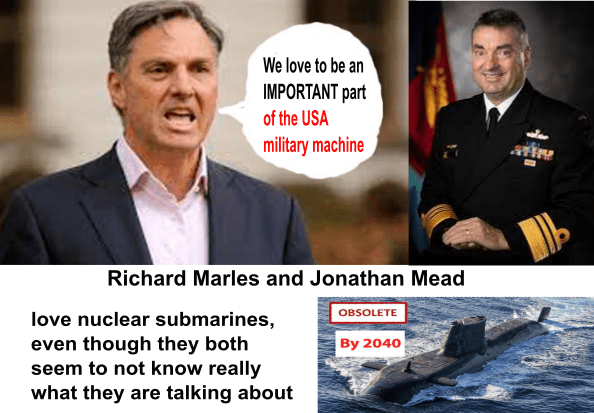
the Royal Australian Navy would be far better off acquiring between 40 to 50 of the Collins Class submarines to police the coastline rather than having nuclear powered submarines lying in wait off the Chinese shoreline.
March 25, 2023, by: Dr Binoy Kampmark https://theaimn.com/aukus-the-australian-labor-party-and-growing-dissent/
It was a sight to behold and took the wind out of the bellicose sails of the AUKUS cheer squad. Here, at the National Press Club in the Australian capital, was a Labor luminary, former Prime Minister of Australia and statesman, keen to weigh in with characteristic sharpness and dripping venom. Paul Keating’s target: the militaristic lunacy that has characterised Australia’s participation in the US-led security pact that promises hellish returns and pangs of insecurity.
In his March 15 address to a Canberra press gallery bewitched by the magic of nuclear-propelled submarines and the China bogeyman, Keating was unsparing about those “seriously unwise ministers in government” – notably Foreign Minister Penny Wong and Defence Minister Richard Marles, unimpressed by their foolish, uncritical embrace of the US war machine. “The Albanese Government’s complicity in joining with Britain and the United States in a tripartite build of a nuclear submarine for Australia under the AUKUS arrangements represents the worst international decision by an Australian Labor government since the former Labor leader, Billy Hughes, sought to introduce conscription to augment Australian forces in World War One.”
In terms of history, this was chilling to Keating. The AUKUS security pact represented a longing gaze back at the Mother Country, Britain, “shunning security in Asia for security in and within the Anglosphere.” It also meant a locking alliance with the United States for the next half-century as a subordinate in a containment strategy of Beijing. This was a bi-partisan approach to foreign policy that saw the US dominating East Asia as “the primary strategic power” rather than a balancing one.
For Keating, the impetus for such madness came from a defence establishment that dazzled the previous Prime Minister, Scott Morrison. That effort, he argues, was spearheaded by the likes of the US-funded Australian Strategic Policy Institute and Andrew Shearer of the Office of National Intelligence. They even, he argues, managed to convince PM Albanese, Marles and Wong to abandon the 20-month review period on the scope of what they were seeking.
The steamrolling Keating was also unsparing in attacking a number of journalists for their ditzy, adolescent belligerence. The sword, once produced, was never sheathed. Peter Hartcher, most notably, received a generous pasting as a war infatuated lunatic whose anti-China campaign at the Fairfax presses had been allowed for years.
In terms of the submarines themselves, Keating also expressed the view that the Royal Australian Navy would be far better off acquiring between 40 to 50 of the Collins Class submarines to police the coastline rather than having nuclear powered submarines lying in wait off the Chinese shoreline.
As we all should know, submarine policy is where imagination goes to expire, often in frightful, costly ways. For all Keating’s admiration for the Collins Class, it was a nightmarish project marred by fiascos, poor planning and organisational dysfunction within the defence establishment. At stages, two-thirds of the Australian fleet of six submarines was unable to operate at full capacity. The lesson here is that submarines and the Australian naval complex simply do not mix.
The reaction from the Establishment was one of predictable dismissal, denial and distortion, typical of what Gore Vidal would have called deranged machismo. Instead of being critical of the powers that are, they have turned their guns and wallets on spectres, ghosts and devilish images. The tragedy looms, and it will be, like many tragedies, the result of colossal, unforgivable stupidity.
At the very least, the intervention by Keating, notably in the Labor Party, has not gone unnoticed. Within the Labor caucus, tremors of dissatisfaction are being recorded, breaches growing. West Australian Labor backbencher Josh Wilson defied his own party’s dictates by telling colleagues in the House of Representatives how he was “not yet convinced that we can adequately deal with the non-proliferation risks involved in what is a novel arrangement, by which a non-nuclear weapons state under the NPT (Non-proliferation of Nuclear Weapons Treaty) comes to acquire weapons-grade material.”
Wilson’s views are not outlandish to the man. He is keen to challenge the notion of unaccountable executive war powers, a problem that looms large in the Westminster system. “To assume that such decision-making is already perfect, immutable, and beyond scrutiny,” he wrote in December last year, “puts Australia at risk of making the most dangerous judgments without the best institutional framework for doing so.”
A gaggle of former senior Labor ministers have also emerged, even if they initially proved sluggish. Peter Garrett, former environment minister and front man of Midnight Oil, while proving a bit squeamish about Keating’s invective, found himself in general agreement. “The deal stinks with massive cost, loss of independence, weaking nuke safeguards & more.”
Kim Carr, who had previously held ministerial positions in industry and defence materiel, revealed that the matter of AUKUS had never been formally approved in the Federal Labor caucus, merely noted. Various “key” Labor figures – again Marles and Wong – agreed to endorse the proposition put forth to them on September 15, 2021 by the then Coalition government.
He also expressed deep concern “about a revival of a forward defence policy, given our performance in Vietnam.” For Carr, the shadow cast by the Iraq War was long. “Given it’s 20 years since Iraq, you can hardly say our security agencies should not be questioned when they provide their assessments.”
For former foreign minister, Gareth Evans, there were three questions: whether the submarines are actually fit for purpose; whether Australia retained genuine sovereignty over them in their use; and, were that not the case, “whether that loss of agency is a price worth paying for the US security insurance we think we might be buying.”
Will these voices make a difference? They just might – but if so, Australia will have to thank that political pugilist and Labor veteran who, for all his faults, spoke in terms that will be considered, in a matter of years, treasonous by the Empire and its sycophants.
“Collaborative” bases, and the ideology of AUKUS
What we need now under either the optimist or the more realistic pessimistic view is a massive campaign, a campaign that starts today against the background of this terrible shock, this awful sense of betrayal.
Pearls and Irritations, By Richard Tanter, Mar 24, 2023“……………………………………………. The Minister for Defence in the Albanese government made a ministerial statement last month, in which he talked about the joint facilities. But he also introduced a new category of bases under the US-Australia Force Posture Initiative that the previous Rudd-Gillard-Abbott-Turnbull-Morrison alliance supporting government had not thought of – collaborative bases.
Collaborative – an interesting word in its double meaning, isn’t it.
At the moment we don’t know how many Agreed Locations and Facilities there are on this list of collaborative bases identified in a secret part of the Force Posture Agreement – the bases given over by Australia to the US to be under varying degrees of US operational control. The most recent example is RAAF Tindal thanks to Scott Morrison, and we are going to see a lot more of that.
And the last part of nuclear permissiveness is the atmosphere that fills the room in Canberra when you listen to certain senior officials, compliant academics, and insider journalists talk about nuclear weapons for Australia.
In the past few years we have already had three former deputy secretaries of defence – the people who do the planning – saying in public it’s time for us to reconsider the decisions taken by the Fraser and Whitlam governments half a century ago to stop our development of nuclear weapons.
It’s time, they say, to think again about Australian nuclear weapons.
No, they say, we’re not advocating nuclear weapons for Australia, we just need to think about it.
But in the context of half a century of nuclear restraint, of full knowledge of what the possession of nuclear weapons will mean in our region, or what the actual effects of nuclear weapons use will mean in human and environmental terms, ‘just considering’ nuclear weapons acquisition means clearly much more than that.
The ideology of AUKUS
Ideology’s a funny word. Usually it’s used about other people. Like bad breath, ideology is something that afflicts the other guy, not us. Well, that’s nonsense. We all suffer from ideological thinking at certain times.
Ideology is that category of thinking that actually stops thought, which by its emotional logic takes means you don’t have to think about what’s actually being said.
In the ideological nonsense in The Age’s ‘Red Alert’ we saw a kind of triple equation, born of the Russian invasion of Ukraine and American plans to take the opportunity to reshape its alliances.
Russia = China – we don’t need to think about that, do we – they’re autocracies, and we’re not.
Putin = Xi. I’m happy to see that President Putin is to be indicted by the International Criminal Court for the war crime of his invasion of Ukraine. President Xi is not a particularly nice man, but a long way from Putin’s desperate criminality.
Ukraine = Taiwan. Putin invaded Ukraine, so Xi must be about to invade Taiwan – without any serious evidence, and in contrast to the behaviour of China since 1949.
This is the kind of talk that disables critical thinking. None of that makes any sense of the biggest historical defence spend we’ve ever seen, and nothing to say what will happen over the next forty years.
I think that China has some problems. If I lived in Tibet or Xinjiang I would be extremely concerned about what is happening to most of the people in those provinces of China in a deeply repressive kind of way.
If I lived in Vietnam I would know from a thousand years of history there’s a lot of pushing and shoving between China and its neighbours.
But the Vietnamese are still there – they have survived on their own resources.
I would be very concerned about some of the ways China treats its own citizens.
I would not like the concrete islands that China has made – and militarised – in the South China Sea.
True, China now has its first overseas base, in Djibouti on the Horn of Africa – a little one across the bay from giant American and French bases of longstanding.
There may be, may be, some kind of PLA naval access to a port in the Solomon Islands, largely, if it eventuates, because of the arrogance with which Australia has treated the Pacific Islands for decades – ‘family’ when we wanted; shoved into the outhouse of history when we don’t care.
I don’t know. That might happen. That would mean, oh dear, they will have two overseas bases – just 798 or so to go before they equal the Americans.
We need a country-agnostic policy of opposing all foreign bases in our neighbourhood – all.
I think Australia needs to be a little more careful and self-reflective about the way in which it talks about some of these undoubted sins of China.
We know something about islands that have been taken over for military purposes.
The forced removal of the people of the Chagos Islands so the US could build Diego Garcia – a British crime even recognised in the World Court.
Guam, an unvarnished American military colony since the end of the Second World War.
We know that China has bullied countries whose policies it doesn’t like with economic coercion – including Australia. We might, though, remember the seven decades of crushing US sanctions against Cuba – for the crime of defeating American plans. And now, again, the people of Afghanistan facing punishing sanctions for the crime of winning a war against the US.
We just need to be a little more honest and self-critical about this.
What China is doing in Xinjiang and Tibet is pretty recognisable as settler-colonialism with an overlay of ghastly pre-emptive counter-terrorism.
We know a bit about that sort of thing here.
And it doesn’t matter how we weigh the balances of these sins, whether we think any of these are equal or not.
But the important thing is that this must not stand.
I heard Lenore Taylor, the excellent editor of The Guardian Australia talking in a podcast the other day in an interesting way about a small sense of optimism buried in the Albanese proposal.
Taylor pointed out, and other people have noted the same thing, that in terms of the finances, the only thing that has been agreed to by the Albanese government concerns the forward estimates, the four year commitment from the budget in May.
The forward estimates, Taylor reminded us, amount to about $9 bn over those four years – probably mostly as an industrial subsidy to expand the US submarine-building yards.
Now, to you and me, $9 bn is a lot of money, but to the Defence Department, I suspect they waste something like that every month with costs overruns, white elephants, and renegotiating contracts when they change their minds.
This optimistic view suggests that the Albanese government, wedged by Morrison’s brilliant stroke of madness, has done the only thing it could do – gone along verbally, and got itself as much wiggle room as possible by pushing the serious spending out for years.
Events, they may be hoping, will save them from going through with the whole plan.
And on that they may not be wrong. The AUKUS scheme is so poorly conceived, so grandiosely conceived, so incalculably expensive, and so contingent on so many highly risky contingencies that it is very likely to go badly wrong.
So, they have, on this view, left themselves a back door out of the trap.
May be. Maybe not.
But the US has a long history of keeping recalcitrant junior partners in line, and Australian political, academic and media life does not lack for alliance supporters and enforcers who will keep a foot on that back door to keep it shut.
But it doesn’t matter, whichever view is right.
What we need now under either the optimist or the more realistic pessimistic view is a massive campaign, a campaign that starts today against the background of this terrible shock, this awful sense of betrayal.
A campaign which is made up diverse community-based groups, which has branches in suburbs and branches in country towns, broadly based with all sorts of elements and streams of opinion about peace.
Making the argument very clearly, based on experience, that the only times we have known Labor governments to stand up to the will of the United States have been on the back of huge long-running popular campaigns.
The first, now a long way back, was in the days of the Vietnam War, when Gough Whitlam became prime minister in 1972, and immediately responded to that high public pressure by ending our war in Vietnam, and of course, conscription of 19 year-olds for that purpose.
That only happened because of the pressure.
And the second was in the early 1980s when the Reagan administration, the most extreme rightwing administration since the early 1950s was pressuring Australia to take a greater role in the war against the then current demon, the Soviet Union.
It was again public pressure that forced the Hawke government to back down – in this city the role of the coalition of groups around People for Nuclear Disarmament and similar groups across the country – and then the electoral success of Nuclear Disarmament Party in the 1984 federal election.
We need that pressure – whether there is in fact a back door way out of this or not, there has to be huge public pressure on the Albanese Labor government.
Every time a Labor member of parliament or senator puts foot outside their office to appear in public, turns up at a public meeting, we need to ask them why have you betrayed us. Why have you allowed this to happen? What are you going to do?
We have to make it personal and objectionable and we have to make a whole lot of noise.
This must not stand.
Thank you. https://johnmenadue.com/these-are-the-horrors-of-aukus/
Lethal underwater nuclear submarines -their power to devastate the climate
Insanity: governments betray what climate science demands, Pearls and Irritations, By Andrew Glikson, Mar 25, 2023
Nowadays the last thing governments and major parties are following is what climate science requires, the single most critical factor society has ever faced…………………………………………………………………….
………………………………….another factor triggering major climate change: With the proliferation of nuclear weapons world-wide a combination of greenhouse and nuclear-induced climate changes have become increasingly likely. Armed with up to 40 nuclear Tomahawk Cruise missiles equipped with multiple warheads the Virginia class submarines constitute a lethal nuclear war platform whereby the arsenal of a single submarine can potentially annihilate major industrial centres and large population concentrations of an adversary. The firing of these missiles and retaliation from the surviving nuclear forces of the opponent virtually guarantee a global nuclear conflagration, including clouding of the atmosphere and obliteration of agriculture on a time scale of up to decades.
There were times when prophets promised the people peace on Earth, now the powers-to-be and their media mouthpieces are promising the world a nuclear holocaust between the rival empires in three years to come. Previous wars often erupted from territorial, economic, political, religious or ideological disputes, now the US vs China + Russia conflict is taking place between essentially private enterprise systems, repeating “sapiens’” insane obsession with war for the sake of war.
A nuclear war would terminate such insanity. Is it too late to hold pre-emptive Nuremberg trial for those who poison the planetary atmosphere and promote nuclear war? https://johnmenadue.com/the-faustian-bargain-how-governments-betray-what-climate-science-demands/
Macron’s nuclear power plan hits trouble

In a POLITICO interview, Luxembourg’s leader Xavier Bettel slams French push to include nuclear energy in EU’s green tech plan.
BY SUZANNE LYNCH AND JAKOB HANKE VELA, MARCH 22, 2023
French President Emmanuel Macron is facing an uphill battle to persuade EU leaders to designate nuclear energy as a key green technology of the future, after one of his allies blasted his plan on the eve of a summit in Brussels.
Luxembourg’s Prime Minister Xavier Bettel told POLITICO in an interview that while it is up to individual countries to choose their own energy mix, nuclear power must not benefit from an official “European label” that would give the vital French industry a boost.
Bettel’s criticism risks reinforcing divisions between Macron and his fellow leaders as they meet in Brussels to discuss the green tech plans at the European Council summit starting Thursday.
“Nuclear is neither sustainable, nor safe, nor fast,” Bettel said in an interview. “Some people think they are selling nuclear power as the answer to everything,” he continued, but pointed out that it can take at least 10 years for a plant to be operational.
“Secondly, we have had incidents at the international level which are worrying and which have had catastrophic repercussions for many other countries. And thirdly, we still have a problem with nuclear waste. We still don’t know how to deal with it, so we can’t say that it is safe and sustainable.”
France’s energy diet is dominated by nuclear power and Macron’s government has been lobbying Brussels to include nuclear energy in the EU’s Net Zero Industry Act — a package of plans unveiled last week by the European Commission.
The proposals in the act would allow “strategic net-zero” projects to qualify for a fast-track permitting process and smoother access to funding, part of the effort by Brussels to jump-start the transition away from fossil fuels to greener forms of energy.
Bettel said it’s up to each national government to decide its own energy mix, but argued that nuclear power should not be seen as good for the environment. “Everyone can do what they want,” he said. “But for me, the European label on nuclear energy — it would be in fact wrong to call it a green energy, or safe, or renewable.”
As POLITICO previously reported, in recent days France has not only lobbied to include nuclear energy in the EU’s Net Zero Industry Act, but it is also making a renewed push to give nuclear-based hydrogen a bigger role in meeting EU renewable energy goal,
Several diplomats said they expect the issue of nuclear to be discussed by leaders during Thursday and Friday’s summit. In particular, France — as well as countries like the Czech Republic — have been pushing for the phrase “technological neutrality” to be included in the language of the summit conclusions, which will be signed off on by leaders in Brussels. That would represent an oblique acknowledgment that all forms of energy, including nuclear, could form part of the EU’s green tech plan.
NATO sending depleted uranium shells to Ukrainian military in major escalation

LeoHohmann.com 24 Mar 23
Scottish Baroness Annabel Goldie, a conservative deputy minister of defense in the government of the United Kingdom, has confirmed that the U.K. will be sending depleted uranium shells to the Ukrainian military for use against Russian forces.
In response to a parliamentary crossbench question from Lord Hylton on March 20, Goldie stated:
“Alongside our granting of a squadron of Challenger 2 main battle tanks to Ukraine, we will be providing ammunition including armor-piercing rounds which contain depleted uranium. Such rounds are highly effective in defeating modern tanks and armored vehicles.”
Depleted uranium is highly toxic to humans, leading to cancers, birth defects and other horrific outcomes. According to the journal Scientific American:
“Used as ammunition, it penetrates the thick steel encasing enemy tanks; used as armor, it protects troops against attack. And when it was used in the Gulf War and later during the Allied bombing of Yugoslavia and Kosovo, depleted uranium (DU) was hailed as the new silver bullet that would solve most of the military’s problems. After the end of Operation Allied Force, however, several Italian soldiers were diagnosed with leukemia. Politicians and the media soon forged a link between the disease and depleted uranium use. They further drew a parallel with Gulf War Syndrome, and in no time, depleted uranium became the Agent Orange of the Balkan conflict.”
This decision to send depleted uranium weapons to Ukraine did not go unnoticed by the Russians……………………
Russian Foreign Ministry spokeswoman Maria Zakharova chimed in with the following statement:
“We consider the plans officially confirmed by the UK Department of Defense for the transfer of depleted uranium shells to Ukraine as a step fraught with a further escalation of the conflict. The British supply of weapons to Kiev, especially such sensitive species, leads to further destabilization of the situation and pushes the prospect of finding mutually acceptable interruptions. They are contrary to international law. The radioactivity, high toxicity and carcinogenicity of such weapons are well known. Among the consequences of using depleted uranium – the growth of oncological diseases among the population and the enormous environmental damage for the Ukrainian territory where it will be applied.
“The civilians of Serbia and Iraq, who still feel the impact of such actions, can tell about all of this. It is unlikely that the leadership of the UK itself, which was directly involved in these conflicts, forgot about it.”
Biden administration spokesman John Kirby dismissed the Russian concerns about depleted uranium as “a straw man” and, like the U.S. government has always done, he denied there are any negative health effects of depleted uranium. To do otherwise would be to admit that the U.S. poisoned thousands of its own troops in Iraq, as well as the Iraqi people.
A 2019 study documented the devastating impacts of depleted uranium on Iraqi children born with birth defects………………………………………………………………………………………. https://leohohmann.com/2023/03/22/nato-sending-depleted-uranium-shells-to-ukrainian-military-in-major-escalation/
Australian Strategic Policy Institute (ASPI) flexes its muscles – forces the ABC to back down on a Media Watch show that dared to criticise ASPI
Despite ASPI telling Media Watch it only has four defence industry sponsors, page 143 of its latest annual report clearly lists five. Since its establishment, ASPI has enjoyed the financial largesse of a dozen weapons makers, which collectively picked up $51 billion in Defence contracts between 2011 and 2021.
ASPI conveniently classifies sponsors who make billions of dollars supplying mainly high-tech services to the military as “private sector” companies.
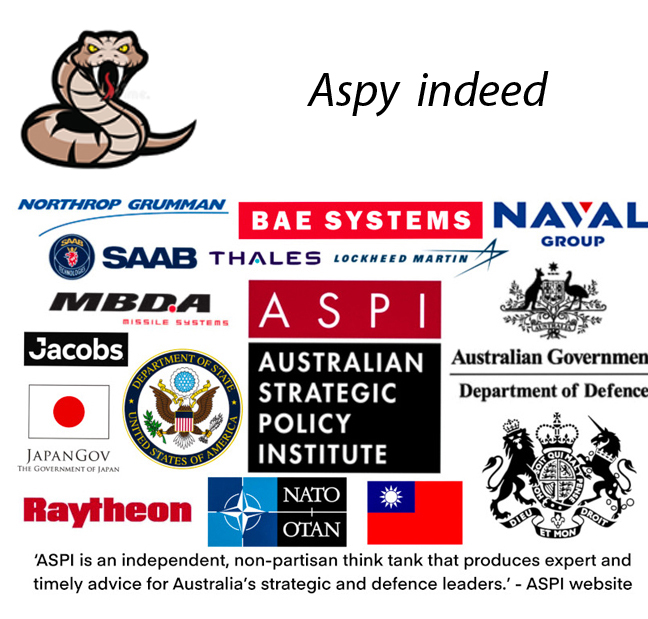
ASPI takes exception to media scrutiny, By Ainslie Barton, https://johnmenadue.com/aspi-takes-exception-to-media-scrutiny/ 25 Mar 23,
ABC’s Media Watch backs down, following complaint from Australian Strategic Policy Institute, after it aired a segment of Channel Nine political reporter Chris O’Keefe berating both ASPI and Nine Newspaper over the Red Alert series.
Two weeks ago, ABC’s Media Watch carried the banner “Hysterical reporting stokes fears of war with China” aimed at Nine Newspapers’ three-part Red Alert series in the Sydney Morning Herald and The Age. Host, Paul Barry took them to task for gathering a one-sided China hawk panel upon which to base its report. The program included comments from a host of experts who strongly disagree with the proposition that China is poised for war.
It also quoted from mainstream media, including a clip from Nine’s Today Show in which political correspondent Chris O’Keefe had this to say, “The reporting this morning is hysterical, now if you’ve got the Australian Strategic Policy Institute [ASPI] who are saying ‘Oh well, we are the ones who could be going off to war in three years’, well they’re funded by the Australian Defence Force, Lockheed Martin, Thales and Boeing.”
Barry later brought up one of Nine’s China experts, former ASPI boss Peter Jennings, making it clear he was no longer the think tank’s executive director.
This week, Media Watch again picked up the China threat and nuclear submarine debate, following former prime minister Paul Keating’s National Press Club appearance. In summary, Barry argued instead of mainstream journalists just launching into Keating for opposing AUKUS, they should have been doing their actual jobs. That job is not being cheerleaders for our massively hawkish foreign and defence policies, it’s asking questions about the government’s rationale to commit hundreds of billions of dollars to nuclear submarines.
However, at the end of the episode, it was Barry himself coming up with explanations, saying this, “And finally, a clarification about last week’s show. When discussing Nine’s Red Alert series on China we played a short clip of Chris O’Keefe linking Peter Jennings to the Australian Strategic Policy Institute. ASPI says Jennings no longer plays an active role with the institute and it was not involved in the framing of The Age and Herald’s report. ASPI also says it receives funding from only four defence manufacturers and it’s two percent of its budget.”
Even though the hot war may not have yet started the fog created by ASPI abounds.
Jennings is synonymous with ASPI, outside of Canberra he was a little-known Liberal ministerial adviser and a Defence Department policy wonk. It wasn’t until he took up the role at ASPI that he became the go to China hawk for mainstream media.
He might have vacated the executive director’s office but the views he expressed in the Nine Newspapers series are entirely consistent with his views at ASPI, and indeed the views of his successor Justin Bassi.
Despite ASPI’s constant claim of independence, Bassi walked right out of the office of Liberal Cabinet Minister Marise Payne into ASPI’s office, just a few blocks from Parliament House. He was a ‘captain’s pick’ with it widely reported then Defence Minister Peter Dutton intervened to veto the ASPI board’s preferred candidate, instead installing China hawk Bassi. The appointment of the ASPI executive director has to be ratified by the Cabinet, indeed a very broad interpretation of the term “independent”.
What constitutes no active role?
Jennings might have vacated his corner office but, the simple fact is, immediately upon the completion of his tenure, he assumed the position of “ASPI Senior Fellow”. His profile is on the ASPI website, his phone number is included, and that number is the ASPI direct line.
As ASPI complained, it might not have framed the Nine Newspapers report, but it absolutely framed the narrative. No single group has done more to portray China as a military threat than ASPI. There is an argument, had ASPI not spent years laying the China threat groundwork, this Nine Newspapers series would not have hit the front pages.
While Bassi had nothing to do with the Red Alert series, one could hardly argue he didn’t support it, after all he Tweeted a link to the SMH story the day of publication.
Far more egregious than this and the nature of Jennings’ ongoing connections with ASPI are those of Nine Newspapers’ gang of five experts. One in particular is Lavina Lee, who Nine described as a “geopolitics guru” and “senior lecturer in the Department of Security Studies and Criminology at Macquarie University”.
What both Nine in its publications, and presumably ASPI in its demands to Media Watch, did not disclose is Lee’s position as a member of the ASPI Council. This is not an honorary role, as the ASPI Annual Report reveals, it is a paid position.
The issue with Lee is not so much the freedom to express her opinions outside of her role at ASPI. It’s the fact she was peddling a narrative indistinguishable from ASPI’s, under the guise of being an independent academic, and did so without disclosing her formal paid role with the think tank.
Breaching the defences
Despite ASPI telling Media Watch it only has four defence industry sponsors, page 143 of its latest annual report clearly lists five. Since its establishment, ASPI has enjoyed the financial largesse of a dozen weapons makers, which collectively picked up $51 billion in Defence contracts between 2011 and 2021.
ASPI conveniently classifies sponsors who make billions of dollars supplying mainly high-tech services to the military as “private sector” companies.
One of its, non-defence industry, backers is the multi-billion dollar US engineering and systems integration company Leidos which has a substantial defence division. According to figures published on the Department of Finance website, since July 2021, it has been awarded more than 140 contracts, with the Department of Defence and security agencies, worth over $1 billion. The classification of Leidos as a run of the mill private sector player seems to be a loose definition.
Other, non-defence, supporters include engineering company Jacobs (107 Defence contracts worth $154 million); cybersecurity company Quintessence Labs, which has been awarded one small Defence contract; Palo Alto Networks which supplies multi-billion dollar network security systems for the military; Splunk Technologies, yet another military supplier; Senatas, a maker of military encryption systems; and software company Oracle, one of the biggest ICT service suppliers to the US military.
That adds up to 12 current sponsors who either make weapons or provide services supporting military infrastructure. The lesson is you can’t take anything ASPI says at face value.
Greens attack Albanese government’s ‘deeply unsettling’ secrecy on submarine nuclear waste plans.

Radiation Health and Safety Advisory Council also warned against cloak of national security to ‘mask inadequate radiation safety protection’.
Guardian. Daniel Hurst, 24 Mar 23
Labor and the Coalition have been accused of taking a “deeply unsettling approach” to transparency around Aukus after the major parties blocked the publication of documents about nuclear safety and waste issues.
The government cited national security concerns when it rejected a Senate order to produce documents, including those about options to manage operational waste from the nuclear-powered submarine program.
The move comes just months after the Radiation Health and Safety Advisory Council warned against allowing a cloak of national security to “mask inadequate radiation safety protection of the Australian public, weaken regulatory authority, or inhibit transparency on matters of Australian public safety”.
David Shoebridge, a Greens senator and defence spokesperson, said the council was “the very agency entrusted to protect Australians from radiation and ensure nuclear safety and security, yet the government is already ignoring its advice”.
“The hiding of information at this early stage signals a deeply unsettling approach to future regulation, transparency and oversight of these nuclear submarines,” Shoebridge said.
His motion had sought a range of documents reviewed by the Australian Nuclear Science and Technology Organisation (Ansto) working group, including the safeguards required for a nuclear-powered submarine program.
It also sought information about the “characterisation, classification and acceptance of risks in a nuclear environment” and any minutes of meetings held with the nuclear-powered submarine taskforce on these topics………….
The Coalition joined with Labor to defeat the motion in the Senate this week.
The former independent senator and submariner Rex Patrick said the blocking of the motion “shows the shallowness of thinking behind both major parties as to the need for complete transparency around this important issue”.
“This Aukus program has been orchestrated in total secrecy such that the government and Defence could get to a point of announcing a fait accompli without any debate or resistance,” Patrick said.
“There are some things that should properly be kept secret around a submarine – but these things should not include nuclear stewardship, nuclear regulation, nuclear safety or how to deal with operational waste and spent fuel.”
Patrick has, however, used freedom of information laws to obtain some other documents from Ansto and the Australian Radiation Protection and Nuclear Safety Agency (Arpansa).
These include minutes of an Ansto board meeting on 9 February showing the agency will seek government funding of $34.5m over the next four years because it faces increased workload “as a direct result of a nuclear-powered submarine program”…………………………………………………..
In the latest sign of misgivings within Labor, a party branch in the electorate of the prime minster, Anthony Albanese, passed a motion calling on his government to “withdraw from the Aukus alliance and cease any program in pursuit of the acquisition of nuclear submarines”.
Party members at the Enmore branch meeting this week agreed that Labor should prioritise spending that contributes to the “social good of our society rather than wasting hundreds of billions of dollars on a dangerous and unnecessary weapons program”.
According to a copy that has been widely circulated within NSW Labor, including to a large number of branch secretaries, the motion argued Aukus was “not in the interests of the Australian people” and “could take us into an unnecessary and devastating war”.
The motion reflects concerns within elements of the party’s rank-and-file membership, but does not yet indicate a groundswell that could stop the deal.
……………. The Petersham branch – also within Albanese’s electorate – passed an anti-Aukus motion in late February, before the San Diego announcement.
Labor members are also mobilising against the possibility of Port Kembla being selected as a future base for nuclear-powered submarines.
Some members are understood to have been emboldened to register their concerns, after several prominent Labor figures including the former prime minister Paul Keating spoke out against Aukus. https://www.theguardian.com/world/2023/mar/24/greens-attack-albanese-governments-deeply-unsettling-secrecy-on-submarine-nuclear-waste-plans
AUKUS – “These are the horrors”
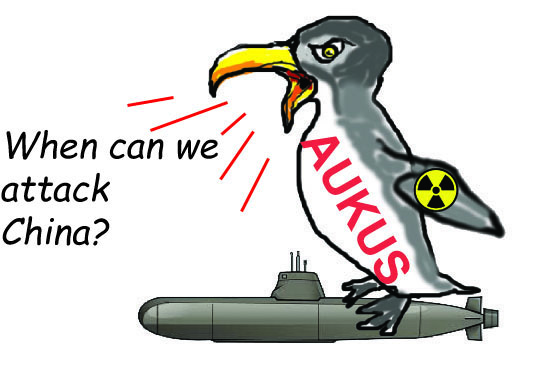
Instead of humiliatingly accepting the smirking American ‘we neither confirm nor deny the presence of nuclear weapons visiting your country’, the Albanese government could reassert a little of our lost sovereignty by stating up front, no nuclear weapons never.
The AUKUS submarines will not be here to defend Australia, but only to attack China in a subordinate role with the American forces.
Pearls and Irritations, By Richard Tanter, Mar 24, 2023
AUKUS. This is a horror for which I now fear for the lives of my children and their children. Every time a Labor member of parliament or senator puts foot outside their office to appear in public, turns up at a public meeting, we need to ask them: why have you betrayed us? Why have you allowed this to happen? What are you going to do?
Transcript of a speech at the Anti-AUKUS Rally, Naarm, State Library of Victoria lawn, 18 March 2023.
These are horrors.
This is a horror for which I now fear for the lives of my children and their children.
This is now changing the direction of Australia for the next forty or fifty years.
We have never seen anything like this in peacetime Australia. At any stage.
This must not stand.
But it’s with the suite of profound horrors that we must start with.
The horrors of AUKUS
Firstly, the automatic involvement in war.
We have already been tied to the United States by the bases – by Pine Gap, by North West Cape, by the Space Surveillance Telescope that take us into space warfare, by the many other Australian bases to which the US has access.
We are already tied in, hard-wired in many cases, to the American war machine.
And the ADF is barely an autonomous force today.
But AUKUS takes us very much further down that road.
We already know what the submarines are there for.
In a rational world I actually think submarines are very important for the defence of Australia – but not in the form of this politically-driven, call-from-Washington-inspired scheme for long-range, long-endurance nuclear-powered submarines whose only rational use is to attack China.
Not on their own – Keating’s right about that calling them toothpicks thrown at a mountain – but in concert with American submarines and carrier task forces.
Maybe not immediately nuclear-armed, but almost certainly capable of nuclear-attack as well.
The AUKUS submarines will not be here to defend Australia, but only to attack China in a subordinate role with the American forces.
The horror of that fiscal black hole.
What does that $368 billion actually amount to? As if we have any idea of what the value of a dollar will be in forty years time – the lifetime cost of AUKUS will be an order of magnitude higher, certainly two or even four trillion dollars.
But what that means in terms of the sacrifice from what’s needed from government for decent health and survival for the Australian people is itself horrific.
This moves us towards what I think is an almost irrevocable position of enmity as far as the Chinese are concerned.
Principally because the only rational strategic role for those submarines is to contribute, potentially, to an American existential threat to China.
Even if we stop tomorrow, is China going to forget that?
Why should they?
We’ve revealed our hand.
We have a Minister for Defence who is effectively the minister for Washington, and this is where we have come to.

The horror of the sacrifice zone that the high-level nuclear waste storage site that is to be somewhere built in Australia.
I have to say that of all things that have shocked me about this scheme, this is one that has shocked me most.
Not just because I made the mistake of thinking that Albanese might be halfway reasonable because in my role as a former president of ICAN I had relations with those people, and he pledged he would support a nuclear ban treaty.
Well, that’s not happening now unless we make it happen.
But the announcement of a nuclear waste dump for high-level toxic nuclear waste, radioactive for thousands of years, is another world all together.
I had foolishly thought that they would follow their own mantra for the past year of saying that ‘this will be a sealed reactor full of highly enriched uranium, and to prevent diversion to nuclear weapons, the US will deliver it sealed, and when the fuel is exhausted it will return to the United States sealed for disposal, somewhere safe, where no-one else can get at it …’
More fool me. More fool me.
They betrayed us again, and that nuclear sacrifice zone of high level waste is going to be a huge problem – and struggle – for decades and decades.
What really troubles me as someone who works on strategic issues and thinks that defence issues are real and important, is that this the largest defence expenditure – if we can use the word ‘defence’ with a straight face in this context – this massive defence expenditure actually disables our genuinely necessary defence capabilities.
There will be very little money left over for anything else in defence.
Worst of all, it disables the possibility of what we have come here today to call for – an independent defence and foreign policy – because there will be nothing left.
I heard one of those defence experts quoted in that authoritative source, Nine Entertainment’s Red Alert on the front pages of The Age – the same report that said yes, we have allies, we have Diego Garcia – all 27 square kilometres of it grabbed by the Brits and rented by the Americans, and we have Guam – the tiny American colony almost wholly taken up by US military bases – it would be funny if it wasn’t so awful and so telling about the government’s grasp of the actual facts – I saw that one of those experts said ‘we have to accept that if there is a war with China ‘that means Pine Gap goes’.
Actually I think that’s quite true, under certain circumstances. But the blitheness, the casualness with which that is said tells us a lot about how these people think.
Because if ‘Pine Gap goes’ in a nuclear missile attack, then Alice Springs and most of its 25,000 citizens ‘go’ too. No need to think about that, is there?
Just the casualness with which this is proposed and debated, apart from the ignorance, is stunning and revealing.
And the last part of the horror for me is the nuclear permissiveness which is now beginning to swell in discussions in Canberra security circles.
The momentum that is going to be built out of this first step of nuclear-powered submarine will mean we’re already going to have naval training for this; we’re going to have expanded nuclear engineering programs at places like the ANU.
We’re going to have military and naval careers built around this.
We’re going to have an industry here which has a deep interest in going the next step from naval nuclear propulsion to a civilian nuclear power industry.
We also know, because this is preceded by the US B-52 bombers at RAAF Tindal near Katherine in the Northern Territory – not nuclear-armed bombers at present, but quite definitely possibly nuclear-armed in the future at the stroke of a presidential pen –that those bombers will be used as part of an attack on China.
And what’s really important to understand now is that the South pacific Nuclear Weapon Free Zone, which Australia signed and says it’s proud of, has a loophole in it sponsored by the Australians to meet US needs, which says there are to be no nuclear weapons in the territories of the member states, like Australia, except in the case of ‘transits’ or ‘visits’.
Transits and visit in these days of American rotational deployments can cover an awful lot of interpretations.
The Albanese government could do one very simple thing to address this fear: it could declare that under no circumstances will any nuclear weapons from any country be allowed into Australia.
Not for a visit, not of layover in transit, just never.
No nuclear-armed aircraft, warships or submarines will ever be allowed to enter Australia.
The USS Asheville nuclear-powered attack submarine in Perth at the moment at Stirling Naval Base, and its successors, will never be allowed to return without a verifiable declaration that they come without nuclear weapons.
Instead of humiliatingly accepting the smirking American ‘we neither confirm nor deny the presence of nuclear weapons visiting your country’, the Albanese government could reassert a little of our lost sovereignty by stating up front, no nuclear weapons never.
The strategy of AUKUS
The strategic part of what’s happening at the American bases in Australia (aka ‘joint facilities’) is part of all this.
You know what is happening at Pine Gap, the giant American-built and American-paid for joint surveillance station outside Alice Springs.
You know about the wonderfully-named Harold E. Holt Naval Communications Station on the tip of North West Cape in Western Australia – a critical submarine communications base for American nuclear submarines and in the future for these AUKUS submarines. It’s immensely important, and probably another priority target, most likely nuclear under certain circumstances.
But just down the road the US has built a giant and highly advanced space telescope.
That doesn’t sound very much, does it.
But what it’s there for is our contribution to American plans for space warfare, to ensure what the US calls ‘space dominance’. And you understand perfectly well how critical space is for all militaries – and indeed our whole society – today.
We are deeply and increasingly plugged into that activity.
All governments have talked for the last thirty years about ‘the joint facilities’ – we don’t have any American bases, of which Australia has full knowledge and concurrence of any activities conducted at these bases.
When you peel that back, and when you talk to ministers – I can tell you I am continually shocked by their ignorance, as well as their deceptions………………………………………………………………………………………………………….. more https://johnmenadue.com/these-are-the-horrors-of-aukus/
Low dose radiation linked to heart disease
Columbia University Irving Medical Center, March 23, 2023
People exposed to low doses of ionizing radiation have an extra, but modest, risk of developing heart disease during their lifetime, according to a new study(link is external and opens in a new window) published by an international consortium of researchers.
“The study suggests that radiation exposure, across a range of doses, may be related to an increased risk of not just cancer, as has been previously appreciated, but also of cardiovascular diseases,” says Andrew Einstein, MD, PhD, professor of medicine at Columbia University Vagelos College of Physicians and Surgeons and one of the study’s senior authors.
“It should not steer people away from receiving radiation if necessary—in fact many medical uses of radiation are lifesaving—but it underscores the importance of ensuring that radiation is used appropriately and kept as low as reasonably achievable.”…………
The researchers used data from 93 studies covering all ranges of radiation exposures to find a relationship between dose and heart disease.
They found an increased excess lifetime risk of 2.3 to 3.9 cardiovascular deaths per 100 persons exposed to one Gy of radiation. (In the United States, about 25 out of every 100 people die from cardiovascular disease; a person exposed to 1 Gy of radiation will have a slightly higher, 27% to 29%, risk of dying from cardiovascular disease).
Few people other than those receiving radiation therapy will receive 1 Gy during their lives. But the researchers also found a higher risk of heart disease at low dose ranges (<0.1 Gy) more commonly experienced by the public and also for protracted exposures to low doses.
More research is needed to determine the precise increased excess lifetime risk of heart disease from these low doses.
“The effect of lower doses of radiation on the heart and blood vessels may have been underestimated in the past,” Einstein says. “Our new study suggests that guidelines and standards for protection of workers exposed to radiation should be reconsidered, and efforts to ensure optimal radiation protection of patients should be redoubled.”
References
More information
The study, titled “Ionising radiation and cardiovascular disease: systematic review and meta-analysis(link is external and opens in a new window),” was published March 8 in The BMJ…………………………….. https://www.cuimc.columbia.edu/news/low-dose-radiation-linked-heart-disease
—
Climate change may pose key risk to French reactors – said the country’s Court of Auditors

Each year, the volume of water withdrawn to cover the needs of the French population amounts to 33.5bcm, half of which is used to cool nuclear power plants.
Some 98% of this water is released back into rivers but at a higher temperature, which is regulated on a plant-by-plant basis.
MURIEL BOSELLI, Paris, 22 Mar 2023 https://www.montelnews.com/news/1466974/climate-change-may-pose-key-risk-to-french-reactors–court
The impact of global warming on France’s nuclear fleet could become “critical” by 2050, with three to four times more outages than today, said the country’s Court of Auditors in a report published late on Tuesday.
“These outages are concentrated, admittedly on short summer periods, but are increasingly long and can prove critical by increasing the risks of pressure on the grid,” said Annie Podeur, president of the second chamber of the court, during a hearing at the Senate.
These outages and capacity cuts led to “losses amounting to several TWh per year”, Podeur said, citing the record unavailability in 2003 of 6 GW of nuclear power, or 10% of France’s installed nuclear capacity.
Extreme heat
Increased risk of extreme heat and droughts amid climate change could impact nuclear plants, which use water to cool down.
Combined with this, the report pointed to the expected significant increase in power demand in the years to come, which would strain the grid.
Each year, the volume of water withdrawn to cover the needs of the French population amounts to 33.5bcm, half of which is used to cool nuclear power plants.
Some 98% of this water is released back into rivers but at a higher temperature, which is regulated on a plant-by-plant basis.
The reduced availability of water resources amid drought could exacerbate conflicts about usage with agriculture, tourism and other industries, said Podeur.
Predicting river flows
Climate models should be updated to include river flow levels for the coming years, recommended the report, adding that EDF needed greater storage capacity for water to cool reactors during periods of low flows.
Last summer, which was particularly hot and dry, France’s nuclear safety authority ASN authorised EDF to exceed temperature limits for certain plants to continue producing power.
This decision was taken after the utility stopped a record number of reactors for maintenance and corrosion probes.
The court urged EDF to quantify the total costs of adapting its fleet to deal with climate change.
The utility spent EUR 1bn on currently operational reactors from 2006-2021 and plans to invest only EUR 612m from 2023-2038, added Podeur.
EDF has estimated that outages related to heat and drought result in a loss of annual nuclear production of around 1%.
March 24 Energy News — geoharvey

Science and Technology: ¶ “The Promise Of Kelp-Powered Flight” • Catriona Macleod, deputy head of the Fisheries and Aquaculture Centre at the University of Tasmania’s Institute for Marine and Antarctic Studies in Australia, describes seaweed as the “Swiss army knife” of tools to tackle planetary challenges. Already widely used for food, it could eventually power […]
March 24 Energy News — geoharvey
Australia’s Defence Minister Richard Marles is a master of “weasel words”
I’ve been underestimating this guy.
I thought that he was just just emotionally ignorant, just a bit stupid in that area of thought. Well, he probably is, anyway.
But Richard Marles is not stupid. He is very clever in that way that seemingly fair-minded , oh-so-reasonable people, can manage to put across militaristic, propagandist, right-wing views. He’s got a great new term for US military bases in Australia –“collaborative facilities“
I think that they’re a rising breed – these nice-looking, clean-cut, pleasantly spoken types like the USA’s Anthony Blinken, who go around persuading everybody that it’s a good idea to pay $squillions of tax-payers’ money to their friendly USA and UK weapons company, and to move towards the brink of war against China, Russia or whoever.

At times, I almost yearn for the straightforwardness of the publicly admitted extreme right – in Australia, we have the lovely Peter Dutton, Leader of the Liberal Opposition, and an out and proud spokesman for militarism. At least we know where we are with these types.

“Weasel words” are very valuable currency in the present day and age. Look at the value to the warmongers of White House National Security Council spokesman John Kirby . I mean some people have been anxious in learning that depleted uranium weapons are to be used by the Ukrainian troops. But Mr Kirby was able to reassure us – “The ammunition, which enhances ability to overcome defenses on tanks, ‘is not radioactive’ – a commonplace type of munition“
Alas the Labor Party of Gough Whitlam and Paul Keating is long gone.
The Albanese Labor government is all about strategy and cunning manipulation of policies. This is a style in which the weasel-word likes of Richard Marles thrives. I’d like to think that Albanese has some long-term goal of thwarting the militaristic control of Australia by the USA.
But for now, Labor has lost me.
Richard Marles’ ill-advised spending on completely inappropriate Tomahawk missiles for Australia’s existing submarines
Marles the drunken sailor: Rex Patrick on Defence Minister’s haste to defence spending waste
by Rex Patrick | Mar 22, 2023
News yesterday that our Collins Class submarines will get fitted with Tomahawks reveals a serious lack of understanding about the tactical use of land attack missiles on submarines. Exposing the blithe war enthusiasts of the Murdoch press, former submariner Rex Patrick explains why Tomahawks on a Collins is a dumb idea.
Richard Marles is behaving like a drunken sailor as he spends your money. Drunken sailors, most of whom are happy souls, buy things like several rounds for everyone in the bar, pink Hawaiian t-shirts for themselves and their families, or tattoos of the name of the girl they met the night before. Upon sobering up they realise that what they had purchased was a hole in their wallets.
And that’s what Mr Marles will discover in time. The Tomahawk missiles he’s purportedly buying for our Collins Class submarines, as reported in The Australian yesterday, are not a good match.
Let me explain why.
Submarines and Tomahawk Missiles
Just after noon on 19 January 1991, during operation “Desert Storm”, USS Louisville became the first submarine to launch a land attack missile in anger, when she fired eight missiles at targets in Iraq. She did this operating from the Red Sea. Shortly afterwards, USS Pittsburgh became the second submarine to launch Tomahawks when she fired four more missiles from the Mediterranean Sea.
Submarines have subsequently fired land attack missiles in a number of other operations.
USS Miami fired some into Iraq In 1998 at the start of “Desert Fox” (the 4 day bombing operation undertaken in response to Iraq’s failure to comply with UN Security Council resolutions). USS Albuquerque, USS Miami and HMS Splendid fired some into Kosovo a year later as part of “Allied Force” during the Balkan war. HMS Trafalgar and HMSTriumph fired them into Afghanistan. In 2001 as part of operation “Enduring Freedom,” and in 2003, 12 US Navy submarines and the Royal Navy submarines HMS Splendid and HMS Turbulent attacked land targets in Iraq as part of “Iraqi Freedom”.
Finally, in March 2011 guided missile submarines USS Florida, and nuclear attack submarines USS Providence, USS Scranton and HMS Triumph fired some into Libya as part of operation “Odyssey Dawn”.
The role of land attack from submarines is clearly established.
Why land-strikes from submarines?
A submarine’s endurance, autonomy and relative impunity to detection allow pre-strike positioning to occur several weeks or months prior to the commencement of hostilities. This can occur without the “presence” of a force that might otherwise negatively influence diplomatic efforts to resolve an issue. The submarine can also conduct intelligence, surveillance and reconnaissance until such time as the land strike capability is needed. The submarine can be discreetly withdrawn if offensive action is not required.
The submarine also allows a land strike capability to be deployed into an area of operation where there is a lack of sea or air control, with the aim of attacking enemy defences to make the area safer for other more vulnerable units to enter. This includes ships with larger missile magazines and aircraft who can return the next day to launch more missiles.
Finally, when the strike order is given, having an undetected submarine very close to shore provides an advantage when striking the most sensitive of military targets or executing the most time critical attacks. Launch surprise maximises targeting effectiveness and minimises the chance of the weapons being intercepted. Close-to-shore submarines can also reach targets that are further inland.
Collins submarines’ limitations
Almost all submarines fitted with Tomahawks have nuclear propulsion, The Spanish S-80 submarines are the exception.
That’s because conventional submarines have their limitations………………………………………………………………………………………
Defence of Australia or like a tattoo?
There’s hardly a case to argue that our Collins class submarine’s need land attack cruise missiles to help defend Australia.
They would only be acquired to assist in a conflict with China, where we’re acting as part of a coalition. But even then, the issues associated with conventional submarines armed with Tomahawks are highly challenging and make the choice highly questionable.
So is Richard Marles behaving like a drunken sailor? Yes. But with some difference. Mr Marles seems loose with the money, but can’t really bring himself to look back on his commitment to spend.
1 This month


Help Aunty Sue Protect Her Land and Sacred Sites From Destructive Rocket Testing.
.

Australians deserve the truth
about
AUKUS – https://aukuspublicinquiry.com/

PETITION – To: Prime Minister Anthony Albanese and the Australian Labor Government

of the week – Australians for War Powers Reform (AWPR)
To see nuclear-related stories in greater depth and intensity

