The USA’s “climate” envoy at COP27 John Kerry is just another nuclear shill

John Kerry, ostensibly the US Special Climate Envoy, but actually yet another nuclear industry shill, used the occasion of the COP first to hold a special press conference to trumpet a $3 billion US nuclear deal with Romania and then announced a small modular reactor partnership with, incredibly, Ukraine.
“We have a viable alternative in nuclear,” Kerry told reporters. Viable? This was duly lapped up by the press without challenge.
John Kerry uses last-chance climate summit to tout nuclear power, https://beyondnuclearinternational.org/2022/11/13/the-kerry-copout/
By Linda Pentz Gunter, 14 Nov 22
“Russia’s seizure earlier this year of Ukraine’s Zaporizhzhia nuclear energy facility is shining a new light on the safety and security risks of the atomic export policies of the United States and other technologically advanced countries,” began a promising November 8 article in Roll Call.
However, that light seems to have blinded those in power to any common sense.
What has the alarm over the vulnerabilities of Ukraine’s reactors caught in a war zone actually taught any of them? Let’s start with the International Atomic Energy Agency.
“The problem is not nuclear energy,” IAEA Director General Rafael Grossi told the BBC recently. Nuclear power, Grossi said,“can provide a safe, clean source of energy and this is why many countries in Africa and in other places are turning to nuclear.” It’s just war that’s the trouble, Grossi said.
That’s like the gun lobby claiming it’s bad guys, not guns, that do the killing. Sorry, but no. Bad guys without guns can’t shoot people. Broken solar panels and fallen wind turbines can’t release massive amounts of radioactivity. The problem here very definitely IS nuclear energy. Period.
The IAEA position isn’t disingenuous of course. It’s a necessity borne of the agency’s massive conflict of interest, bound, as it is, to further and expand the use of nuclear power across the world. And then enforce safety at plants that are inherently dangerous.
“You will see that nuclear energy has a really solid, very consistent safety record,” said Grossi as the COP27 climate summit got underway in Egypt.
Except of course when there is a war, a prolonged loss of power, a natural disaster, a major human error or a catastrophic technical failure. Then, all of a sudden, having nuclear power plants is, according to Grossi, “playing with fire.”
Will US elected (or appointed) officials take heed of the obvious obstacles presented by nuclear power plants to achieving lasting peace and safety? Of course not. As we wrote here last week, US vice president, Kamala Harris, crowed about selling three Westinghouse reactors to Poland, tweeting that “We can address the climate crisis, strengthen European energy security, and deepen the US-Poland strategic relationship.”
Only the third part is true and is, of course, the basis for the contract in the first place, given Poland’s shared Eastern borders with Russia, Lithuania, Belarus, and Ukraine.
John Kerry, ostensibly the US Special Climate Envoy, but actually yet another nuclear industry shill, used the occasion of the COP first to hold a special press conference to trumpet a $3 billion US nuclear deal with Romania and then announced a small modular reactor partnership with, incredibly, Ukraine.
“We have a viable alternative in nuclear,” Kerry told reporters. Viable? This was duly lapped up by the press without challenge.
The Romanian debacle-to-be will be funded by the US Export-Import Bank. The Ukraine announcement read:
“Special Presidential Envoy for Climate John Kerry and Ukraine Minister of Energy German Galushchenko announced a Ukraine Clean Fuels from SMRs Pilot project that will demonstrate production of clean hydrogen and ammonia using secure and safe small modular nuclear reactor (SMR) and cutting-edge electrolysis technologies in Ukraine.”
Then they used the word “clean” again four times in the next paragraph. Which speaks volumes and definitely falls into the “doth protest too much” category.
Meanwhile, some experts in the field are warning against exporting nuclear technology to countries that might become embroiled in a war. Surely that would rule out Ukraine? And most if not all of Grossi’s beloved Africa? And what about Poland and Romania? How can we ever be sure which countries might suddenly find themselves at war? Another world war in Europe seemed unthinkable until February 24, 2022.
“An air raid siren sounded for the first time this morning in the nuclear city of Sosnovy Bor on the southern coast of the Gulf of Finland in the Baltic,” wrote Russian activist, Oleg Bodrov, a member of the Public Council of the Southern Coast of the Gulf of Finland (PCSCGF) in a November 8 email.
“A similar siren would have been heard by 2 million residents of the Leningrad Region,” said Bodrov. “It was a drill in case of war, which was carried out by decision of the authorities of the region.”
The term “nuclear football” is traditionally applied to the black bags containing the “nuclear button” that accompany the US president and vice president at all times. (The third is kept at the White House.) But nuclear power plants are also now proverbial nuclear footballs, being used to deliver a false sense of security but actually putting the countries on whose soil they sit in far greater danger.
Selling US reactors to Eastern European countries clearly has nothing whatever to do with climate or energy needs. “We don’t get to net zero by 2050 without nuclear power in the mix,” Kerry said at his COP press conference. Actually, yes, doing without slow, expensive and dangerous nuclear power is essential if we have any chance whatsoever of achieving net zero (2050 is already too late).
It is ever more apparent that most of our “mediocre politicians,” as Bodrov rightly characterizes them, are not interested in net zero. They are interested in using nuclear power as a nuclear weapons surrogate; in bolstering alliances with Russia’s neighbors in a dangerous move to drive Russia into ever greater political isolation; in propping up failing nuclear corporations like Westinghouse; and in answering their nuclear paymasters in Washington by wasting time and our money on foolish new nuclear plants that are irrelevant to addressing the climate peril we are already in.
Linda Pentz Gunter is the international specialist at Beyond Nuclear and writes for and curates Beyond Nuclear International.
Bill Gates and techno-fix delusions

When elites try to change the world, it’s not usually for the better for the rest of us
Beyond Nuclear By M.V. Ramana and Cassandra Jeffery 14 Nov 22
Bill Gates, the businessman, made one of the world’s biggest fortunes by designing, selling and marketing computer technology. It shouldn’t come as a surprise that when it comes to climate change, he’s pushing more technology.
When wealthy people push something, the world pays attention. Practically all major media outlets covered his recent book, How to Avoid a Climate Disaster, and Gates has been interviewed dozens of times. All this pushing came with the pre-emptive caveat expressed in his book that the “world is not exactly lacking in rich men with big ideas about what other people should do, or who think technology can fix any problem.”
In his account of how elites try to “change the world,” journalist Anand Giridharadas explained: “All around us, the winners in our highly inequitable status quo declare themselves partisans of change. They know the problem, and they want to be part of the solution. Actually, they want to lead the search for solutions…the attempts naturally reflect their biases.
Gates is no exception to the rule; his bias favors maintaining the current economic and political system that has made him into one of the richest people in the world. The same bias also underpinned his stance on preserving intellectual property rights over Covid-19 vaccines, even at the cost of impeding access to these vaccines in much of the world.
Just as the pandemic was accentuated by insisting on the rights to continued profits for pharmaceutical companies, climate change is exacerbated by the current economic system that is predicated on unending growth.
A focus on technical solutions without fixing the underlying driver of climate change will not help. What is worse, some of the proposed technologies are positively dangerous.
Exhibit A: untested nuclear reactors like the ones that Gates is developing and endorsing.
Puzzling Choices
In an interview with CNBC following the publication of his book, Bill Gates announced: “There’s a new generation of nuclear power that solves the economics, which has been the big, big problem.”
To understand the economic problem, consider the only two nuclear reactors being built in the United States. These are in the state of Georgia, and the cost of constructing these has ballooned from an initial estimate of $14 billion to over $30 billion.
Even worse was the case of the V. C. Summer project in South Carolina, where over $9 billion was spent, only for the project to be abandoned because cost overruns led to Westinghouse, one of the leading nuclear reactor companies in the world, filing for bankruptcy protection.
These high construction costs naturally result in high electricity costs. In 2021, Lazard, the Wall Street firm, estimated the average cost of electricity from new nuclear plants to be between $131 and $204 per megawatt hour, whereas it estimated that newly constructed utility-scale solar and wind plants produce electricity at somewhere between $26 and $50 per megawatt-hour.
Likewise, in June 2022 NextEra, a large electricity utility, estimated that wind and solar energy, with four hours of electricity storage to allow for generation even when the sun is not shining or the wind is not blowing, ranged between $25 and $37 per megawatt-hour. Electricity from renewables is thus far cheaper than nuclear power, a difference only growing as solar and wind continue to become cheaper.
Many reactors have been shut down because they are unprofitable. In 2018, Bloomberg New Energy Finance concluded that more than a quarter of U.S. nuclear plants don’t make enough money to cover their operating costs.
That year, NextEra decided to shut down the Duane Arnold nuclear reactor in Iowa, because it was cheaper to take advantage of the lower costs of renewables, primarily wind power. The decision, NextEra estimated, will “save customers nearly $300 million in energy costs, on a net present value basis.”
It is this economic conundrum that Gates is claiming to address through new nuclear reactor designs. He is not alone. A number of other investors have backed “new” nuclear technology, and dozens of companies have received funding to design “advanced” or “small modular” reactors.
But these nuclear reactors of the future are no less problematic than traditional reactors. Besides unfavourable economics, there are at least three other well-known “unresolved problems” with nuclear power.
First, the acquisition of nuclear power technology increases the capacity of a country to make nuclear weapons, and thus increases the risk of nuclear weapons proliferation.
Second, despite assurances about safety, all nuclear reactors can undergo major accidents, albeit infrequently. Chernobyl and Fukushima are the best-known examples, but not the only ones.
Third, the multiple forms of radioactive waste produced during the nuclear energy generation process pose a seemingly intractable management problem. Exposure to these wastes will be harmful to people and other living organisms for hundreds of thousands of years.
Wastes must therefore be isolated for millennia from human contact. The storage and disposal of these wastes often take place in poor, disadvantaged communities, typically far away from the gated homes of people like Gates.
It is not possible to simultaneously address all of these four challenges — cost, safety, waste, and proliferation — facing nuclear power. To a greater or lesser extent, all these problems will afflict the reactors being developed by TerraPower, the nuclear power company backed by Gates………………………………………………………………………….more https://beyondnuclearinternational.org/2022/11/13/bill-gates-and-techno-fix-delusions/
Surprise surprise. USA co-opts Ukraine to try out small nuclear reactors

US, Ukraine announce project on construction of small modular nuclear reactor,
New initiative aims to accelerate conversion of coal-fired power plants in central, eastern Europe: US State Department AA, Burc Eruygur |13.11.2022
The US and Ukraine have announced the launch of a project on the construction of a small modular nuclear reactor (SMR) in Ukraine during the 27th UN Climate Change Conference (COP27) in Egypt, according to the US State Department.
“Special Presidential Envoy for Climate John Kerry and Ukraine Minister of Energy Herman Halushchenko announced a Ukraine Clean Fuels from SMRs pilot project that will demonstrate the production of clean hydrogen and ammonia using secure and safe SMRs and cutting-edge electrolysis technologies in Ukraine,” read a statement by the US State Department on Saturday………………………
In addition to Argonne National Laboratory and Ukraine’s Energoatom, National Security and Defense Council, and State Scientific and Technical Center for Nuclear and Radiation Safety, the statement expresses that multiple private companies will also take part in the project’s multinational consortium.
Kerry separately announced the launch of a new initiative, called Project Phoenix, “to accelerate the transition in Europe of coal-fired plants to SMRs while retaining local jobs through workforce retraining,” it also said.
“Project Phoenix will provide direct US support for coal-to-SMR feasibility studies and related activities in support of energy security goals for countries in central and eastern Europe,” according to the statement.
On Sunday, Ukraine’s Ambassador to the US Oksana Markarova also confirmed the project, reiterating the information released by the US State Department.
“Ukraine is not only working to protect and quickly repair/replace what was destroyed but is already planning to build an innovative energy system,” Markarova said on Facebook. https://www.aa.com.tr/en/russia-ukraine-war/us-ukraine-announce-project-on-construction-of-small-modular-nuclear-reactor/27
Why molten salt nuclear reactors really can’t succeed
Beyond Nuclear By M.V. Ramana and Cassandra Jeffery 14 Nov 22

………………………………………………………….Technical Problems
Let us start with the problems with the molten chloride fast reactor. As its name suggests, the reactor uses nuclear materials dissolved in molten chemical salts.
Salt is corrosive — just ask anyone who lives on the coast. So the inside of the reactor will be a chemically corrosive and highly radioactive environment.
No material can perform satisfactorily in such an environment. After reviewing the available studies, all that the U.S. Idaho National Laboratory — a nuclear power booster — could recommend was that “a systematic development program be initiated.”
TerraPower has three different nuclear reactor designs on the books: the Natrium reactor; the molten chloride fast reactor; and the traveling wave reactor.
Given his emphasis on novelty and innovation, one would expect Gates to put his money on reactor designs that are new and likely to succeed. None of these designs have that merit. All of these reactors are based on two old reactor designs vexed with major problems.
Other leading research laboratories like France’s Institut de radioprotection et de sûreté nucléaire (IRSN) and the U.K.’s Nuclear Innovation and Research Office, have concluded that molten salt reactors are problematic. As IRSN put it, “numerous technological challenges remain to be overcome before the construction of an MSR can be considered.”
The historical experience with molten salt reactors has been pretty bleak, to put it mildly. The last one to be built was the Molten Salt Reactor Experiment in Oakridge, Tennessee. It operated intermittently from 1965 to 1969, and operations were interrupted 225 times in those four years; of these interruptions, only 58 were planned.
But it’s not just a matter of molten salt reactors being unreliable or technologically challenged. As Edwin Lyman from the Union of Concerned Scientists has documented at length, the “use of liquid fuel instead of a solid fuel” in molten salt reactors “has significant safety implications for both normal operation and accidents.”
Specifically, the molten nature of the fuel makes it easier for radioactive materials to escape into the atmosphere and be dispersed.
Terrapower’s other two reactor designs are not much better. Both the Travelling Wave Reactor and the Natrium use molten sodium. Another problematic material, molten sodium is used to transport the intense heat produced by the nuclear fission reactions. Again, such reactors have been constructed since the dawn of the nuclear age and with similarly dismal results.
To start with, such reactors have had numerous accidents. The record starts on November 29, 1955 when the Experimental Breeder Reactor (EBR-1) in Idaho had a partial core meltdown.
A decade later, in October 1966, the Fermi-1 demonstration fast reactor in Michigan suffered a partial core meltdown. The shock made its way into the cultural mainstream in the form of a book called We Almost Lost Detroit and a song with the same name by Gil Scott Heron.
In Japan, the Monju reactor suffered a series of accidents and produced almost no electricity, after an expenditure of at least $8.5 billion
The use of molten sodium makes such reactors susceptible to serious fires, because the material burns if exposed to air. Almost all sodium-cooled reactors constructed around the world have experienced sodium leaks, likely because of chemical interactions between sodium and the stainless steel used in various components of the reactor.
Finally, the use of sodium also makes it difficult to maintain and carry out repairs on fast reactors, which then become susceptible to long shutdowns. Having to deal with all these volatile properties and safety concerns naturally drives up the construction costs of fast reactors, rendering them substantially more expensive than common thermal reactors.
Sodium-cooled reactors are also unreliable, operating at dismally low rates compared to standard reactors. The load factor (the ratio of the amount of electrical energy a power plant has produced to the amount of energy it would have produced had it operated at full capacity) for the Prototype Fast Reactor in the United Kingdom was 27%; France’s Superphenix reactor managed a mere 7.9%.
The typical U.S. reactor operates with a load factor of more than 90%. Sodium- cooled reactors would have to sell their power at higher prices to compensate for the fewer units of electrical energy generated.
“Without innovation, we will not solve climate change,” chanted Gates. But no amount of innovation will change the laws of chemistry or physics. How sodium behaves when it interacts with air or water won’t be affected, even if the sodium is inside a nuclear reactor backed by one of America’s oligarchs.
Innovation will not change the fact that the radioactive wastes produced by the Natrium reactor will remain hazardous for tens of thousands of years……………………………………………….. more https://beyondnuclearinternational.org/2022/11/13/bill-gates-and-techno-fix-delusions/
November 13 Energy News — geoharvey

Opinion: ¶ “Millions Of US Homes Are Installing Heat Pumps. Will It Be Enough?” • Across the United States, over 15 states and roughly 100 cities have begun to shift policies to encourage or require electrification of homes, workplaces, schools, and government buildings. Nevertheless, we are falling woefully short on climate pledges. We have to […]
November 13 Energy News — geoharvey
The Australian nuclear lobby is at it again. Nine right-wing rural senators push to change the laws on nuclear activities
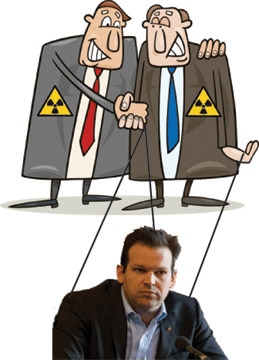
Senator Matt Canavan has a chequered history when it comes to his attitudes and statements on energy and resources
Sept 2021 Canavan cold on the push for nuclear power – and talked up the prospects of coal exports. “Obviously, if we can’t find a long-term solution for that level of waste it’s pretty hard to fathom that we could go beyond that for the production of nuclear energy that does produce a larger amount and more waste of a higher category to manage.”
Augus 31 21 Canavan tweeted called on Australia to boycott Glasgow, labelling the conference a “sham”
August 28 21 – lead the charge in his party’s anti-science war, with the CSIRO a main target
August 11 21 “Myself and Member for Flynn, Ken O’Dowd, we’re happy to have a nuclear power station in our backyard.”
Canavan was called out, in March 21 for his inaccurate hype about small nuclear reactors
.
“On 27 October 2022 the Senate referred the Environment and Other Legislation Amendment (Removing Nuclear Energy Prohibitions) Bill 2022 to the Environment and Communications Legislation Committee for inquiry and report by 31 March 2023.
The close date for submissions is 12 December 2022.
About this inquiry:
The bill would amend the Australian Radiation Protection and Nuclear Safety Act 1998 to remove the prohibition on the construction or operation of certain nuclear installations; and Environment Protection and Biodiversity Conservation Act 1999 to remove the prohibition on the Minister for Environment and Water declaring, approving or considering actions relating to the construction or operation of certain nuclear installations. https://www.aph.gov.au/Parliamentary_Business/Committees/Senate/Environment_and_Communications/Nuclearprohibitions?fbclid=IwAR1ZJyT5tShsXWXm9q2XGv4aHPnN7r_gj6V1VNNNmET3YAfCQWG7RSJ21bQ
The leader is this push is Senator Matt Canavan, Strangely, Canavan resigned from the task of being in charge of the nuclear waste dump program, in order to pursue his own politcal ambitions in a spill in the National Party.
Others include Jacinta Yangapi Nampijinpa Price– Country Liberal Party, (Northern Territory)
David Julian Fawcett – Liberal Party, (SA), Alex Antic – Liberal (SA) David Van -Liberal Party (Victoria), Ross Cadel – National Party (NSW), Gerard Rennick – Liberal National Party ( Queensland)
·Note from Kazzi Jai – at Fight to stop a nuclear waste dump in South Australia
I’ll get back to you on this, but judging by last Thursday’s Senate Estimates, it sounds like there is again a push for nuclear energy by vested interests….Seems people like Matt Canavan – the Senator who RESIGNED from being Minister in charge of the dump SO THAT HE COULD PURSUE HIS OWN POLITICAL AMBITIONS in a spill in the Nats….and now crows about putting SCIENCE into these debates AND NOT POLITICS – absolutely LAUGHABLE….anyway he OPENED the Global Uranium Conference 2022 last week
AND he was in my opinion disruptive in the Senate Estimates sitting, interjecting when Minister Ayres was answering a question FROM A DIFFERENT SENATOR! Matt Canavan was given A LOT OF LATTITUDE in my opinion from the Seat…..GIVEN ALSO THAT BOTH HOUSES OF PARLIAMENT ARE NOT RULED BY THE COALITION! Seems OLD HABITS die hard!
Australia “should not face intimidation from so-called allies under the auspices of defense cooperation”

Australia “should not face intimidation from so-called allies under the auspices of defense cooperation,” said Kate Hudson, general secretary of the Campaign for Nuclear Disarmament. “The TPNW offers the best chance for lasting global peace and security and a clear road map for nuclear disarmament.”
‘So Irresponsible’: US Condemned for Warning Australia Against Joining Anti-Nuclear Treaty.
Australia “should not face intimidation from so-called allies under the auspices of defense cooperation,” said one advocate. https://www.themoscowtimes.com/2022/11/08/russia-us-eye-nuclear-arms-reduction-talks-in-coming-weeks-kommersant-a79313 JULIA CONLEY, November 9, 2022, Anti-nuclear weapons campaigners rebuked the Biden administration on Wednesday over its opposition to Australia’s newly announced voting position on the Treaty on the Prohibition of Nuclear Weapons, which could signal the country’s willingness to sign on to the agreement.
As The Guardian reported, the U.S. Embassy in Canberra warned Australian officials that the Labour government’s decision to adopt an “abstain” position regarding the treaty—after five years of opposing it—would obstruct Australia’s reliance on American nuclear forces in case of a nuclear attack on the country.
Australia’s ratification of the nuclear ban treaty, which currently has 91 signatories, “would not allow for U.S. extended deterrence relationships, which are still necessary for international peace and security,” the embassy said.
The U.S. also claimed that if Prime Minister Anthony Albanese’s government ratifies the treaty it would reinforce “divisions” around the world.
Australia “should not face intimidation from so-called allies under the auspices of defense cooperation,” said Kate Hudson, general secretary of the Campaign for Nuclear Disarmament. “The TPNW offers the best chance for lasting global peace and security and a clear road map for nuclear disarmament.”
The TPNW prohibits the development, testing, stockpiling, use, and threats regarding the use of nuclear weapons.
The Australian chapter of the International Campaign to Abolish Nuclear Weapons (ICAN) noted that Albanese’s vocal support for achieving nuclear disarmament puts him in line with the majority of his constituents—while the U.S., as one of nine nuclear powers in the world, represents a small global minority.
According to an Ipsos poll taken in March, 76% of Australians support the country signing and ratifying the treaty, while only 6% are opposed.
Albanese has won praise from campaigners for his own anti-nuclear advocacy, with the prime minister recently telling The Australian that Russian President Vladimir Putin’s nuclear saber-rattling “has reminded the world that the existence of nuclear weapons is a threat to global security and the norms we had come to take for granted.”
“Nuclear weapons are the most destructive, inhumane, and indiscriminate weapons ever created,” Albanese said in 2018 as he introduced a motion to commit the Labour Party to supporting the TPNW. “Today we have an opportunity to take a step towards their elimination.”
Labour’s 2021 platform included a commitment to signing and ratifying the treaty “after taking account” of factors including the development of “an effective verification and enforcement architecture.”
Australia’s decision to change its voting position comes as the U.S. is planning to deploy nuclear-capable B-52 bombers to the country, where the weapons will be positioned close enough to strike China.
Gem Romuld, Australia director of ICAN, said in a statement that “it’s no surprise the U.S. doesn’t want Australia to join the ban treaty but it will have to respect our right to take a humanitarian stance against these weapons.”
“The majority of nations recognize that ‘nuclear deterrence’ is a dangerous theory that only perpetuates the nuclear threat and legitimizes the forever existence of nuclear weapons, an unacceptable prospect,” Romuld added.

Beatrice Fihn, executive director of ICAN, called the U.S. embassy’s comments “so irresponsible.” “Using nuclear weapons is unacceptable, for Russia, for North Korea, and for the U.S., U.K., and all other states in the world,” said Fihn. “There are no ‘responsible’ nuclear armed states. These are weapons of mass destruction and Australia should sign the TPNW!”
The definitive case against nuclear subs
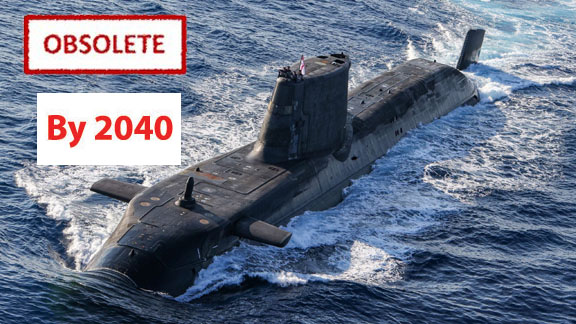
Australia needs submarines, but conventional ones are more than adequate for the nation’s security. Australia’s north is archipelagic, which means smaller, shorter-ranged submarines can close maritime avenues of approach.
Australia needs submarines, but conventional ones are more than adequate for the nation’s security. Australia’s north is archipelagic, which means smaller, shorter-ranged submarines can close maritime avenues of approach.
The Saturday Paper, Albert Palazzo -adjunct professor at UNSW Canberra. He was a former director of war studies for the Australian Army. November 12, 2022
It’s more than a year since Australia scuttled its submarine deal with France in favour of the nuclear-powered submarine arrangement Scott Morrison announced as part of the AUKUS agreement. There’s been a change of government and more announcing, yet any real detail on why we need such boats, how we’ll get them, which ones they’ll be and how much they’ll cost remains unknown. What has become increasingly clear, however, is that these warships are a massive boondoggle for which there is little strategic justification.
Australia maintains its defence forces to provide for the nation’s security. Every capability the Australian Defence Force acquires undergoes a detailed decision process that includes an examination of how the weapon meets national security requirements. With the nuclear-powered submarine program, however, Australia’s starting point was an announcement confirming the acquisition and the AUKUS agreement, an order of proceedings that conveniently bypassed the messy and challenging aspects of justification for the purchase.
Perhaps skipping this phase was necessary because the rationale given for the acquisition is unsound. At best, it is a desire to be seen to be supporting the ANZUS Treaty. What is not being asked is whether support for the alliance should be the main basis for the acquisition of such expensive platforms with such narrow utility.
Like a kid in a lolly shop, Australia has been given permission to buy the biggest treat on display … What is missed, however, is that being in the inner sanctum generates a massive obligation – and some day that bill may fall due.
What does Australia intend to do with its fleet of nuclear-powered submarines? The answer seems to be that we’ll project power into the East and South China seas, in order to deter our largest trading partner, China, from taking actions inimical to Australian and American interests.
If China is a threat today, why is the government planning to acquire a platform that will not be available for 15 years or more? Shouldn’t the priority be on more readily available weapons? These would include off-the-shelf conventional submarines, additional long-range strike missiles, and drones of all kinds.
Even once Australia has acquired its entire fleet of eight submarines, only two or three are likely to be available for operations at any one time. Deterrence necessitates the ability to intimidate one’s opponent. China is a large country with great industrial depth and a population accustomed to hardship. It also has 66 submarines of its own and more on the way. It is hubris to expect Australia will be able to intimidate a great power, at least on its own.
More worryingly, the seas in which Australia aims to operate are within China’s anti-access/area denial zone, an area guarded by missiles, mines, aircraft and ships, and of such lethality that even the United States is unsure it could penetrate without massive losses. Even if our future submarines did get inside this defensive zone, they would not last long. Essentially, these submarines should not be expected to return home.
Survivability is an important criterion for such an expensive purchase. Enthusiasts point to the better survival potential of nuclear-powered submarines because they remain submerged for longer periods, thereby making detection harder. By contrast, conventional subs must periodically surface to recharge their batteries. But this is an advantage that is fast becoming irrelevant. Sensor technology is improving and becoming pervasive, as demonstrated daily in the war in Ukraine. It is a very big gamble to act on a presumption that sub-surface sensors will not improve in the 15 to 20 years before Australia’s submarines become operational. In fact, a study from Australian National University’s National Security College expects that before 2050 the oceans will become fully transparent to hunters from above.
Any defensive advantage currently possessed by nuclear-powered submarines will be gone.
More questions need to be asked: What is the strategic benefit of being able to operate off the Chinese coast? How do nuclear-powered submarines improve Australia’s security? And are there better options for the nation’s defence?
The answers to the first two questions are: “There is none” and “They don’t.” The third answer is: “Yes, there are indeed better options.” Australia needs submarines, but conventional ones are more than adequate for the nation’s security. Australia’s north is archipelagic, which means smaller, shorter-ranged submarines can close maritime avenues of approach. …………
Supporters of the nuclear-powered submarine pay too little attention to the project’s opportunity cost. According to experts at the Australian Strategic Policy Institute, the eight planned submarines will cost at least $116 billion, and likely much more – upwards of $200 billion, according to some analysts. Australia needs submarines, but conventional ones are more than adequate for the nation’s security. Australia’s north is archipelagic, which means smaller, shorter-ranged submarines can close maritime avenues of approach………………………….. more https://www.thesaturdaypaper.com.au/opinion/topic/2022/11/12/the-definitive-case-against-nuclear-subs
A Father Fights for His Son & What’s Left of Democracy
The film Ithaka, about the quest of Julian Assange’s father to save his son, makes its U.S. premiere on Sunday in New York City. It is reviewed by Joe Lauria.
By Joe Lauria
Special to Consortium News
To the extent that the media has covered the tragedy of Julian Assange at all, the focus has been on politics and the law.
Consortium News, which has provided perhaps the most comprehensive coverage of the prosecution under the Espionage Act of the WikiLeaks publisher, has also focused more on the case and less on the man.
The great issues involved transcend the individual: war, diplomacy, official deception, high crimes, an assault on press freedom and on the core of what little democracy is left in a militarized and money-corrupted system.
Assange supporters sometimes also overlook the person and concentrate instead on the larger issues at stake. Ironically, it has been Assange’s enemies and detractors who’ve long focused on the person in the worst tradition of ad hominem assaults.
He has been attacked to deflect public attention from what WikiLeaks has revealed, from what the state is doing to him and to hide the impact on freedom in the media and standards in the courtroom.
There has been a steady and organized stream of smears against Assange, from ridiculous stories about him smearing feces on Ecuadoran Embassy walls to the widely reported falsehood that he was charged with rape. That case was dropped three times before any charges were filed, but the “rape” smear persists.
These personal attacks were planned as far back as March 8, 2008 when a secret, 32-page document from the Cyber Counterintelligence Assessment branch of the Pentagon described in detail the importance of destroying the “feeling of trust that is WikiLeaks’ center of gravity.” The leaked document, which was published by WikiLeaks itself, said: “This would be achieved with threats of exposure and criminal prosecution and an unrelenting assault on reputation.”
An answer to these slurs and the missing focus on Assange as a man is Ithaka. The film, which makes its U.S. premiere Sunday night in New York, focuses on the struggle of Assange’s father, John Shipton, and his wife, Stella Assange, to free him.
f you are looking for a film more fully explaining the legal and political complexities of the case and its background, this is not the movie to see. The Spanish film, Hacking Justice, will give you that, as well as the more concise exposition in the brilliant documentary, The War on Journalism, by Juan Passarelli.
Ithaka, directed by Ben Lawrence and produced by Assange’s brother, Gabriel Shipton, humanizes Assange and reveals the impact his ordeal has had on the people closest to him.
The title comes from the poem of that name by C.P. Cavafy (read here by Sean Connery) about the pathos of an uncertain journey. It reflects Shipton’s travels throughout Europe and the U.S. in defense of his son, arguably the most consequential journalist of his generation.
The story begins with Shipton arriving in London to see his son for the first time behind bars after the publisher’s rights of asylum were lifted by a new Ecuadoran government leading to him being carried out of the embassy by London police in April 2019.
“The story is that I am attempting in my own … modest way to get Julian out of the shit,” Shipton says. “What does it involve? Traipsing around Europe, building up coalitions of friendship.” He meets with parliamentarians, the media and supporters across the continent. Shipton describes the journey as the “difficulty of destiny over the ease of narrative.”……………………………
We learn that Julian Assange’s frustration with the inability to stop the 2003 Iraq invasion, despite the largest, worldwide anti-war protests in history, motivated him to start WikiLeaks.
The releases he published about the Iraq and Afghanistan wars, leaked by Army intelligence analyst Chelsea Manning, were published not only by WikiLeaks but by its partners at The New York Times, Die Spiegel and The Guardian, yet only Assange has been prosecuted.
The main focus of the film is the extradition hearing in Westminster Magistrate’s Court that began in February 2020 and ended in September of that year…………………………
One of several scenes that drives home the personal side of the story is audio of Assange speaking from Belmarsh Prison to Stella about what children’s books to read to their two sons. The toll it is taking on her is seen as she breaks down emotionally during the recording of a BBC interview that has to be paused.
“Extraditions are 99 percent politics and one percent law,” Stella says. “It is entirely the political climate around the case that decides the outcome. And that is shaped by the media. For many years there was a climate that was deliberately created through false stories, smears; through a kind of relentless character attack on Julian to reduce that support and make it more likely to successfully extradite him to the United States.”
“This is the public narrative that has been spread in the media for ten years,’ Nils Melzer, the now former U.N. Special rapporteur on torture, says in the film.
“No one has been able to see how much deception there is. Why is this being done? For ten years all of us were focused only on Julian Assange, when he never wanted it to be about him. It never was about him. It was about the States and their war crimes and their corruption. That’s what he wanted to put a spotlight on – and he did. And that’s what made them angry. So they put the spotlight on him.”
“He just needs to be treated like a human being,” says Stella, “and be allowed to be a human being and not denied his dignity and his humanity, which is what has been done to him.”
Ithaka makes its first theatrical showing in the U.S. at the SVA Cinema, 333 W. 23rd St, New York, N.Y., on Sunday, Nov. 13, at 7:45 pm. There will be a Q&A following the first screening with Ben Lawrence, Gabriel Shipton, Adrian Devant, cinematographer Niels Ladefoged, and John Shipton.
For ticket information: https://docnyc.net/film/ithaka/ https://consortiumnews.com/2022/11/11/a-father-fights-for-his-son-whats-left-of-democracy/
Memo G20 – there is a greater enemy than China to fight
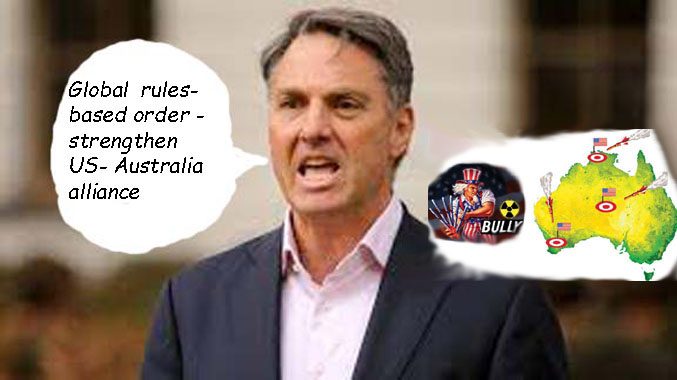
But Australia’s biggest diplomatic effort is going into creating a bifurcated world, preparing to fight another war for another imperial power, surrendering our sovereignty and our military in the process – and happy to remain in the rear on climate.
The Albanese Government shows no sign of changing course, plunging ahead with Australia’s biggest defence spend – submarines designed to sit off China’s coast as part of an offensive force – and hosting American long-range strategic bombers.
Michael Pascoe, The New Daily, 12 Nov 22,
When Earth faces an existential threat in the movies – aliens, rogue asteroids, that sort of thing – human beings unite to fight Armageddon.
Turns out real life isn’t like that.
Right now our quality of life and, for many millions, perhaps billions of people, their actual lives are in imminent danger. So what policy is Australia championing in the face of global disaster?
As a middle power that, in the past, has sometimes punched above its weight, what influence are we trying to exert to save the world? Unite and fight the killer aliens? Pool our talents to divert the asteroid? Nah.
We’re pushing for a hopelessly divided world, ignoring the real problem to fiddle about with less challenging matters, concentrating on supporting one superpower’s economic interests over another.
Tipping Points
Earth is approaching horrific climate change tipping points. It’s not a matter of an extra few tenths of a degree, some more monster bushfires and extra floods.
It’s about sudden collapse in the systems that sustain us.
But Australia’s biggest diplomatic effort is going into creating a bifurcated world, preparing to fight another war for another imperial power, surrendering our sovereignty and our military in the process – and happy to remain in the rear on climate.
The United States’ determination to exert its global primacy isn’t the main game. Much of the world understands that, but not our insular Anglosphere and certainly not the group think that pervades Canberra.
Once Australia hoped to be a bridge between the US and China. That hope was dashed by the gross ineptitude and crass stupidity of the Morrison government, leaping at the opportunity to out Sinophobe the Americans, locking Australia into America’s confrontational agenda.
The Albanese Government shows no sign of changing course, plunging ahead with Australia’s biggest defence spend – submarines designed to sit off China’s coast as part of an offensive force – and hosting American long-range strategic bombers.
“It makes sense to actually normalise the relationships,” Mr Albanese said before heading off to Asia for ASEAN and G-20 summits and, hopefully, a meeting with President Xi.
“We want to see a stabilisation in the relationship.”
Upping the ante
Upping the offensive weaponry ante seems a strange way of normalising a relationship while demanding China roll back the trade penalties imposed after Morrison’s diplomatic blundering. (And regarding Mr Albanese’s alleged “$20 billion” trade sanctions – the figure is bogus. Our wine industry has certainly been hurt, but our other commodity exports have had no trouble finding other markets paying just as well, if not better. Ask any coal miner.)
Back in the main game, climate change doesn’t seem to figure as a headline issue for Mr Albanese at the G20. And it seems not to be for US President Biden ahead of his meeting with President Xi. He is more interested in establishing rules for dividing the world.
Meanwhile, the COP27 climate change summit is underway in Egypt. All the news coming out of it ranges from bad to worse.
Joe Biden is dropping in on his way to Asia. Prime Minister Albanese is skipping it. The approaching climate change tipping points are a very real threat to Australia. Despite what you’re likely to hear on television and read in the mainstream newspapers, China is not.
We won’t be serious about climate change until it is seen as a human problem, not one with national borders. Like COVID, borders don’t register with greenhouse gases. One of the issues at COP27 is rich nations (high carbon intensity people) needing to pay to help poor nations (low carbon intensity people) move to sustainable energy.
Caught in bizarre inertia
Australians are among the world’s very worst polluters. Our previous and present governments prefer not to look at the problem like that, the Albanese government is content with being a little less worse on climate than the coalition governments of the previous nine years………… https://thenewdaily.com.au/opinion/2022/11/12/michael-pascoe-g20-china/
Climate change, not China, is Australia’s real security danger

The definitive case against nuclear subs The Saturday Paper, Albert Palazzo -adjunct professor at UNSW Canberra. He was a former director of war studies for the Australian Army. November 12, 2022 “……………………………………………………………. Too many security officials hold to the mistaken belief that China is the most significant threat Australia faces. In fact, climate change deserves the top spot. Climate scientists, United Nations officials and military commanders themselves, including current US Secretary of Defense Lloyd Austin, consider climate change an existential threat to survival. Any threat posed by China is much more limited. At worst, China’s challenge to the US-led world order could result in America’s withdrawal from the Western Pacific. Climate change could lead to the end of the human project and take countless other species down with us.
China represents, at most, a second-order threat, but it is China that draws the obsessive focus of much of the current generation of security thinkers. It does not make sense for Australia to invest so much in a weapon system that has no utility against the nation’s most dangerous threat, yet this is what is happening.
Advocates of nuclear-powered submarines also propose that constructing these vessels in Adelaide will help sustain a sovereign shipbuilding industry. In fact, the opposite is the likely result. Once in service these vessels will actually increase Australia’s dependence on the US and foreign contractors. This is because many of the sub’s critical components, weapons and systems will be made by foreign parties. Australian sailors might even need shadow US sailors to co-staff technical positions until Australia generates enough nuclear-savvy personnel of its own.
The government has announced it will invest between $168 billion and $183 billion in what it has called a national naval shipbuilding enterprise, with the goal of sustaining and growing a domestic shipbuilding capability and securing Australian jobs for the future. Such a capability is a noble goal, but what has been left unexplained is why it should be such a priority compared with foreign-dominated industries that are more critical to the nation’s future wellbeing.
Last summer, for example, Australian transport risked grinding to a halt as a result of the urea crisis, which led to a serious shortage of AdBlue, a vital diesel fuel additive. Without AdBlue, the nation’s fleet of long-haul trucks would have stopped moving, resulting in supermarkets running out of food, farmers not harvesting their crops and the mining industry coming to a halt. Yet there has been no talk of taxpayer-supported AdBlue production in Australia. Similarly, many medicines are imported, as are a host of important everyday items, such as baking powder and matches. Unlike shipbuilding, these industries apparently warrant no support.
If one wanted a truly sovereign defence industry, then the product that might mandate the level of support proposed for the subs is microchips. Virtually all military and civilian technology contains chips, yet Australia is happy to remain fully reliant on overseas suppliers for this most important of components. Establishing a domestic industry would require a huge subsidy, as well as additional investment in tertiary education and precursor manufacturing processes. Without these chips, however, no weapon system is truly sovereign.
So why the nuclear-powered subs, if they make so little sense? The obvious answer is to support the alliance. Instead of aiming for self-reliance, Australia has always preferred to seek the protection of a great power. But there is another reason: like a kid in a lolly shop, Australia has been given permission to buy the biggest treat on display. Nuclear-powered subs are one of America’s most closely guarded technologies. If Australia gets them, it will be a clear sign that, like Britain, we have been admitted to a very exclusive club, the inner sanctum of US security. What is missed, however, is that being in the inner sanctum generates a massive obligation – and some day that bill may fall due. https://www.thesaturdaypaper.com.au/opinion/topic/2022/11/12/the-definitive-case-against-nuclear-subs
Nuclear Industry’s big lobbying push pays off at COP27, as politicians spout pro nuclear propaganda

The nuclear-military-industrial-government-complex must be paying up very big bucks for the lobbying effort at the climate conference – selling the lie that nuclear is clean and renewable.
Glowing pro nuclear recommendations from US presidential climate envoy John Kerry, Egypt’s oil minister Tarek el-Molla, French President Emmanuel Macron – it all sounds so good, doesn’t it?
IEA executive director Fatih Birol could hardly control his enthusiasm for nuclear – “nuclear is making a comeback”, with countries like the Netherlands, Poland and developing countries in Asia-Pacific finding a renewed appetite for new nuclear deals.“
And yet, and yet, if you listen carefully, they cover their backs with the recognition that nuclear is really unaffordable, – “budget constraints” – they call it
Cop 27: Nuclear energy in focus,
https://www.argusmedia.com/en/news/2389700-cop-27-nuclear-energy-in-focus 10 Nov 22
Finance day at the Cop 27 UN climate conference in Sharm el-Sheikh this week saw more focus put on developing nuclear energy, which has been touted in some quarters as the fuel for a carbon-free system and energy security.
IEA executive director Fatih Birol said on the sidelines of the summit that “nuclear is making a comeback”, with countries like the Netherlands, Poland and developing countries in Asia-Pacific finding a renewed appetite for new nuclear deals. The IEA, which had predicted an atomic comeback in November last year, was no longer alone in “trying to show the world that nuclear has its place when it comes to addressing energy security and climate change”, Birol said.
But he lamented delays in delivery and budget constraints associated with the nuclear industry. He said international financial institutions have “failed” to aid developing countries with clean energy financing, and said: “I wouldn’t give them a passing grade”.
At Cop 27 there have been some signs of progress. The US Export-Import (Exim) Bank said it would provide a $3bn loan to Romania for construction of two units at the country’s 1.4GW Cernavoda nuclear power plant. The bank handed two letters of interest to Romania’s energy minister Virgil Popescu at the summit, outlining an initial $50mn loan to support development of a second phase of the new units, and a subsequent loan of $3bn that will cover the bank’s total contribution to the project.
US presidential climate envoy John Kerry called this financing a “bolster” for energy security and said it will help “expand carbon-free energy” in Romania.
Egypt’s oil minister Tarek el-Molla said at Cop 27 that the country is on track to achieve its goal of increasing the share of renewables in the energy mix, and that nuclear energy should be included in this. Construction at the country’s first nuclear power plant at El-Dabaa, northwest of Cairo, started in July.
Earlier in the week, French President Emmanuel Macron said nuclear energy, alongside renewables, was an important pillar for countries such as South Africa to move away from coal, and said Paris would invest €1bn in helping South Africa achieve that goal.
Countries like Romania, South Africa and Egypt adopting or increasing their nuclear generating capacity are essential if the IEA is to be proven right that there will be a doubling of capacity between 2020-50, as it estimated in its global pathway to net zero emissions by 2050.
“When we look at the world, electricity demand growth comes from emerging countries,” Birol said in Egypt. “And for these emerging countries to build large scale nuclear power plants may be a bit challenging for many reasons, including financial, in the first down payment and the technology.” He stressed the need for small modular reactors to be commercially available before or around 2030, which he said would give a “very good chance” for emerging economies to meet growing power demand.
By Florence Schmit, Nader Itayim and Rithika Krishna
EU Needs $460 Billion Investment Just To Maintain Nuclear Power Capacity, let alone build new

Oil Price.com By Tsvetana Paraskova – Nov 11, 2022,
The European Union will need up to $462 billion (450 billion euros) in investment just to keep the current level of its nuclear power generation capacity, the EU Commissioner for Energy, Kadri Simson, said at a nuclear energy forum this week……..
This year, a year when surging energy prices have highlighted the importance of energy security, the EU is particularly focused on its nuclear power availability.
According to the EU modeling, nuclear power generation will account for around 15%-16% of the EU’s power output in 2030 and 2050, Simson said.
The EU needs a stable generation capacity, at the level of just over 100 GW, in the coming decades. Yet, a lot of investment will be needed to keep that generation capacity in the future.
“Our analysis shows that without immediate investment, around 90% of existing reactors would be shut down around the time when we need them most – in 2030,” Simson noted.
The EU will need between $360 billion (350 billion euros) and $462 billion (450 billion euros) of investment just to maintain the current generation capacity, and another up to $51.3 billion (50 billion euros) in the long-term operation of existing reactors, according to the EU commissioner……… EU Needs $460 Billion Investment To Maintain Nuclear Power Capacity | OilPrice.com
—
G20 leaders to denounce use, or threat, of nuclear weapons – draft (?a pious hypocrisy in opposition to the UN Nuclear Ban Treaty)

The nuclear weapons countries, and their craven supporters deserve a hypocrisy certificate
Among the G20 countries are China, France, Russia, the United Kingdom, and the United States, – all of whom have nuclear weapons and make veiled threats to use them
Australia, Canada, and the European Union also belong – supporting the ‘nuclear umbrella’ that might defend them.
Then there are Japan and Saudi Arbia – itching to get nuclear weapons themselves
BRUSSELS, Nov 11 (Reuters) – Leaders of the world’s 20 biggest economies will next week denounce the use of, or any threat to use, nuclear weapons, according to an early draft of a G20 statement seen by Reuters.
G20 leaders are meeting in Indonesia on Nov 15-16 and the Russian invasion of Ukraine will top their agenda.
“Many members strongly condemned Russia’s illegal, unjustifiable and unprovoked war of aggression against Ukraine, and called on it to immediately end the war,” the draft, which may change and would need Moscow’s approval for unanimity, said.
“The use, or threat of the use, of nuclear weapons is inadmissible.”
Concern about possible nuclear escalation during Russia’s war in Ukraine surged after two speeches by President Vladimir Putin in which he indicated he would, if needed, use such weapons to defend Russia……….
The leaders are also to say they would support all efforts conducive to a “just” peace.
A bigger-than-ever pack of fossil fuel lobbyists at COP27
New research from CEO, Corporate Accountability and Global Witness shows
there were over 100 more fossil fuel lobbyists registered to attend the
COP27 climate talks in Sharm El-Sheik, Egypt, than last year in Glasgow,
UK. Data analysis of the UN’s provisional list of named attendees
identified at least 636 fossil fuel lobbyists, affiliated with some of the
world’s biggest polluting oil and gas giants such as Shell, Chevron and BP.
This is an increase of over 25% from COP26, showing a rise in the influence
of the fossil fuel industry at the climate talks that are already rife with
accusations of civil society censorship and corporate influence.
Corporate Europe 10th Nov 2022
https://corporateeurope.org/en/2022/11/cop27-100-more-fossil-fuel-lobbyists-last-year
There are more than 600 fossil fuel lobbyists at the Cop27 climate
conference, a rise of more than 25% from last year and outnumbering any one
frontline community affected by the climate crisis.
Guardian 10th Nov 2022
Gas producers and their financial backers see Cop27 as an opportunity for
discussions about rebranding natural gas as a transition fuel rather than a
fossil fuel, experts have said. The push is coming from the host Egypt and
its gas-producing allies amid a global energy crisis compounded by
Russia’s invasion of Ukraine.
Guardian 11th Nov 2022
1 This month


Help Aunty Sue Protect Her Land and Sacred Sites From Destructive Rocket Testing.
.

Australians deserve the truth
about
AUKUS – https://aukuspublicinquiry.com/

PETITION – To: Prime Minister Anthony Albanese and the Australian Labor Government

of the week – Australians for War Powers Reform (AWPR)
To see nuclear-related stories in greater depth and intensity

