‘Subpoenas’ Served on US Weapons Manufacturers

These four corporations are representative of the modern-day piracy that is the U.S. war industry, a corporate capture of U.S. foreign policy, the Congress, the Departments of Defense and State, and the U.S. economic system.
https://www.commondreams.org/views/2022/11/11/subpoenas-served-us-weapons-manufacturers BRAD WOLF, November 11, 2022
What is it like to be so ashamed of the company for whom you work that you cannot bring yourself to admit you work there? Ashamed of the products they manufacture, the innocent people those products kill, the hundreds of billions of dollars of public taxpayer money squandered in a gluttonous pursuit of profits?
This is life as seen on November 10th, 2022, at Raytheon Technologies in Arlington, VA. Members and supporters of the Merchants of Death War Crimes Tribunal, a public tribunal, served “subpoenas” on four United States weapons manufacturers charging them with War Crimes, Crimes Against Humanity, Theft, and Bribery.

The other three corporations served that same day were Lockheed Martin, Boeing, and General Atomics. These four corporations are representative of the modern-day piracy that is the U.S. war industry, a corporate capture of U.S. foreign policy, the Congress, the Departments of Defense and State, and the U.S. economic system.
Raytheon Technologies occupies a towering office building in Arlington, a stone’s throw from the Pentagon and Arlington National Cemetery, two sites commemorating death and the utter failure of war. Though the Raytheon building has its corporate logo plastered in blood-red letters at the top, once inside no sign exists evidencing this corporate war profiteer. No name, no logo, no receptionist. A sad attempt to hide their dealings in the black art of war.
When asked, security guards refused to acknowledge Raytheon was in the building. Of the dozens of employees who passed, none would admit they worked at Raytheon, averting their eyes as they hurried away. When police arrived to escort the Tribunal members and supporters off premises, the police would not acknowledge Raytheon was headquartered there. Just like the employees, they had their orders. Keep quiet, admit nothing.
It was silent as a tomb except for the voices of the Tribunal members speaking the truth about the trail of suffering and death Raytheon and its corporate brethren have left across Iraq, Afghanistan, Pakistan, Syria, Somalia, and the Palestinian Occupied Territory. Meanwhile, these Merchants of Death have left the United States financially, morally, and spiritually bankrupt.
Raytheon Technologies has a market capitalization of $96 billion. According to Macrotrends, Raytheon Technologies revenue for the quarter ending September 30, 2022 was $16.951B, a 4.55% increase year-over-year. For 2021 it was $64.388B, a 13.79% increase from 2020, for 2020 was $56.587B, a 24.78% increase from 2019, and for 2019 was $45.349B, a 30.68% increase from 2018. In four years, they have garnered almost a 70% increase in revenue. Marketing death is good for profits if you can live with yourself. Apparently, given their silence, many Raytheon employees struggle with this very issue.
Raytheon builds some of the most destabilizing, destructive, and expensive weapons on earth. The Hypersonic Missile which travels in excess of five times the speed of sound — Mach 5 — covering vast distances in minutes. It is “hard to stop and flies nimbly to avoid detection and dodge defensive countermeasures.” All these are attributes which make the missile so destabilizing to a foreign leader who has only minutes to determine whether they are being attacked with a nuclear weapon.
Raytheon makes the Peregrine Air-to-Air Missile which they claim “increases firepower, penetrates bad weather, and goes the distance.” Add to that their plans to use “high power microwaves” in war and we see the epitome of a Merchant of Death.
Boeing, General Atomics, and Lockheed Martin are the same. They too revel in blood money as they build for war and drain the U.S. economy. In fact, some $8 trillion in U.S. taxpayer money has been given to U.S. defense contractors over the last twenty years.
The U.S. War Industry plays a key role in fomenting war with their congressional lobbying, not just pushing for weapons contracts but influencing military strategy, thereby exacerbating and prolonging the anguish of civilians bearing the brunt of these wars of choice. On the issue of war in particular, Congress must be answerable to its citizens, not a handful of corporations.

With their silence on November 10, these weapons manufacturers revealed their shame. Their corporate mission statement is “War Begets Profit.” For the Merchants of Death War Crimes Tribunal, the mission statement is “Come War Profiteers, Give Account.” Stand before a Tribunal and be judged.
And so, what is it like to give your talents to a corporation which hides its very existence, to give all your efforts and education and experience in the creation of weapons which kill indiscriminately? Their loss of words, their averting eyes, the damning silence offered in their corporate crypt, is the devastating answer.
Concealing US Militarism By Making It Sacred
The depth of the militarization of the United States and the harshness of its wars abroad have been concealed by converting death into something sacred, writes Kelly Denton-Borhaug in an address to U.S. veterans on Veterans Day.
Consortium News. November 11, 2022 By Kelly Denton-Borhaug
TomDispatch.com
Dear Veterans,
I’m a civilian who, like many Americans, has strong ties to the U.S. Armed Forces. I never considered enlisting, but my father, uncles, cousins, and nephews did.
As a child I baked cookies to send with letters to my cousin Steven who was serving in Vietnam. My family tree includes soldiers on both sides of the Civil War. Some years before my father died, he shared with me his experience of being drafted during the Korean War and, while on leave, traveling to Hiroshima, Japan. There, just a few short years after an American atomic bomb had devastated that city as World War II ended, he was haunted by seeing the dark shadows of the dead cast onto concrete by the nuclear blast.
As Americans, all of us are, in some sense, linked to the violence of war. But most of us have very little understanding of what it means to be touched by war. Still, since the events of Sept. 11, 2001, as a scholar of religion, I’ve been trying to understand what I’ve come to call “U.S. war-culture.” For it was in the months after those terrible attacks more than 20 years ago that I awoke to the depth of our culture of war and our society’s pervasive militarization.
“American civilians deceive themselves by insisting that they’re a peaceful nation desiring the well-being of all peoples.”
Eventually, I saw how important truths about our country were concealed when we made the violence of war into something sacred. And most important of all, while trying to come to grips with this dissonant reality, I started listening to you, the veterans of our recent wars, and simply couldn’t stop.
Dismantling the Justifications……………………………………………………
U.S. political leaders annually approve a military budget that’s apocalyptically high (and may reach a trillion dollars a year before the end of this decade). The U.S. spends more on its military than the next nine nations combined to finance the violence of war.
Political leaders in the U.S. and many citizens insist that having such a staggering infrastructure of war is the only way Americans will be secure, while claiming that they’re anything but a warring people. Analysts of war-culture know better. As peace and conflict studies scholar Marc Pilisuk puts it: “Wars are products of a social order that plans for them and then accepts this planning as natural.”
Learning War Is Like Ingesting Poison
I’ve personally witnessed the confusion and conflicted responses of many veterans to this mystifying distortion of reality. How painful and destabilizing it must be to return from your military deployment to a society that insists on crassly celebrating and glorifying war, while so many of you had no choice but to absorb the terrible knowledge of what an atrocity it is.
“War damages all who wage it,” chaplain Michael Lapsley wrote. “The United States has been infected by endless war.” Veterans viscerally carry the violence of war in their bodies. It’s as if you became “sin-eaters” who had to swallow the evil of the conflicts the United States waged in these years and then live with their consequences inside you…………………………………………
The unimaginable losses to families, communities, infrastructure, and culture in the lands where such conflicts have been fought in this century are invisible to most citizens, while typical Veterans Day commemorations recast you as messianic redemptive figures who “have paid the price for our freedom.”
“War-culture in this country leaves us with a residual collective trauma that weighs us all down and is only made worse by a national blindness to it.”
But to convert war-making into something sacred means fashioning a deceitful myth. Violence is not a harmless tool. It’s not a coat that a person wears and takes off without consequences.
Violence instead brutalizes human beings to their core; chains people to the forces of dehumanization; and, over time, eats away at you like acid dripping into your very soul. That same dehumanization also undermines democracy, something you would never know from the way the United States glorifies its wars as foundational to what it means to be an American.
Silencing and Commodifying Veterans……………………………………………………………………
Addiction to War
More often than not, the invisible wounds of returning veterans are shrouded in silence. For some of you, unbearable pain led to disastrous consequences, including self-harm, loss of relationships, isolation, and self-destructive risk-taking. At least 1-in-3 female members of the armed forces has experienced sexual assault or harassment from fellow service members.
More than 17 of you veterans take your own lives every day. And you live with all of this, while so much of the rest of the nation fails to muster the will to see you, hear you, or face honestly the American addiction to war.
The truths about war that you might tell us are generally rejected and invalidated, cementing you into a heavy block of silence. Military chaplain Sean Levine describes how the U.S. must “deny the trauma of its warriors lest that trauma radically redefine our understanding of war.” He continues, “Blind patriotism has done inestimable damage to the souls of thousands of our returning warriors.”
If we civilians paid attention to your honesty, we would find ourselves slammed headlong into a conflict with a national culture that glorifies war, conceals the political and material interests of the titans of weaponry and war production, and successfully distracts us from the depth of its destruction.
We civilians are complicit and so lurch away from facing the inevitable revulsion, sorrow, mourning, and guilt that always accompany the reality of war.
An Alternative for Veterans Day
Honestly, the only way forward is for you to tell — and us to compassionately take in — the unadulterated stories of war. …………………….. https://consortiumnews.com/2022/11/11/concealing-us-militarism-by-making-it-sacred/
To those who sneer at activists blocking roads: what are you doing to save the planet?
To those who sneer at activists blocking roads: what are you doing to save the planet?
Polly Toynbee
The Tories’ despicable plan to imprison protesters is unlikely to stop those who fear imminent climate catastrophe
Let’s Hear Voices from Fukushima: “I feel like a tree in my garden is gone and my roots have been pulled out” — nuclear-news
Vol. 41: Talk Session “Let’s Hear Voices from Fukushima! vol.41 Report (Part 2) “I feel like a tree in my garden is gone and my roots have been pulled out” (Kazue Watanabe) October 26, 2022Let’s Hear from Fukushima!” In the first part, Fumio Horikawa, who evacuated from the town of Namie in Fukushima Prefecture to […]
Let’s Hear Voices from Fukushima: “I feel like a tree in my garden is gone and my roots have been pulled out” — nuclear-news
November 11 Energy News — geoharvey

Opinion: ¶ “How To Donate Solar Panels And Wind Turbines To Ukraine” • The Global 100% Renewable Energy Platform Global100RE and the World Wind Energy Association initially made the call for support buying and deploying solar panels and wind turbines to help the people of Ukraine back in March. Here’s how you can reach out […]
November 11 Energy News — geoharvey
Internal briefing reveals Northern Territory government approach to defence regarding AUKUS nuclear submarines
ABC By Jacqueline Breen 8 Nov 22
The Northern Territory government quietly approached the defence department seeking to discuss Australia’s nuclear submarine program, according to internal briefing documents.
Key points:
- Defence says it initiated talks with ‘priority’ states, while the NT approached the department for talks
- The NT government says a review of the Top End’s ‘suitability and readiness’ is underway
- A government advisor says nuclear submarines from the AUKUS partners could rotate through Darwin
Amid rising tensions in the Indo-Pacific region, Australia last year announced plans to build a fleet of nuclear submarines as part of the AUKUS defence pact with the United States and United Kingdom.
The NT’s interest in the nuclear submarines has been revealed in a defence department briefing given to the incoming Albanese government after the May election.
The briefing was released under Freedom of Information laws in September, but the NT’s approach to the department’s Nuclear-Powered Submarines Taskforce has not been previously reported.
Large parts of the undated brief were redacted but a short section on “stakeholder engagement” was published in full…………………………………
The ABC asked what the NT government had sought to discuss with the taskforce, including whether it included the prospect of hosting the nuclear submarines in Darwin harbour.
A spokesperson for Chief Minister Natasha Fyles said: “The NT government is undertaking a review to assess the Territory’s suitability and readiness to support the Federal Government.”………………….
Defence hints at ‘services and support’ that might be needed in Darwin harbour
Visiting Australian and international submarines are seen periodically in Darwin harbour.
But it is generally considered an unfavourable training ground or deployment point because of the long stretches of shallow waters stretching out from the coast.
A shortlist of three potential locations for a new base for the nuclear submarines — all of them on the east coast — was announced in the lead up to the federal election…………………………
US and UK nuclear subs should rotate through Darwin, advisor says
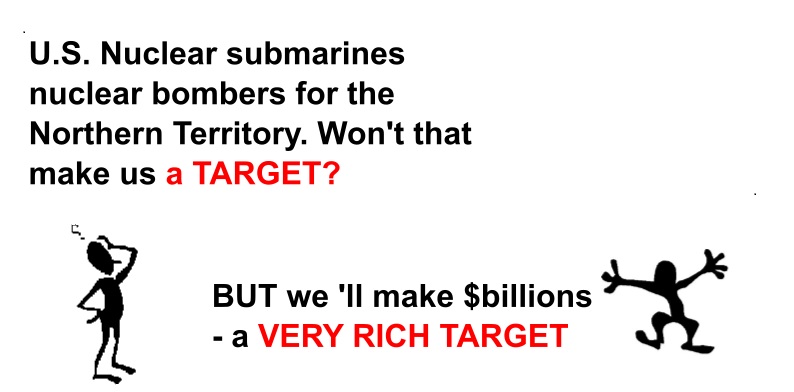
Last week, Four Corners revealed plans for the deployment of up to six nuclear-capable American B-52 bombers in the Top End, as part of an ongoing expansion of military activity in Australia’s north.
Following the report, deputy chief minister Nicole Manison was asked whether the deployment would put the NT at greater risk from potential adversaries………..
Defence and national security are among the key “growth” sectors the NT government hopes will drive its ambitious push to achieve a $40 billion economy by 2030.
To help maximise defence investment in the Top End, Labor created the Canberra-based position of Defence and National Security Advocate to lobby government and industry on the NT’s behalf.
The current advocate, defence analyst Alan Dupont, declined an interview request.
But he has previously argued for an NT role in the transition to nuclear boats, which may not be ready before Australia’s current conventional fleet needs replacing.
“The navy’s nuclear-powered submarines are unlikely to be in the water much before 2040,” he wrote after the AUKUS deal was announced.
“Having our submariners train and operate as joint crews on American and British nuclear submarines rotating through Darwin and Perth would help fill the looming submarine capability gap.” https://www.abc.net.au/news/2022-11-08/nt-govt-seeking-involvement-aukus-nuclear-submarine-program/101585724
U.S. House Intelligence Committee questioned about alleged surveillance of Julian Assange
A Spanish judge has asked the US House Intelligence Committee to provide information regarding the alleged surveillance of Julian Assange and his visitors during his seven-year-long stay in the Ecuadorian embassy in London
El Pais, JOSÉ MARÍA IRUJO, Madrid – NOV 05, 2022 Judge Santiago Pedraz of Spain’s National High Court has filed a request for judicial assistance with the United States House Intelligence Committee. He is asking the committee – charged with overseeing the US intelligence community – to provide his office with information pertaining to a Spanish firm that may have surveilled WikiLeaks founder Julian Assange.
While Assange was protected by the Ecuadorian embassy in London – in an attempt to avoid extradition to the United States to face charges over leaking thousands of classified documents – he was allegedly subjected to espionage by the Spanish security firm Undercover Global SL. Pedraz has pointed out that the CIA may have been a possible recipient of the material that was collected on Assange.
In October of 2021, Adam Schiff – a Democratic congressman and Chairman of the House Intelligence Committee – demanded that all American security agencies inform him about espionage activity that took place concerning Assange during his seven-year-long stay (2012-19) in the Ecuadorian embassy, before he was turned over to British police. Schiff’s initiative came after Yahoo News published a report, in which unnamed former US officials acknowledged the existence of a plan to kidnap Assange from the embassy in 2017. They also claimed that US spies had been monitoring the communications and movements of numerous WikiLeaks personnel.
Undercover Global SL is a Cádiz-based security firm, owned by retired Spanish military officer David Morales. It was hired by the Ecuadorian embassy to the United Kingdom to provide security.
An investigation by EL PAÍS revealed that, in 2019, Morales and his employees may have recorded several months worth of private conversations between Assange and his lawyers, while spying on dozens of his visitors, including medical personnel, politicians and journalists.
The publication in this newspaper of the audios and videos of the alleged espionage led to the arrest of Morales. Since 2019, Spain’s National High Court has been investigating him for crimes against privacy and for violating the confidentiality of attorney-client privilege. Morales is currently out on bail……………………….
In his formal legal request for information, Pedraz describes, in detail, the espionage to which he believes Assange was subjected to at the Ecuadorian embassy. He notes that some of the alleged victims of espionage include former US congressman Dana Rohrabacher and former-president Correa.
Pedraz has also previously requested the testimony of Mike Pompeo. A Trump appointee, Pompeo was the Director of the CIA from 2017 until 2018, before being appointed Secretary of State. William Evanina’s testimony has also been requested: he was the Director of the National Counterintelligence and Security Center from 2014 until 2021, serving under a portion of the Obama administration and the entirety of the Trump administration.
This is not the first time that the National High Court of Spain has requested judicial assistance from the US government to investigate this case. Retired judge José de la Mata – Pedraz’s predecessor – previously asked American authorities to provide him with the IP addresses from which the UC Global SL server had been accessed. But the US Justice Department demanded that De la Mata first reveal the identities of the whistleblowers within UC Global SL, who gave him the details about the alleged espionage……………….
Pedraz continues to ask US authorities for the same data and testimonies that De la Mata requested. He has explained to the House Intelligence Committee that, after three years of investigations, all signs point to US intelligence agencies having been the recipients of whatever UC Global SL gathered while surveilling Assange.
This past August, a group of US citizens who visited Assange in the Ecuadorian embassy sued former CIA director Mike Pompeo for alleged espionage. The lawsuit was filed by lawyers Margaret Ratner Kunstler and Deborah Hrbek, as well as journalists John Goetz and Charles Glass, both specialists in national security issues.
The suit claims that all four plaintiffs – along with dozens of other individuals – were spied on while visiting Assange during Pompeo’s tenure at the CIA. It cites statements made by Pompeo, in which he said that the WikiLeaks founder was a “target.”
The lawyers and journalists suing Pompeo believe that the CIA hired David Morales and his company to spy on Assange, his communications and his visitors, in order to learn his defense strategy in the face of the US extradition request. https://english.elpais.com/international/2022-11-05/house-intelligence-committee-questioned-about-alleged-surveillance-of-wikileaks-founder.html
AUKUS and nuclear submarines: Defence Minister Richard Marles sets Australia’s course in lockstep with USA-UK’s animosity to China.
the United States wants to build the first several nuclear-powered submarines for Australia and provide it with a submarine fleet by the mid-2030s in response to China’s growing military power.
Australia Sets New Defense Course To Establish Nuclear Submarines Fleet – Defense Minister

https://eurasiantimes.com/australia-sets-new-defense-course-to-establish-nuclear-submarines/—By EurAsian Times Desk November 8, 2022
Australia has set the course of its next defense strategy, which includes the development of nuclear-powered submarines to repel attacks far from the country’s shores, Australian Defense Minister Richard Marles said on Tuesday.
“Increasingly, we are going to need to think about our Defence Force in terms of being able to provide the country with impactful projection, meaning an ability to hold an adversary at risk much further from our shores across the full spectrum of proportionate response,” Marles said, delivering a speech at a university in Canberra, as quoted by the Australian Financial Review newspaper.
The minister also said that the new defense strategy relies on the establishment of a submarine fleet in cooperation with the United States and the United Kingdom within the AUKUS trilateral partnership.
Australia, the US, and the UK announced the AUKUS defense partnership in September 2021. The first initiative announced under the AUKUS pact was the development of nuclear-powered submarine technology for the Royal Australian Navy, which prompted the Australian government to abandon a $66 billion agreement with France’s Naval Group company for the construction of diesel-electric submarines.
Earlier, the Wall Street Journal had reported that the Biden administration is in the middle of discussions to expedite the construction of Australia’s first nuclear-powered submarines as guaranteed in the AUKUS defense pact.
The report said on Friday, citing Western officials, that the United States wants to build the first several nuclear-powered submarines for Australia and provide it with a submarine fleet by the mid-2030s in response to China’s growing military power.
The United States’ recommendation has not yet been formally approved, but a final decision on this matter is expected in March, the report said.
The report also highlighted the challenges the United States would face to complete the task, including the need to secure billions of dollars to expand its submarine-production capacity and a contribution from Australia to back the effort.
The White House said in a press release that Australia, the United Kingdom, and the United States – the countries that comprise the AUKUS security pact – have made significant progress toward ensuring that Australia would acquire conventionally armed, nuclear-powered submarines. The AUKUS allies will provide the submarines at the earliest possible date, the release said.
In September, the three allies announced the new trilateral security partnership, forcing Australia to abandon its $66 billion contract with France to receive 12 state-of-the-art conventionally-powered attack submarines from the United States.
In May, the Chinese Foreign Ministry said the AUKUS security pact is provoking an arms race in the South Pacific without any consultation with island countries of the region.
China believes that the AUKUS partnership escalates the arms race in the region and urges the US, the UK, and Australia to commit to the non-proliferation of nuclear weapons, Chinese Defense Ministry spokesman Tan Kefei had said earlier.
“The trilateral security partnership and cooperation on nuclear submarines between the US, the UK and Australia create serious risks of proliferation of nuclear weapons, escalate the regional arms race, undermine regional peace and stability as well as threaten global peace and security,” Tan had said.
The official noted that China had always believed that any regional cooperation should strengthen mutual trust among countries in the region and pose no threat to others.
“We urge the US, the UK, and Australia to abandon the Cold War mentality and ‘zero-sum game’ ideas and fulfill its obligations in good will regarding non-proliferation of nuclear weapons,” the spokesman had added
Government accused of hiding ‘lazy $591 million’ in extra costs from scrapped French submarine program
ABC, By defence correspondent Andrew Greene, 8 Nov 2022
Details of up to $591 million in additional expenses for the cancelled French submarine program have emerged, including asset writedowns on unused infrastructure and re-employment programs in Adelaide.
Key points:
- The extra costs to taxpayers only came to light in a late-night hearing
- $470 million has been spent on a South Australian facility which will have to be partially bulldozed
- A talent pool program costing $28 million has secured 223 jobs
The extra costs to taxpayers were revealed by officials from the government-controlled enterprises Australian Naval Infrastructure (ANI) and Australian Submarine Corporation (ASC) during a late-night Senate estimates hearing on Monday.
Last year the Morrison government cancelled the $90 billion Attack-class submarine program with French company Naval Group, in favour of nuclear-powered boats under the AUKUS partnership.
Earlier this year the Albanese government agreed to an $830 million compensation payment to Naval Group for the scrapped project, but more than half a billion dollars in other costs has now emerged in parliament.
In Senate estimates ANI confirmed a $300 million asset writedown related to the Osborne North Development project, a naval yard constructed for the now scrapped French designed Future Submarine project.
The committee was told $470 million has been spent to date on the Osborne North facility, including some assets which could still be repurposed for the new nuclear submarine program.
However ANI CEO Andrew Seaton told Greens senator David Shoebridge a partly-built “platform land-based test facility” which had been designed for the French submarines would probably now have to be bulldozed.
Separately the head of ASC also revealed that the cost of rehiring workers from the scrapped French submarine program is expected to reach $291 million over three years, but may be extended by the Defence department.
Since beginning six months ago, the Sovereign Shipbuilding Talent Pool (SSTP) has cost $28 million, with 223 workers hired by ASC following the scrapping of the French submarine program………………
Senator Shoebridge said the additional costs had been “ferreted away off the Defence budget”, but the public was paying the price for the scrapped submarine project.
“Only in a bungled multi-billion Defence project would a government even try to hide a lazy $591 million in additional costs,” he said.
“When we pay an extra $591 million for not building submarines we lose those funds for public housing, schools or income relief.
“While there are strategic arguments for retaining skilled staff, the fact that the ASC contract costs $1.3 million for every job is astounding.” https://www.abc.net.au/news/2022-11-08/591-million-most-in-costs-scrapped-french-submarines-australia/101629310
Military buildup in Australia stirs fears

Greg Sheridan, foreign editor of the right-wing, Rupert Murdoch-owned newspaper The Australian, wrote in a commentary on Nov 1 that the reports of the B-52 deployment heralded a “growing ‘prewar’ environment”.
https://global.chinadaily.com.cn/a/202211/09/WS636b0813a3105ca1f2274e75.html By KARL WILSON in Sydney | China Daily Global , 2022-11-09,
Reports of nuke-equipped US aircraft for base fit with secretive tradition
The pandemic and rising household bills have left most Australians blissfully blind to a military buildup that has been taking place in the country’s north.
The Australian Broadcasting Corporation’s flagship current affairs program Four Corners aired on Oct 31 a report outlining how the United States is upgrading a major Australian air force base near Darwin in the Northern Territory that will house at least six nuclear-capable B-52 bombers.
The initiative will also involve major infrastructure upgrades at the Tindal Royal Australian Air Force base and a massive fuel storage depot near Darwin.
In addition, the report exposed a major upgrade to the highly secretive Pine Gap intelligence-gathering facility near Alice Springs in Central Australia. So secretive is this facility that only a few Australians have clearance to enter it. During the Cold War, the former Soviet Union had the facility marked as a “must “target in the event of a nuclear war.
Greg Sheridan, foreign editor of the right-wing, Rupert Murdoch-owned newspaper The Australian, wrote in a commentary on Nov 1 that the reports of the B-52 deployment heralded a “growing ‘prewar’ environment”.
Australian Defense Minister Richard Marles, in a media conference on Nov 2, tried to play down the significance of the military buildup, saying that nuclear-capable US bombers had been visiting Australia since the 1980s.
In a media briefing on Oct 31, Chinese Foreign Ministry spokesman Zhao Lijian, when asked to comment on the reports, said the move by the US and Australia “escalates regional tensions, gravely undermines regional peace and stability, and may trigger an arms race in the region”.
“China urges parties concerned to abandon the outdated Cold War zero-sum mentality and narrow geopolitical mindset, and do more things that are good for regional peace and stability and mutual trust among all parties,” he said.
Zhao said that any defense and security cooperation between countries must “contribute to regional peace and stability and must not target any third party or undermine their interests”.
But Marles said that those against the buildup should “take a deep breath”.
“What we’re talking about is a US investment in the infrastructure at Tindal, which will help make that infrastructure more capable for Australia as well,” the minister said.
Objection voiced
David Shoebridge, an Australian Greens senator and the group’s defense spokesman, objected to the B-52 deployment, saying in a tweet: “This is a dangerous escalation. It makes Australia an even bigger part of the global nuclear weapons threat to humanity’s very existence — and by rising military tensions it further destabilizes our region.”
Indonesia has, in the past, voiced its concern over Australia’s nuclear direction, especially following the formation of the AUKUS security pact for military cooperation with the United Kingdom and the US.
Jim Green, national nuclear campaigner with environmental and social justice organization Friends of the Earth Australia, said: “The plan to base nuclear-capable B-52 bombers at RAAF Tindal escalates and worsens a pattern of Australia providing practical and political support for the US nuclear weapons program.”
In an email to China Daily, Green said: “Australia should refuse to allow US nuclear weapons to be located on Australian territory under any circumstances. The federal Labor government has committed to signing and ratifying the UN’s Treaty on the Prohibition of Nuclear Weapons. The stationing of nuclear weapons on Australian soil flies in the face of the government’s commitment to the UN Treaty.”
Reports of the impending deployment came days after the administration of US President Joe Biden released a Nuclear Posture Review that nonproliferation advocates said makes catastrophe more, rather than less, likely.
When it comes to the US’ deployment of weapons of mass destruction in the region, Australia is not alone.
The Saipan Tribune noted in a report in January that during the Cold War, Guam was a target of the Soviet military in part because it was home to US Navy submarines that carried intercontinental ballistic missiles containing nuclear warheads. “The United States has not spent … money to fully protect Guam and the Chamorro people from military attack,” the report said, referring to the Indigenous people in Guam.
And the same holds true for Australia.
At COP27 Climate Summit the International Atomic Energy Agency joins all those paid nuclear lobbyists in pushing the lie that “nuclear solves the climate problem”.

At COP27, nuclear power industry vies for bigger role in decarbonizing planet
https://www.reuters.com/business/cop/cop27-nuclear-power-industry-vies-role-decarbonizing-planet-2022-11-09/ By Richard Valdmanis, Sarah Mcfarlane and Valerie Volcovici
HARM EL-SHEIKH, Egypt, Nov 9 (Reuters) – Nuclear energy supporters including politicians and activists sought to polish the industry’s spotty image on Wednesday, using the COP27 climate summit in Egypt to argue that atomic power offers a safe and cost-efficient way to decarbonize the world.
Rising concerns about the swift pace of climate change and tight power supplies around the globe have softened some policy makers view of nuclear energy, an industry that has struggled for years to draw investment because of worries about safety, radioactive waste, and huge costs for building a reactor.
The International Atomic Energy Agency, an intergovernmental organization that seeks to promote nuclear power, opened an exhibit at the U.N. climate gathering of global leaders in Egypt – its first time doing so in 27 years of the annual international climate negotiations. The showcase expounded the technology’s potential in the fight against climate change.
When you talk about nuclear, you’re talking about a confirmed energy producer which is not part of the problem, but rather part of the solution,” IAEA Director General Rafael Mariano Grossi told Reuters in an interview.
“You will see that that nuclear energy has a really solid, very consistent safety record,” he added.
U.S. Special Climate Envoy John Kerry, meanwhile, pumped up the industry on Tuesday at a news conference at the summit announcing the U.S. Export-Import Bank (EXIM)’s formal interest in providing $3 billion in financial support for a nuclear plant in Romania.
“We have a viable alternative in nuclear … This is one of the ways in which we can achieve net-zero,” he told reporters, referring to an international target of cutting net greenhouse gas emissions to zero by 2050. “We don’t get to net zero by 2050 without nuclear power in the mix.”
The United States has already earmarked billions of dollars toward keeping existing nuclear power plants open as part of a broader strategy to decarbonize the economy and is hoping to encourage new projects.
The nuclear power industry has had trouble raising money in recent years, having taken a huge public relations hit following the 2011 reactor meltdown at the Fukushima power plant in Japan. Russia’s invasion of Ukraine has further raised concerns about nuclear safety with sporadic fighting and power cuts at the site of the Zaporizhzhia plant.
Oleksii Riabchyn, advisor to the Ukraine government on green energy, told Reuters at the summit that he thought the country’s reactors required a missile shield to protect them.
AEA’s Grossi said the security concerns in Ukraine should not dissuade countries from building nuclear plants: “The big problem is war, is not nuclear energy or any other industrial activity.”
He added he was in the midst of “very complex” negotiations with Russia and Ukraine over a proposed no-combat zone around the plant and hoped for an agreement soon.
Hannah Fenwick, the co-lead of Nuclear for Climate which represents a network of 150 associations advocating for governments to embrace nuclear power, said her organization was lobbying policy-makers at COP27 to consider nuclear energy investments and was getting decent feedback.
“We have been saying that nuclear is a solution for climate for many years and the geopolitical climate has changed and people are now listening,” she said.
Reporting by Richard Valdmanis, Sarah McFarlane and Valerie Volcovici; Editing by Katy Daigle, Frank Jack Daniel and Deepa Babington
Solar Insiders Podcast: The dumb decisions holding back rooftop PV — RenewEconomy

We look at developments in Queensland and South Australia. Nigel delivers All Energy wrap and picks apart Sky After Dark misinformation about cobalt. The post Solar Insiders Podcast: The dumb decisions holding back rooftop PV appeared first on RenewEconomy.
Solar Insiders Podcast: The dumb decisions holding back rooftop PV — RenewEconomy
AGL breaks ground on Broken Hill big battery as AGM looms — RenewEconomy

AGL Energy kicks off construction of ARENA-backed Broken Hill battery, a 50MW/50MWh lithium-ion BESS in the far west of New South Wales. The post AGL breaks ground on Broken Hill big battery as AGM looms appeared first on RenewEconomy.
AGL breaks ground on Broken Hill big battery as AGM looms — RenewEconomy
“Massive pieces of kit:” Wind blades set sail for Andrew Forrest’s huge hybrid project — RenewEconomy

First batch of wind turbine blades for the $3bn Andrew Forrest-backed Clarke Creek renewable energy precinct set sail for port of Gladstone. The post “Massive pieces of kit:” Wind blades set sail for Andrew Forrest’s huge hybrid project appeared first on RenewEconomy.
“Massive pieces of kit:” Wind blades set sail for Andrew Forrest’s huge hybrid project — RenewEconomy
Spanish energy giant switches on ACT battery – its first in the world — RenewEconomy

A 10MW, two-hour (20MWh) battery energy storage system has been completed in the ACT, where it will be used to support the transmission network. The post Spanish energy giant switches on ACT battery – its first in the world appeared first on RenewEconomy.
Spanish energy giant switches on ACT battery – its first in the world — RenewEconomy
1 This month


Help Aunty Sue Protect Her Land and Sacred Sites From Destructive Rocket Testing.
.

Australians deserve the truth
about
AUKUS – https://aukuspublicinquiry.com/

PETITION – To: Prime Minister Anthony Albanese and the Australian Labor Government

of the week – Australians for War Powers Reform (AWPR)
To see nuclear-related stories in greater depth and intensity

