Ukraine behind Crimean Bridge blast – US media
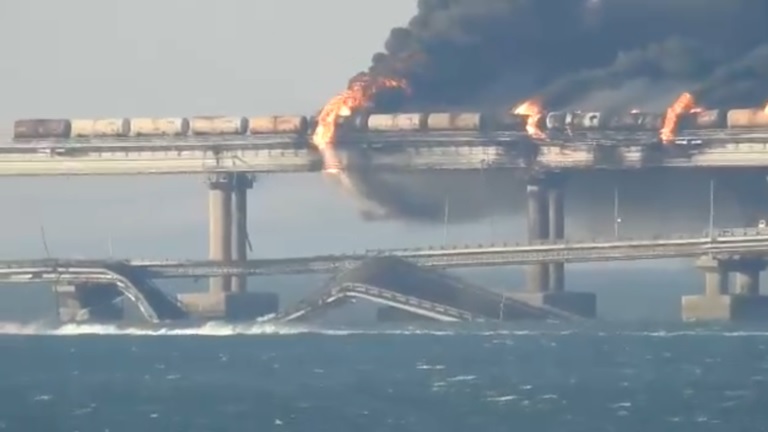
The attack was masterminded by Kiev’s intelligence services, two major outlets claim. https://www.rt.com/russia/564343-ukraine-behind-crimean-bridge-explosion/—9 Oct 22,
The blast that damaged Russia’s strategic Crimean Bridge and killed at least three people was orchestrated by Ukraine, the New York Times and Washington Post both reported on Saturday, citing sources.
A senior Ukrainian official interviewed by the New York Times claimed that Kiev was behind the explosion, adding that the attack was masterminded by Ukraine’s intelligence services, which had arranged a bomb to be planted on a truck that was driving across the bridge..
This claim was echoed by the Washington Post, which, citing a Ukrainian government official, also attributed the explosion to the country’s special services. This version was backed by the news site Ukrainska Pravda, which, quoting a source in the country’s security services, said that the intelligence agency, called the SBU, was behind the attack.
While Ukrainian officials did not explicitly take responsibility for the attack, they cheered it. An aide to President Vladimir Zelensky, Mikhail Podoliak, said that the explosion was “just the beginning,” adding that “everything illegal must be destroyed.”
Since Russia launched its military campaign in late February, Ukrainian officials have repeatedly promised to attack the bridge, which serves as a strategic link between Russia’s Crimean peninsula and its Krasnodar Region.
While the Kremlin did not directly accuse Kiev of staging the explosion, Russia’s Foreign Ministry spokeswoman Maria Zakharova stated that Ukraine’s reaction to the incident is a testament to the “terrorist nature” of its leadership.
Meanwhile, Crimean officials directly pointed the finger at Kiev. Vladimir Konstantinov, the head of the republic’s State Council, claimed that “Ukrainian vandals have finally managed to get their bloodstained hands on the Crimean Bridge.”
The powerful blast rocked the bridge early Saturday morning, causing a partial collapse of the road on the vehicle section, as well as a blaze on a parallel railway span where seven fuel tanks caught fire. According to Russia’s National Anti-Terrorism Committee, the bridge was damaged by a truck that exploded while making its way across the bridge. The blast caused at least three deaths.
Radioactive releases from the nuclear power sector and implications for child health

British Medical Journal Paedistrics,Cindy Folkers & Linda Pentz Gunter 9 Oct 22, :
Although radioactivity is released routinely at every stage of nuclear power generation, the regulation of
these releases has never taken into account those potentially most
sensitive—women, especially when pregnant, and children.
From uranium mining and milling, to fuel manufacture, electricity generation and
radioactive waste management, children in frontline and Indigenous
communities can be disproportionately harmed due to often increased
sensitivity of developing systems to toxic exposures, the lack of resources
and racial and class discrimination.
The reasons for the greater susceptibility of women and children to harm from radiation exposure is not
fully understood. Regulatory practices, particularly in the establishment
of protective exposure standards, have failed to take this difference into
account.
Anecdotal evidence within communities around nuclear facilities
suggests an association between radiation exposure and increases in birth
defects, miscarriages and childhood cancers.
A significant number of academic studies tend to ascribe causality to other factors related to diet
and lifestyle and dismiss these health indicators as statistically insignificant.
In the case of a major release of radiation due to a serious
nuclear accident, children are again on the frontlines, with a noted
susceptibility to thyroid cancer, which has been found in significant
numbers among children exposed both by the 1986 Chornobyl nuclear accident
in Ukraine and the 2011 Fukushima-Daiichi nuclear disaster in Japan.
The response among authorities in Japan is to blame increased testing or to
reduce testing. More independent studies are needed focused on children,
especially those in vulnerable frontline and Indigenous communities. In
conducting such studies, greater consideration must be applied to
culturally significant traditions and habits in these communities.
BMJ Paediatrics 7th Oct 2022
Renewables need minerals. Can their pollution and public health challenges be overcome?
https://beyondnuclearinternational.org/2022/10/09/renewables-need-minerals/ By Linda Pentz Gunter, by beyondnuclearinternational,
We are now both on the path to — and amidst the crisis of — resolving our past greed and irresponsibility in the energy and transport sector. But few, if any, human industries are without a carbon footprint. This has made the climb out of our carbon-intensive paradigm all the harder.
Consequently, our first imperative — in order to do as little current or future environmental harm as possible — is to focus on solutions that have the lowest carbon footprint and environmental and human impact. This puts conservation at the pinnacle of our priorities, followed by energy efficiency.
Particularly in developed countries — where we bear almost the entire responsibility for the mess we have made of our planet — we can, and must, consume less, become more energy efficient, live in smaller homes, use public transport routinely, walk and bicycle more and drive and fly less.
Using fossil fuels has to stop. Completely. And ideally now, but, realistically, as soon as possible. Replacement power will still be needed. But nuclear power, which creates long-lived lethal radioactive waste from the beginning to the end of its fuel cycle, and, as a large thermo-electric generator, relies on huge quantities of what will become increasingly scarce water supplies, is not the substitute for fossil fuels. Nuclear power cannot be an environmentally clean and just energy solution. And it has no answers for the transport sector, either.
Yet, as we decry the extraction of uranium — and all its attendant poisoning of the environment and ourselves along with human rights violations — we are met with the legitimate argument that increasing the use of renewables (and electric cars) in order to decarbonize, brings with it the same extractive environmental impacts.
But are they really the same? If we dig deeper, to use an unwelcome metaphor, we find parallels but not necessarily equity between the impacts of renewables and nuclear. This does not excuse or justify worker abuse, human rights violations or extractive contamination in any sector. But it’s an important distinction.
First and foremost, we must look to carbon emissions. It makes sense, even if all the other downsides were equal — which they clearly are not — to at least focus on the lowest carbon emitters. And those are unquestionably renewables. Therefore, our responsibility now is to put things right in the renewable energy industry, even as we must point out, criticize and urge change in those areas that need improvement, including recycling, sustainable sourcing and human rights.
A second priority, is the ability and willingness of industries to make those improvements.
We have seen how the wind industry has worked to minimize its impacts on migratory birds. It’s no coincidence that some of the biggest bird conservation groups, including BirdLife International, the American Bird Conservancy and the Audubon Society, cautiously support the development of wind power while scrupulously watchdogging its progress.
The renewable energy and electric vehicle industries recognize the fact that they rely on mineral extraction and, as such, must try to mitigate or avoid negative environmental, social and human rights impacts. Unlike the nuclear industry — which has been guilty of environmental and human rights abuses since it began — the renewable energy industry is working to resolve these significant drawbacks.
As Justine Calma wrote in The Verge at the end of last year: “There are ways to get the minerals the clean energy revolution needs while minimizing the impact on people and the planet. Startups are figuring out how to get better at recycling lithium batteries.” Mining companies are also looking to power their extraction using renewables rather than fossil fuels.
The World Bank program — The Climate-Smart Mining Initiative — aims to help “resource-rich developing countries benefit from the increasing demand for minerals and metals, while ensuring the mining sector is managed in a way that minimizes the environmental and climate footprint as it works to decarbonize”.
The nuclear industry, by contrast, has made no such effort to mitigate its environmental impact, and cannot do so, because splitting the atom to boil water is inherently dangerous and polluting. Worse, the industry actively pushes back against — or outright rejects — mitigation efforts because it would cost the already financially struggling nuclear sector money it can’t afford to expend if it is to stay in business.
The end product of nuclear power is long-lived highly radioactive waste with no long-term, safe, permanent management solution. While the renewable energy sector is looking into the recycling of batteries, there is no recycling of nuclear waste. Reprocessing — often misleadingly called “recycling” — does no such thing.
In separating out the uranium and plutonium from irradiated reactor fuel, reprocessing produces even higher volumes of largely “low” and “intermediate”-level radioactive wastes, discharged into the air and sea or stored indefinitely.
The mining of uranium for use in nuclear power leaves behind radioactive waste and heavy metals that persistently contaminate the local environments, harming the health and safety of those communities and that of their land and water resources.
Nevertheless, there is no getting around the reality that the renewable industry, too, requires mining of minerals and rare earth metals, and that recycling, while beneficial, is not always done sustainably.
These hurdles are laid out in detail in a useful report prepared for Earthworks by the Institute for Sustainable Futures — Responsible minerals sourcing for renewable energy (Dominish, E., Florin, N. and Teske, S., 2019, Responsible Minerals Sourcing for Renewable Energy. Report prepared for Earthworks by the Institute for Sustainable Futures, University of Technology Sydney.)
The report emphasizes that “recycling and responsible sourcing are fundamental to improving the sustainability of the renewable energy transition”.
However, it points out that while “the renewable energy and battery industries have made significant improvements to the efficiency of technologies, to improve performance, minimize demand for materials and reduce production costs,” attention to stewardship and human rights abuses has been less promising. “The industry experts interviewed noted that reducing the environmental and social impacts of supply is not a major focus of the renewable energy industry.”
Inevitably, many of the resources for the renewable energy industry (along with electric vehicles, not discussed here as these are outside our energy focus), are to be found in troubled parts of the world — most notably DR Congo. In turn, the manufacturing of those minerals into metals is largely carried out in China, where human rights are suppressed.
The impacts of mining to supply the renewable energy industry invariably result in “pollution and heavy metal contamination of water and agricultural soils, and health impacts on workers and surrounding communities”.
The wind energy industry emerges as the least offender, according to the report. “Material use for wind turbines is already very efficient. Recycling of bulk materials (steel, aluminium, copper) used in wind turbines is well established with high recycling rates.”
The report offers some glimmers of hope, noting that increased use of renewables means a reduction in coal mining, “which is responsible for the greatest number of fatalities, health and environmental issues.”
But we are undoubtedly now in the land of Faustian bargains. We have left it too late to make choices that are problem-free. Renewables, therefore, must be measured up against the alternatives and nuclear power isn’t one of them. Aside from the carbon footprint and human rights violations of nuclear power, and its high costs and long construction times, we must also factor in the lethal waste; the daily radioactive releases harming primarily children; the outcome of a catastrophic accident; and the inextricable link to nuclear weapons development, to name a few.
We must learn to live more simply; smaller. More quietly. Tread lightly. And yes, we must transition to renewables, energy efficiency and conservation, not tomorrow, not gradually, but immediately. Can we do it without leaving yet another mess? Without further abuses?
As the ISF study concludes, not yet, but we are getting there. “There are a large number of responsible sourcing initiatives that promote environmental stewardship and the respect of human rights in the supply chain, most of which are voluntary and industry-led,” the authors wrote. “If these initiatives are harmonized and widely adopted, it may lead to more responsible supply chains.”
Until then, renewables are our least worst power option, and, out of time as we are, it’s a choice we have brought upon ourselves.
Ukraine’s ZNPP Must Be Urgently Protected, IAEA’s Grossi Says After Plant Loses All External Power Due to Shelling
https://www.iaea.org/newscenter/pressreleases/ukraines-znpp-must-be-urgently-protected-iaeas-grossi-says-after-plant-loses-all-external-power-due-to-shelling 8 Oct 22, Ukraine’s Zaporizhzhya Nuclear Power Plant (ZNPP) has lost its last remaining external power source due to renewed shelling and is now relying on emergency diesel generators for the electricity it needs for reactor cooling and other essential nuclear safety and security functions, Director General Rafael Mariano Grossi of the International Atomic Energy Agency (IAEA) said today.
The ZNPP’s connection to the 750 kilovolt (kV) power line was cut at around 1am local time today, Director General Grossi said, citing official information from Ukraine as well as reports from the team of IAEA experts present at the site of Europe’s largest nuclear power plant.
Sixteen of the plant’s diesel generators started operating automatically, providing its six reactors with power. After the situation stabilised, ten of the generators were switched off, leaving six to provide the reactors with necessary electricity.
“The resumption of shelling, hitting the plant’s sole source of external power, is tremendously irresponsible. The Zaporizhzhya Nuclear Power Plant must be protected,” Director General Grossi said. “I will soon travel to the Russian Federation, and then return to Ukraine, to agree on a nuclear safety and security protection zone around the plant. This is an absolute and urgent imperative.”
All the plant’s safety systems continue to receive power and are operating normally, the IAEA experts were informed by senior Ukrainian operating staff at the site. Although the six reactors are in cold shutdown, they still require electricity for vital nuclear safety and security functions. The plant’s diesel generators each have sufficient fuel for at least ten days. ZNPP engineers have begun work to repair the damaged 750 kV power line.
October 9 Energy News — geoharvey

Opinion: ¶ “US Should Be More Transparent About Our Transportation Emissions – Our Health And Climate Depend On It” • The Biden administration has two weeks left to hear from Americans on a proposal that would require states, cities and towns to track and reduce greenhouse gas emissions that result directly from highway activity. This […]
October 9 Energy News — geoharvey
Rotting in jail’: Thousands march for Julian Assange’s release as his brother urges Anthony Albanese to act.
Supporters of jailed WikiLeaks founder Julian Assange have formed a human chain in Melbourne’s city centre to protest his detention.
Thousands have marched through Melbourne’s city centre calling for the release of WikiLeaks founder Julian Assange.
The 51-year-old Australian has been in London’s Belmarsh prison since he was removed from the Ecuadorian embassy in 2019.
Mr Assange is fighting a long-running legal battle to avoid extradition to the United States,
Melbourne protesters marched through the city streets and formed a human chain across a Southbank bridge on Saturday morning as they called on the Australian government to intervene.
“There’s an expectation in the electorate that the prime minister and this government is going to get Julian out of jail,” Mr Assange’s brother Gabriel Shipton told AAP.
“The prime minister’s statements before the election – enough is enough, he doesn’t see what purpose is served by Julian being kept in prison – those were seen as a commitment.
“It’s been so many days of this government and Julian is still rotting in that prison.”
Prime Minister Anthony Albanese should contact the United States president directly and plead Mr Assange’s case, Mr Shipton said.
“They can pick up the phone, call Joe Biden and say, hasn’t Julian suffered enough? Drop the charges and extradition,” he said.
“Julian would walk free.”
What’s the latest on Julian Assange’s case?
In June, then-United Kingdom home secretary Priti Patel approved Mr Assange’s extradition to the US
.Then, in August, lawyers for Mr Assange filed an appeal , arguing he is being prosecuted and punished for his political opinions.
Mr Assange was charged by the US with 17 counts of espionage and one charge of computer misuse after WikiLeaks published thousands of leaked military and diplomatic documents.
Melbourne’s demonstration against Mr Assange’s detention was one of many being held across the world on Saturday.
It was heartening to see such global solidarity for Mr Assange’s cause, Mr Shipton said.
“The movement is growing around the world as evidenced by these protests,” he said.
“We’re not going to stop. We are not going to be quiet.”
.
Nuclear Power: the Right’s giant red herring
https://johnmenadue.com/nuclear-power-the-rights-giant-red-herring/?fbclid=IwAR2QLkHEc5nz2. By Ralph Evans, Oct 5, 2022
Politicians of the Right keep suggesting Australia should build nuclear power stations. Why? They are slow to build, very expensive and potentially risky, and we have far better alternatives. Their aim is to divide and to wedge. We should treat it as a giant red herring.
Why do politicians on the Right keep bringing up nuclear power?
Eric Abetz used to do it at every opportunity, before he lost his senate seat and (bizarrely) reappeared as head of the Monarchist movement.
Early this month Peter Dutton said in a speech to the Minerals Council that Australia needs “a frank debate” about nuclear power and that it presents “a wonderful opportunity to add value” to our uranium resources.
Many readers will have seen an interview by David Speers with a barely coherent Barnaby Joyce on Insiders. Twice, with no prompting, Joyce brought up the idea of small modular nuclear reactors. Speers commented wryly that these are not something people are talking about at the checkout in IGA.
The latest pro-nuclear voice is Matt Canavan, the Queensland senator who loves to dress up as a coal miner, replete with face covered in coal dust. Canavan announced in a tweet this week that he would join a group of senators proposing repeal of the current law banning nuclear power in Australia. He said “It is time to join the rest of the world and treat nuclear energy as a safe and effective option”.
This is just nonsense, babble. Nuclear power is a non-starter in Australia today. Nobody is champing at the bit to invest billions in nuclear, as they are in solar, wind, storage and hydrogen. So why is the Right carrying on about it?
We were bound to hear more of this when CPAC met in Sydney last weekend. CPAC is a conclave of deplorables, an American franchise.
Even if its economics were better, nuclear power would take far too long to build to contribute to our urgent need to reduce emissions. There is no way we could see nuclear power on-line here before the later 2030s, at the earliest. First, Parliaments (state and federal) would have to repeal the ban. Then governments would have to set up a strong regulatory regime, which is not a simple thing. Next, in the unlikely event that somebody were to step forward to propose a plant, there would be a long process of argument about sites and environmental approval. Who wants one of these in their neighbourhood? Last, construction and testing could easily take a decade or more, based on American and European examples.
Barnaby’s small modular reactors are an intriguing idea, but they don’t exist yet. The first, being built by US start-up Nuscale Power, is due to be complete in 2028 or 2029. It will take years after that to establish whether these smaller reactors have the lower costs and faster construction their proponents hope for.
CSIRO and the Australian Energy Market Operator published their 2021-22 edition of their annual Gencost report in July. They concluded (once again) that an integrated mix of solar and wind power and storage offers the lowest-cost new-build means of supplying the Australian market with electricity. The report saw no prospect of small modular nuclear reactors operating here in this decade. It said their cost could possibly come down in the future, but this would depend on successful deployment overseas.
Stories abound of delays and cost overruns with nuclear power. Britain’s Hinkley Point C station was first estimated to cost £4 billion. It is now over a decade late and expected to come in at £22-3 billion. Do we seriously want to get into this, when a renewable network can be built far more quickly and in smaller pieces?
The safety record of nuclear power is generally good. But when accidents occur they can be very big indeed. Naturally, they can prompt widespread community opposition. The Chernobyl disaster in Ukraine led to strong opposition to nuclear power in Germany and a plan to exit nuclear power. Fukushima led the government of Japan to mothball many existing nuclear stations. The total cost of the Fukushima clean-up may be as high as US$1 trillion. We have no need to take this kind of risk in Australia.
So why do the politicians of the Right keep talking up nuclear power? No doubt, some want to attract attention to themselves or to ingratiate themselves with interest groups like the Minerals Council. In addition, I suspect, they aim to sow confusion and to drive wedges into the community.
Nuclear power is a great subject for an old bore to bang on about in a pub or at a barbecue. It is easily linked to other hardy perennials, like the Bradfield Plan to pump water from coastal Queensland rivers like the Burdekin over the Great Divide to irrigate the inland. This has been demonstrated time and again to be uneconomic, but its advocates go on about it like a dog with a bone.
Nuclear power for Australia is nothing more than a giant red herring and should be treated as such.
Radiation ‘hotspots’: legacy of British nuclear tests lingers on idyllic islands in Western Australia
Tourists warned not spend more than an hour at the Montebello Islands sites – as a new study examines the effect of radioactive sands on marine life.
Guardian, Narelle Towie, @narelletowie 8 Oct 22,
The white ocean sands of Western Australia’s Montebello Islands may appear inviting, but 70 years ago they were the site of Britain’s first nuclear tests.
Now researchers are working to uncover how much and what type of radioactive material persists in sediment on the ocean floor of the archipelago, made up of 265 low-lying islands and islets, 1,200km north of Perth. They hope to get a clearer idea of its effects on the area’s abundant marine life and any lingering dangers to people who visit the islands for tourism or fishing.
The nuclear fallout from atomic blasts in the 1950s have been well studied on land, but little is known about how radioactive sands affect the 60,000-hectare marine park’s ecosystem.
In June 2020 a team led by Madison Hoffman, an environmental radioecologist at Edith Cowan University, collected hundreds of kilograms of sediment from an area near the blast sites, 120km west of Dampier, for analysis.
Hoffman says they detected levels of radioactivity higher than background levels, as expected.
“Those levels are highest in areas around where those three detonations took place, but we also have some areas which have come up with levels a little higher than we expected for where we found them.”
Advertisement
The 12 nuclear tests carried out between 1952 and 1957 – including three in the Montebellos – were part of a secretive deal between Britain and Australia that was championed by the then prime minister, Robert Menzies. Further “minor trials” were carried out in South Australia until 1963.
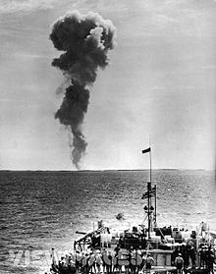
The first test, codenamed Operation Hurricane, took place on 4 October 1952 at a lagoon off Trimouille Island in the Montebellos.
A decommissioned warship, HMS Plym, was rigged up with a 7kg plutonium device, sending tonnes of seawater and mud 3,000 metres into the air and impregnating the ocean sand with radioactive isotopes.
On 16 May and 19 June 1956 two more bombs were set off from towers at Trimouille and Alpha islands as part of Operation Mosaic. The bombs were boosted with hydrogen and lithium and were the biggest ever detonated in Australia.
Hoffman says while some radionuclides, or radioactive atoms, are blasted inside sand grains, others attach to the surface of sediment and shift in rough weather, such as during cyclonic activity.
“When we know what radionuclides there are and what ratios they are in, they can act like a fingerprint, kind of like a forensics tool that is distinct to the Montebellos,” Hoffman says.
“When sediment rock gets moved from point A to point B, it is taking those radionuclides with it and potentially moving those hotspots and migrating them around.”
Hoffman wants to know where these hotspots are so she can study how the radiation exposure affects sediment-dwelling marine life. The area is home to a rich variety of marine species including dugongs, turtles, whales, hundreds of fish species and mangroves………………….
Darren Koppel, a marine contaminant expert with the Australian Institute of Marine Science, says low levels of radiation over long periods can cause chronic toxicity to plants and other organisms.
“We do not have much data on the chronic effects of radiation to marine organisms, so this type of research is critical to fill those data gaps,” Koppel says.
“The most likely effect is that sensitive organisms and plants will have stopped living or growing in the areas with higher radioactivity, leaving only the more tolerant species.”
The Montebello Islands are managed by the WA Department of Biodiversity, Conservation and Attractions.
It says there are still “slightly elevated radiation levels” at Trimouille and Alpha islands and warns tourists not to camp or spend longer than one hour at those sites.
Tourists travel from the nearby towns of Karratha, Port Hedland, Onslow and Dampier on fishing trips. Despite warning signs , the department has found evidence of campers on the islands in recent years.
In the Great Victoria Desert, in outback South Australia, authorities spent millions trying to clean up radioactive fallout from nuclear testing at Maralinga, where the British detonated seven atomic bombs.
According to researchers at Monash University, residual plutonium and uranium still contaminate the land at Maralinga as tiny radioactive grains in the soil.
Little heed was given to the Anangu Pitjantjatjara people who lived on the land, who lived with the legacy of the explosions for decades afterwards. It wasn’t until 1994 that the Australian government paid $13.5m in compensation for what had been done to the land.
British and Australian servicemen exposed to radiation by the blasts have also fought long campaigns for the effects on their health to be recognised and adequately compensated…………………
Hoffman says that key technical documents about the nuclear testing, which could help with her research, were reclassified by the UK in 2018.
“We have so little documentation or information about what really happened,” Hoffman said.
“Without that information and all the really crucial statistics [about the blasts] it is really difficult to make sense of the answers we have now in relation to what originally happened.” https://www.theguardian.com/australia-news/2022/oct/08/radiation-hotspots-legacy-of-british-nuclear-tests-lingers-on-idyllic-islands-in-western-australia
Zelensky aide attempts to walk back call for ‘preemptive strike’

It’s not clear what Zelensky meant by a “pre-emptive strike”. He might not have meant that NATO/USA should use a nuclear weapon.
But – he might well have meant that USA/NATO should strike at Russian nuclear sites
And that would indeed mean a Nuclear Pre-emptive Strike
https://www.rt.com/russia/564204-zelensky-no-nuclear-strike/ 7 Oct 22, The Ukrainian president didn’t urge NATO to attack Russia with nuclear weapons, he pointed out.
Ukrainian President Vladimir Zelensky’s call for a preemptive NATO strike against Russia should not be interpreted as a request to attack the country, his press secretary has insisted.
“Colleagues, you have gone a bit too far with your nuclear hysterics and hear ‘nuclear strikes’ where there are none,” Sergey Nikoforov wrote on Facebook on Thursday, responding to widespread alarm over the president’s words.
The press secretary pledged that Ukraine will never resort to nuclear threats, calling it something only the “terrorist state Russia” would do.
Moscow has denied that its senior officials were threatening anybody when they described the country’s official nuclear posture, in the context of warning NATO members against attacks on Russia.
Hours earlier, Zelensky told the Australian Lowy Institute that NATO should carry out preemptive strikes against Russia so that it “knows what to expect” in the event that it uses atomic weapons.
Such an attack would “eliminate the possibility of Russia using nuclear weapons,” the Ukrainian leader claimed. He urged the US and its allies to make a show of force, recalling how he appealed to other nations for preemptive measures against Russia before Moscow sent troops into Ukraine in late February.
“I once again appeal to the international community, as it was before February 24: preemptive strikes so that they [Russians] know what will happen to them if they use it, and not the other way around,” he said.
His press secretary also noted that before the hostilities started, “the only measures we talked about were preemptive sanctions”.
Russian officials have accused Zelensky of trying to provoke a global nuclear war. Foreign Ministry spokeswoman Maria Zakharova described him as “a monster, whose hands can destroy the planet,” after being pumped with Western weapons.
The Russian military doctrine allows the use of nuclear weapons in a conventional conflict, if Moscow believes that the existence of the country is under threat. Russian officials have repeatedly warned against escalating the crisis in Ukraine, stating that it could spiral out of control and result in a global nuclear exchange.
Lavrov explains why Russia sees Ukraine as a threat – Zelensky asked NATO for a pre-emptive nuclear strike.

https://www.rt.com/russia/564206-lavrov-zelensky-preemptive-strike/ 7 Oct 22, President Zelensky did ask NATO for a preemptive nuclear strike, despite claims to the contrary, the Russian foreign minister said.
A call by Ukrainian President Vladimir Zelensky for NATO members to deploy nuclear weapons against Russia is a reminder of why Moscow launched military action against his country, Russian Foreign Minister Sergey Lavrov has said.
“Yesterday, Zelensky called on his Western masters to deliver a preemptive nuclear strike on Russia,” Moscow’s top diplomat stated during a media conference on Wednesday
In doing so, the Ukrainian leader “showed to the entire world the latest proof of the threats that come from the Kiev regime.” Lavrov said Russia’s special military operation had been launched to neutralize those threats.
He dismissed as “laughable” an attempt to downplay Zelensky’s words made by his press secretary, Sergey Nikoforov.
We all remember how [Zelensky] declared in January Ukraine’s intention to acquire nuclear weapons. Apparently, this idea has long been stuck in his mind,” the Russian minister said.
On Thursday, Zelensky told the Australian Lowy Institute that NATO must carry out preemptive strikes against Russia so that it “knows what to expect” if it uses its nuclear arsenal. He claimed that such action would “eliminate the possibility of Russia using nuclear weapons,” before recalling how he urged other nations to preemptively punish Russia before it launched its military action against his country.
“I once again appeal to the international community, as it was before February 24: Preemptive strikes so that [the Russians] know what will happen to them if they use it, and not the other way around,” he said.
His spokesman then claimed that people interpreting Zelensky’s words as a call for a preemptive nuclear strike were wrong, and that Ukraine would never use such rhetoric.
2022 Nobel Peace Prize award violates the purpose of the prize
2022: Nobel Committee Gets Peace Prize Wrong Yet Again, https://davidswanson.org/2022-nobel-committee-gets-peace-prize-wrong-yet-again/ 7 Oct 22,
The Nobel Committee has yet again awarded a peace prize that violates the will of Alfred Nobel and the purpose for which the prize was created, selecting recipients who blatantly are not “the person who has done the most or best to advance fellowship among nations, the abolition or reduction of standing armies, and the establishment and promotion of peace congresses.”
With its eyes on the news of the day, there was no question that the Committee would find some way to focus on Ukraine. But it steered clear of anyone seeking to reduce the risk of that thus-far relatively minor war creating a nuclear apocalypse. It avoided anyone opposing both sides of the war, or anyone advocating for a ceasefire or negotiations or disarmament. It did not even make the choice one might have expected of picking an opponent of Russian warmaking in Russia and an opponent of Ukrainian warmaking in Ukraine.
Instead, the Nobel Committee has chosen advocates for human rights and democracy in Belarus, Russia, and Ukraine. But the group in Ukraine is recognized for having “engaged in efforts to identify and document Russian war crimes against the Ukrainian civilian population,” with no mention of war as a crime or of the possibility that the Ukrainian side of the war was committing atrocities. The Nobel Committee may have learned from Amnesty International’s experience of being widely denounced for documenting war crimes by the Ukrainian side.
The fact that all sides of all wars have always failed and always will fail to engage in humane operations is possibly why Alfred Nobel set up a prize to advance the abolition of war. It’s too bad that prize is so misused. Because of its misuse, World BEYOND War has created instead the War Abolisher Awards.
Media hide the fascist ideology of Ukrainian militia who visit U.S. Congress.

The U.S. financed Anti-Corruption Action Center is now promoting the visits of fascists to the center of U.S. power. Democrats are welcoming them. Their hate of anything Russia allows them to ally with even the worst people one can think of while main stream media provide cover for those people’s hateful ideology.
MEDIA HIDE FASCIST IDEOLOGY OF UKRAINIAN MILITIA WHO VISIT CONGRESS
https://popularresistance.org/media-hide-fascist-ideology-of-ukrainian-militia-which-visit-congress/ By Moon of Alabama.,October 5, 2022, Educate!
‘Western’ media continue to denazify Ukraine by pretending that the Nazi formations in that country, which they had long decried, are now a harmless collection of celebrities.
One could follow those changes along various pieces in the New York Times:
On his flak jacket was a symbol commonly used by the Azov Battalion, a Ukrainian neo-Nazi paramilitary organization.
Defenders of the Ukrainian Azov Battalion, which the F.B.I. calls “a paramilitary unit” notorious for its “association with neo-Nazi ideology,” accuse us of being part of a Kremlin campaign to “demonize” the group.
Facebook last week said it was making an exception to its anti-extremism policies to allow praise for Ukraine’s far-right Azov Battalion military unit, “strictly in the context of defending Ukraine, or in their role as part of the Ukraine National Guard.”
These scenes are from videos shared online in recent days by the Azov regiment, a unit in the Ukrainian military, which says they were taken in the mazelike bunkers beneath the sprawling Azovstal steel plant in Mariupol, Ukraine.
As I had written previously:
What was once “a Ukrainian neo-Nazi paramilitary organization” which even the FBI said is notorious for its “association with neo-Nazi ideology” was first relabeled as merely “far right” before it became a normal “unit in the Ukrainian military”.
Today the New York Times topped that evolution by turning a Ukrainian government press release into a tear dripping story about the reunion of freed Azov losers with their families:
Released Azov commanders have an emotional reunion with family members in Turkey.
Commanders of Ukraine’s celebrated Azov Battalion have held an emotional reunion with their families in Turkey, Ukrainian officials said, honoring the fighters released from Russian confinement last month as part of the largest prisoner swap since the start of the war.
Among the 215 Ukrainian prisoners of war released in the exchange were 108 members of the Azov Battalion……………… Ms. Zelenska said she gave the Azov Battalion members “thanks from Ukraine, from the president and all the people for whom they are fighting.”
How can anyone working at the New York Times not be ashamed of this whitewash of a deeply fascists organization.
The NYT is far from the only ‘western’ media doing this. I was easy to find some 40 stories in main stream media which between 2014 and April 2022 which critically discussed the ‘controversial’ Nazi ideology of Azov and other Ukrainian militia. Then the coverage abruptly changed turning those fascist groups into harmless patriots.
Others have done similar analyses:
In order to get a better sense of how Canadian media’s approach to reporting on the Azov Regiment (formerly the Azov Battalion) has changed over the years, we searched for every mention of the group in the archives of the Toronto Star, Globe and Mail, and National Post. We also searched through the CBC News website, as well as some of their broadcasts. All of the 90 unique mentions we found (as of August 10) were compiled, with the description of Azov provided in said article or broadcast being noted for comparison. We found that these news outlets (and the wire services much of their coverage relied upon) went from directly acknowledging Azov’s neo-Nazi ideology to suggesting that the group is merely “controversial” or has a “checkered past.” Some reports included no qualifiers at all, and simply presented the group as just another Ukrainian military unit fighting against Russia.
It is not just the media but also politicians who have done a U-turn from condemning Azov and other Nazi groups to welcoming them as guests in Washington DC.
On March 27 2018 The Hill reported:
Congress bans arms to Ukraine militia linked to neo-Nazis
A little-noticed provision in the 2,232-page government spending bill passed last week bans U.S. arms from going to a controversial ultranationalist militia in Ukraine that has openly accepted neo-Nazis into its ranks. House-passed spending bills for the past three years have included a ban on U.S. aid to Ukraine from going to the Azov Battalion, but the provision was stripped out before final passage each year.
This year, though, the $1.3 trillion omnibus spending bill signed into law last week stipulates that “none of the funds made available by this act may be used to provide arms, training or other assistance to the Azov Battalion.”
White supremacy and neo-Nazism are unacceptable and have no place in our world,” Rep. Ro Khanna (D-Calif.), an outspoken critic of providing lethal aid to Ukraine, said in a statement to The Hill on Tuesday. “I am very pleased that the recently passed omnibus prevents the U.S. from providing arms and training assistance to the neo-Nazi Azov Battalion fighting in Ukraine.”
A year later that language was again stripped from the omnibus spending bill.
Three years on and the very same Nazis are greeted by prominent members of Congress:
California Democrat Rep. Adam Schiff, who pushed the Trump-Russia hoax as hard as anyone, invited neo-Nazis serving in Ukraine’s Azov Battalion to the U.S. Capitol and met with them on Monday. “The American Left is openly aligning itself with Nazis while painting its domestic political opposition as Nazis who present a danger to democracy,” Sean Adl-Tabatabai noted in a Sept. 27 News Punch analysis.
How quickly they seem to forget.
Just three years ago, 40 U.S. senators signed a letter demanding that the Azov Battalion be added to a list of terrorist organizations.
…
When it was reported that the Azov Battalion was in the thick of the fight against Russia’s invasion this year, however, Democrats and their legacy media allies treated them more as heroes than terrorists, critics say.
…
During their visit, the Ukrainian soldiers reportedly thanked the U.S. Congress for the billions in aid it has approved thus far … and then asked for more.
There is whole series of pictures of Democrat congressmen and senators meeting such groups posted by Daria Kaleniuk, the assistant director of a Ukrainian activist group called Anti-Corruption Action Centre. The Anti Corruption Action Center is a U.S. government financed non-government organization in Kiev. Together with Ukraine’s controversial National Anti-corruption Bureau it is a political enforcer which accuses anyone in Ukraine of ‘corruption’ as soon as they divert from the U.S. dictated line. Back in July it even took on Zelenski:
[M]any political experts and anti-corruption activists viewed the removal of Ivan Bakanov, head of Ukraine’s state intelligence service, the SBU, and Iryna Venediktova, the country’s prosecutor general, by presidential decree as Zelenskyy taking advantage of extraordinary wartime authority to consolidate his own power. “It’s not a move to do the right thing. It’s a move to gain more control over our top law enforcement bodies,” Tetiana Shevchuk, a lawyer and activist at the Kyiv-based Anti-Corruption Action Center, said in an interview.
The U.S. financed Anti-Corruption Action Center is now promoting the visits of fascists to the center of U.S. power. Democrats are welcoming them. Their hate of anything Russia allows them to ally with even the worst people one can think of while main stream media provide cover for those people’s hateful ideology.
Are Putin’s nuclear threats really likely to lead to Armageddon?
The realities underlying the menacing vocabulary are a grey area – it is far from certain that Putin would be prepared to use nuclear weapons
Guardian, by Julian Borger in Washington, Sat 8 Oct 2022
The past week has seen a rapid escalation in nuclear rhetoric, beginning with Vladimir Putin’s threat to use “all forces and means” to defend newly seized territory in Ukraine and ending with Joe Biden’s warning of “Armageddon” if Russia crosses the nuclear Rubicon.
However, the realities underlying the menacing vocabulary are a far greyer area than the bluster suggests. It is far from certain that Putin would be prepared to be the first leader to use nuclear weapons in wartime since 1945, over his territorial ambitions in Ukraine. If his primary goal is to stay in power, that could be exactly the wrong way of going about it.
Even if he did issue the launch order, he has no guarantee it would be carried out. Nor can he be absolutely sure that the weapons and their delivery systems would work.
On the US side, despite the US president’s apocalyptic language at a private fundraiser on Thursday night, it is not at all inevitable that Washington would respond to Putin’s nuclear use with nuclear retaliation. Past wargaming suggests there would be vigorous debate within the administration to say the least.
Like US presidents, Putin is normally accompanied by an aide carrying a briefcase with codes used to authorise a nuclear launch. In the US it is called the football, in Russia it is the cheget. In the Russian system, the defence minister and the chief of the general staff have their own chegets but it is believed that Putin can order a launch without them.
However, the cheget is relevant for the strategic nuclear forces, the intercontinental ballistic missiles (ICBMs) launched from land or sea, or long-range bombers. Because they need to be launched within minutes in case of enemy attack, the warheads need to be deployed, mounted on the delivery systems.
Any nuclear use in Ukraine would be likely to involve non-strategic, or tactical, weapons with shorter-range delivery systems, and which are usually (but not necessarily) less powerful than strategic arms, though on average they are many times more powerful that the Hiroshima or Nagasaki bombs.
The US only has one kind of tactical weapon, the B61 gravity bomb, of which there are about a hundred in Europe and a similar number in the US, according to the Federation of American Scientists (FAS).
FAS estimates Russia has 2,000 tactical weapons, in very many shapes and sizes for use on land, sea and air. The weapons are not deployed on missiles or aircraft, but kept in bunkers in storage sites dotted around Russia. There are 12 national storage sites, known in Russian military parlance as “Object S”, one of which is in Belgorod, right on the Ukrainian border.
There are also 34 “base-level” sites, closer to the delivery systems. In a time of crisis, warheads would be moved from national to base-level sites – and up to now western intelligence agencies say no such movement has been observed.
Any such movement would be carried out by the 12th main directorate of the Russian armed forces, which has the job of storing and maintaining the warheads and then delivering them in specialised trains or trucks to base-level sites, or directly to the unit designated to launch them.
Pavel Baev, a military researcher who worked for the Soviet defence ministry, said that Putin cannot count on these weapons actually working.
“Most of these warheads stored there are very old,” Baev, now a professor at the Peace Research Institute Oslo, said. “Without testing it’s really hard to say how suitable they are because many of them are past their expiration date.”
Baev added that it was also far from clear that the Russian can successfully pair old warheads with the much newer delivery systems that would have to be used, possibly 9K720 Iskander or Kinzhal hypersonic missiles……………………………………………………………………………………………………………………………………….
The key question is more likely to be whether the US and its allies should respond with devastating conventional firepower, as Poland’s foreign minister, Zbigniew Rau, and the former CIA director David Petraeus have suggested. But that would transform the war into one between Russia and Nato, in which escalation to a nuclear exchange could become hard to stop.
According to Eric Schlosser, the author of a book about the nuclear establishment, Command and Control, the Pentagon’s Defence Threat Reduction Agency (DTRA) conducted another war game in 2019 focused on Russian nuclear use in Ukraine. That wargame appears to have been updated, suggesting it is in constant use. The results in 2019 are top secret, but as Schlosser wrote in the Atlantic, one of the participants told him: “There were no happy outcomes.” https://www.theguardian.com/world/2022/oct/07/biden-putin-nuclear-threats-tactical-strike-us-response-analysis
No nuclear power ‘renaissance’ as Europe wrestles energy crisis

“Most efforts right now are based on developing renewables, that’s what you can see in the European strategy in response to the Russian crisis,” “Nuclear is still not a shared solution in Europe.”
Russian invasion of Ukraine sparks incremental shifts in divisive issue, but no major pivot seven months into fighting.
Aljazeera, By Joseph Stepansky 6 Oct 20226
Nuclear power, and the heavy safety baggage it carries, has long divided European opinion, with individual countries charting vastly divergent paths on the industry’s role in future energy sustainability and security plans.
The Russian invasion of Ukraine has again brought the atomic question to the fore, as nations scrambled for short-term solutions before winter sets in, as well as longer-term safeguards, to avoid similar energy upheavals in the years ahead.
But after eight months of fighting in Ukraine, and an energy crisis compounded most recently by the alleged sabotage of the arterial Nord Stream 1 and 2 Russia-to-Europe pipelines in the Baltic Sea, European governments long opposed to nuclear power have shown only incremental shifts in their attitudes, which have been informed by years of concerns about nuclear waste and safety.
A wider pivot has remained absent…………………..
Mark Hibbs, a Germany-based non-resident senior fellow at the Carnegie Endowment for International Peace, “I don’t see a major [nuclear power] watershed from what’s happening in Ukraine.”
Instead, the situation has reinforced some trends among countries already bought into nuclear energy, he said, while slowing some opponents’ phase-outs of the technology.
Europe’s nuclear hesitancy
Opposition to nuclear power, coupled with other factors, has created a 25 percent overall decline in electricity produced by splitting atoms in the 27-country European Union from 2006 to 2020, according to the bloc’s executive wing, the European Commission.
By 2020, the EU produced 24 percent of the bloc’s overall electricity from nuclear plants, with 13 countries operating nuclear reactors: France, Belgium, Germany, Bulgaria, the Czech Republic, Finland, Hungary, the Netherlands, Romania, Slovakia, Slovenia, Spain and Sweden.
Countries that already have nuclear power capacity, according to Hibbs, are likely to face the greatest demands in light of the conflict in Ukraine, particularly as typically 30- to 40-year power plant licences begin to expire.
“There will be pressure on European governments and industry to continue operating their nuclear power plants,” he said, adding that pressure will grow as the conflict stretches on…………………………………….
More recently, Greenpeace, an organisation that has long opposed nuclear power, has pointed to fighting around the Russian-seized Zaporizhzhia nuclear plant in Ukraine as an example of the ever-present danger of relying on nuclear as an energy source.
Denmark, Ireland and Serbia, countries that do not have nuclear power industries, have longstanding bans on developing the technology. Others, such as Greece, have avoided the technology for fear of natural disasters……………………………………………………………………………………..
No short-term solutions
Still, a more immediate pivot has been widely constrained by the reality that nuclear power’s ability to address Europe’s short-term energy challenges is “fairly limited”, according to Cobb.
“And the reason for that is, in most countries, nuclear operates in a baseload mode. So, it is already the case that nuclear plants tend to operate full-time,” he said. “They’re not like gas plants that operate at a peaking load, producing electricity, when demand is at the highest. They’re always operating”.
Meanwhile, developing new nuclear facilities remains a daunting, costly and years-long ambition, with a high barrier of entry, IDDRI’s Berghmans said.
“It’s a complex industry,” he said. “You need big infrastructure. You need to plan where you can put these facilities. You need nuclear know-how, which is not as widespread as it used to be in Europe.”
Proponents of new generation small modular reactors (SMRs), which can be built off-site and transported, have said the new technology could offer more efficient and cheaper development, although the plants are still years away from operating and have raised their own unique safety concerns.
And while nuclear power analysts have said the nuclear supply chain is generally more stable and easier to reroute than that of many fossil fuels, particularly natural gas, it does not come without its own Russia problems.
In 2020, EU utilities imported about 20 percent of their natural uranium, the fundamental resource needed to produce nuclear energy, from Russia. The bloc also received 26 percent of its enrichment services, the required process of altering uranium’s makeup before it can be used to create energy, from Russia, according to the European Atomic Energy Community (Euratom).
Bulgaria, the Czech Republic, Finland, Hungary, Slovakia and Ukraine also currently operate Russian-made nuclear reactors, raising questions about their long-term needs for specific Russian-made parts and services, according to an analysis by Matt Bowen and Paul Dabbar of Columbia University’s Center on Global Energy Policy.
To date, Russia’s nuclear industry has broadly escaped Western sanctions.
Recent outages at French power plants, because of maintenance, corrosion problems and heat stresses, have also reinforced longstanding hesitancy towards nuclear power, according to Carole Nakhle, the founder of the Crystol Energy consulting organisation.
“Mind you, one of the problems that the EU faced that made the current crisis even worse were the nuclear outages in France,” she told Al Jazeera. “France, which usually exports electricity, had to import this year because its power plants couldn’t keep up.”
Given the myriad challenges that continue to surround nuclear, governments are more likely to see renewable energies, such as wind and photovoltaic energy, as “more economical” alternatives to energy security and sustainability, according to Berghmans.
“Most efforts right now are based on developing renewables, that’s what you can see in the European strategy in response to the Russian crisis,” he said. “Nuclear is still not a shared solution in Europe.”
https://www.aljazeera.com/news/2022/10/6/europe-sees-shift-in-attitudes-no-nuclear-power—
1 This month


Help Aunty Sue Protect Her Land and Sacred Sites From Destructive Rocket Testing.
.

Australians deserve the truth
about
AUKUS – https://aukuspublicinquiry.com/

PETITION – To: Prime Minister Anthony Albanese and the Australian Labor Government

of the week – Australians for War Powers Reform (AWPR)
To see nuclear-related stories in greater depth and intensity

