Permit problems for Sizewell C nuclear project? Cooling system could kill millions of fish.
Permit problems for Sizewell C predicted after report confirms cooling
mechanisms can kill millions of fish. The Sizewell C nuclear reactor may
face obstacles in receiving an environmental permit after a report revealed
that the cooling mechanism at a similar development could kill millions of
fish.
ENDS 12th Sept 2022
Ukraine’s threatened nuclear power plant has been shut down. Has a crisis been averted?

https://www.abc.net.au/news/2022-09-12/russia-ukraine-war-zaporizhzhia-nuclear-power-plant-explainer/101430510 By Andrew Thorpe, with wires
The sixth and final operating reactor at Ukraine’s Zaporizhzhia nuclear power plant was shut down on Sunday to lower the risk of a radiation disaster amid the continuing fighting between Russia and Ukraine.
Key points:
- All six of the Zaporizhzhia nuclear power plant’s reactors have now stopped, in a “cold shutdown”
- The move diminishes the risk of meltdown as an active fission reaction is no longer taking place, but the nuclear material at the site still requires constant cooling
- Constant shelling around the plant risks further disrupting the plant’s electricity supply and causing its cooling systems to fail
The move became possible after the plant was partially reconnected to Ukraine’s power grid, following weeks of
disconnections and reconnections caused by heavy shelling in the area damaging power lines.
The facility had been isolated from the power grid and operating in “island mode” since September 5, meaning only one reactor remained operational, generating power to run the cooling systems and other crucial processes for the rest of the plant.
Fighting near the plant, one of the 10 biggest atomic power stations in the world, fuelled fears of a disaster like the one that took place at Chernobyl in northern Ukraine in 1986, when a reactor exploded and contaminated a vast area that remains unsafe to live in.
So, are we out of the woods yet?
While Zaporizhzhia’s reactors are protected by a reinforced containment shelter that should withstand being hit by a shell or rocket, a disruption in the electrical supply to the plant risks knocking out its cooling systems, which are essential for the reactors’ safety — even after they have been shut down.
Nuclear reactor cores continue to emit radioactivity and generate heat long after they have finished operating, meaning systems that circulate water through the cores to cool them are required to stay operational for extended periods of time.
The risk of a full-scale meltdown diminishes over time once reactors cease operating, meaning Zaporizhzhia’s “cold shutdown” is a significant risk-reduction strategy — but the danger is far from over yet.
Further damage to the plant’s electricity supply, a high likelihood given the continued fighting, would require the plant to begin running its safety systems using emergency diesel generators.
TODAY. The Ukrainian propaganda war becomes ever more sinister – with “filtration”

“Filtration” – yes – that’s the key word. It means the torture, expulsion, killing, of people that you call ‘collaborators” ETC. in Western propaganda now, there are dozens of media reports on how the Russians are abusing Ukrainians.
Then there’s just this one headline from the Wall Street Journal – “Ukraine hit squads are killing Russian occupiers and collaborators” (behind a paywall). What could they be thinking of? – When the standard Western dogma is that all the bad things are done by Russia, and Ukrainians are squeaky clean.
One report , from a pro-Russian media source, says “Ukraine cracks downs on civilians – official“
I can’t imagine why on earth the Wall Street Journal lapsed from its religious Western duty to blacken Russians, but I bet they won’t let it happen again.
A heretical thought from a Westerner – but is it possible that, not just Russia, but both sides are guilty of atrocities, in this hate-filled Ukraine situation?
The Weapons Industry as a Taxpayer Scam

In all, the top five weapons contractors—Lockheed Martin, Raytheon, Boeing, General Dynamics, and Northrop Grumman—split more than $200 billion in “defense” revenue in the last fiscal year, mostly from the Pentagon but also from lucrative foreign arms sales. The new budget proposals will only boost those already astounding figures.
Military contractors and arms manufacturers cash in as Congress adds billions to the Pentagon budget each year.
The jobs card is the strongest tool of influence available to the arms industry in its efforts to keep Congress eternally boosting Pentagon spending, but far from the only one
So far, in the 2022 election cycle, weapons firms have already donated $3.4 million to members of the House Armed Services Committee
There are scant, if any, restrictions against members of Congress owning or trading defense company stocks, even those who sit on influential national-security-related committees. In other words, it’s completely legal for them to marry their personal financial interests to those of defense contractors.
https://www.commondreams.org/views/2022/09/12/weapons-industry-taxpayer-scam JULIA GLEDHILL, WILLIAM HARTUNG, September 12, 2022 Congress has spoken when it comes to next year’s Pentagon budget and the results, if they weren’t so in line with past practices, should astonish us all. The House of Representatives voted to add $37 billion and the Senate $45 billion to the administration’s already humongous request for “national defense,” a staggering figure that includes both the Pentagon budget and work on nuclear weapons at the Department of Energy. If enacted, the Senate’s sum would push spending on the military to at least $850 billion annually, far more—adjusted for inflation—than at the height of the Korean or Vietnam wars or the peak years of the Cold War.
U.S. military spending is, of course, astronomically high—more than that of the next nine countries combined. Here’s the kicker, though: the Pentagon (an institution that has never passed a comprehensive financial audit) doesn’t even ask for all those yearly spending increases in its budget requests to Congress. Instead, the House and Senate continue to give it extra tens of billions of dollars annually. No matter that Secretary of Defense Lloyd Austin has publicly stated the Pentagon has all it needs to “get the capabilities… to support our operational concepts” without such sums.
It would be one thing if such added funding were at least crafted in line with a carefully considered defense strategy. More often than not, though, much of it goes to multibillion dollar weapons projects being built in the districts or states of key lawmakers or for items on Pentagon wish lists (formally known as “unfunded priorities lists”). It’s unclear how such items can be “priorities” when they haven’t even made it into the Pentagon’s already enormous official budget request.
In addition, throwing yet more money at a department incapable of managing its current budget only further strains its ability to meet program goals and delivery dates. In other words, it actually impairs military readiness. Whatever limited fiscal discipline the Pentagon has dissipates further when lawmakers arbitrarily increase its budget, despite rampant mismanagement leading to persistent cost overruns and delivery delays on the military’s most expensive (and sometimes least well-conceived) weapons programs.
Inn short, parochial concerns and special-interest politics regularly trump anything that might pass as in the national interest, while doing no favors to the safety and security of the United States. In the end, most of those extra funds simply pad the bottom lines of major weapons contractors like Lockheed Martin and Raytheon Technologies. They certainly don’t help our servicemembers, as congressional supporters of higher Pentagon budgets routinely claim.
A Captured Congress
The leading advocates of more Pentagon spending, Democrats and Republicans alike, generally act to support major contractors in their jurisdictions. Representative Jared Golden (D-ME), a co-sponsor of the House Armed Services Committee proposal to add $37 billion to the Pentagon budget, typically made sure it included funds for a $2 billion guided-missile destroyer to be built at General Dynamics’ shipyard in Bath, Maine.
Similarly, his co-sponsor, Representative Elaine Luria (D-VA), whose district abuts Huntington Ingalls Industries’ Newport News Shipyard, successfully advocated for the inclusion of ample funding to produce aircraft carriers and attack submarines at that complex. Or consider Representative Mike Rogers (R-AL), the ranking Republican on the House Armed Services Committee and a dogged advocate of annually increasing the Pentagon budget by at least 3% to 5% above inflation. He serves a district south of Huntsville, Alabama, dubbed “rocket city” because it’s the home to so many firms that work on missile defense and related projects.
There are even special congressional caucuses devoted solely to increasing Pentagon spending while fending off challenges to specific weapons systems. These range from the House shipbuilding and F-35 caucuses to the Senate ICBM Coalition. That coalition has been especially effective at keeping spending on a future land-based intercontinental ballistic missile dubbed the Sentinel on track, while defeating efforts to significantly reduce the number of ICBMs in the U.S. arsenal. Such “success” has come thanks to the stalwart support of senators from Montana, North Dakota, Utah, and Wyoming, all states with ICBM bases or involved in major ICBM development and maintenance.
The jobs card is the strongest tool of influence available to the arms industry in its efforts to keep Congress eternally boosting Pentagon spending, but far from the only one. After all, the industrial part of the military-industrial-congressional complex gave more than $35 million in campaign contributions to members of Congress in 2020, the bulk of it going to those on the armed services and defense appropriations committees who have the most sway over the Pentagon budget and what it will be spent on.
So far, in the 2022 election cycle, weapons firms have already donated $3.4 million to members of the House Armed Services Committee, according to an analysis by Open Secrets.org, an organization that tracks campaign spending and political influence. Weapons-making corporations also currently employ nearly 700 lobbyists, more than one for every member of Congress, while spending additional millions to support industry-friendly think tanks that regularly push higher Pentagon spending and a more hawkish foreign policy.
The arms industry has another lever to pull as well when it comes to the personal finances of lawmakers. There are scant, if any, restrictions against members of Congress owning or trading defense company stocks, even those who sit on influential national-security-related committees. In other words, it’s completely legal for them to marry their personal financial interests to those of defense contractors.
The Cost of Coddling Contractors
Continue readingVeteran Intelligence Professionals: Ukraine Decision Time for Biden
We hope you have been adequately briefed on the likely outcome of the recent Ukrainian “offensive”
by Veteran Intelligence Professionals for Sanity
MEMORANDUM FOR: The President
FROM: Veteran Intelligence Professionals for Sanity
SUBJECT: Ukraine Decision Time
REF: Nukes Cannot be Un-Invented, VIPS
Mr. President:
Before Defense Secretary Austin flies off to Ramstein for the meeting Thursday of the Ukraine Defense Contact Group we owe you a few words of caution occasioned by our many decades of experience with what happens to intelligence in wartime. If he tells you Kyiv is beating back the Russians, kick the tires – and consider widening your circle of advisers
Truth is the coin of the realm in intelligence analysis. It is equally axiomatic that truth is the first casualty of war, and that applies to the war in Ukraine as well as earlier wars we have been involved in. When at war, Defense Secretaries, Secretaries of State, and generals simply cannot be relied upon to tell the truth – to the media, or even to the President. We learned that early – the hard and bitter way. A lot of our comrades in arms did not come back from Vietnam.
Vietnam: President Lyndon Johnson preferred to believe Gen. William Westmoreland who told him and Defense Secretary McNamara in 1967 that South Vietnam could win – if only LBJ would supply an additional 206,000 troops. CIA analysts knew that to be untrue and that – worse still — Westmoreland was deliberately falsifying the number of forces he faced,……………………….
All being fair in love and war, the generals in Saigon were determined to offer a rosy picture……………………
The Demise of Imagery Analysis: Until 1996, CIA had an independent capability to do unencumbered military analysis enabling it to speak the truth – even during war. ……………the National Photographic Interpretation Center (NPIC,) a solid reputation for professionalism and objectivity.
………………………. In 1996, when NPIC and its 800 highly professional imagery analysts were given, kit and kaboodle, to the Pentagon, it was goodbye to impartial intelligence.
Iraq: Retired Air Force General James Clapper was eventually put in charge of NPIC’s successor, the National Imagery and Mapping Agency (NIMA) and thus was well positioned to grease the skids for the “war of choice” on Iraq.
Indeed, Clapper is one of the few senior functionaries to admit that, under pressure from Vice President Cheney, he was “leaning forward” to find weapons of mass destruction in Iraq; could find none; but went along anyway…………………………
Afghanistan: You will recall the extreme pressure on President Obama coming from Defense Secretary Gates, Secretary of State Clinton, and generals like Petraeus and McCrystal to double down in sending more troops to Afghanistan. They were able to push aside Intelligence Community analysts,……………………..
The President, as you well know, deferred to Gates and the generals. And, last summer, it was left to you to pick up the pieces, so to speak……………………..
Syria – Austin’s Reputation Not Without Blemish: Closer to home, Secretary Austin is no stranger to accusations of politicizing intelligence………………………….. The analysts claimed their reports were being changed by higher-ups to dovetail with the administration’s public line that the US was winning the battle against ISIS and the al-Nusra Front, al Qaeda’s branch in Syria……………………….
In Summary: We hope you take the time to review this history – and to take it into account before sending Secretary Austin off to Ramstein. …………………. (We hope you have been adequately briefed on the likely outcome of the recent Ukrainian “offensive”.)
You may also wish to seek counsel from CIA Director William Burns and others with experience in the history of Europe – and particularly of Germany. Media reports suggested earlier that in Ramstein Secretary Austin will commit to providing Ukraine with still more weaponry and will encourage his colleagues to do the same. If he follows that script, he may find few takers – particularly among those most vulnerable to winter cold.
FOR THE STEERING GROUP: Veteran Intelligence Professionals for Sanity
signed by 19 highly qualified members of Veteran Intelligence Professionals for Sanity (VIPs) is made up of former intelligence officers, diplomats, military officers and congressional staffers. https://original.antiwar.com/veteran-intelligence-professionals-for-sanity2/2022/09/05/veteran-intelligence-professionals-ukraine-decision-time-for-biden/
Ukraine cracks downs on civilians – official

Amazingly, this is reported also in the Washington Post – article headed:
“Ukraine hit squads are killing Russian occupiers and collaborators“
(I can’t read this – as it’s behind a paywall.)
https://www.rt.com/russia/562619-ukraine-crackdown-kharkov-russia/ 12 Sept 22, Kiev’s forces “are shooting people” in the north of Kharkov region, pro-Russian local authorities claim.
The Ukrainian military has unleashed repressions on the civilian population in Kharkov region, with mercenaries executing people on the streets to frame Russia, a local official claimed on Monday.
“The Ukrainian Armed Forces have occupied settlements in the north of the Kharkov region. They have started repressive actions,” Vitaly Ganchev, the head of pro-Russian administration, said.
Speaking to Russian media, he said local residents who managed to escape from the areas retaken by Kiev’s forces, described Ukrainian “mercenaries that are driving around and shooting people while filming it on camera.”
“As I see it, they want to cleanse these towns, and to portray it as if the Russian troops are behind it, to allege that it was them who had committed these atrocities,” he said.
He added that in many cases residents could no longer cross the Russia-Ukraine border due to the Ukrainian military presence, with many civilians forced into hiding.
Nevertheless, according to Ganchev, more than 5,000 people have been evacuated to Russia in recent days, with local authorities doing their best to fast-track the process.
Ganchev’s comments echo remarks made by Leonid Pasechnik, the head of the Lugansk People’s Republic (LPR), who claimed on Sunday that Kiev’s forces were cracking down on the civilian population in areas from which Russian forces had retreated.
“The Ukrainian authorities have confirmed their neo-Nazi nature. In Kharkov region, in a number of cases Ukrainian intelligence services set up purges and repressions against the civilian population“, he claimed.
The comments came after Ukraine’s State Bureau of Investigations said last week it would conduct a “filtration” of civilians in Balakleya, a town in Kharkov region that’s been retaken by Kiev’s forces.
The purpose of these efforts is to “prevent the subversive activities of the Russians and their allies” and retaliate against those “who cooperated with aggressors,” the agency said at the time.
Russia sent troops into Ukraine on February 24, citing Kiev’s failure to implement the Minsk agreements, designed to give the regions of Donetsk and Lugansk special status within the Ukrainian state. The protocols, brokered by Germany and France, were first signed in 2014. Former Ukrainian President Pyotr Poroshenko has since admitted that Kiev’s main goal was to use the ceasefire to buy time and “create powerful armed forces.”
In February 2022, the Kremlin recognized the Donbass republics as independent states and demanded that Ukraine officially declare itself a neutral country that will never join any Western military bloc. Kiev insists the Russian offensive was completely unprovoked.
The madness of some environmentalists sucked in by Edward-Teller style nuclear propaganda

Roaming Charges: Nuclear Midnight’s Children
BY JEFFREY ST. CLAIR, 26 Aug 22, As one of the world’s largest, and most troubled, nuclear power facilities has become a radioactive pawn in an increasingly savage and internecine war, the atomic clock is about as close to ringing Midnight as it can get. Yet most of the world seems to be sleeping–or sleepwalking–soundly, either unaware or unruffled by the immediacy of the peril in Ukraine.
………………. How can a demonic technology that has left only death, destruction, environmental ruin, cancer, sterility and genetic mutation as its legacy be treated so cavalierly by so many? We’ve reached the point where even Oliver Stone is pushing the virtues of nuclear power, despite its inextricable ties with the military-industrial complex he’s assailed most of his career.
In large measure, this dismal state of affairs is the consequence of the deepening fractures in the global environmental movement, a large swath of which has desperately embraced nuclear power as an atomic shield–dubious though it will prove to be–against cataclysmic climate change.
The emerging compact between the nuclear industry and some high-profile environmentalists is surely one of the most surreal–and treacherous–alliances of our time. Freelance nuclear shills, such as the odious James Hansen and the clownish George Monbiot, have left carbon footprints that would humble Godzilla by jetting across the world promoting nuclear energy as a kind of technological deus ex machina for the apocalyptic threat of climate change. Hansen has gone so far as to charge that “opposition to nuclear power threatens the future of humanity.” Shamefully, many greens now promote nuclear power as a kind ecological lesser-evilism.
Of course, there’s nothing new about this kind of rationalization for the doomsday machines. The survival of nuclear power has always depended on the willing suspension of disbelief. In the terrifying post-Hiroshima age, most people intuitively detected the symbiotic linkage between nuclear weapons and nuclear power and those fears had to be doused. As a consequence, the nuclear industrial complex concocted the fairy tale of the peaceful atom, zealously promoted by one of the most devious conmen of our time: Edward “H-Bomb” Teller.
After ratting out Robert Oppenheimer as a peacenik and security risk, Teller set up shop in his lair at the Lawrence Livermore Labs and rapidly began designing uses for nuclear power and bombs as industrial engines to propel the post-World War II economy. One of the first mad schemes
to come off of Teller’s drafting board was Operation Chariot, a plan to excavate a deep-water harbor at Cape Thornton, near the Inuit village of Point Hope, Alaska, by using controlled (sic) detonations of hydrogen bombs.
In 1958, Teller, the real-life model for Terry Southern’s character Dr. Strangelove, devised a plan for atomic fracking. ………………………………………………………………………………………………………….
Edward Teller’s deranged ideas of yesteryear have now been dusted off and remarketed by the Nuclear Greens, including James Lovelock, the originator of the Gaia Hypothesis, with no credit given to their heinous progenitor.
There are currently 460 or so operating nukes, some chugging along far past their expiration dates, coughing up 10 percent of global energy demands. Teller’s green disciples want to see nuclear power’s total share swell to 50 percent, which would mean the construction of roughly 2100 new atomic water-boilers from Mogadishu to Kathmandu. What are the odds of all of those cranking up without a hitch? https://www.counterpunch.org/2022/08/26/roaming-charges-67/
If we want to cut energy bills we must stop wasting energy

Britain could save at least £100 billion if it stopped wasting so much
energy, an investor in the sector has said. Jonathan Maxwell, founder and
chief executive of Sustainable Development Capital, accused the government
of looking at the energy crisis “the wrong way round” and of failing to
recognise the savings that could flow from making the nation more energy
efficient.
He said the government’s plan to spend an estimated £150 billion
subsidising consumers’ bills should be seen as “a huge wake-up call”
that Britain has to restructure its energy markets. However, he was aghast
that Liz Truss had said “nothing” substantial on energy efficiency,
given the “high level of waste, inefficiency and outdated
infrastructure” in the system.
Maxwell said that 82 per cent of the
world’s energy comes from oil, gas and coal, with as much as 70 per cent of
it “lost” before it even reached the end user: 10 per cent in
extraction; 50 per cent in gas turbines, where the heat from generation
does not reach the customer; and 10 per cent in transmission and
distribution inefficiencies associated with a centralised grid. “Then, at
the point of energy use, you lose even more,” he said.
More than half the
energy used by buildings can be wasted via such things as inefficient air
conditioning or lighting systems, with some of the biggest culprits in the
public sector — “hospitals, schools, Ministry of Defence sites”.
He welcomed any initiatives to encourage households to cut energy consumption,
but “the bigger problem is outside the household. Public and commercial
buildings, heavy industry and transport are responsible for much more
energy waste than households.”
He said “the good news is you can cut
energy use quickly: you can rooftop solar or, instead of generating energy
in the middle of nowhere and losing it, you could bring the generation to
the point of use with a decentralised grid”. However, “the government’s
. . . focus is on adding more energy. I’m not saying we don’t need that,
but even if you build everything — more gas, nuclear, wind, solar, frack
everywhere — most of it will take ten to fifteen years. But we can stop
wasting energy now.”
Times 12th Sept 2022
France calls for more electricity to be imported from neighbouring countries

France sent an emergency power alert to neighbours including the UK and
Spain this week, asking them to be ready to send as much electricity as
possible after a huge trading error jeopardised French supplies. The
request was triggered by a trading error by one of France’s regional energy
providers, which accidentally oversold huge amounts of electricity over a
two-day period.
The unusual alert added to Europe-wide energy stresses as
the region faces its worst power crisis in decades owing to soaring costs
driven by Russia’s cutting of gas flows.
It also underlined severe strains
in France’s power network, which is struggling with an unprecedented number
of outages at its nuclear reactors — the linchpin of its generation
system. French grid operator RTE said it on Tuesday sent the call for
neighbouring countries to prepare to export more power overnight. The UK’s
National Grid and a person close to Spain’s power network confirmed that
their countries received the alert.
FT 11th Sept 2022
https://www.ft.com/content/4d38e508-6b0a-4074-8978-3feca795a90f
What’s the real price tag for renewable energy for the planet?
A new Stanford study calculated the cost of global renewable energy would
be $62 trillion (yes, with a “t”). But the big upfront investment would
create jobs, drastically reduce carbon emissions, and pay for itself in
just six years.
It was hot this summer—record-shatteringly hot, in many
places. And the extreme heat around the world in the last few months is
only one symptom of the climate change caused by greenhouse gasses, which
are released into the atmosphere when fossil fuels like coal and gas
burn—more extreme droughts, wildfires, flooding, storms, and unseasonable
weather patterns are also symptoms.
Unless we significantly curb how much
coal and gas we burn in the next few decades, scientists are pretty much in
agreement that the consequences will keep getting more severe.
One of the simplest ways to cut back greenhouse gas emissions is in how the
electricity we use is generated. Even though the current system is
dominated by coal, oil, and natural gas, the technology for producing
energy from renewable sources like wind, hydro, and solar is effective,
available, and increasingly economical.
A new study by Stanford engineer
Mark Jacobson and his team published in the journal Energy & Environmental
Science calculates that the world would need to spend around $62 trillion
to build up the wind, solar, and hydro power generating capacity to fully
meet demand and completely replace fossil fuels. That looks like a huge
number, even spread out across the 145 countries cited in the study.
But after crunching the numbers, estimates show that countries would make the
money back in cost-savings in a relatively short period of time: Between
one to five years. The study also projected that shifting to 100 percent
renewable energy generation would result in a net increase of over 28
million jobs when factoring in the fossil fuel industry jobs that would be
lost.
It also only requires 0.36 percent more land than is currently used
for energy generation, addressing two major concerns about switching from
fossil fuels to renewables. Making the shift, and soon, is important to
slow and limit planetary warming. The study called for 100 percent clean
energy by 2035 ideally, and 2050 at the latest, with an interim goal of 80
percent by 2030.
This lines up with the roadmap laid out in the UN’s most
recent climate report and the Paris Agreement, a 2015 international treaty
for climate action that includes reducing global emissions to net-zero by
2050 to avoid worst-case levels of warming.
Adventure 9th Sept 2022
New forum on nuclear waste policy in UK
A founding document was signed in Edinburgh by the Nuclear Decommissioning
Authority’s Head of Stakeholder Engagement and the Secretary of the Nuclear
Free Local Authorities to launch a new NGO Forum. The informal signing
ceremony by Paul Vallance for the NDA and Richard Outram on behalf of the
NGO community took place at the NDA Stakeholder Summit held in the Scottish
capital on 7-8 September.
Work on establishing a forum had started under
Richard’s predecessor, Sean Morris. Good progress was made before
everything halted with the onset of the Covid-19 pandemic. Contact between
the parties was renewed in February 2022 after the NDA had completed its
restructuring into four ‘pillars’ – Sellafield, Magnox/Dounreay, Nuclear
Transport Services and Nuclear Waste Services. An NGO forum to cover waste
issues is already well established and ‘lively’ as meetings represent an
opportunity for representatives from NGOs, generally campaign groups
opposed to local civil nuclear power projects, to question and challenge
senior nuclear industry figures.
NFLA 12th Sept 2022
This week’s nuclear news
Our international news website nuclear-news.net is out of action now, due to a glitch about the domain name. Webcentral Group Limited dba Melbourne it (Australia) might be fixing this for us. In the meantime the international news is going up on antinuclear.net

A bit of good news – Reasons for (cautious) optimism: the good news on the climate crisis
Coronavirus Disease (COVID-19) Epidemiological Update. No – it hasn’t gone away.
Nuclear. The media contradiction continues – as anxiety increases over Ukraine’s Zaporizhzhia nuclear station – so does the increase in propaganda about how safe, – clean – cheap – is nuclear power!
AUSTRALIA
The Defence Strategic Review and the loss of our strategic autonomy to the US. Pine Gap a target as Ukraine invasion raises nuclear war risk, Australian defence expert warns. Don’t mention the war powers: what’s behind Labor’s silence on inquiry?
PM grills Peter Dutton on location of power plants amid Coalition’s nuclear push. One legal win for Aboriginal people in South Australia gives hope to the Barngarla people who are fighting the Kimba nuclear waste dump plan.
INTERNATIONAL
Leni Riefenstahl said her epic films glorifying the Nazis depended on a “submissive void” in the German public. This is how propaganda is done.
The colossal failure of the 10th Non Proliferation Treaty Treaty (NPT) Review Conference. After U.N. conference, nuclear disarmament advocates look to new strategies.
Wow! The nuclear lobby comes up with a new plan “to compel governments to make difficult decisions“.
Small nuclear reactors emerge as energy option, but risks loom.
Researchers agree: The world can reach a 100% renewable energy system by or before 2050.
UKRAINE. All 6 reactors at Zaporizhzhia now completely stopped operating . Zaporizhzhia nuclear power station is still under threat. Kiev spreading ‘propaganda by fear’ – French ex-presidential candidate. On Ukraine’s war on the Donbass, Russia’s denazification operation, & being on Ukraine’s kill list. https://www.youtube.com/watch?v=m1Kp7IpzA5Y Zaporizhzhia: proposals for demilitarised zone around Europe’s biggest nuclear power plant are unprecedented – expert reveals. Putin and Macron trade blame over risk at Ukraine’s Zaporizhzhia nuclear plant.
Western media continues to ignore Ukraine’s public ‘kill list’ aimed at those who question the Kiev regime. . It’s not okay for grown adults to say the Ukraine invasion was “unprovoked”.
EUROPE. Drying up of Europe’s great rivers – the death knell for France’s nuclear fleet?
UK. UK and Europe cannot depend on nuclear power, with reactors shutting down, just as winter hits. Sizewell C nuclear project might be scrapped as UK faces ‘long winter’ due to energy crisis. A farcical detachment from reality’: Green groups respond to Government’s energy bills plan. Nuclear is the worst possible way to back up wind power.
Sizewell C nuclear plant “will never get built” due to impossibility of raising finance for it.Environment Agency rejects EDF’s appeal against requirement to protect millions of fish from Hinkley C’s huge cooling system.
UK government grants £3.3M funding for Advanced Modular Development and Demonstration Nuclear Reactors. Safety a ‘top priority’ for anti-nuclear groups seeking answers on nuclear rail transport. Public opinion in UK – overwhelming support for solar and wind energy .
NORTH KOREA. Kim Jong Un says North Korea’s new law allowing pre-emptive nuclear strikes is ‘irreversible’.
CANADA. Peaceful Walk Against Nuclear Waste Resumes. Medical nuclear reactors becoming redundant as technetium imaging becoming obsolete?
USA. Race Correction and the X-Ray Machine — The Controversy over Increased Radiation Doses for Black Americans in 1968. Trump’s Top-Secret Document Hoard Included Nuclear Weapons Data. Mishandling of Classified Nuclear Documents Is Bad. Mishandling of the Sole Authority to Use Nuclear Weapons Would Be Much Worse. Navy Seeks Solution for Decommissioned Nuclear Carrier USS Enterprise.
IRAN. Revival of the Iran nuclear deal is not likely any time soon. France, Germany and UK lose faith in negotiations with Iran, to restore the nuclear agreement.
GERMANY. German chancellor rejects calls to reverse nuclear power plant closures. Germany to extend last 2 nuclear power plant lifespans by a few weeks. Operator doubts German plan to keep nuclear plants on standby.
SWITZERLAND. Switzerland plans controversial nuclear waste dump all too close to German border.
SOUTH KOREA. Super Typhoon Hinnamnor Could Slam Straight Into Nuclear Power Plant. Jung Jae Kwon: Questioning the nuclear umbrella.
Sizewell C nuclear project might be scrapped as UK faces ‘long winter’ due to energy crisis

A NEW NUCLEAR reactor which is planned for the Sizewell site in Suffolk could face numerous problems with funding and completion, an expert has warned.
Express UK, By MATTHEW DOOLEY, Sun, Sep 11, 2022 Sizewell C nuclear power station is a proposed nuclear plant in Suffolk which would meet up to seven percent of the UK’s energy demand. The project is owned by the French nuclear giant EDF and the China Nuclear group who own an 80 and 20 percent stake, respectively, in the project.
………. the plant will take years to complete, so it is unlikely it will have any effect on consumers’ bills in the short term.
Concerns have also been raised about the French company taking on the project, EDF. The company is reportedly heavily in-debt – €42.8billion (£37billion) at the end of June, according to Bloomberg.
In July, French Prime Minister Elisabeth Borne announced that EDF would be nationalised with the French Government buying 14 percent of the company which it did not already own.
This led some experts to express concern over the viability of the new Sizewell plant amidst an ongoing energy crisis.
Associate Fellow at the Science Policy Research Unit, Sussex Business School, University of Sussex Paul Dorfman is an expert in civil nuclear technology.
He said that following the winter, EDF may lose its appetite for building a nuclear project in the UK, particularly when the rest of Europe was struggling with its own energy crisis.
He said: “EDF has huge problems, as they are massively in debt – essentially bankrupt, right now about €42billion in debt, with huge waste and decommissioning costs on the horizon.
“At the moment half of all French EDF reactors are offline, many with ageing maintenance and corrosion safety problems. Because of all this, the French Government has been forced to fully nationalise EDF.
“This winter will be a long time in energy and in politics. It will be a cold winter, and what would happen if France needed all its power for Paris, and fails to deliver power to the UK? How will that go down with UK people and policy, and could that impact the any new nuclear decision at Sizewell C?”
“What will happen if France says, ‘well we are in such problems with our nuclear, we don’t want to commit to the UK?’ Already, just this week, the EDF Board has refused sign off on Johnson’s Sizewell C contract – are they getting cold feet because they worry about taking on more debt for another UK project, when they have their own problems at home.”
Dr Dorfman was referring to a number of sources close to the matter who apparently told the French magazine Le Figaro EDF’s board of directors had voted against the Government’s negotiated decision with EDF to build the reactor at Sizewell……………….
The Sizewell C project would be funded by three parties – EDF would fund 20 percent while the Government would take on another 20 percent of the project. Private investors would take on another 60 percent of the funding while current investor China General Nuclear Power is expected to ease out of its 20 percent investment.
This adds more uncertainty to the project, according to Dr Dorfman who claims the current market won’t “touch nuclear with a barge pole”.
A portion of the construction will be funded by the Regulated Asset Base (RAB) module, which will see consumers pay a premium on their energy bills to go towards the construction of the plant. https://www.express.co.uk/news/science/1667357/energy-crisis-sizewell-c-nuclear-plant-uk-long-winter-energy-crisis
Ukraine Considers Shutting Nuclear Plant After Loss of Backup Power

After shelling destroys key electricity supply, Zaporizhzhia facility may have to rely on generators with 10 days of fuel left
WSJ, By Drew Hinshaw and Laurence Norman Sept. 9, 2022
Ukraine is considering shutting down the sole remaining reactor at the Zaporizhzhia nuclear plant, the International Atomic Energy Agency said Friday, after shelling left the plant without a safe and sustainable source of backup power.
The plant, which has already shut down five of its six reactors, risks having only one remaining source of electricity to power its systems in case the sixth reactor has to go offline, said Director General Rafael Grossi in a statement..
Normally, if the plant can’t supply itself power,
it can draw electricity from a nearby thermal-energy plant. But shelling
overnight Thursday destroyed a switchyard that carries electricity out from
that coal-fired plant, Mr. Grossi said.
It is unlikely that it will be
repaired, he added, given the constant artillery fire, meaning the nuclear
plant would have no off-site emergency source of power. The plant could
turn to back up generators, but those only have enough fuel for about 10
days, according to Ukraine’s state-owned nuclear company, Energoatom. The
plant, occupied by Russian soldiers who patrol with grenades dangling off
their belts, is still operated by the company’s Ukrainian workforce.
Plant workers, meanwhile, have no electricity in their homes and the
shelling risks accelerating an exodus of essential staff. “This is an
unsustainable situation and is becoming increasingly precarious,” Mr.
Grossi said. “The power plant has no off-site power, This is completely
unacceptable. It cannot stand. ”The Zaporizhzhia plant is now producing a
minimal 250 megawatts, enough to monitor and sustain the temperature of its
cooling ponds, to pump water through the station, to clean the air inside
the plant, and to perform other basic safety functions, said Petro Kotin,
interim president of Energoatom.
If the last operating reactor goes down,
he said, the staff will need to supply 200 tons of diesel daily to the
generators. The IAEA said in a report Tuesday Ukraine had 2,250 tons of
diesel fuel available for the whole site. Procuring more would require
several truckloads of fuel to cross through an active conflict area
subjected to continual artillery fire, many times a day. Nuclear experts
said it could make sense to shut down the last reactor and work off backup
generators, because the earlier that is done, the cooler the reactor core
would be if Zaporizhzhia’s generators run out of fuel and there is an
accident.
Workers reached by The Wall Street Journal have blamed the
artillery fire on Russia. Plant technicians, backed by European officials
and independent nuclear analysts, have said the shelling serves the
Kremlin’s broader goal of severing Zaporizhzhia’s power connection to
Ukraine’s remaining territory and eventually rerouting it into
Russian-held areas. Russian soldiers have laid land mines around the
plant’s cooling ponds, parked heavy artillery near its reactors, and
turned its safety shelters—meant for plant workers to flee to in an
emergency—into a bunker for themselves, workers say.
When IAEA inspectors
visited the plant last week, they found that the alternative emergency
center that Russian soldiers offered the staff didn’t have its own
ventilation system to filter out radiation from the air, or its own source
of power—or even an internet connection.
Shutting down the plant, in the
midst of an active conflict, would pose enormous and unprecedented
challenges for the nuclear industry. Defunct or dormant nuclear plants
still require electricity and careful maintenance by trained staff to
monitor and safeguard spent nuclear fuel, among other safety operations.
The plant currently suffers obstacles sourcing the spare parts and fuel
that would be required. Compounding difficulties, the Zaporizhzhia plant
has seen a considerable amount of its workforce flee, slipping out through
Russian checkpoints to Ukrainian-held ground.
Wall Street Journal 10th Sept 2022 https://www.wsj.com/articles/ukraine-considers-shutting-nuclear-plant-after-loss-of-backup-power-11662747396
Wow! The nuclear lobby comes up with a new plan “to compel governments to make difficult decisions”

The solution that we have created – the creation of a multilateral bank that will support nuclear investment and nuclear infrastructure all across the world – is a needed tool to achieve these objectives.
The proposed International Bank for Nuclear Infrastructure (IBNI)will be based on the same model as the World Bank, European Bank for Reconstruction and Development and the Asian Development Bank, among others.
“What a multilateral can do, through the establishment, adoption and enforcement of country-level agreements, is compel governments to make the politically-difficult decisions.
Financing issues for nuclear under the spotlight
World Nuclear News, 09 September 2022 The financing of nuclear projects under current mechanisms faces many challenges, panelists at World Nuclear Symposium agreed. However, plans for a new multilateral bank specifically for nuclear infrastructure could help projects move forward.
I think we all share a vision that nuclear needs to play a major role in the attainment of [energy security, sustainable development, climate targets] policy objectives,” said Daniel Dean, chair of the International Bank for Nuclear Infrastructure (IBNI) Implementation Organisation Strategic Advisory Group.
“The more we make nuclear accessible, financeable and achievable in countries throughout the world, the more that nuclear will be considered as a viable option to achieve those carbon transition objectives. But we are talking about multiple trillions of dollars of investment to achieve this vision. That is a problem given the existing financing mechanisms, the existing commercial structures being utilised to deliver nuclear projects.
George Borovas, partner and head of nuclear at law firm Hunton Andrews Kurth, who chaired the session, said the financing of nuclear projects is “an issue that is dear to my heart”. He said he has seen many such projects fail because of a lack of the right financial solutions……… You have to think about the financing solution up front.”
“General issues of public acceptance, reputational risk, potential controversies inevitably makes a lot of banks nervous, or at least cautious, about engaging with nuclear,” said Mark Muldowney of BNP Paribas…………..

Dean said nuclear must been considered from an Environmental, Social and Governance (ESG) perspective as an investor.
“We need to establish a better basis for the ESG status of nuclear and its role in terms of net-zero and its role in energy security,” he said. “That’s important as that will start to aggregate stability and actually say that nuclear is something that collectively financiers want to finance.”
what you need for that assessment is for industry collectively to put together the case why nuclear makes sense – from a policy point of view that’s the government’s domain
Dean said it is not just a financing issue. “It is a multidimensional problem that needs a multidimensional solution. The solution that we have created – the creation of a multilateral bank that will support nuclear investment and nuclear infrastructure all across the world – is a needed tool to achieve these objectives.
…………………… The proposed IBNI will be based on the same model as the World Bank, European Bank for Reconstruction and Development and the Asian Development Bank, among others.
“What a multilateral can do, through the establishment, adoption and enforcement of country-level agreements, is compel governments to make the politically-difficult decisions. https://world-nuclear-news.org/Articles/Financing-issues-for-nuclear-under-the-spotlight
1 This month
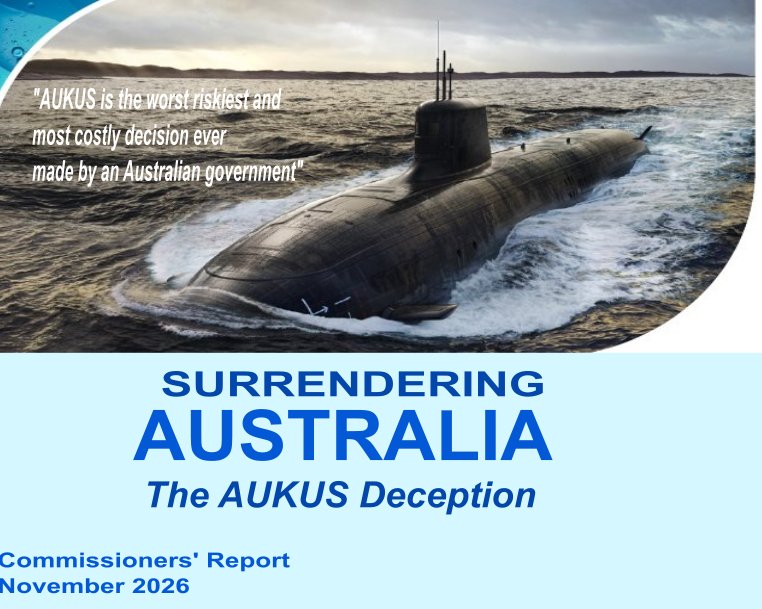
Read the Public Inquiry Report, the Commissioners’ report, Surrendering Australia: The AUKUS Deception is available to download for free at aukuspublicinquiry.com. Or just watch the replay of the National Press Club Luncheon.

4 November – Will AUKUS keep us safe – at what cost?
the Commissioners of the AUKUS Public Inquiry present their findings at the National Press Club of Australia in Canberra. iview.abc.net.au/show/national-press-club-address
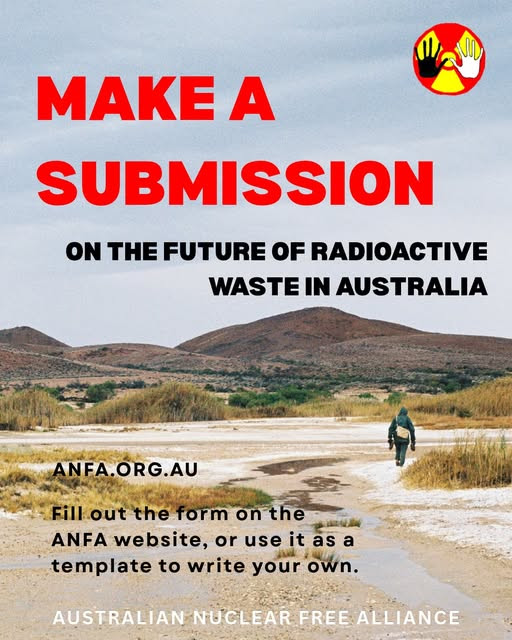
Submissions to the federal government’s new draft framework close on the 13th November 2026.
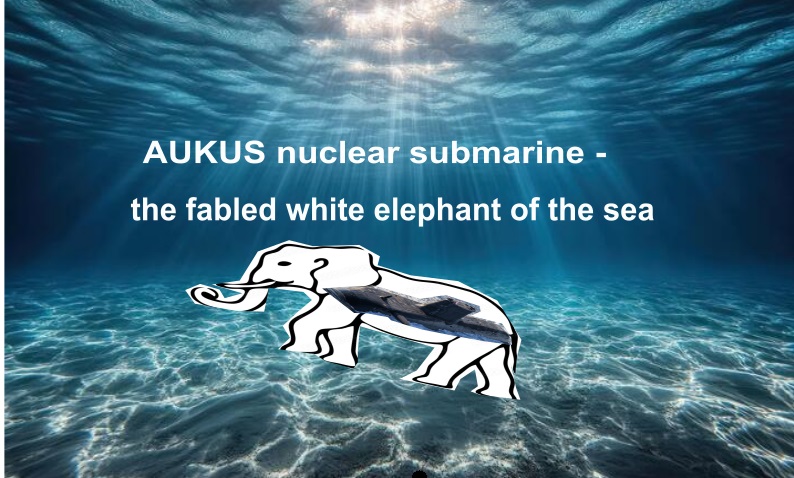
Australians deserve the truth
about
AUKUS – https://aukuspublicinquiry.com/

PETITION – To: Prime Minister Anthony Albanese and the Australian Labor Government

of the week – Australians for War Powers Reform (AWPR)
To see nuclear-related stories in greater depth and intensity

