AUKUS submarines: Beasts of nuclear proliferation
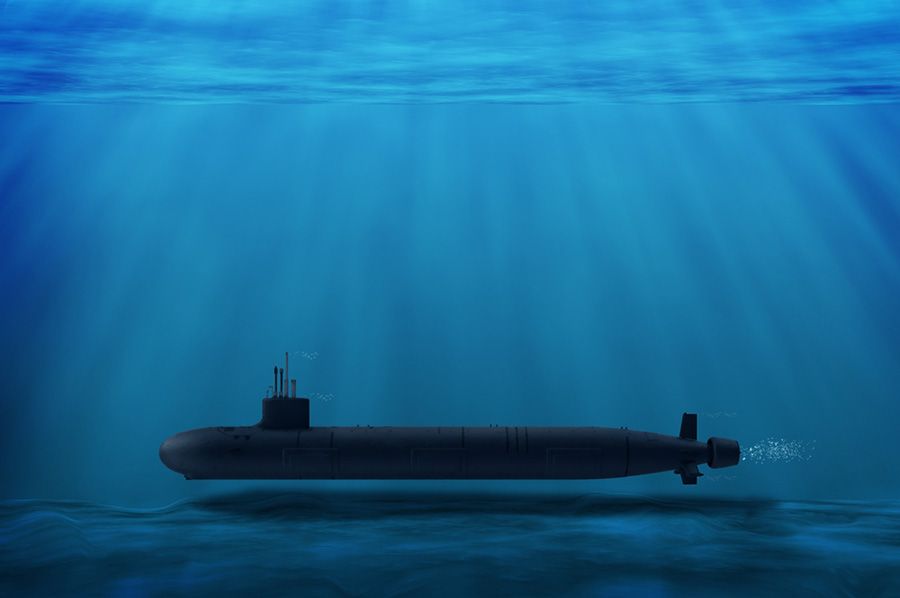
The AUKUS security partnership, announced last September by Australia, the United States and Britain, has muddied the pool of non-proliferation.
The precedent of permitting Australia to be the only non-nuclear weapons state with HEU-propelled technology is also seismic on another level.
For one thing, Article III of the NPT exempts naval reactors from nuclear safeguards, which threatens a pillar of the non-proliferation regime — limiting the production and use of highly enriched uranium (HEU) which can be used, in turn, to make nuclear weapons.
There will be nothing stopping China and Russia doing what the United States and Britain promise to do: proliferate naval reactor technology and long-range missiles with a nuclear capability.
https://www.greenleft.org.au/content/aukus-submarines-beasts-nuclear-proliferation Binoy Kampamrk, July 6, 2022, Issue 1352,
When faced with the option of acquiring nuclear technology, states have rarely refused. Since the splitting of the atom and the deployment of atomic weapons in war, the acquisition of a nuclear capacity has been a dream. Those who did acquire it, in turn, tried to restrict others from joining what has become, over the years, an exclusive club.
Members of this club engage in elaborate ceremonial claims that their nuclear weapons inventory will eventually be emptied. Non-nuclear weapons states allied to such powers go along with appearances, taking comfort that nuclear weapons states will offer them an umbrella of security.
This hypocrisy underlines such arrangements as the Treaty on the Non-Proliferation of Nuclear Weapons (NPT).
Central to the document is the discouragement of non-nuclear weapons states from weaponising nuclear technology, as long as members of the nuclear club pursue “good-faith” disarmament negotiations. While it is true to say that the NPT probably prevented a speedier, less infectious spread of the nuclear virus, it remains a constipated regime of imperfections that has only delayed proliferation.
Most tellingly of all, most non-nuclear weapon states have complied with their undertakings whereas nuclear weapons states have not: they have disregarded serious multilateral nuclear disarmament. Nor do they have an incentive to alter current arrangements, given that any changes to the NPT can only take place with the unanimous support of the three treaty depositories: Russia, Britain and the United States.
The NPT supporters pour scorn on alternative approaches to nuclear weapons, such as the Treaty on the Prohibition of Nuclear Weapons (TPNW), which held its first meeting of state parties in Vienna from June 21—23.
While the Anthony Albanese government sent Susan Templeman MP to the meeting as an observer, Canberra has remained consistently opposed to the TPNW as a threat to the accepted disarmament and NPT framework. Dated and spurious concepts, such as extended nuclear deterrence and the interoperability of Australian and US military systems, tend to be common justifications.
The AUKUS security partnership, announced last September by Australia, the United States and Britain, has muddied the pool of non-proliferation.
A central component of the agreement is a promise to share nuclear propulsion technology with Australia, thereby enabling it to acquire eight nuclear submarines, to supposedly be built in Adelaide.
While much of this is wishful thinking — Australia has no expertise in the field and will have to rely on expertise from the other two — the glaring problem with AUKUS is what it does to non-proliferation arrangements.
While former Prime Minister Scott Morrison said the agreement would comply with Australia’s own non-proliferation commitments, such confidence is misplaced.
For one thing, Article III of the NPT exempts naval reactors from nuclear safeguards, which threatens a pillar of the non-proliferation regime — limiting the production and use of highly enriched uranium (HEU) which can be used, in turn, to make nuclear weapons.
Non-proliferation experts have not been enthusiastic with the promised new Royal Australian Navy submarines. Daryl G Kimball, director of the Arms Control Association, noted the salient difference between deepening defence cooperation with allies on the one hand and proliferating “sensitive HEU nuclear propulsion tech in contravention of US and global nonpro principles”.
Hans Kristensen, director of the Nuclear Information Project at the Federation of American Scientists, greeted AUKUS with gloom when it was announced. Its provisions on nuclear technology would “further intensify the arms race in the region and the dynamics that fuel military competition”.
The International Atomic Energy Agency’s (IAEA) Director General Rafael Mariano Grossi is visiting Australia to discuss safeguards of nuclear material used for naval propulsion.
This is nothing short of problematic, given that IAEA inspectors are unable to inspect such material for extended periods of time when the vessel is at sea. Grossi described this process as “quite complex”, although he wants Australia to commit to non-proliferation alongside the acquisition of nuclear technology.
“There is a period of 18 months which was given by the three partners — the United States, United Kingdom and Australia — to define how the project is going to be implemented but, already we have started this interaction, this joint work of technical levels so that we can reconcile both things.”
Prior to Grossi’s visit, Foreign Minister Penny Wong reiterated Australia’s “longstanding” support of the “IAEA’s mission to harness the peaceful use of nuclear technology in areas like medicine, industrial processes and environmental monitoring, as well as upholding the international nuclear non-proliferation regime”.
The world Wong described is distinctly pre-AUKUS. Despite promises of “open and transparent engagement with the IAEA on nuclear safeguards”, the whinnying horse of proliferation has bolted from the stable. Assurances to avoid the future development of nuclear weapons capability in Australia or a national nuclear fuel cycle also ring hollow.
The precedent of permitting Australia to be the only non-nuclear weapons state with HEU-propelled technology is also seismic on another level.
There will be nothing stopping China and Russia doing what the United States and Britain promise to do: proliferate naval reactor technology and long-range missiles with a nuclear capability. [Dr Binoy Kampmark lectures at RMIT University.]
Kimba nuclear waste dump – phase 3 in progress, but the Australian Radioactive Waste Agency (ARWA) has not completed phase 2 !
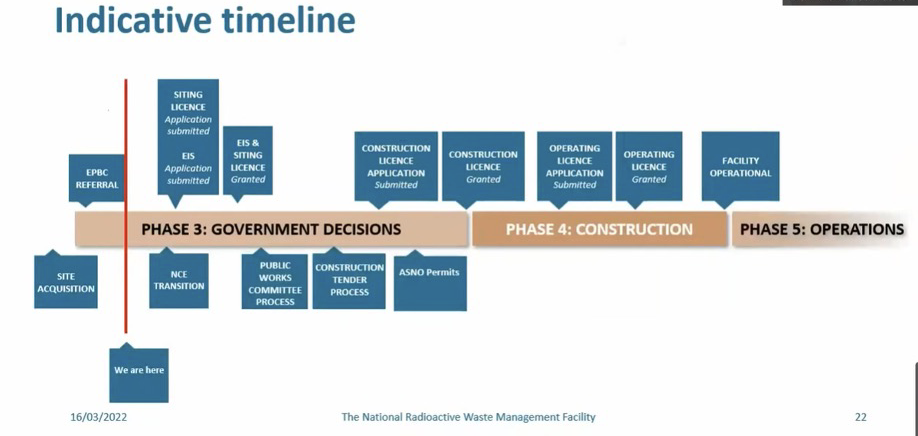
Peter Remta. Timeline for development of Kimba facility 6 July 22.
Out of interest this is the timeline produced by the Australian Radioactive Waste Agency (ARWA) showing where the progress of the Kimba nuclear waste facility development was as at 16 March 2022.
From this timeline it appears that the government is already into phase 3 of the Kimba development but this is completely false as it has still not completed phase 2 in accordance with the prescriptions of its official nomination guidelines issued in November 2016 and titled Radioactive Waste Management Land Nomination Guidelines.
Time to speak up: water apartheid is Australia’s dirty secret
Canberra Times By Erin O’Donnell, Kirsty Howey, July 4 2022
Imagine, in Australia, having to buy bottled water just so you can have clean water to drink. Imagine in 2022, in Australia, Aboriginal communities still have to do that, because they don’t have access to safe drinking water supplies.
While the 2022 NAIDOC week theme is get up, stand up, and show up, that’s an instruction for all of us.
All Australians need to get up, stand up, show up and speak up about this national shame.
In the Northern Territory, drinking water in remote communities regularly breaches guidelines for uranium, and heavy metals. It makes people sick. In Western Australia, the Auditor-General found 24 communities still require the government to truck in bottled water, as local supplies contain harmful contaminants, including uranium. In Queensland, remote, largely Indigenous, townships have faced ongoing water quality issues. Further south, NSW communities also struggled with water quality during the recent drought, and a 2022 study found towns and communities with higher Aboriginal populations and lower income levels were less likely to have access to free sources of filtered water within the community.
In the NT, predominantly white towns such as Darwin, Alice Springs and Katherine have a regulated and safe drinking water supply, but in Indigenous communities drinking water supply is unregulated, with many residents needing to resort to buying bottled water. And far from being an unavoidable consequence of life in remote communities, this is the result of ongoing failure by successive NT governments to plug gaps in water regulation.
………………………………………… The new Labor government’s commitment to restoring a National Water Commission must end water apartheid in Australia. The commission cannot come too soon for northern Australia, where this disaster is unfolding. https://www.canberratimes.com.au/story/7804335/time-to-speak-up-water-apartheid-is-australias-dirty-secret/
USA causing tensions and uncertainty with its expanding militarism in the Pacific, targeting China

Wshington should stop playing dangerous games https://www.chinadaily.com.cn/a/202207/04/WS62c225a5a310fd2b29e6a123.html By Martin Sieff | CHINA DAILY , 6 Jul 22
US President Joe Biden has taken a vague approach on an understanding with Beijing over the Taiwan question negotiated in 1972 by then president Richard Nixon that has ensured peace and mutual prosperity in the Pacific for half a century.
The US-led West continues to push NATO’s eastward expansion and build NATO-like military alliances in the Asia-Pacific region such as AUKUS, the much-touted Australia-United Kingdom-United States strategic alliance. Now the Western powers with some other countries are holding RIMPAC 2022, or Rim of the Pacific, military exercises, the largest in the program’s history, which will further increase uncertainties in the Asia-Pacific.
The alleged reason the West cites for trying to brainwash the prosperous and, left to themselves, peaceful and well-meaning populations of those and other countries is that China, Russia and some other countries present some hideous threat to the rest of the world like Hitler’s Nazi Germany and therefore must be resisted.
Yet the Joe Biden administration, oblivious to the ageless teachings, remains consistent in holding on to the extraordinary irony and blasphemy that its own political values and ideology-which it so manifestly fails to live up to in its own domestic policies and society-must nevertheless be imposed as the inevitable and unavoidable destiny on the rest of the world. Such ridiculous hubris, or arrogance according to the classical Greek view of life, must inevitably generate an annihilating nemesis: total destruction.
How else can one explain the determination of the US administration, pulling its Pacific allies in tow, to provoke a full-scale confrontation, threatening no holds barred confrontation with China over the Taiwan question?
US President Joe Biden has taken a vague approach on an understanding with Beijing over the Taiwan question negotiated in 1972 by then president Richard Nixon that has ensured peace and mutual prosperity in the Pacific for half a century. Biden is also continuing to arm Ukraine to the teeth so Kyiv can keep fighting a bloody conflict it cannot possibly win against Moscow.
What possible sanity can lie behind provoking a war and openly threatening the world’s two other leading strategic and nuclear-armed powers with destabilization and destruction at the same time?
Now, the next step on this march of folly to an extended war has also been taken. Following the recently concluded G7 summit which was apparently targeted at both Russia and China, the Biden administration has dragooned its Pacific allies of New Zealand, Australia and (maybe a reluctant) Japan into the latest RIMPAC exercises specifically aimed at targeting Beijing and bullying it into accepting Washington’s diktat over Taiwan.
Neither Biden nor any of his national security team of Secretary of State Antony Blinken, National Security Advisor Jake Sullivan, Secretary of Defense Lloyd Austin and Under Secretary of State for Policy Victoria Nuland shows the slightest realization that all their policies are certain to bring about the very Armageddon they claim to be determined to deter.
In fact, in his first face-to-face meeting with Austin on the sidelines of the Shangri-La Dialogue in Singapore on June 10, Chinese State Councilor and Defense Minister Wei Fenghe made clear that any move, encouraged or manipulated by the US, to get Taiwan to declare independence would be immediately taken by Beijing as a casus belli.
This would be an insane risk for the US administration to take even if it was to secure peace with the rest of the world, and at no risk of a full-scale war with Russia, another catastrophe which Biden has been assiduously courting.
Far from deterring China, the announcement of the latest RIMPAC exercises, as well as the provocative, hostile and contemptuous language in which that statement was made, can only lock the US even further into its suicidal leap of the Gadarene swine off the edge of a gigantic cliff from which there can be no return or recovery.
Only about 25 people are reported to have survived trying to commit suicide by jumping off the Golden Gate Bridge in San Francisco since it was completed in 1937 out of the 1,700 who have tried. Every one of those survivors has testified that they realized they had made a terrible mistake as soon as they jumped the 67 meters into San Francisco Bay.
Will Biden, Blinken, Sullivan and Nuland experience a similar far-too-late moment of clarity when the catastrophe they have worked so ceaselessly to provoke finally explodes on their country and its allies? By that point, it will not matter: the damned cannot escape their inevitable destruction. One can only weep for the hundreds of millions they will take with them.
The author is a senior fellow at the American University in Moscow.
Drought and hot weather this summer are adding to France’s nuclear powergeneration problems at the worst possible moment.
Drought and hot weather this summer are adding to France’s nuclear power
generation problems at the worst possible moment. As Europe grapples with
low Russian gas supply and the threat of no Russian supply at all,
non-Russian energy sources are more important than ever.
French power giant
Electricite de France (EDF) warned on Tuesday that it may have to reduce
nuclear power generation as the water levels of rivers are low and water
temperatures high. France has been experiencing outages at its nuclear
reactors in recent months, slashing power generation from nuclear power
plants. France’s nuclear power generation accounts for around 70 percent
of its electricity mix and when its reactors are fully operational it is a
net exporter of electricity to other European countries.
Prolonged
maintenance at several nuclear reactors this year, however, means that
France—and the rest of Europe—have less nuclear-generated power supply
now.
Oil Price 5th July 2022
EnergyAustralia downgraded over coal plant breakdowns, coal supply shortages — RenewEconomy

Repeated breakdowns and coal supply shortages have led to a significant ratings downgrade of EnergyAustralia. The post EnergyAustralia downgraded over coal plant breakdowns, coal supply shortages appeared first on RenewEconomy.
EnergyAustralia downgraded over coal plant breakdowns, coal supply shortages — RenewEconomy
Works start at big NSW solar project that will help power NBN — RenewEconomy

Construction work starts at the Wylong solar farm in central NSW, which will supply power to the National Broadband Network. The post Works start at big NSW solar project that will help power NBN appeared first on RenewEconomy.
Works start at big NSW solar project that will help power NBN — RenewEconomy
Australia has finally accepted climate change as a national security threat. What next? — RenewEconomy

The Albanese government review of climate and security risk is a crucial first step in preparing Australia for the dangers ahead. But it must avoid these five pitfalls. The post Australia has finally accepted climate change as a national security threat. What next? appeared first on RenewEconomy.
Australia has finally accepted climate change as a national security threat. What next? — RenewEconomy
Solar duck curve: Why we must fix the cause and not just the symptoms — RenewEconomy

Australia leads the rest of the world in the generation of rooftop solar. However, the same cannot be said about the take-up of household batteries. The post Solar duck curve: Why we must fix the cause and not just the symptoms appeared first on RenewEconomy.
Solar duck curve: Why we must fix the cause and not just the symptoms — RenewEconomy
Germany plans 32GW of new wind and solar a year to meet 2030 renewables target — RenewEconomy

Germany aims for 80pct renewables by 2030 with target of 32GW of new wind and solar a year, plus offshore wind and green hydrogen targets. The post Germany plans 32GW of new wind and solar a year to meet 2030 renewables target appeared first on RenewEconomy.
Germany plans 32GW of new wind and solar a year to meet 2030 renewables target — RenewEconomy
France’s EDF says hot summer could hit nuclear output, shares fall
PARIS, July 5 (Reuters) – France’s EDF (EDF.PA) might be forced to cut nuclear output further because of expected prolonged hot temperatures over the summer months, an executive told a briefing on Tuesday, prompting a sharp fall in the company’s shares.
EDF’s shares ended down 7.5% on the Paris stock market, underperforming the Stoxx Europe 600 Utilities (.SX6P) index, which lost 2.03%.
“We have a peculiar year due to the drought that has started early, especially in southeastern France. But there is generally a little bit less water available this year,” Catherine Laugier, Environment Director at EDF, told a news conference.
France is already grappling with reduced electricity generation because of unexpected maintenance at its aging nuclear reactors.
EDF faces the prospect of having to reduce output because of insufficient river water, which is often used for cooling nuclear reactors before being returned to the river at a higher temperature.
Regulations are in place to limit reactor production during times of exceptional heat and low water levels to prevent the process from damaging local wildlife.
“We’ve had some production cuts between end May and early June. That was indeed pretty early (…) And there are some global evaluations suggesting (…) this might be a very long summer and the levels could be impacted in September,” Laugier said.
Since the start of the year, EDF has lost 20.6% of its value, well below a 12.9% sector-wide decline……………. https://www.reuters.com/business/energy/frances-edf-says-hot-summer-could-hit-nuclear-output-shares-fall-2022-07-05/
Nuclear power in Japan may be a mistake we are doomed to repeat
https://www.asahi.com/ajw/articles/14663000VOX POPULI: Nuclear power in Japan may be a mistake we are doomed to repeat. Vox Populi, Vox Dei is a daily column that runs on Page 1 of The Asahi Shimbun., July 7, 2022
The Supreme Court was extremely lenient with the government in its June 17 verdict concerning the Fukushima nuclear catastrophe of 2011.
Multiple high courts had already ruled that the government was liable for damages for failing to order Tokyo Electric Power Co. to take sufficient preventive measures against a potentially disastrous tsunami.
The top court, however, overturned all these rulings.
Explaining the reason, the presiding justice noted to the effect that the tsunami turned out to be “simply too massive.”
The gist of his argument was that since the accident would have occurred anyway even if the government had ordered TEPCO to install a seawall, his court could not hold the government responsible as a nuclear safety regulator.
What an utterly magnanimous ruling for a government that failed to do its part. This is akin to giving someone a pass because they are too inexperienced or immature to be treated seriously.
I could not possibly support this ruling. However, trying to go along with the court’s reasoning just for the sake of argument, the conclusion to be drawn is the government was never capable of regulating a nuclear power plant at all.
Ultimately, any discussion of nuclear power boils down to whether humans are ever capable of being a party to handling it.
Radioactive nuclear waste must be kept isolated for an utterly mind-boggling period of 100,000 years. We have also learned that once a nuclear accident occurs, we cannot even go near the accident site, let alone control it.
For some years after the Fukushima disaster, the idea of ending nuclear power generation was a major issue in national elections.
A decade has elapsed, however, and the issue is hardly “hot” in the July 10 Upper House election. In fact, the recent rise in energy prices has given a boost to advocates for a greater reliance on nuclear energy.
If radioactive nuclear waste could talk, it must be scoffing at our forgetfulness and taunting us: “You will never be able to measure us by your yardstick.”
Enthusiastic space travel publicity avoids mentioning radiation danger
We need to talk about radiation in space, Cosmos By Jamie Seidel/1 July 2022,
Escape from it all: go above and beyond in your quest for relaxation. Space hotels promise to capitalise on the ultimate dream. But there’s an elephant in orbit, and nobody’s talking about it.
“We’ve seen a lot of great concept designs for orbital hotels lately,” says Dr Iwan Cornelius. “But none of them seem worried about radiation.”
Cornelius is the managing director of Amentum Scientific, an Australian predictive scientific modelling company that quantifies the risks of radiation exposure for the aviation, transport, mining and space industries.
“I’m guessing being sick in space is not good,” the former radiation worker quips. “It’s a long way to your local GP – and the emergency department.”
Radiation exposure has bothered NASA since the earliest days of its space programs. It’s why the International Space Station (ISS) has a tiny bunker surrounded by water and equipment where astronauts can hunker down.
Space tourism is closer to reality than you think – but a few important things remain to be ironed out.
Escape from it all: go above and beyond in your quest for relaxation. Space hotels promise to capitalise on the ultimate dream. But there’s an elephant in orbit, and nobody’s talking about it.
“We’ve seen a lot of great concept designs for orbital hotels lately,” says Dr Iwan Cornelius. “But none of them seem worried about radiation.”
Cornelius is the managing director of Amentum Scientific, an Australian predictive scientific modelling company that quantifies the risks of radiation exposure for the aviation, transport, mining and space industries.
“I’m guessing being sick in space is not good,” the former radiation worker quips. “It’s a long way to your local GP – and the emergency department.”
Radiation exposure has bothered NASA since the earliest days of its space programs. It’s why the International Space Station (ISS) has a tiny bunker surrounded by water and equipment where astronauts can hunker down.
“One thing you’ll notice with all these concept diagrams for space hotels is there’s not a lot of information about a radiation refuge.”
…………… “If we’re talking about a packed hotel in space, where will they go?” Cornelius asks. “How long will it take to get there? Does everyone get access to a shelter – including staff? I don’t know if this is being thought through”.
And solar events aren’t the only space radiation source…………………………….
Renewables supply nearly half of German power demand in first half 2022
Renewable energy has supplied roughly half of Germany’s electricity
demand for the first half of 2022, new data has shown, boosting the amount
of renewables in the mix by six percentage points compared to the same
period in 2021. Germany’s Center for Solar Energy and Hydrogen Research
Baden-Württemberg (ZSW) and the Federal Association of Energy and Water
Management (BDEW) said on Monday that renewables had covered around 49% of
gross domestic electricity consumption over the period. In a joint press
release, the organisations said that the main contributor to the increased
renewables output was a “significant increase” in onshore wind and
solar capacity – each generating around one-fifth more electricity than
in the same period in 2021.
Renew Economy 6th July 2022
July 6 Energy News — geoharvey

Opinion: ¶ “Supposed Benefits Of Biofuels Are A Dangerous Illusion” • Guardian columnist George Monbiot had a few things to say about biofuels recently, none of them complimentary. His latest opinion piece starts this way: “Modern biofuels are touted as a boon for the climate. But, used on a large scale, they are no more […]
July 6 Energy News — geoharvey
1 This month
17 October, Free Public Talk on Nuclear Issues in South Australia
David Noonan will speak on public interest concerns over the new Roxby Downs Indenture Act 2026 on BHP copper-uranium mining and ore processing in SA, and on how AUKUS may face SA with a High-Level nuclear waste agenda.
Dr Jim Green will discuss international developments in the field of nuclear power including ‘small modular reactors’ and Generation 4 ‘advanced’ nuclear reactor concepts.


Help Aunty Sue Protect Her Land and Sacred Sites From Destructive Rocket Testing.
.

Australians deserve the truth
about
AUKUS – https://aukuspublicinquiry.com/

PETITION – To: Prime Minister Anthony Albanese and the Australian Labor Government

of the week – Australians for War Powers Reform (AWPR)
To see nuclear-related stories in greater depth and intensity

