Antinuclear

Australian news, and some related international items

‘Canaries in the coal mine’: Frogs face an uncertain future, and that’s bad news for us as well

‘Canaries in the coal mine’: Frogs face an uncertain future, and that’s bad news for us as well

As Australia comes to grips with mosquito-borne diseases like Japanese encephalitis, frogs help keep the mozzies under control — but they’re among the first species to show signs of stress when the environment deteriorates

June 6, 2022 Posted by | Uncategorized | Leave a comment

Arms sent to Ukraine will end up in criminal hands, says Interpol chief

Jürgen Stock urges members to cooperate on arms tracing as weapons will flood hidden economy when war ends,

Guardian, Kim Willsher, Thu 2 Jun 2022

Weapons sent to Ukraine after Russia’s invasion in February will end up in the global hidden economy and in the hands of criminals, the head of Interpol has said.

Jürgen Stock says once the conflict ends, a wave of guns and heavy arms will flood the international market and he urged Interpol’s member states, especially those supplying weapons, to cooperate on arms tracing.

“Once the guns fall silent [in Ukraine], the illegal weapons will come. We know this from many other theatres of conflict. The criminals are even now, as we speak, focusing on them,” Stock said.

“Criminal groups try to exploit these chaotic situations and the availability of weapons, even those used by the military and including heavy weapons. These will be available on the criminal market and will create a challenge. No country or region can deal with it in isolation because these groups operate at a global level.”

He added: “We can expect an influx of weapons in Europe and beyond. We should be alarmed and we have to expect these weapons to be trafficked not only to neighbouring countries but to other continents.”

He said Interpol urged members to use its database to help “track and trace” the weapons. “We are in contact with member countries to encourage them to use these tools. Criminals are interested in all kinds of weapons … basically any weapons that can be carried might be used for criminal purposes.”

Ukraine’s western allies have sent shipments of high-end military weapons to Ukraine since the Russian invasion more than three months ago. On Tuesday, the American president, Joe Biden, announced the US would supply Kyiv with advanced missile systems and munitions. After the US pulled out of Afghanistan in 2021, following 20 years of war, huge amounts of often highly sophisticated military equipment was left behind and fell into the hands of the Taliban.

Stock, the secretary general of the international policing organisation who was speaking to the Anglo-American Press Association in Paris, said the conflict in Ukraine had also led to a rise in large-scale fertiliser theft and an increase in counterfeit agrochemicals. There was also a huge rise in fuel theft. “These products have become more valuable,” he said……………………………………. https://www.theguardian.com/world/2022/jun/02/ukraine-weapons-end-up-criminal-hands-says-interpol-chief-jurgen-stock

June 6, 2022 Posted by | Uncategorized | Leave a comment

The National Radioactive Waste Management Act is racist and the Act must be amended or repealed and replaced.

Submission to Legal & Constitutional Affairs References Committee
Inquiry into the application of the United Nations Declaration on the Rights of Indigenous Peoples in Australia Friends of the Earth Australia nuclear.foe.org.au/racism nuclear.foe.org.au/waste
June 2022

Article 29 of the UN Declaration on the Rights of Indigenous Peoples:

  1. Indigenous peoples have the right to the conservation and protection of the environment and the productive capacity of their lands or territories and resources. States shall establish and implement assistance programmes for indigenous peoples for such conservation and protection, without discrimination.
  2. States shall take effective measures to ensure that no storage or disposal of hazardous materials shall take place in the lands or territories of indigenous peoples without their free, prior and informed consent.
  3. States shall also take effective measures to ensure, as needed, that programmes for monitoring, maintaining and restoring the health of indigenous peoples, as developed and implemented by the peoples affected by such materials, are duly implemented.
    https://www.un.org/development/desa/indigenouspeoples/wp-
  1. SUMMARY SUMMARY & RECOMMENDATIONS
  2. Friends of the Earth Australia welcomes the opportunity to provide a submission to this inquiry and would be happy to appear at a public hearing.
  3. This submission argues that successive Australian federal governments have repeatedly breached the UN Declaration on the Rights of Indigenous Peoples (UNDRIP) in relation to nuclear waste management plans, and that the National Radioactive Waste Management Act contains multiple indefensible clauses designed to disempower Aboriginal Traditional Owners

The recommendations are as follows:

  1. The Committee should recommend revocation of the Morrison Coalition Government’s declaration of a site near Kimba in SA for a national nuclear waste dump. The opposition of Barngarla Traditional Owners is unanimous. It would be unconscionable for the Labor Government to do anything other than to revoke the declaration and abandon the former government’s plan for a nuclear dump on Barngarla Country.
  2. The Committee should recommend that the federal Albanese Labor Government adopt South Australian Labor policy whereby traditional owners have a right of veto over any nuclear waste sites.
  3. The National Radioactive Waste Management Act is racist through and through, it breaches the UNDRIP on multiple counts, and the Act must be amended or repealed and replaced.
  1. THE PROPOSED NATIONAL NUCLEAR WASTE DUMP ON BARNGARLA COUNTRY IN SA
    The Morrison Coalition Government’s plan to establish a national nuclear waste dump on Barngarla Country on SA’s Eyre Peninsula ‒ despite the unanimous opposition of Barngarla Traditional Owners ‒ clearly violates Article 29 of the UNDRIP:
    “States shall take effective measures to ensure that no storage or disposal of hazardous materials shall take place in the lands or territories of indigenous peoples without their free, prior and informed consent”.

In a 2018 submission to the UN OHCHR United Nations Expert Mechanism on the Rights of Indigenous Peoples, the Morrison Coalition Government claimed that “the [radioactive waste] facility will not be forced on an unwilling community, in line with Article 29(2) of the Declaration [on the Rights of Indigenous Peoples].”
Article 29(2) of the UN Declaration stresses free, prior and informed consent:
“States shall take effective measures to ensure that no storage or disposal of hazardous materials shall take place in the lands or territories of indigenous peoples without their free, prior and informed consent.”

The proposed Kimba dump does not have the “free, prior and informed consent” of Barngarla Traditional Owners. They are unanimous in their opposition. There is no consent.
The Morrison Government excluded Barngarla Traditional Owners from a sham ‘community ballot’. So the Barngarla Determination Aboriginal Corporation (BDAC) engaged the Australian Election Company to conduct an independent ballot which revealed unanimous opposition among Traditional Owners. The ballot was ignored by the federal government.
Jason Bilney, Chair of BDAC, noted:
“It is a simple truth that had we, as the first people for the area, been included in the Kimba community ballot rather than unfairly denied the right to vote, then the community ballot would never have returned a yes vote.”

In April 2020, federal parliament’s Joint Committee on Human Rights Committee concluded that the Morrison government was violating the human rights of Barngarla people. The Committee noted the unanimous opposition of the Barngarla Traditional Owners to the proposed nuclear dump and it concluded that the National Radioactive Waste Management Amendment Bill did not sufficiently protect the rights and interests of Traditional Owners and that “there is a significant risk that the specification of this site will not fully protect the right to culture and self-determination.”

Importantly, the Human Rights Committee’s report was unanimous and was endorsed by Liberal and National Party members as well as Labor members. However the Morrison Coalition Government ignored the Human Rights Committee’s report and continued in its efforts to dispossess and disempower Barngarla Traditional Owners.

The National Radioactive Waste Management Amendment Bill was the Morrison Government’s attempt to amend federal legislation to prevent Barngarla Traditional Owners from launching a legal challenge against the nomination of the dump site. Thankfully, the attempt to prevent a legal challenge failed due to opposition from Labor and cross-bench Senators.

Barngarla Traditional Owners have launched a legal challenge in the Federal Court against the Morrison Government’s declaration of the Napandee site, near Kimba, for a national nuclear waste dump. It would be unconscionable for the incoming Labor Government to engage in a legal fight in order to allow the government to ignore and override the unanimous opposition of Barngarla Traditional Owners to the proposed nuclear dump.

The Barngarla Determination Aboriginal Corporation states:
“It remains shocking and saddening that in the 21st Century, First Nations people would have to fight for the right to vote in Australia and that the Federal Government would deliberately remove judicial oversight of its actions in circumstances where the Human Rights Committee, a bipartisan committee no less, has considered the process to locate the NRWMF flawed.”

A 22 June 2021 joint statement by Barngarla Determination Aboriginal Corporation and No Radioactive Waste on Agricultural Land in Kimba or SA group states:2

“The Government has completely and utterly miscarried the site selection process. There are many examples of this. No proper heritage assessment of the site was ever undertaken, and they have marginalised the voices of the farming community throughout the entire process. However, the most obvious and appalling example of this failed process was when the Government allowed the gerrymandering of the Kimba “community ballot”, in order to manipulate the vote. The simple fact remains that even though the Barngarla hold native title land closer to the proposed facility than the town of Kimba, the First Peoples for the area were not allowed to vote. They prevented Barngarla persons from voting, because native title land is not rateable. Further, they did not allow many farmers to vote, even

though they were within 50km of the proposed facility, because they were not in the Council area. They targeted us, because they knew that if they had a fair vote which included us, then the vote would return a “no” from the community.”
BDAC has written to Prime Minister Albanese calling on the Labor government to scrap Morrison’s plans for a nuclear waste dump in SA.3 The letter states:
“Although we appreciate all that Labor have done in opposition, the Barngarla people unequivocally make it clear that we request that the new Labor minister revoke the declaration or consent to the orders quashing the declaration. We call for this to occur at the earliest opportunity possible.”

The BDAC letter further states:
“Sadly, the former Government at every turn tried to silence us in this process, as the Government did not allow us access to the land to undertake a proper heritage survey, tried to remove our right to judicial review, sought to legislate the location directly, abandoned their commitment to ensure that the facility had broad community support, altered the proposal to include military waste inconsistently with the treaty and tried, through various affiliated organisations, to interfere with our ability to bring judicial review including having parties costs orders against us as a means to blocking the Barngarla people from going to Court.

“Despite this, we stood tall, and we have brought these legal proceedings. They were brought against Minister Pitt, but because you have won the election, the matter now becomes your Governments to deal with.

“Although we appreciate the right to bring these proceedings and all that Labor have done in Opposition, the Barngarla people unequivocally make it clear that we request that the new Labor Minister revoke the declaration or consent to the orders quashing the declaration. We call for this to occur at the earliest opportunity possible in the new Labor Government, because we do not want to fight against your Government in Court which would not only take a number of years, but result in spending our vulnerable community’s resources protecting our people against the contemptuous behaviour of the last Government; nor do we want your Government to be tarnished by these horrible failures of the former Government. …
“The Uluru Statement from the Heart makes clear that our “sovereignty is a spiritual notion: the ancestral tie between the land, or ‘mother nature’, and the Aboriginal and Torres Strait Islander peoples who were born therefrom, remain attached thereto, and must one day return thither to be united with our ancestors. This link is the basis of the ownership of the soil, or better, of sovereignty. It has never been ceded or extinguished, and co-exists with the sovereignty of the Crown”. Again, as we said to the new Minister, our spiritual sovereignty has been violated by the former Government, and we hope and believe in your Government that you will not violate it further.”

Right of Veto
The Albanese Labor Government should adopt South Australian Labor’s policy whereby traditional owners have a right of veto over any nuclear waste sites. This is of course consistent with UNDRIP principles regarding free, prior and informed consent.
Susan Close, now Deputy Premier of South Australia, noted in a September 2020 media statement:
“This was a dreadful process from start to finish, resulting in fractures within the local community over the dump. The SA ALP has committed to traditional owners having a right of veto over any nuclear waste sites, yet the federal government has shown no respect to the local Aboriginal people.”
Likewise, in October 2021 SA Labor supported a parliamentary motion stating that in light of the opposition of the Barngarla Traditional Owners, the (since defeated) Marshall Government should oppose the federal government’s attempt to impose a national nuclear waste dump in SA and stands condemned for its failure to do so.4


Labor’s Kyam Maher spoke in favour of the parliamentary motion:5
“We have had since before the last election, and maintained the view since the election, that for a nuclear radioactive storage facility it is fundamental that traditional owners’ views are taken into account. Since Jay Weatherill was Premier we have taken the view ‒ and that has continued in this term while we are in opposition ‒ that for a nuclear radioactive dump or storage facility the traditional owners should have a right of veto, a right of refusal of such a thing on their land. That has not changed and that is why we support this motion, from that one very simple principle which we have had and which remains unchanged.”
The Albanese Labor Government should respect SA legislation banning the import, transport, storage and disposal of nuclear wastes ‒ the SA Nuclear Waste Storage (Prohibition) Act 2000. The Act states:
“The Objects of this Act are to protect the health, safety and welfare of the people of South Australia and to protect the environment in which they live by prohibiting the establishment of certain nuclear waste storage facilities in this State.”

The Nuclear Waste Storage (Prohibition) Act is supported by South Australians; the proposed nuclear waste dump is not. A 2018 poll found that 55% agreed that SA should stop the federal government from building a national nuclear dump in SA while 35% disagreed. A 2016 Sunday Mail-commissioned poll found that support in SA for a national dump (39.8%) was well short of a 50% majority and even further short of the Morrison Coalition Government’s own benchmark of 65% to demonstrate ‘broad community support’. A 2015 Advertiser-commissioned poll found just 15.7% support for a nuclear waste dump in SA.
SA Unions, the peak body representing trade unionists in South Australia, unanimously passed a resolution in March 2022 supporting Barngarla Traditional Owners in their struggle

against the Morrison government’s proposed nuclear dump.6 SA Unions Secretary Dale Beasley said the that South Australian labour movement stood shoulder to shoulder with the Barngarla Traditional Owners:
“South Australian unions are completely united in their support of the Barngarla Traditional Owners and their opposition to the proposed nuclear waste site at Kimba. … We have in South Australia a shameful legacy of imposing the impact of nuclear technology on aboriginal communities. Decades after the end of British nuclear tests around Maralinga, radioactive particles containing plutonium and uranium still contaminate the landscape. Given that history, we would have expected Steven Marshall to stand up for the Barngarla Traditional Owners. … South Australian unions join with the Traditional Owners and the South Australian Community in complete opposition to the dangerous proposal.”

Recommendations:

  1. The Committee should recommend revocation of the Morrison Coalition Government’s declaration of a site near Kimba in SA for a national nuclear waste dump. The opposition of Barngarla Traditional Owners is unanimous. It would be unconscionable for the Labor Government to do anything other than to revoke the declaration and abandon the former government’s plan for a nuclear dump on Barngarla Country.
  2. The Committee should recommend that the federal Albanese Labor Government adopt South Australian Labor policy whereby traditional owners have a right of veto over any nuclear waste sites.
  1. THE NATIONAL RADIOACTIVE WASTE MANAGEMENT ACT
    The National Radioactive Waste Management Act (NRWMA) is wildly inconsistent with UNDRIP principles.
    The NRWMA gives the federal government the power to extinguish rights and interests in land targeted for a radioactive waste facility.7 In so doing the relevant Minister must “take into account any relevant comments by persons with a right or interest in the land” but there is no requirement to secure consent ‒ or to back off if consent is not forthcoming.
    Aboriginal Traditional Owners, local communities, pastoralists, business owners, local councils and State/Territory Governments are all disadvantaged and disempowered by the NRWMA.
    The NRWMA goes to particular lengths to disempower Traditional Owners. The nomination of a site for a radioactive waste facility is valid even if Aboriginal owners were not consulted and did not give consent. The NRWMA states that consultation should be conducted with

Traditional Owners and consent should be secured ‒ but that the nomination of a site for a radioactive waste facility is valid even in the absence of consultation or consent.
Needless to say, that is in no way, shape or form compliant with UNDRIP clauses regarding free, prior and informed consent.
The NRWMA has sections which nullify State or Territory laws that protect the archaeological or heritage values of land or objects, including those which relate to Indigenous traditions.
The Act curtails the application of Commonwealth laws including the Aboriginal and Torres Strait Islander Heritage Protection Act 1984 and the Native Title Act 1993 in the important site-selection stage. The Native Title Act 1993 is expressly overridden in relation to land acquisition for a radioactive waste facility.

The NRWMA has been criticised in both Senate Inquiries and a Federal Court challenge to an earlier federal government attempt to impose a national radioactive waste facility at Muckaty in the Northern Territory.
The NRWMA needs to be radically amended or replaced with legislation that gives local communities and Traditional Owners the right to say ‘no’ to nuclear waste dumps.
Sadly, the only recent attempt to amend the NRWMA was the Morrison Coalition Government’s attempt to strip ever more rights from Traditional Owners, by removing the right for judicial review. Thankfully, that attempt to further weaken the legislation failed.
Recommendation:

  1. The National Radioactive Waste Management Act is racist through and through, it breaches the UNDRIP on multiple counts, and the Act must be amended or repealed and replaced.

June 4, 2022 Posted by | AUSTRALIA - NATIONAL, Federal nuclear waste dump, politics, reference | Leave a comment

Ex-CIA director called to testify on plot to kill Assange — ABC

  https://www.rt.com/news/556551-pompeo-court-kill-assange/  3 June 22,     A Spanish court has summoned Mike Pompeo, according to the outlet.  A Spanish court has summoned former CIA Director Mike Pompeo as a witness to testify about whether the US government planned to abduct or even assassinate WikiLeaks founder Julian Assange, ABC has reported on Friday citing its sources. 

“The judge of the National Court Santiago Pedraz has agreed to summon as a witness Mike Pompeo, former US Secretary of State and former CIA director, to explain whether the intelligence agency and the US government with Donald Trump at its helm drew up a plan in 2017 to kidnap and

 assassinate the founder of WikiLeaks,” the report read.

According to the outlet’s sources, Pompeo has been summoned to appear as a witness this June, although he may give testimony via video link. Pedraz made the decision after prosecutor Carlos Bautista supported the request made by Assange’s lawyer Aitor Martinez. 

In September 2021, Yahoo News broke a story alleging that the CIA plotted to kidnap the WikiLeaks founder, a plan that sparked fierce debates within the Trump administration over the legality and practicality of such an operation. Moreover, senior US officials reportedly went so far as to request 

“sketches” or “options” on how to assassinate Assange. 

Following the report, Pompeo called for the criminal prosecution of the sources who shared the story with Yahoo News, saying that they all “should all be prosecuted for speaking about classified activity inside the Central Intelligence Agency”. 

Julian Assange rose to fame owing to WikiLeaks’ pro-transparency activism and the publication of huge troves of leaked classified documents that exposed dark secrets of many governments, including alleged war crimes committed by US forces in Afghanistan and Iraq. The WikiLeaks founder has been confined in the Belmarsh maximum-security prison in London since April 2019 pending possible extradition to the US. 

 In April, a London court issued a formal extradition order for Assange that is now subject to approval by Britain’s interior minister. However, the WikiLeaks founder still has legal avenues of appeal. Should he be extradited to the US, he will be tried under the Espionage Act, which prohibits obtaining information related to national defense that can be used to undermine US interests.The activist has denied all charges and his lawyers have argued that the defendant had not been under US jurisdiction and had engaged in completely legal journalism

June 4, 2022 Posted by | Uncategorized | Leave a comment

After the Coalition’s failure, there is no higher duty than being Australia’s environment minister

After the Coalition’s failure, there is no higher duty than being Australia’s environment minister

Amelia Young

The portfolio carries the fate of Australia’s unique constellation of lifeforms, and the world will be watching whether we choose to let them thrive

June 4, 2022 Posted by | Uncategorized | Leave a comment

La Niña’s big hit on coal is forgotten factor behind Australia’s energy crisis — RenewEconomy

Blame it on the rain? Amid the energy price chaos is the simple fact that La Niña has dramatically disrupted coal production right down the east coast. The post La Niña’s big hit on coal is forgotten factor behind Australia’s energy crisis appeared first on RenewEconomy.

La Niña’s big hit on coal is forgotten factor behind Australia’s energy crisis — RenewEconomy

June 4, 2022 Posted by | Uncategorized | Leave a comment

Australian researchers make clear gains in solar glass technology — RenewEconomy

Researchers from Monash and CSIRO find way to boost the energy efficiency and longevity of solar glass, while also allowing more natural light to pass through it. The post Australian researchers make clear gains in solar glass technology appeared first on RenewEconomy.

Australian researchers make clear gains in solar glass technology — RenewEconomy

June 4, 2022 Posted by | Uncategorized | Leave a comment

More wind farm project delays put dent into contractor’s revenue hopes — RenewEconomy

Contracting firm downgrades revenue forecasts for second time in two months after yet more delays at two wind farm projects. The post More wind farm project delays put dent into contractor’s revenue hopes appeared first on RenewEconomy.

More wind farm project delays put dent into contractor’s revenue hopes — RenewEconomy

June 4, 2022 Posted by | Uncategorized | Leave a comment

Wind power meets and beats Denmark’s total electricity demand – two days in a row — RenewEconomy

Windy conditions in northern Europe provided more than 100% of Denmark’s electricity consumption for two days in a row in May. The post Wind power meets and beats Denmark’s total electricity demand – two days in a row appeared first on RenewEconomy.

Wind power meets and beats Denmark’s total electricity demand – two days in a row — RenewEconomy

June 4, 2022 Posted by | Uncategorized | Leave a comment

June 3 Energy News — geoharvey

Opinion:  ¶ “The World May Be Careening Toward A 1970s-Style Energy Crisis – Or Worse” • The world is grappling with energy price spikes on everything from gasoline and natural gas to coal. Some experts fear this may just be the beginning of a situation that may rival or even exceed the oil crises of […]

June 3 Energy News — geoharvey

June 4, 2022 Posted by | Uncategorized | Leave a comment

Joe Biden’s huge move against Russia: ‘This is how nuclear war begins’, 

Yahoo News Australia and agencies, Thu, 2 June 2022

The US overnight has unveiled a new US$700 million package ($975 million) of sophisticated weapons for Ukraine in an urgent effort to prevent Russia from seizing the final swaths of land in the Donbas region.

But the most advanced rocket systems will take at least three weeks to reach the battlefront, raising questions of whether they will arrive in time to stop Russia’s slow but steady gains as the war inches closer to global catastrophe.

The Biden administration’s decision to send four medium-range rocket systems came after weeks of debate over whether the precision-guided weapons would provoke a strong military reaction from Russian President Vladimir Putin. It suggests the US believes it has zeroed in on what weapons deliveries are worth the risk…….

“The Ukrainians have given us assurances that they will not use these systems against targets on Russian territory,” Secretary of State Antony Blinken said Wednesday (local time).

“There is a strong trust bond between Ukraine and the United States.”

Nuclear war beings ‘one step at a time’

But not everyone has such faith in the latest decision by the US.  

“The Ukrainians have given us assurances that they will not use these systems against targets on Russian territory,” Secretary of State Antony Blinken said Wednesday (local time).

“There is a strong trust bond between Ukraine and the United States.” 

“This is a textbook example of how a nuclear war begins. One step at a time,” tweeted popular author Jim Rickards on Wednesday.

The Kremlin is also making threatening noises about the move.  Kremlin spokesman Dmitry Peskov told reporters Wednesday the US is “deliberately and diligently pouring fuel on the fire.” He added that Russia doesn’t trust 

Kyiv’s assurances that the multiple rocket launch systems supplied by the US will not be used to attack.

“In order to trust (someone), you need to have experience with situations when such promises were kept. Regretfully, there is no such experience whatsoever,” Peskov said.,……………….

The Pentagon would not say how many rockets it will provide to Ukraine, only that it is sending four of the truck-mounted HIMARS systems. The trucks each carry a container with six precision-guided rockets, which can travel about 70 kilometres……………… https://au.news.yahoo.com/joe-bidens-huge-move-against-russia-nuclear-war-223931012.html

June 4, 2022 Posted by | Uncategorized | Leave a comment

Documentary – Chernobyl: The Lost Tapes

The trailer for Chernobyl: The Lost Tapes documents the coverup of one of the worst nuclear disasters in historyhttps://www.yahoo.com/entertainment/trailer-chernobyl-lost-tapes-documents-182752165.html

Savannah Olson

Sat, June 4, 2022 Back in 2019, the miniseries Chernobyl aired on HBO, unflinchingly chronicling the horrors of the 1986 Chernobyl nuclear disaster through actors and the big budget of cable television. Now, unseen footage taken at the time of the incident combined with in-person interviews has been put together in the trailer for HBO’s newest documentary Chernobyl: The Lost Tapes

The unnerving documentary’s synopsis reads: “Thirty-six years after the Chernobyl nuclear reactor exploded in Soviet Ukraine, newly uncovered archival footage and recorded interviews with those who were present paint an emotional and gripping portrait of the extent and gravity of the disaster and the lengths to which the Soviet government went to cover up the incident, including the soldiers sent in to ‘liquidate’ the damage. Chernobyl: The Lost Tapes is the full, unvarnished true story of what happened in one of the least understood tragedies of the twentieth century.”

June 4, 2022 Posted by | Uncategorized | Leave a comment

Small nuclear reactors produce ’35x more waste’ than big plants

Mini nuclear reactors that are supposed to usher in an era of cheaper and
safer nuclear power may generate up to 35 times more waste to produce the
same amount of power as a regular plant, according to a study.

A team of researchers at Stanford University and the University of British Columbia
came to this conclusion after studying a design from each of three small
modular reactor (SMR) manufacturers: NuScale Power, Toshiba, and
Terrestrial Energy.

The study, published this week, found that not only did
those particular SMR approaches generate five times the spent nuclear fuel
(SNF), 30 times the long-lived equivalent waste, and 35 times the low and
intermediate-level waste (LILW), their waste is also more reactive,
therefore more dangerous and consequently harder to dispose of.

 The Register 2nd June 2022

https://www.theregister.com/2022/06/02/nuclear_reactors_waste/

June 4, 2022 Posted by | Uncategorized | Leave a comment

Nuclear waste from small modular reactors

Lindsay M. Krall https://orcid.org/0000-0002-6962-7608 Lindsay.Krall@skb.seAllison M. Macfarlane https://orcid.org/0000-0002-8359-9324, and Rodney C. Ewing https://orcid.org/0000-0001-9472-4031Authors Info & Affiliations

May 31, 2022  Small modular reactors (SMRs), proposed as the future of nuclear energy, have purported cost and safety advantages over existing gigawatt-scale light water reactors (LWRs). However, few studies have assessed the implications of SMRs for the back end of the nuclear fuel cycle. The low-, intermediate-, and high-level waste stream characterization presented here reveals that SMRs will produce more voluminous and chemically/physically reactive waste than LWRs, which will impact options for the management and disposal of this waste. Although the analysis focuses on only three of dozens of proposed SMR designs, the intrinsically higher neutron leakage associated with SMRs suggests that most designs are inferior to LWRs with respect to the generation, management, and final disposal of key radionuclides in nuclear waste.

Abstract

Small modular reactors (SMRs; i.e., nuclear reactors that produce <300 MWelec each) have garnered attention because of claims of inherent safety features and reduced cost. However, remarkably few studies have analyzed the management and disposal of their nuclear waste streams. Here, we compare three distinct SMR designs to an 1,100-MWelec pressurized water reactor in terms of the energy-equivalent volume, (radio-)chemistry, decay heat, and fissile isotope composition of (notional) high-, intermediate-, and low-level waste streams. Results reveal that water-, molten salt–, and sodium-cooled SMR designs will increase the volume of nuclear waste in need of management and disposal by factors of 2 to 30. The excess waste volume is attributed to the use of neutron reflectors and/or of chemically reactive fuels and coolants in SMR designs. That said, volume is not the most important evaluation metric; rather, geologic repository performance is driven by the decay heat power and the (radio-)chemistry of spent nuclear fuel, for which SMRs provide no benefit. 

 SMRs will not reduce the generation of geochemically mobile 129I, 99Tc, and 79Se fission products, which are important dose contributors for most repository designs. In addition, SMR spent fuel will contain relatively high concentrations of fissile nuclides, which will demand novel approaches to evaluating criticality during storage and disposal. Since waste stream properties are influenced by neutron leakage, a basic physical process that is enhanced in small reactor cores, SMRs will exacerbate the challenges of nuclear waste management and disposal.

In recent years, the number of vendors promoting small modular reactor (SMR) designs, each having an electric power capacity <300 MWelec, has multiplied dramatically (12). Most recently constructed reactors have electric power capacities >1,000 MWelec and utilize water as a coolant. Approximately 30 of the 70 SMR designs listed in the International Atomic Energy Agency (IAEA) Advanced Reactors Information System are considered “advanced” reactors, which call for seldom-used, nonwater coolants (e.g., helium, liquid metal, or molten salt) (3). Developers promise that these technologies will reduce the financial, safety, security, and waste burdens associated with larger nuclear power plants that operate at the gigawatt scale (3). Here, we make a detailed assessment of the impact of SMRs on the management and disposal of nuclear waste relative to that generated by larger commercial reactors of traditional design.

Nuclear technology developers and advocates often employ simple metrics, such as mass or total radiotoxicity, to suggest that advanced reactors will generate “less” spent nuclear fuel (SNF) or high-level waste (HLW) than a gigawatt-scale pressurized water reactor (PWR), the prevalent type of commercial reactor today. For instance, Wigeland et al. (4) suggest that advanced reactors will reduce the mass and long-lived radioactivity of HLW by 94 and ∼80%, respectively. These bulk metrics, however, offer little insight into the resources that will be required to store, package, and dispose of HLW (5). Rather, the safety and the cost of managing a nuclear waste stream depend on its fissile, radiological, physical, and chemical properties (6). Reactor type, size, and fuel cycle each influence the properties of a nuclear waste stream, which in addition to HLW, can be in the form of low- and intermediate-level waste (LILW) (68). Although the costs and time line for SMR deployment are discussed in many reports, the impact that these fuel cycles will have on nuclear waste management and disposal is generally neglected (911).

Here, we estimate the amount and characterize the nature of SNF and LILW for three distinct SMR designs. From the specifications given in the NuScale integral pressurized water reactor (iPWR) certification application, we analyze basic principles of reactor physics relevant to estimating the volumes and composition of iPWR waste and then, apply a similar methodology to a back-end analysis of sodium- and molten salt–cooled SMRs. Through this bottom-up framework, we find that, compared with existing PWRs, SMRs will increase the volume and complexity of LILW and SNF. This increase of volume and chemical complexity will be an additional burden on waste storage, packaging, and geologic disposal. Also, SMRs offer no apparent benefit in the development of a safety case for a well-functioning geological repository.

1. SMR Neutronics and Design………………

2. Framework for Waste Comparison………….

3. SMR Waste Streams: Volumes and Characteristics………….

………….. 

3.3.2. Corroded vessels from molten salt reactors.

Molten salt reactor vessel lifetimes will be limited by the corrosive, high-temperature, and radioactive in-core environment (2324). In particular, the chromium content of 316-type stainless steel that constitutes a PWR pressure vessel is susceptible to corrosion in halide salts (25). Nevertheless, some developers, such as ThorCon, plan to adopt this stainless steel rather than to qualify a more corrosion-resistant material for the reactor vessel (25).

Terrestrial Energy may construct their 400-MWth IMSR vessel from Hastelloy N, a nickel-based alloy that has not been code certified for commercial nuclear applications by the American Society of Mechanical Engineers (2627). Since this nickel-based alloy suffers from helium embrittlement (27), Terrestrial Energy envisions a 7-y lifetime for their reactor vessel (28). Molten salt reactor vessels will become contaminated by salt-insoluble fission products (28) and will also become neutron-activated through exposure to a thermal neutron flux greater than 1012 neutrons/cm2-s (29). Thus, it is unlikely that a commercially viable decontamination process will enable the recycling of their alloy constituents. Terrestrial Energy’s 400-MWth SMR might generate as much as 1.0 m3/GWth-y of steel or nickel alloy in need of management and disposal as long-lived LILW (Fig. 1Table 1, and SI Appendix, Fig. S3 and section 2) [on original]…………

4. Management and Disposal of SMR Waste

The excess volume of SMR wastes will bear chemical and physical differences from PWR waste that will impact their management and final disposal. …………………….

5. Conclusions

This analysis of three distinct SMR designs shows that, relative to a gigawatt-scale PWR, these reactors will increase the energy-equivalent volumes of SNF, long-lived LILW, and short-lived LILW by factors of up to 5.5, 30, and 35, respectively. These findings stand in contrast to the waste reduction benefits that advocates have claimed for advanced nuclear technologies. More importantly, SMR waste streams will bear significant (radio-)chemical differences from those of existing reactors. Molten salt– and sodium-cooled SMRs will use highly corrosive and pyrophoric fuels and coolants that, following irradiation, will become highly radioactive. Relatively high concentrations of 239Pu and 235U in low–burnup SMR SNF will render recriticality a significant risk for these chemically unstable waste streams.

SMR waste streams that are susceptible to exothermic chemical reactions or nuclear criticality when in contact with water or other repository materials are unsuitable for direct geologic disposal. Hence, the large volumes of reactive SMR waste will need to be treated, conditioned, and appropriately packaged prior to geological disposal. These processes will introduce significant costs—and likely, radiation exposure and fissile material proliferation pathways—to the back end of the nuclear fuel cycle and entail no apparent benefit for long-term safety.

Although we have analyzed only three of the dozens of proposed SMR designs, these findings are driven by the basic physical reality that, relative to a larger reactor with a similar design and fuel cycle, neutron leakage will be enhanced in the SMR core. Therefore, most SMR designs entail a significant net disadvantage for nuclear waste disposal activities. Given that SMRs are incompatible with existing nuclear waste disposal technologies and concepts, future studies should address whether safe interim storage of reactive SMR waste streams is credible in the context of a continued delay in the development of a geologic repository in the United States.

Supporting Information

Appendix 01 (PDF)

Note

This article is a PNAS Direct Submission. E.J.S. is a guest editor invited by the Editorial Board.

References……………………………..  https://www.pnas.org/doi/10.1073/pnas.2111833119

June 2, 2022 Posted by | Uncategorized | Leave a comment

Has the Coalition gone cold on nuclear power?

New Nationals leader David Littleproud is keeping up the party’s support for nuclear power in Australia, but is the debate dead in the political water? The post Has the Coalition gone cold on nuclear power? appeared first on RenewEconomy.

Has the Coalition gone cold on nuclear power? — RenewEconomy New Nationals leader David Littleproud says he will push for a debate on lifting legal bans which prohibit nuclear power plants in Australia, and that he plans to raise the issue with Prime Minister Anthony Albanese.
Littleproud complained about the “demonisation” of nuclear power “without even putting the lens over new nuclear technology like small-scale modular.”

Has the Coalition gone cold on nuclear power?

Dr. Jim Green 1 June 2022 51

11

Shares

Share11

Tweet

New Nationals leader David Littleproud says he will push for a debate on lifting legal bans which prohibit nuclear power plants in Australia, and that he plans to raise the issue with Prime Minister Anthony Albanese.

Littleproud complained about the “demonisation” of nuclear power “without even putting the lens over new nuclear technology like small-scale modular.”

“Our party room will come to a position on that and it’s one that obviously we’re very passionate about,” Littleproud said. “We should back ourselves as Australians to do it better and safer than anyone else. But we need to educate before we legislate.”

Former Nationals leader Barnaby Joyce has also voiced support for nuclear power in recent days. Australia should embrace nuclear power to address climate change, Joyce said at a May 31 press conference, and Australia should be building small modular reactors.

Joyce also said at his press conference that he wouldn’t support a conversation within his party-room about the need to transition away from coal. So Joyce isn’t getting serious about climate

change – he’s playing politics.

Wedging the Labor Party on nuclear power is an old playbook that has never worked. John Howard supported nuclear power in his final years in office, swept up by President George Bush’s plans for a Global Nuclear Energy Partnership.

Has the Coalition gone cold on nuclear power?

Dr. Jim Green 1 June 2022 51

11

Shares

Share11

Tweet

New Nationals leader David Littleproud says he will push for a debate on lifting legal bans which prohibit nuclear power plants in Australia, and that he plans to raise the issue with Prime Minister Anthony Albanese.

Littleproud complained about the “demonisation” of nuclear power “without even putting the lens over new nuclear technology like small-scale modular.”

“Our party room will come to a position on that and it’s one that obviously we’re very passionate about,” Littleproud said. “We should back ourselves as Australians to do it better and safer than anyone else. But we need to educate before we legislate.”

Former Nationals leader Barnaby Joyce has also voiced support for nuclear power in recent days. Australia should embrace nuclear power to address climate change, Joyce said at a May 31 press conference, and Australia should be building small modular reactors.

Joyce also said at his press conference that he wouldn’t support a conversation within his party-room about the need to transition away from coal. So Joyce isn’t getting serious about climate change – he’s playing politics.

Wedging the Labor Party on nuclear power is an old playbook that has never worked. John Howard supported nuclear power in his final years in office, swept up by President George Bush’s plans for a Global Nuclear Energy Partnership.

https://googleads.g.doubleclick.net/pagead/ads?gdpr=0&us_privacy=1—&client=ca-pub-4737885209238599&output=html&h=280&slotname=8795554017&adk=2740222603&adf=1334940724&pi=t.ma~as.8795554017&w=775&fwrn=4&fwrnh=100&lmt=1654137745&rafmt=1&psa=0&format=775×280&url=https%3A%2F%2Freneweconomy.com.au%2Fhas-the-coalition-gone-cold-on-nuclear-power%2F&fwr=0&fwrattr=true&rpe=1&resp_fmts=3&wgl=1&uach=WyJXaW5kb3dzIiwiMTQuMC4wIiwieDg2IiwiIiwiMTAyLjAuNTAwNS42MyIsW10sbnVsbCxudWxsLCI2NCIsW1siIE5vdCBBO0JyYW5kIiwiOTkuMC4wLjAiXSxbIkNocm9taXVtIiwiMTAyLjAuNTAwNS42MyJdLFsiR29vZ2xlIENocm9tZSIsIjEwMi4wLjUwMDUuNjMiXV0sZmFsc2Vd&dt=1654155544418&bpp=5&bdt=761&idt=489&shv=r20220531&mjsv=m202205260101&ptt=9&saldr=aa&abxe=1&correlator=3401575100784&rume=1&frm=20&pv=2&ga_vid=1723826971.1654155544&ga_sid=1654155545&ga_hid=1665910088&ga_fc=1&u_tz=600&u_his=1&u_h=864&u_w=1536&u_ah=816&u_aw=1536&u_cd=24&u_sd=1.25&dmc=8&adx=190&ady=1232&biw=1519&bih=656&scr_x=0&scr_y=0&eid=44759876%2C44759927%2C44759837%2C31065544%2C31067748%2C31061691%2C31065824%2C31061693&oid=2&pvsid=4420401308535831&pem=493&tmod=1562510587&uas=0&nvt=1&eae=0&fc=896&brdim=0%2C0%2C0%2C0%2C1536%2C0%2C1536%2C816%2C1536%2C656&vis=1&rsz=%7C%7CeEbr%7C&abl=CS&pfx=0&fu=128&bc=31&ifi=1&uci=a!1&btvi=1&fsb=1&xpc=w9mlhSFC4V&p=https%3A//reneweconomy.com.au&dtd=507

The Labor Party wasn’t wedged, but the Coalition was. At least 22 Coalition candidates publicly distanced themselves from the government’s pro-nuclear policy during the 2007 election campaign and the policy was ditched immediately after the election was lost.

Economist Professor John Quiggin notes that, in practice, support for nuclear power in Australia is support for coal. It’s a safe bet that Joyce hopes that promoting nuclear power will slow the transition from fossil fuels to renewables, even if a reactor is never built.

Coalition culture warriors should take another look at the November 2021 article by veteran Murdoch columnist Paul Kelly.

Kelly pointed to the “popular pull of renewables” and their falling costs. He noted that “nuclear plant construction remains poor in advanced OECD nations, the main reason being not safety but its weak business case”. Kelly also questioned the rhetoric around small modular reactors given that “none has so far been built in developed nations”.

On the politics, Kelly wrote:

“The populist conservatives have form. Before the 2019 poll, they campaigned on the mad idea that Morrison follow Donald Trump and quit the Paris Agreement. Now they campaign on the equally mad but more dangerous idea that he seek to split the country by running on nuclear power… As for those conservatives who say Morrison’s job is to fight Labor, the answer is simple. His job is to beat Labor. That’s hard enough now; vesting the Coalition with an unnecessary ideological crusade that will crash and burn only means he would have no chance.”

The Coalition cools on nuclear

Joyce said he “would love to see the Labor party come onboard” with his nuclear push. But nuclear power doesn’t enjoy support within the Coalition and there is zero chance of Labor coming onboard.

It was John Howard’s Coalition government that banned nuclear power in Australia. That ban has been retained by every subsequent government including the Coalition governments led by Abbott, Turnbull and Morrison.

New Liberal leader Peter Dutton said on May 31 that nuclear power is currently “not on the table” for policy consideration and that he wants to reduce power prices, not increase them.

Nationals Senator Matt Canavan supports nuclear power even though he has himself noted that nuclear power would increase power bills.

State coalition parties

An interesting feature of the 2019 federal parliamentary nuclear inquiry was that a number of state Coalition governments and parties made submissions opposing nuclear power while none made submissions supporting it.

The South Australian Liberal government’s submission said that “nuclear power remains unviable now and into the foreseeable future”.

The Tasmanian Liberal government’s submission said that “Tasmania will not pursue nuclear energy … and considers that Australia’s energy needs are best met by pursuing renewable energy options, such as pumped  hydro, with additional firming capacity supported through greater grid

interconnection.”

Even the Queensland Liberal-National Party’s submission said that “the LNP does not support lifting the bipartisan ban on nuclear energy generation”, citing “unacceptably high health and safety risks” and “significant negative consequences for the environment”. The submission said that “Australia’s rich renewable energy resources are more affordable and bring less risk than the elevated cost and risk associated with nuclear energy”.

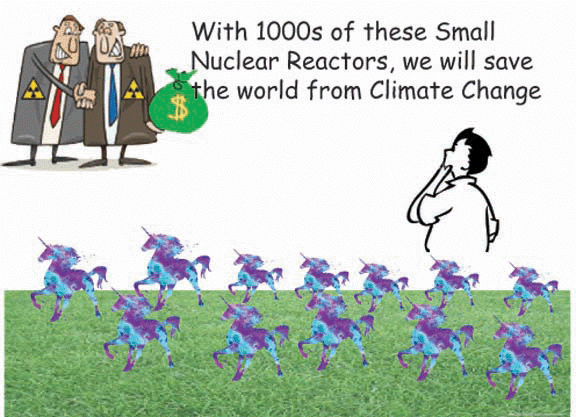
Likewise, the NSW Coalition government isn’t interested in nuclear power. Treasurer Matt Kean said that nuclear power was like “chasing a unicorn” and “doesn’t stack up at the moment on practical grounds or on economic grounds”. Kean said that nuclear is several times more expensive than renewables backed up with energy storage — a claim supported by CSIRO research.

Former prime minister Malcolm Turnbull described nuclear power as the “loopy current fad … which is the current weapon of mass distraction for the backbench.”

Teal independents

Perhaps the nuclear advocates within the Coalition think they might be able to win support from teal community independents elected to parliament at the May 21 election?

June 2, 2022 Posted by | AUSTRALIA - NATIONAL, politics | Leave a comment