February 7 Energy News — geoharvey

Opinion: ¶ “Is California Becoming Anti-Solar?” • Is California becoming an anti-solar state? It sure seems that way considering its recent desire to start charging homeowners with solar $8 per kW. The state’s utility commission also wants to cut its rooftop solar energy incentives after many years of success. There has been a tremendous backlash. […]
February 7 Energy News — geoharvey
This week’s nuclear news

Some bits of good news. Not much of it about. But I did find, in nuclear history, a story that can give some hope. From 2000 to 2012, 47 nations co-operated, in a clean-up, led by Kazakhstan, Russia and USA, of ”Plutonium Mountain” – showing that it is possible for countries to work together, to heal this wounded world. Small island communities – pioneers for sustainability and climate action. Renewable energy: The past decade has seen stunning change. Australia -the next 10 years will be breathtaking.
Coronavirus. In the USA case numbers are dropping. In other countries mounting numbers are breaking records
Climate change. Fixing the Climate: Hopes and Hazards.
AUSTRALIA.
The coming Khaki election: will Labor join in the belligerence against China?
Nuclear waste dumping. Channel 10’s ”The Project” had the guts to show Australia the Kimba nuclear waste dump story. ARPANSA cannot with a straight face, approve flood-prone Napandee farm as a safe location for a nuclear waste dump. https://www.youtube.com/watch?v=MGwsbGufXc0 Flooding the planned nuclear waste dump area.
Nuclear submarine plan does not mean jobs for Australians. In fact it’s already caused 1,100 job losses. Ranger uranium mine rehabilitation costs could blow out to $2.2 billion, Energy Resources tells ASX. Nuclear medicine incidents.
Greens set climate terms for backing Labor in the case of a hung parliament
The ABC is under the biggest attack in its history .
Federal Government continues spin and inaction on environment in 2022
Morrison’s ‘Australian Way’ climate plan is criminally irresponsible
Information wars: are we getting a fair view of China’s treatment of Uyghurs?
INTERNATIONAL
UK court should slap down the US Justice Department in the Assange case.
Claims Over Broken Promises About NATO Simmer at the Heart of the Ukraine Crisis.
Can Space Tourism Co-exist with Space being turned into a War Zone?
The nuclear future and the dread factor. Time to start stopping the wars: No war in Ukraine, then no war anywhere. How giving AI bots control over nuclear weapons could spark World War III.
Electromagnetic radiation, said by telecom companies to be harmless, could be hurting wildlife..,
Flooding the planned nuclear waste dump area
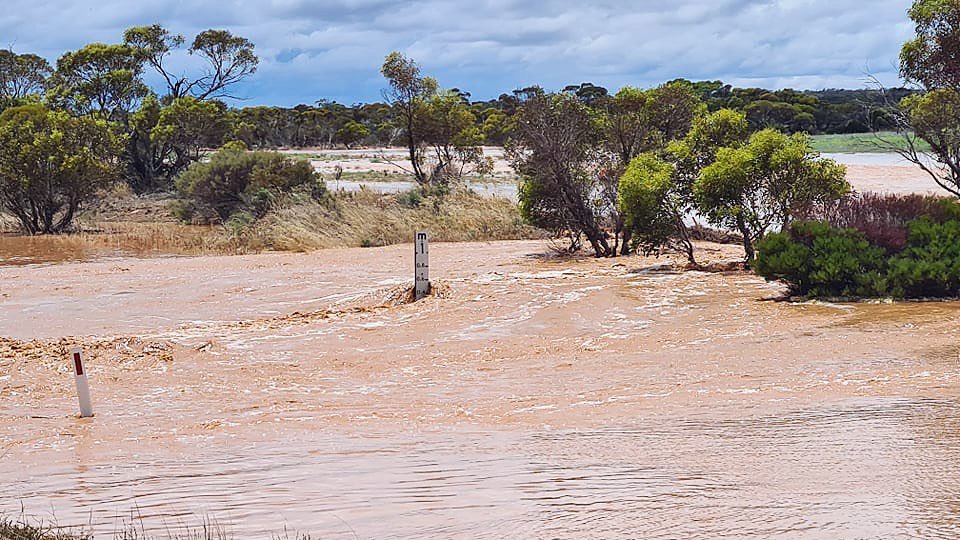
Flooding the Dump Michele Madigan, Sunday Mail, 6 Feb 22,
Well surely that has settled the matter- the Kimba region is a totally unsuitable site for where the federal government is proposing to dumping the nation’s highest-level radioactive waste.
Just out of Kimba, at Buckleboo where the proposed Napandee site actually is, neighbours recorded 185 mm in just the first recent downpour. Some areas received up to 300mm in two days. The Kimba mayor reported ‘massive damage to our roads and general infrastructure.’
The federal government is planning to transport this dangerous radioactive waste half way across the country to simply store it above ground for at least 100 years. The storage sheds will be designed with water outlets to leak.
Despite government assurances, 90% of the waste, measured by radioactivity, is intermediate level waste – toxic for an unimaginable 10,000 years.
In these times of galloping climate change it is certainly optimistic to be talking about ‘once in 100 years’ downpours. How much safer to keep it where it is manufactured in ANSTO’s solid buildings in Lucas Heights outer Sydney, with its on-site nuclear experts and highest-level security.(added ? )
UK court should slap down the US Justice Department in the Assange case

UK court should slap down the US Justice Department in the Assange case https://thehill.com/opinion/judiciary/591776-uk-court-should-slap-down-the-us-justice-department-in-the-assange-case?fbclid=IwAR1FwC11pSY_hGdiCvIdBqIj6mttfTheEDtcNR3EUpQG38xWS3-ZRC6TLhw
BY JAMES C. GOODALE, 6 Feb 22, As the lead attorney for the New York Times in the “Pentagon Papers” case in 1971, I’ve been doing a slow burn ever since over the government’s behavior in that instance: lies, disregard of court rules, arrogance, destruction of documents. All of this was brought to mind earlier this week when a British court hinted in the Julian Assange case that the U.S. government has acted in the same way once again.
It asked Britain’s supreme court to determine the appropriateness of a late filing by the government that completely undercut a ruling that Assange could NOT be extradited to the U.S. This followed British trial court Judge Vanessa Baraitser, who was hearing Assange’s extradition case, ruling that Assange might commit suicide if held in a U.S. prison in solitary confinement under what is called Special Administrative Measures (SAMs) and, so, he could not be extradited.
As soon as she announced her decision, the U.S. government filed assurances that Assange would not be held in that kind of detention, although it reserved the right to revoke the assurance if circumstances changed.
The judge was unmoved by this assurance, but she was reversed on appeal. The U.K.’s supreme court has now asked to consider the timeliness of this filing.
I do not believe the U.S. government’s assurances are worth the paper on which they have been written. Its behavior in this case has been rampant. Most outrageously, the CIA discussed a plot to kidnap Assange from the Ecuadorian Embassy in London, where he was holed up, and to kill him. The CIA also tapped into conversations in the Ecuadorian Embassy, including those with Assange’s lawyers.
There is not much question whether all of this is true. There was testimony about it in open court, and Mike Pompeo, the CIA director at the time and later secretary of State during the Trump administration, has conceded that there is “some truth” in the foregoing.
I do not pretend to be particularly familiar with the extradition laws of the U.K. But common sense tells me that you deliver highly important documents about a case — such as government assurances — before the case begins, not after it has been decided. U.K. counsel representing the U.S. disagrees, saying he can deliver documents when he wants and if he loses the appeal, he will start the extradition proceedings all over again.
This is the very same arrogance that was on display in the Pentagon Papers case, in which then-U.S. Solicitor General Erwin Griswold said the usual rules of evidence did not apply. His view of the law manifested itself in his introduction of new evidence in the case anytime the government was so moved. The claims were always extravagant: Publication of the new evidence would be a disaster for the country’s national security, etc., etc. They never were. Indeed, most of them turned out to be previously published.
The other principal fallacious claim made by the government back then was that the Times had revealed that the United States had broken the Vietnamese code. This also proved to be so much hogwash.
The government also destroyed — or, in its words, “lost” — New York Times briefs in the case. It prevailed upon me to give them these briefs to protect national security and to be returned if the government indicted the Times. A later research request evoked the response “they were lost.”
We do not know if the U.K.’s supreme court will take the Assange case to determine the issue of the timing of the U.S. government’s filing. Let’s hope that it does and then decides the U.S. government should not get away with the latest example of its less than appropriate behavior in a national security case.
James C. Goodale is the former general counsel and vice chairman of the New York Times and the author of “Fighting for the Press: The Inside Story of the Pentagon Papers and Other Battles.”
Greens set climate terms for backing Labor in the case of a hung parliament
Greens set climate terms for backing Labor in the case of a hung parliament
Leader Adam Bandt wants to set the terms of potential negotiations, should the Greens hold the balance of power in either the House of Representatives or the Senate, with an election due before the end of May.
A big pile of Plutonium – UK reprocessing ceases, leaving deadly waste and no plan

in the end, reprocessing became a commercial venture rather than producing anything useful. Nine countries sent spent fuel to Sellafield to have plutonium and uranium extracted for reuse and paid a great deal of money to do so. In reality, very little of either metal has ever been used because mixed oxide fuels were too expensive, and fast breeder reactors could never be scaled up sufficiently to be economic.
UK reprocessing ceases, leaving deadly waste and no plan
A big pile of PU — Beyond Nuclear International https://beyondnuclearinternational.org/2022/02/06/a-big-pile-of-pu/120 tons of plutonium is legacy of Britain’s dirty decades of reprocessing, By Paul Brown, The Energy Mix
Seventy years after the United Kingdom first began extracting plutonium from spent uranium fuel to make nuclear weapons, the industry is finally calling a halt to reprocessing, leaving the country with 120 tons of the metal, the biggest stockpile in the world. However, the government has no idea what to do with it.
Having spent hundreds of billions of pounds producing plutonium in a series of plants at Sellafield in the Lake District, the UK policy is to store it indefinitely—or until it can come up with a better idea. There is also 90,000 tons of less dangerous depleted uranium in warehouses in the UK, also without an end use.
Plans to use plutonium in fast breeder reactors and then mixed with uranium as a fuel for existing fission reactors have long ago been abandoned as too expensive, unworkable, or sometimes both. Even burning plutonium as a fuel, while technically possible, is very costly.
The closing of the last reprocessing plant, as with all nuclear endeavours, does not mean the end of the industry, in fact it will take at least another century to dismantle the many buildings and clean up the waste. In the meantime, it is costing £3 billion a year to keep the site safe.
Perhaps one of the strangest aspects of this story to outside observers is that, apart from a minority of anti-nuclear campaigners, this plutonium factory in one of prettiest parts of England hardly ever gets discussed or mentioned by the UK’s two main political parties. Neither has ever objected to what seems on paper to be a colossal waste of money.
Continue readingThe nuclear power dilemma: where to put the lethal waste

The nuclear power dilemma: where to put the lethal waste
France is exploring new ways to dispose of radioactive materials but public opposition is as fierce as ever, Ft.com Anna Gross in Chooz and Sarah White in Bure 6 Feb 22,
Every morning, Benoit Gannaz places a small black device in his breast pocket to make sure his work is not killing him. Like every worker at the Chooz A nuclear power facility in northern France, he carries a detector that measures ionising radiation levels at all times. The reactor was turned off more than three decades ago and the most hazardous materials removed soon after, but nobody here is taking any chances — least of all the project manager overseeing the challenging and lengthy process of decommissioning Chooz A. Gannaz’s job is to ensure the remaining hazardous materials on site are removed and stored away safely now that the lifecycle of the reactor is at an end. ………….
…………….. as momentum grows for a new generation of nuclear power plants in Europe and elsewhere, there is little discussion of the huge costs and complexity of dismantling the plants at the end of their approximately 50-year lifespan. And nobody has yet given a satisfactory answer to the question of what to do with thousands of metric tonnes of high-level nuclear waste, some of which can remain radioactive, and thereby lethal, for up to 300,000 years.
A quarter-million metric tonnes of spent fuel rods are believed to be spread across 14 countries worldwide, mostly collected in cooling pools at closed-down nuclear plants, as engineers and waste specialists puzzle over how to dispose of them permanently. Many believe these are sitting ducks for terrorist organisations and that they could potentially cause catastrophic spills or fires. The cost of maintaining these sites can be extraordinary, and last for decades. Sellafield in the UK, for example, contains the largest stock of untreated nuclear waste on earth, including 140 tonnes of plutonium. Though the plant was shut down in 2003, it remains the biggest private employer in Cumbria. More than 10,000 people continue to undertake a colossally expensive clean-up that is expected to take more than 100 years and cost above £90bn.
“Nowhere in the world has anyone managed to create a place where we can bury extremely nasty nuclear waste forever,” says Denis Florin, partner at Lavoisier Conseil, an energy-focused management consultancy in Paris. “We cannot go on using nuclear without being adult about the waste, without accepting we need to find a permanent solution.” With the Chooz A reactor, France is attempting to do just that — and in the process create a prototype for how decommissioning could be done more efficiently. If it succeeds, it could help convince environmentalists that nuclear power has a part to play in creating a greener planet. But there is still a heavy dose of popular opposition to the best option there is on the table for the waste: burying it.
The legacy of a spent reactor The challenge with cleaning up Chooz A is not so much the site itself as the materials once contained within. The facility was shut in 1991, and within three years 99.9 per cent of the most highly radioactive materials had been evacuated to a specialist plant 620km away in La Hague, in the north-west of France. According to French law, the most highly radioactive elements of a plant, the fuel and the rods, should be removed as quickly as possible once the plant has been shut down — in stark contrast to policy in most other parts of the world, where the most hazardous products are handled last.
Decommissioning a reactor
Click on the numbers to see the process in sequence (Interactive graphic on original)
Some of these products have since been recycled. In a process pioneered by France, many of the uranium, plutonium and fission chemicals have been reprocessed into new fuel at the La Hague site, while waste chemicals that cannot be reused have been vitrified, or turned into glass, for short-term storage in shallow sites underground. Though EDF says the 23,000 tonnes of spent fuel it has reprocessed at La Hague are enough to power France’s nuclear fleet for 14 years, critics point to the fact that the fuel can only be reused once and the process itself creates yet more radioactive waste, without providing a long-term solution.
The dismantling of the rest of Chooz A began in 2007, after it received legal permission from the state, and is due to be completed by 2024, at a total cost of €500mn. But the most hazardous waste removed from the site will remain radioactive for centuries to come, and perhaps millennia. “Only a state or a religion will live as long as the waste, and maybe not even them,” says Florin. Countries have toyed with ejecting such waste into space or burying it deep under the seabed, but these ideas were eventually deemed either impossible or too dangerous. Only one long-term solution is broadly considered safe and feasible: deep geological repositories, where radioactive material can be stored several hundred metres below ground in formations of clay, rock salt and granite that have not moved for millions of years.
But no one has yet managed to do it. The US has come close; it pumped $15bn into a project to bury waste beneath Yucca Mountain in Nevada, but the initiative was eventually abandoned in the face of intense and sustained public backlash. Similar opposition from local communities has dogged attempts to find burial sites in Germany, the UK and Japan. Some countries have earmarked provisional sites to try again. After a decades-long planning and negotiation process with a remote island community, Finland will bury its radioactive waste in copper tubes in a tomb 1,400 feet below the granite bedrock in Olkiluoto island. The burial site is expected to begin operation in 2023.
France has identified its own site, just outside Bure, 300km east of Paris, in which radioactive waste might be entombed. Consisting of a research centre sitting above a web of tunnels and vaults almost 500 metres below ground, the Cigeo project has so far cost €2.5bn and involved 25 years of research.
The French government is due to decide this year whether to declare the site officially viable as a storage option, setting in motion another sequence of construction and authorisation stages that would lead to the first toxic samples being deposited between 2035 and 2040. The ambition is to seal all the tunnels irreversibly from 2150, with residues encased in blocks of cement or steel within the ultimate barrier — a subterranean layer of clay with the ideal properties to entrap any material that eventually seeps out. This seeping material should lose its radioactive qualities within the 100,000 years it would take them to permeate other strata,,,………………https://www.ft.com/content/246dad82-c107-4886-9be2-e3b3c4c4f315?segmentid=acee4131-99c2-09d3-a635-873e61754ec6
Claims Over Broken Promises About NATO Simmer at the Heart of the Ukraine Crisis
Francis A Boyle 7 Feb 22, Under basic principles of international law, high level government officials acting within the scope of their official authority can bind a State under international law. It does not have to be in writing. Over the years I have dealt with some of the top Soviet/Russian International Lawyers. They know these Rules as well as I do.
Clearly, these commitments would preclude the concerned NATO States from admitting Ukraine as a NATO Member. It is time for them to put this binding commitment into writing as Russia has demanded in order to solve this matter.
US created Ukraine mess, now it must repair Russia relationship
But the US and NATO’s interest in Ukraine is not really about resolving its regional differences, but about something else altogether. The US coup was calculated to put Russia in an impossible position. If Russia did nothing, post-coup Ukraine would sooner or later join NATO, as NATO members already agreed to in principle in 2008. NATO forces would advance right up to Russia’s border and Russia’s important naval base at Sevastopol in the Crimea would fall under NATO control.

Underlying all these tensions is NATO’s expansion through Eastern Europe to the borders of Russia, in violation of commitments Western officials made at the end of the Cold War. The US and NATO’s refusal to acknowledge that they have violated those commitments or to negotiate a diplomatic resolution with the Russians is a central factor in the breakdown of US-Russian relations.
US created Ukraine mess, now it must repair Russia relationship https://johnmenadue.com/us-created-ukraine-mess-now-it-must-repair-russia-relationship/ By Medea Benjamin and Nicolas J.S. DaviesFeb 5, 2022 Western media accounts of the current Ukraine crisis are forgetting the US’s role in the 2014 coup, which forced the then-president to flee.
By Medea Benjamin and Nicolas J.S. DaviesFeb 5, 2022 Western media accounts of the current Ukraine crisis are forgetting the US’s role in the 2014 coup, which forced the then-president to flee.
Feb 5, 2022 Western media accounts of the current Ukraine crisis are forgetting the US’s role in the 2014 coup, which forced the then-president to flee. So what are Americans to believe about the rising tensions over Ukraine? The United States and Russia both claim their escalations are defensive, responding to threats and escalations by the other side, but the resulting spiral of escalation can only make war more likely. Ukrainian President Volodymyr Zelensky is warning that “panic” by US and Western leaders is already causing economic destabilisation in Ukraine.
By Medea Benjamin and Nicolas J.S. DaviesFeb 5, 2022 Western media accounts of the current Ukraine crisis are forgetting the US’s role in the 2014 coup, which forced the then-president to flee.
US allies do not all support the current US policy. Germany is wisely refusing to funnel more weapons into Ukraine, in keeping with its long-standing policy of not sending weapons into conflict zones. Ralf Stegner, a senior Member of Parliament for Germany’s ruling Social Democrats, told the BBC on January 25 that the Minsk-Normandy process agreed to by France, Germany, Russia and Ukraine in 2015 is still the right framework for ending the civil war.
“The Minsk Agreement hasn’t been applied by both sides,” Stegner explained, “and it just doesn’t make any sense to think that forcing up the military possibilities would make it better. Rather, I think it’s the hour of diplomacy.”
By contrast, most American politicians and corporate media have fallen in line with a one-sided narrative that paints Russia as the aggressor in Ukraine, and they support sending more and more weapons to Ukrainian government forces. After decades of US military disasters based on such one-sided narratives, Americans should know better by now. But what is it that our leaders and the corporate media are not telling us this time?
The most critical events that have been airbrushed out of the West’s political narrative are the violation of agreements Western leaders made at the end of the Cold War not to expand NATO into Eastern Europe, and the US-backed coup in Ukraine in February 2014.
Continue readingTHE ILLEGALITY OF NATO

THE ILLEGALITY OF NATO, By John Scales Avery, Popular Resistance.6 Feb 22, Recent threats of war over Ukraine.
Russia understandably fears the eastward expansion of NATO. Recently NATO countries, led by the United States, have supplied arms to Ukraine. There is a threat that the tensions building up in the region will lead to war. Such a development would be catastrophic for the entire world. Against this backdrop, let us examine the question of NATO’s illegality.
Violation of the UN Charter and the Nuremberg Principles
In recent years, participation in NATO has made European countries accomplices in US efforts to achieve global hegemony by means of military force, in violation of international law, and especially in violation of the UN Charter, the Nuremberg Principles.
Former UN Assistant Secretary General Hans Christof von Sponeck used the following words to express his opinion that NATO now violates the UN Charter and international law: “In the 1949 North Atlantic Treaty, the Charter of the United Nations was declared to be NATO’s legally binding framework. However, the United-Nations monopoly of the use of force, especially as specified in Article 51 of the Charter, was no longer accepted according to the 1999 NATO doctrine. NATO’s territorial scope, until then limited to the Euro-Atlantic region, was expanded by its members to include the whole world”
Article 2 of the UN Charter requires that “All members shall refrain in their international relations from the threat or use of force against the territorial integrity or political independence of any state.” This requirement is somewhat qualified by Article 51, which says that “Nothing in the present Charter shall impair the inherent right of individual or collective self-defense if an armed attack occurs against a Member of the United Nations, until the Security Council has taken measures necessary to maintain international peace and security.”
Thus, in general, war is illegal under the UN Charter. Self-defense against an armed attack is permitted, but only for a limited time, until the Security Council has had time to act. The United Nations Charter does not permit the threat or use of force in preemptive wars, or to produce regime changes, or for so-called “democratization”, or for the domination of regions that are rich in oil. NATO must not be a party to the threat or use of force for such illegal purposes.
In 1946, the United Nations General Assembly unanimously affirmed “the principles of international law recognized by the Charter of the Nuremberg Tribunal and the judgment of the Tribunal”. The General Assembly also established an International Law Commission to formalize the Nuremberg Principles. The result was a list that included Principles VI and VII, which are particularly important in the context of the illegality of NATO:
Principle VI: The crimes hereinafter set out are punishable as crimes under international law:
a) Crimes against peace: (I) Planning, preparation, initiation or waging of a war of aggression or a war in violation of international treaties, agreements or assurances; (ii) Participation in a common plan or conspiracy for accomplishment of any of the acts mentioned under (I).
b) War crimes:……………….
Violation of the Nuclear Nonproliferation Treaty
At present, NATO’s nuclear weapons policies violate both the spirit and the text of the Nuclear Nonproliferation Treaty in several respects:………………………………….. https://popularresistance.org/the-illegality-of-nato/
France is exploring new ways to dispose of radioactive materials but public opposition is as fierce as ever

“There may be a price [communities] are willing to accept in order to stomach the waste and its risks, but we don’t know what that price is yet,” … “If it’s high enough, it will ultimately add to the cost of disposal.” Local authorities have poured millions of euros of subsidies and compensation into the area to support the project
The nuclear power dilemma: where to put the lethal waste
France is exploring new ways to dispose of radioactive materials but public opposition is as fierce as ever, Ft.com Anna Gross in Chooz and Sarah White in Bure 6 FEB 22,
”………………….Resistance is fissile Cigeo has attracted the same kind of vocal opposition found at other potential burial sites. And, as a result Bure, a village of fewer than 100 inhabitants, has become a battleground where protesters have regularly clashed with police over the future of the site. Demonstrators have set up a “house of resistance” in Bure that has become a magnet for anti-nuclear protesters around the country. The former barn is equipped with a projection room, mattresses to welcome guests and a cosy communal kitchen.
Campaigners say the Bure site has become representative of a broader cause. “Beyond the waste, it’s nuclear production above all else that worries us,” says a 29-year-old jurist who gave his name as Antoine, one of a handful of campaigners manning the fort on a snowy February morning. “It’s a supposedly low carbon source of energy, but you’ve got to build the reactors . . . it is such a dangerous and destructive solution.” Yet the state holds that the undeniable risks of nuclear energy are outweighed by its potential benefits as a cost-effective way of cutting CO2 emissions. According to a report last year from French grid operator RTE, France’s cheapest way to reach carbon neutrality by 2050 would involve building 14 new reactors. Under the scenarios RTE presented, if France built no new nuclear reactors and relied exclusively on expanding renewables and extending the lifespan of existing nuclear, this would cost €10bn more per year than other options including new reactors, with the cost of decommissioning factored into the final bill.
But that may not factor in the costs of convincing French citizens to host such facilities in their backyards. Bure resident Anne-Marie Henn, a retiree, says the project has forced her and her artist husband Jacques to give up on their dream of creating a painting atelier in an annex to their home. “We’d like to leave, but our house isn’t worth anything any more,” she says. Ed Lyman, senior global security scientist with the Union of Concerned Scientists, who has spent decades researching nuclear power safety, says the science behind burying waste is robust, and the dangers of corrosion or leakage minimal. But there remain real risks for the public, he says, such as accidents happening when materials are transported to the site.
“There may be a price [communities] are willing to accept in order to stomach the waste and its risks, but we don’t know what that price is yet,” he adds. “If it’s high enough, it will ultimately add to the cost of disposal.” Local authorities have poured millions of euros of subsidies and compensation into the area to support the project and residents. In Bure, that has translated into snazzy lampposts lining every street alongside the barns and stone houses; households have also got fibre optic internet connections and sanitation networks have been improved. “We’ve got to deal with this crap,” Henn says. “At the very least we can benefit a bit from [subsidies].”
But the concerns of many communities go way beyond immediate dangers to more existential questions: how can we ensure that not just our children and grandchildren, but people living thousands of years in the future have the knowledge and understanding to handle it responsibly? And how can we be sure that the storage containers we have developed now will stand the test of time? “What we’ll be getting here is the really dangerous core of the waste,” Henn says, adding that it was “the generations to come” that worried her.
Andra, the French state agency responsible for nuclear waste management, is considering ways to warn future generations of what lies below Bure — perhaps by inscribing microscopic information on a hard disk of sapphire, designed to withstand erosion, should the site be forgotten. “Even if we lose our collective memory, the storage site will be safe,” says spokesperson Audrey Guillemenet. If these kinds of innovations fail to impress French lawmakers and the site does not win approval, that leaves the government with a problem that goes far beyond the billions spent on construction. “Some 50 per cent of the [nuclear] waste destined to come here eventually already exists,” says Guillemenet. Forget the next generation of power plants; the decades-old materials Gannaz and his predecessors have removed from Chooz A are a problem that needs a solution. If it is not Bure, then what is it? https://www.ft.com/content/246dad82-c107-4886-9be2-e3b3c4c4f315?segmentid=acee4131-99c2-09d3-a635-873e61754ec6
Nuclear baloney

Majority support for nuclear energy — which does not appear to be the case publicly, even if it is so politically — is a clear testament to the power of well-funded propaganda campaigns and the deep pockets of lobbyists. None of us engaged on this subject have missed the saturation media campaign, on-going now for months if not years, that sows the erroneous notion in the heads of politicians that nuclear power is an answer — even the answer — to climate change.
Repeat a lie often enough and people will believe it. Today’s media has become especially guilty of this. I recently had to correct a Financial Times reporter who, in an otherwise perfectly good article, described nuclear power as having “no carbon footprint.” There is no stop-and-think going on here. After all, even renewable energy does not have “no” carbon footprint.
Nuclear waste risks can be “minimized” and other myths
Nuclear baloney — Beyond Nuclear International AP story on states’ nuclear choice fails to point out key realities
By Linda Pentz Gunter, 6 Feb 2,
There are geniuses amongst us. We just didn’t know it. They are the supporters of nuclear power, who, according to the Associated Press, “say the risks can be minimized” when it comes to the perpetual and unsolved problem of long-lived, high-level radioactive waste — the main by-product of generating electricity using nuclear power.
This observation comes within an AP story headlined: “Majority of US states pursue nuclear power for emission cuts”, and which has garnered significant pickup in numerous media outlets. (However, we never do learn the secret to precisely how nuclear waste risks can be “minimized”.)
The agency surveyed “the energy policies in all 50 states and the District of Columbia,” finding that “about two-thirds” plan to use nuclear power to replace fossil fuels.
The mantra about solving the nuclear waste problem has been repeated since the dawn of the Nuclear Age, coming up on 80 years this December. That was when, on December 2, 1942, the first cupful of radioactive waste was generated, a result of the first self-sustaining nuclear chain reaction achieved at the Chicago Pile-1 by Enrico Fermi and his team.
At that time, scientists knew that radioactive waste was a problem, but assumed it would be solved later. Well, here we are at “later” and it’s still unsolved. Now, “minimizing” rather than solving the problem is apparently justification enough to keep using this dangerous technology.
Continue readingFebruary 6 Energy News — geoharvey

Opinion: ¶ “Winter Olympics: Will The Beijing Games Be ‘Green And Clean’?” • China has promised to deliver a “green and clean” Winter Olympics. Organisers say they prioritized protecting native species, reducing greenhouse gas emissions and cutting down on resources used. Extraordinary as efforts have been, there have been criticisms. [BBC] Two-man bobsled (Rowan Simpson, […]
February 6 Energy News — geoharvey
New ‘cool’ pro nuclear propaganda ignores plutonium danger – theme for February 22
The new pro nuclear shills are young, feminine, cool, and disastrously ignorant about radioactivity and nuclear wastes.
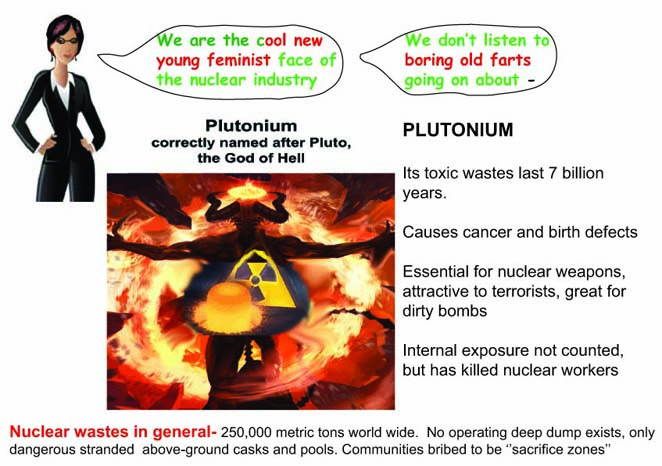
Why do we let them keep on making this toxic radioactive trash?
.
ARPANSA cannot with a straight face, approve flood-prone Napandee farm as a safe location for a nuclear waste dump.
Kimba flooding https://www.onlineopinion.com.au/view.asp?article=21824, By Peter Remta – 3 February 2022 The years of touting by the federal government and the responsible ministers of Kimba in South Australia as the perfect and inarguably superior location for the proposed national radioactive waste management facility have dramatically and quite suddenly disappeared. There is no doubt that the severe flooding caused by the recent heavy rains in South Australia which included the Kimba district is a serious and essential reason for immediately aborting the proposed management facility at Napandee farm near Kimba as the selected facility location |
From expert advice it is quite clear that Kimba as a whole – and not just Napandee – is far too dangerous to become the location for the holding of nuclear waste particularly as the results of the present flooding may take up to ten years to overcome without any further flooding
This is especially the case as nuclear isotopes are dispersed and travel freely in water which can affect and contaminate all the surrounding land for many centuries making it completely unusable
There cannot be any excuse by claiming that this flooding may be a once in a lifetime unexpected event as there had been extensive previous floods in the Eyre Peninsula over sixty years ago
More importantly the nature of the proposed facility is that it must be a completely safe and competent environment to hold nuclear waste for several centuries which the federal government claims to be the case as part of its planning
The government as the proponent of the Kimba nuclear waste facility cannot deny knowledge of floods – and also fires – as risks for the purposes of the safety requirements for management of nuclear waste in Australia
The advice by overseas experts is that these two major risks are far more pertinent to Australia than other countries with nuclear waste and consequently the regulatory bodies should or must include these risks within the Australian waste management framework and other applicable prescriptions and standards for the long-term management of Australia’s radioactive waste.
This must obviously include the storage or disposal of nuclear waste at suitably located and established facilities
l informed ARPANSA some eighteen months ago about the formal inclusion of these risks in its safety codes and the requirement for the long overdue start of the safety case for Kimba but the response was that it was not necessary at that stage
The prescriptive requirement is for a safety case for any nuclear installation be started at the very beginning as to why a specific site is considered worthy of investigation
The safety case is then updated as the site characterisation proceeds and if the site fails to live up to initial expectations then it should be abandoned.
This process is an important part of public engagement and if one waits until the end of the process then the argument for safety is less credible and the chance to generate public support has been lost (1)
It seems to be a case of falling asleep at the wheel as mentioned previously by the Hon. George Gear with regard to the regulatory role of ARPANSA (2)
Irrespective of the colourful presentations and nicely sounding spin by the Australian Nuclear Science and Technology Organisation (ANSTO) and even to some extent by ARPANSA there is no doubt that this is a serious breach of the safety requirements that should have been applied to Kimba at the outset
I think that ARPANSA will shortly hear from the UN Special Rapporteurs involved with this situation so that they can properly protect the human rights of the Kimba community.
It will be interesting to see how specifically ARPANSA and ANSTO will deal with the lack of a safety case from the beginning of the government’s proposals as this seems a major failing in proper and necessary safety regulation
As also previously pointed out the federal government should have given the Kimba community the opportunity and with the necessary funding for getting an independent assessment and review of the government’s proposals particularly as there had been so much vehement opposition to the proposed facility
I am not in any way suggesting that this would have stopped the flooding but there should have been proper and early regulation and oversight of the risks of floods and other calamities whether natural or man-made in a much stronger manner
It is now quite obvious that the Kimba region is completely unsuitable and inappropriate for the establishment of the national waste facility and ARPANSA as the regulator should immediately stop anything further being by or on behalf of the government to pursue the establishment of the facility
This should include the withdrawal and cancellation of ministerial declaration to select Napandee as the site for the proposed facility even if the necessary legislative changes may need to await the next parliament
At least this may give the community of Kimba and in fact the whole Eyre Peninsula some comfort and respite from their long-standing concerns.
1 This month
17 October, Free Public Talk on Nuclear Issues in South Australia
David Noonan will speak on public interest concerns over the new Roxby Downs Indenture Act 2026 on BHP copper-uranium mining and ore processing in SA, and on how AUKUS may face SA with a High-Level nuclear waste agenda.
Dr Jim Green will discuss international developments in the field of nuclear power including ‘small modular reactors’ and Generation 4 ‘advanced’ nuclear reactor concepts.


Help Aunty Sue Protect Her Land and Sacred Sites From Destructive Rocket Testing.
.

Australians deserve the truth
about
AUKUS – https://aukuspublicinquiry.com/

PETITION – To: Prime Minister Anthony Albanese and the Australian Labor Government

of the week – Australians for War Powers Reform (AWPR)
To see nuclear-related stories in greater depth and intensity

