Environmental Working Group (EWG) urges Biden to reject ‘outrageous’ call for more nuclear power subsidies in clean energy agenda

“Nuclear power is truly an example of privatizing profits and socializing risks.”
EWG urges Biden to reject electric utility executives’ call for more nuclear power subsidies in clean energy agenda. https://www.ewg.org/news-insights/news-release/2022/02/ewg-urges-biden-reject-electric-utility-executives-call-more WASHINGTON – President Joe Biden is meeting today with top executives from several investor-owned electric utilities who want Congress to approve vital clean energy tax credits as part of Biden’s Build Back Better agenda. But they are also seeking new federal subsidies for existing nuclear power plants that the Environmental Working Group is urging the president to oppose.“Nuclear power is truly an example of privatizing profits and socializing risks.”
The Build Back Better plan is a broad infrastructure proposal and includes some important tax credits that the utilities support. They would help expand utility-scale solar projects and boost sales of electric vehicles, crucial steps in fighting the climate emergency.
But the call for wasting more federal tax dollars propping up uneconomic and dangerous nuclear power plants too is an outrageous request, noted EWG.
“Nuclear power is a relic of the electricity sector, and a dangerous and extremely expensive one that has cost taxpayers billions of dollars,” said EWG President Ken Cook. “The federal government must stop throwing away money propping up the nuclear industry and instead make critical investments to expand safe, clean renewable energy.”
“President Biden and congressional leaders can and should unravel the federal government’s long history of pouring scarce resources into this failed industry and its legacy of radioactive waste and the enormous threat it poses to the public,” said Cook.
Nuclear power has never been financially viable and never will be, so new subsidies make no sense. It has the distinction of a permanent negative learning curve – costs always rise and never decline – despite 60 years of taxpayer-funded research and development, construction risks dumped onto ratepayers to lure private financing, a series of bailouts worth tens of billions to the industry, and billions wasted on upgrades to keep aging power plants running that could have been much more wisely spent replacing them.
“It is time to systematically replace nuclear power with modern clean energy technology and to stop burdening ratepayers and taxpayers with this financial albatross,” said Cook. “Nuclear power is truly an example of privatizing profits and socializing risks.”
In its 2021“None of the Above” series calling out dirty and dangerous power sources that should quickly be replaced by clean, safe and renewable energy, such as solar and wind, EWG likened nuclear power to “nothing more than a public works project with no prospects for the future that has failed financially while generating huge amounts of radioactive waste, with no viable method of disposal, that will linger for thousands of years.”
The Environmental Working Group is a nonprofit, non-partisan organization that empowers people to live healthier lives in a healthier environment. Through research, advocacy and unique education tools, EWG drives consumer choice and civic action. Visit www.ewg.org for more information.
Ahead of regulatory approval the US Dept of Energy wants Govt to grant $4 billion for Small Nuclear Reactors development
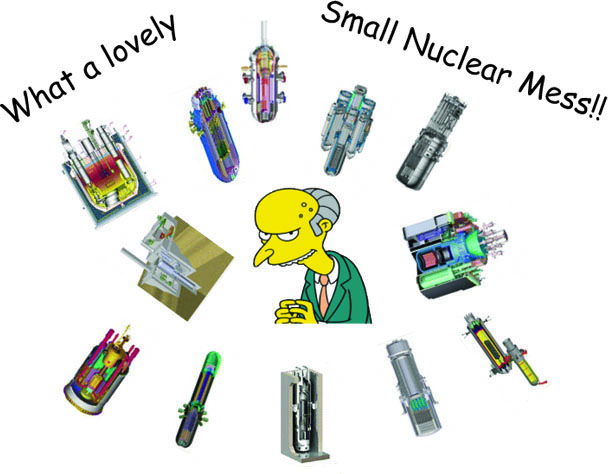
Bloomberg Business Week, 7 Feb 22, –………………………… Congress has ordered the Nuclear Regulatory Commission to replace a rules framework that dates to the 1950s. The new guidelines aren’t expected until at least 2025……… To prove the safety of designs, for instance, the commission demands data from similar plants, but none of the smaller installations have been built in the U.S., so there’s no performance history.
……….. the U.S. Department of Energy has gotten ahead of the NRC. The department is asking Congress for as much as $4 billion over seven years for advanced reactor development.
Beneficiaries include TerraPower, a startup founded by Bill Gates that’s working on a project in Wyoming; X-energy, which is planning a high-temperature, gas-cooled reactor in Washington state; and Kairos Power, which aims to build a 35-megawatt salt-cooled test reactor in Tennessee and applied for a construction license last September.
…………… these plants face staunch opposition. Environmental groups say that small reactors—some have a capacity of only 1.5MW, about 0.1% the size of a traditional plant—still produce enough radioactive material to present a contamination risk. And building more plants, even small ones, will add to the pile of toxic waste that no one can figure out what do with. “To the extent that there will be efforts to weaken the regulatory envelope, we will aggressively push back,” says Geoff Fettus, an attorney with the Natural Resources Defense Council.
Globally, more than 70 small modular reactors, with a total capacity of about 12 gigawatts, have been proposed or are under development in at least five countries, according to the International Atomic Energy Agency. The only one that’s been built is a floating reactor in the Russian town of Pevek, on the Arctic Sea, where it’s used to power mining operations. Gregory Jaczko, who served as NRC chair from 2009 to 2012, says the lack of movement on such plants around the world suggests we would be wrong to count on them as a way out of the climate crisis. “They’re just not ready,” he says. “And by the time they could be ready, they’re not going to be useful.”
Inquiry finds some medical and dental practices non-compliant with radiation rules
Seven medical practices non-compliant with radiation rules, Hiqa finds
Three dental practices among those criticised by watchdog in latest inspection report
Irish Times, 10 Feb 22, Tim O’Brien Seven out of 12 medical practices – including three dental practices – inspected by Hiqa have been found to be in breach of regulations concerning the control of exposure to ionising radiation.
Medical exposure to ionising radiation is when radiation is used as part of diagnosis such as an X-ray or CT scan, for medical research purposes or in the use of radiotherapy as part of cancer treatment.
It also includes radiation received by carers and comforters while attending to a patient. Inspectors from the Health Information and Quality Authority found evidence of non-compliance with controls in Bantry General Hospital; the Mater Private in Cork; Meridian Dental Clinic Clarehall, Dublin; River Lee Dental; Rowe Creavin Medical Practice in Waterford, Touchstone Dentistry in Dublin and University Hospital Kerry………………………… https://www.irishtimes.com/news/health/seven-medical-practices-non-compliant-with-radiation-rules-hiqa-finds-1.4798107
Population decline isn’t happening fast enough to save planet
| Population decline isn’t happening fast enough to save planetPaul CollinsBy 2050 we will consume three earths per year. Degradation of land and the oceans, biodiversity loss and global warming are the direct results. |
February 9 Energy News — geoharvey

Opinion: ¶ “What Is Nord Stream 2 And Can Biden Kill It?” • President Joe Biden said that natural gas will not flow through Russia’s Nord Stream 2 pipeline to Germany if Moscow orders an invasion of Ukraine. It is a $11 billion undersea pipeline between Russia and Germany. Russia could use it as a […]
February 9 Energy News — geoharvey
Australian demand for solar goes through the roof, smashing records
Australian demand for solar goes through the roof, smashing recordsBorder lockdowns and supply chain disruptions fail to slow the rampant uptake of rooftop solar in Australia where householders installed record amounts of new capacity last year.
Labor rules out ‘fringe’ deal in rebuff to Greens on climate
Labor rules out ‘fringe’ deal in rebuff to Greens on climate
Labor leader Anthony Albanese has ruled out negotiating with “fringe” parties to form government in a hung parliament after the Greens called for a temporary halt to new coal, gas and oil projects as a condition on any deal after the election.
Renewable energy records blown away in January as wind farms match coal output — RenewEconomy

One wind farm delivers capacity factor of 64 per cent in record-breaking January, meaning its output ranked higher than many coal generators. The post Renewable energy records blown away in January as wind farms match coal output appeared first on RenewEconomy.
Renewable energy records blown away in January as wind farms match coal output — RenewEconomy
Greens to seek moratorium on new fossil fuel projects in any post-election negotiations — RenewEconomy

The Greens will use a potential ‘balance of power’ position after the next election to seek a moratorium on new fossil fuel projects. The post Greens to seek moratorium on new fossil fuel projects in any post-election negotiations appeared first on RenewEconomy.
Greens to seek moratorium on new fossil fuel projects in any post-election negotiations — RenewEconomy
Fully renewable grid by 2030, no new coal or gas: CEC lays down new roadmap — RenewEconomy

Clean Energy Council calls on Australia’s political leaders to commit to a 100% renewable electricity grid by 2030, and no new coal or gas plants. The post Fully renewable grid by 2030, no new coal or gas: CEC lays down new roadmap appeared first on RenewEconomy.
Fully renewable grid by 2030, no new coal or gas: CEC lays down new roadmap — RenewEconomy
Canadian First Nations do not want small nuclear reactors on their lands

Decolonizing energy and the nuclear narrative of small modular reactors https://policyoptions.irpp.org/magazines/february-2022/decolonizing-energy-and-the-nuclear-narrative-of-small-modular-reactors/
Kebaowek First Nation is calling for an alternative to a planned SMR project, one that won’t undermine proper consultation and leave a toxic legacy.
by Lance Haymond, Tasha Carruthers, Kerrie Blaise, February 7, 2022 In early 2021, the Canadian Nuclear Safety Commission began reviewing the application from a company called Global First Power to build a nuclear reactor at the Chalk River Laboratories site about 200 kilometres northwest of Ottawa.
This project, known as a micro modular reactor project, is an example of the nuclear industry’s latest offering – a small modular reactor (SMR).SMRs are based on the same fundamental physical processes as regular (large) nuclear reactors; they just produce less electricity per plant. They also produce the same dangerous byproducts: plutonium and radioactive fission products (materials that are created by the splitting of uranium nuclei). These are all dangerous to human health and have to be kept away from contact with people and communities for hundreds of thousands of years. No country has so far demonstrated a safe way to deal with these.
Despite these unsolved challenges, the nuclear industry promotes SMRs and nuclear energy as a carbon-free alternative to diesel for powering remote northern communities. The Canadian government has exempted small modular reactors from full federal environmental assessment under the Impact Assessment Act. Many civil society groups have condemned this decision because it allows SMRs to escape the public scrutiny of environmental, health and social impacts.
The proposed new SMR in Chalk River, like the existing facilities, would be located on Algonquin Anishinabeg Nation territory and the lands of Kebaowek First Nation – a First Nation that has never been consulted about the use of its unceded territory and that has been severely affected by past nuclear accidents at the site.
At this critical juncture of climate action and Indigenous reconciliation, Kebaowek First Nation is calling for the SMR project at Chalk River to be cancelled and the focus shifted to solutions that do not undermine the ability of First Nations communities to be properly consulted and that do not leave behind a toxic legacy.
While these reactors are dubbed “small,” it would be a mistake to assume their environmental impact is also “small.” The very first serious nuclear accident in the world involved a small reactor: In 1952, uranium fuel rods in the NRX reactor at Chalk River melted down and the accident led to the release of radioactive materials into the atmosphere and the soil. In 1958, the same reactor suffered another accident when a uranium rod caught fire; some workers exposed to radiation continue to battle for compensation.
What makes these accidents worse – and calls into question the justification for new nuclear development at Chalk River – is that this colonized land is the territory of the Algonquin Anishinabeg Nation territory (which consists of 11 First Nations whose territory stretches along the entire Ottawa River watershed straddling Quebec and Ontario). Kebaowek First Nation, part of the Algonquin Nation, was among those First Nations never consulted about the original nuclear facilities on their unceded territory, and is still struggling to be heard by the federal government and nuclear regulator. Its land has never been relinquished through treaty; its leaders and people were never consulted when Chalk River was chosen as the site for Canada’s first nuclear reactors; and no thought was given to how the nuclear complex might affect the Kitchi Sibi (the Ottawa River).
History is being repeated at Chalk River today as the government pushes ahead with the micro modular reactor project without consent from Kebaowek. Assessments of the project have been scoped so narrowly that they neglect the historical development and continued existence of nuclear facilities on Kebaowek’s traditional territory. The justification for an SMR at this location without full and thorough consideration of historically hosted nuclear plants – for which there was no consultation nor accommodation – is a tenuous starting point and one that threatens the protection of Indigenous rights.
The narrative of nuclear energy in Canada is one of selective storytelling and one that hides the reality of the Indigenous communities that remain deeply affected, first by land being taken away for nuclear reactor construction, and later by the radioactive pollution at the site. All too fitting is the term radioactive colonialism coined by scholars Ward Churchill and Winona LaDuke, to describe the disproportionate impact on Indigenous people and their land as a result of uranium mining and other nuclear developments. In country after country, the uranium that fuels nuclear plants has predominantly been mined from the traditional lands of Indigenous Peoples at the expense of the health of Indigenous Peoples and their self-determination.
Kebaowek First Nation has been vocal in its objection to the continuation of the nuclear industry on its lands without its free prior and informed consent, as is its right under the United Nations Declaration on the Rights of Indigenous Peoples (UNDRIP). Despite requests for the suspension of the SMR project, pending adequate provisions for Indigenous co-operation and the Crown’s legal duty to initiate meaningful consultation, Kebaowek has yet to see its efforts reflected in government decisions and Crown-led processes.
Nuclear is a colonial energy form, but it is also bio-ignorant capitalism – a term coined by scholars Renata Avila and Andrés Arauz to describe the ways in which the current economic order ignores the planetary climate emergency, human and ecological tragedies, and the large-scale impact on nature. The narrative of nuclear as a “clean energy source” is a prime example of this bio-ignorance. Decision-makers have become fixated on carbon emissions as a metric for “clean and green,” ignoring the radioactive impacts and the risks of accidents with the technology.
It is more than 70 years since Chalk River became the site for the splitting of the nucleus. The continuation of nuclear energy production on unceded Indigenous territory without meaningful dialogue is a telling example of continued colonial practices, wherein companies extract value from Indigenous land while polluting it; offer little to no compensation to impacted communities; and abide by timelines driven by the project’s proponents, not the community affected. We need to move away from this colonial model of decision-making and decolonize our energy systems.
The challenge of climate change is urgent, but responses to the crisis must not perpetuate extractivist solutions, typical of colonial thinking, wherein the long-term impacts – from the production of toxic waste to radioactive releases – lead to highly unequal impacts.
The authors thank Justin Roy, councilor and economic development officer at Kebaowek First Nation, and M.V. Ramana, professor at the School of Public Policy and Global Affairs at the University of British Columbia, for contributing to this article.
European dispute over the Taxonomy plan to class nuclear power as ”green”, qualifying it for billions of euros in subsidies.
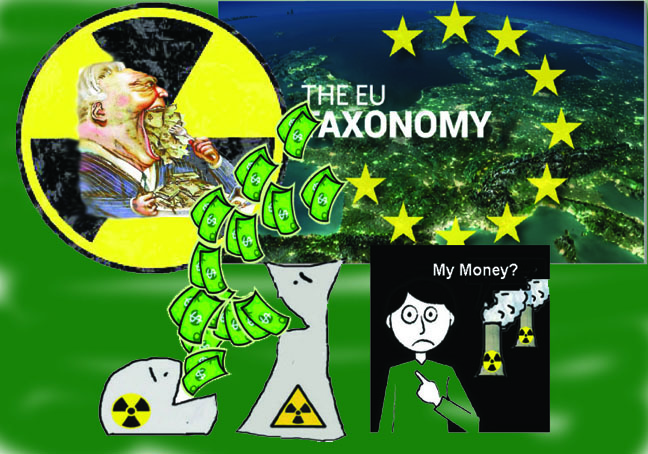
EU Observer, 7. FEB, 07:22, Barely a month since France took over the rotating presidency of the Council of the European Union, and France and Germany are already in dispute over the highly-controversial EU proposal to grant nuclear energy and natural gas a green investment label under the EU taxonomy on sustainable finance rules.
The EU proposal was published on Wednesday (2 February) with only minor edits – despite the internal row it had sparked amongst several member states.
The initial proposal itself had been quietly distributed to EU members on New Year’s Eve – the day Germany closed half of its six nuclear power plants.
If the proposal now passes the EU’s legislative procedures without getting blocked by the commission or the parliament (both unlikely scenarios), it will likely channel billions of euros into the construction of new nuclear power plants across the bloc…………………….
During the past weeks France has taken a strong stance in support of nuclear energy with president Emmanuel Macron labelling it as the “sovereign solution”, while Germany has expressly rejected the integration of nuclear power into the green taxonomy…………….
After their success in September’s federal elections, German Greens secured their position as the second-largest party in the current coalition government – making them crucial for the future of the German coalition.
No compromise
And nuclear energy is one of the topics the Greens are not willing to compromise on.
The Greens, born out of the 1980s anti-nuclear protests, were quick to call out the EU over the new energy proposal with the German vice-chancellor and climate minister, Robert Habeck, accusing the EU of “greenwashing”.
In Ukraine, USA to finance American companies to sell nuclear technology there and to other States

Where the Russians are coming, so is Westinghouse with its nuclear ambitions, ANYA LITVAK, Post Gazette, 7 Feb 22, Over the past few months, Joel Eaker, Westinghouse Electric Co.’s vice president for new nuclear power plant projects, has been shaking hands and posing for pictures all over Eastern Europe.
He was in Poland last month, where he plans to move in the spring. A week before that, he was in the Czech Republic to announce agreements signed with local companies in Cranberry-based Westinghouse’s bid to sell its AP1000 reactors in the region.
The nuclear renaissance never happened in the United States. But Mr. Eaker thinks Europe is headed in that direction.
The long game
The nuclear business is a long game with fits and starts.
For more than two decades, Westinghouse has been seemingly on the cusp of selling new nuclear reactors to various Eastern European countries ………….
All along, Westinghouse was pursuing a parallel strategy: making fuel that could be used in existing Russian-made reactors that are scattered across Europe.
…… Westinghouse could provide an alternate supply of fuel, which effectively delinks those countries from Russia.”
After some attempts loading the fuel in Russian-made reactors at Temelin in the Czech Republic, it was Ukraine that allowed Westinghouse to test and refine its fuel assemblies in Russian reactors.
Today, the U.S. company’s fuel is loaded into nearly half of Ukraine’s nuclear plants, and Westinghouse is trying to use those bona fides to sell fuel to existing Russian-style reactors in Finland, Czech Republic, Slovakia and Hungary, Tarik Choho, president of Westinghouse’s Europe, the Middle East and Africa division, told Ukraine’s news service in August.
Mr. Eaker said Westinghouse’s pursuit of that market was both earnest and strategic.
The company’s bread-and-butter business is supplying fuel to and servicing existing reactors. It’s what made Westinghouse, then in bankruptcy, attractive to the Canadian asset management firm Brookfield Business Partners, which has owned it since 2018.
It’s difficult to predict if this recent burst of nuclear promise in Eastern Europe will yield actual new reactor projects, Ms. Harrington said.
………… In 2014, when the continued existence of the U.S.’s Export-Import Bank became a topic of debate in Congress, Westinghouse’s then-CEO Danny Roderick said the first thing he was asked when pitching a new plant to clients in places like Central Europe is how much the U.S. government is willing to help financially.
………. Pierre Paul Oneid, the chief nuclear officer at Holtec International, a New Jersey-based company that specializes in decommissioning and nuclear fuel storage. Holtec, Mr. Oneid said, had been working for a decade to close a deal for a centralized storage facility for spent nuclear fuel in Ukraine, which would not be possible without financing from the U.S. government.
…….. While Mr. Oneid said the deal was in the “eleventh hour,” in fact it took three more years to finalize. U.S. Overseas Private Investment Corp. announced in 2017 that it was providing $250 million in political risk insurance to the Ukrainian utility. Bank of America/Merrill Lynch would then sell that $250 million commitment in the form of fixed-rate bond securities.
It was the first such deal of its type, but probably not the last.
Show me the money
If there’s another major piece, other than climate change, that’s opening doors for Westinghouse in Eastern Europe, it’s the prospect of the U.S. government’s expanded role in financing nuclear projects, Mr. Eaker said.
In 2019, then-President Donald Trump created the U.S. Nuclear Fuel Working Group………. Among its recommendations was for the U.S. Development Finance Corp., a newly-created vehicle to fund projects in low-income countries, to lift its ban on providing funds to nuclear projects.
The development agency listened and, in the summer of 2020, it unshackled itself from the ban, which was a holdover from its predecessor and modeled on the language of the World Bank. The DFC can even provide financing to projects in higher-income countries in Eastern Europe as part of its charge under the The European Energy Security and Diversification Act of 2019.
This means the U.S. government can now offer equity financing for nuclear projects abroad, a first. It can also give larger loans and loan guarantees than what is typically handled by the Export-Import Bank, and it can offer political risk insurance.
This is the next step in Westinghouse’s advances in Eastern Europe. Once it finishes doing a $10 million front end engineering and design study for AP1000 reactors in Poland — the U.S. government funded 70% of that work as part of an intergovernmental agreement — then it hopes to submit a formal bid along with a U.S. government financing proposal this fall.
In Ukraine, Westinghouse has already signed contracts with the electric utility to start ordering long-lead equipment and doing other preparations, but the contracts won’t be fully implemented until the U.S. comes with the financing package.
Anya Litvak: alitvak@post-gazette.com. https://www.post-gazette.com/business/powersource/2022/02/07/Russia-Ukraine-Westinghouse-Electric-nuclear-AP1000-reactors-climate-change-energy-eastern-europe/stories/202201300126
February 7 Energy News — geoharvey

Opinion: ¶ “Is California Becoming Anti-Solar?” • Is California becoming an anti-solar state? It sure seems that way considering its recent desire to start charging homeowners with solar $8 per kW. The state’s utility commission also wants to cut its rooftop solar energy incentives after many years of success. There has been a tremendous backlash. […]
February 7 Energy News — geoharvey
This week’s nuclear news

Some bits of good news. Not much of it about. But I did find, in nuclear history, a story that can give some hope. From 2000 to 2012, 47 nations co-operated, in a clean-up, led by Kazakhstan, Russia and USA, of ”Plutonium Mountain” – showing that it is possible for countries to work together, to heal this wounded world. Small island communities – pioneers for sustainability and climate action. Renewable energy: The past decade has seen stunning change. Australia -the next 10 years will be breathtaking.
Coronavirus. In the USA case numbers are dropping. In other countries mounting numbers are breaking records
Climate change. Fixing the Climate: Hopes and Hazards.
AUSTRALIA.
The coming Khaki election: will Labor join in the belligerence against China?
Nuclear waste dumping. Channel 10’s ”The Project” had the guts to show Australia the Kimba nuclear waste dump story. ARPANSA cannot with a straight face, approve flood-prone Napandee farm as a safe location for a nuclear waste dump. https://www.youtube.com/watch?v=MGwsbGufXc0 Flooding the planned nuclear waste dump area.
Nuclear submarine plan does not mean jobs for Australians. In fact it’s already caused 1,100 job losses. Ranger uranium mine rehabilitation costs could blow out to $2.2 billion, Energy Resources tells ASX. Nuclear medicine incidents.
Greens set climate terms for backing Labor in the case of a hung parliament
The ABC is under the biggest attack in its history .
Federal Government continues spin and inaction on environment in 2022
Morrison’s ‘Australian Way’ climate plan is criminally irresponsible
Information wars: are we getting a fair view of China’s treatment of Uyghurs?
INTERNATIONAL
UK court should slap down the US Justice Department in the Assange case.
Claims Over Broken Promises About NATO Simmer at the Heart of the Ukraine Crisis.
Can Space Tourism Co-exist with Space being turned into a War Zone?
The nuclear future and the dread factor. Time to start stopping the wars: No war in Ukraine, then no war anywhere. How giving AI bots control over nuclear weapons could spark World War III.
Electromagnetic radiation, said by telecom companies to be harmless, could be hurting wildlife..,
1 This month
17 October, Free Public Talk on Nuclear Issues in South Australia
David Noonan will speak on public interest concerns over the new Roxby Downs Indenture Act 2026 on BHP copper-uranium mining and ore processing in SA, and on how AUKUS may face SA with a High-Level nuclear waste agenda.
Dr Jim Green will discuss international developments in the field of nuclear power including ‘small modular reactors’ and Generation 4 ‘advanced’ nuclear reactor concepts.


Help Aunty Sue Protect Her Land and Sacred Sites From Destructive Rocket Testing.
.

Australians deserve the truth
about
AUKUS – https://aukuspublicinquiry.com/

PETITION – To: Prime Minister Anthony Albanese and the Australian Labor Government

of the week – Australians for War Powers Reform (AWPR)
To see nuclear-related stories in greater depth and intensity

