Traditional owners expected to challenge nuclear waste facility in South Australia

Traditional owners expected to challenge nuclear waste facility in South Australia
The Barngarla people have unanimously rejected the federal government’s controversial plan to store radioactive medical waste on their land, and may take their case to the state’s supreme court, Guardian, Tory Shepherd 29 Nov 21
The federal government has confirmed that a controversial nuclear waste facility will be built near Kimba, in South Australia – but the traditional owners are expected to mount a legal challenge.
Resources minister Keith Pitt announced two months ago that a 211-hectare site at Napandee, 24km out of Kimba, had been chosen from three potential sites to store Australia’s radioactive waste. After 60 days of further consultation, he confirmed that decision on Monday morning.
An Australian Electoral Commission ballot found more than 60% of local residents supported the facility. However, the traditional owners, the Barngarla people, say many of them missed out on the vote because they were not living in the Kimba council area.
When surveyed separately, the Barngarla voters unanimously rejected the proposal.
At the time, Barngarla Determination Aboriginal Corporation chair Jason Bilney said he planned to launch a judicial review, challenging in the supreme court the selection of Kimba over other sites.
Guardian Australia has contacted the corporation for comment.
Pitt said the government would now acquire the land to build a new facility that would store low- and medium-level medical waste that is scattered across more than 100 locations in Australia……….
The new facility will house low-level waste permanently, and medium-level waste temporarily, until a permanent solution is found for that.
Conservationists have told a parliamentary inquiry into the future of the Lucas Heights nuclear facility that the Sydney site should be expanded to take the nation’s waste until that long-term decision is made, rather than having a new facility built. https://www.theguardian.com/australia-news/2021/nov/29/traditional-owners-expected-to-challenge-nuclear-waste-facility-in-south-australia
The Kimba nuclear dump is a long way from a done deal: needs formal environmental and regulatory assessment and approval.
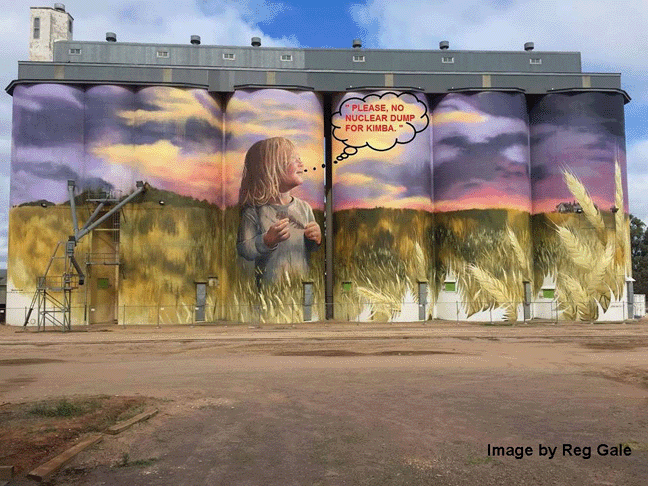
Resources Minister Keith Pitt’s formal declaration of Napandee, near Kimba in regional South Australia, as the location for a co-located radioactive waste disposal and storage facility is likely to see an escalation in community contest and opposition, the Australian Conservation Foundation said today.
ACF’s concerns with the plan include:
- No consent from the region’s Traditional Owners, the Barngarla people. Barngarla were actively excluded from key ‘consultation’ processes, including a highly restricted community ballot.
- The planned facility is unnecessary given federal parliament’s recent support for a $60 million waste storage upgrade to secure the most problematic intermediate level waste (ILW) at the Australian Nuclear Science and Technology Organisation’s (ANSTO) Lucas Heights nuclear site for the next three to five decades.
- Moving intermediate level waste from ANSTO, a site with many institutional assets – security, radiation monitoring and emergency response, local expertise etc – to a site near Kimba with far fewer assets and resources is irresponsible and inconsistent with best industry practice.
Further concerns are outlined in ACF’s 3-page background brief on radioactive waste plans.
“The Kimba plan is effectively redundant on the day Minister Pitt has made his decision,” said ACF’s national nuclear-free campaigner Dave Sweeney.
“Extended storage of Australia’s most problematic waste at Lucas Heights where most of it is already stored, makes far more economic, environmental and radiological sense than the ill-considered Kimba plan.
“Sites that currently store and manage nuclear medicine waste around Australia will still need to do so, irrespective of the status of any national facility, so the Minister’s repeated reference to nuclear waste being spread across 100 sites is disingenuous and inaccurate.
“The planned federal action is contrary to SA state law and does not enjoy bi-partisan political support.
“Fewer than one thousand South Australians have had a say in a plan that has profound inter-generational implications.
“This is particularly concerning given the prospect of project creep as atomic enthusiasts spruik domestic nuclear energy in the context of the proposed acquisition of nuclear-powered submarines.
“Minister Pitt is continuing the same top-down, flawed approach that has failed in the past.
“Minister Pitt’s decision is the start of a new stage in the campaign for responsible waste management.
“This politicised move will be contested in the Courts and on the streets.
“Setting up processes to manufacture consent – including denying a voice to Aboriginal Traditional Owners – speaks volumes about the poverty of the arguments in favour of the waste facility.
“If the Minister was convinced of the project’s merits he would not be cutting corners with Traditional Owners and the wider community or making myth about nuclear medicine.
“Canberra should stop playing politics and instead get serious about responsible radioactive waste management.
“This issue has a long way to run. The plan needs formal environmental and regulatory assessment and approval and is a long way from a done deal.”
ACF’s 3-page background brief on federal radioactive waste plans
Measure twice, cut once: Advancing responsible radioactive waste management in Australia
Kimba nuclear dump: Premier Marshall must enforce South Australia’s legislation
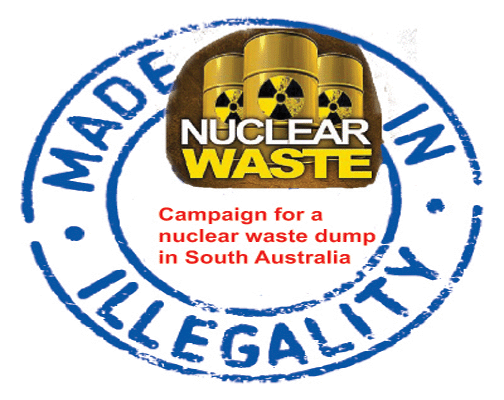
“The SA Nuclear Waste Storage Facility (Prohibition) Act was an initiative of the SA Olsen Liberal government to prevent the imposition of an intermediate-level nuclear fuel waste dump in SA. The state legislation was strengthened by the Rann government in 2002. Premier Marshall should fight Canberra’s push to dump nuclear waste on SA and to override state legislation, as did Premier Olsen and Premier Rann.
The Act mandates a state Parliamentary inquiry in response to any attempt to impose a nuclear waste dump on SA and the Premier should initiate that inquiry immediately.
The Morrison government’s plan to impose a national nuclear waste dump at Kimba still faces multiple hurdles despite today’s announcement from Minister Keith Pitt that the site has been formally declared and land acquired. Those hurdles include a judicial challenge to the declaration, environmental assessment, assessment by the federal nuclear regulator ARPANSA, a state parliamentary inquiry, and upcoming state and federal elections.
The Howard government had proceeded further towards imposing a dump on SA before abandoning the plan in 2004.
Dr. Jim Green, national nuclear campaigner with Friends of the Earth Australia, said: “The Morrison government’s disgraceful efforts to override the unanimous opposition of Barngarla Traditional Owners will be challenged in the courts. Barngarla Traditional Owners are expected to launch a judicial challenge following today’s announcement.
“Traditional Owners were excluded from the government’s sham ‘community ballot’ so they held their own ballot. When the results of the government’s ballot and the Barngarla ballot are combined, support falls to 43%, short of a majority and well short of the 65% that the government indicated was the benchmark to determine ‘broad community support’.
“Premier Steven Marshall’s support for a nuclear waste dump that is unanimously opposed by Barngarla Traditional Owners is unconscionable, crude racism and Friends of the Earth calls on the Premier to support Traditional Owners ‒ and all South Australians ‒ instead of shamefully falling into line behind his undemocratic, racist federal colleagues.
“The SA Nuclear Waste Storage Facility (Prohibition) Act was an initiative of the SA Olsen Liberal government to prevent the imposition of an intermediate-level nuclear fuel waste dump in SA. The state legislation was strengthened by the Rann government in 2002. Premier Marshall should fight Canberra’s push to dump nuclear waste on SA and to override state legislation, as did Premier Olsen and Premier Rann.
“The Act mandates a state Parliamentary inquiry in response to any attempt to impose a nuclear waste dump on SA and the Premier should initiate that inquiry immediately.
“The proposed nuclear dump will be contested at the SA and federal elections. Friends of the Earth welcomes SA Labor’s policy that Traditional Owners should have a right of veto over nuclear projects given the sad and sorry history of nuclear projects in this state. Deputy Leader Susan Close says that SA Labor is “utterly opposed” to the “appalling” process which led to the federal government targeting the Kimba site.
“The government’s claim that most of the waste arises from nuclear medicine is a blatant lie. The claim that 45 permanent jobs will be created is implausible. When the Howard government planned a dump in SA, it said there would be zero jobs.
“Measured by radioactivity, well over 90% of the waste is long-lived intermediate-level reactor waste that the federal government wants to store above ground at Kimba until such time as a deep underground disposal facility is established. No effort is being made to find a location for such a facility so this long-lived waste would remain stored above ground in SA ad infinitum. The only deep underground nuclear waste repository in the world, in the US state of New Mexico, was closed in 2014 following an underground chemical explosion in a nuclear waste barrel.
“Intermediate-level waste should be stored at ANSTO’s Lucas Heights site until a suitable disposal facility is available. The Morrison government’s plan to move intermediate-level waste from secure above-ground storage at Lucas Heights to far less secure storage at Kimba is absurd and indefensible.
“South Australians fought long and hard to prevent the Howard government turning SA into the nation’s nuclear waste dump. We fought and won the campaign to stop the Flinders Ranges being used for a national dump. We fought and won the campaign to stop SA being turned into the world’s high-level nuclear waste dump. And now, we will fight until the Morrison government backs off.”
Minister Keith Pitt confirms that the federal government has bought the land at Kimba for the national nuclear waste dump.

Kimba confirmed as home to nuclear waste facility, The Advertiser, 29 Nov 21,
Small Eyre Peninsula town of Kimba confirmed by Canberra as home to Australia’s new nuclear waste facility.
The small Eyre Peninsula town of Kimba will be home to a $325m nuclear waste facility for Australia, with Resources Minister Keith Pitt confirming the federal government has acquired land to build the complex.
Mr Pitt said the decision to choose Kimba provided “a solution that has eluded consecutive governments for more than 40 years’’. In August, Mr Pitt said the 211ha site at Napandee farm, 24km west of Kimba, was the preferred location for the dump, which will store low-level radioactive waste permanently and some intermediate waste for several decades.
The selection of Kimba has divided the local community. Opponents believe a nuclear waste dump would ruin the area’s clean, green image, although a ballot run by Kimba Council in 2019 found 62 per cent of residents supported the facility. The Barngarla Determination Aboriginal Corporation has previously argued that it was not consulted about the site and has flagged it will ask for a Judicial Review of the decision………
Nestlé Australia switches to 100 pct renewables with CWP wind farm deal — RenewEconomy

Nestlé Australia accelerates switch to 100 per cent renewable with 10-year deal with CWP wind farms. The post Nestlé Australia switches to 100 pct renewables with CWP wind farm deal appeared first on RenewEconomy.
Nestlé Australia switches to 100 pct renewables with CWP wind farm deal — RenewEconomy
November 28 Energy News — geoharvey

Science and Technology: ¶ “Electric Car FAQs: Do EVs All Use The Same Plug?” • Electric cars are mostly like regular cars. You step on the pedal on the right and the car goes, you turn the wheel and the car turns. 99% of the time the only difference is what kind of fuel goes […]
November 28 Energy News — geoharvey
COP26, “A fragile win”? — The Update

An event believed to be the world’s best last chance in mitigating climate change was held during the month of November in Glasgow, Scotland. One of this year’s most critical talks, the 26th annual climate change conference (COP26) involved 197 states coming together to reach a agreement on tackling climate change. There are two main […]
COP26, “A fragile win”? — The Update
Australian Conservation Foundation comments to Parliamentary Committee on nuclear submarine agreement.

Australian Conservation Foundation comment on the Joint Standing Committee on Treaties review of the Agreement between the Government of Australia, the Government of the United Kingdom of Great Britain and Northern Ireland, and the Government of the United States of America for the Exchange of Naval Nuclear Propulsion Information (ENNPIA)
November 2021
- Unreasonable time frame
ACF maintains that the focus of the proposed Treaty action – the planned acquisition of nuclear powered submarines – has profound security, diplomatic, environmental and economic implications. The plan has been described by the RAN’s Head of Navy as one that “will shape the direction of our navy forevermore, and will no doubt change the shape of our nation”.
In this context the scarcity of time given to the consideration of this proposed action is neither justified nor acceptable.
To provide less than one working week for invited comment is not consistent with the credible and comprehensive consideration of the many and complex issues.
This truncated approach undermines community confidence and procedural credibility. There is a risk JSCOT be perceived not as a respected and effective review mechanism, but rather an eviscerated rubber stamp.
ACF seeks to formally record our concern and disappointment that the first piece of policy architecture being used to advance such a significant change has been approached in this fashion.
If part of the rationale for the planned action is to ensure “Australia is a responsible and reliable steward of this technology” this cavalier approach is a counter-productive one.
- Limited consultation
The consultation process for the proposed Treaty action mirrors the compressed timeline as it both unnecessarily restrictive and limited.
Only federal government agencies – DFAT, PMC and AGs – were consulted.
There has been no consultation with wider nuclear related agencies including the Australian Radiation Protection and Nuclear Safety Agency, the Australian Radioactive Waste Agency or any environmental experts.
State governments and state agencies were not consulted, despite these jurisdictions being the host sites for activities directly related to the Treaty action.
The comment that no public consultation was undertaken “as the ENNPIA relates to national security and operational capability matters” ignores the fact that there is a legitimate and high level of community interest and concern with the wider AUKUS proposal and further undermines community confidence in these politicised decision making processes.
In light of this, ACF would welcome clarification through the JSCOT review of the nature of the proposed “18 month consultation period” Who is going to be consulted? Will there be a public or wider stakeholder aspect to these consultations? Are they genuine consultations or top-down information updates?
ACF also notes that the NIA (in particular NIA point 5) contains assumptions on the benefits of nuclear submarines that underpin the wider AUKUS plan that have not been openly tested. The clear focus of this process is to advance a pathway to operationalise a decision that has already been made, rather than have an open examination of the issues to inform evidence-based decision making.
- Non-proliferation concerns
Should AUKUS be advanced, Australia would be the only non Nuclear Weapon State to have nuclear powered submarines. This unhelpful exercise in Australian exceptionalism and the proposed use of weapons grade highly enriched uranium (HEU) has clear proliferation sensitivities and has understandably been the focus of deep concern from nations in the region.
This has also attracted attention and concern from the International Atomic Energy Agency which has stated that “with Australia, with the United States and with the United Kingdom, we have to enter into a very complex, technical negotiation to see to it that as a result of this there is no weakening of the nuclear non-proliferation regime.”
The current approach to fast-track this Treaty action utterly fails to recognise or reflect the complexity and significance of the non-proliferation concerns related to the AUKUS plan.
The proposed use of a designated non-explosive military use, facilitated by direct military transfer, in order to place weapons grade HEU outside of IAEA safeguards is a disturbing development that could increase pressure on the already strained global non-proliferation framework. It raises the likelihood of other nations seeking similar exceptions and HEU safeguard exemptions.
ACF notes and welcomes that the “ENNPIA does not authorise and will not support the sharing or transfer of any information related to nuclear weapons”. ACF further notes that a comparable commitment that AUKUS does not involve nuclear weapons was made by the Prime Minister when the plan was announced in mid-September.
This pivotal commitment needs to be given a firmer basis than a political assurance. ACF has called on the PM and federal government to send an unequivocal signal that Australia will not countenance or consider nuclear weapons by moving to sign and ratify the UN Treaty on the Prohibition of Nuclear Weapons
- Nuclearisation by stealth
ACF has previously expressed concern that the AUKUS nuclear submarine plan could lead to increased pressure for a domestic nuclear industry: https://www.acf.org.au/dont-turn-nuclear-powered-subs-into-nuclear-power-subsidies and https://www.acf.org.au/nuclear-submarines-australia
ACF notes and welcomes that both the Prime Minister and Opposition Leader have explicitly ruled out a domestic nuclear power industry and stated that the AUKUS plan is not a forerunner to any such activity.
ACF notes that the NIA (12) limits the scope of the planned action to naval nuclear propulsion and states that the ENNPIA “does not support the transfer of any equipment or technology, nor does it support the sharing or transfer of any information on civil nuclear matters”. This is a welcome but insufficient specification.
Since the mid-September AUKUS announcement a range of voices, including within the federal government, have made calls for Australia to embrace domestic nuclear power. The Prime Minister needs to act decisively to give effect to his clear statements that AUKUS is not linked to and will not propel any domestic nuclear industry by explicitly referencing and re-affirming the two key legislative prohibitions on nuclear power in the EPBC and ARPANS Acts.
ACF notes with concern the potential for opaque expansion of the proposed Treaty action, including in Article 2 which states that parties will “provide support to facilitate such communication or exchange, to the extent and by such means as may be mutually agreed”.
This provides considerable latitude and given the AUKUS process to date has been characterised by surprise announcements, non-inclusion and fast-tracking there is no basis for community confidence that mutual agreement might see an expanded set of activities. Could UK or US nuclear submarines be hosted routinely or permanently in Australia as part of this critical skills and information exchange?
In a similar vein, the approach taken with this ENNIPA process reinforces community unease over the nature and speed of AUKUS related decision making and the risk that this approach will become the standard. In relation to further Treaty actions ACF notes that the “agreement can be changed subject to all party agreement and subject to Australia’s domestic treaty-making requirements”. Given the current truncated approach there is no assurance in this statement and no confidence that any future changes will be openly and robustly scrutinised.
- Recommendations:
- JSCOT not recommend advancing the current Treaty in the absence of sufficient time to credibly review key aspects of the proposed action, especially in relation to the “very complex, technical negotiation” needed to ensure there is no weakening of the nuclear non-proliferation regime.
- JSCOT recommends Australia sign the Treaty on the Prohibition of Nuclear Weapons (TPNW) both as a regional assurance mechanism and to give effect to PM Morrison’s clear statements that AUKUS is not related to any Australian ambition to acquire a nuclear weapons capability
- That greater detail on the proposed AUKUS submarine plan be presented to the Australian Parliament and people, including but not limited to issues around cost, rationale, the 18 month “consultation” process and emergency and waste management concerns.
- That the Prime Minister give effect to his repeated commitment that naval nuclear propulsion will not lead to increased moves for an Australian nuclear power industry by explicitly referencing and re-affirming the two key legislative prohibitions on domestic nuclear power in the EPBC and ARPANS Acts.
To discuss or clarify any aspect of this submission please contact Dave Sweeney, ACF nuclear policy analyst via dave.sweeney@acf.org.au or 0408 317 812
CSIRO study proves climate change driving Australia’s 800% boom in bushfires.
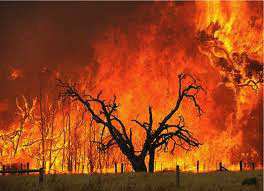
CSIRO study proves climate change driving Australia’s 800% boom in bushfires, The Age, By Mike Foley, November 26, 2021 Climate change is the dominant factor causing the increased size of bushfires in Australia’s forests, according to a landmark study that found the average annual area burned had grown by 800 per cent in the past 32 years.
The peer-reviewed research by the national science agency, CSIRO — published in the prestigious science journal, Nature — reveals evidence showing changes in weather due to global warming were the driving force behind the boom in Australia’s bushfires.
Lead author and CSIRO chief climate research scientist Pep Canadell said the study established the correlation between the Forest Fire Danger Index – which measures weather-related vegetation dryness, air temperature, wind speed and humidity – and the rise in area of forest burned since the 1930s.
“It’s so tight, it’s so strong that clearly when we have these big fire events, they’re run by the climate and the weather,” Dr Canadell said.
Prime Minister Scott Morrison went to the COP26 climate talks in Glasgow to commit Australia to reach net zero emissions by 2050, and to upgrade his expectations for Australia’s 2030 carbon cuts, but he defied a global push to commit to phasing out fossil-fuel use. Instead, the Coalition government is backing a significant expansion of the gas industry, which it predicts will be 13 per cent larger in 2050 than it is now.
Under the federal government’s gas industry strategy, taxpayers will support the private sector to develop viable new gas fields and develop an extensive network of new pipelines and related infrastructure.
The bushfire royal commission identified climate change as a key risk to ongoing bushfire catastrophe but did not make recommendations about reducing greenhouse emissions to curb the threat.
The CSIRO report found other factors have an impact on the extent and intensity of bushfires such as the amount of vegetation or fuel load in a forest, the time elapsed since the last fire, and hazard reduction burning. But Dr Canadell said the study showed the link between weather and climate conditions and the size of bushfires was so tight, it was clear these factors far outweighed all other fire drivers…………….
oyal c
Mega-fires, which burn more than 1 million hectares, have “markedly” increased with three of the four recorded from 1930 occurring since 2000, while the gap between big blazes has had a “rapid decrease”, the study says.
Last year, the bushfire royal commission reported fuel-load management through hazard reduction burning “may have no appreciable effect under extreme conditions” that typically cause loss of life and property. https://www.theage.com.au/politics/federal/csiro-study-proves-climate-change-driving-australia-s-800-percent-boom-in-bushfires-20211126-p59cgr.html
French nuclear submarines a better choice for Australia
We’re repeating all the same Collins mistakes, THE AUSTRALIAN 27 Nov 21, Why we should turn AUKUS into FAUKUS and buy our nuclear-powered submarines from France.By JON STANFORD
”…………………unfortunate decision is to effectively eliminate competition in selecting Australia’s SSNs. The likelihood is that our AUKUS partners will decide which of them – probably the British – will provide Australia with SSNs. Without a competitor – and the French Suffren is the only option – we will again be negotiating with a monopolist on a “take it or leave it” basis.
In addition, the prospect of acquiring a US or British SSN takes us back to the third problem with the Attack program – overambition. Both the British and US navies operate large submarines – around three times the size of Collins – that may be too much for the smaller RAN to digest.
Defence has stated that Australia should acquire a mature submarine design. This will be difficult to achieve within AUKUS. With production of its PWR2 reactor now terminated, there will be no further construction of the British Astute-class after delivery of the seventh boat. The next British SSNs will use the new PWR3 reactor, largely an American design, and the platform will need to be bigger in order to accommodate it.
Were we able to acquire an American submarine, this would also probably be a new design. The US is already planning for the first SSN(X) to replace the Virginia-class in the early 2030s.
In both the British and American options, therefore, all the risks of a new design, including late delivery, will be present.
Both these new platforms will be bigger than the submarines they replace and require even larger crews. The Virginia-class has a crew of 135, 80 more than Collins, while Astute’s complement is 98. Would we be able to populate these very large submarines? Even the British, with a much bigger population than Australia, have difficulty in recruiting and retaining crews for their submarines.
The latest French SSN, Suffren, has some advantages for the RAN. It is a relatively recent design with only the first of class in commission. Reputedly, it has superior stealth characteristics. It has a crew of 60, only five more than Collins. Given the progress already made on Attack, whose reference design was Suffren, Australia should be able to acquire a mature French SSN in a shorter timeframe than a new American or British design.
French SSNs also have the advantage of using low enriched uranium (LEU) rather than the weapons grade, highly enriched uranium (HEU) that fuels American and British boats………
The government’s story that Australian industry cannot refuel nuclear reactors is also pure fiction. ……. Our 20MW nuclear reactor is located in Lucas Heights, a leafy Sydney suburb in Sutherland Shire, adjacent to the Prime Minister’s electorate of Cook. The Australian Nuclear Science and Technology Organisation has been refuelling nuclear reactors there for more than 60 years
Unlike its predecessor, which was designed for HEU, the current OPAL reactor uses LEU fuel…….
It is difficult to see any benefit in scrapping our strategic partnership with France. While a Barry McKenzie-style of diplomacy may trigger political resonance for the government, it has needlessly damaged an important relationship and constrained our options for acquiring nuclear submarines……..
The US administration, blindsided by the unprecedented recall of the ambassador of its oldest ally, may already be thinking of extending an olive branch to France. Time for FAUKUS, anyone?
Jon Stanford is principal of the think tank Submarines for Australia and a former senior official in the Department of Prime Minister and Cabinet. https://www.theaustralian.com.au/inquirer/were-repeating-all-the-same-collins-mistakes/news-story/eaeff234940e33bec455dab9ead8ed3b
Guest Post from Gordon Frederick Coggon – a Nuclear Test Veteran’s Experience — RADIATION FREE LAKELAND

Gordon Frederick Coggon ·26 Nov 21,
Guest Post from Gordon Frederick Coggon – a Nuclear Test Veteran’s Experience — RADIATION FREE LAKELAND
https://wordpress.com/read/feeds/331643/posts/3682558618 During 1957 and 1958 I was one of 20,000 British serviceman sent to the central Pacific testing ground of British Hydrogen bomb tests which in my own case involved being at Christmas Island.(now named Kiritimati). During my year there I was subjected to radiation contamination. I witnessed two hydrogen bombs, the first being Operation Grapple X with a 1.8 megaton yield on Nov 8th. 1957 and the second bomb being on 28th. April 1958. Which had a yield of 3 megatons.( Both these devices were dropped by a Valient ‘V’ bomber about 20 miles off the southern tip of the Island.)
After the Grapple X test I was sent to hand wash a Canberra Aircraft,s engine nacelles after it had flown through the cloud of the hydrogen bomb collecting samples. I was set to work using a small bore hosepipe and a scrubbing brush, (the Aircraft had been hosed down with high pressure jets of water before I was employed on a gantry cleaning where the jets of water were not directed at the intakes of the engines.) Initially, I was given a pair of denims, wellingtons, rubber gloves and a remote breathing apparatus (which consisted of a face mask attached to 38 feet of corrugated rubber hose and connected to a fresh air filter which was fastened down as far away as possible from the aircraft. The face mask head straps were broken so the man in the white suit and gas mask said it was useless for the job in hand so I was given a crude homemade mask made from cotton wool sandwiched between a silver paper foil.
Whilst working on the gantry the mask got wet through and I wasnt able to breathe, so I had to move it from my mouth and nose to enable myself to breathe. I continued to work for between 20 to 30 minutes before I was replaced by someone else and I was then sent to the decontamination tent where I showered several times until the man in the white suit and Geiger counter said I was ok to get dressed in the clean side of the tent and was given a new set of kd shorts and shirt. This showering and decontamination took at least one and a half hours, My contaminated clothing was put in a yellow barrel marked with radiation signs in the dirty side of the facility. I have to say also that some of us were given other dangerous tasks like picking up dead fish and birds after the tests and some guys had to dump contaminated equipment in the ocean or bulldoze contaminated earth. After the Grapple Y bomb on 28th.April 1958, there was a massive downpour of rain, which came from the bomb cloud, a lot of the young innocent troops stood outside bathing in it like one normally did during the rain showers, but unlike the normal rain this was said to be contaminated because there was no other clouds in the sky at the time.
At that time I was 18 years old (picture of me above whilst there) and most of us had no idea what radiation was. Nor was I told anything about it until later in my career when I remustered into the Fire, Crash and rescue trade, where I was trained up to an advanced stage about radiation and biological warfare and every Monday I was teaching an induction course to new arrivals on the station that I was posted too. That was when I began to worry about my own health. Had I been put at an high risk of radiation whilst on Christmas Island ??. The Aircraft that I had helped to decontaminate was still emitting Gamma radiation, to what extent?? Also, did I swallow, inhale Alpha particles.?? ( Alpha radiation cannot penetrate human skin but they can be swallowed in water droplets, eaten if on food, or more commonly inhaled.)
These Alpha particles may remain inside your body for your whole life, attacking cells of your body for decades and could take many years before irrepairable damage becomes apparent. Recently it has been associated with radiation caused diseases and malformities in new born descendants of nuclear test veterans. I have had Cancer and several other illnesses which most lightly have been caused by atomic radiation, so far, even after seventy years, the successive British Governments have continued to deny that their troops were subjected to radiation during their atomic and hydrogen tests in the fifties and sixties. And yet, many of the nuclear armed countries have acknowledged the troops that was sent to take part in their experiments with nuclear fission and have been recognised by being given a medal and/or compensation.
I have only mentioned my own experience at Christmas Island (Kiritimati) but during a period 1952 – 1968 there have been many such tests in Australia, other testing areas of the Pacific where a lot of fellow veterans were irradiated by atomic fallout and nuclear poisoning from various clean-up operations after the tests, many of these young men never got to grow old because of their contamination from the tests. Many test sites were carried out where local people lived, these same people have since lost their homes and way of life by the poisoning effects of radiation . Since; atomic radiation contamination illnesses have continually been killing test veterans and clean-up veterans nothing has been done so far to help the families of these brave innocent troops and civilians by the British Government, who were subjected to experiments during the trials.
It is now becoming more alarming by the number of offspring who have also inherited their veteran father’ s damaged cells genetically. * reference to these tests are also available in two books that I have published on Amazon. The first one is titled :- ‘ Christmas Island 1957-1958 ‘ an Ebook on Kindle. The other is a paperback, titled:-‘ The Life of a Yorkshire Lad’ on Amazon and an ebook on kindle.
All royalties for the (latter paperback/ebook have been donated to LABRATS INTERNATIONAL for their continued valuable work in helping test veterans and their descendants come together from all over the world in their fight for justice.
Morrison Government failing young people on climate yet again
Morrison Government failing young people on climate yet againThe Morrison government is set to announce fast track approvals and further public money for big gas corporations to open new gas basins as part of the release of the national gas investment framework today.
More Black Summers ahead as climate change increases risk of megafires – CSIRO
| Christina Macpherson <christinamacpherson@gmail.com> | 1:06 PM (5 minutes ago) |  | |
| to me |
More Black Summers ahead as climate change increases risk of megafires: CSIRO
Research shows climate change has increased the frequency and extent of megafires in Australia, with scientists warning the year following a La Niña is the most treacherous.
Morrison chaos and fossil fuel funding is undermining Queensland’s efforts to go green — RenewEconomy

Morrison government’s policy chaos and its massive taxpayer subsidies for fossil fuels is undermining Queensland’s efforts to shift to renewables. The post Morrison chaos and fossil fuel funding is undermining Queensland’s efforts to go green appeared first on RenewEconomy.
Morrison chaos and fossil fuel funding is undermining Queensland’s efforts to go green — RenewEconomy
Part of the frozen soil barrier may have thawed at the Fukushima Daiichi Nuclear Power Plant. Steel pipes are being driven into the ground to stop groundwater flow. — Fukushima 311 Watchdogs

Nov. 25, 2021Tokyo Electric Power Company (TEPCO) announced on November 25 that it may have thawed part of the frozen soil barrier wall built around the No. 1 to No. 4 reactors at the Fukushima Daiichi Nuclear Power Plant (Okuma and Futaba towns, Fukushima Prefecture) to prevent the inflow of groundwater. The company has announced […]
Part of the frozen soil barrier may have thawed at the Fukushima Daiichi Nuclear Power Plant. Steel pipes are being driven into the ground to stop groundwater flow. — Fukushima 311 Watchdogs
1 This month
17 October, Free Public Talk on Nuclear Issues in South Australia
David Noonan will speak on public interest concerns over the new Roxby Downs Indenture Act 2026 on BHP copper-uranium mining and ore processing in SA, and on how AUKUS may face SA with a High-Level nuclear waste agenda.
Dr Jim Green will discuss international developments in the field of nuclear power including ‘small modular reactors’ and Generation 4 ‘advanced’ nuclear reactor concepts.


Help Aunty Sue Protect Her Land and Sacred Sites From Destructive Rocket Testing.
.

Australians deserve the truth
about
AUKUS – https://aukuspublicinquiry.com/

PETITION – To: Prime Minister Anthony Albanese and the Australian Labor Government

of the week – Australians for War Powers Reform (AWPR)
To see nuclear-related stories in greater depth and intensity

