Indonesia, Malaysia, and the Director General of the IAEA all anxious about Autralia’s planned nuclear submarines
We feel the heat’: Malaysia cool on Australian submarines, SMH, By Chris Barrett, October 21, 2021 Singapore: Australia’s attempts to ease south-east Asian anxiety about its submarine ambitions continue to fall short, with Malaysia deeply concerned despite acknowledging the difference between nuclear power and nuclear arms.
The Philippines, Singapore and Vietnam have welcomed the AUKUS pact between Australia, the United States and the United Kingdom, as well as Australia’s plans to enhance its military capability with varying degrees of enthusiasm. But Indonesia and Malaysia are fearful its acquisition of nuclear-propelled submarines will ramp up tension and trigger an arms build-up in the region.
It is a view not disputed by Rafael Grossi, the director general of the International Atomic Energy Agency, who on Wednesday said the prospect of other countries seeking to follow Australia and develop their own nuclear-powered submarines “cannot be excluded”.
The Morrison government has sought to address consternation in Jakarta and Kuala Lumpur by sending Vice Admiral David Johnston, the Vice Chief of the Defence Force, to the region for talks but two of Australia’s most important neighbours are unconvinced.
……….. . Saifuddin said nuclear power was “not something that will make Malaysians and I believe many ASEAN people comfortable”……… He said some ASEAN member nations would raise the issue with Australia, a dialogue partner of the regional bloc, when leaders convened for a three-day virtual summit next week.“During the next ASEAN [leaders meeting] there is the ASEAN-Australia summit. I believe some member states want to raise the issue with Australia during the summit,” he said.
“I don’t think it is useful to evaluate whether we are satisfied with [Australia’s] explanation. The issue is still there.“
…. He said Malaysia didn’t want to have to choose sides in the geopolitical rivalry between the US and China.
……. Grossi, the head of the IAEA, the United Nations nuclear watchdog, said Australia’s pursuit of a fleet of nuclear-powered submarines as a non-nuclear armed nation needed to be closely monitored. https://www.smh.com.au/world/asia/we-feel-the-heat-malaysia-cool-on-australian-submarines-20211020-p591o6.html
BHP’s legal privileges overOlympic Dam copper-uranium mine have had devastating consequences for traditional Aboriginal owners
David Noonan Nuclear Fuel Cycle Watch, 20 Oct 21
· “A Way Forward” Juukan Caves Inquiry Final Report https://www.aph.gov.au/…/Nort…/CavesatJuukanGorge/Report Inquiry Report conveys a striking critique of BHP legal privileges over Olympic Dam copper-uranium mine, see Legislative exemptions from cultural heritage protections p.147-148:
“Acts such as these have had devastating consequences for traditional owners as rights to protect cultural heritage are intentionally disrupted and prevented … these Acts remain in force and even when they are repealed their associated histories of injustices will remain … States and territories as well as companies involved in such acts should seek to fast-track transitions and recompense traditional owners for injustices that have occurred.”
IAEA chief: Aukus could set precedent for pursuit of nuclear submarines
Guardian, Julian Borger 20 Oct 21, Special taskforce convened by IAEA to look into Aukus deal as Iran hints at fresh pursuit of its 2018 naval nuclear propulsion program
The head of the UN’s nuclear watchdog has said other states could follow Australia’s example and seek to build nuclear-powered submarines, raising serious proliferation and legal concerns.
Rafael Grossi, the director general of the International Atomic Energy Agency (IAEA) said during a visit to Washington that he had set up a special team to look into the nuclear safeguards and legal implications of the Aukus partnership announced last month, in which the US and UK will help Australia build a fleet of nuclear-powered submarines.
If the plan is carried through, it would be the first time a non-nuclear weapons state has acquired nuclear-powered submarines. It reflects a grey area in the 1968 Nuclear Non-Proliferation Treaty, which allows fissile material to be removed from IAEA safeguards for such purposes.
The procedures by which the agency would ensure that the fuel, removed from agency oversight, is not diverted to making nuclear weapons have yet to be worked out………..
Grossi said it “cannot be excluded” that other countries would use the Aukus precedent to pursue their own nuclear submarine plans.
Canada and South Korea have both contemplated building nuclear-powered submarines, which can stay underwater longer and are quieter than their conventional counterparts. Brazil too has an ongoing nuclear submarine project……….. https://www.theguardian.com/world/2021/oct/19/iaea-aukus-deal-nuclear-submarines
Morrison refuses to release net zero modelling, as Australia outed for fudging climate report — RenewEconomy

Leaked documents show Australia trying to water down influential UN-backed climate report, as Morrison government refuses to release its net zero modelling. The post Morrison refuses to release net zero modelling, as Australia outed for fudging climate report appeared first on RenewEconomy.
Morrison refuses to release net zero modelling, as Australia outed for fudging climate report — RenewEconomy
Sydney Trains goes zero emissions, with renewable certificate deal — RenewEconomy

Sydney Trains transitions its network to zero net emissions, after inking a deal with Red Energy to buy renewable energy certificates. The post Sydney Trains goes zero emissions, with renewable certificate deal appeared first on RenewEconomy.
Sydney Trains goes zero emissions, with renewable certificate deal — RenewEconomy
Australia ranked worst amongst international peers for climate action, fossil fuel use — RenewEconomy

Australia ranked last among developed countries for climate action, due to its poor track record on emissions and its ongoing dependence on fossil fuels. The post Australia ranked worst amongst international peers for climate action, fossil fuel use appeared first on RenewEconomy.
Australia ranked worst amongst international peers for climate action, fossil fuel use — RenewEconomy
The folly of gas: Most new gas generators not viable, says Carbon Tracker — RenewEconomy

Australia is hitching its future to a “gas-led recovery”, but new report says gas plants are not viable because renewables and storage are cheaper, and cleaner. The post The folly of gas: Most new gas generators not viable, says Carbon Tracker appeared first on RenewEconomy.
The folly of gas: Most new gas generators not viable, says Carbon Tracker — RenewEconomy
October 20 Energy News — geoharvey

Opinion: ¶ “Biden’s Climate Targets Are Possible Without Clean Energy Program, But Will Need Tax Credits And Regulations” • Even if Democrats’ cornerstone climate policy is stripped out of their budget bill, an independent analysis estimates President Joe Biden can still meet his climate goals. But it would take decisive action and regulations. [CNN] Offshore […]
October 20 Energy News — geoharvey
UK’s Net Zero Strategy lacks concrete plans for reducing emissions and promoting renewables
| In reaction to the government’s Net Zero Strategy, Rebecca Newsom, Greenpeace UK’s head of politics, said “This document is more like a pick and mix than the substantial meal that we need to reach net zero. Extra cash for tree planting and progress on electric vehicles doesn’t make up for the lack of concrete plans to deliver renewables at scale, extra investment in public transport, or a firm commitment to end new oil and gas licences. There are only half-hearted policies and funding commitments to decarbonise our draughty homes at the speed necessary, and it fundamentally fails to grapple with the need to reduce our meat and dairy consumption to stop global deforestation. With just eight years left to halve global emissions, the government can’t just keep dining out on its ‘ambitious targets’. Until the policy and funding gaps are closed, Boris Johnson’s plea to other countries to deliver on their promises at the global climate conference next month will be easy to ignore.” Greenpeace 19th Oct 2021 https://www.greenpeace.org.uk/latest-updates/?news_type=press-release |
Nuclear power? It’s of zero use to Australia’s emissions plan
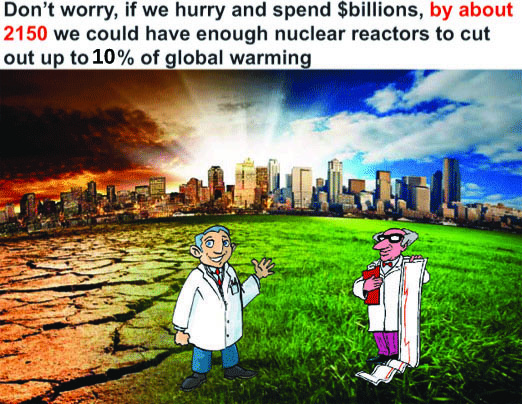
I have no problems with nuclear power. But the only way it would be viable is with an extremely high carbon price. I say bring that on!
Except a high carbon price makes renewables an even better investment, and thus nuclear less needed.
And even a high carbon price won’t get enough nuclear plants built soon enough to prevent temperatures rising above 2C.
Nuclear power is too costly, too slow, so it’s zero use to Australia’s emissions plan, EXCELLENT GRAPHS Guardian, Greg Jericho 18 Oct 21, With a 20-year development timeline, nuclear plants won’t be built soon enough to stop temperatures rising above 2C. So why are we wasting precious time debating them?
The catch-22 of nuclear power in Australia is that you would only consider it if you wanted to reduce emissions because of climate change, but if you agree climate change is real and we need to reduce emissions, you would not consider nuclear power.
Currently Australia burns a lot of coal – more than other comparable economies with nuclear power.
Even worse, Victoria relies greatly on the dirtiest and least-efficient brown coal.
But if you think climate change is a load of bunk then, as current head of charging with ChargeFox, Evan Beaver, puts it in his excellent blog post on the issue, “we might as well burn all the coal we have. And we have a lot.”
But if you do agree climate change is real then what we need to do is reduce emissions as fast as possible. As I noted last month, at a certain point there will be so much CO2 in the atmosphere that we won’t be able to limit temperatures rising above either 1.5C or 2C above pre-industrial levels, no matter when we get to net zero afterwards.
Projected cumulative emissions between 2021 and 2050
6,161Gt is the carbon budget to stay below 2C; 3,521Gt is the carbon budget for 1.5C
We must cut emissions fast – at least 50% below 2005 levels by 2030, and probably by about 75% if we want to limit temperature rises to less than 1.5C.
Nuclear power is of zero use on that score.
We know this because nuclear power has already been examined a lot.
One excellent study was in 2006 under the Howard government, by Ziggy Switkowski. It noted that “the earliest that nuclear electricity could be delivered to the grid would be 10 years, with 15 years more probable”.
Alright then. Firstly, not even the National party is insane enough to make nuclear power an election promise.
So let’s assume if the Coalition wins next year’s election, but announces a move to legalise nuclear power, that even with the best intentions, given the task of getting the votes, it’d be lucky for that to happen until the end of 2022.
Now all that has to happen is choose the type of reactor, and oh, pick a spot (have fun).
Ignore the coming election in 2025 and assume everything gets in place by 2024 (not a hope, but hey, let’s play pretend). That means at best we’re looking at 2035 but more likely 2040 before the first nuclear plant comes on line.
That is already too late to help prevent temperatures reaching 2C, and by then an overwhelming amount of our electricity will already be generated by renewables.
That means the need for such a plant is gone. Markets know this, which is why no one will ever invest in such a plant here.
The CSIRO’s latest “GenCost” report suggests the capital costs of small modular reactor (SMR) nuclear power plants by 2030 and even out to 2050 will be greater than renewables, including solar thermal plants.
But perhaps rather surprising is that nuclear becomes even less viable when the CSIRO projects the world getting to net zero by 2050.
The reason is that, under such a scenario, the push for renewables accelerates so greatly that the development of nuclear power effectively stalls, meaning Australia would have to be a leading investor in new plants – thus paying the first mover costs.
As the CSIRO notes, “a major source of discomfort” for nuclear stakeholders is that the high cost estimate of nuclear power “is of theoretical value only” because “a nuclear SMR plant is not planned to be built in Australia anytime soon”………………….
I have no problems with nuclear power. But the only way it would be viable is with an extremely high carbon price. I say bring that on!
Except a high carbon price makes renewables an even better investment, and thus nuclear less needed.
And even a high carbon price won’t get enough nuclear plants built soon enough to prevent temperatures rising above 2C.
Nuclear power: too costly, and too slow. https://www.theguardian.com/business/grogonomics/2021/oct/19/nuclear-power-too-costly-too-slow-so-its-zero-use-to-australias-emissions-plan
On economics, nuclear power just doesn’t stack up – Labor’s Shadow Minister for Climate Change

‘The economics don’t stack up of nuclear for Australia’: Bowen, https://www.skynews.com.au/business/tech-and-innovation/the-economics-dont-stack-up-of-nuclear-for-australia-bowen/video/c743e790999f7e62fa243b50aa7c15ea Shadow Climate Change Minister Chris Bowen says the economics “don’t stack up of nuclear for Australia”. 19 Oct 21,
“Open and shut,” Mr Bowen told Sky News Australia.
“It’s the most expensive form of energy.”
Mr Bowen also said the National Party “likes to blame renewables for the energy crisis in Europe”. “When you actually look at the detail a lot of it is also relating to the unreliability both of gas and nuclear, in the British context.
“But no, the economics don’t stack up of nuclear for Australia.”
David Littleproud, Minister for Agriculture – a National Party enthusiast for the nuclear industry

‘Nuclear is OK’: Agriculture Minister backs controversial clean energy source https://www.2gb.com/nuclear-is-ok-agriculture-minister-backs-controversial-clean-energy-source/
The Agriculture Minister is throwing his support behind nuclear energy as the government debates net-zero.
The government is set to make a decision on committing to a global target of net-zero emissions.
Agriculture Minister David Littleproud told Ben Fordham polling shows hesitancy amongst the community for nuclear energy.
“I’m not afraid of it … Nats are big believers in nuclear.
“I think we should create that environment to try and educate our population that it’s OK, nuclear is OK.”
Concern in Association of Southeast Asian Nations about Australia’s nuclear submarines
Indonesia, Malaysia concerned about Australia’s nuclear subs. By NINIEK KARMINI , 18 Oct 21,
JAKARTA, Indonesia (AP) — The foreign ministers of Malaysia and Indonesia expressed concern Monday that Australia’s plan to obtain nuclear-powered submarines may increase the rivalry of major powers in Southeast Asia.
The U.S., Britain and Australia announced last month that they have formed a security alliance that will help equip Australia with nuclear-powered submarines. The alliance will reshape relations in the Indo-Pacific region and beyond……..
“This situation will certainly not benefit anyone,” Indonesian Foreign Minister Retno Marsudi said after meeting with her Malaysian counterpart, Saifuddin Abdullah, in Jakarta. “We both agreed that efforts to maintain a peaceful and stable region must continue and don’t want the current dynamics to cause tension in the arms race and also in power projection.”
The two ministers said at a joint news conference that they agreed to strengthen the unity and centrality of the Association of Southeast Asian Nations and urged all members of the bloc to contribute to the stability, security, peace and prosperity of the region and respect international law.
Saifuddin said having a near-neighbor build new nuclear-powered submarines could encourage other countries to come more frequently into Southeast Asian territory………………………..
ASEAN’s members are Brunei, Cambodia, Indonesia, Laos, Malaysia, Myanmar, the Philippines, Singapore, Thailand and Vietnam. Brunei is chair of the bloc this year.
ASEAN has formal partnerships with several countries including Australia, China, Canada, New Zealand, South Korea and Pakistan as well as the European Union.
Malaysia and Indonesia share many similarities in religion, language and culture. https://apnews.com/article/business-asia-australia-indonesia-global-trade-fbbf5b52e6822d01cdc11c8a5870ebb4
Australian Labor Party has no intention of developing nuclear power.

Labor doesn’t have ‘any desire’ to pursue nuclear: Tony Sheldon https://www.skynews.com.au/opinion/chris-kenny/labor-doesnt-have-any-desire-to-pursue-nuclear-tony-sheldon/video/be4936ec8a8dc0169ff85fcf26b8f2f1 19Oct 21,
Labor Senator Tony Sheldon says he doesn’t believe the party has “any desire” to go down a nuclear energy route to de-carbonise the economy.
“There is still substantially cheaper alternatives to that,” Mr Sheldon told Sky News host Chris Kenny.“We’re talking about making sure we develop those industries and develop that work – such as a hydrogen industry, which is going to be very critical into our future.”
1 This month.
20 September –National Day of Action in Melbourne on the International Day of Peace


Help Aunty Sue Protect Her Land and Sacred Sites From Destructive Rocket Testing.
.

Australians deserve the truth
about
AUKUS – https://aukuspublicinquiry.com/

PETITION – To: Prime Minister Anthony Albanese and the Australian Labor Government

of the week – Australians for War Powers Reform (AWPR)
To see nuclear-related stories in greater depth and intensity
 Antinuclear