Australia set to disappoint key allies on 2030 emissions target.
Australia set to disappoint key allies on 2030 emissions target, SMH, By Mike Foley October 18, 2021 Australia’s decision not to boost its 2030 emissions reduction target will disappoint key allies that have called on Prime Minister Scott Morrison to do more ahead of next month’s United Nations climate summit in Glasgow.Mr Morrison told Parliament on Monday he would stick with the target that he took to the 2019 election, which was set by former prime minister Tony Abbott in 2015, to reduce emissions by at least 26 per cent from 2005 levels. His decision comes after Nationals leader Barnaby Joyce on Sunday all but ruled out support for a higher 2030 commitment.
British cabinet minister Alok Sharma, who will head the COP26 climate change conference, has called on Australia to set a 2030 emissions reduction target of up to 50 per cent. The United Kingdom has committed to cut emissions 68 per cent by 2030 while the United States has set a goal to reduce emissions by 50 per cent and urged Australia to increase its near-term target. Japan is targeting 46 per cent. South Korea 40 per cent and the European Union 55 per cent.
Climate scientists say deep emissions cuts by 2030 are needed to achieve the goal of the Paris Agreement to limit global warming to less than 2 degrees, and as close to 1.5 degrees as possible to avoid the worst damage from climate change. Waiting longer to
reduce greenhouse gases will allow too much carbon to build up in the atmosphere and cause heating long after 2050, even if net zero is achieved by then.
The government’s “technology not taxes” policy is focused on investment in low-emissions technologies to replace current carbon-intensive systems…………….
A report released on Monday by the Asian Investor Group on Climate Change, Ceres and the Investor Group on Climate Change, which represent investors with a cumulative $62 trillion in assets, called for G20 leaders including Australia to set ambitious 2030 targets. It said Australia was among the least attractive countries for green investment, alongside Argentina, India, Indonesia, Mexico, Russia and Saudi Arabia.
Investor Group on Climate Change policy director Erwin Jackson said global investors, which Australia relies on for foreign investment, would flow away from countries without ambitious 2030 targets………https://www.smh.com.au/politics/federal/for-the-love-of-god-act-now-church-leaders-join-chorus-urging-government-to-boost-2030-climate-target-20211018-p590uy.html
Norway oil giant tips millions into Australian dispatchable “solar hydro” tech — RenewEconomy

Australian concentrated solar and hydro storage technology outfit RayGen Resources claims Norwegian giant as major new investor. The post Norway oil giant tips millions into Australian dispatchable “solar hydro” tech appeared first on RenewEconomy.
Norway oil giant tips millions into Australian dispatchable “solar hydro” tech — RenewEconomy
Taylor faces re-election test in Hume, independent challenger to be revealed soon — RenewEconomy

Angus Taylor to face re-election challenge in Hume, with a community endorsed independent candidate to be revealed next month. The post Taylor faces re-election test in Hume, independent challenger to be revealed soon appeared first on RenewEconomy.
Taylor faces re-election test in Hume, independent challenger to be revealed soon — RenewEconomy
Australia’s biggest online energy and climate change event, the Smart Energy Council Global Race to Zero Summit — RenewEconomy

The Smart Energy Council will be holding Australia’s biggest online energy and climate change event, the Global Race to Zero Summit on 20-21 October. The post Australia’s biggest online energy and climate change event, the Smart Energy Council Global Race to Zero Summit appeared first on RenewEconomy.
Australia’s biggest online energy and climate change event, the Smart Energy Council Global Race to Zero Summit — RenewEconomy
Easiest first step to net zero is to build massive amounts of solar — RenewEconomy

Solar offers the cheapest and quickest option to cut emissions in the net 10 years. We just need to build more of it, and connect more of it. The post Easiest first step to net zero is to build massive amounts of solar appeared first on RenewEconomy.
Easiest first step to net zero is to build massive amounts of solar — RenewEconomy
FRV steps up Australia solar and battery plans, with new investment partner — RenewEconomy

Canadian pension fund takes 49% stake in FRV Australia, including huge development pipeline of solar and battery storage projects. The post FRV steps up Australia solar and battery plans, with new investment partner appeared first on RenewEconomy.
FRV steps up Australia solar and battery plans, with new investment partner — RenewEconomy
Joyce fills Morrison’s policy vacuum and says no to green energy transition — RenewEconomy

Morrison has ceded control of Australia’s climate policies to Joyce’s Nationals, and didn’t even ask them to support an increased 2030 target. The post Joyce fills Morrison’s policy vacuum and says no to green energy transition appeared first on RenewEconomy.
Joyce fills Morrison’s policy vacuum and says no to green energy transition — RenewEconomy
Book review: The Great Melt, by Alister Doyle — The Earthbound Report

Rising sea levels are a well known consequence of climate change, but they’re not necessarily well understood. The exact processes of why it happens, how it happens – and who it happens to – are quite complex. And there’s no better guide to those vital questions that Alister Doyle’s book on the subject, The Great […]
Book review: The Great Melt, by Alister Doyle — The Earthbound Report
October 18 Energy News — geoharvey

Opinion: ¶ “James Hansen Says Nuclear Power Is Answer To Climate. Is He Right?” • We have a climate guru like Hansen saying that the only answer can be the “development and deployment of modern nuclear power.” He believes that without it, we will need natural gas. But is he right? Michael E Mann’s new […]
October 18 Energy News — geoharvey
The week in nuclear news
The past week has seen a bigger than usual burst of news items about small nuclear reactors (SMRs) – with numerous claims about how SMRs are going to be the focus of a nuclear revival that will combat climate change. In country after country, political leaders announce SMRs as a central part of their climate policy, even reversing policies to phase out nuclear power. France is the leading example. There’s even a very interesting logic that goes like this:
‘‘Big nuclear power reactors are unsustainable: therefore small nuclear reactors will be sustainable” – as they say in all those police shows on TV – copy that!
Pandemic
Pandemic Coronavirus around the world.
The climate disaster is here. Climate. Earth is already becoming unlivable. Will governments act to stop this disaster from getting worse?
Some bits of good news.– Solar-Powered Desalination Device Will Turn Sea Water Into Fresh Water For 400,000 People. World’s First Totally-Green Tractor Set to Plow Down European Farming Emissions
AUSTRALIA.
AUKUS nuclear submarines deal must be abandoned. Australia’s nuclear submarines are looking more and more like a mirage. Uncertain delivery date for nuclear submarines. Australia’s existing fleet still in use in 2050? Inquiry to question whether Australia needs nuclear industry to support submarine program. Senate Inquiry quizzes Australian Nuclear Science and Technology Organisation (ANSTO) and Australian Radiation Protection and Nuclear Safety Agency (ARPANSA) on infrastructure needs for nuclear submarines.
New push for nuclear energy in Australia, but does it really stand the test? Pro nuclear argument has ‘more holes than Swiss cheese’ – Ian Lowe. Nuclear power is too expensive for Australia. Collapse of the nuclear industry‘s ”golden hope”. https://www.youtube.com/watch?v=DvpmGP8P6Mk
‘It makes us sick’: remote NT community wants answers about uranium in its water supply.
INTERNATIONAL.
Bizarre twists in USA’s war on Julian Assange and Wikileaks.
Epidemiology – research on baby teeth gives valuable information on health effects of ionising radiation.
What Does Building A Nuclear Power Station Mean for CO2 Emissions As We Near COP26 ?
Crypto currency and nuclear power – a worrying partnership.
Smoke from nuclear war would devastate ozone layer, alter climate.
The scale of global e-waste .
Vale Sister Megan Rice – an anti-nuclear hero. Libbe HaLevy’s interview with Sister Megan Rice 2019.https://www.youtube.com/watch?v=I_cguuNy-3U
Prince William: Saving Earth should come before space tourism.
Catholic Archbishop at UN urges immorality of nuclear weapons, and of militarising space.
Patients lack knowledge on radiation in medical imaging,
Catholic Archbishop at UN urges immorality of nuclear weapons, and of militarising space.
Patients lack knowledge on radiation in medical imaging,
Bizarre twists in USA’s war on Julian Assange and Wikileaks
Britain’s Guantanamo: is Julian Assange a terrorist? https://www.michaelwest.com.au/britains-guantanamo-is-julian-assange-a-terrorist/ By Gary Lord|October 18, 2021
As Julian Assange prepares to face a British court for possibly the last time, threatened with up to 175 years detention in a US supermax prison, journalist Gary Lord, explores the latest bizarre twists in the US effort to extradite the Wikileaks founder and the silence of global media.
Julian Assange likes to say that censorship is “always an opportunity” that should be welcomed because it indicates that “there is something worth looking at”. He also says that it is a sign of weakness because it “reveals a fear of reform”.
So it’s interesting that recent bombshell stories about Assange himself are being censored by global media giants. As the WikiLeaks founder prepares to face a British court for possibly the last time on October 27, threatened with up to 175 years detention in a US supermax prison, perhaps this media censorship is something worth looking at?
wo major stories have emerged since a UK judge ruled against Assange’s extradition to the United States (on health grounds only) at the start of this year.
Firstly, Icelandic media revealed in June that the US prosecution’s prize witness, a convicted pedophile and fraudster who has since been jailed, had withdrawn his testimony against Assange.
Sigurdur Thordarson, who worked for Wikileaks in 2010 but embezzled over $50,000 from the organization, admitted to fabricating key accusations in the US indictment. This important story was almost totally ignored by global media.
Secondly, some 30 anonymous US officials recently confirmed that CIA boss Mike Pompeo, US President Donald Trump, and other staff “at the highest levels” of the Trump administration actively discussed assassinating Julian Assange, and even enlisted UK government support to shoot out airplane tyres if required.
The US government officially designated WikiLeaks a “non-state hostile intelligence service” in order to provide legal cover for any violent action, with “sketches” including possible shootouts with Russian agents on the streets of inner London.
The USA’s FAIR media watch group investigated the extraordinary lack of media coverage this astonishing revelation received, noting that “BBC News, one of the most-read news outlets in the world, appears to have covered the story just once — in the Somali-language section of the BBC website”.
The New York Times, the Washington Post, and many other major media outlets totally ignored it. The Guardian published just two articles about it; by comparison, they devoted 16 articles to alleged Russian government attempts to murder Alexei Navalny.
Sadly, this media censorship of Assange is not new, even if it does appear to be reaching new heights of absurdity. Another widely ignored story is the relentless and invasive spying on Assange and his visitors – including lawyers, family and journalists – while he was in the Ecuadorian embassy.
A Spanish court is currently investigating allegations that UC Global, the company that supposedly provided “security” at the behest of the Ecuadorian government, was secretly working for the CIA as a client of former Las Vegas casino mogul Sheldon Adelson, a major supporter of Donald Trump.
Max Blumenthal first reported back in May 2020 that these spies also discussed plots to kidnap or poison Assange.
A “fix” or media apathy?
How to explain the widespread lack of mainstream media interest in such shocking news stories which could easily be given front page importance?
Are we to assume that “the fix is in”? Is this part of a deliberate effort to suppress public support for Assange, ahead of his inevitable extradition? If so, who is behind it, and what does it say about the politicisation of the British court system, never mind global media organisations? If not, how else can we understand it?
It’s well known that Assange fell out with many of his old media partners following the 2010 Cablegate publications, but most of those journalists still argue that the Australian should not be extradited for the “crime” of journalism.
Editorials in the Guardian, New York Times, the Sydney Morning Herald and other newspapers have called for the US extradition case to be dropped. But the media fraternity’s “support” for Assange has never extended to a full-blown campaign, such as we saw when (for example) Peter Greste was jailed.
In fact, there has been a remarkable lack of Western media interest in Assange’s court case – coupled with smears, lies and poor reporting – for over a decade.
Italian journalist Sefania Maurizi, who has worked closely with WikiLeaks for many years, appears to be the only journalist who bothered to lodge Freedom of Information requests about the Assange case with the British and Swedish governments.
A “non-state hostile intelligence service”
She discovered that the Crown Prosecuting Service, which was then controlled by Sir Keir Starmer (now UK Labour Party leader), advised Swedish prosecutors not to come and question Assange in London, and not to “get cold feet” and close the case. “Please do not think this case is being dealt with as just another extradition,” they wrote – then they deleted all their emails!
In Australia, lawyer Kellie Tranter has been putting Aussie journos to shame by lodging her own FOI applications and sharing the results. Maurizi also has FOI applications lodged with the Australian and US governments, but they have been stalled for years with no explanation.
Assange and WikiLeaks still enjoy huge public support around the world. So why don’t big media organisations want more online clicks from readers digging into these amazing stories?
A clue may come from the CIA’s determination to get WikiLeaks officially designated a “non-state hostile intelligence service”. This legal designation would surely make media reporting on WikiLeaks the subject of increased government attention and maybe even censorship.
All the AUKUS countries have now adopted extreme new “anti-terror” laws that include Orwellian restrictions on the media. Maybe it’s time for AUKUS journalists to ask whether WikiLeaks is also officially designated a “non-state hostile intelligence service” in Canberra and London?
Is it possible that Julian Assange – who has been held in “Britain’s Guantanamo Bay” since 11 April 2019 – has been secretly defined as some new form of “information terrorist“? And if so, would our media today even be allowed to report it? Gary Lord is the author of Julian Assange biography “Wikileaks: a True History“
Epidemiology – research on baby teeth gives valuable information on health effects of ionising radiation

Baby Teeth Hold Key to Illinois, Michigan Nuclear Reactor Radiation Exposure – Epidemiologist Joseph Mangano – NH #538 http://nuclearhotseat.com/2021/10/14/illinois-michigan-nuclear-reactor-radiation-studied-in-baby-teeth/?fbclid=IwAR268TYnERFMNoEuCYGlk2xbsH_-sq0XESbzxOuMmaEdeDB44TzG4s2CPfg
by Libbe HaLevy | Oct 14, 2021 |
Listen to This Week’s Featured Interview:
Baby teeth were studied in the 1950’s and 60’s to determine childhood exposure to radioactive strontium 90 from atmospheric nuclear bomb tests. The results from what was called theTooth Fairy Project led to U.S. President Kennedy and Russia’s Premier Khrushchev creating the 1963 Treaty Banning Nuclear Weapon Tests in the Atmosphere, in Outer Space and Under Water, known as the Atmospheric Nuclear Test Ban Treaty. Now, a cache of more than 100,000 teeth not used in that initial study has just recently been discovered. These teeth will be compared with baby teeth from communities in Illinois and Michigan near nuclear reactors. The more recent teeth are being collected now by epidemiologist Joseph Mangano, the Executive Director of the Radiation and Public Health Project (RPHP) to determine through data analysis if radiation releases from nuclear reactors pose health problem.
Mangano is a health researcher who has served RPHP since 1989. He is author or co-author of 33 medical journal articles on radiation health, and is the author of the books Low Level Radiation and Immune System Damage: An Atomic Era Legacy (1998) and Radioactive Baby Teeth: The Cancer Link (2008). He managed the study of Strontium-90 in baby teeth, and now manages the citizen-based radiation monitoring programs near the Indian Point NY and Oyster Creek NJ nuclear plants.
Australia’s nuclear submarines are looking more and more like a mirage.

NUCLEAR SUBMARINES LOOK MORE AND MORE LIKE A MIRAGE, AU Manufacturing, Analysis by Peter Roberts, 18 October 21,
Admiral Mead first implied (by wanting to take a question on notice) that he had no idea of schedule, then that the boats were to be in the water by the end of next decade.
Mead then implied he had no idea of whether advice on cost was given to the government, then that advice had been ‘provided by the department to government over many months’, and then that ‘our projected cost forward is that it will be significant and it will be more than Attack’.
The upshot is that Australia entered into a process that will lead to the expenditure of more than $90 billion with only the vaguest idea of how much they would cost or when they could be delivered.
The more time passes since the Prime Minister’s sudden cancelling of our order for French submarines in favour of US or British nuclear ones, the more obvious it is that Australia will never actually acquire them.
Not only that, the more time passes the more obvious it is that even if we did buy nuclear boats, they are unlikely to be built in Adelaide. Or if Adelaide, somehow, had some involvement there would be bugger all genuine Australian industrial content in the things.
This became clearer on Friday in the Senate economic references committee when South Australian Senator Rex Patrick – himself a former submariner – closely questioned the Royal Australian Navy Commander Admiral Jonathan Mead about the N-submarine decision.
As Patrick put it later: ‘Our Collins class subs will still be needed in 2050.
“By that time the last Collins boat, HMAS Rankin, will be unmaintainable and a steel coffin in combat.”
The lack of clarity from the Navy is mirrored by other evidence given – our nuclear science agency and regulator gave very few details on what their role will be in monitoring and regulating any new nuclear propelled submarines, according to Senator Kim Carr.
But it is the likely lack of science and industry involvement in this massive expenditure which is really worrying.
Defence media has been full of speculative stories about whether any submarines would be built in Adelaide, whether Australia might lease submarines from the US, and whether these might be second-hand submarines.
Who would crew and maintain these vessels, who would provide for basic safety given that N-reactors are supposedly going to be fitted to submarines in Adelaide, and whether they would be under Australia’s sovereign control remains a mystery since we will know nothing about the nuclear propulsion systems on board.
Australia acquiring N-submarines under these circumstances is about as useful as giving Borneo head-hunters a F-35 fighter jet………………. https://www.aumanufacturing.com.au/nuclear-submarines-look-more-and-more-like-a-mirage
US nuclear submarine accident sparks safety fears in South China Sea
US nuclear submarine accident sparks safety fears in South China Sea https://www.scmp.com/news/china/military/article/3152181/us-nuclear-submarine-accident-sparks-safety-fears-south-china?module=perpetual_scroll&pgtype=article&campaign=3152181Busy waterway’s complex underwater terrain and shipping litter make it a challenging environment for the giant vessels
Collision has also highlighted the difficulties in safely disposing of the reactors from decommissioned subs, with no agreed guidelines, experts say. Minnie Chan 16 Oct, 2021
The damage to a US nuclear attack submarine which collided with a mystery object in the South China Sea earlier this month has raised concerns about their operational safety, as well as what happens to damaged and decommissioned nuclear reactors.
Defence experts have warned that nuclear submarines – among the world’s deadliest weapons – are also vulnerable in the event of an underwater accident causing a nuclear leak, regardless of whether they are general-purpose attack subs (SSN) or platforms for the launch of ballistic missiles (SSBN).
AUKUS and the Philippines – sleepwalking into military-nuclear entanglements
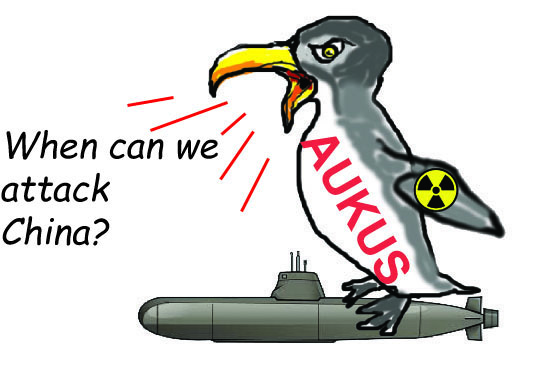
From peaceful, nuclear-free Asean to battle-ready Indo-Pacific? Manila Times, By Dan Steinbock, October 18, 2021As the Duterte era is gradually ending, new arms races and nuclear proliferation cast a dark shadow over Southeast Asia. The Philippines may be sleepwalking into military-nuclear entanglements.
ACCORDING to the new trilateral security pact between the United States, the United Kingdom and Australia (Aukus), Washington and London will “help” Canberra to develop and deploy nuclear-powered submarines.
The highly controversial $66-billion deal is expected to trigger arms races and nuclear proliferation in Asia. It violates the Southeast Asian Nuclear-Weapon-Free Zone Treaty (SEANWFZ, 1995), effective since 1997. It would seem to violate the Philippine Constitution. And it is strongly opposed by China.
Yet, right after the Aukus, when Asean began to build consensus on the nuclear pact, Philippine Foreign Affairs Secretary Teodoro Locsin Jr. welcomed the pact.
PH policies, Asean concerns
According to Locsin, the Philippines “welcomes Australia’s decision to establish” the Aukus. And he added: “Asean member states, singly and collectively, do not possess the military wherewithal to maintain peace and security in Southeast Asia.”
According to this logic, Asean is irrelevant in matters of regional peace and security and therefore each Asean should align with one or another major military power, irrespective of collective consequences.
Such logic shuns and could derail, inadvertently or purposefully, the ongoing work by the Asean and China on the Code of Conduct for the South China Sea by 2022. Most importantly, the logic opens the door to the nuclearization of the region at the expense of the SEANWFZ treaty and the aspirations of the Asean community. That’s why Malaysia’s veteran statesman Mahathir Mohamad blasted the Aukus statement: “You have escalated the threat.”
The first reaction of both Malaysia and Indonesia was to warn of an impending arms race unleashed by such a pact. Australia’s nuclear decision prompted the Indonesian foreign ministry’s official note that it was “deeply concerned over the continuing arms race and power projection in the region.” So, why did Locsin choose to break ranks with the Asean?
ADRi: China the issue of 2022
The plan to drag the Philippines into the Indo-Pacific containment front against China seems to have evolved in the mid-2010s, but fell apart with the Duterte election triumph and the meltdown of the Liberal Party.
To avoid a déjà vu, former Foreign Affairs secretary Albert del Rosario recently called on the Philippines to choose a leader who will reverse President Rodrigo Duterte‘s policy of “loving and embracing” China after the “’22 polls.”
In this quest, a key supportive role belongs to the Stratbase Albert del Rosario Institute (ADRi), embedded with US business and national security interests. Through its board members and executives, Rosario’s ADRi is joined with its parent, Stratbase, an “advisory and research consultancy,” and Bower Group Asia led by Ernest Z. Bower 4th. Stratbase is the Philippine partner of Bower Group Asia.
Until the 2000s, Bower led the US-Asean Business Council. He is an ADRi board member and Southeast Asia advisor at the Center for Strategic and International Studies (CSIS), a leading US think-tank close to the State Department, Pentagon, defense contractors and Wall Street.
The maritime dispute with China, said ADRi’s president Victor Manhit, is what “we will make an issue in the 2022 elections.” Due to interlocking leaderships, Manhit himself heads Stratbase and Bower Asia Group‘s Philippine branch.
The goals go back to the Benigno “Noynoy” Aquino 3rd government (2010 to 2016).
As the Duterte era is gradually ending, new arms races and nuclear proliferation cast a dark shadow over Southeast Asia. The Philippines may be sleepwalking into military-nuclear entanglements.
ACCORDING to the new trilateral security pact between the United States, the United Kingdom and Australia (Aukus), Washington and London will “help” Canberra to develop and deploy nuclear-powered submarines.
The highly controversial $66-billion deal is expected to trigger arms races and nuclear proliferation in Asia. It violates the Southeast Asian Nuclear-Weapon-Free Zone Treaty (SEANWFZ, 1995), effective since 1997. It would seem to violate the Philippine Constitution. And it is strongly opposed by China.
Yet, right after the Aukus, when Asean began to build consensus on the nuclear pact, Philippine Foreign Affairs Secretary Teodoro Locsin Jr. welcomed the pact.
Such logic shuns and could derail, inadvertently or purposefully, the ongoing work by the Asean and China on the Code of Conduct for the South China Sea by 2022. Most importantly, the logic opens the door to the nuclearization of the region at the expense of the SEANWFZ treaty and the aspirations of the Asean community. That’s why Malaysia’s veteran statesman Mahathir Mohamad blasted the Aukus statement: “You have escalated the threat.”
The first reaction of both Malaysia and Indonesia was to warn of an impending arms race unleashed by such a pact. Australia’s nuclear decision prompted the Indonesian foreign ministry’s official note that it was “deeply concerned over the continuing arms race and power projection in the region.” So, why did Locsin choose to break ranks with the Asean?…………..
Conflicts of interest, military entanglements…………..
…….. the Aukus pact does contribute to the ongoing arms races in Southeast Asia. It will foster nuclear proliferation in the region. It violates the goals of the nuclear-free Southeast Asia treaty. It is not in line with the Philippine Constitution.
President Duterte has pledged to end the bilateral military deal with Washington if US nuclear weapons are found in the Philippines. But his term will end by next summer.
Obviously, Australia, the US and UK seek to calm Asean members, arguing that nuclear weapons are not really for military purposes. But since 1945, assurances have not been reliable in nuclear matters. During the Cold War, US nuclear warheads were secretly stockpiled in the Philippines. Moreover, in the 1965 Philippine Sea A-4 crash, a US Skyhawk attack aircraft fell into the sea off Japan. Coming from the US Naval Base in Subic Bay, it was carrying a nuclear weapon with 80 times the blast power of the Hiroshima explosion.
It wasn’t until 1989 that the Pentagon disclosed the loss of the 1-megaton hydrogen bomb.
New policy? Two policies? No policy?
Today, the destructive power of these weapons is far greater, as stressed by the International Campaign to Abolish Nuclear Weapons (ICAN). In January, the Philippines ratified the ICAN’s legally binding Treaty on the Prohibition of Nuclear Weapons (TPNW). On May 19, Locsin stated that the Philippines welcomes the Aukus nuclear pact.
Only two days later, Locsin reaffirmed the Philippines’ “principled policy and commitment toward the complete prohibition of nuclear weapons as enshrined in the relevant provisions of the Philippine Constitution and the Treaty.”
The Philippines’ principled policy is crystal clear: The country definitely welcomes nuclear proliferation in Southeast Asia. And the country is absolutely committed against nuclear-free Southeast Asia. Where will that “principled policy and commitment” take us after the 2022 election?
 |
1 This month.
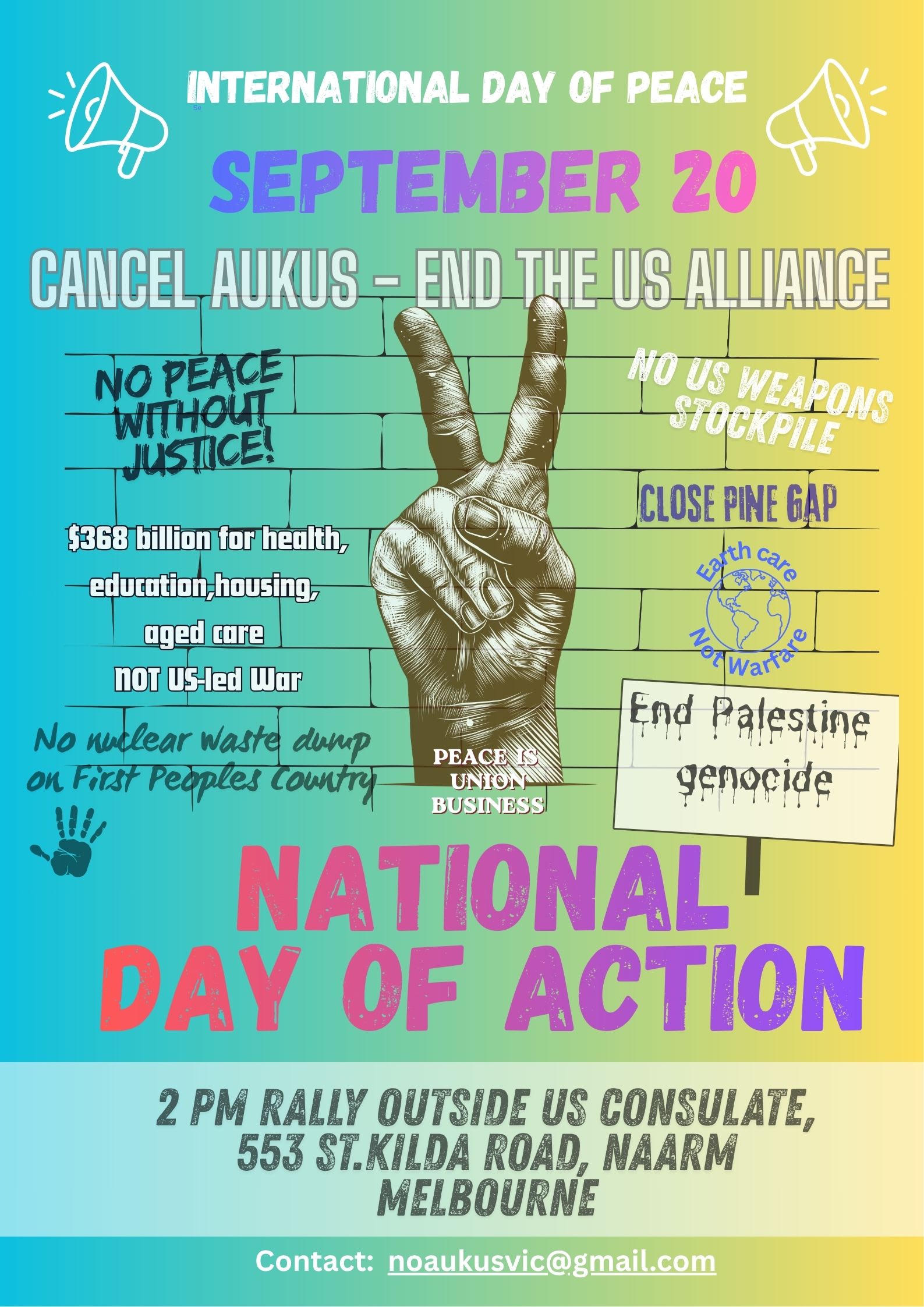
20 September –National Day of Action in Melbourne on the International Day of Peace

Help Aunty Sue Protect Her Land and Sacred Sites From Destructive Rocket Testing.
.

Australians deserve the truth
about
AUKUS – https://aukuspublicinquiry.com/


PETITION – To: Prime Minister Anthony Albanese and the Australian Labor Government

of the week – Australians for War Powers Reform (AWPR)
To see nuclear-related stories in greater depth and intensity
 Antinuclear