Transparency needed so nuclear-powered subs don’t turn into nuclear power subsidies
Transparency needed so nuclear-powered subs don’t turn into nuclear power subsidies, 21 Sep 21 https://www.acf.org.au/dont-turn-nuclear-powered-subs-into-nuclear-power-subsidiesPrime Minister Scott Morrison must give the Australian people confidence that his planned submarine deal will not put the nation on the path to nuclear power, nuclear weapons and nuclear waste, the Australian Conservation Foundation said today.
ACF has identified three key actions and is calling on the Prime Minister to act on these before he commits Australia to this deal:
- Mr Morrison should sign and ratify the United Nations Treaty on the Prohibition of Nuclear Weapons.
- Mr Morrison should uphold the Government’s commitment to the Environmental Protection and Biodiversity Conservation Act and the Australian Radiation Protection and Nuclear Safety Act, which prohibit nuclear power in Australia.
- In the interests of transparency and democracy, Mr Morrison must release the detail of this deal before he commits Australia to it. Parliament and the people need to see the fine print.
“We are calling on the Prime Minister to do his due diligence to make sure this is not a Trojan Horse for a failed technology,” said ACF nuclear free campaigner Dave Sweeney.
“The Australian Conservation Foundation has a genuine concern this nuclear subs deal could turn into nuclear subsidies.
“The Prime Minister must urgently rein in the nuclear spruikers – including those in his own government – because their views do not represent the views of the Australian community, which has repeatedly rejected this dangerous technology.”
“Nuclear reactors cost a fortune, take decades to build, come with the possibility of disastrous accidents and the certainty of eternal radioactive waste.
“The climate crisis we face is too serious and too urgent to be distracted by nuclear promises.
“Australia’s future is renewable, not radioactive.”
Maritime Union of Australia calls for government spending on health, not nuclear submarines
NO TO NUCLEAR SUBMARINES – JOBS AND HEALTH, NOT NUKES
Today, on the International Day of Peace, the Maritime Union of Australia (MUA) declares its total opposition to the reckless announcement by Scott Morrison that Australia would be developing nuclear-powered submarines as part of a military alliance with the US and UK.
At a time when Morrison should have been pursuing vaccination supplies and providing maximum support to our health system and millions of people in lockdown, he has been pursuing secret military deals. The deal will continue to escalate unnecessary conflict with China. Workers have already been impacted with seafarers stranded on coal ships and some trades shut down.
Extraordinary sums of money have been wasted with the previous submarine contract scrapped only five years after it was signed. That contract was worth $90 billion – nuclear submarines will cost much more.
Only six countries in the world have nuclear submarines, and they all have nuclear power stations. Advocates for nuclear power and nuclear weapons have been emboldened. The submarines will use highly enriched uranium ideal for nuclear weapons.
The Australian government has repeatedly tried to set up nuclear waste dumps on First Nations land. This will intensify that pressure.
The billions wasted on submarines should be spent on:
· Building an Australian strategic shipping fleet in Adelaide that could operate in cabotage and international trades;
· Building renewable energy and offshore wind turbines to ensure we prevent global heating from exceeding 1.5°C;
Raising Jobseeker payments to well above poverty levels;
Pay increases for health workers and investments in our health systems;
· Pay increases for teachers and investments in public schools to make them covid-safe;
· Investing in firefighting capacity and ensuring we are ready for the next bushfire season.
Workers have no interest in war with China or any other country. Every effort should be made to pursue peaceful relations.
The MUA stands in solidarity with workers in all countries in opposing war and wasteful environmentally harmful military spending. We pledge our opposition to oppose the development of nuclear submarines in Australia, and the development of any other nuclear industry.
Scientists still don’t know how far melting in Antarctica will go – or the sea level rise it will unleash
Chen Zhao and Rupert Gladstone
The Antarctic ice sheet is the largest mass of ice in the world, holding around 60% of the world’s fresh water. If it all melted, global average sea levels would rise by 58 metres. But scientists are grappling with exactly how global warming will affect this great ice sheet.
French ambassador says Scott Morrison gave no warning on the nuclear submarine deal
‘Maybe we’re not friends’: French Ambassador claims ScoMo offered no warning about AUKUS deal A powerful French official has slammed Scott Morrison, accusing the Prime Minister of one thing to do with the submarine deal. news.com.au , Helena Burke, 20 Sep 21
The former French Ambassador to Australia has ripped into Scott Morrison for his defence of the AUKUS submarine deal, claiming the Prime Minister lied about warning France about it.
Jean-Pierre Thebault, who had been the French Ambassador in Canberra since 2020, was recalled last week after France expressed outrage at being left out of the new nuclear submarine deal between the US, UK, and Australia.
Speaking to Radio National on Monday, Mr Thebault said France had been completely blindsided by Mr Morrison’s decision to accept the new deal.
“We discover(ed) through the press that the most important person in the Australian government kept us in the dark intentionally until the last minute and was not willing to at least have the decency to enter conversation about the alternative,” Mr Thebault said.
“This is not an Australian attitude towards friends.”
Maybe we’re not friends.”
Mr Morrison had previously rejected that he had not warned France about the new deal, insisting he told French President Emmanuel Macron in June that Australia might scrap its original submarine agreement,,,,
But the French Ambassador insisted France had never been warned about the potential for a new deal which would exclude them. https://www.news.com.au/national/politics/maybe-were-not-friends-french-ambassador-claims-scomo-offered-no-warning-about-aukus-deal/news-story/467293b479eca4741c116ba5ced54751
Records smashed as renewables break through 60pct, coal output at new low — RenewEconomy

Renewables surge through 60 per cent of Australia’s main grid for first time, as output of coal and network demand also hit new lows. The post Records smashed as renewables break through 60pct, coal output at new low appeared first on RenewEconomy.
Records smashed as renewables break through 60pct, coal output at new low — RenewEconomy
“Gigawatts to terawatts:” Lightsource bp to boost solar capacity to 25GW by 2025 — RenewEconomy

Lightsource bp to lift its global solar capacity to 25GW by 2025, with its Australian operating portfolio to grow four-fold to 2GW. The post “Gigawatts to terawatts:” Lightsource bp to boost solar capacity to 25GW by 2025 appeared first on RenewEconomy.
“Gigawatts to terawatts:” Lightsource bp to boost solar capacity to 25GW by 2025 — RenewEconomy
September 20 Energy News — geoharvey

Opinion: ¶ “Australia Claims 1.2% Of Global CO₂ Emissions – Should Be 10%” • The hypocrites in Canberra blame the big emitters India and China for climate change, but the coal they are burning is ours. We dig the stuff out of the ground, sell it overseas, and wash our hands of the outcome. We […]
September 20 Energy News — geoharvey
Submarine special – for this week in Australia

Scott Morrison’s decision on nuclear submarines is his first foray into the murly world of Khaki electioneering. A pity that Joe Biden doesn’t even remember Morrison’s name. But no matter -the big thing is to sell super expensive U.S. nuclear technology to a willing, if somewhat ignorant and unimporrtant customer.
During the coming week, this website will feature the various aspects of this extraordinarily unwise decision, (while not ignoring other important Australian nuclear issues.)
Scott Morrison’s AUKUS deal designed to win election, not make Australia safe
That Fella Down Under! Scott Morrison’s AUKUS deal designed to win election, not make Australia safe
By Michael West| September 17, 2021

Strap in for a media blitz on the threat from China. Prime Minister #ThatFellaDownUnder Scott Morrison and his merry band are about to take a war to the election. Michael West reports.
US President Joe Biden might have forgotten his name but, in the Canberra Bubble, Scott Morrison is unforgettable, a marketing maestro, a prince among men; literally, because there don’t seem to be any women among his phalanx of advisers.
The PM’s army of propagandists has been working around the clock over the past two days marketing the latest announcement to a fawning press: AUKUS, a new “Alliance for the Ages as China Threat Grows”, according to The Australian. And what results!
Christian Porter’s secret legal payments are off the front pages, as is the JobKeeper mega-rort, the biggest transfer of wealth in history from working Australians to wealthy Australians and foreign corporations.
Early Thursday morning there was no AUKUS. The AFR did have a scoop though, splashing with: “PM to announce $90b French submarine deal is dead”.
That story soon vanished from the website. Bad headline. Around 7.30, The Australian was trumpeting “A major coup for Australia”. A veritable onslaught of gushing PR ensued: the new “Forever Alliance” as Nine put it, or “Friends in Freedom” as The Australian glowed.
“Australia confirms landmark nuclear submarine deal and it’s ‘China’s worst nightmare’,” declared a truckling news.com.au.
That Fella Down Under
The funny thing was that US President Joe Biden seemed to have forgotten Scott Morrison’s name as he announced this new AUKUS alliance with Boris Johnson. “That Fella Down Under” he called him, casually gesticulating in Scott Morrison’s general direction.
Perhaps it was a deliberate thing, such was the PM’s unctuous toadying to the buffoon Donald Trump.
n any case, Australia’s massive $90 billion submarine deal with the French had been junked in a jiffy. Good thing too, because if the French had got involved in this new alliance for freedom it might have been more appropriately monikered FAUKUS.
What that will cost in tearing up this contract with the Gauls, who knows? Probably in the billions. We’ve toasted $2b so far.
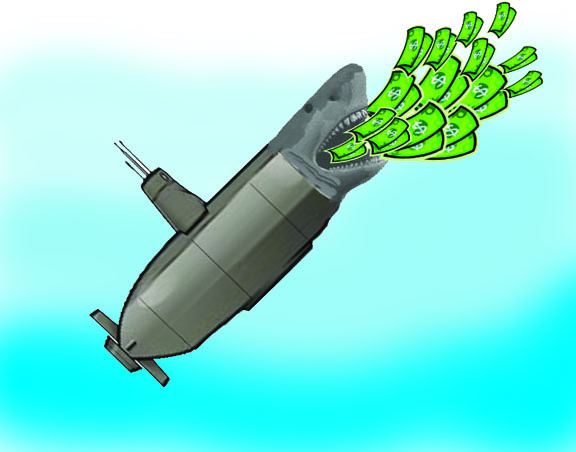
What will the new subs cost? Probably more than $100 billion. As jobless Australians are degraded with their measly $4 a day rise in welfare payments, you can count on one thing; the sheer, incontestable incompetence of this government will ensure a new maelstrom of waste and spending.
They struggle to get anything right, except announcements, media relations, scare campaigns at election time.
That King of Lemons the F-35 Strike Fighter is a gilten cadaver now, debunked even by the top military figure in the US. The chair of the Armed Services Committee Democrat Adam Smith reckons they should stop throwing money down “that particular rat hole”.
For Australia, the cost of those 72 lemons is $17 billion, before running into the hundreds of billions to be maintained for life, if they can fly.
Where is New Zealand?
In light of the long-standing ANZUS treaty there was one notable omission in the AUKUS line up, New Zealand. Notwithstanding that NZAUKUS or AUKUSNZ is far too ugly an acronym, the Kiwis are too sensible to blow up their biggest trading partner, China, as the Coalition Government here has proven so adroit at doing.
Unlike #ThatFellaDownUnder, New Zealand Prime Minister Jacinda Adern would have the sense to ask her people first if they wanted to poke the bear, tear up billions on last century military hardware and park nuclear submarines in their harbours. They don’t. They are sticking to their no-nuclear policy and won’t even let the subs in their waters, said Ardern
The whole thing is so last century, and so dangerous in geopolitical terms. To deflect from their abominable policies at home, to deflect from the retinue of scandals the likes of Christian Porter, JobKeeper, Team Australia, as the AFR calls them, or Team #ThatFellaDownUnder on Twitter, now appears certain to fight the Election by beating up the China military threat.
Murdoch loves it, Keating not
There is nothing like an enemy to exploit for political purposes, a military threat, no matter how ludicrous and unlikely. Naturally, it plays well for the craven Murdoch press which adores a war; has cheered avidly every failed US invasion from Vietnam, through Iraq to Afghanistan.
Gird the loins then for the daily barrage of provocative, misleading nonsense in the corporate media, to be followed daily – with a tad less fervour – on the airwaves of the ABC.
China has zero intention of invading Australia but already, thanks to this reckless messaging by a suborned corporate media, half the country thinks they might…………..
What is this deal which #ThatFellaDownUnder has signed up for, besides electoral fodder and domestic distraction value? Presumably we buy defence tech from the US, so it’s commercial for them. If the F-35 debacle is anything to go by they will control our submarines anyway. We weren’t allowed to control the software in our own billion-dollar jets.
AUKUS reaffirms ties with the “Mother Country” Great Britain, which has ballsed-up its own markets thanks to Brexit.
Er … uranium?
It begs the question of uranium. Do we use our own uranium, breaking tradition with decades of sensible nuclear policy? What do we do with the toxic waste? Where are these things going to be berthed? South Australia, at the bottom of the country, or at the top, somewhere near the Port of Darwin which the Coalition sold to the Chinese?
The warmongers lobby is loving it. Chief among them the Australian Strategic Policy Institute (ASPI) whose executive director Peter Jennings suddenly enthused: “AUKUS sets a better direction for Australia’s defense”.
But of course, ASPI is funded by Defence, the department that is – it is paid by the Government to lobby the Government – and by foreign weapons manufacturers and the media leaks are already foreshadowing a big escalation on defence spending. The irony is that Jennings himself, a champion of the French subs deal, was awarded France’s top honour, Le Légion d’Honneur.
“Vive Australia’s choice of a French submarine,” headlined the story in The Australian.
The silence of the Labor
That Fella Down Under has also managed to wedge Labor. Not matter how foolish and provocative is AUKUS, you won’t hear a ruckus from Albo. The Opposition Leader is sticking steadfastly to his small target tactics, as well he would. Were he to kick up a stink about China provocation and cuddling up to the US and the Poms, Albanese would be pounced upon as a chicken, anti US, pro China.
And so billions will be squandered and hostilities will increase with our major trading partner and there is unlikely to be a squeak of disapproval from Labor. That of course leaves it open slather for a PMO media campaign to scare as many Australians as they can while delivering enormous profits to foreign weapons manufacturers. https://www.michaelwest.com.au/that-fella-down-under-scott-morrisons-aukus-deal-designed-to-win-election-not-make-australia-safe/
$90 Billion Nuclear Powered Subs To Bring Australia Out Of Lockdown In Time For Christmas
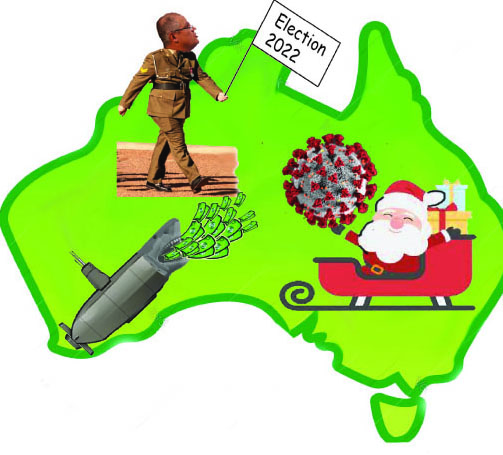
$90 Billion Nuclear Powered Subs To Bring Australia Out Of Lockdown In Time For Christmas, https://www.betootaadvocate.com/breaking-news/90-billion-nuclear-powered-subs-to-bring-australia-out-of-lockdown-in-time-for-christmas/LOUIS BURKE |.
Locked down Australians are getting ready to say a big hello to freedom as $90 billion worth of nuclear powered submarines are coming to our nation girt by sea.
During a teleconference that many mistook for the worst episode of Gogglebox yet, US President Joe Biden, UK Prime Minister Boris Johnson and our very own Scotty from Marketing announced they had formed a new security partnership called AUKUS with the first item of business to set Australia up with $90 billion worth of nuclear powered submarine freedom.
Despite the fact the three nations recorded a total of 317,060 new cases between them on Monday alone, the three world leaders really put their heads together and decided what their constituents really needed was to splash out big on some top-secret subs.
“I’m actually really excited for them!” said one local weirdo who, thankfully, does not live near any schools.
“Oh no, you’re not one of those anti-nuclear guys are you? Seriously? In 2021? I blame Chernobyl. The show.”
According to Scotty, this historic new alliance is great news for freedom loving Australians as we partner closer with the most hated nation on Earth and a country led by a man who literally cannot count the amount of illegitimate children he has.
When asked if the USA were a good military ally based on very recent events, Scotty was quick to remind our reporting team that we should be out of lockdown in time for Christmas.
“It’s all about perspective,” stated Scotty, as he thumbed through a sample book of the best submarine photo-ops.
“Christmas is coming and Santa is riding in on a nuclear sub pulled by water-breathing reindeer and in his big red sack is a present for you; family.”
Nuclear submarines may never eventuate; it’s just Scott Morrison’s giant new election ploy
The timing of Mr Morrison’s announcements also merits some consideration. In our view, this project is a political stunt aimed to distract from Covid failures, please coalition constituencies, and split the Labor Party and render the Greens shrill and sidelined.
In reality, it is likely that after a passage of years of staged announcements and pseudo-planning there will be little to show for it, and the enormously expensive, strategically ill-considered, and force-structure distorting project will quietly die.
But, to use Prime Minister Morrison’s phrase, “let us be clear,” in terms of Australian security, it is a gigantic nuclear election stunt that in the long run may increase the risk of nuclear war while drawing Chinese return fire on our vulnerable export sectors, including iron ore.
“To be clear” again, it is utterly mendacious of Prime Minister Scott Morrison to say that these forces have nothing to do with nuclear weapons because Australian submarines won’t be so armed, assuming it does not cross that barrier in the future if the submarines ever come to pass. As noted above, they may play a crucial role in US nuclear strike and defence operations……..
Scott Morrison’s Giant Nuclear Election Ploy, APLN Asial Pacific Leadership Network. 19 Sep 21,
Even leaving aside the fiscal profligacy and defence opportunity costs for Australia of the literal blank cheque issued by the Morrison government, the nuclear submarine decision takes Australia into the heart of naval warfighting in East Asia and Southeast Asia.
Further, the Australian nuclear submarine decision will have knock-on effects in Japan and the Republic of Korea, leading them not only to move their already highly capable submarine fleets to nuclear power, but also thereby heighten the likelihood they will then equip those submarines with nuclear weapons.
For several decades the US has been concerned to negate two military advances the Chinese regard as essential protection against literally existential threats. The Australian submarines will be designed primarily to contribute to negating both of those military advances.
Continue readingWe need a full and transparent Inquiry into the nuclear submarine deal
But the uncertainties are huge. We don’t know whether it’s proposed to acquire a US or a British submarine. We don’t know how many might be constructed. We don’t know the cost, although we know it’s going to be huge. We don’t know the delivery schedule, though it’s been suggested the first boat won’t be completed until 2040 and not operational for several years after that.
Putting the schedule into perspective, by the time Australia’s first nuclear submarine goes into the water, Aussies will have voted in at least seven federal elections. Scott Morrison will be 72 years old, Prime Minister Boris Johnson will be 76 and President Joe Biden will be a venerable 98.
Nuclear-level spin masks a massive failure, https://indaily.com.au/opinion/2021/09/17/nuclear-level-spin-masks-a-massive-failure/
This week’s nuclear submarine announcement raises questions that need full and transparent examination. What is certain, writes Rex Patrick, is that the Federal Government’s atomic marketing efforts are designed to cover a huge mess of its own making.
In many respects Scott Morrison’s nuclear submarines announcement fits the Prime Minister’s standard modus operandi.
Having presided over a huge shambles, he’s always ready to pull down the curtain and then present something new and shiny to the electorate as a distraction to the failure.
In this case, however, he’s taken his marketing strategy to a new atomic level.
I’ve been a strong critic of the French submarine deal. The projected delays and cost overruns, jointly the fault of Defence and Naval Group, were huge and unacceptable. The Government managed to achieve Australia’s worst-ever defence procurement disaster – which is saying a lot.
Although they repeatedly refused to admit it, and fought tooth and nail to prevent the release of information about the problems with the Future Submarine Program, the Government knew they had a total lemon on their hands – a lemon of their own making.
To deal with the strategic possibility of conflict with China, the Government contracted the French to redesign one of their nuclear submarines to create a completely new long-range diesel-electric submarine. That was always going to be fraught with difficulty, with inevitable cost and time overruns.
It wasn’t Australia’s changing strategic circumstances that have driven a shift to the US/UK nuclear submarine option – that was already factored into the French program – it was complete project disarray.
The PM’s atomic marketing is intended to mask the Government’s own mess.
The distant and uncertain future
We now have to be very careful not to jump from the frying pan into the fire.
I don’t underestimate the significance of the joint announcement of a new strategic and defence technology partnership between Australia, the United States and the United Kingdom. It’s a big commitment with long term national security, geopolitical, and economic consequences.
But the uncertainties are huge. We don’t know whether it’s proposed to acquire a US or a British submarine. We don’t know how many might be constructed. We don’t know the cost, although we know it’s going to be huge. We don’t know the delivery schedule, though it’s been suggested the first boat won’t be completed until 2040 and not operational for several years after that.
Putting the schedule into perspective, by the time Australia’s first nuclear submarine goes into the water, Aussies will have voted in at least seven federal elections. Scott Morrison will be 72 years old, Prime Minister Boris Johnson will be 76 and President Joe Biden will be a venerable 98.
And by 2040, the first of the Collins-class submarines, HMAS Collins, will have been operating for 44 years. The Royal Australian Navy will be trying to stretch out the life of the Collins-class subs far beyond what was ever intended.
At least the Government has finally decided to end the nonsense of shifting Collins-class full-cycle dockings from South Australia to Western Australia. We’re going to have to preserve and nurture all the submarine expertise we have to keep the Collins boats ticking over. The risk of a major capability gap is significant.
The nuclear question
The PM says the new nuclear-powered vessels will be built in Adelaide. It is unclear whether this would involve manufacturing or just assembly of pre-manufactured modules supplied from the US or UK.
If it’s the latter, this would have a huge impact on the extent of technology transfer and the shipbuilding workforce in Adelaide. The Australian local manufacturing content for nuclear boats is certainly likely to be much lower.
If the project proceeds there will be operating nuclear reactors sitting on hard-stands at Osborne and moored in the Port River.
Acquiring, operating and maintaining a nuclear submarine fleet without a domestic nuclear power industry is a challenge that must not be underestimated. The nuclear safety and non-proliferation safeguards issues are unquestionably complex and likely to be controversial.
This decision will likely reignite debate over nuclear power options for Australia. It can’t be said there is much political consensus about that.
There are many significant issues that will need to be properly considered and I fear that they haven’t yet. The proposed initial US-UK-Australia joint study to be undertaken over the next 18 months will take place after Australia’s election. But that doesn’t mean that there shouldn’t be rigorous and wide-ranging scrutiny of the Government’s decision now.
I am going to press for the Senate to open an immediate inquiry to ensure that all the angles, including alternative conventionally-powered submarine procurement options, are fully explored and understood.
We need such an inquiry to inform Government, Opposition, the Parliament and, most importantly, the Australian people before the next election.
This is a huge decision taken in response to a Liberal Party own goal which has cost the taxpayer and national security dearly. We don’t want an even bigger repeat of a failure and this massive project should not proceed further without full transparency and scrutiny.
Rex Patrick, a former submariner, is an independent senator for South Australia.
Australia to lease nuclear submarines from USA, UK?
Dutton may consider leasing nuclear subs, Canberra Times, Colin Brinsden 19 Sept
The federal government is prepared to lease nuclear submarines from the US while its own fleet is being built, Defence Minister Peter Dutton says. Last week, Australia entered into a surprise regional security pact with the US and the UK, known as AUKUS, which includes building US nuclear submarines but these will not be ready until the late 2030s.
Asked on Sky News’ Sunday Agenda program whether the government would consider leasing nuclear submarines in the interim, Mr Dutton said: “The short answer is yes”.
“There is all of that discussion to take place in the next 12 to 18 months,” he said………
The technology used by Britain and the US means the reactor does not need to be refuelled for the life of the submarine – about 35 years.
“Therefore, we don’t need a domestic industry around nuclear,” Mr Dutton said.
“That is a game changer for the Labor party and we wanted to make sure that this was a bi-partisan effort.”
While Labor backs the government’s decision, one of its frontbenchers, Ed Husic, said it is typical of the coalition that as soon as events start to unravel, they try to shift responsibility to someone else. https://www.canberratimes.com.au/story/7436344/dutton-may-consider-leasing-nuclear-subs/
How much will Australia’s nuclear submarines cost the taxpayer?
How much does a nuclear submarine cost?
Jessica YunFri, 17 September 2021 Is the new ‘AUKUS’ alliance to build Australia a fleet of nuclear-powered submarines battles growing criticism, a key question has emerged: how much do nuclear submarines actually cost?Before we get to that, what’s a nuclear submarine? It’s not considered a nuclear weapon, first of all. It all comes down to how it’s powered; a nuclear submarine works from its own miniature nuclear reactor, whereas conventional submarines use diesel-electric engines.In terms of how much they’ll cost, not even the Federal Finance Minister knows.
“Finalisation of those costs is something that will be assessed in [that] 12-18 month process we’re now embarking on with the UK and the US,” Finance Minister Simon Birmingham told ABC Radio National when asked about how much building the submarines would cost.
“The Prime Minister has acknowledged that it will likely cost more than what we had assessed for the conventionally powered submarines.”
Before the new AUKUS deal, Australia had a $90 billion contract with France to build 12 conventional submarines. To make way for the new defence pact, that deal has now been scrapped.
Opposition Leader Anthony Albanese has taken aim at the question marks around what this will cost Australian taxpayers.
“We know there are contracts in place already that will be breached. And we know there will be substantial compensation costs payable,” Albanese said. These ‘walk-away’ costs are estimated to be in the hundreds of millions.
“And Australian taxpayers are entitled to know, given that under this Government they began with arrangements with Japan, then arrangements with France, and now we have these arrangements with the United States and potentially the UK as well.”
What DO we know about the nuclear submarine deal and the costs so far?
T he new ‘AUKUS’ partnership will see Australia acquire a fleet of “at least eight” nuclear-powered submarines to “protect our national security interests” and “work with our partners across the region to achieve the stability and security of our region”, in Prime Minister Scott Morrison’s words………the new AUKUS deal means that we’ve torn up a $90 billion contract with France’s Naval Group to build 12 “Attack class” submarines, infuriating France along the way.
How much nuclear submarines cost around the world
The US Navy’s latest submarine model, the Virgina-class submarine, claims to have the latest tech in stealth, intelligence gathering and weapons system tech.
According to documents prepared for the US Congress, procuring a Virgina-class submarine is estimated to cost US$3.45 billion, or AU$4.73 billion, per boat.
Australia doesn’t currently have a domestic nuclear industry. SA Senator Rex Patrick told Yahoo Finance he expects each submarine will cost at least $5 billion to build.
Australian National University research fellow and nuclear science expert AJ Mitchell said there would be an “eye-watering cost” to constructing these high-tech watercrafts.
“Each nuclear submarine typically costs several billion dollars to build, and requires a highly skilled workforce with expertise in nuclear science,” Mitchell wrote in a new piece for The Conversation……… https://au.finance.yahoo.com/news/how-much-nuclear-submarine-cost-022130602.html
Big questions remain about Australia’s nuclear submarines, but it’s a massive financial gain for nuclear corporations

The possibility of a submarine deal with Australia came at an opportune moment. It provided Biden with a chance to demonstrate support for a close ally and boost its military strength. For Boris Johnson it could show that
relations with the US had not fallen apart because of the chaotic Afghanistan withdrawal, and it validated claims that the UK can play a prominent security role in the Indo-Pacific region.
For Australians it provides reassurance that it is still backed by its oldest allies. Having abandoned a “forever war”, the US and UK have signed up to what the Australian prime minister, Scott Morrison, has described as a “forever
partnership”. The test will lie in this submarine project being more successful than the French-backed one it has replaced. This is not something that can be taken for granted.
The big questions about the boats’ design and manufacture will not be answered until 2023. The value
of the contract will be massive, and we should expect the competing claims of all three partners to be pressed hard when they are deciding their contributions. Instead of building diesel-powered submarines with the French, Australia upgraded its requirement to nuclear-powered submarines. These are quieter, can spend more time at sea and can travel greater distances, but they are fiendishly difficult to construct. Although the UK’s Astute-class programme is now running reasonably smoothly, with each boat costing almost £1.5 billion, the first vessel was almost five years
late and massively over budget.
Times 19th Sept 2021
https://www.thetimes.co.uk/article/the-submarine-deal-is-a-real-downer-for-china-x6t89v022
1 This month
17 October, Free Public Talk on Nuclear Issues in South Australia
David Noonan will speak on public interest concerns over the new Roxby Downs Indenture Act 2026 on BHP copper-uranium mining and ore processing in SA, and on how AUKUS may face SA with a High-Level nuclear waste agenda.
Dr Jim Green will discuss international developments in the field of nuclear power including ‘small modular reactors’ and Generation 4 ‘advanced’ nuclear reactor concepts.


Help Aunty Sue Protect Her Land and Sacred Sites From Destructive Rocket Testing.
.

Australians deserve the truth
about
AUKUS – https://aukuspublicinquiry.com/

PETITION – To: Prime Minister Anthony Albanese and the Australian Labor Government

of the week – Australians for War Powers Reform (AWPR)
To see nuclear-related stories in greater depth and intensity

